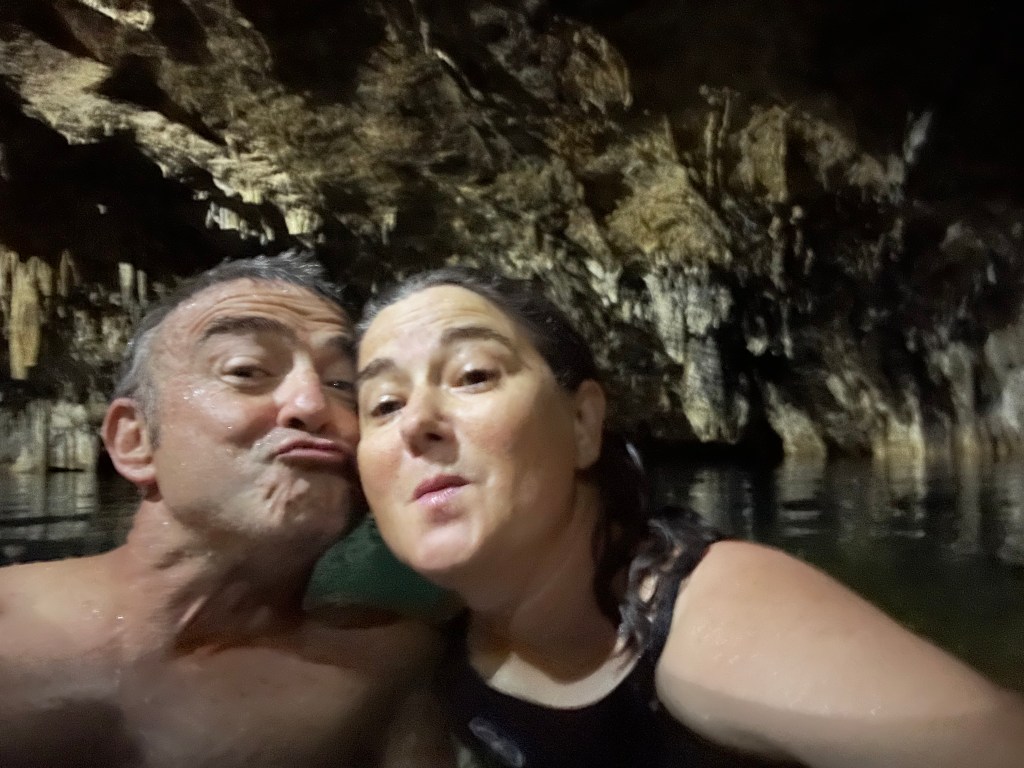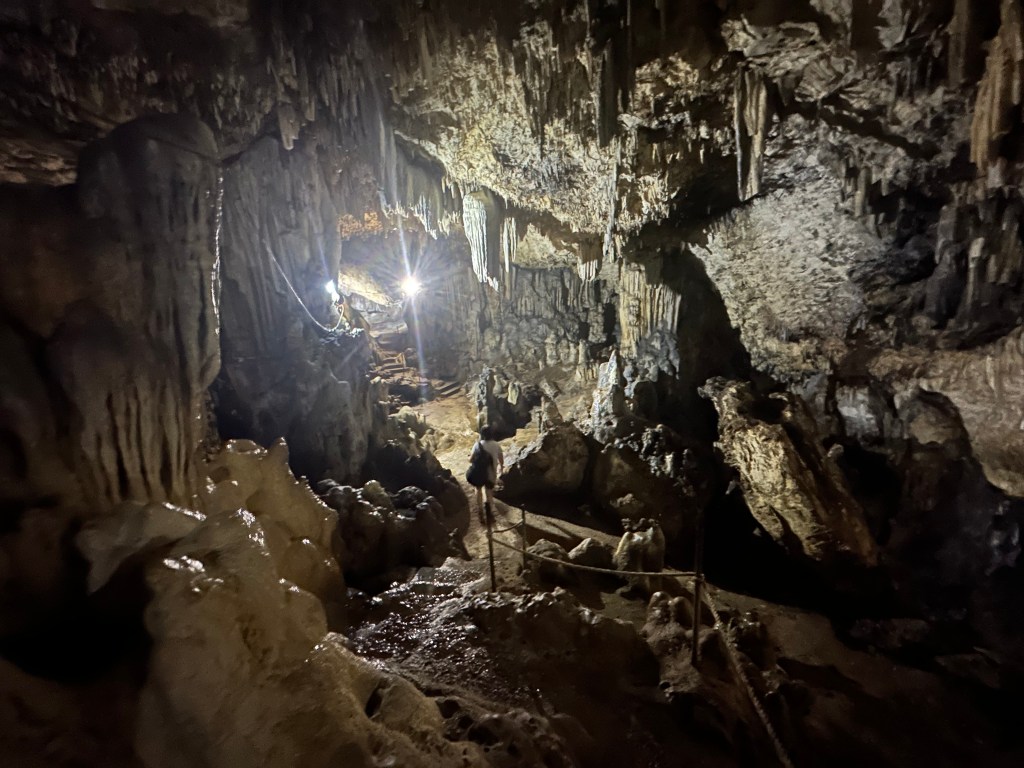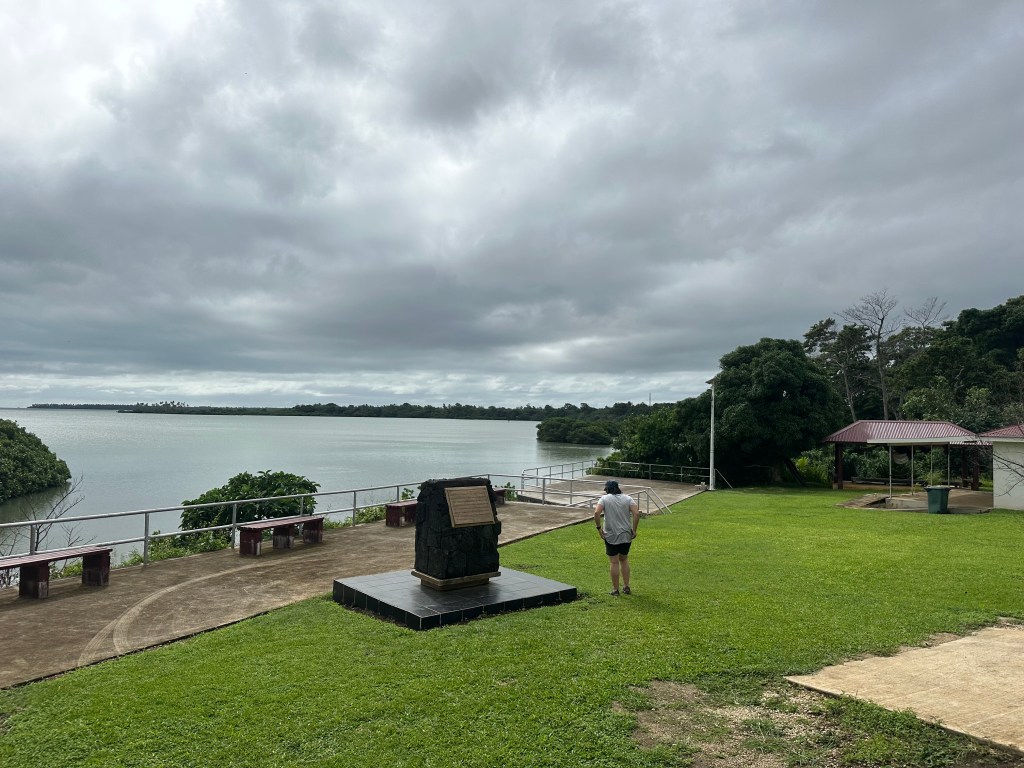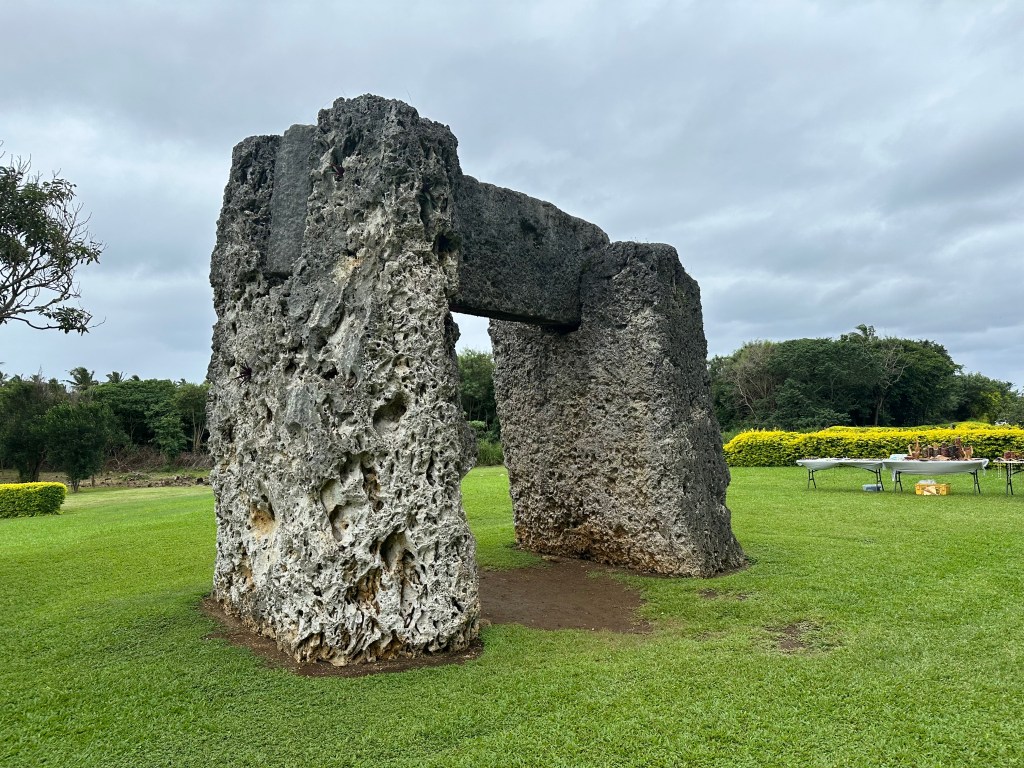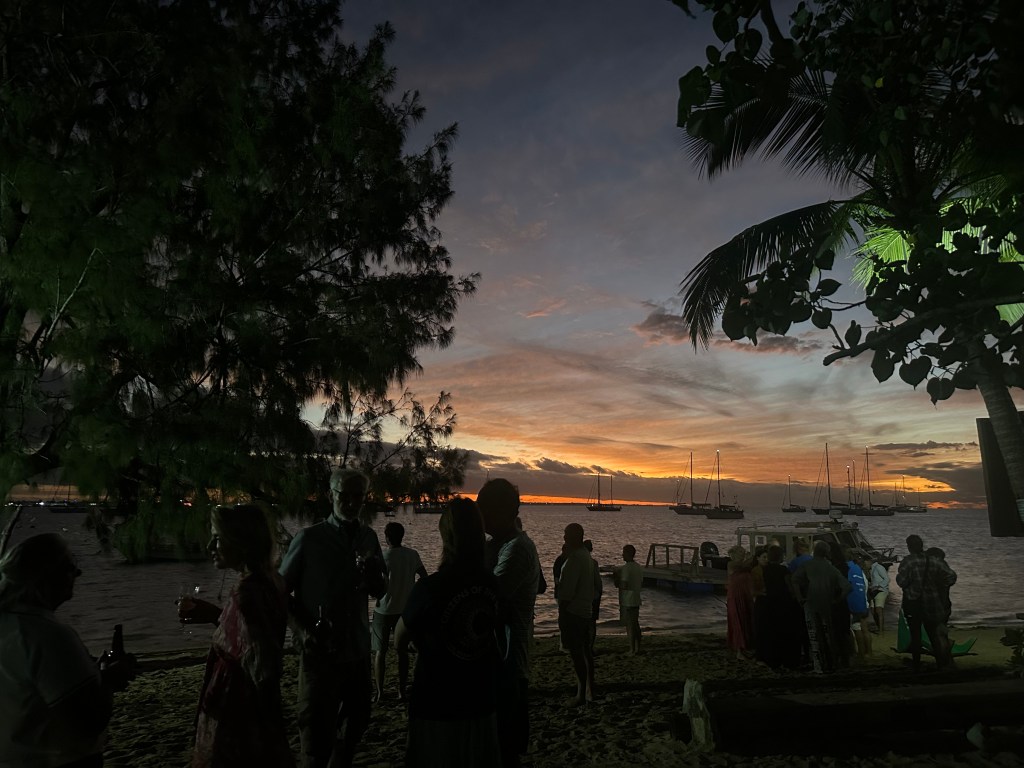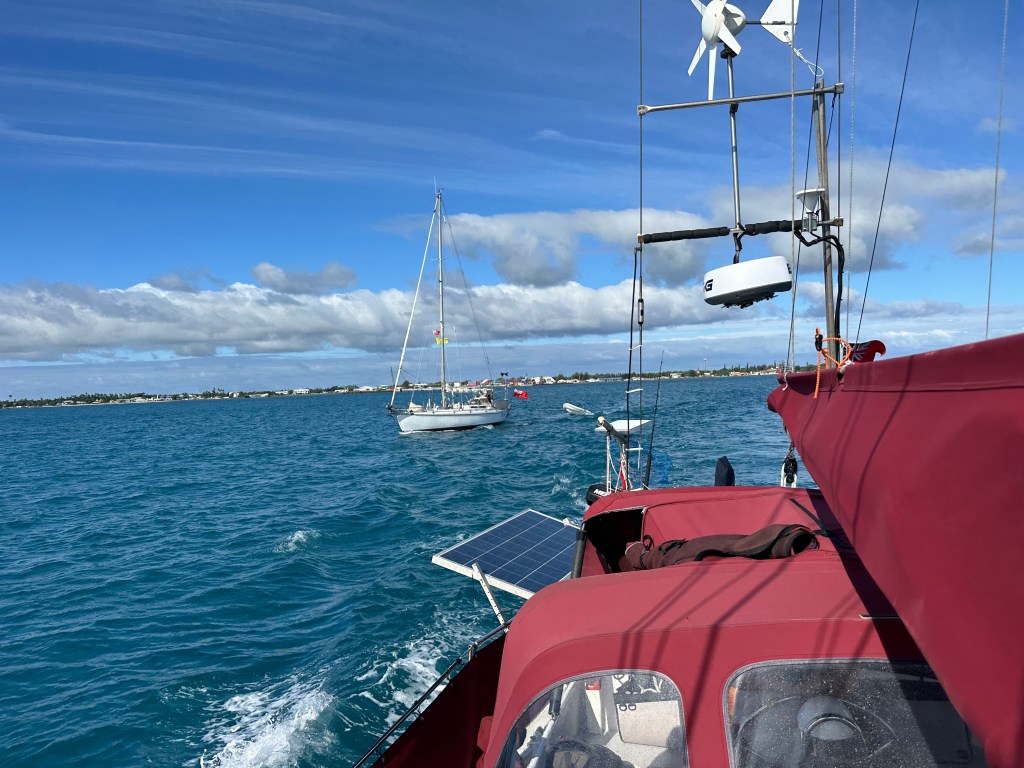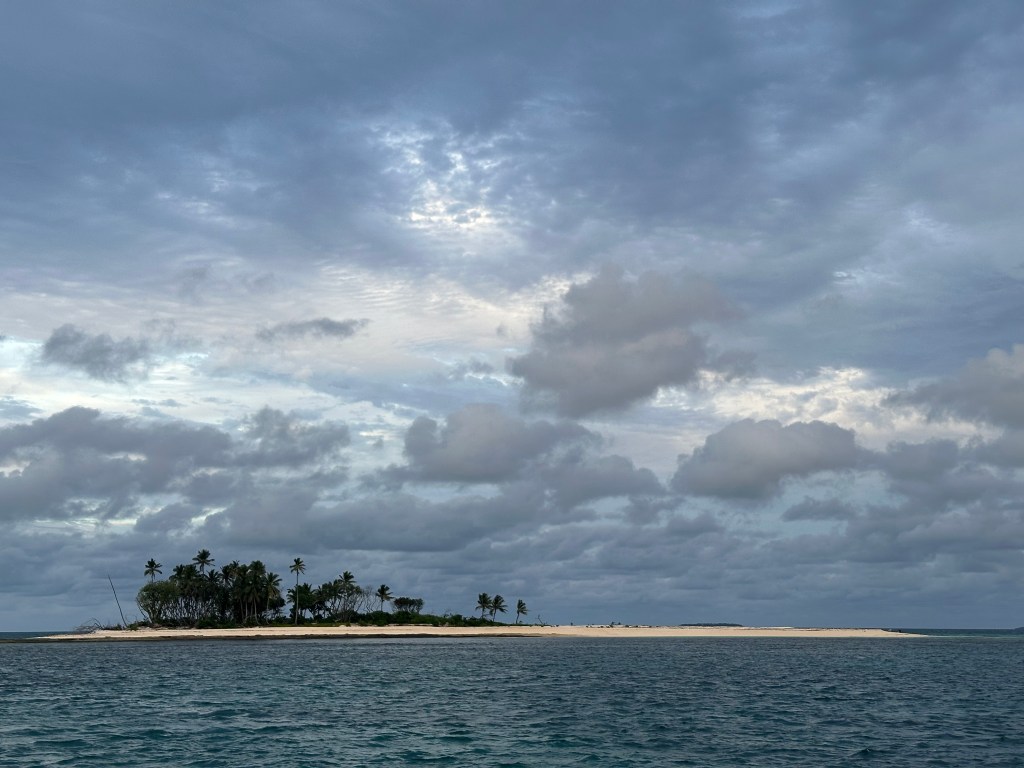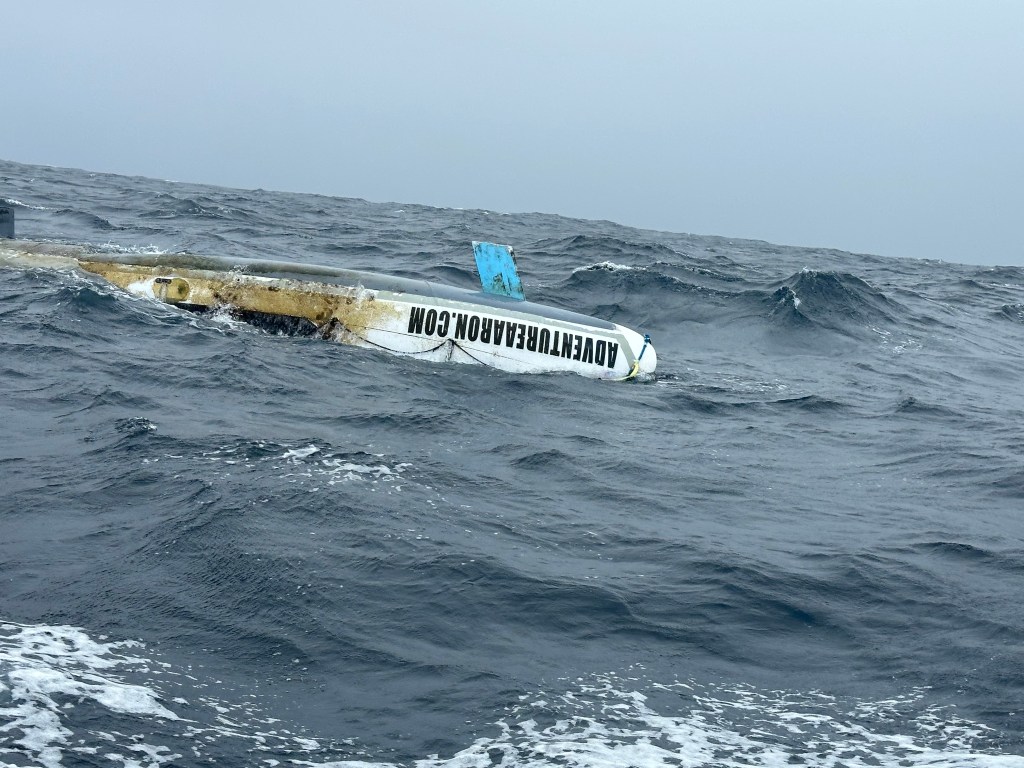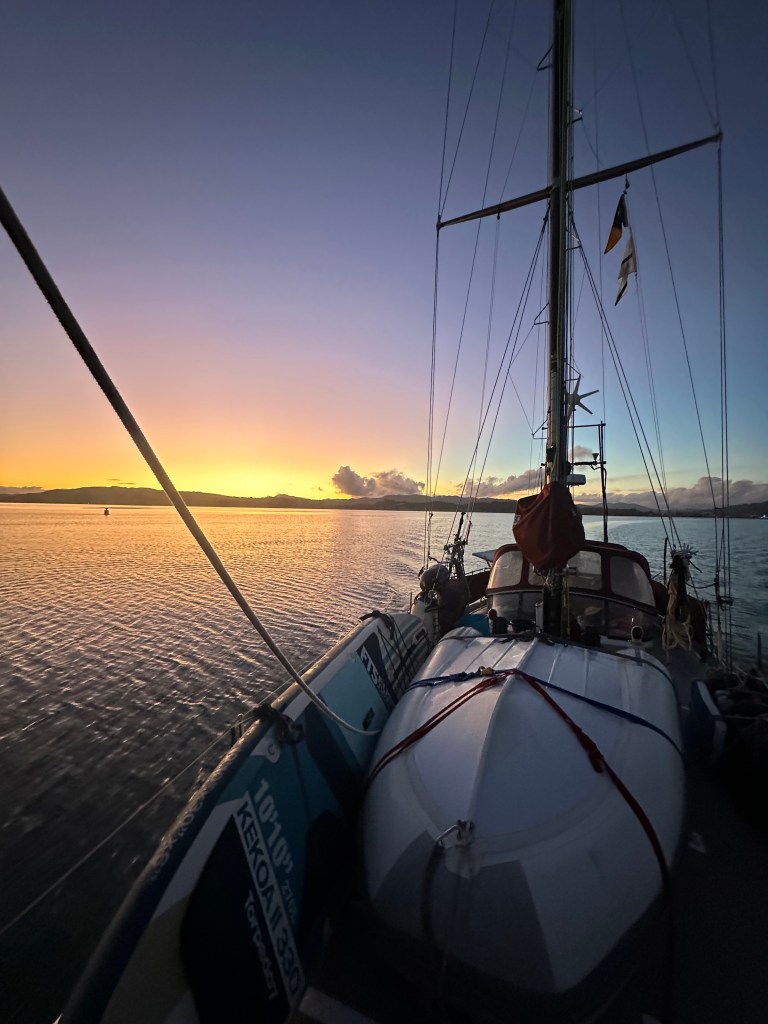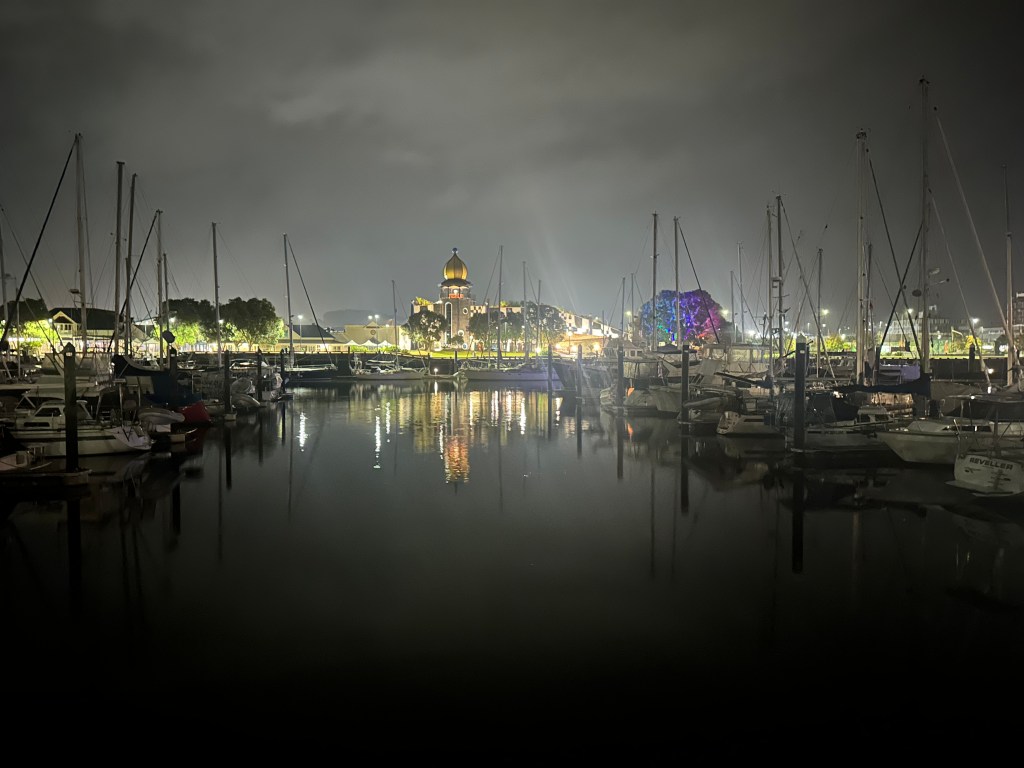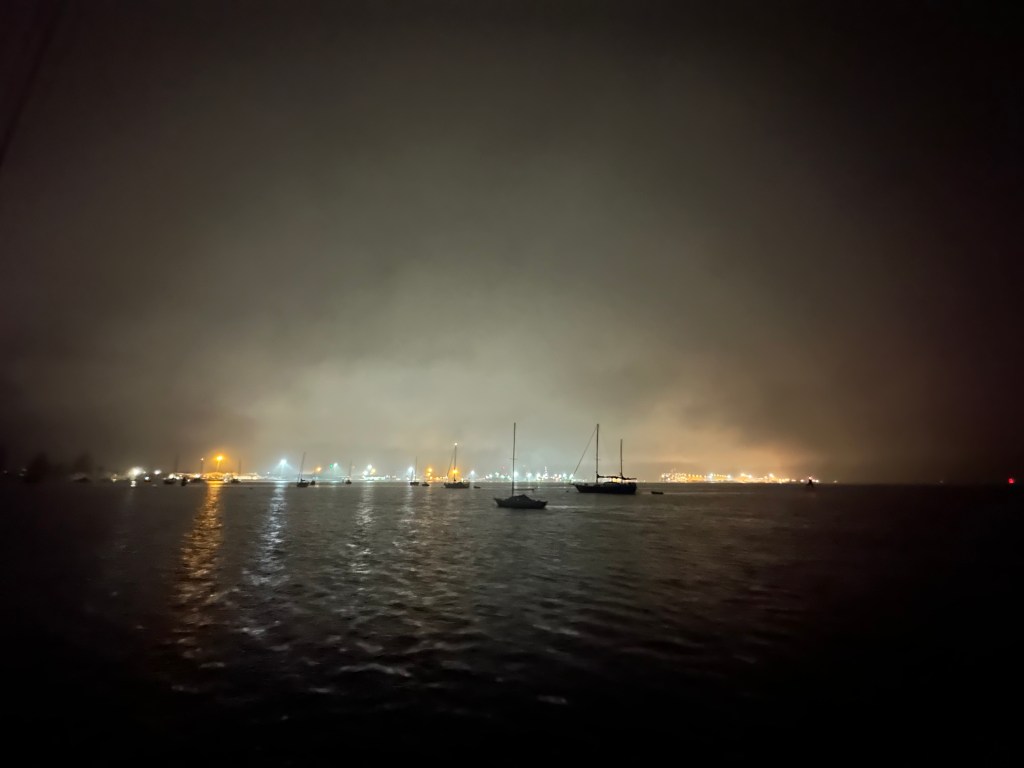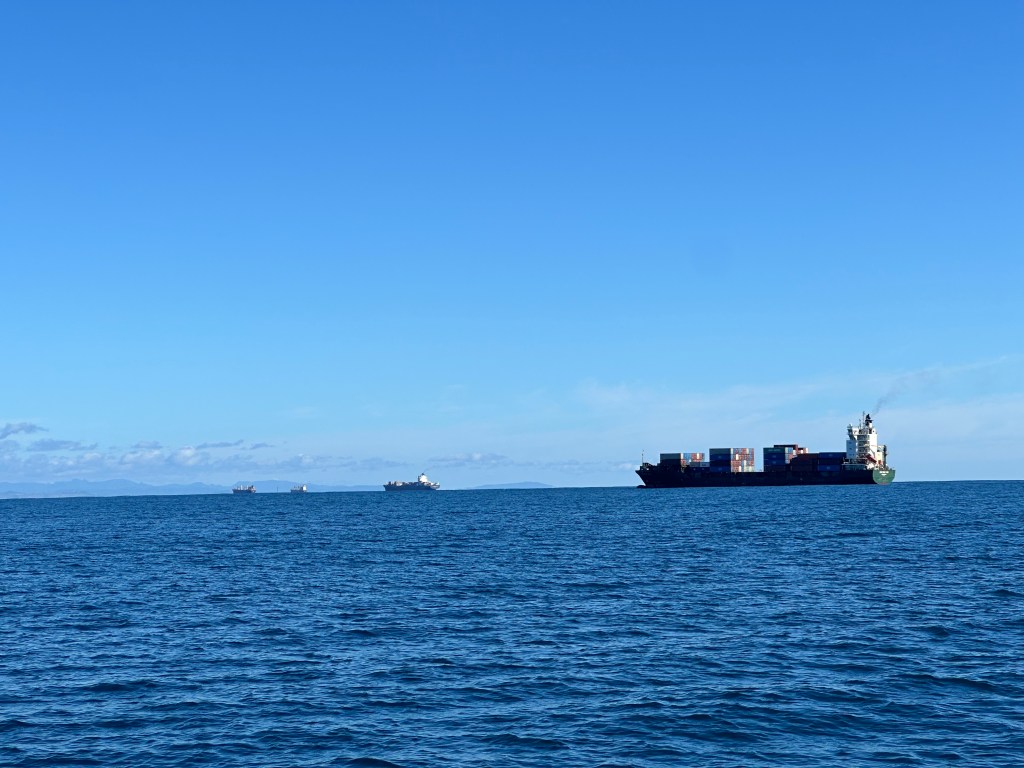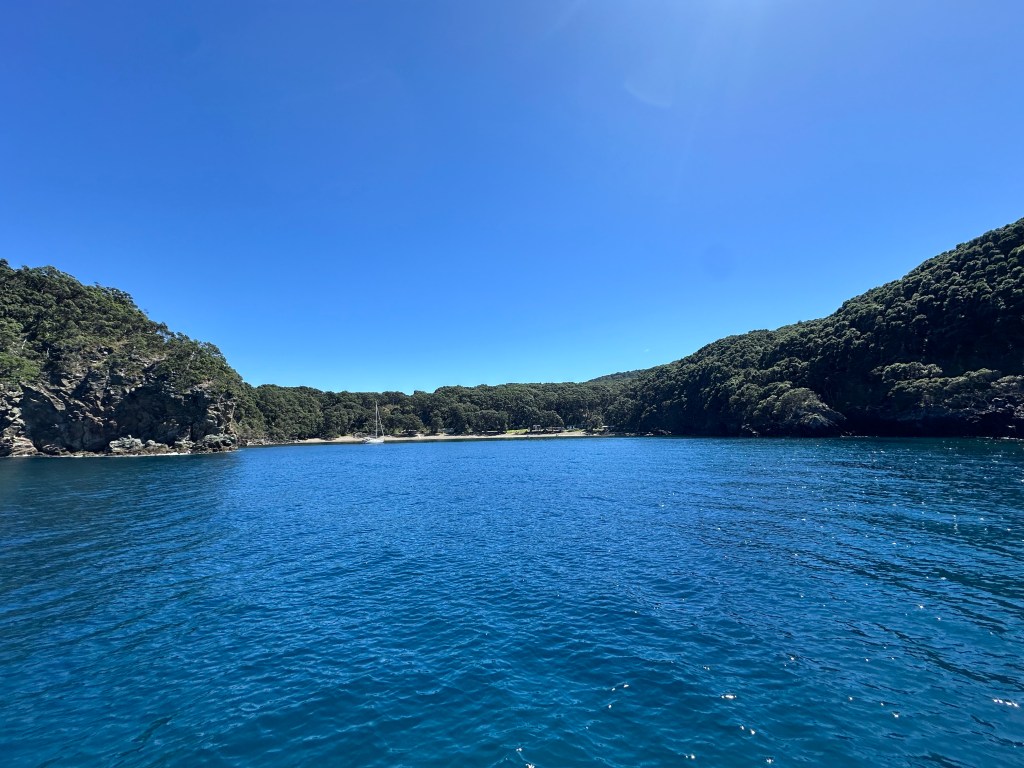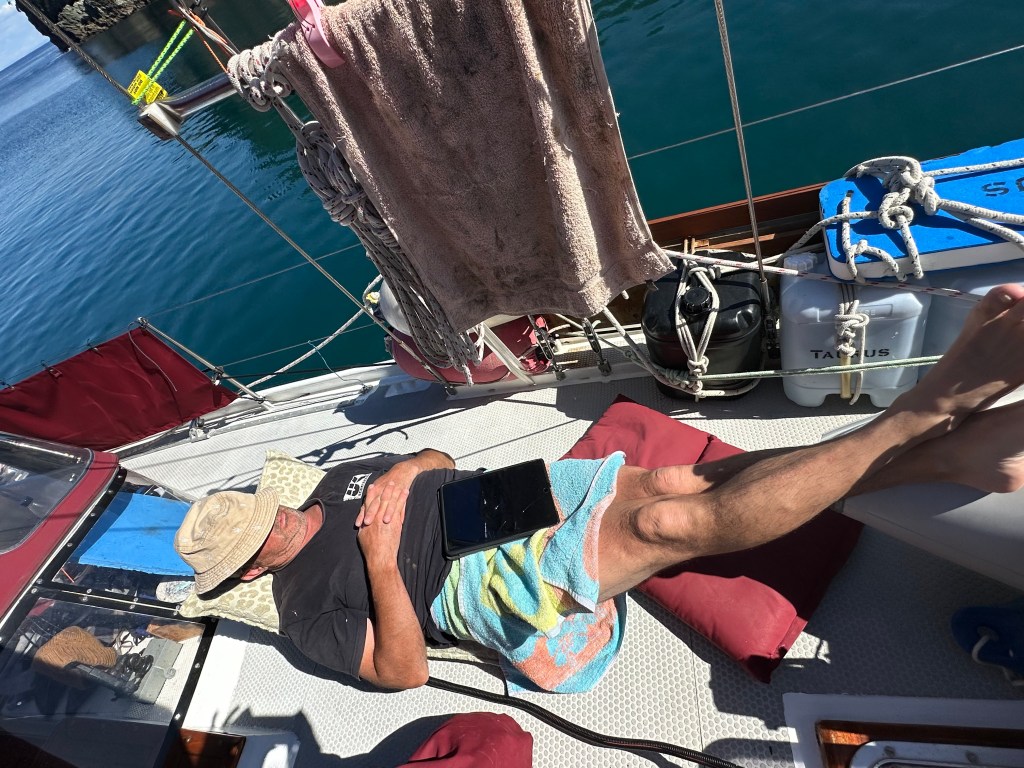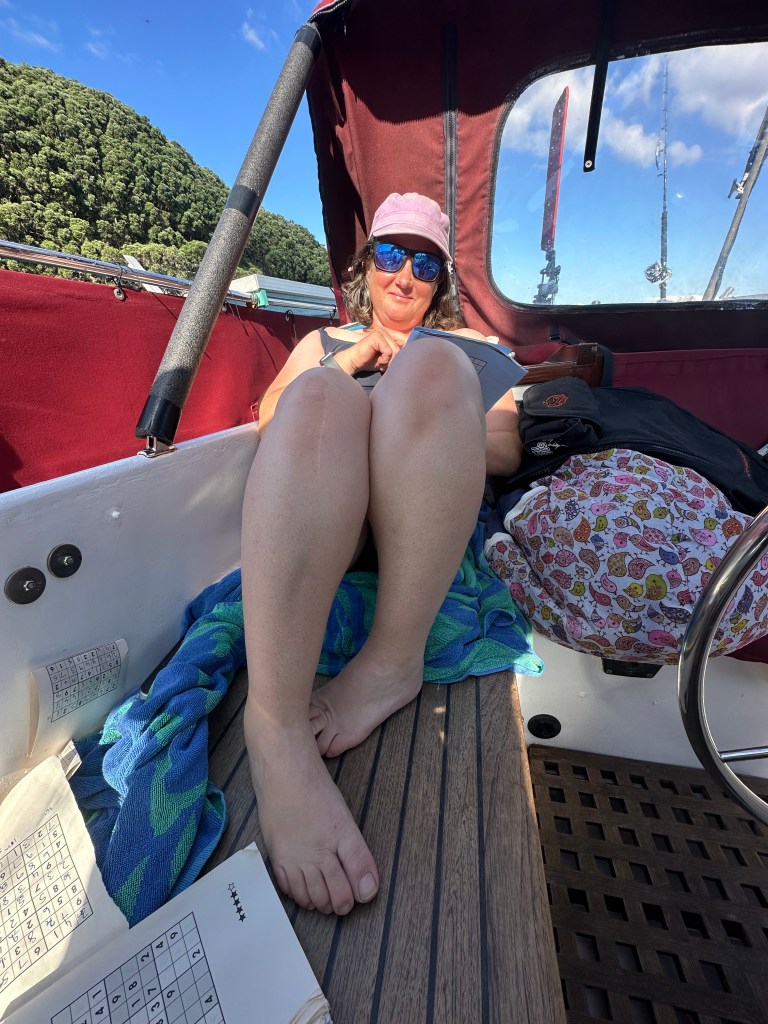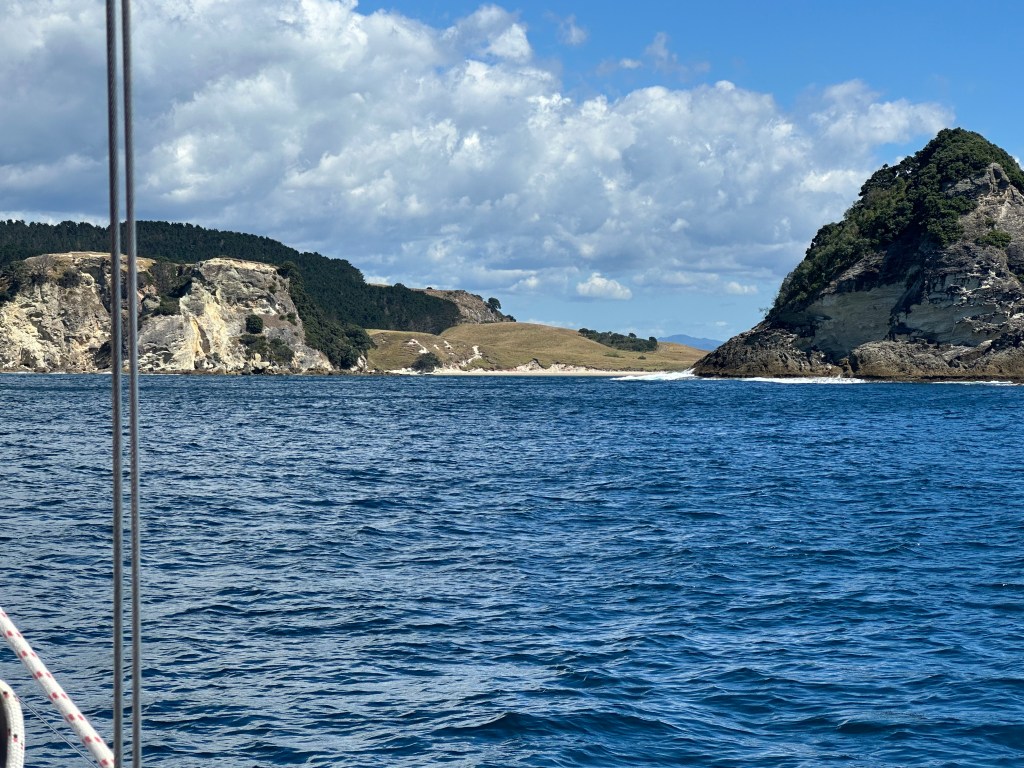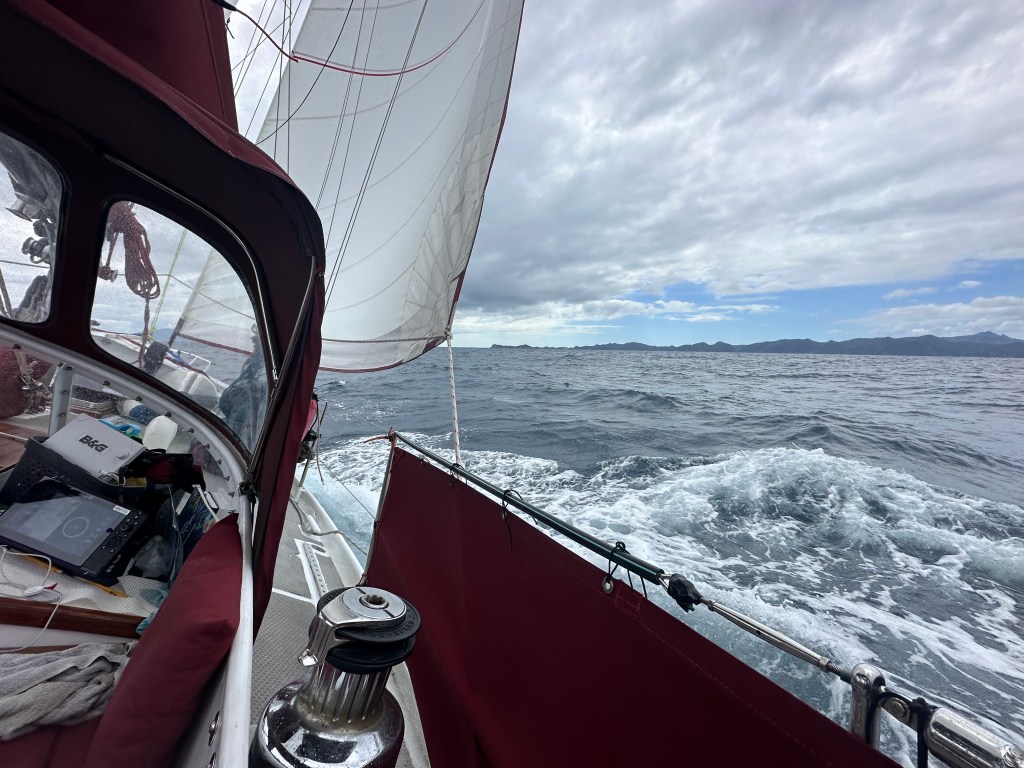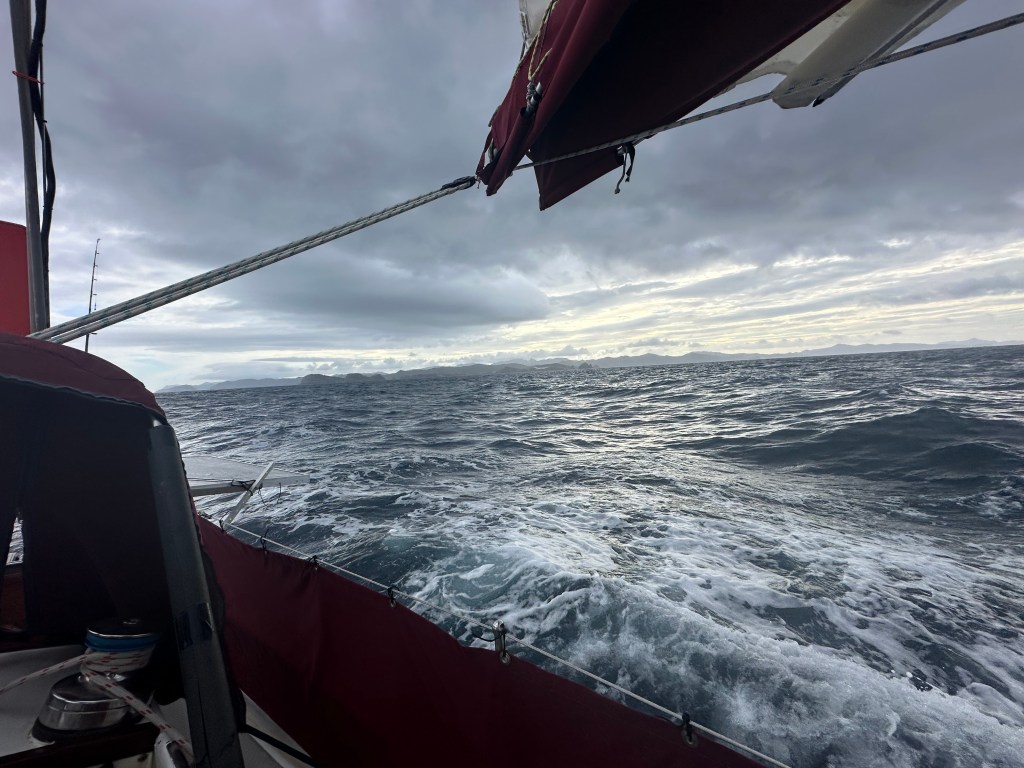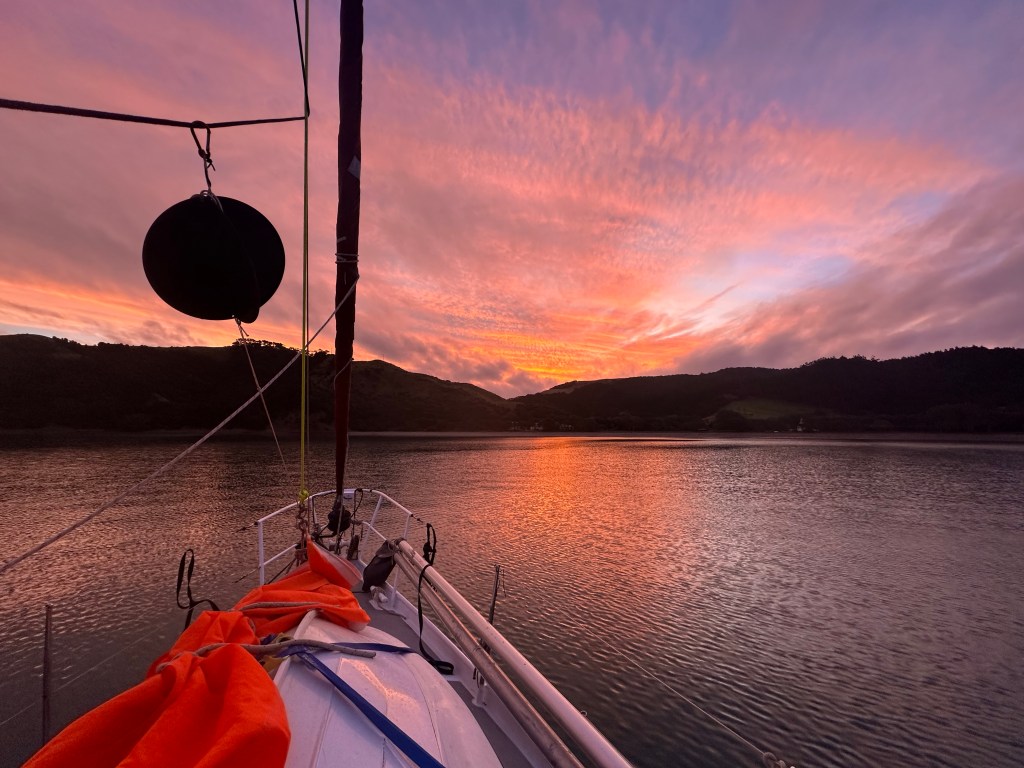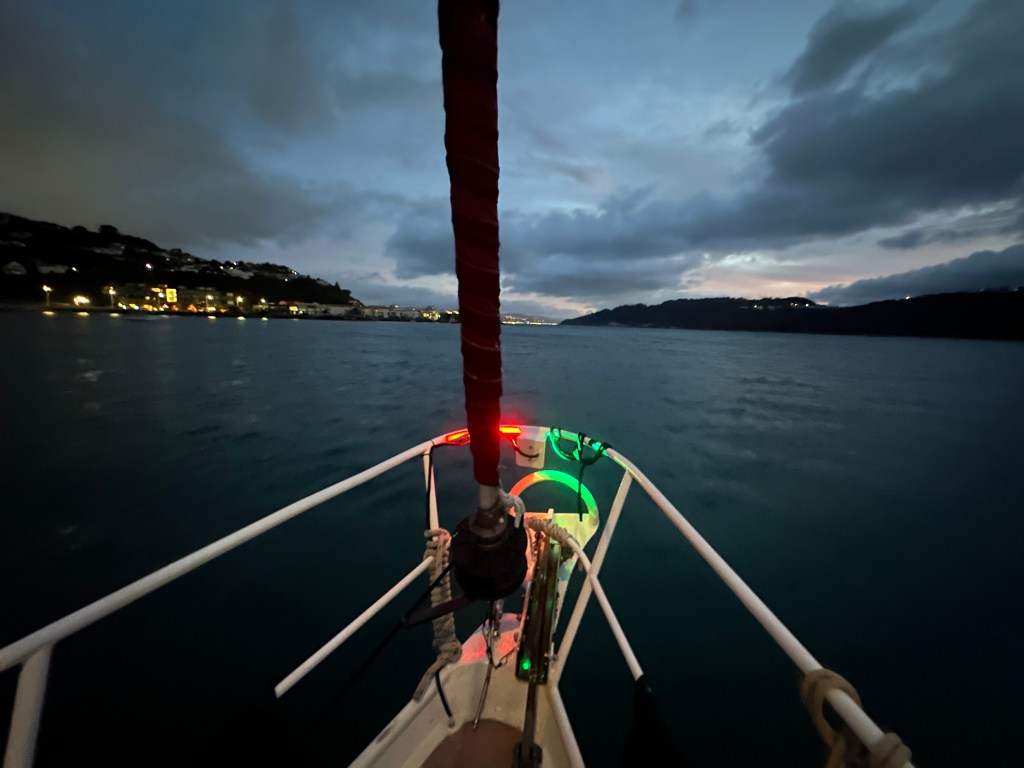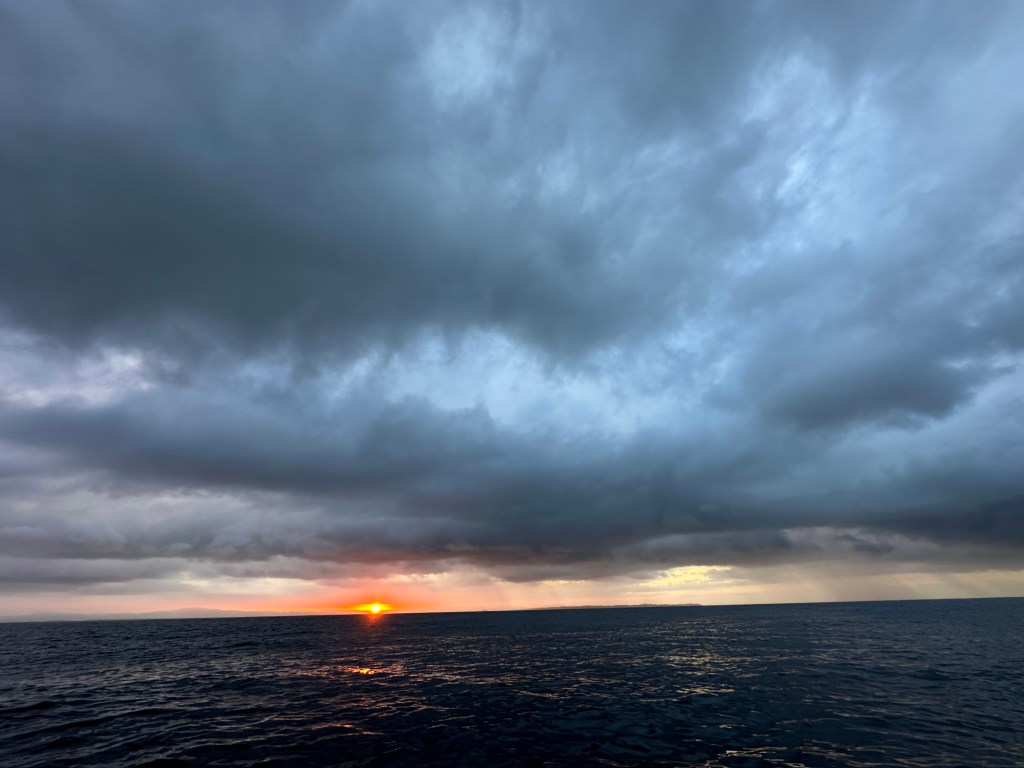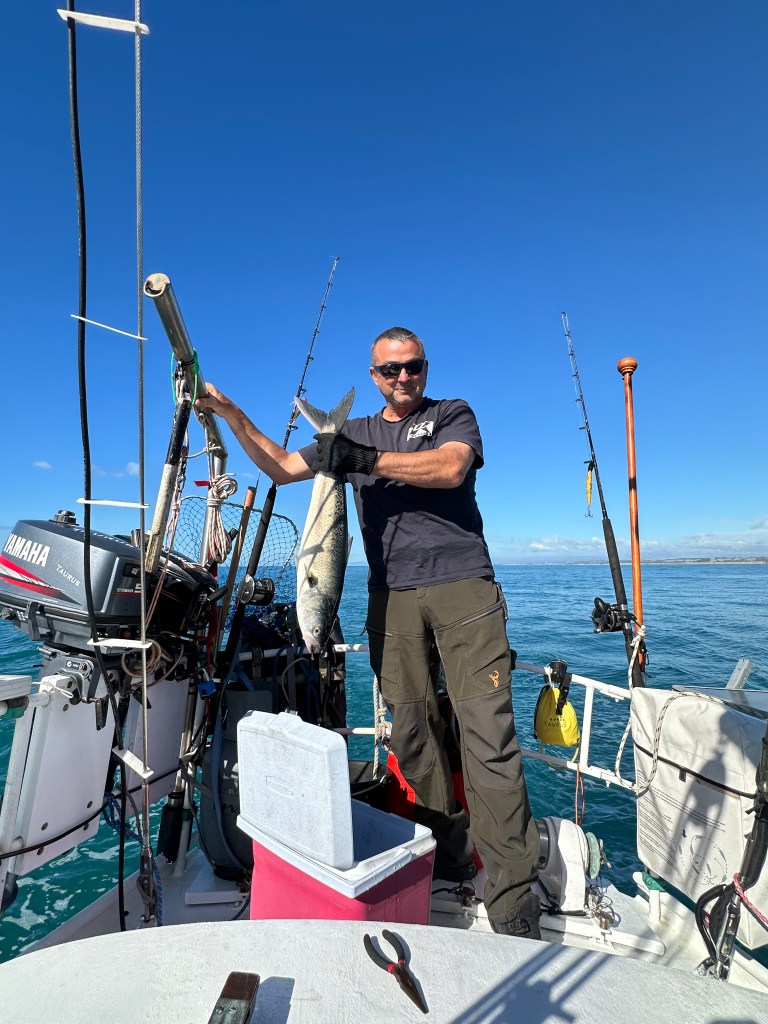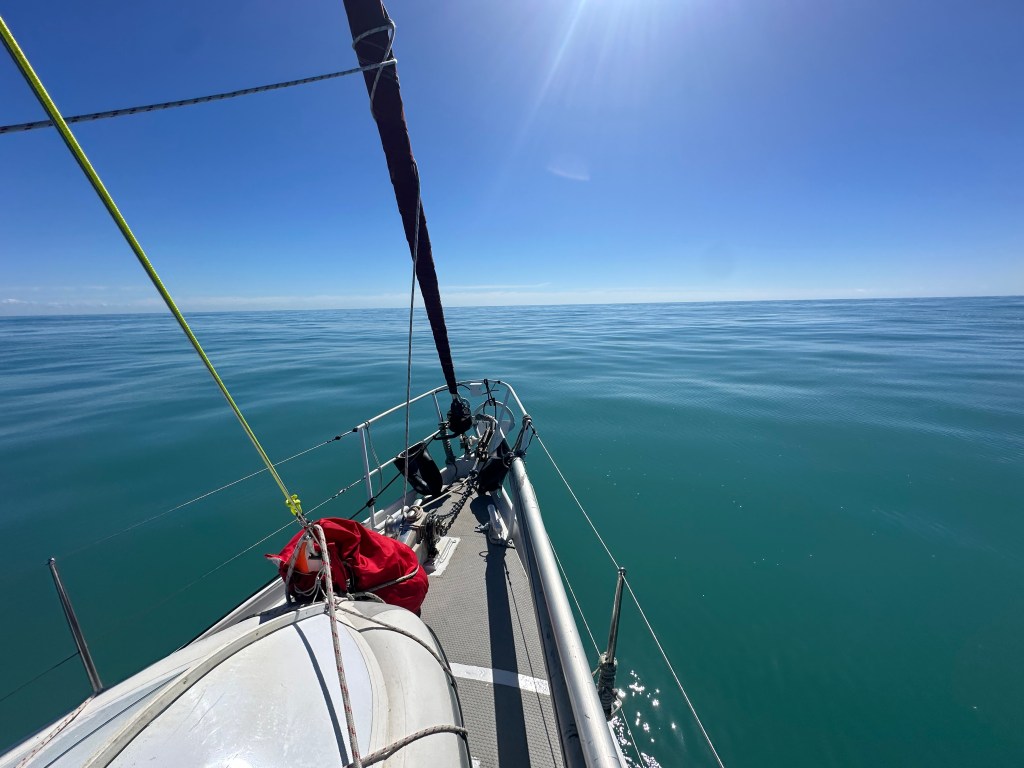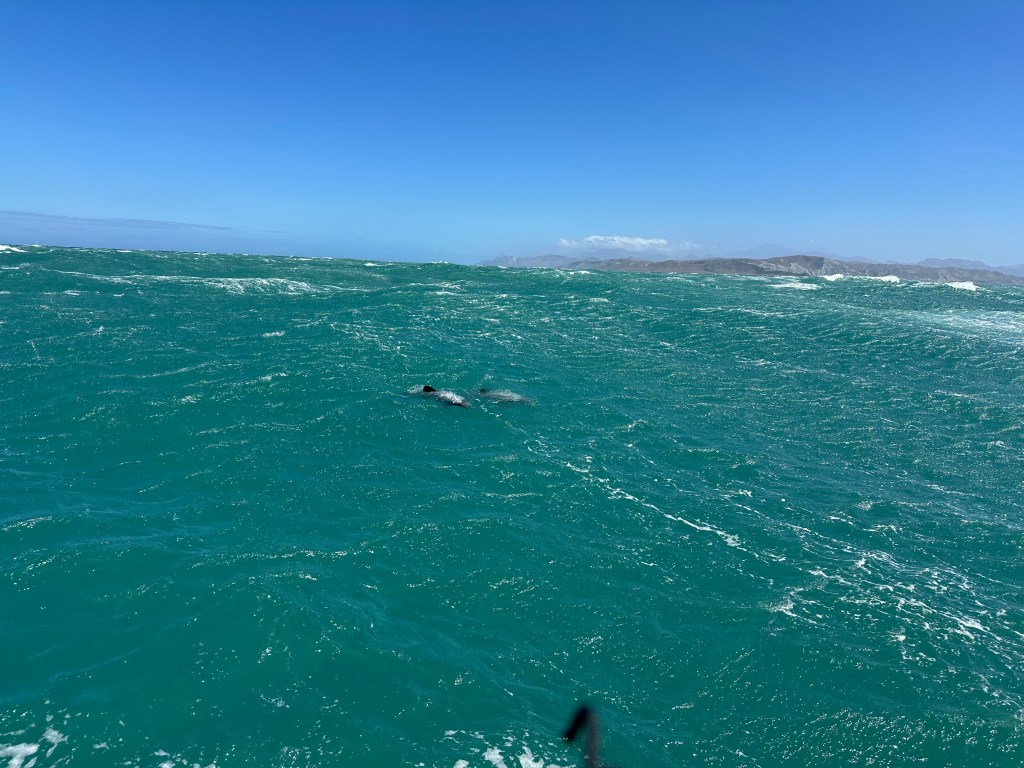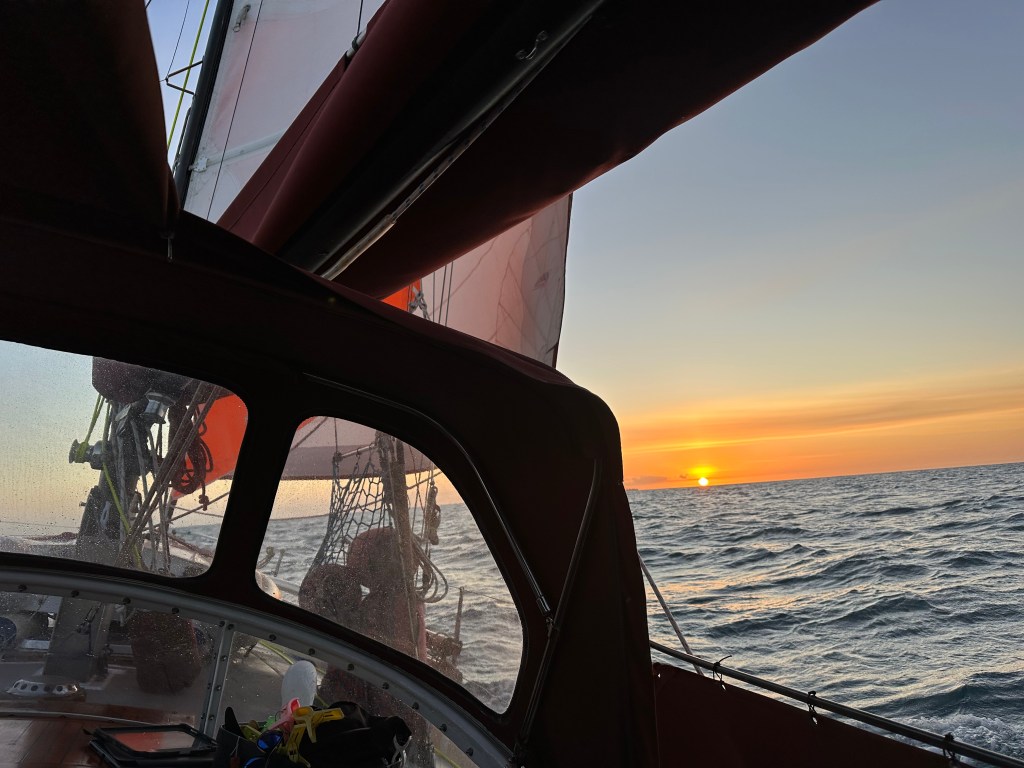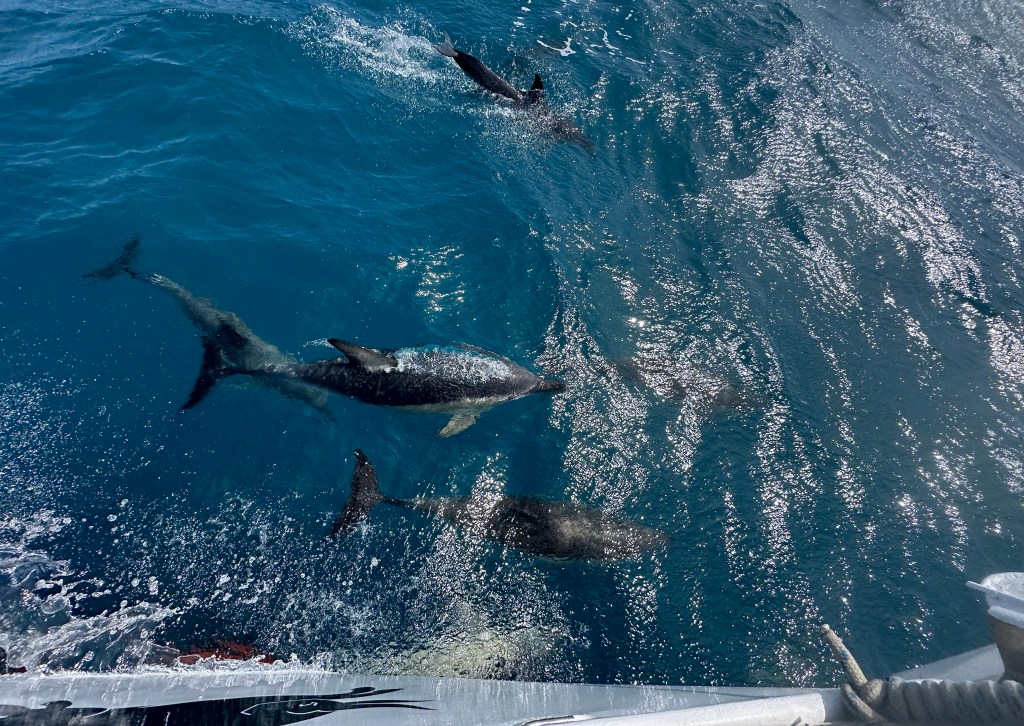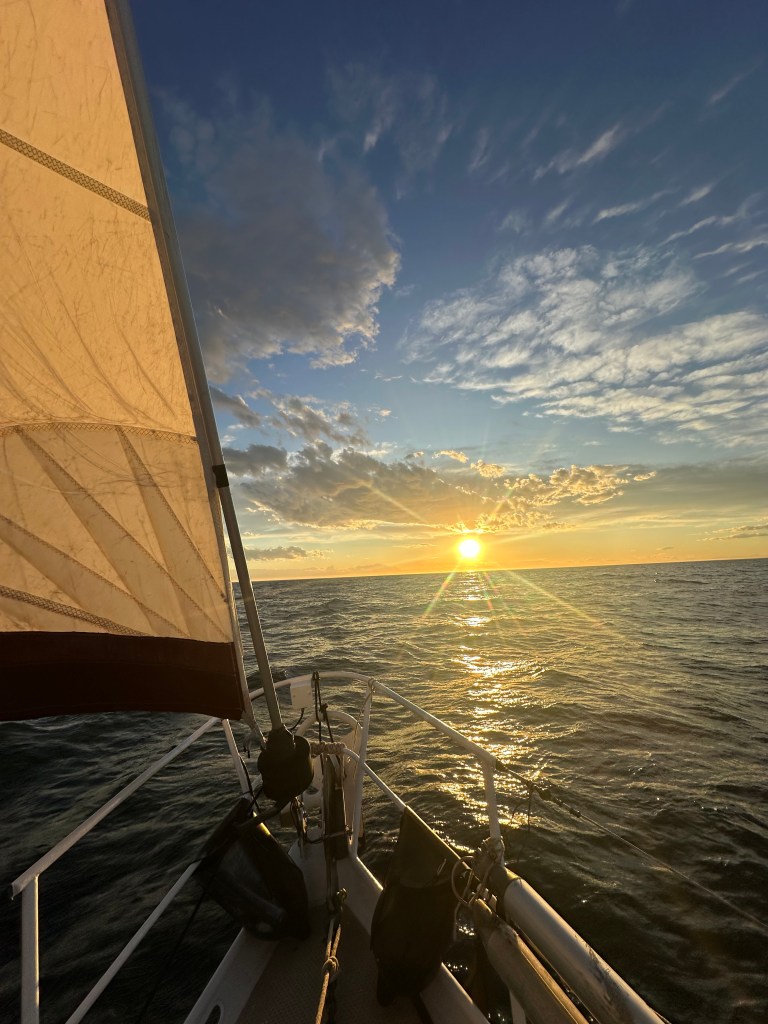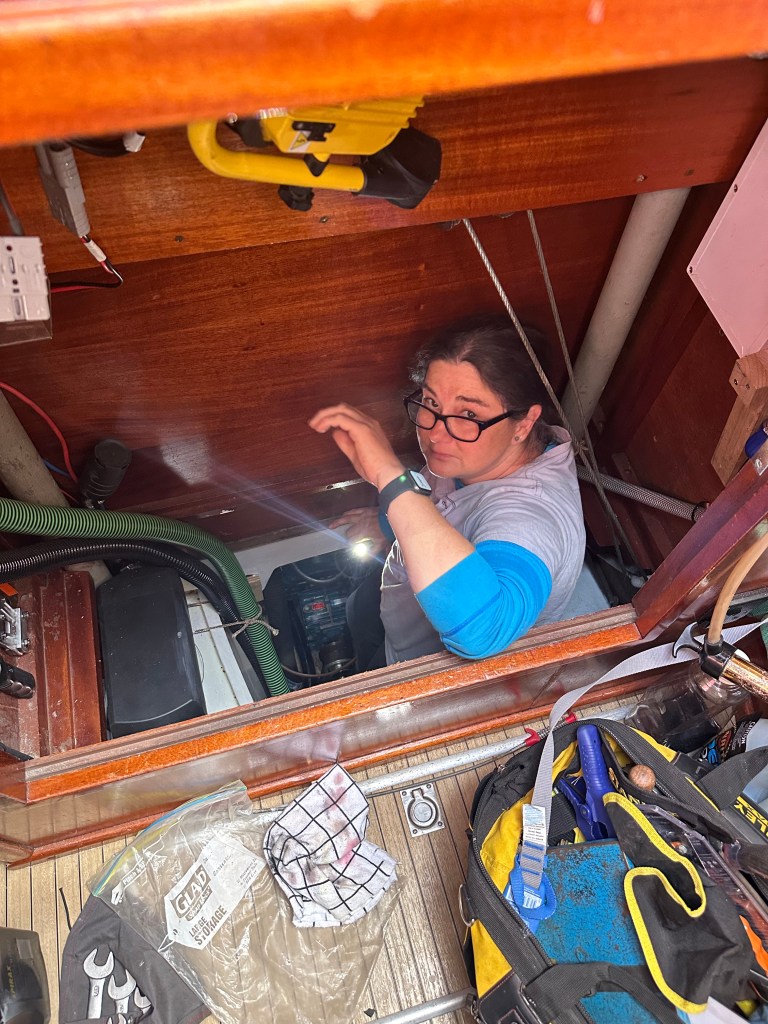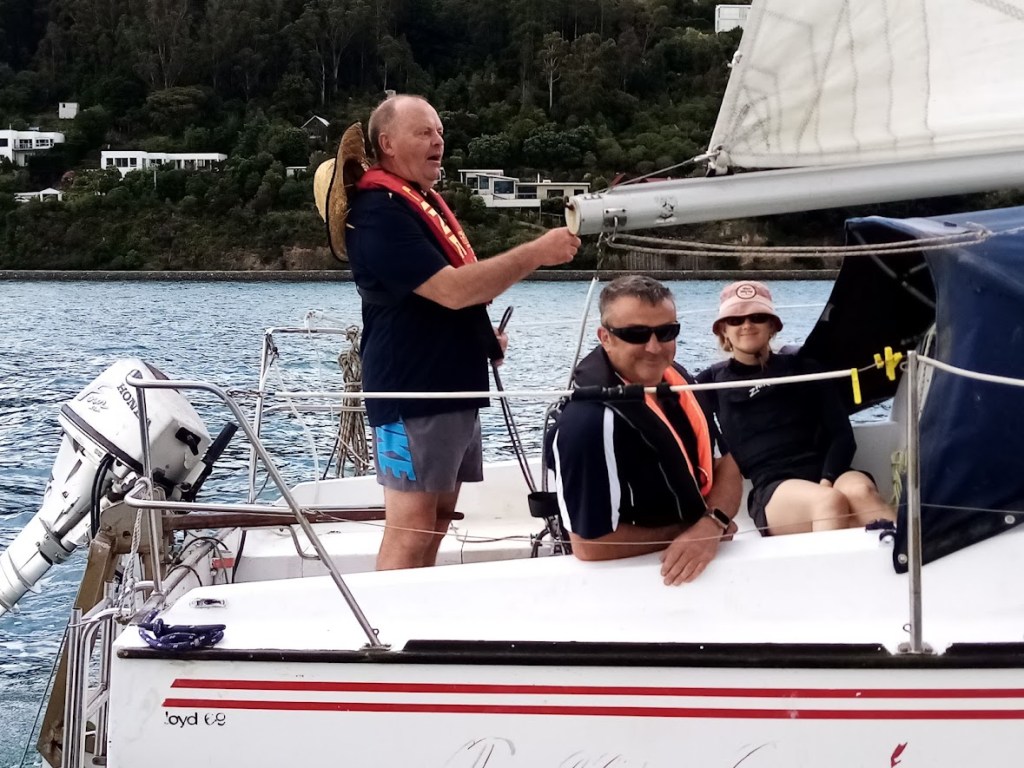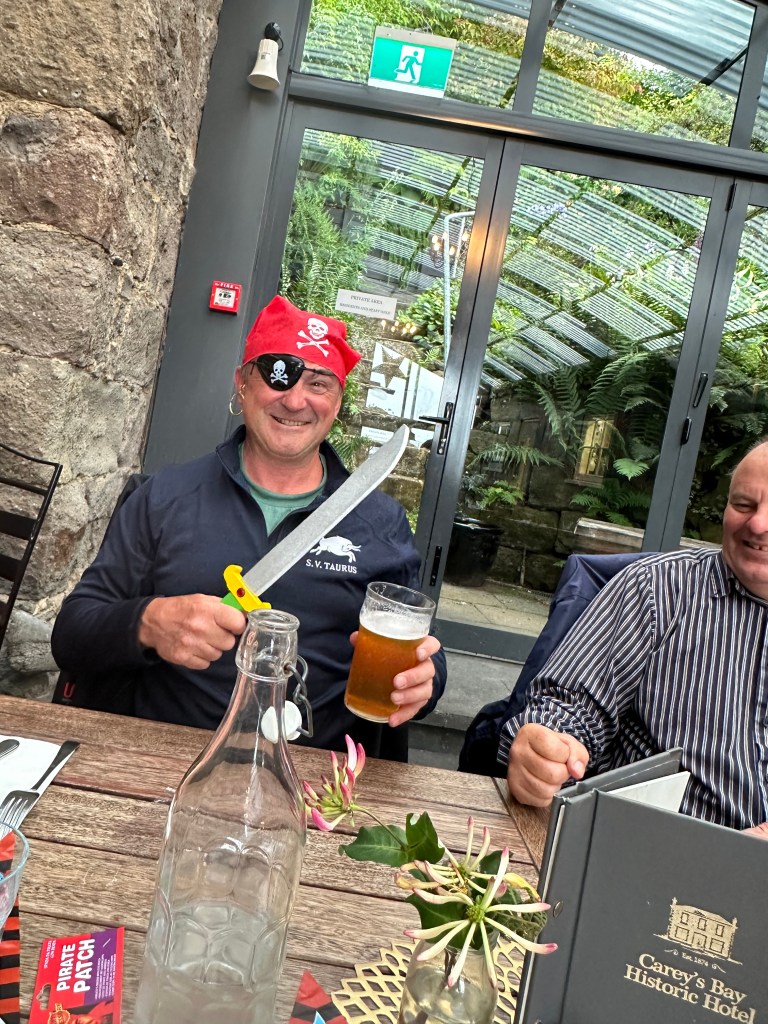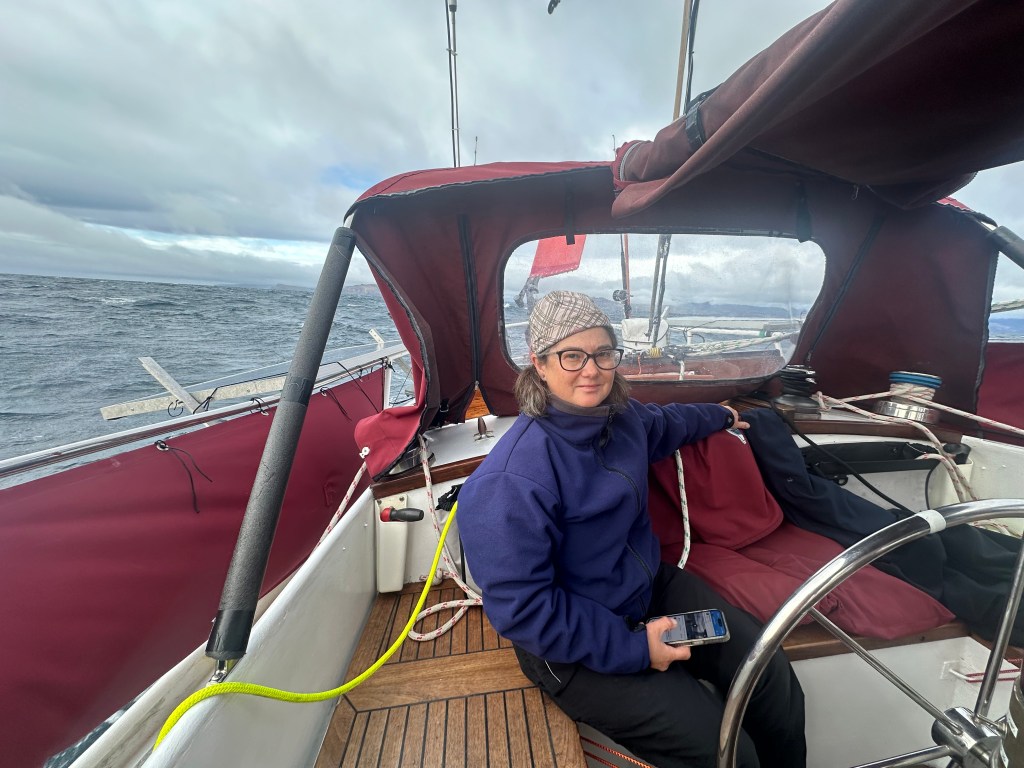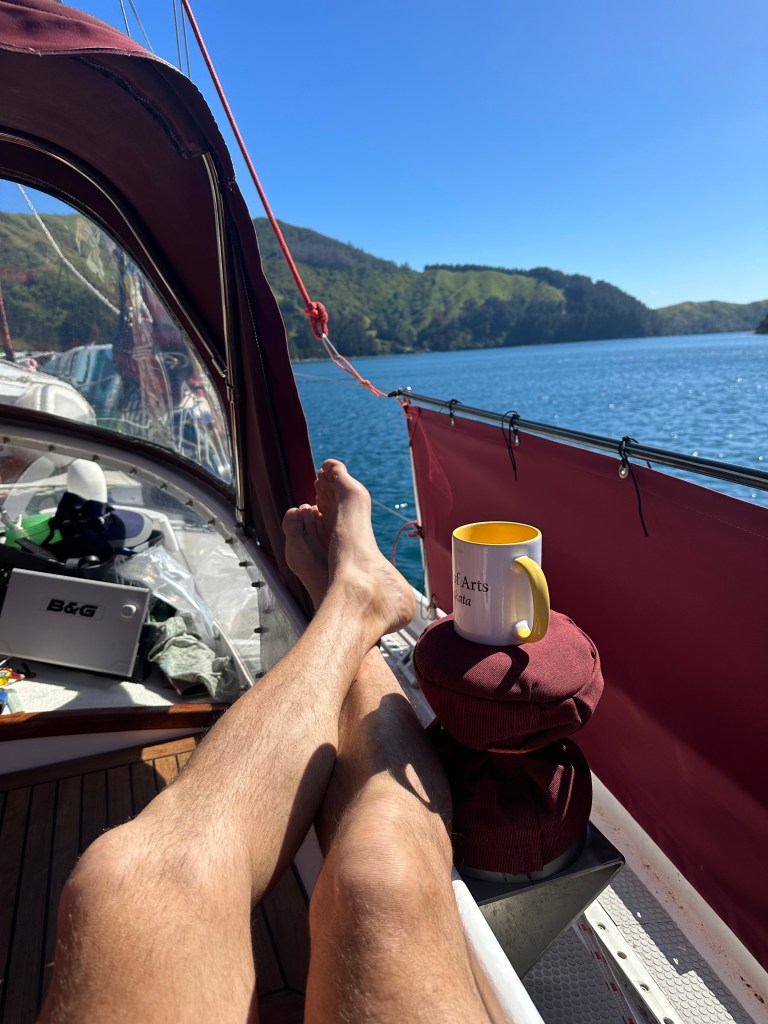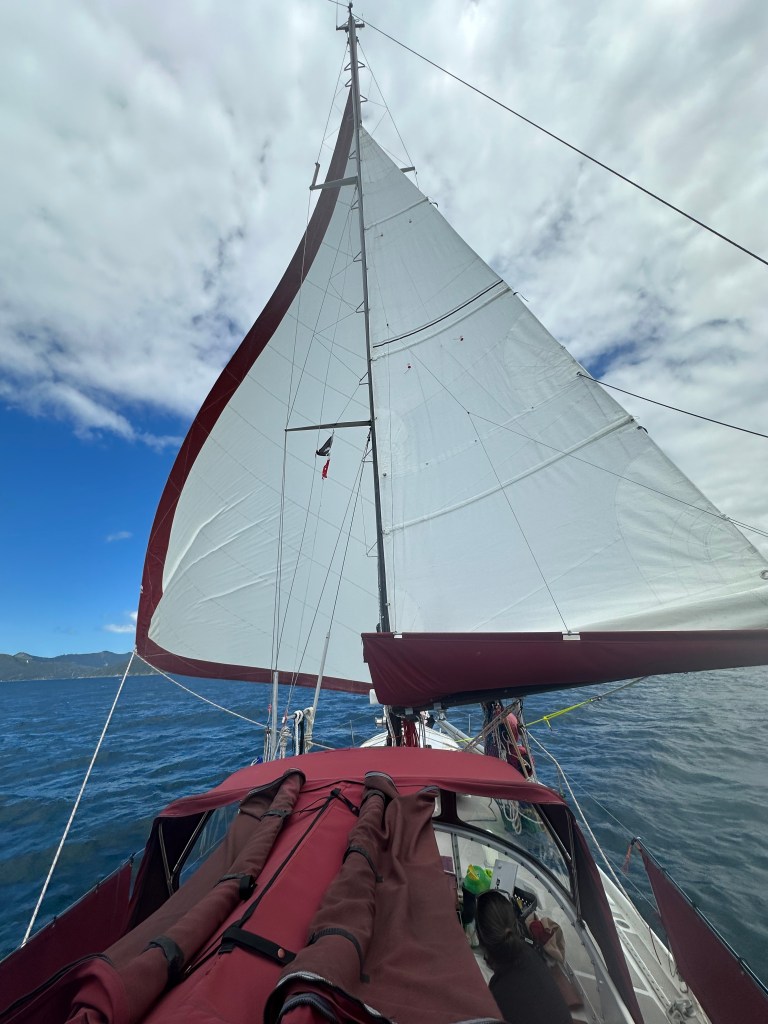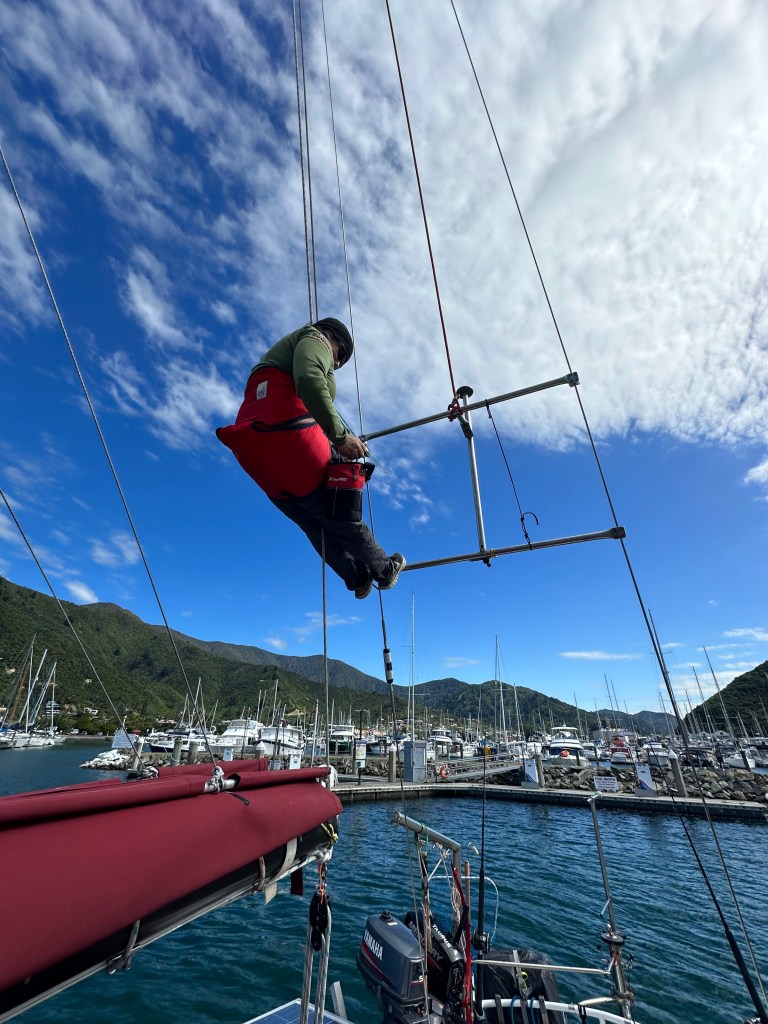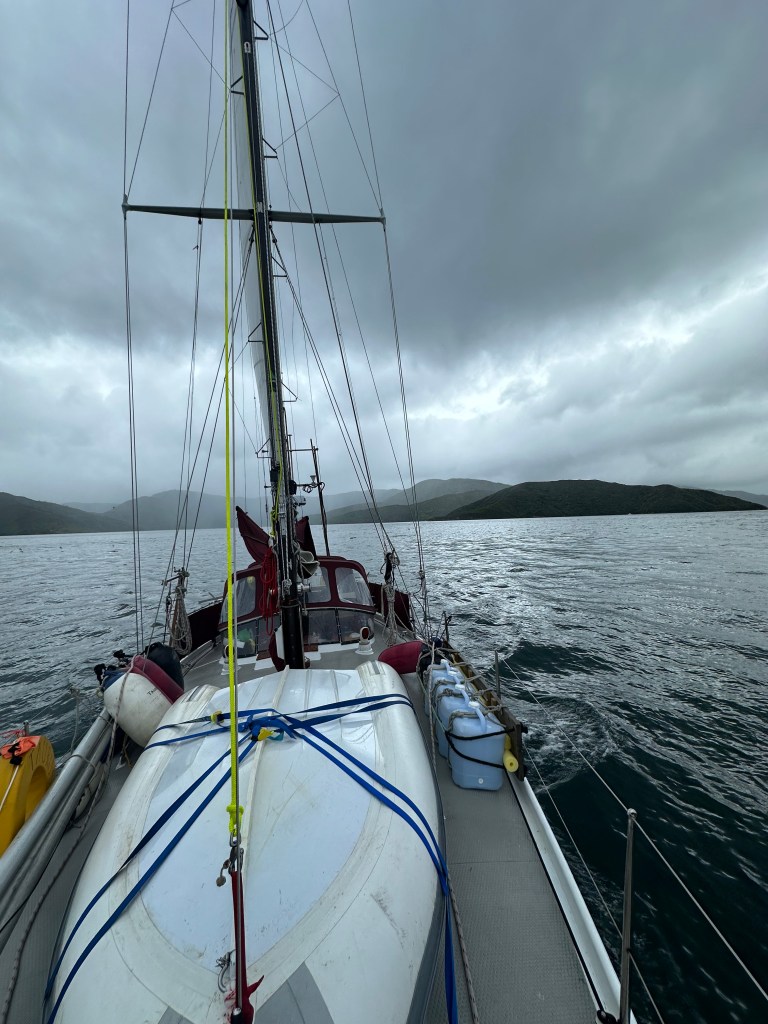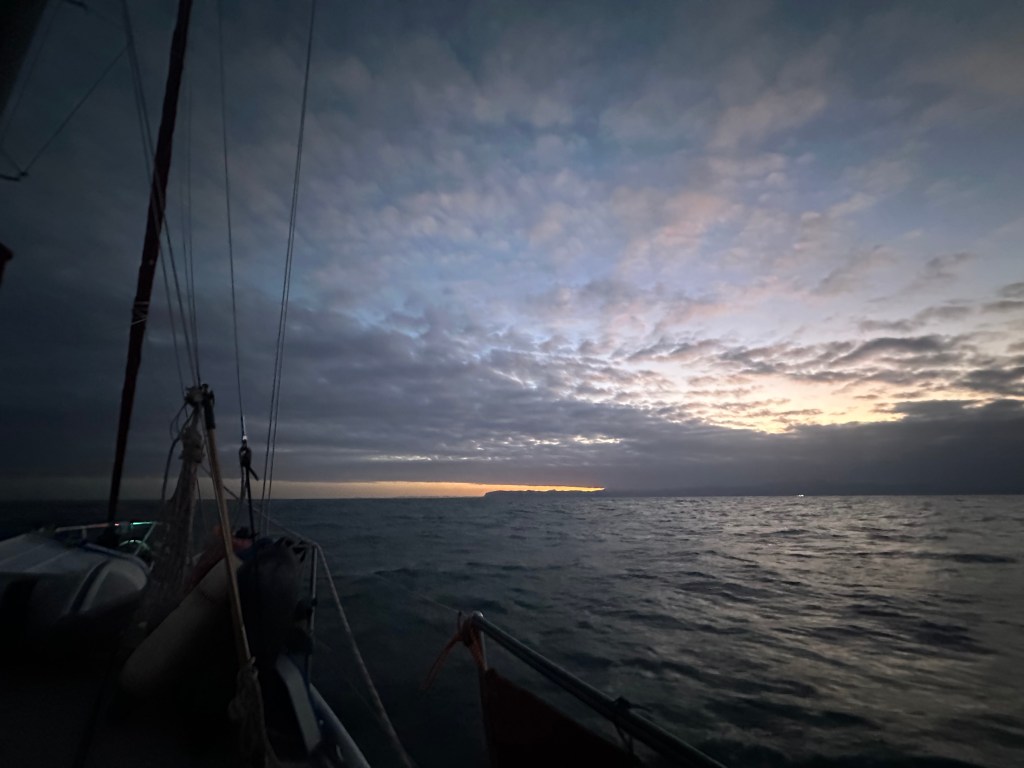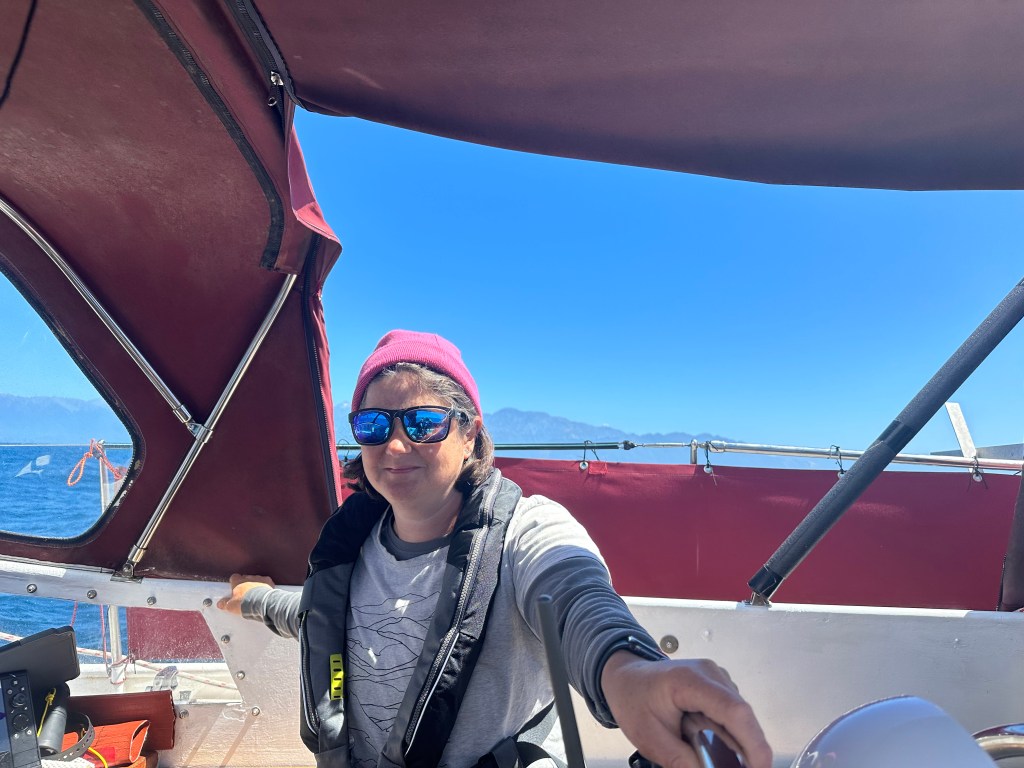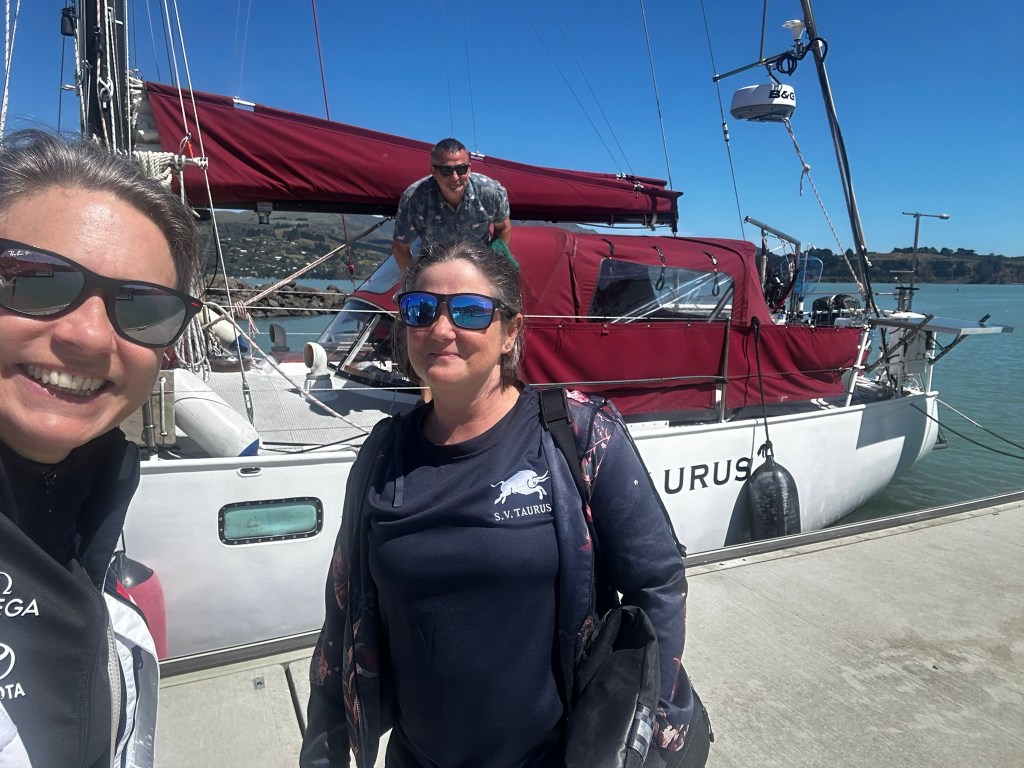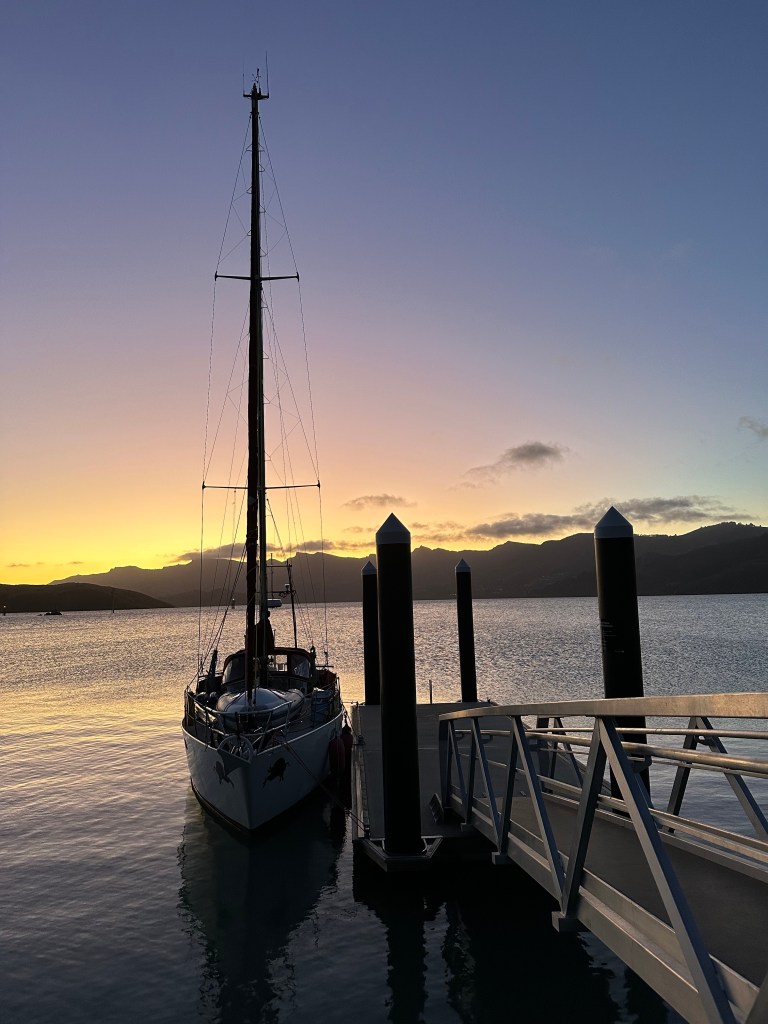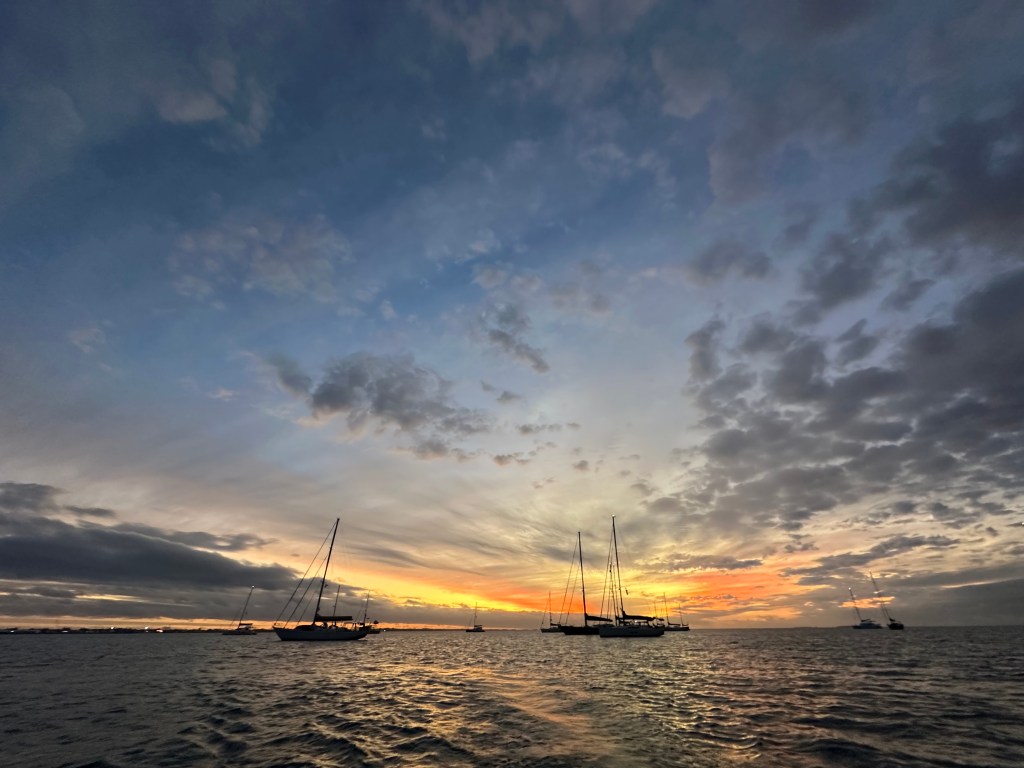
• Leaving Opua and a little bit nervous…

    Tuesday May 7th saw up early as we had an appointment with NZ Customs at 8:30 am. The guys were friendly and relaxed but they made a point of making sure we understood that when we left we had ‘cleared customs’ and had to go straight back to Taurus and leave. No stopping for coffee, no visiting friends, no last minute errands.
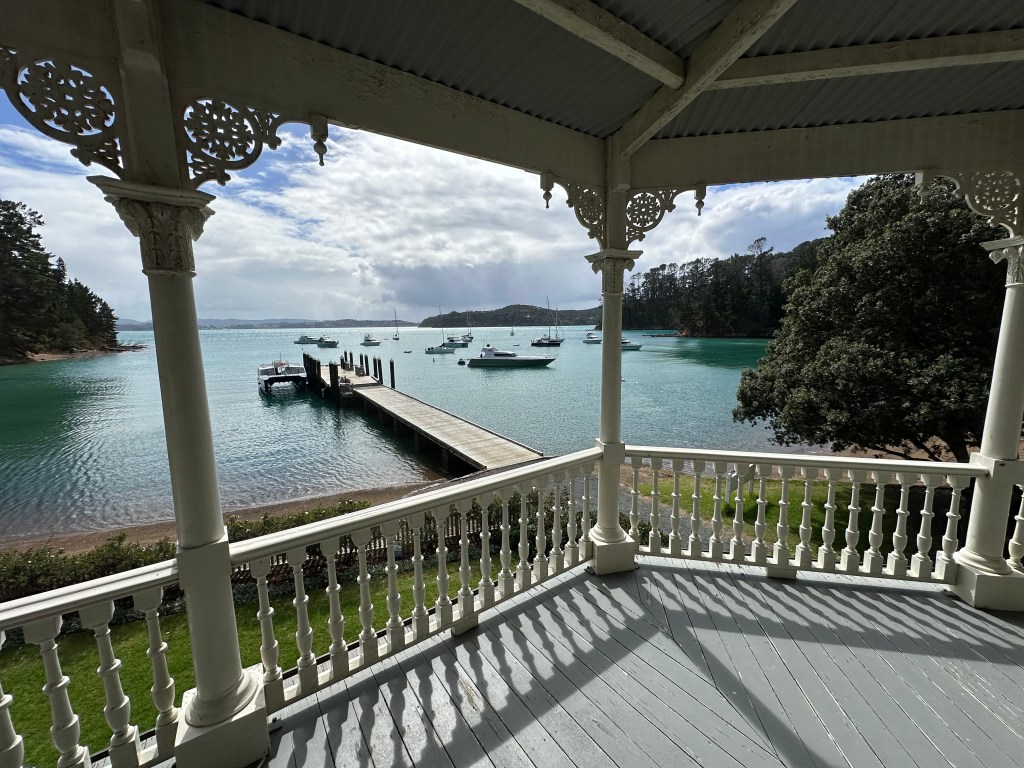
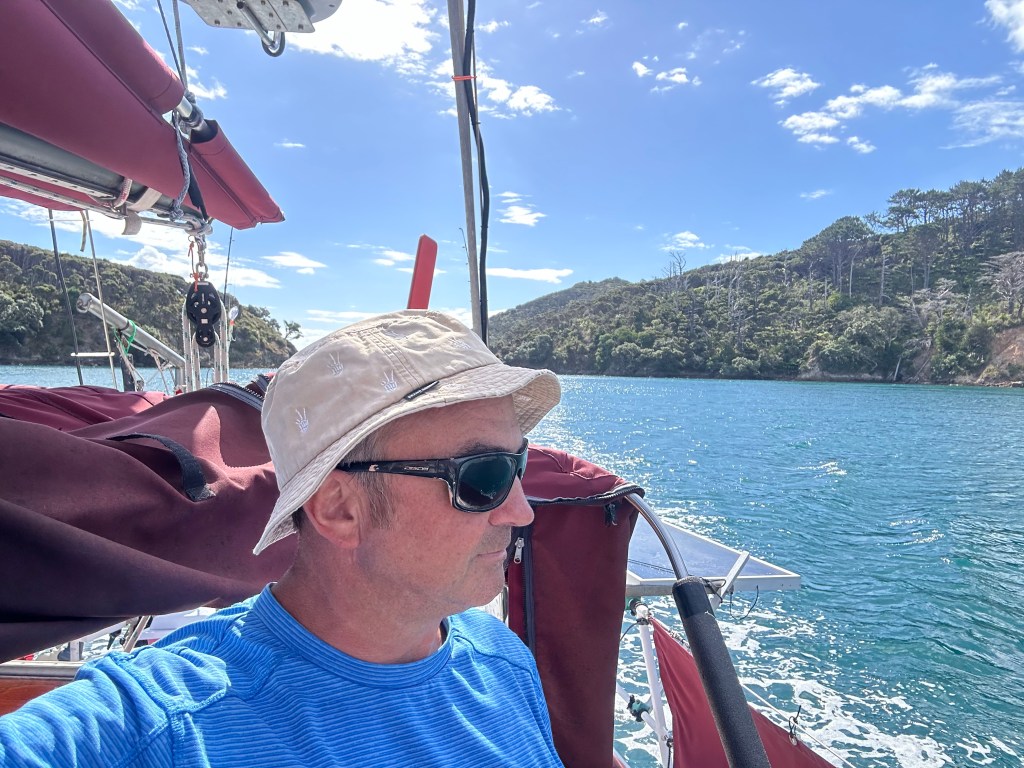
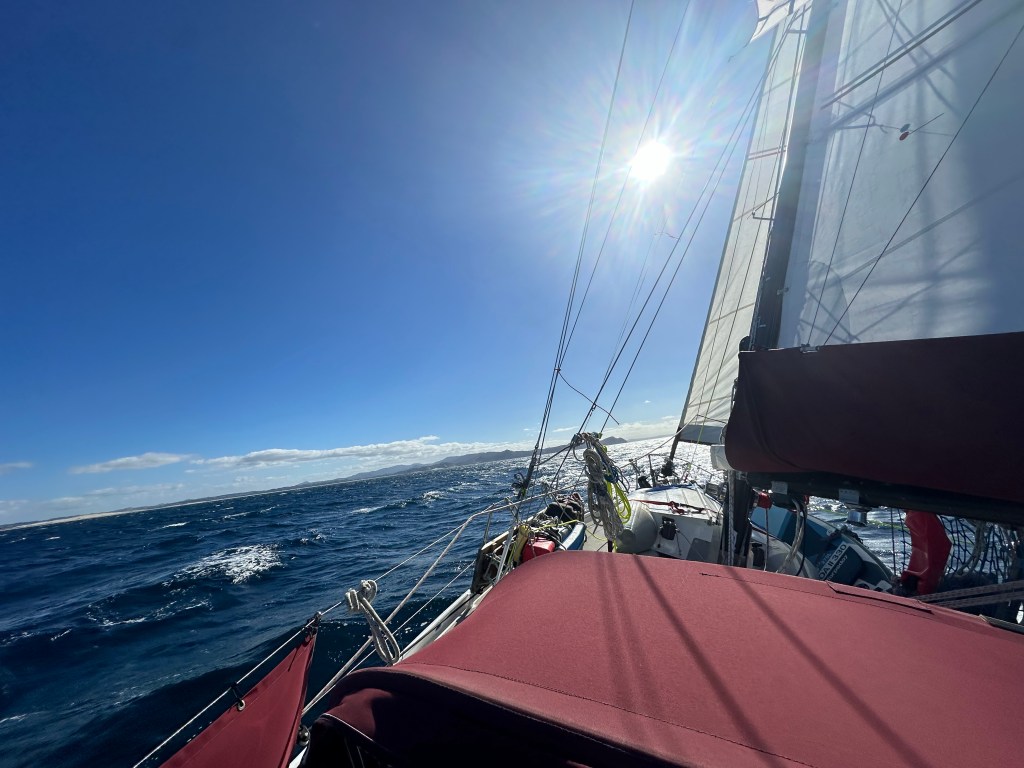
    It was a beautiful, sunny day and as we motored out of the marina a girl on large steel ketch called Saltlines yelled across, “Where are you heading?” With equal measure of trepidation and pride I yelled back “Tonga!” There was very little wind so once we were at sea we set out to hoist our spinnaker. This is a sail that we have never used with just the two of us on board because it’s a massive piece of cloth, designed for light air, and if the wind builds a spinnaker can get out of control very quickly. If you want to see what I mean just google something like ‘spinnaker fails.’

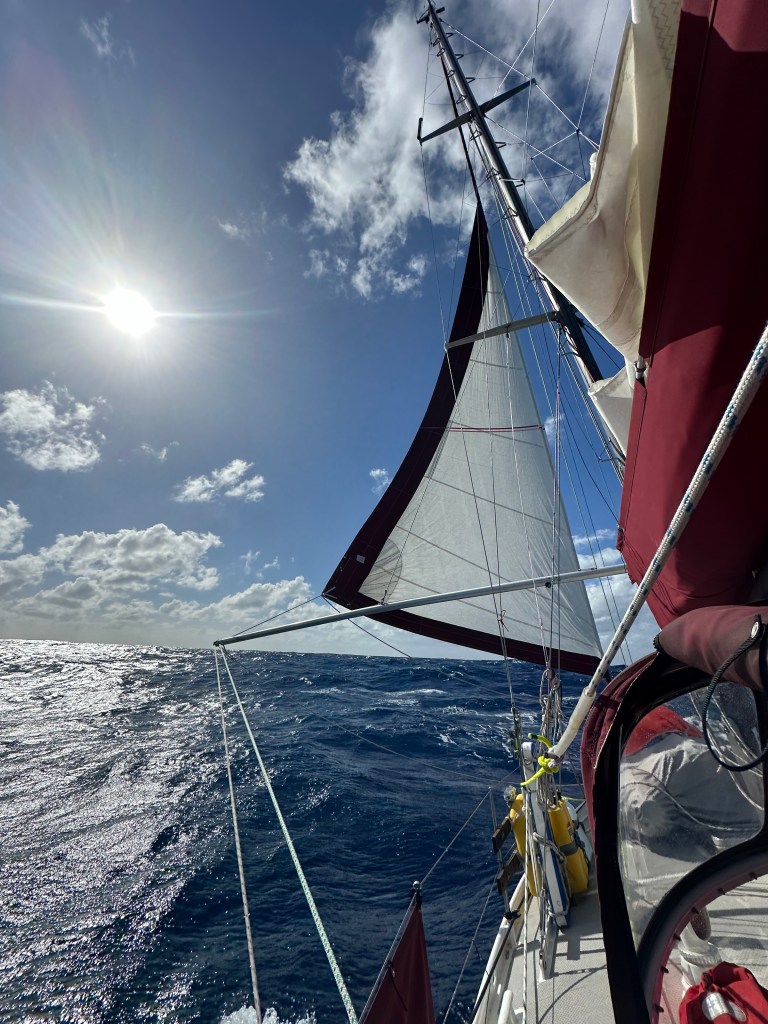
    Spinnaker up!

    With the spinnaker up we began making decent speed, but the wind slowly built and soon enough we had to take the sail and pole down again. That day we went from main and spinnaker, to main and jib, and slowly reefed the sails down until we hoisted the storm jib in about 35 knots of wind. We were sailing conservatively as there had been a number of squalls, including a spectacular thunder and lightning show with driving rain. However, the lack of drive meant the boat wallowed terribly and we watched on the AIS as Saltlines, also heading to Tonga, caught us and then sped away.

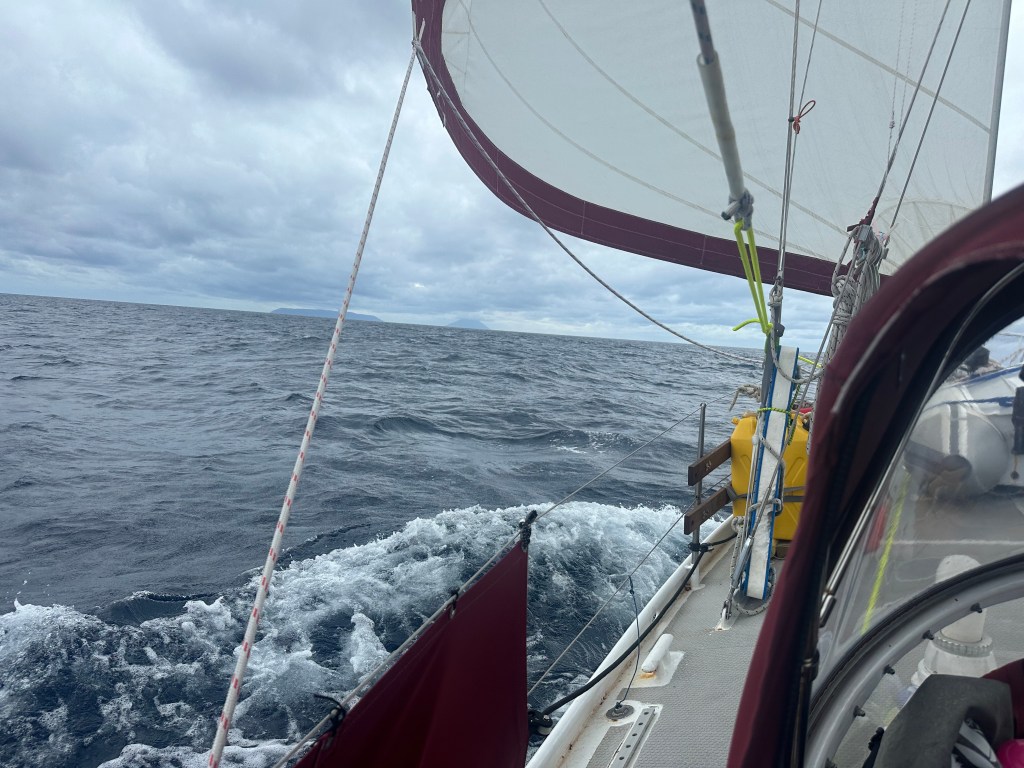
    The next day the wind blew from astern and we finally poled out the jib to stop it slatting as the boat rolled and the gusts rose and fell. We ended up travelling at quite a good rate of knots, which helped with the sloppy seas so much that I was loathe to take it down even as the wind gained in strength. On an extended passage a crew of just two people can’t really afford to sail too conservatively. Faffing around with the sails all night means you don’t get enough rest, the slower you go the harder life on board becomes due to the motion of the boat, and, of course, the slower you go the longer you have to spend at sea, with the inherent danger of being caught in bad weather. So, with all that in mind we left the jib poled out and fairly rocketed along all night.

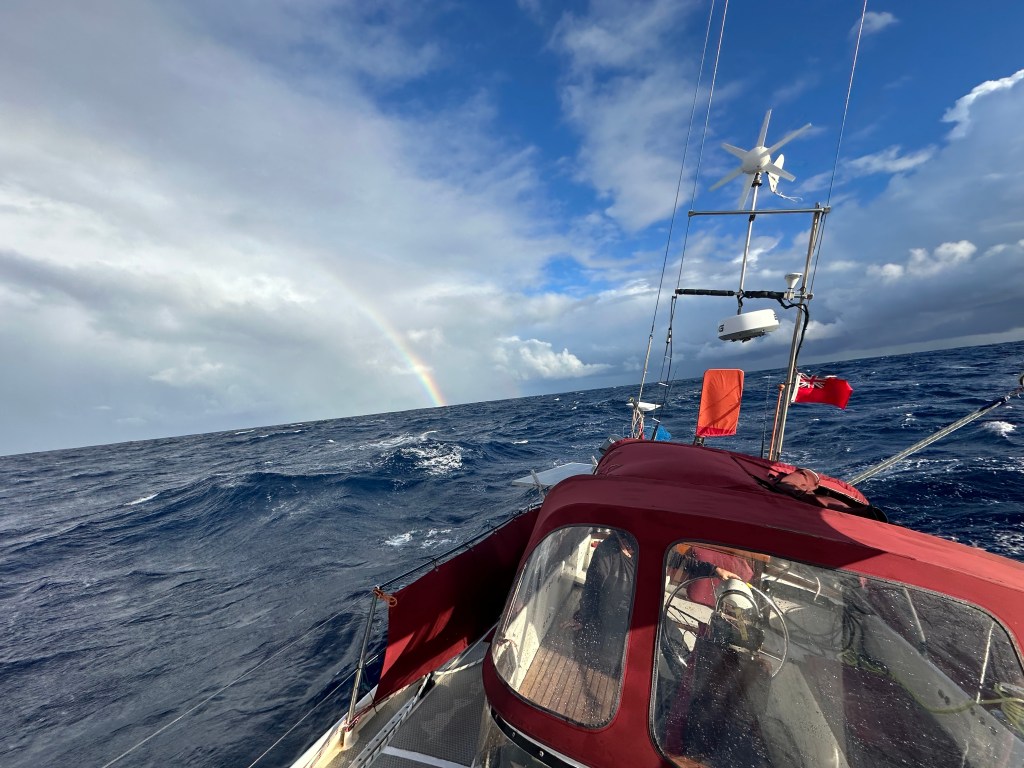
    Jib poled out. We were flying along in 30 plus knots of wind at one point but the boat was fine.

    Our first two days at sea were pretty rough due to the sea state. We knew that this would be the case, but the later weather pattern suggested light winds and our heavy steel boat doesn’t sail well in light air, so we chose rough seas and wind over motoring. As it happened many of the boats that waited in Opua were to experience rough weather near Minerva when we were tucked up inside in the shelter of the reef.

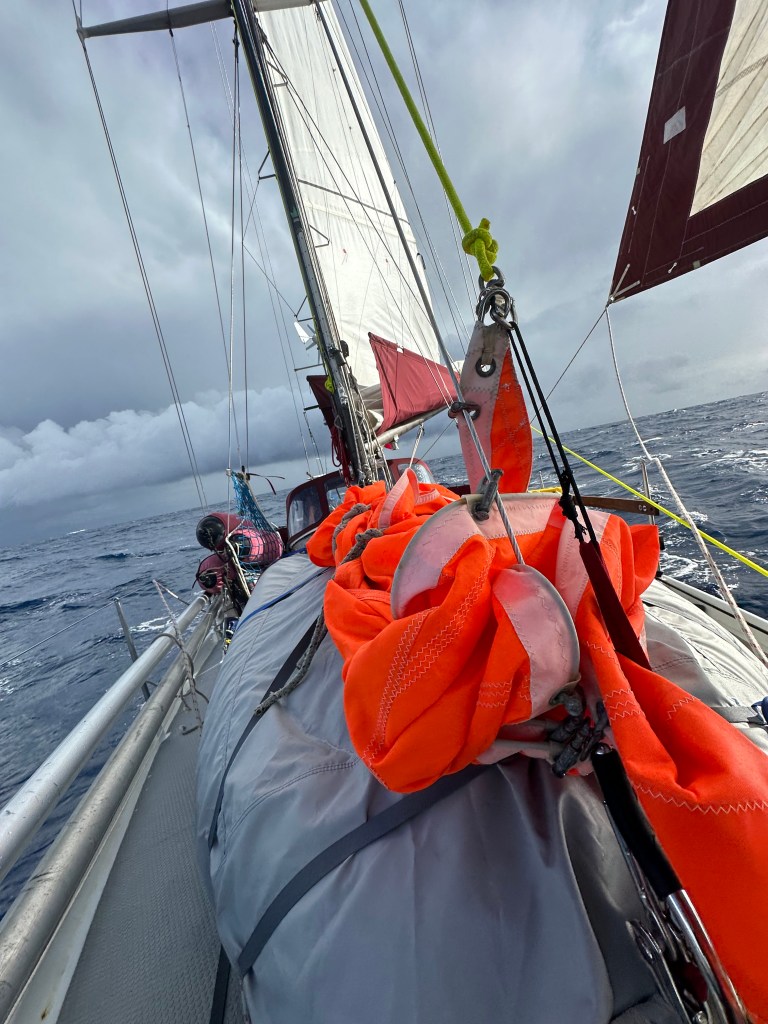
    One of the rougher days. Storm jib all ready to go…

    So what is it like to spend thirteen days crossing a small part of the Pacific? Obviously, Cara and I are pretty new at the game, and there are many books written by sailing legends that can provide a much better, more accurate, and more nuanced narrative. My short answer would be something unhelpfully ambiguous like, ‘it is miserable and glorious.’ The miserable aspect is easy to quantify. The eminently quotable Dr. Samuel Johnson, of English Dictionary fame, once claimed that “no man will be a sailor who has contrivance enough to get himself into a jail; for being in a ship is being in a jail, with the chance of being drowned… a man in a jail has more room, better food, and commonly better company.” In a similar vein, J. Boyd Shellback argued that “he that would go to sea for pleasure, would go to hell for a pastime.” Though these gentlemen are referring to sailing in the days of yore, the sea hasn’t changed a great deal, and the theme retains a good nugget of truth.

    In this modern world we generally live incredibly comfortable and secure lives. When we have to face the rare prospect of being uncomfortable the experience is finite, a few minutes, a few hours perhaps. When you go to sail across an ocean in a small boat being uncomfortable lasts day after day after day, and how very uncomfortable it is. Imagine living in a small room, perhaps half the size of your living room, in which you have kitchen, bathroom, bedroom, and living room. You can’t leave this room. Now add an extra person, so that you have to negotiate the space with them and work around them. Put that room at 30 degrees, so that whenever you put something down it immediately tries to slides away and crash to the floor; a not quite shut door swings and slams shut, generally with your fingers in the jam; you have to think about which side of the room to sit on — get it wrong and you’ll be thrown out of your seat; the drain of either your kitchen or toilet sink will be below sea level, so that should you open the sea cock to drain the sink you will find that rather than the sink emptying, the sea will pour inside. The sea will continue filling your room until you notice and reclose the seacock — best not to leave it open too long as there is a lot of sea and not a lot of volume in a boat (we once took on about 200 litres of seawater in this fashion). If you can’t open the seacock how do you get rid of the dirty water from the dishes that’s sloshing round and trying to escape the sink? Silly things like this are frustrating for a day or two, but after thirteen days they become a real PITA. Now imagine this oddly angled but stationary room swinging between 30 degrees to the left and 30 degrees to the right, your living space undulating irregularly like a madly erratic pendulum. Add some violent vertical movements, up and down, the odd horizontal slam sideways as a wave smashes against the hull. Imagine trying to making dinner, going to the toilet, trying to sleep. Remember that you and your partner have to maintain a constant watch for other vessels, this demands a watch system through the hours of darkness that will allow you, on a good night, perhaps 3-5 hours of broken sleep. This ‘room’ doesn’t sail itself. Adjusting the sails, the course, the helm, is a constant demand, a demand that you can’t ignore if you’re sleepy or a bit fed up, because if you get it wrong you can break your boat, yourself, or your crew-mate, and help is a long, long way away. Should you happen to fall overboard, perhaps whilst reefing your main at 3am in a gale and driving rain, then you are simply dead. There have been numerous incidents of professional sailing teams, five or six strong, being unable to rescue lost crew members (even when they are still attached to the boat). For a short handed, two person, crew, the chances of a successful rescue are miniscule. For this reason, sailor’s lore often compares the sea to molten lava — fall in and you’re history. All of this sailing business depends upon an immediate relationship with the weather. If its raining you get wet; if its hot you sweat, you can’t just open the windows because the sea will come crashing in. Of course we use weather forecasts and prediction services, but often they are wrong. This results in sometimes having to motor. When we left Minerva a wind was supposed to help us half way, but it didn’t appear. When a wind did spring up it was on our nose and the size of the swell prevented us being able to get anywhere near Tonga. On one tack we sailed North West, on the other South East — but Tonga was East and the only way we could get there was by dropping the sails and motoring, for two days. Two days of the engine droning away as it consumed expensive, smelly diesel. Naturally, it would be nice to be able to throw your dummy out of the cot and quit at times, but once you’re on the roller coaster there ain’t no getting off. You are trapped in your noisy, smelly, deranged room that won’t remain still for two seconds, in the company of a tired, grumpy, seasick partner, that hates you for convincing him/her that this was a good idea. Does days of this sound fun?

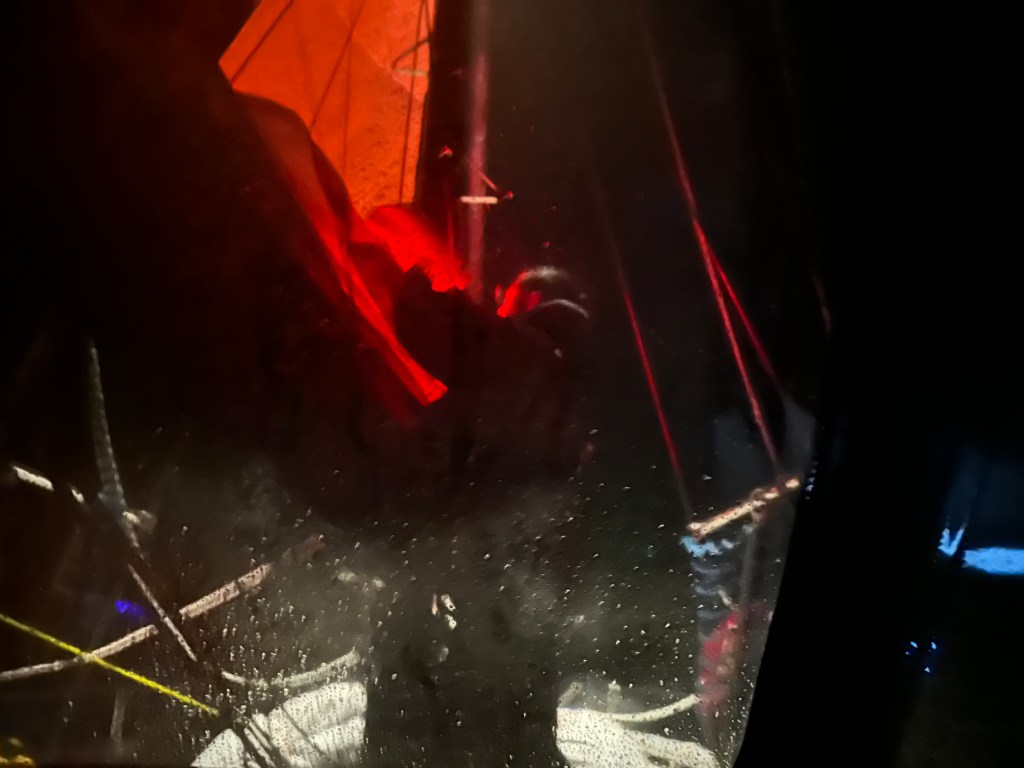
    Reefing main in the early hours of the morning. I’m using a red-light to preserve night vision.

    So, where, you may wonder, is the up side in all this? Sailing boats, in my humble opinion, are the least inanimate of inanimate objects. You will never be able to persuade a sailor that his boat doesn’t have a soul, because if they didn’t feel their boat’s soul they wouldn’t sail. In between the misery, fear, and nausea there are joyous days when the wind, sea, and course combine to make the boat a living creature that transports its crew to magical destinations as if it were a flying carpet. It has been said, with some justification, that sailing is the most expensive way in the world to travel for free — but sailing is more than travelling, its a way of communing with nature, of breaking the shackles of life in the 21st century, of experiencing the immediacy of life and finding reward in the experience. Sailing is not like driving, not like catching a train, no where near the oh so sanitised experience of flying. Sailing, on a good day, is pure, elemental, exhilaration. This sense of freedom more than makes up for the bad days, obviously, because otherwise no-one would sail.

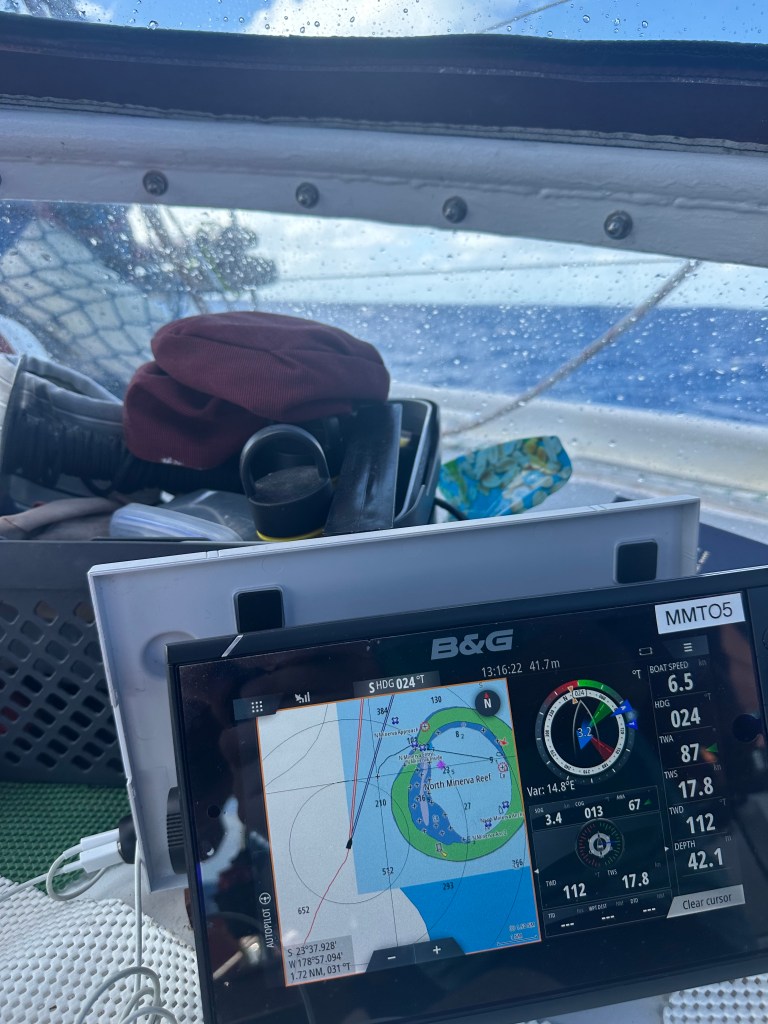
    On our sixth day at sea Cara and I arrived at South Minerva Reef. The two Minerva Reefs (North and South) belong on any sailor’s bucket list. They are surreal. To start, you can’t actually see them as you approach, and it is only when you are frighteningly close that you see a rim of white water as the sea crashes against the coral.

    The chart shows our proximity to the reef, but looking out the window there’s nothing to see. Weird.

    The southern reef is in the shape of a figure ‘8’ with entry into one of the circles through a gap in the coral. You approach the reef unable to see it, essentially following your chart inside, and suddenly you find yourself in twenty metres of sheltered water and able to drop anchor. All around all you can see is ocean, often rough waves, but you are calm and still. After days of constant movement the sensation of peace is magnified to a near religious experience. The Minerva Reefs are special places.

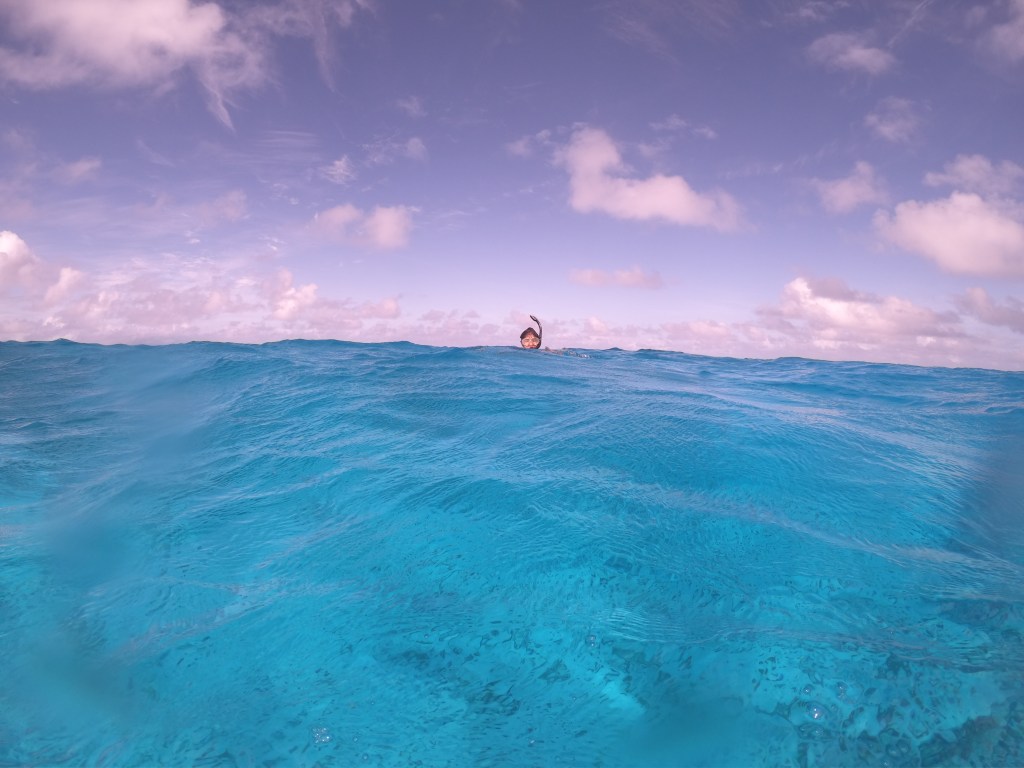
    Cara post swim, Minerva Reef.

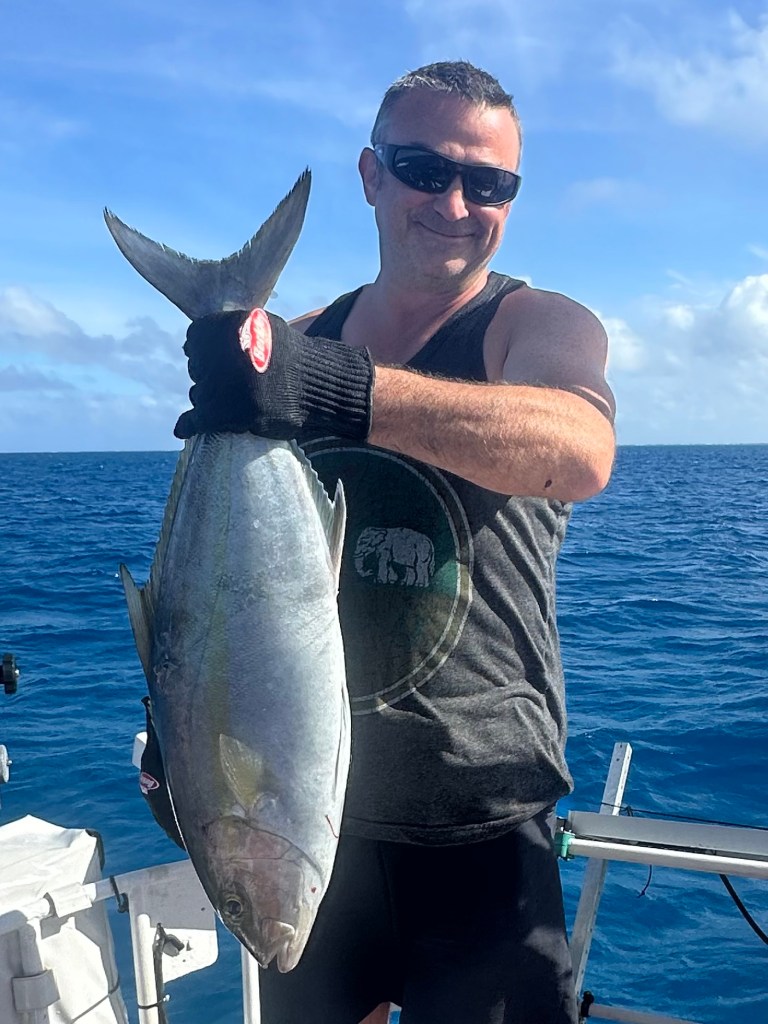
    The following day we sailed for four hours to North Minerva, and experienced the same bizarre sense of finding haven where there really shouldn’t be any. The first day we swam in the beautifully clear water. Anchored in 16 metres we could easily see the seafloor. Next day Cara noticed a school of fish beneath the boat. We grabbed our fishing rods to try and catch dinner but the fish weren’t biting and we soon realised why. Large tuna type fish were diving through the school that were obviously seeking protection from our hull. I ran downstairs to get the spear gun intending to jump in, but as I got to the dive platform I saw several of these tuna swimming towards me. In the second or so I had before they disappeared I calculated trajectory, velocity, depth and surface refraction, pulled the trigger, and to my eternal surprise missed my toes and speared a fish!

    School of fish beneath Taurus.
    The fish is an Amber Jack. Great eating!

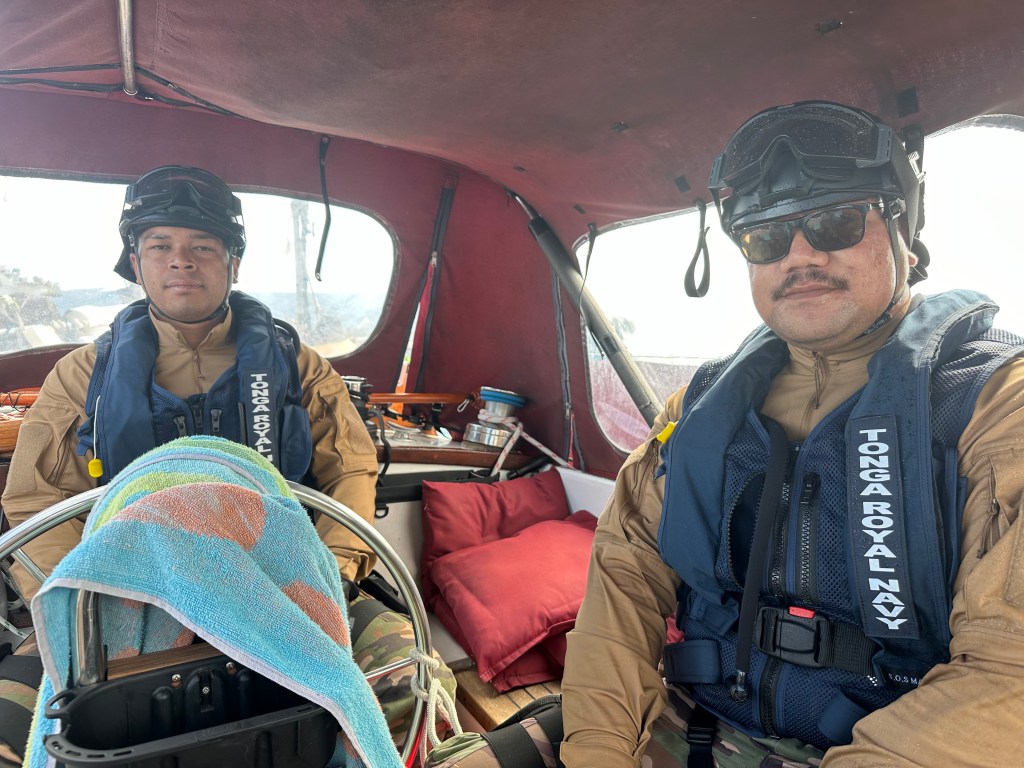
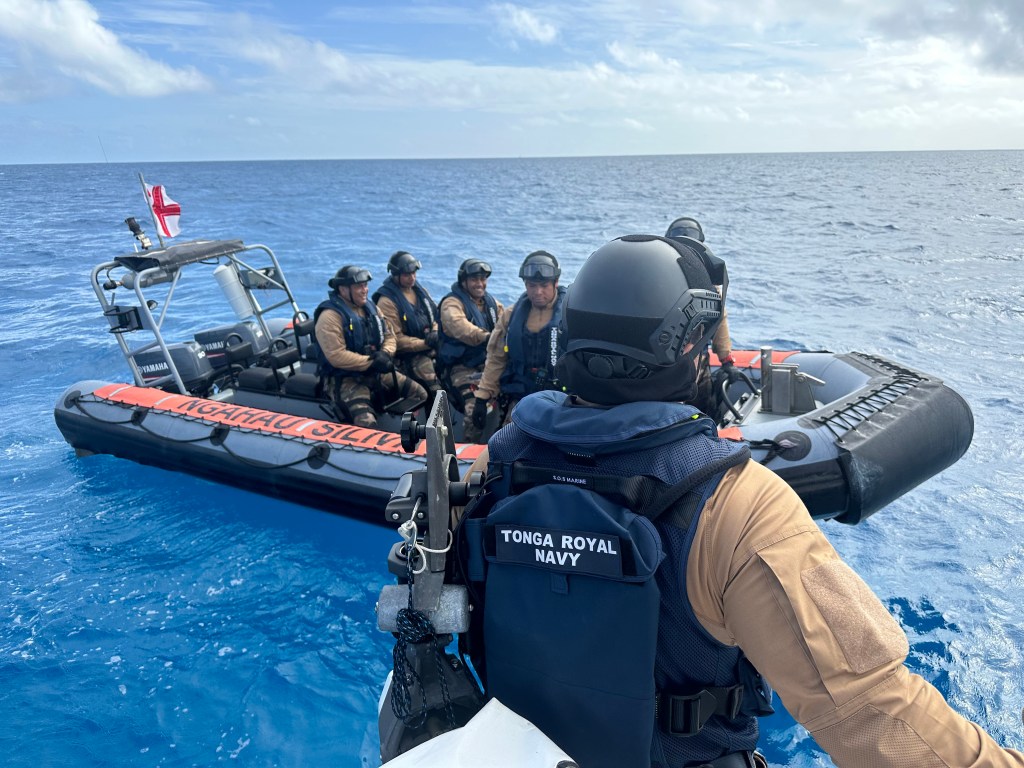
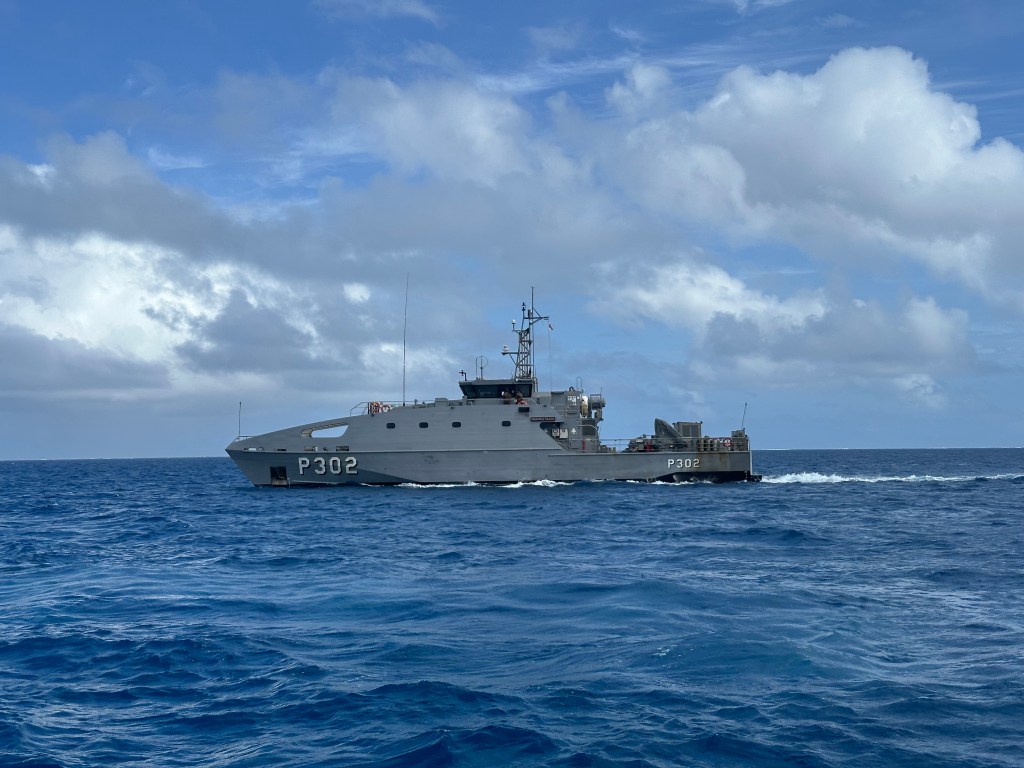
    That afternoon the Tongan Navy came to tea — at least we offered them tea when they came to see what we were up to. The guys were built like the proverbial outdoor facilities, so big they could hardly fold themselves inside the dodger, and armed to the teeth with half a rugby team in an IRB for backup and a naval ship sitting behind us; we made sure we were super polite.

    Answer to every question: Yes Sir!
    Yes sirs!
    Funny how you feel guilty when the authorities turn up — even when you’re not!

    We sheltered at Minerva for a couple of days as a gale blew through and decided to make a run for Tonga, about three hundred nautical miles away, two and a half day’s sailing. Before we left we went snorkelling in the incredible water and went for a walk on the reef.

    Terra Firma? This was low tide..

    The sea life was pretty incredible, and we did see a massive crayfish, which the Minerva’s are renown for, but we still had a fridge full of Amber Jack so we left it in peace.

    The weather window to get to Tonga was pretty marginal, with one day’s good sailing predicted following by head winds and then zero wind. Not wanting to motor too much we decided to take advantage of the decent day to get half way and then tack the rest. As I mentioned above this plan didn’t work out and we had to motor most of the way, which was disappointing. Still, other people who left after us had an even more miserable time with stronger headwinds, so we can’t complain.

    One exciting incident en-route was finding lots of water in the bilge. It is a tenet of sailing that the sea should stay outside of the boat, so this was of concern. We heaved to, a way of placing your sails in opposition so that the boat essentially stops, and quickly checked the seacocks (the holes in the hull that can let water in) to work out where the water was coming from. Regular readers of the blog will remember that we had a big oil leak in Whangarei. When sorting out that mess we had to move a plastic box from beneath the engine that the anchor compartment drained into. We felt that not a lot of water would drain from said compartment (sealed except for a small hole that allows the 10mm chain in and out) so replaced it with a smaller container that we placed under the cabin soul (floor). This container had filled and then overflowed and was under such pressure that we had a small fountain when we removed the hose. The anchor compartment was sealed with silicone for our passage but I had left the bung out whilst at Minerva. During the gale we had torrential rain but I didn’t imagine that that much water could have found its way in. This seems to be the way of boats — you try to fix something which causes a chain reaction which ends in something biting you in the bum. Needless to say we have kept a close eye on the container since, and might return to the old system. Whilst stopped we also checked the engine oil (which was fine!), and filled up the diesel tank.

    Back in my naughty box. Pumping out water this time (not ideal but better than oil)

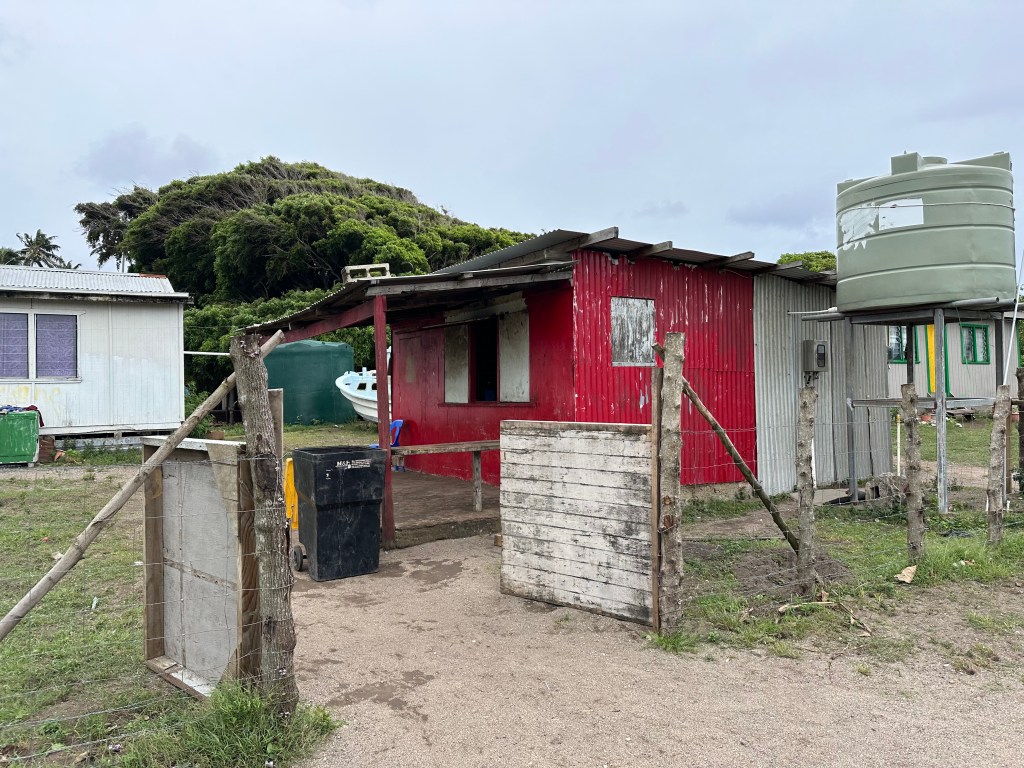
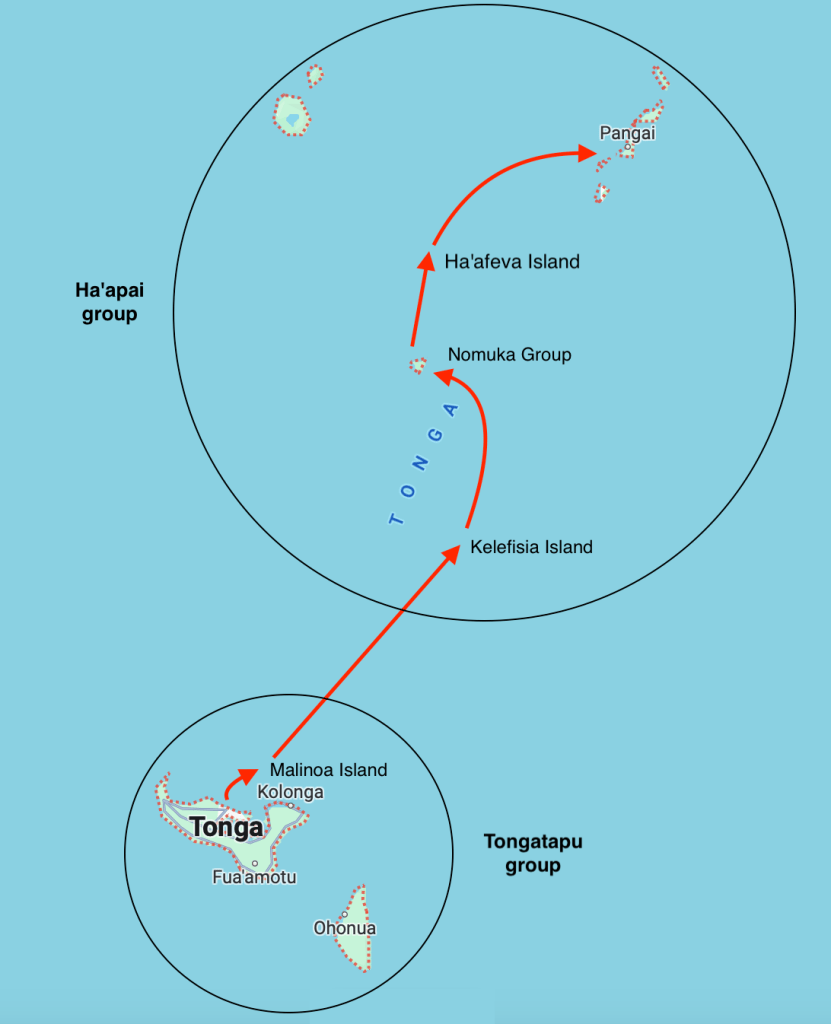
    After two days of trying to sail but being unable to get any closer to our destination we bit the bullet and motored, finally ‘arriving’ at Tonga at about 1 am on Sunday 19th of May. Not wanting to enter the reef strewn area in the dark we hoved to again and gently jogged along at about 1 knot until 5:30 am when it gets light. We then sailed into Tongatapu Harbour to clear customs at the city of Nuku’alofa. This again is an odd experience as the chart warns of all manner of ‘land,’ which is in fact underwater reef, so you follow a torturous route in, trusting entirely to the chart plotter. The customs mooring is famously rough concrete, so we were delighted to be asked to moor alongside a larger yacht that had just beaten us in. ‘Yes Sir!’ we said. The customs formalities went smoothly, though the quarantine officer ripped us, and several other yachties, off —the $23 fee being elevated to $50. Have a beer on us mate, what goes around comes around.

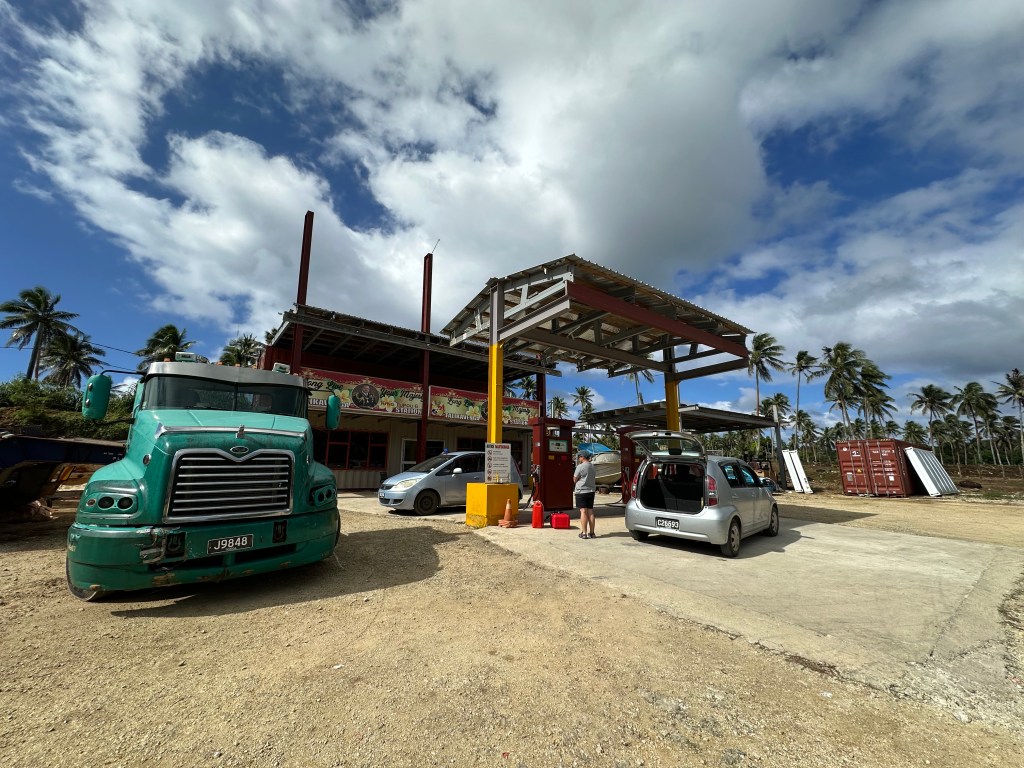
    Since our arrival we have been catching up on sleep, and spending a lot of time swimming because it is very hot and humid. Any activity results in sweat beading on the end of your nose and dripping into your lap. Yesterday we took the dinghy to town and wandered round Nuku’alofa. I wasn’t sure what to expect but I was surprised by how few people speak English, and how much damage remains from the tsunami a few years ago. There are few facilities here but we intend to stay till Saturday as there is a rally party at ‘Big Mamma’s,’ and who could miss that?

    Cara and Mama. Her bar and restaraunt , Big Mama’s,’ is a famous sailing destination. Unfortunately the 2022 tsunami caused a lot of damage.
    We sailed to Tonga!
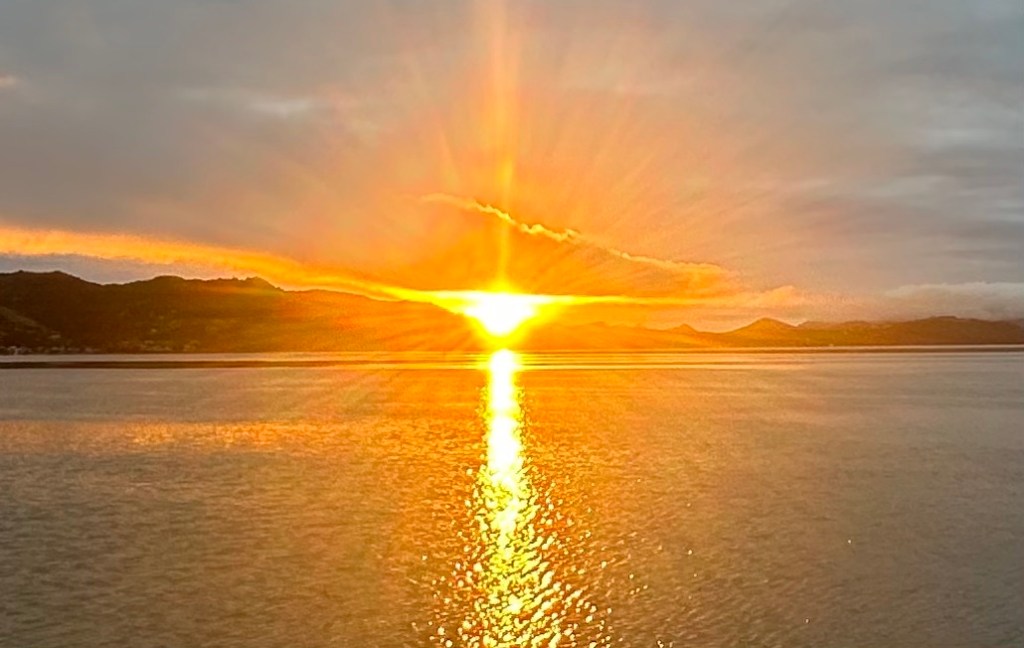
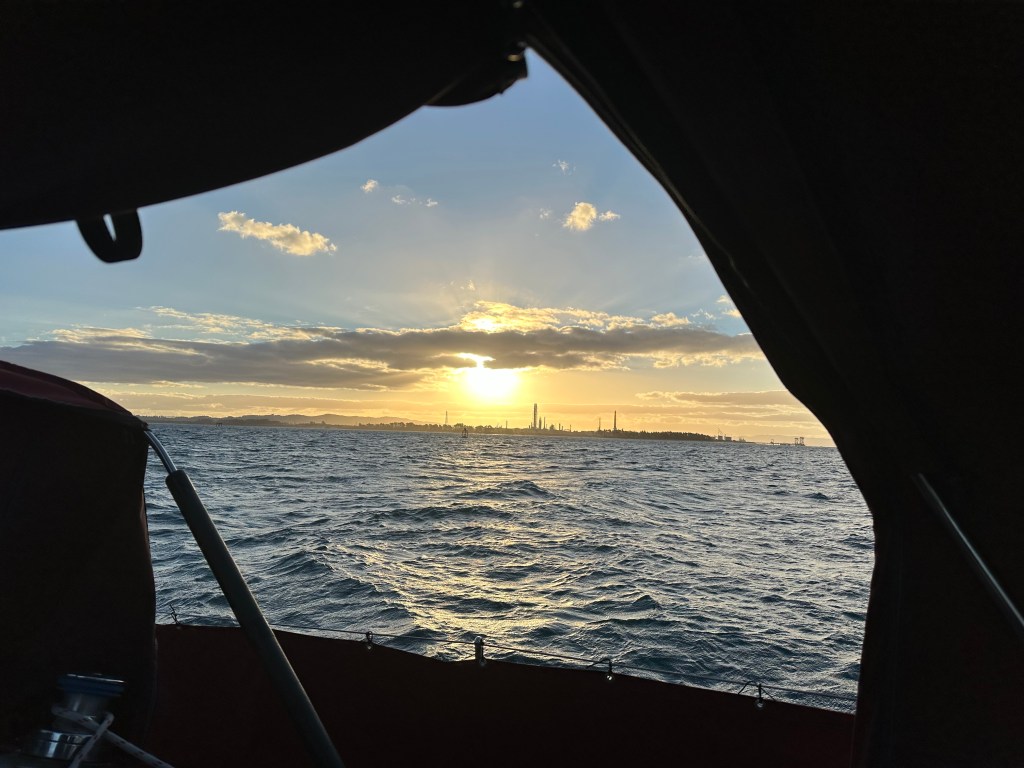
  • Sunset near Limestone Island

    We left Whangarei Harbour on Monday 22nd of April. Leaving the heads we were caught out by an unexpected squall that caused us to struggle with our sails for a minute or two, and managed to make such a hash of it that a container ship coming in to the harbour blew its foghorn at us to make sure we knew he was there. Abashed, we carried on and hoped that not too many people had seen our amateur dramatics!

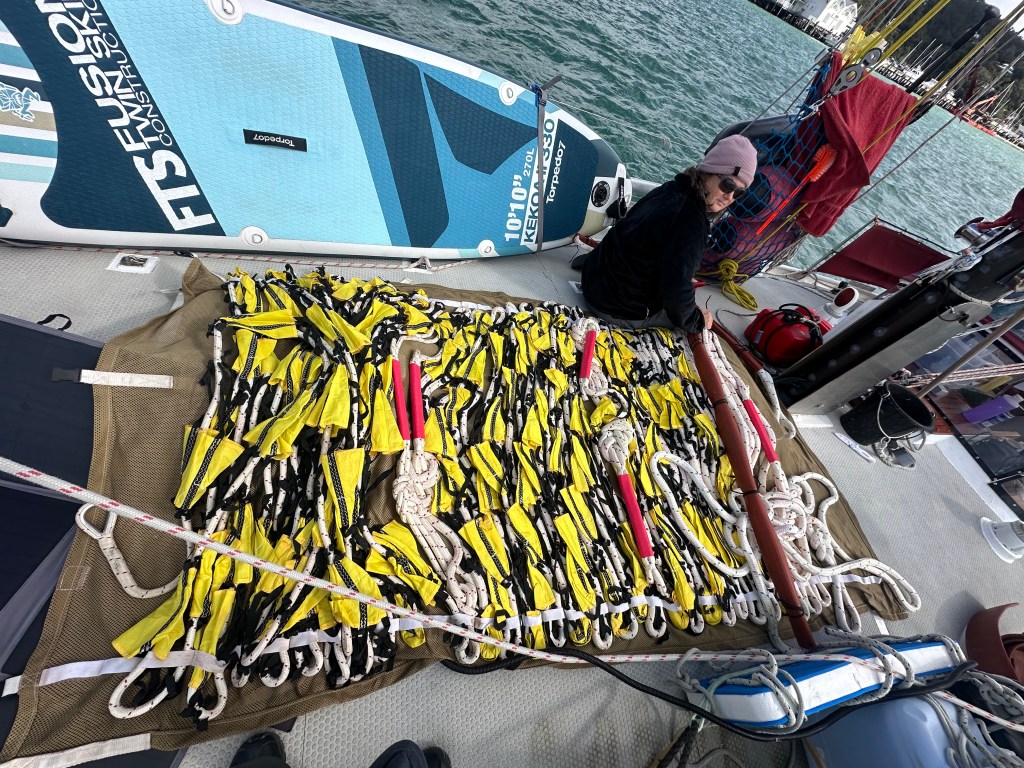
    We needed to call in to Whangaruru to pick up a Jordan Series Drogue that we had bought second hand. The Jordan drogue was designed after the Fastnet Race disaster in 1979 in which nineteen sailors lost their lives. The drogue is essentially a long line with a number of small fabric cones attached (Taurus requires about 130 cones) that create drag and stop a boat accelerating too quickly in storm conditions. The idea is that with a drogue deployed the boat rides up and over waves as they go past, rather than flying down the face of a wave and smashing into the bottom of a trough and potentially pitchpoling (turning end over end), or broaching side on to the wave pattern and being rolled and capsized. As with all things sailing there is little consensus about storm tactics, but it is generally acknowledged that if you are going to use a drogue then a Jordans is probably the best option. Having been caught out in a storm of nearly 50 knots coming up the coast we were keen to have something in our arsenal that we could throw out, even if it was a kind of Hail Mary.

    Ron, whose drogue we were buying, came out and picked us up in his dinghy and took us ashore to his beach front home. He and his wife, Sheryl, had sailed to the Islands many times in their fifty foot ferro boat, Pilgrim. Ron, now in his 70s, was clearly chomping at the bit to go cruising again, but Sheryl had a nice home and a little dog, and so it seemed like Ron’s cruising days were over and he had unhappily ‘swallowed the anchor.’ The deal done we were ferried back out to Taurus and Ron gave us a final wave, yelling out how jealous he felt as we motored away.

    Our Jordan Series Drogue. The whole thing gets wrapped up in a canvas roll, but it’s still a serious investment in weight and space on a small boat.

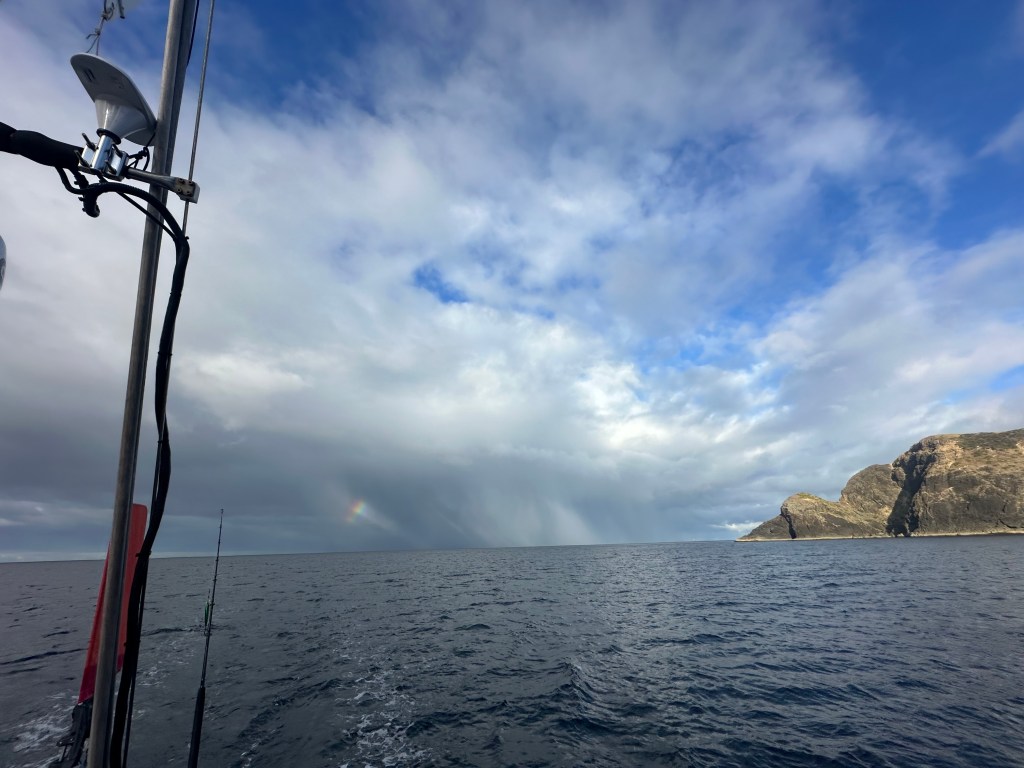
    Our next stop was a magical spot at Whangamumu and we had a fantastic sail, just managing to stay ahead of rain clouds and a series of rainbows that coloured the sky behind us.

    Staying ahead of the squalls and rainbows.
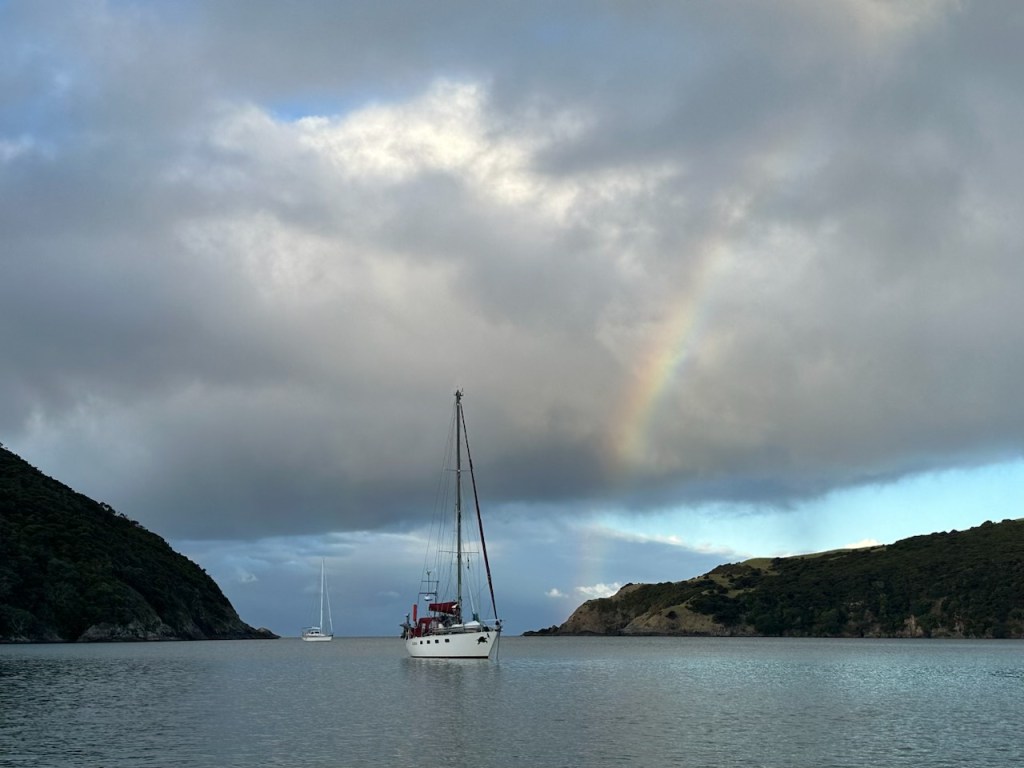
    Whangamumu Bay.

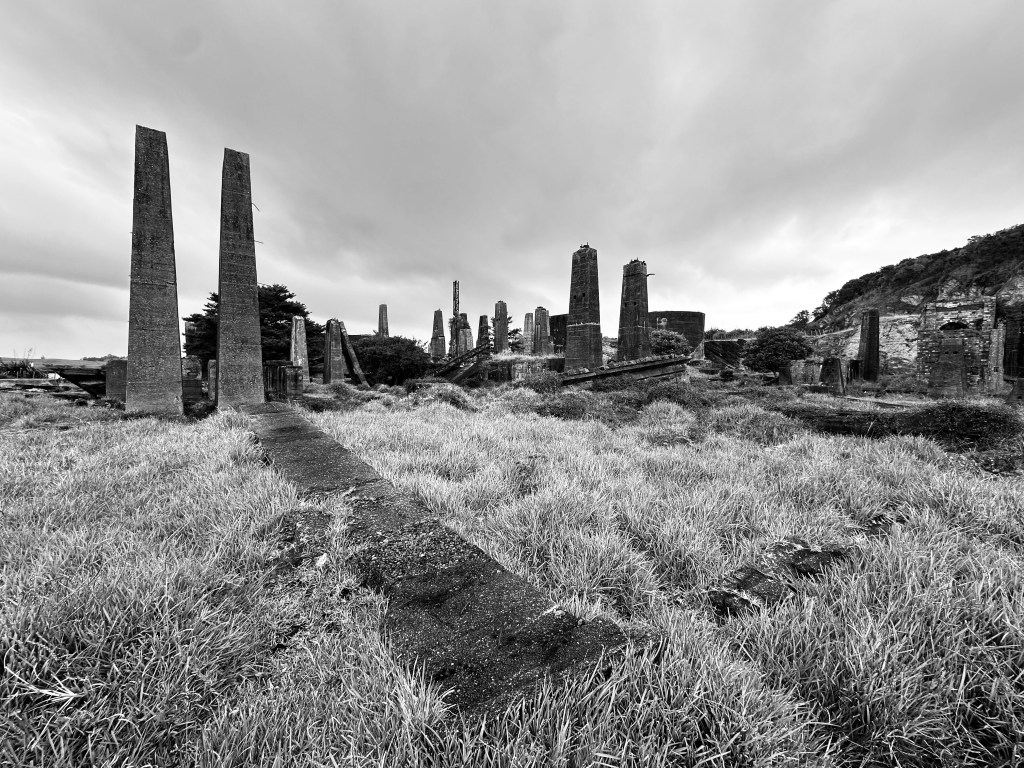
    Whangamumu is the site of an old whalers’ station. The area was once so popular with whales that it allowed a unique hunting technique. The whalers would shepherd the whales into a bay and then string up a steel net to prevent them leaving, allowing the hunters to kill the trapped animals at their leisure. The ruins of the whalers’ station remain, with pieces of machinery and large concrete vats for rendering blubber standing as mute witnesses to a bygone era when our oceans were full of life.

    An old boiler returning to nature.

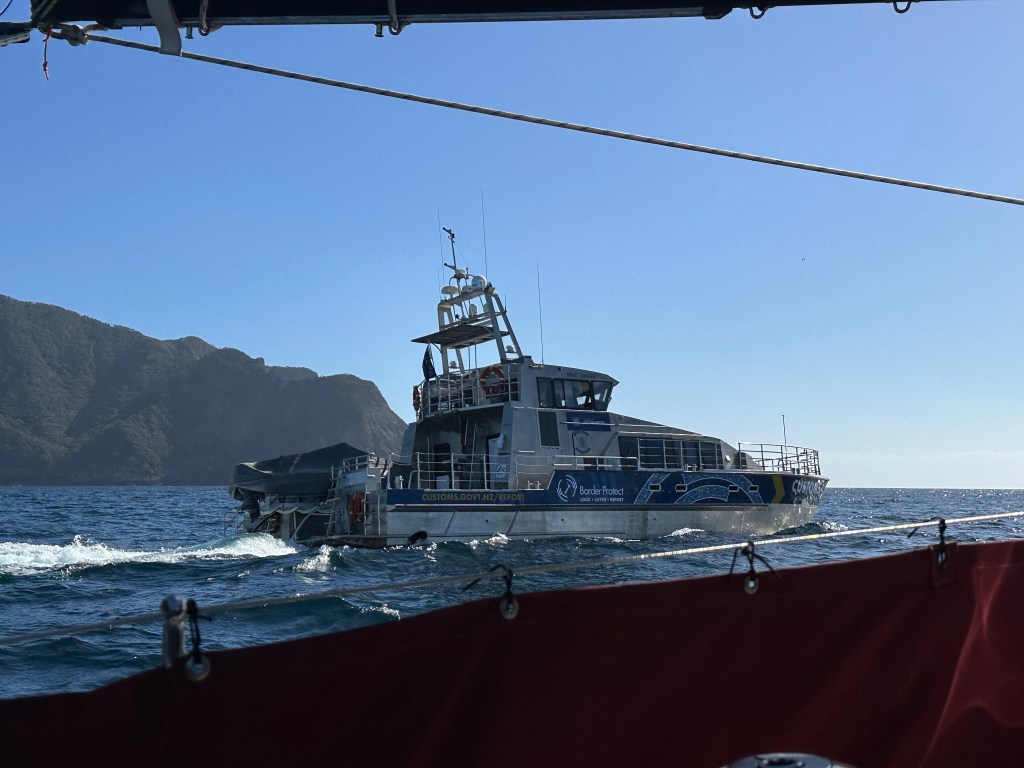
    The following day we headed north once again and were approached by a NZ Customs vessel just before we rounded Cape Brett. A crewman shouted over that we needed to identify ourselves as they had no record of our boat entering New Zealand. The problem appears to have been due to our current UK registration, Taurus having been registered in Germany when she arrived. This explanation seemed to satisfy the authorities and they left us to try and sail around the Cape in the fretful light winds.

    Running foul of the authorities…
    Cape Brett. Last time we were here, heading South, I was in the bilge bailing out about 200 litres of water..

    Sailing into the Bay of Islands we chose to anchor off Russell for the first night. This picturesque town, once a base for whaling ships coming and going from NZ, had such a reputation for violence and vice that it used to be known as the ‘hellhole of the Pacific.’ Cara and I stopped for a drink but there was little vice to be found, and even the fish and chip shop was shut.

    Good beer.

    The anchorage off Russell was a bit rolly with the coming and going of ferries, so we picked up the hook next morning and headed round the corner to Opua. There we managed to find a quiet spot amongst the moored boats to anchor, and began setting about the latest job list. As any boatie knows, the job list is never finished! We needed to make sure that our drogue could be attached to the boat without chafing, fix our steaming light (a light halfway up the mast that is lit when the boat is under engine), cure a small coolant leak in the engine (I didn’t tighten up a hose properly after disturbing the heat exchanger), take down our dodger and replace the zips, replace the inverter that we use for the sewing machine after it let out its magic smoke whilst we were replacing the zips, clean the head pump, reinforce the stitching on some of our mainsail slugs, address some minor corrosion on our boom and mast, finish off an improvised mechanical advantage system for our traveller (a device that allows the angle of the mainsail to be altered), and first and foremost try to get rid of some of the stuff we had accumulated whilst living aboard for four years, and which had become a massive hindrance when cruising full time.

    Replacing the zips on our dodger, ripped apart in a squall at Waiheke. Part of the joy of working on boats is the massive amount of space one has to spread out….
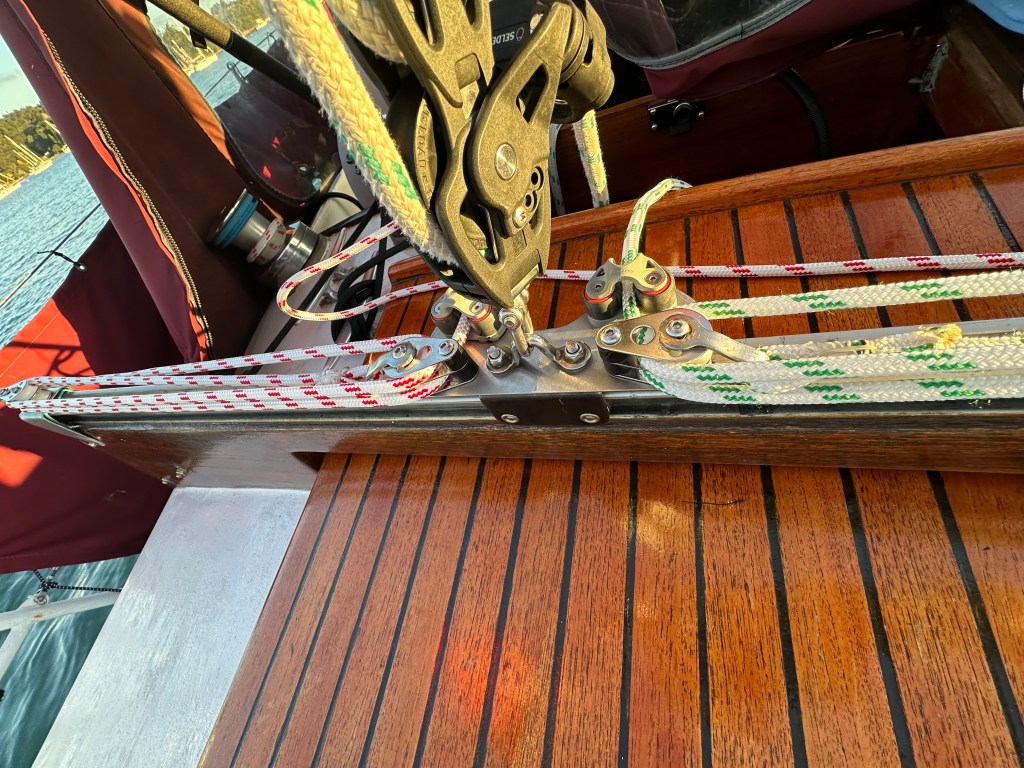
    Improvised 4:1 mechanical advantage system. The mainsheet traveller provides a way to depower or power up the mainsail. However, without mechanical advantage it can be very difficult to adjust. This system should make life much easier, but it is version 1.0. Time will tell…

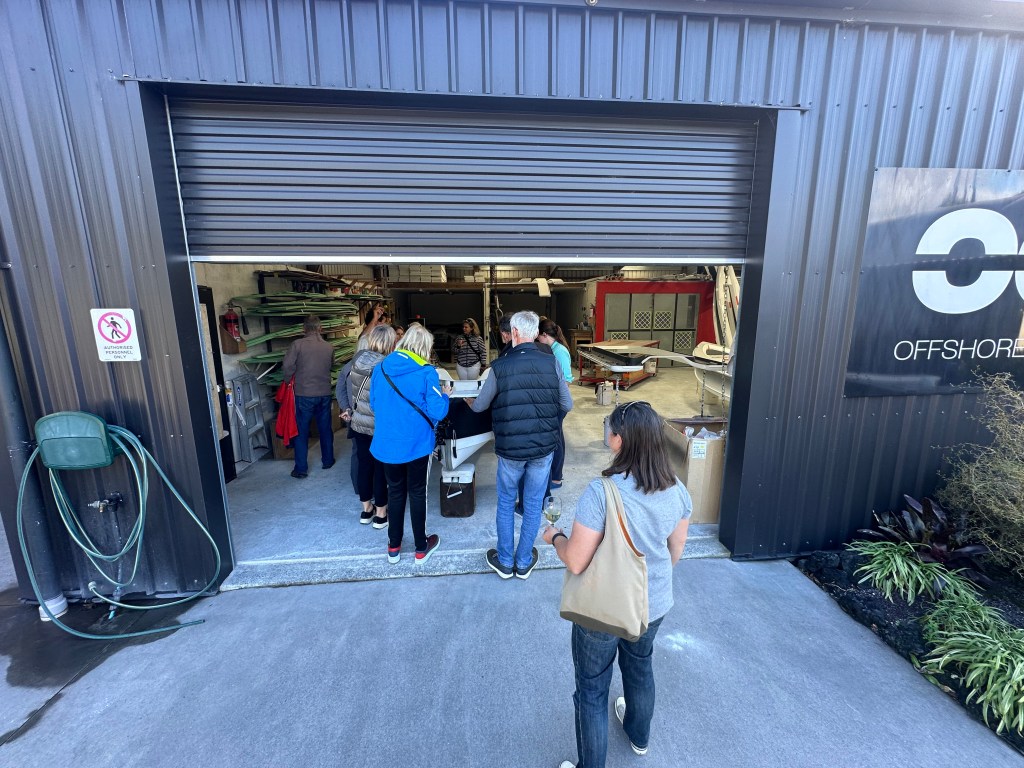
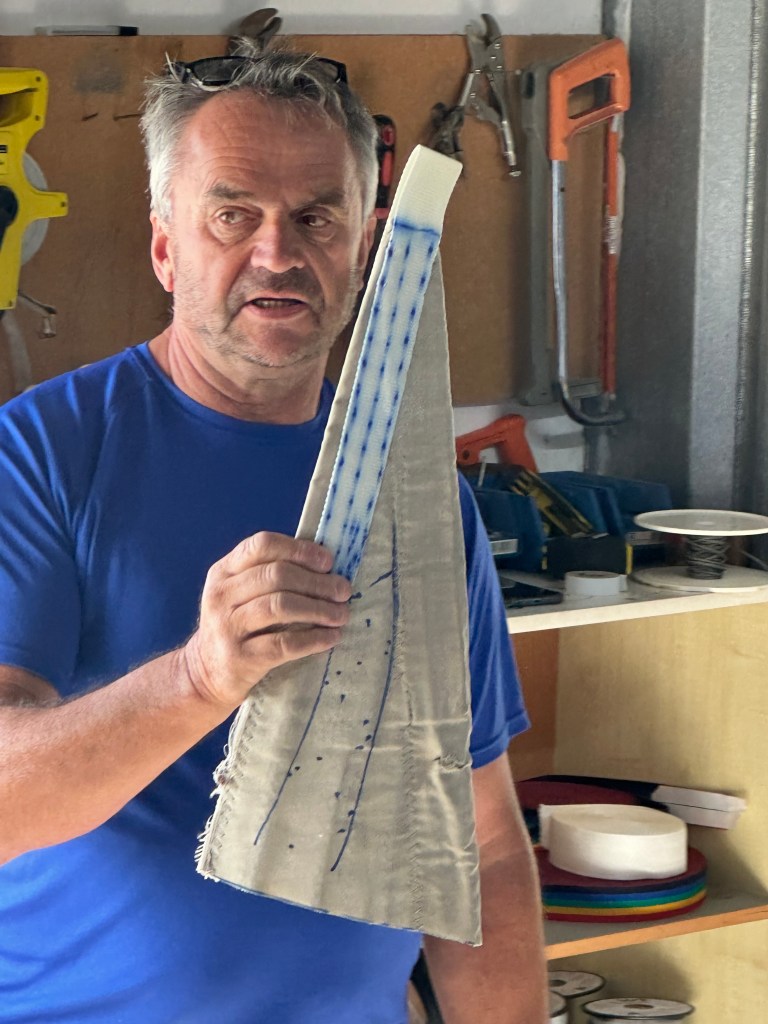
    In our down time we had the chance to meet other Island Rally members as boats and people began to assemble at Opua ready for the off. Viki, who readers of this blog might remember as our saviour when we arrived in a stormy Lyttleton a few months ago, is the Director of Island Cruising NZ. She had organised various seminars and get togethers for rally crews. We had a chance to visit the OC Tender factory, enjoyed excellent lessons on sail repairs and diesel engines, weather routing, Pacific Island customs, fishing, and so on, as we waited for a weather window to depart New Zealand.

    OC tender factory. The boss, Russell, is a bloody nice chap and provided free beer!
    Fixing sails lesson…
    What to do when your sail shrinks in the wash….

    So, after much discussion, analysis, and a sense of ‘the hell with it, let’s go,’ Cara and I have decided that tomorrow, May 7th, is the big day. Waiting till further in the week is likely to see a reduced sea state, but will also see a period of lighter winds that would force us to motor for several days. The hardest part of any journey, so the saying goes, is casting off the mooring lines. Certainly, after four years of thinking and preparing for this trip it seems a bit surreal to be at the point of departure, but we are looking forward to the challenges and rewards of the passage. As Henry David Thoreau said, “The price of anything is the amount of life you exchange for it.” The cruising life we have experienced over the past few months has certainly not been a constant idyl, though it’s had its moments. At other times its been hard work, stressful, sometimes even frightening — but the idea of returning to a secure and stable existence with a 9-5 job, house, car, and so on, demands way too high a price in my opinion. Next stop Minerva Reef and then Tonga… Neptune willing.

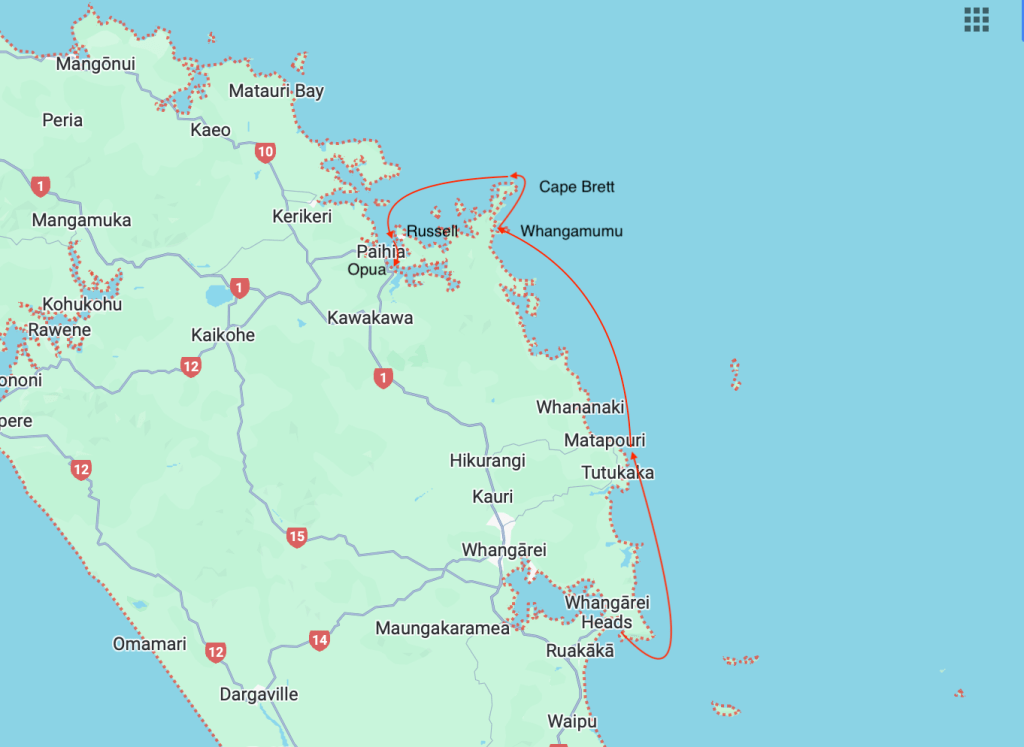
    Whangarei to Opua.
  • Sunrise from an anchorage

    Having spent a couple of nights on anchor in Okoromai Bay we set sail early, heading to Scotts Landing for the Ocean Cruising Club weekend. The festivities didn’t start until late afternoon so we had time to sail, and as the wind was coming from the direction we wanted to go in, we had the chance for a nice long sail. We headed north, tacked to the south west, tacked again to the north and sailed into Mahurangi Harbour in time to get the sails down in a hurry as the weather turned squally.

    We anchored just off Oaua Point next to a catamaran and a few monohulls flying the OCC burgee. That evening we were all invited onto Sabre II, a fifty foot cat owned by Brice, an American who had sailed to NZ from San Diego. Sabre II is so large that we were all able to settle round the outside dining table and get to know each other. A highlight of the evening was meeting Lin Pardey and her partner David Haigh. Lin is a living sailing legend. She and her husband, Larry, who sadly passed away a few years ago, were pioneers of cruising in small boats. Setting sail in the 1960s they inspired a generation of would be circumnavigators to “go small, go simple, go now.” David is a vastly experienced sailer in his own right, having circumnavigated mainly sailing his yacht solo. Other people at the shin-dig included a bunch of people who had sailed all round the world for decades. Needless to say Cara and I had a fantastic evening, talking boats, voyages, and exotic anchorages.

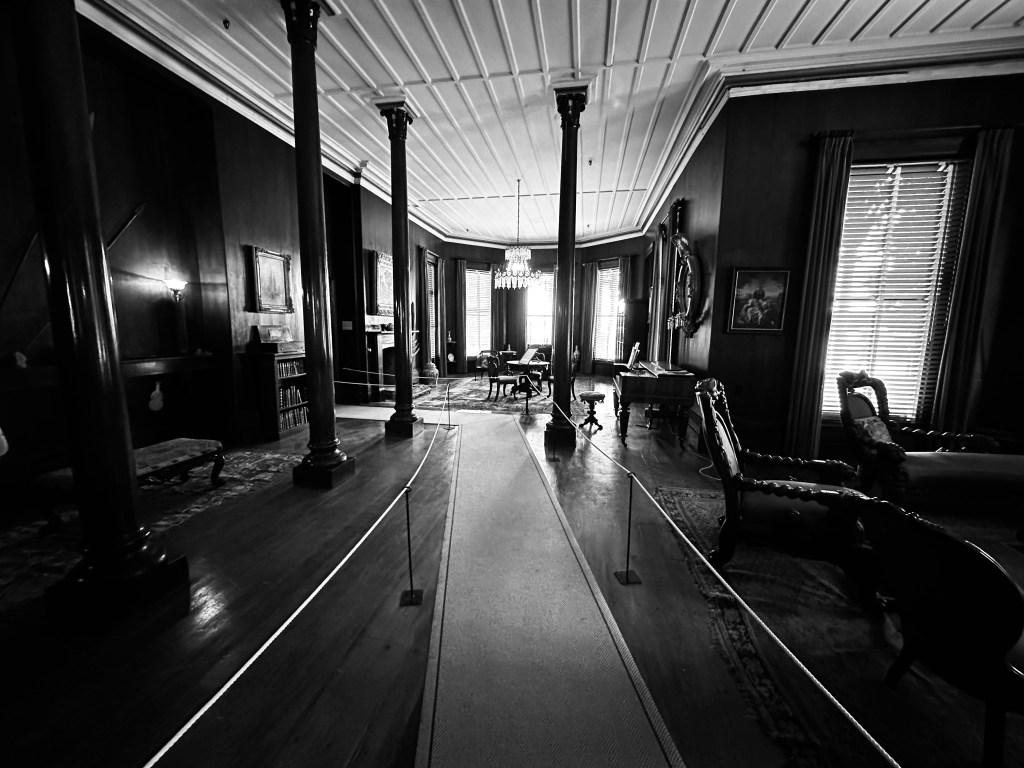
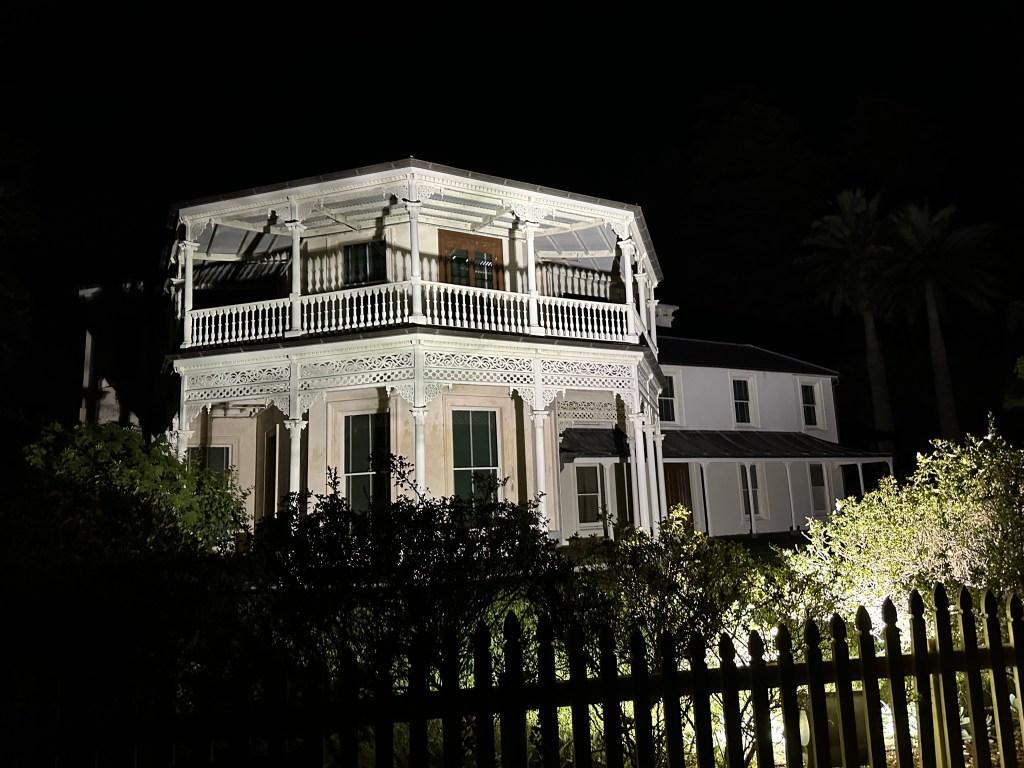
    Next day we sailed to Kawau Island and anchored in Mansion House Bay. We were booked in to have dinner there with the OCC that night. The mansion in question was owned in the 1860s by New Zealand Governor, Sir George Grey and has been extensively renovated over the past few years. The island is also is the site of an old copper mine with a ruined steam pump house that reminded me of some of the walks I had done round the Cornish coast in the distant past.

    Mansion House Bay from the Mansion House.
    Victorian decor inside the house.
    The Mansion House at night.

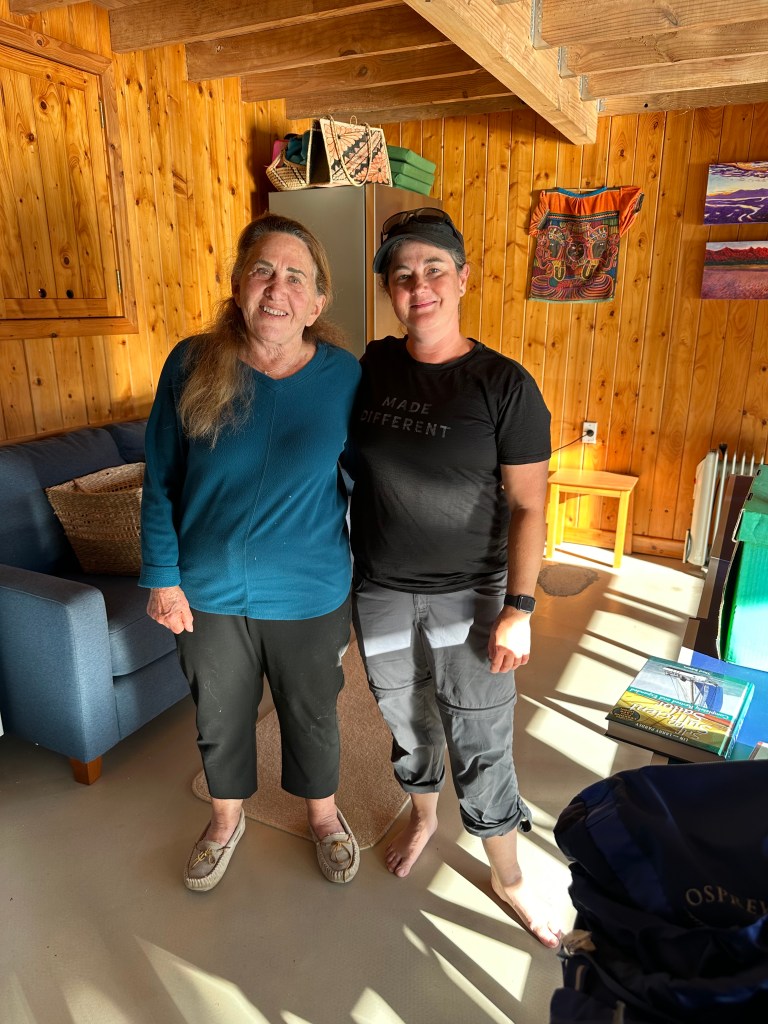
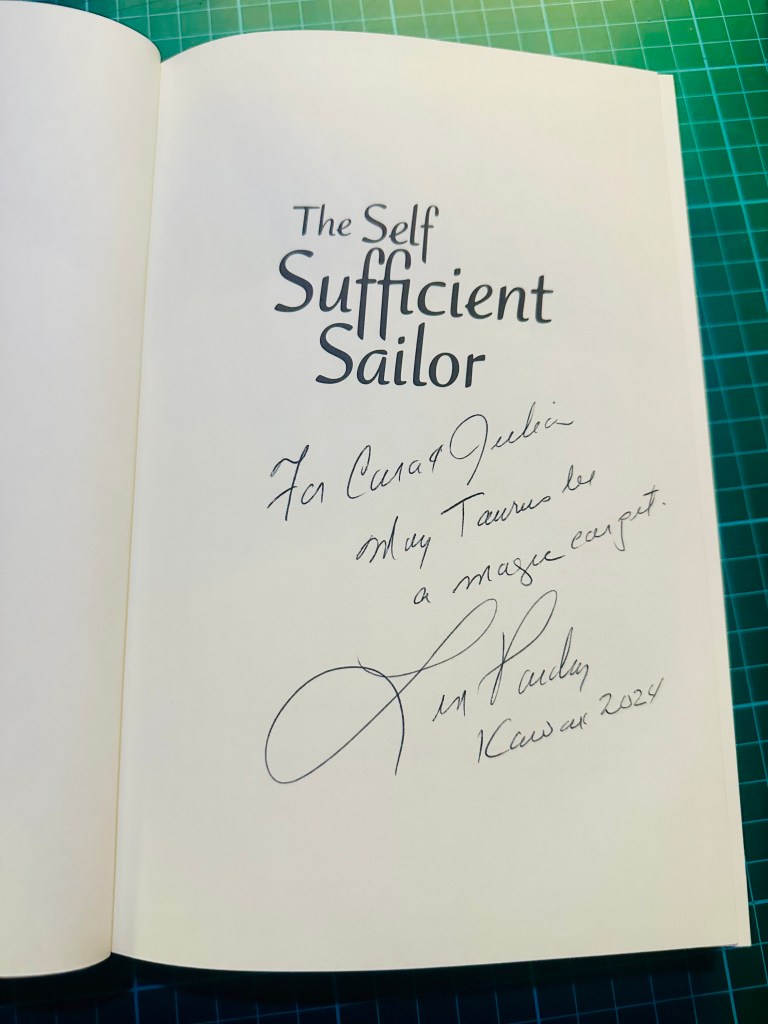
    After a great meal we left next day to sail the short distance to the bay where Lin’s house is located. We had a BBQ there that evening and Lin kindly signed Cara’s copy of her book, The Self Sufficient Sailor.

    Ten feet of sailing legends — Cara with Lin.

    Next day David spent some time showing us around his yacht, Sahula. This was really interesting for us because it’s a very well organised and thought out steel boat of similar size and vintages to Taurus. After a great weekend and with plenty to think about — mainly in regard to reducing the amount of stuff we have on board, we headed north again.

    Our destination was Whangarei, about eight hours away. It was a lovely day with winds of up to 25 knots on the beam, nigh on perfect for Taurus. We flew along, and soon were sailing into Urquhart’s Bay, the first protected anchorage in Whangarei Harbour.

    Marsden Cove, opposite Urquhart’s Bay. This was NZ’s only oil refinery but was shut down recently. It remains a small commercial port.
    Urquhart’s Bay

    Next morning we left early and sailed up the long channel to Limestone Island. Our friends, Ralph and Annie on Jemellie were anchored here and had recommended the site as a good place to anchor.

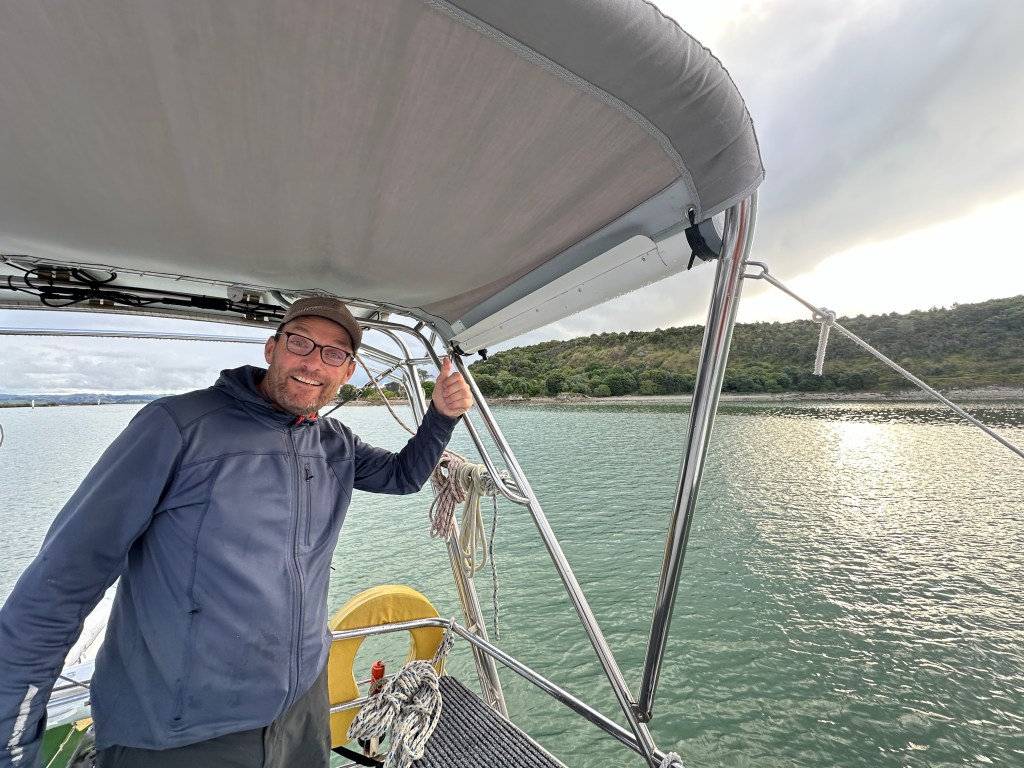
    Ralph on Jemellie

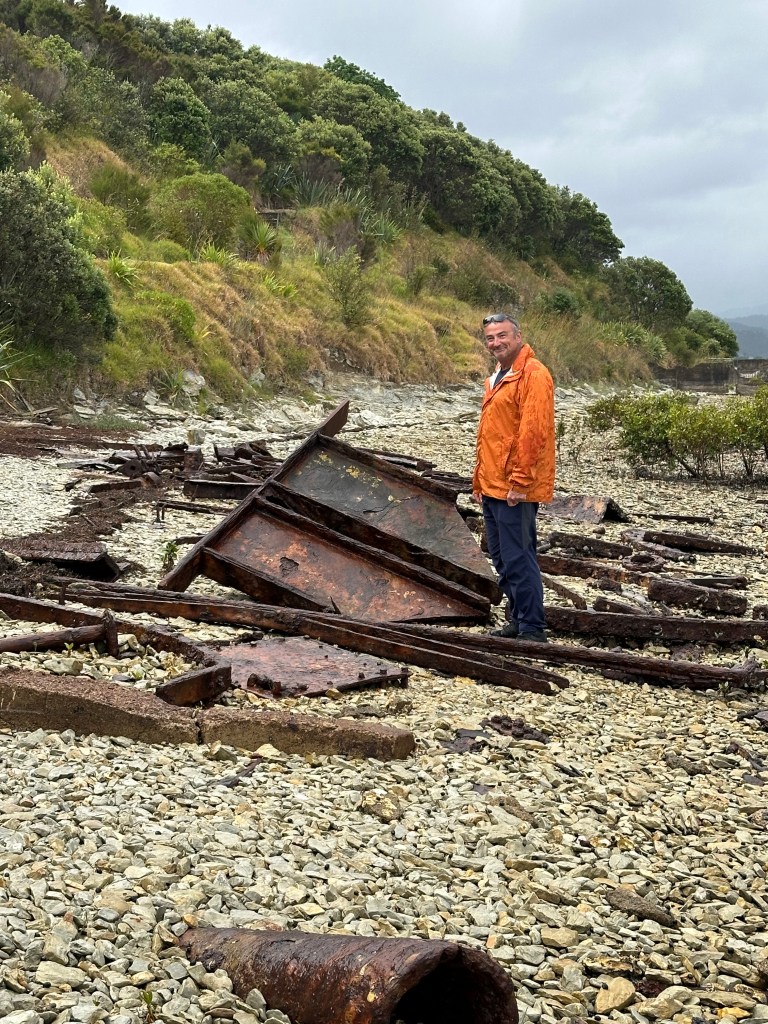
    Ralph and Anna were soon over for coffee and after a good catch up we all went across to the island to stretch our legs. The island has old ruins from a lime stone mining operation and some wrecked ships on the shoreline so it was an interesting place to poke around.

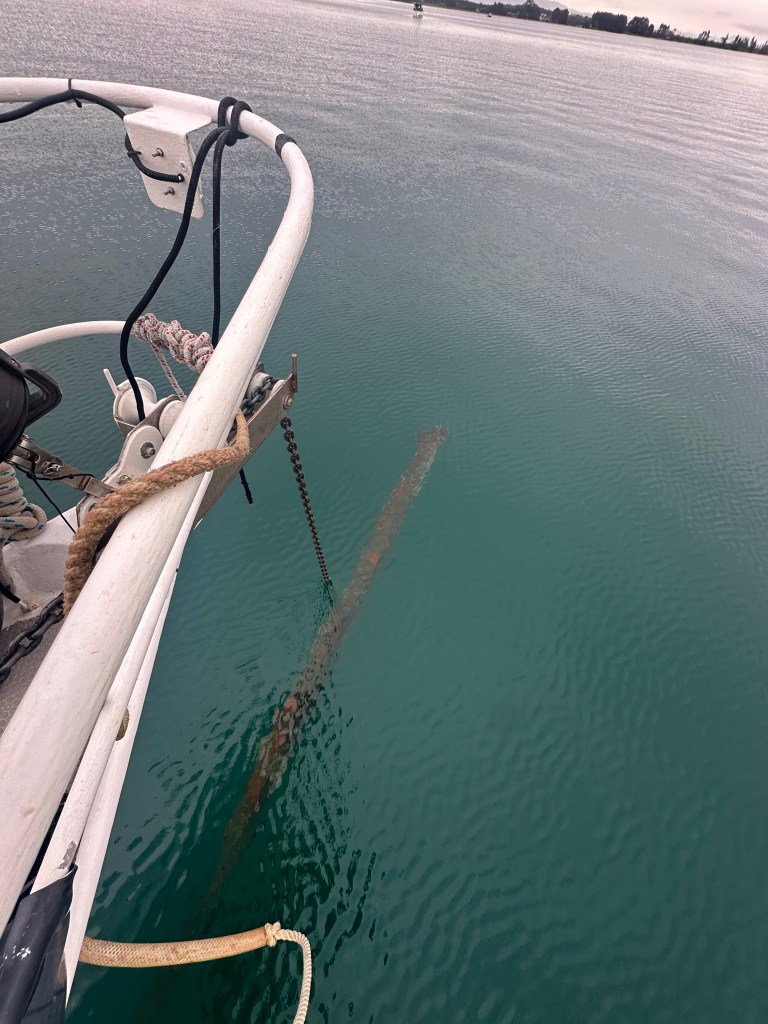
    That’s what I call an anchor!

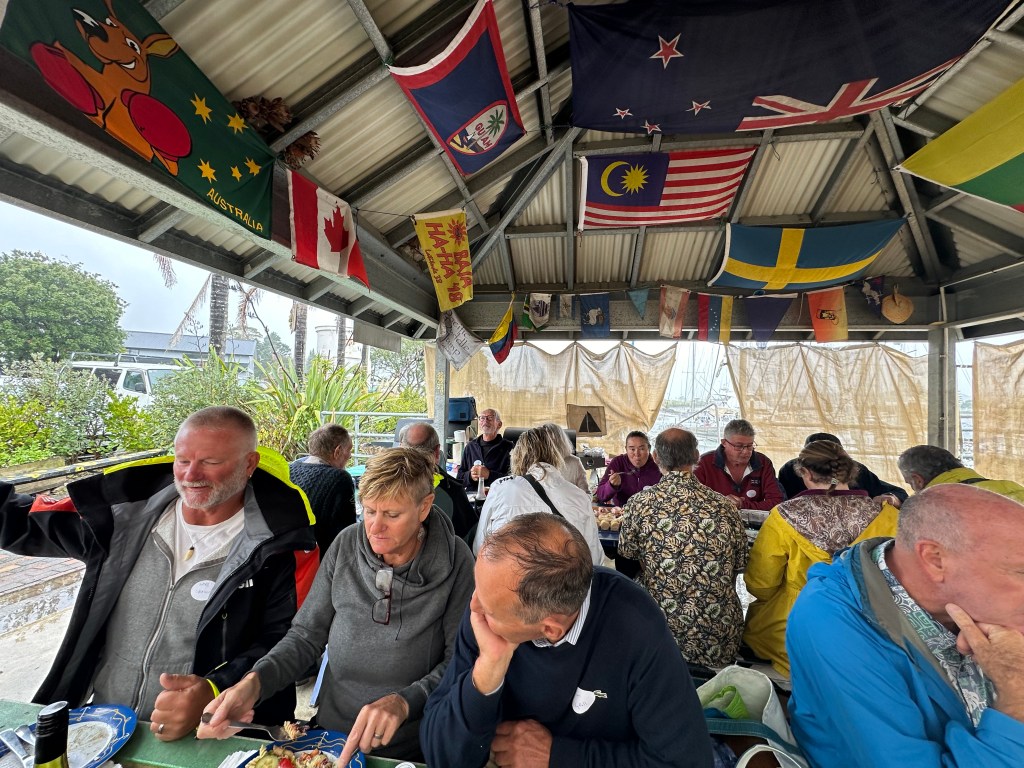
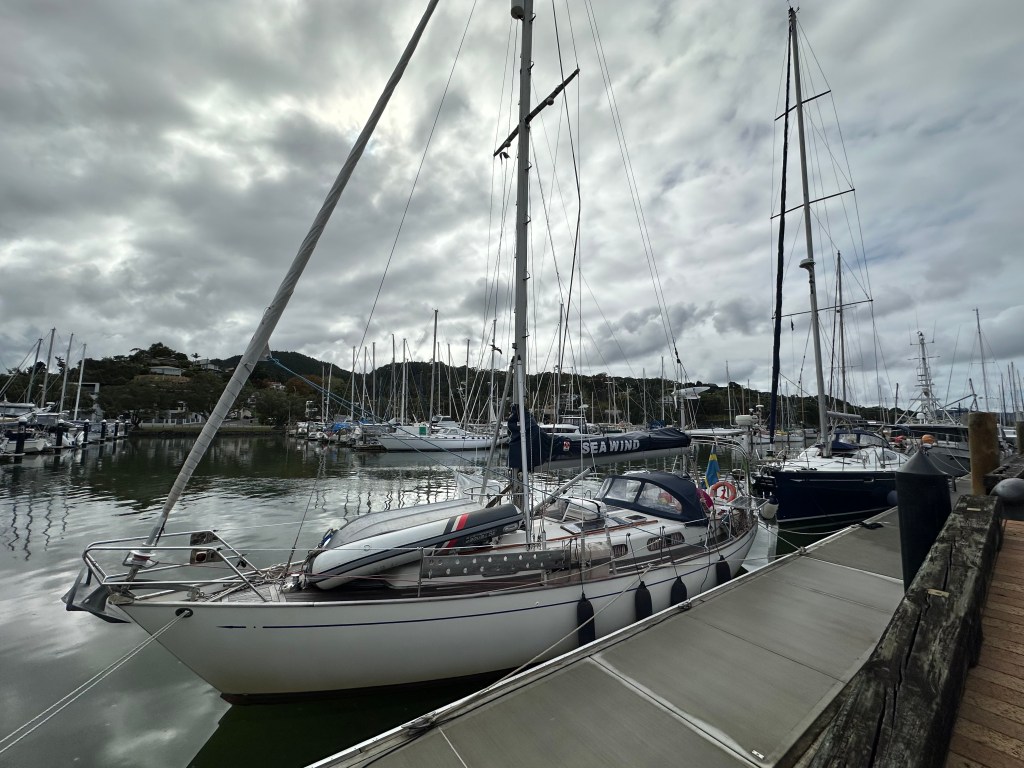
    All too soon we were off again, heading into Whangarei Marina. We had a few jobs to do on the boat, and another OCC event was scheduled for the weekend. The OCC barbecue didn’t disappoint, and once again we met some fascinating characters. One Swedish couple, Lars and Susanne, later invited us to their boat, Seawind for drinks. Though a fairly standard looking 37 foot fibreglass sloop, Lars and Susanne have taken her from Sweden to Greenland, Iceland, halfway round the world and down to Antartica. The photos of their journey are outstanding and include pictures of a polar bear who swiped the flag off their boat and wore it on its head like a shawl! Seawind has a blog and Facebook page and I’d highly recommend it if you are interested in expedition type sailing.

    More drinkies with sailing legends. Lars and Susanne on the left.
    Seawind

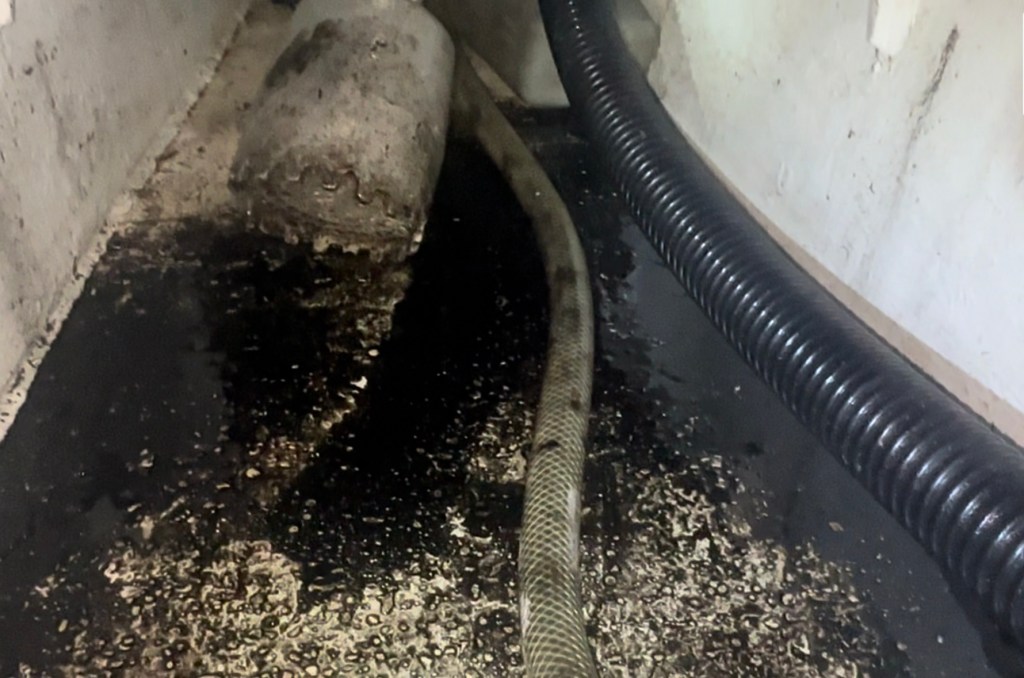
    All too soon it was time to leave the marina and think about heading north. A storm was coming and after a night back at Limestone Island we headed to The Nook, an anchorage with better protection from the north. For the next two days we were buffeted around in winds of about 35 knots but it was quite comfortable and we were happy with our holding. When the weather cleared we headed further down the Harbour towards the sea. However, I had noticed quite a lot of oil in the bilge… We anchored in Little Munroe Bay to investigate the source of the leak. It seemed to be coming from the oil filter, so hoping that perhaps it hadn’t seated properly when I changed it last I did an oil and filter change and cleaned the area up as best possible. Alas, the hoped for simple solution didn’t materialise and the oil kept leaking out from an unknown source.

    oily bilge — bugger.

    Whilst I was in the bilge working on the engine the weather had turned nasty. An almighty bang brought me out of the bilge in a hurry to find that our snubber had snapped. A snubber is a nylon bridle that attaches to the anchor chain. The thin nylon line has elastic properties so reduces the snatching forces on an all chain anchor rode, which makes life more comfortable and reduces the chances of the anchor being yanked out of the bottom. With the engine still in pieces and gusts of over 30 knots we were uncomfortably close to a lee shore (a shore that the wind would blow the boat onto). We quickly reassembled the engine and decided to seek a better anchorage. Unfortunately there was no protection from the wind nearby, and we were making such poor progress against the wind and tide, with an ailing engine, that we decided to head into Marsden Point marina. Taurus then decided to add to our stress by performing like a trained seal and absolutely refusing to reverse in the direction we tried to point her in. This is a well known issue with long keel boats, but we have not have such difficulties with her in a long time. The chaos on board from working in the bilge compounded the issues as our normal mooring lines were buried somewhere so we were using shorter lines than normal. Tempers flared, words were spoken, but eventually a samaritan came over to grab our lines and we were moored with the only dents being to our egos.

    At this low moment we met a true gent. Dave Chapman is a diesel mechanic in Marsden Cove. After giving him a call, on a Saturday, Dave headed straight over. Dave, being a bit bigger than myself could barely fit in the bilge, though he tried valiantly, and also unable to find the source of the oil he produced a magic substance: a liquid which when added to the oil glowed bright yellow under UV light. Dave refused any payment for his time or this magic substance, so many thanks again Dave — we owe you a beer!

    Marsden Cove is a nice marina but there are not many shops and public transport is very poor. We therefore decided to return to Whangarei Marina where we could access the town. We thus added some more oil and sailed back up the harbour, noticing on the way that the UV strip on our jib was coming undone. Another job to sort before we could leave — sometimes it rains, sometimes it pours!

    Heading back into Whangarei.
    Whangarei Marina.

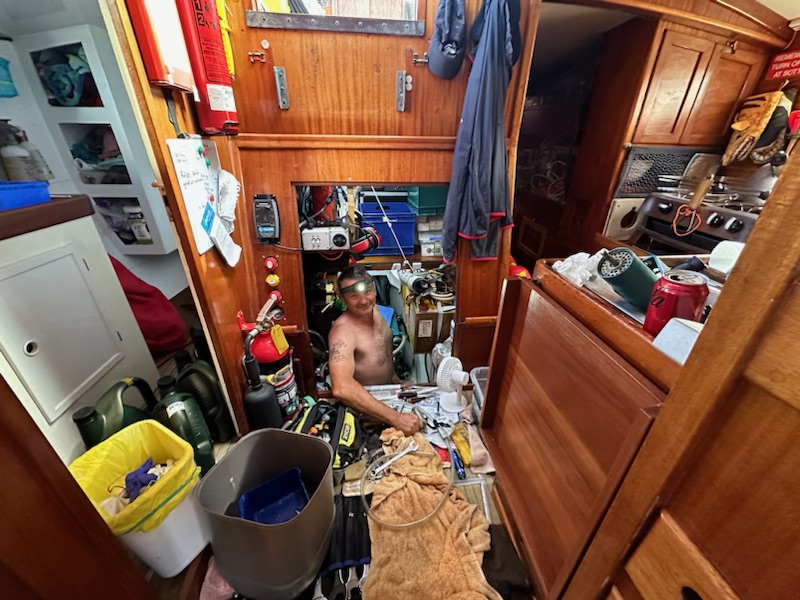
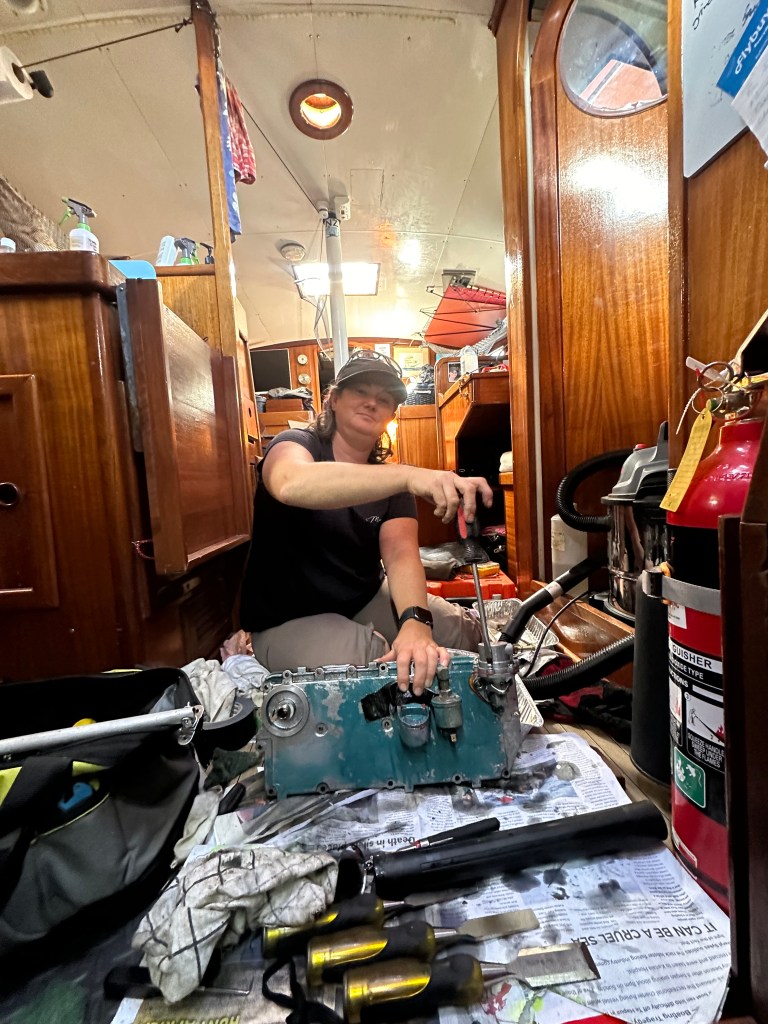
    With the benefit of Dave’s UV solution we were able to trace the leak to the crankcase door — specifically the joint just behind the oil filter. We carry a set of gaskets on board, so all we needed to do was remove the heat exchanger, diesel line, and throttle assembly to access the door, whip it off, replace the seal, replace the heat exchanger, etc., and hope the engine didn’t still leak. Three days later the engine was back together — and not leaking, or at least not yet!

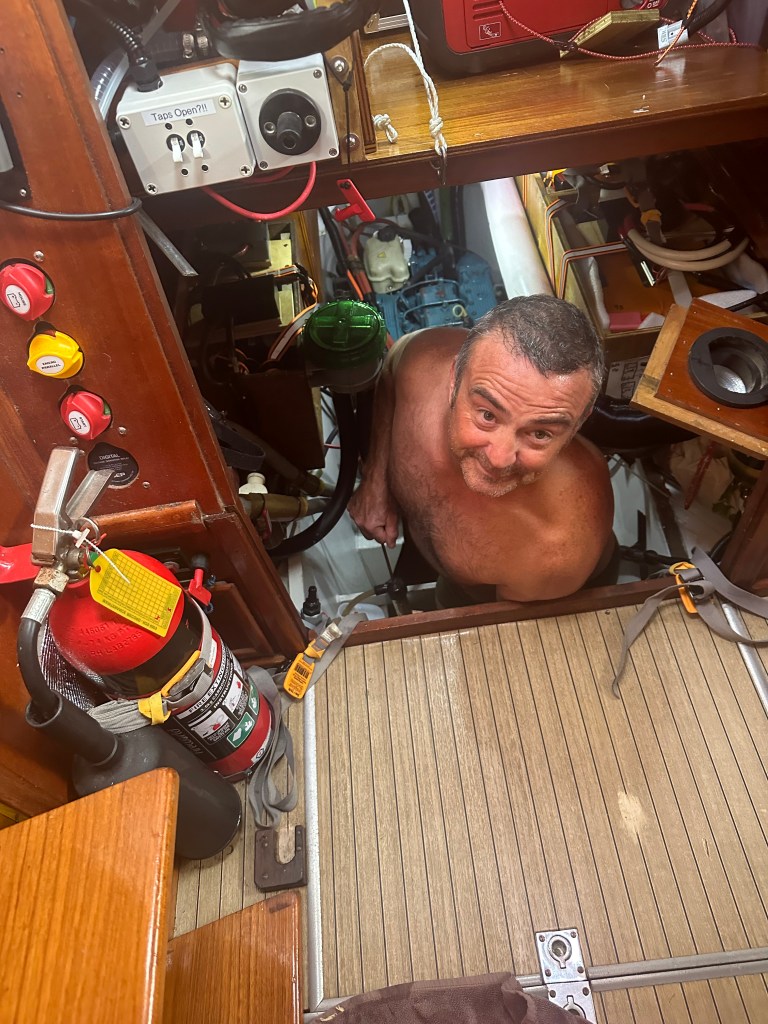
    The naked mechanic! Working in the bilge in hot and humid weather is sweaty ‘fun.’
    Cara working on the crankcase door. Note the chisels, the gasket was baked onto the crankcase so hard that nothing else would shift it (not ideal I know)

    We tried to stitch up the jib ourselves but our sewing machine wouldn’t punch through the fabric, and having started the job by hand we realised that the whole strip needed to be resown. Translating to hours of work to achieve a mediocre job we got the sail to a sailmaker who ran the sail through a machine for a mere $400. Ouch.

    Naturally, the universe wasn’t finished with us yet. We had been getting an orange light on our stray current monitor for a few days and Cara managed to track it down to our LPG solenoid — which remotely turns the gas bottle of and reduces the risk of the boat exploding. Another couple of boat dollars later we had a new solenoid fitted and basked in the glow of a cheery green light from our stray current monitor. Later today we are leaving (again) and hope to head north towards Opua. Fingers crossed that the bilge stays clean.

  • Auckland skyline from Okahu Bay.

    Cara and I left Waiheke Island on Tuesday, 5th of March heading to Okahu Bay, Auckland. The bay is next door to the Akarana Yacht Club, which was putting on a Yachting NZ presentation about offshore sailing safety, and while anchoring in the bay is free the club generously allows visitors to use their showers and dinghy dock. The club is also home to a bar and restaurant which provided a great venue for catching up with friends.

    One of these friends was Simon, an old mate who I had worked with in St John Ambulance some twenty five years ago. Simon now runs his own medic training business and is one of the most enthusiastic and positive people I know. It was great to have a beer and reminisce about the old days. Simon and family later went way above and beyond, picking up an outboard engine and bringing it into the city for us. We’d have been stuck without his help, so thanks again Si!

    Si Townsend and daughter Sophie. Kiwi legends!

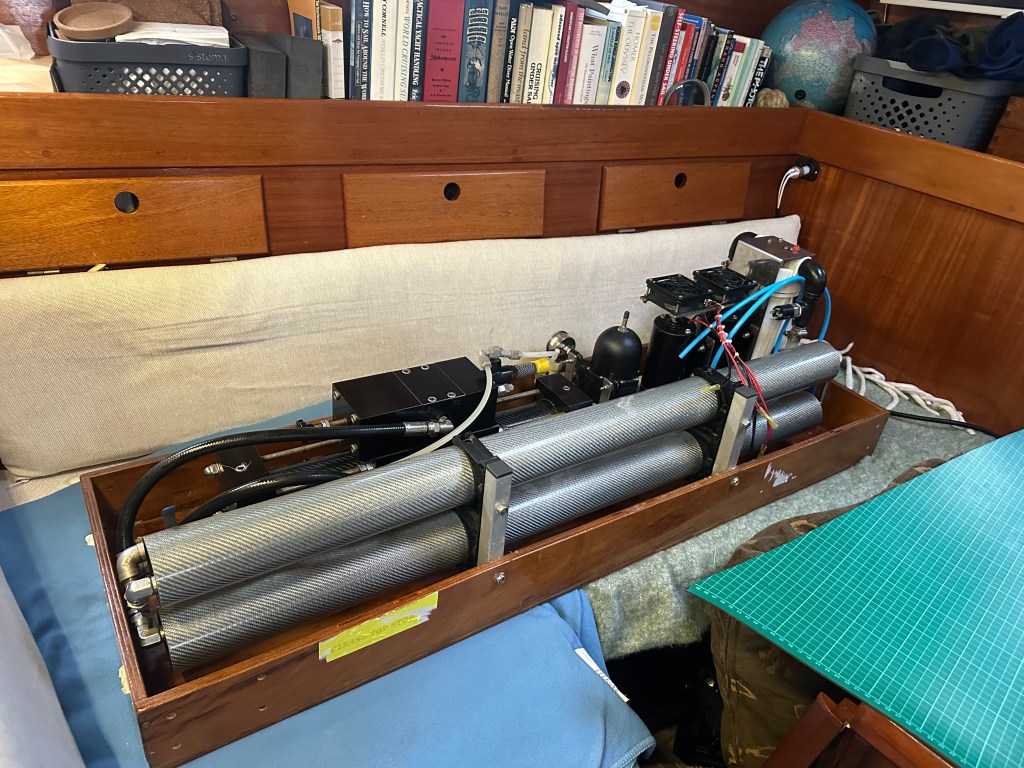
    We stayed at Akarana for a couple of nights and then headed into Westhaven Marina. When we bought Taurus she came with a Schenker 60 watermaker (the 60 denoting its supposed ability to make 60 litres of fresh water an hour). Unfortunately it wasn’t working, but the previous owner told us that the machine just needed a new pump. However, after several unsuccessful attempts to get it going we resorted to sending the water maker to the New Zealand agent, who happened to be in Auckland. The agent, Phil, managed to get the thing going, and had stored it for us, pending our arrival in the big smoke. We had agreed to rendezvous at Westhaven so that Phil could assist us plumb the machine in.

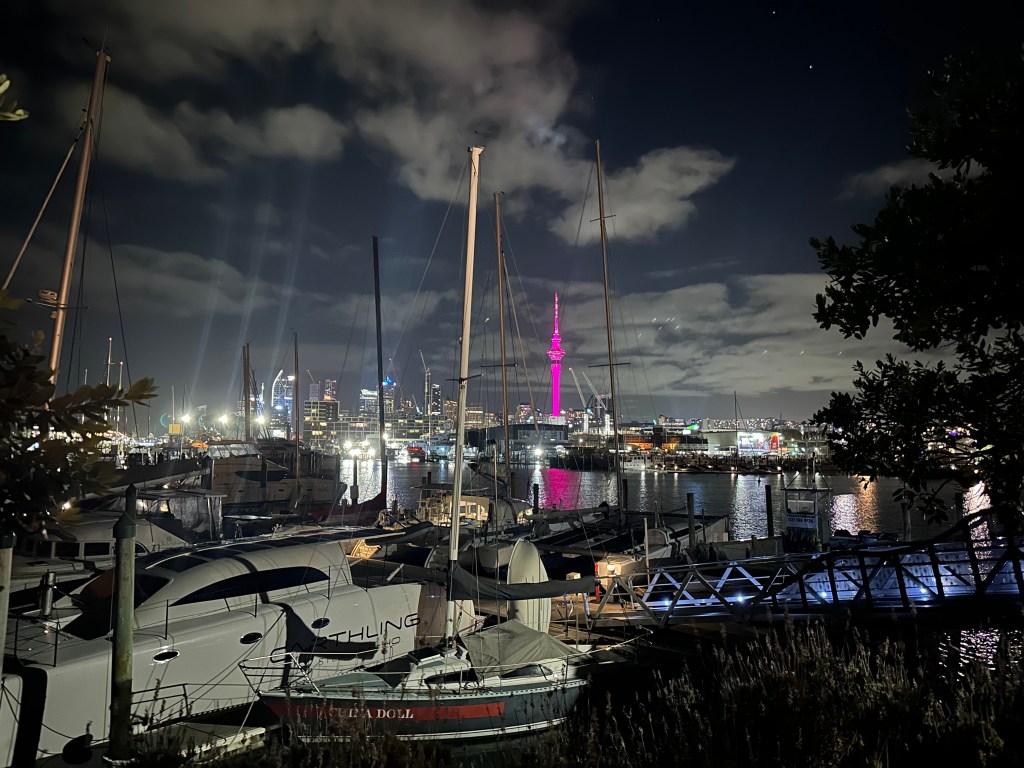
    Westhaven Marina – the Sky Tower (a casino) has been made to look like a giant dog’s dick because the singer Pink was visiting.
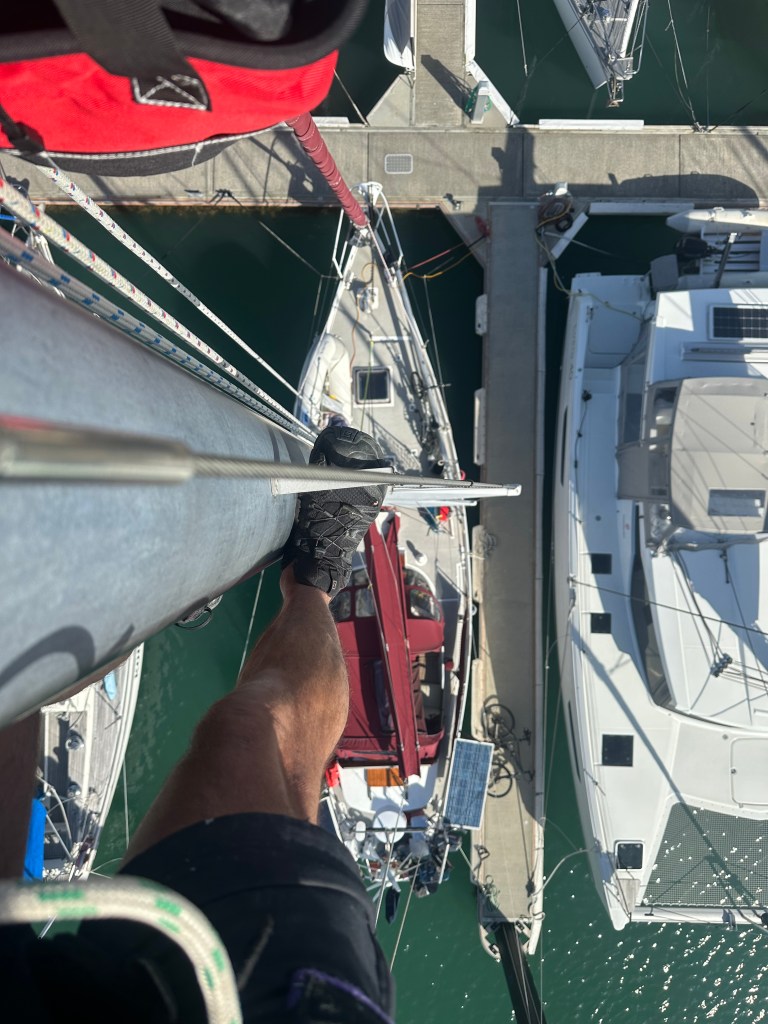
    Other jobs also needed taking care of. Back in my least favourite position on the boat — up the mast.

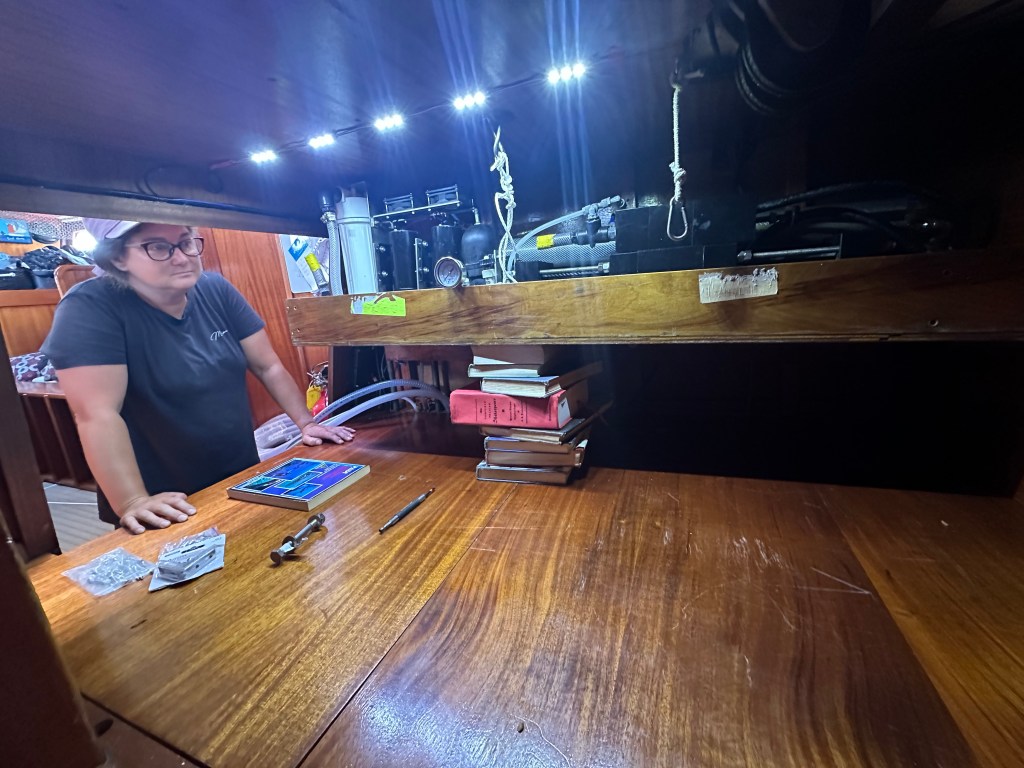
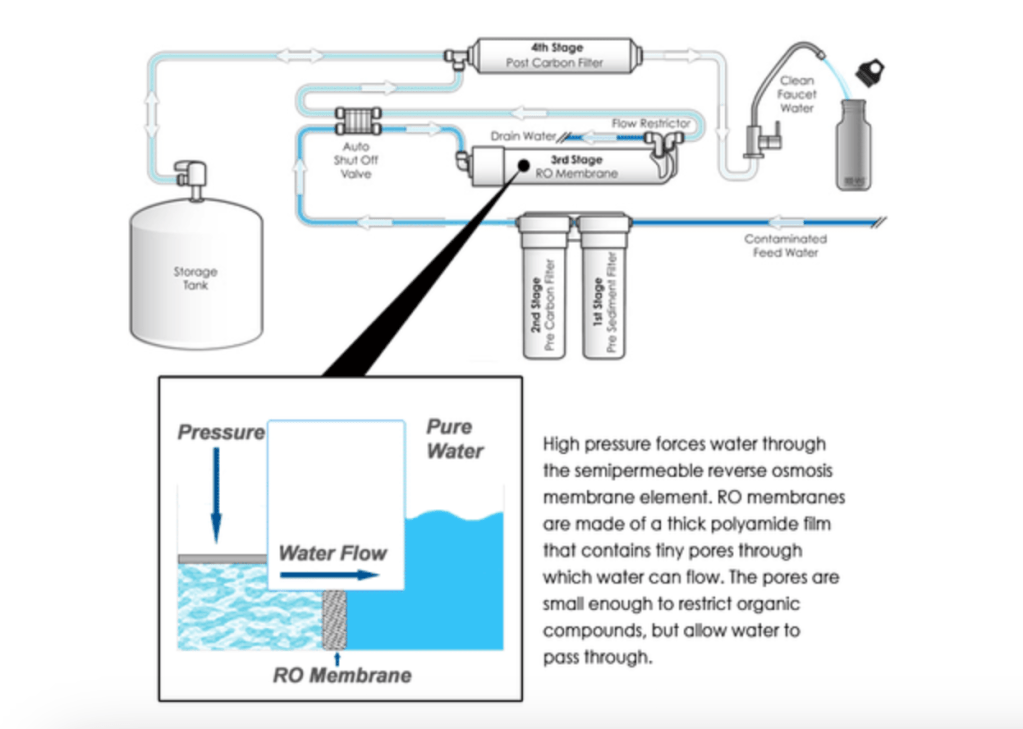
    Watermakers are notoriously finicky pieces of equipment. Working through a system of reverse osmosis they turn salt water into drinking water. Naturally, a boat floating on the sea has a plentiful supply of the former, but the volume of the latter is strictly limited by the boat’s storage capacity, and the less certain amount that can be captured from that which falls from the sky. Taurus’ water tank is a fairly puny (by modern standards) 220 litres. Most authorities suggest that a person should drink eight glasses of water a day which equates to about two litres. Cooking and washing raises this bare minimum up to about five litres a day per person. By being careful not to waste water, all our taps work via foot pump for example, Cara and I can normally make our 220l last about a month, but this has been in a cool, temperate climate where beer can be used to substitute drinking water if required (and often when not). In a warmer environment we expect to need 5 litres a day pp — which gives us a realistic supply of 22 days. An added issue is that all our water is stored in a single tank. If this should rupture or be polluted (by sea water entering through a leaking deck filler, or added water turning out to be contaminated) we could lose our entire supply. In the past we have boosted our storage capacity and added the security of a separate ‘tank’ by carrying five, twenty litre jerrycans. The problem with this solution is that the jerrycans can only be stored on deck, which puts weight high and to one side of the boat (they have to be lashed to the lifelines — see images below). The jerrycans also create a possible hazard should they come loose in bad weather, are prone to deteriorate in UV, and the water can readily become tainted by bacteria. The point of this digression is to make clear that whilst we don’t need a water maker, having a water maker solves a lot of potential issues. Naturally, there is a price to pay, and this, beyond the fairly considerable initial outlay, is considerable power consumption (about 20 amps an hour), considerable noise when running, and considerable loss of space.

    Our Schenker watermaker before installation.
    Watermaker in place above our engine compartment. Studying Shakespeare finally came in handy!
    Reverse osmosis system. See https://cannonwater.com/blog/discussion-on-reverse-osmosis-ro-system/ if curious to learn more.

    Getting the Schenker to work in our boat was, of course, not straight forward. But thanks to Phil we were able to leave the marina at the end of the week as planned.

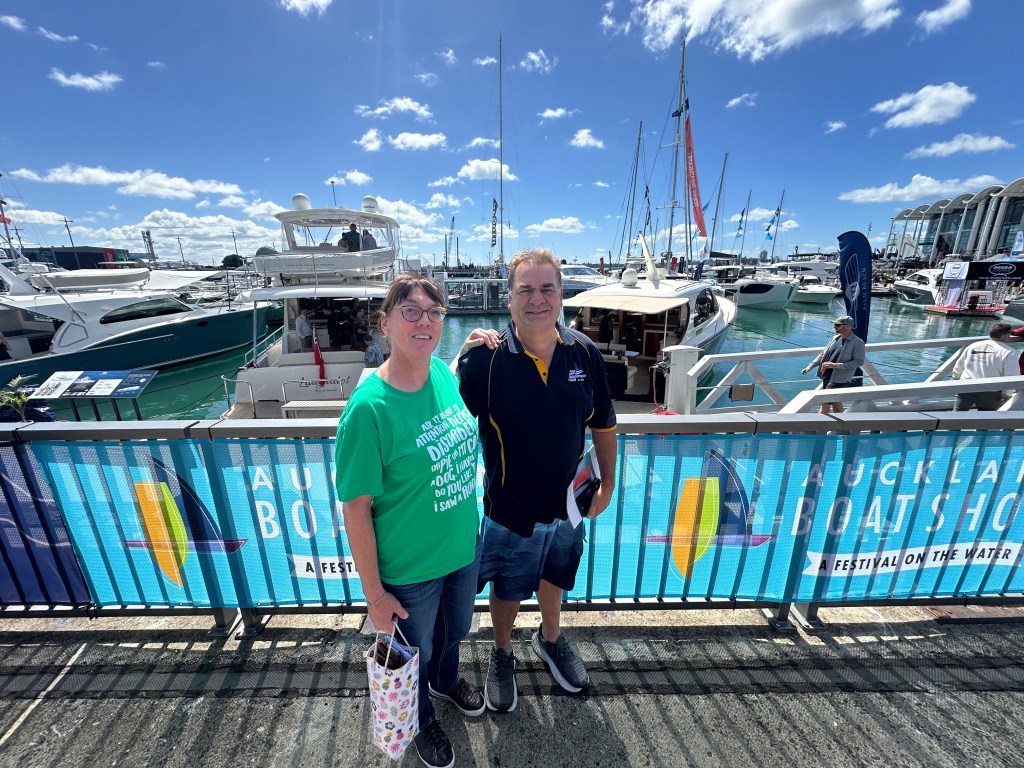
    One highlight of our stay was a visit by Pete and Penny, friends of ours from Dunedin who were visiting Auckland to attend the Boat Show. Cara and I happily tagged along to ‘ooh’ and ‘aaaah’ at the latest offerings from Moody, Beneteau, Jenneau, and so on. Though I recognise my bias, I was quite shocked by the price tag for these new boats, especially as the ‘price’ was pretty shady because most things a boat needs to go sailing, like shackles, lines, and even sails I believe, are considered extras that have to be added to the initial cost. The finish of most of these boats was also pretty naff — essentially they are built like cheap kit set kitchens with formica everywhere, there is nothing to hang on to in a seaway, and they all have fin keels and spade rudders that are easily broken off by playful fish. Taurus is much slower than modern boats but she is full of teak and mahogany, and was created by craftsmen who built her with care and skill to cross oceans. Still, horses for courses.

    Two more Kiwi legends. Pete and Penny from Dunedin.
    Pete and Penny check out the ‘his and hers’ wheels.
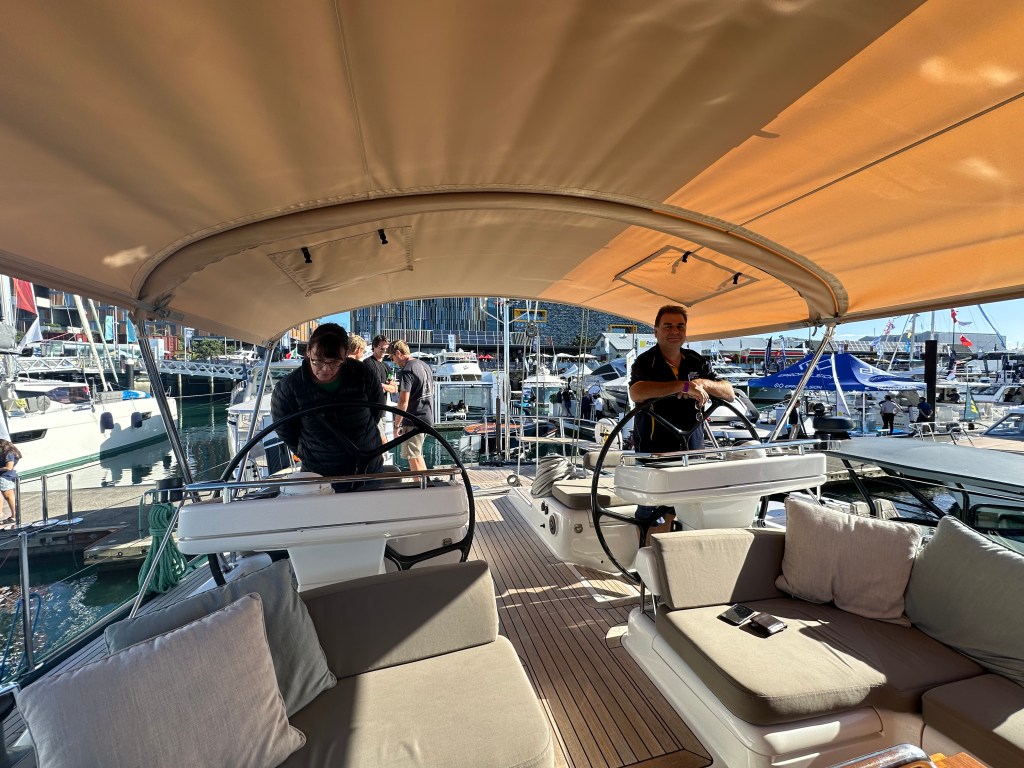
    Pete and Cara trying not to get lost in a floating condominium masquerading as a boat. Imagine being in here in a gale!

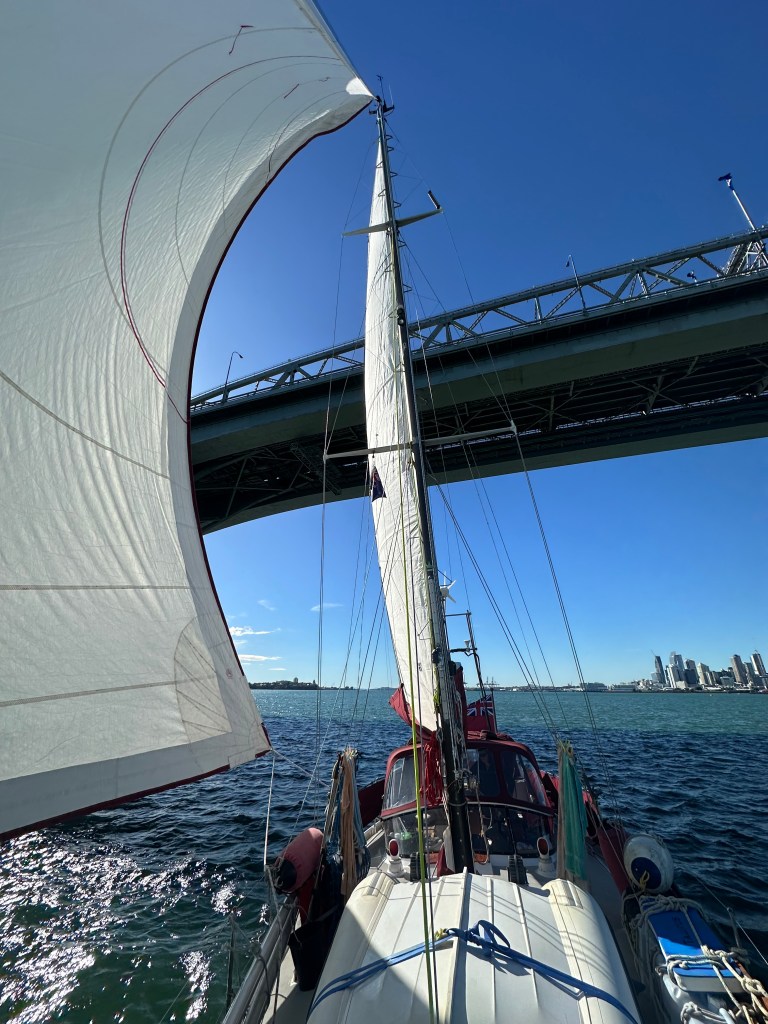
    With the water maker installed we left Westhaven, and though intending to head east to Rangitoto we instead turned west so that we could sail under the iconic Auckland Harbour Bridge. It seemed a shame to be so close and not tick this off, so tick it off we did, sailing under it, tacking, and then sailing under it again.

    Heading west…
    Heading east… (note jerrycans on port side).

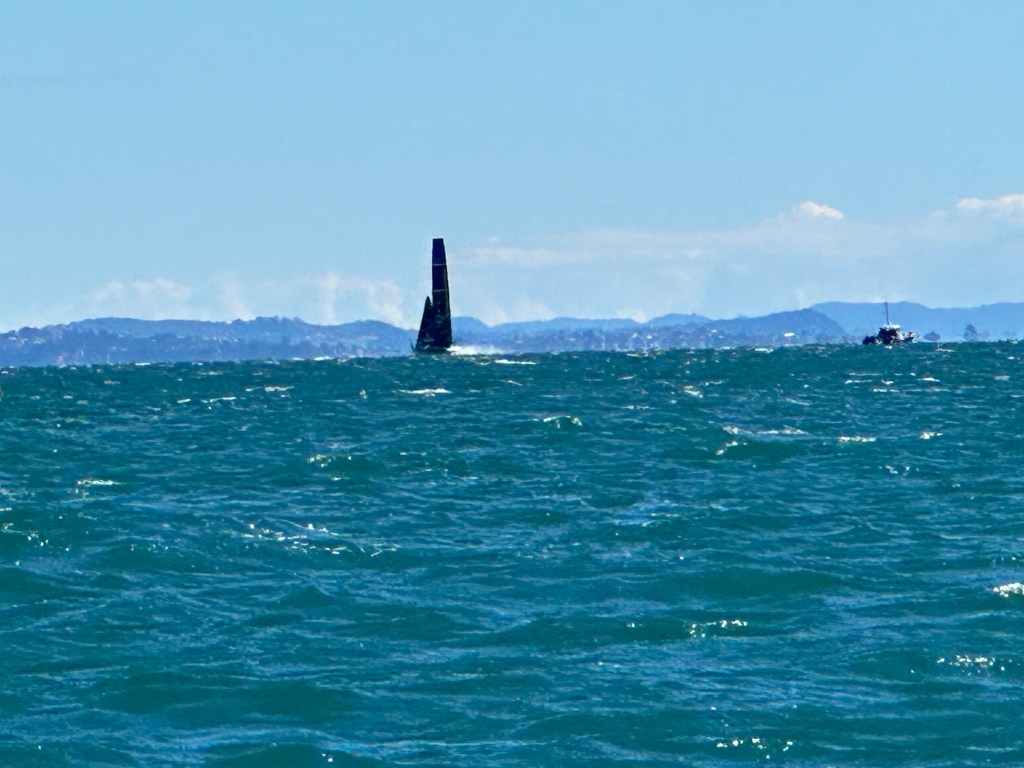
    After this exhilarating experience we headed out of Auckland, remembering to dip our ensign as we passed the RNZ Navy ships at Devonport, and after a very brief race with a foiling yacht, we anchored in Islington Bay, Rangitoto Island.

    GP style foiling yacht. It’s not small, by the time we got a camera out it was far away!

    Rangitoto is a beautiful spot. An extinct volcano that Cara has visited many times over the years so that it has become a bit of a site of pilgrimage for her when visiting Auckland. It was fantastic to be back on anchor, and out of the marina. Westhaven was pleasant enough but we didn’t feel too comfortable there. Perhaps it was the very expensive boats surrounding us, and the rush of the time-share owners to get out and enjoy their time on their boat before rushing back, and the paid help rushing in to clean and restock before the next owners rushed in; perhaps it was the toilets that timed your visits, nagged you to hurry, played irritating elevator music, and opened the door if you took too long; maybe it was the way we were locked out of the jetty when we extended our stay by a couple of days and didn’t pay the invoice immediately. We may be too small city to enjoy big city life, but there often seemed a quiet desperation in the other boat owners, and a focus on money rather than customer service from the marina.

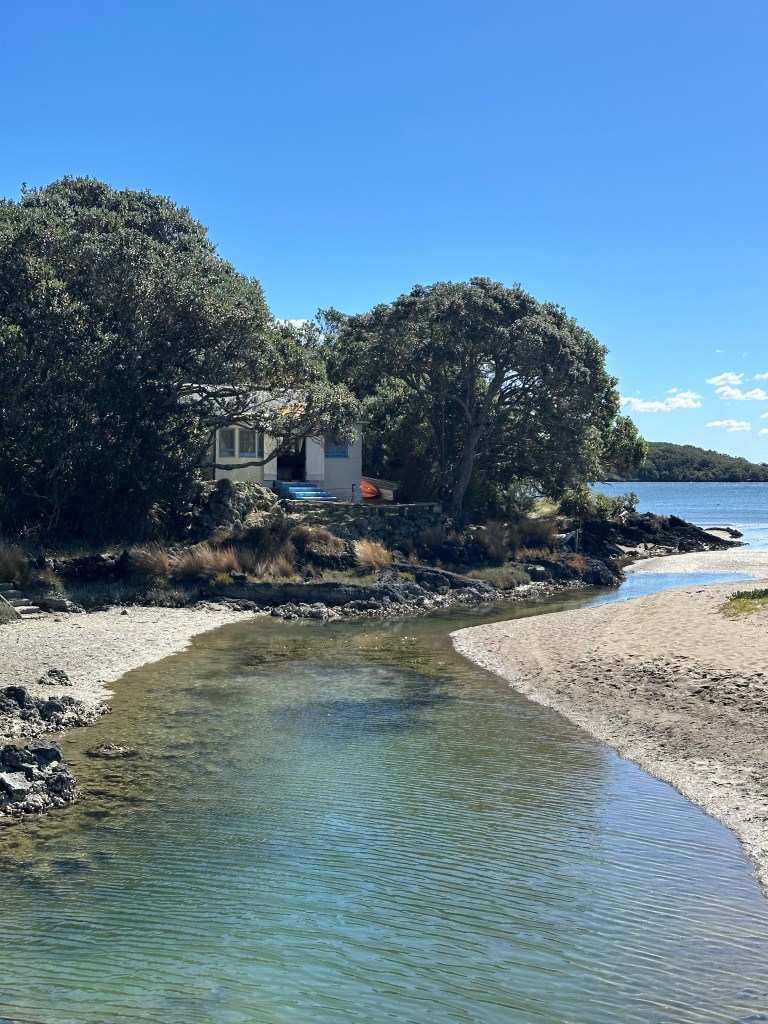
    Rangitoto was a world away from such nonsense. This charming island is home to some beautiful old bachs, small, traditional, Kiwi holiday homes. Many of these were built in the 1930s when the Auckland city council offered rental rates of $4 a year for campsites. Houses later sprang up on these sites, often humble, but still more permanent than later councils liked. Recently, it was decided that the tenure of the bach owners dies with them, and many of the houses have been removed — though now there seems to be a move to preserve some for historical interest. They certainly make manifest the idyllic lifestyle that so many Kiwis remember and hold dear.

    Bach, Rangitoto Island.
    Another bach, Rangitoto.
    Cara and I had to run / walk up to the summit of Rangitoto. Stunning views, bursting lungs, very hot.

    After a brief stay we departed Rangitoto and headed to another anchorage at Oneroa Bay, Waiheke. Here we had a pleasant snorkel and later an ice cream in the holiday town, but the bay was so rolly we got no sleep and we left first thing in the morning.

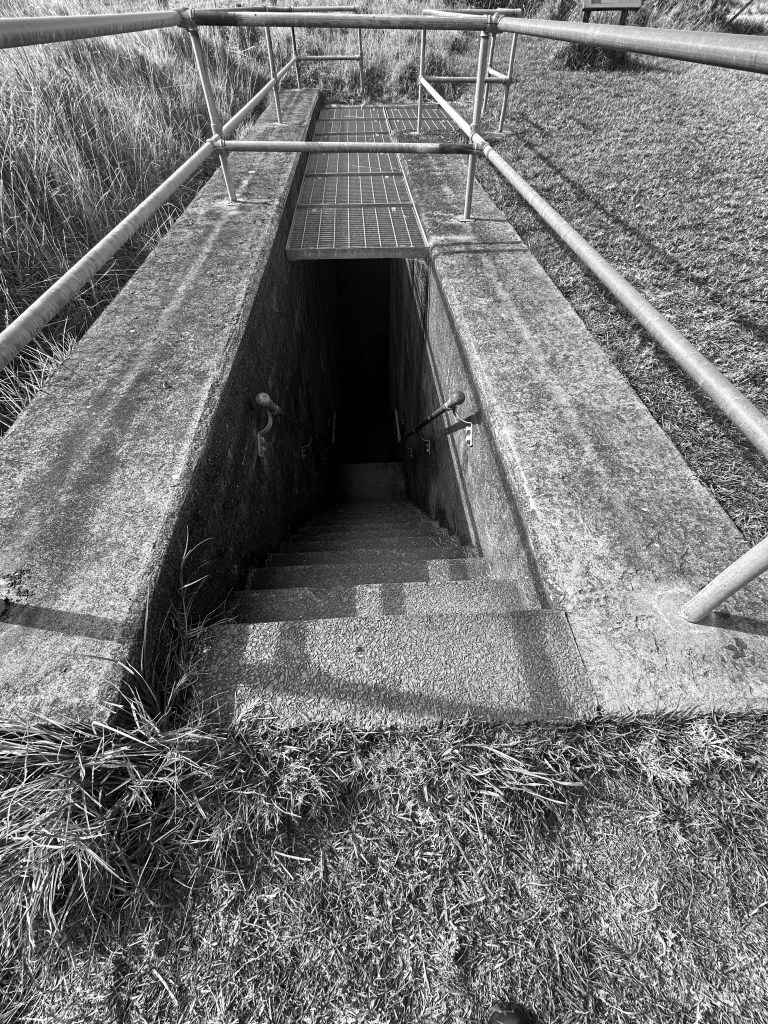
    We crossed to Rakino Island and spent the night in Home Bay, before crossing another channel and anchoring at Station Bay at Motutapu Island. In the morning we took the dinghy to shore and walked up to a series of WWII gun emplacements. These were well preserved and fascinating, especially the underground magazines that were very deep, dark, and claustrophobic.

    Don’t go into the cellar!
    Boo!

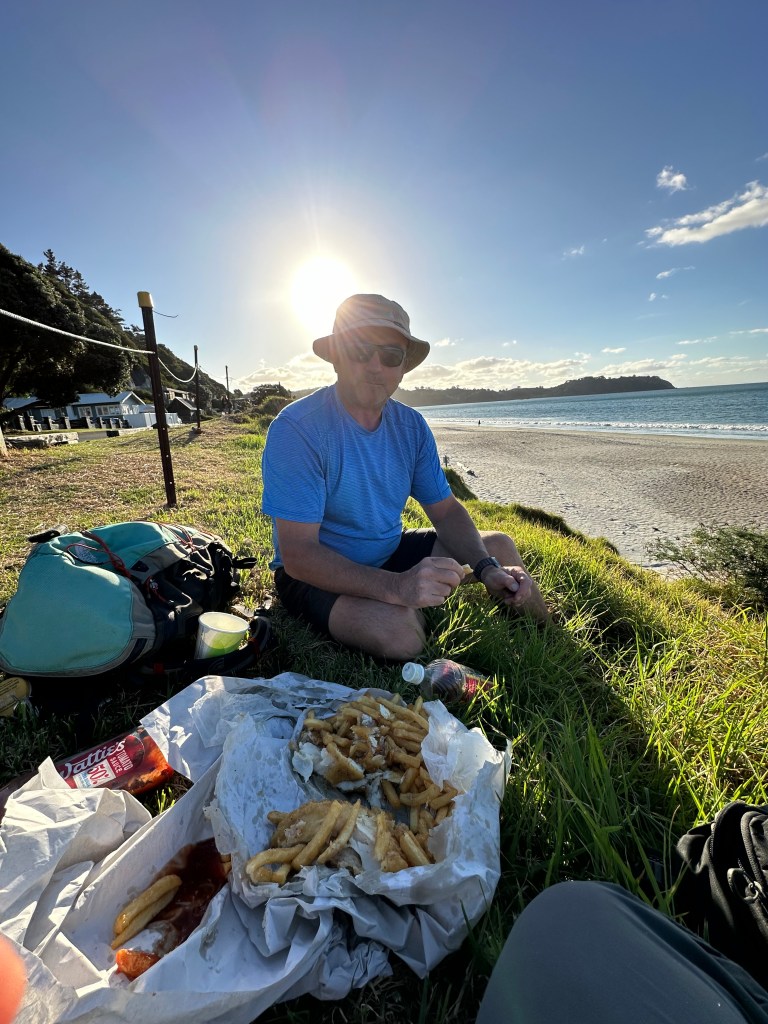
    Heading back to Waiheke we stayed in Opopoto Bay where we enjoyed great fish and chips and a bottle of wine on the beach. The relaxed mood was only slightly spoilt by collecting a big wave as we tried to get the dinghy off the beach…

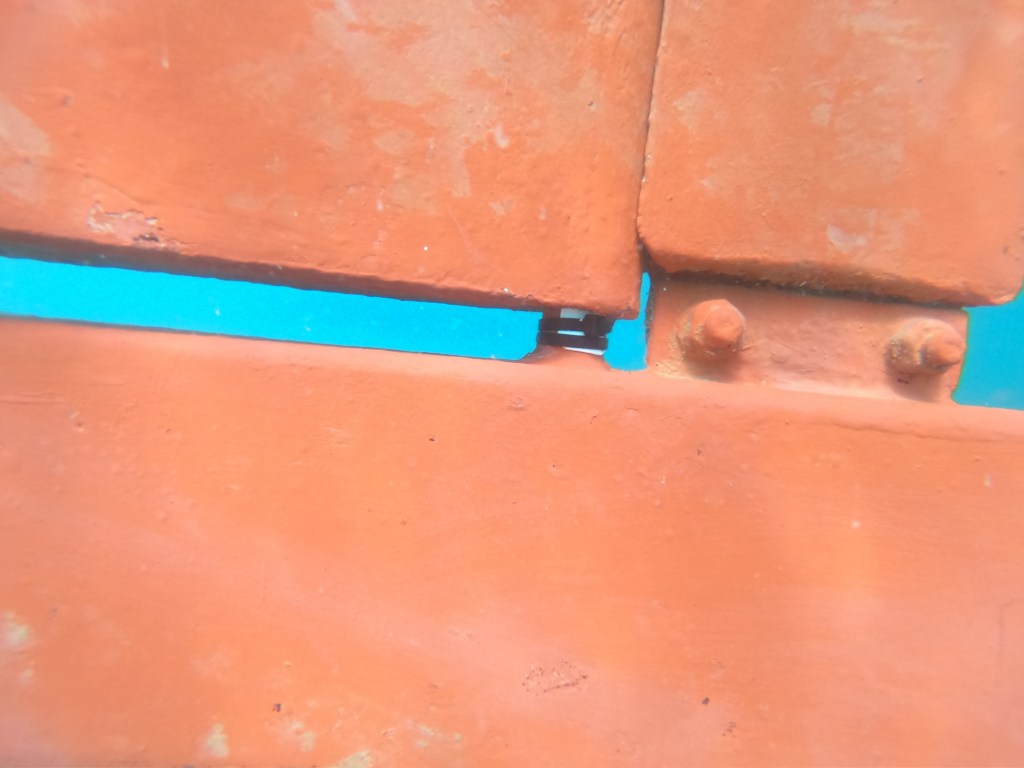
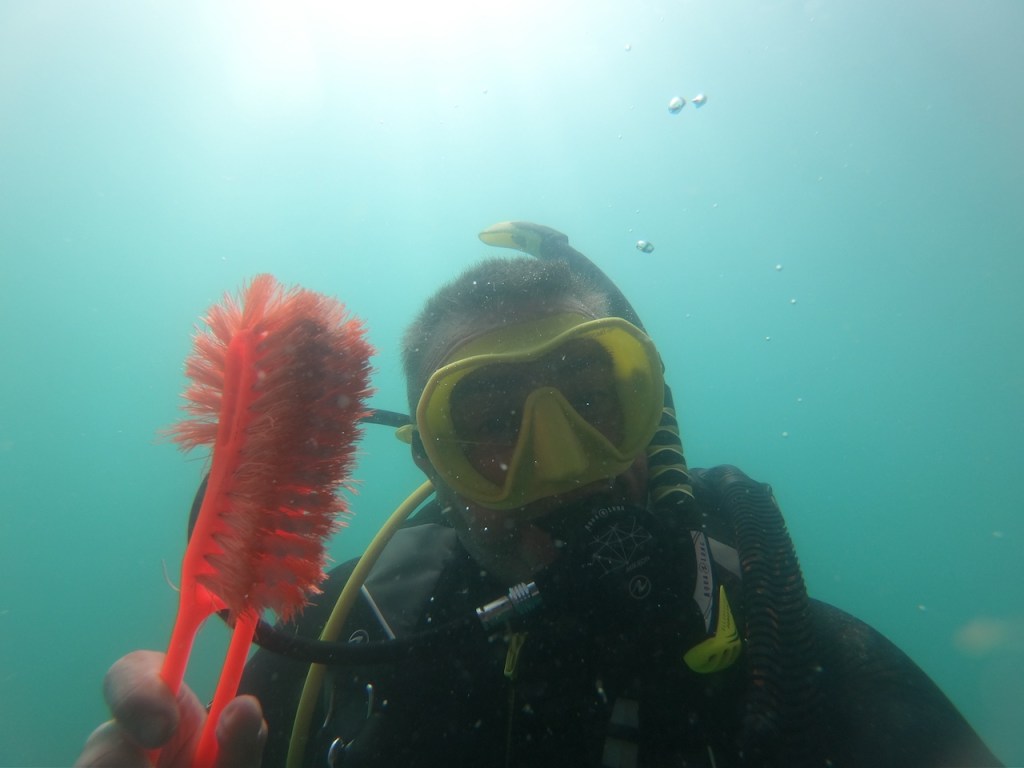
    The following day we upped sticks again and sailed to Tiritiri Matangi Island, but the anchorage was a bit too exposed and we didn’t stay, preferring to sail to Okoromai Bay at Whangaparoa. Here I went for a dive to assess a funny knocking noise that our rudder was making. It turned out that we needed to bush the lower rudder pintle, so Cara and I put our heads together and came up with a plan to insert some thin pieces of plastic and zip tie them in place. Though this might sound a bit rough, the rudder is in no danger of falling off and we’re in no danger of losing our steering. We just needed a bit of space taking up, which this fix will take care of until we get hauled out and make a proper bush, though the gap is so small, perhaps 1-2mm, I’m not sure how best to achieve this. Ideas?

    Bits of plastic and zip ties. Problem fixed!?
    Time to clean Taurus’ bottom..

    So, it’s now Wednesday, 27th of March, and we’re all caught up. As the map below makes clear we have been bouncing about a bit this past week, enjoying this part of New Zealand but not really going anywhere. This is because we are members of the Ocean Cruising Club, and they are having a BBQ and mini-cruise to celebrate their 70th year. The host of the local event is Lin Pardey, a living sailing legend, and we couldn’t pass up the opportunity to meet and have a drink with her. After the cruise we’ll be heading north towards Whangarei, and then the Bay of Islands. It’s not long now before our planned departure for Tonga. To paraphrase the words of Detective Mark Burnett in Bad Boys II — “shit’s gonna get real!”

    Ocean Cruising Club burgee.
  • The lights of Tauranga from Pilot Bay.

    Our plan to leave Tauranga on Tuesday was foiled by strong nor-easterly winds that would have blown directly onto our nose. Rather than burn a lot of fuel and waste a lot of time we chose to delay our departure and make sure we were ready to go the following day. One of the items to take care of was a check of our engine’s oil level. Upon examination I was concerned to find that the oil level wasn’t showing on the dipstick. As we regularly check this it meant that we had used a considerable amount of oil since we last checked — about 40 hours of running time ago. The engine took about a litre to reach the right level, so we’d gone through a litre in 40 hours. No leaks could be found so it appeared the engine was burning oil, and indeed the transom (back of the boat) had a bit of an oily residue, which could only have come from the exhaust. A quick google of possible explanations suggested various dire issues, and a query on the Lister Petter Facebook group had a number of people suggest that the issue might be too much low speed running. This causes excess carbonisation that could possibly be reversed, to some extent, by running the engine hard.

    As we wanted to go over to Tauranga Marina to top up our diesel and water tanks this short run seemed like a good opportunity to work the engine. We have some history with Tauranga Marina. When we were bringing Taurus south after buying her we arranged to stop there for a few days. At the time we had a lot less experience and entering the busy port was pretty stressful. It was a windy day and the marina had given us a berth number, something like K21. The ‘K’ signified the row, and ’21’ the berth in that row. We entered the marina through a narrow dog leg of built up blocks of stone. Once inside we found the row easily enough but none of the berths were numbered. At the end of the row was land so we were forced to try and reverse the boat whilst desperately looking for some idea of where to go. One of the great disadvantages of full keel boats is that they do not like to reverse, and rather than go where directed they prefer to go wherever they will. You can imagine our predicament. We were stuck in a narrow strip of water, other peoples’ expensive boats stacked either side, with a strong crosswind blowing, no idea of where we were supposed to go, and the only way out demanding we reverse through a narrow dog leg. Taurus refused to back up in anything like a straight line, and instead kept veering to port where we could see an empty berth. Rather than fight the will of the gods we decided that that was our spot and with barely any input from us Taurus parked herself beautifully. We were later very relieved to find that that berth was indeed K21, so we had no need to move. Sometimes it pays to bend like a reed in the face of the wind! On this new occasion, some years later, we were just approaching the dog leg with a strong wind blowing onto shore when the engine temperature alarm went off. Now, marine engines are cooled by raw water from the sea. Should something interrupt this flow then the engine will seize in short order — the pistons become friction welded into the cylinders and the engine is ruined. In our situation we were not able to turn off the engine as we were in a channel and had no room to try and turn to sail away, and any change in our drive was likely to see us blown onto the rocks. A quick run around the boat showed us that water was still being blown out the exhaust, so we knew that we had some cooling ability. In the circumstances we had little option but to slow the engine to help with the overheating and then ignore the alarm. Naturally, as we entered the marina we found a launch filling up and another waiting in the channel. Fortunately, an empty berth lay in front of us so we aimed for that, tied up, and turned the engine off asap.

    After a cup of tea and another check of the engine compartment we restarted the engine. Thankfully, everything behaved, no alarms went off, and we were able to fuel up. Clearly the engine did not like being run as hard as we had tried to run her, and we did find a piece of rope wrapped round the prop a few days later which may have contributed to the problem. We are now trying to run the engine harder than we used to and keeping an eye on our oil consumption. Hopefully it drops because otherwise an engine overhaul lies in the not distant future.

    A rough night on anchor before our departure from Tauranga.

    That night we anchored near the marae on Rangiwaea Island ready to leave early the next day. Once again the strength of the currents in Tauranga took us by surprise and we found an incoming tide of 5 knots demanded that we had to work the engine hard to make headway. Happily, with a more judicious hand on the throttle and a close eye on the temperature gauge, we had no issues.

    Decent current at the heads.

    We were heading to an anchorage on Mayor Island called South East Bay — so named because it’s open to the south east. The wind proved light and fickle so we had to motor for several hours before the predicted winds arrived and we were able to sail past the container ships at anchor waiting their turn to enter Tauranga port.

    Elephants racing?

    When the wind finally appeared the sail to Mayor Island was fantastic, and with the hydrovane steering us beautifully we were able to relax. I sat at the bow to enjoy the sun and views and had a long chat with my daughter, Abi, via Messenger. Abi has started nurse training in Australia and is somehow balancing two jobs whilst studying. The apple of my eye, I take my hat off to her.

    South East Bay turned out to be a lovely spot, and we soon found ourselves the only boat there. The island is privately owned and a small fee is charged to go ashore and walk around. As it was a bit late in the day, the water looked so inviting, and the dinghy was tied up on the deck we decided to go for a swim and think about going ashore later on. As happens, we had a nice swim and snorkel, then some snacks and wine, then it was time for a bit of a snooze.

    South East Bay, Mayor Island. The yacht in the bay was leaving as we arrived.
    Beautiful, clear water.
    Catching up on some beauty sleep.
    Cara chilling.

    The forecast had predicted a 15 knot sou-easterly later in the day, which would of course blow straight into the bay. However, in our state of sleepy torpor 15 knots didn’t seem too big a deal, whereas hauling up the anchor, finding another bay, and re-anchoring did. If this sounds like a plot from Aesop’s Tales you might imagine, correctly, that the consequence of our foolishness would soon make itself apparent and teach us a sound moral lesson. The wind gradually built until it was blowing steadily in the low 20s and we were again bouncing around with a lee shore too close to comfort behind. After watching the chart plotter for a while to see how things were trending we decided to lift the hook at about midnight. We motored out and planned to hide in another bay around the corner. After a bit of a rough motor we found about a dozen fishing launches had beaten us to it. We had further issues trying to get our anchor to catch, whilst keeping our distance from the other boats and the shore. Finally, at about 3:00 am on our third or fourth attempt, we felt confident that we weren’t dragging and could turn in.

    The next day, a bit worse for wear, we headed for Slipper Island. The conditions were grand and we enjoyed a cracking sail all the way, ultimately anchoring in Home Bay. The bay is home to a fancy holiday lodge, but at least you are allowed to walk along the beach, and I had another swim and snorkel, whilst Cara went paddle boarding. Getting closer to Auckland, the self-titled ‘City of Sails,’ we were finding a lot more ‘boaties’ about, and before dark four launches had joined us in the bay. The last tried to anchor practically on top of us, and whilst the inebriated crew were yelling across about their fishing, I was yelling back, ‘you’re too close!’ Thankfully the skipper realised that we would easily swing the short distance between us and moved further away. However, the proximity of all these boats, often on what seemed to be considerable shorter anchor rodes (the chain they swing on), meant another night with one eye and ear open.

    In the morning we up-anchored and sailed towards our destination for the day: Great Mercury Island. Gail force nor-westerlies were predicted for that night so we were keen to find a well sheltered spot. A number of anchorages are no longer available on the east side of the island due to environmental concerns so we ended up on the west side. There the best option appeared to be Coralie Bay, though entering the bay is a bit nerve wracking. The cruising guide advises that you stick to the north shore to avoid rocks, and then move to the south side to avoid the reef that extends south west from the northern side. As we approached in some early strong gusts we were trying hard to identify the breaking waves that would give us a clue where these rocks and reefs lay. Ultimately, the entrance proved easier than we had feared, and once inside we found a nice spot to anchor. Another swim and snorkel and it was time for an early night.

    Well reefed down in the gusty conditions.
    Entrance to Coralie Bay. Stick to the north, then stick to the south!

    We had received some sad news on the way to Great Mercury. Rollo, one of Cara’s relatives, whom she had lived with whilst studying in Auckland, had fallen gravely ill. We were keen to get near to Auckland so that we could try to support Rollo and his family if at all possible. We made plans to try and get round Cape Colville and enter the Hauraki Gulf, gateway to Auckland. Unfortunately, the wind dictated that this was not going to be possible, and despite our best efforts we couldn’t sail west into the westerlies that blew up. Despite running the engine to try and reduce our leeway until we could tack and head south west we were inexorably pushed further and further to the north west.

    Great Barrier Island in the distance.

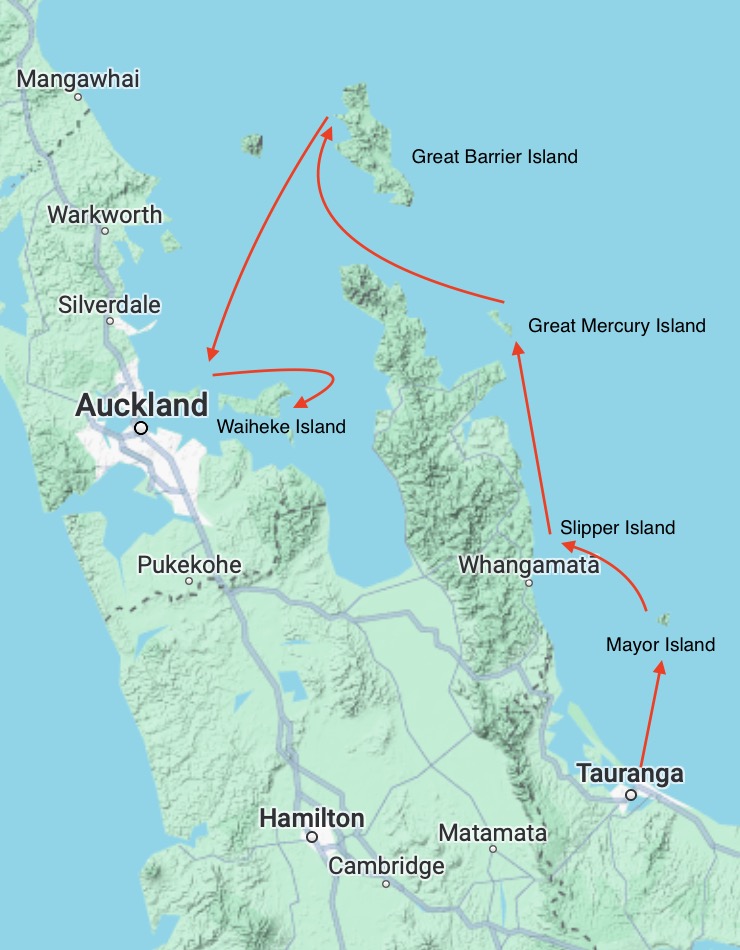
    Ultimately, we had to accept that we couldn’t change the situation and ended up staying the night at Great Barrier Island. The decision to head south the following day wasn’t taken lightly as winds of up to 35 knots were predicted, but we had to weigh this against the fact that the winds expected for the rest of the week were all from the south and would leave us unable to reach Auckland.

    Man of War passage, Great Barrier Island.

    We headed out in a decent 15-20 knots and were a little relieved to see two other yachts heading in the same direction. Happily, The weather gods played nicely, and the rest of the day was more or less plain sailing with just one big squall an hour or so out from Waiheke.

    Heading in the right direction!
    Little Barrier Island.

    The squall came with driving rain and increased the wind from about 15 knots to 35 knots. Whilst we were busy sorting out our sails the hydrovane, which steers the boat to the wind rather than on any course, quietly changed our heading so that when we looked at the plotter again we found our course had changed by 90 degrees. The wind had unexpectedly shifted from the west to south just like that. There was no point trying to follow our previous southerly course, so we decided to head around the east side of Waiheke rather than the planned west side (see map at bottom). We anchored that night in Man of War Bay, a spot that Captain Cook visited in 1769, which was supposed to offer good shelter from strong nor-westerlies and that already contained a number of other yachts.

    The black ball indicates that a ship is at anchor. The signal for having run aground is three black balls — hence the phrase ‘a balls up.’

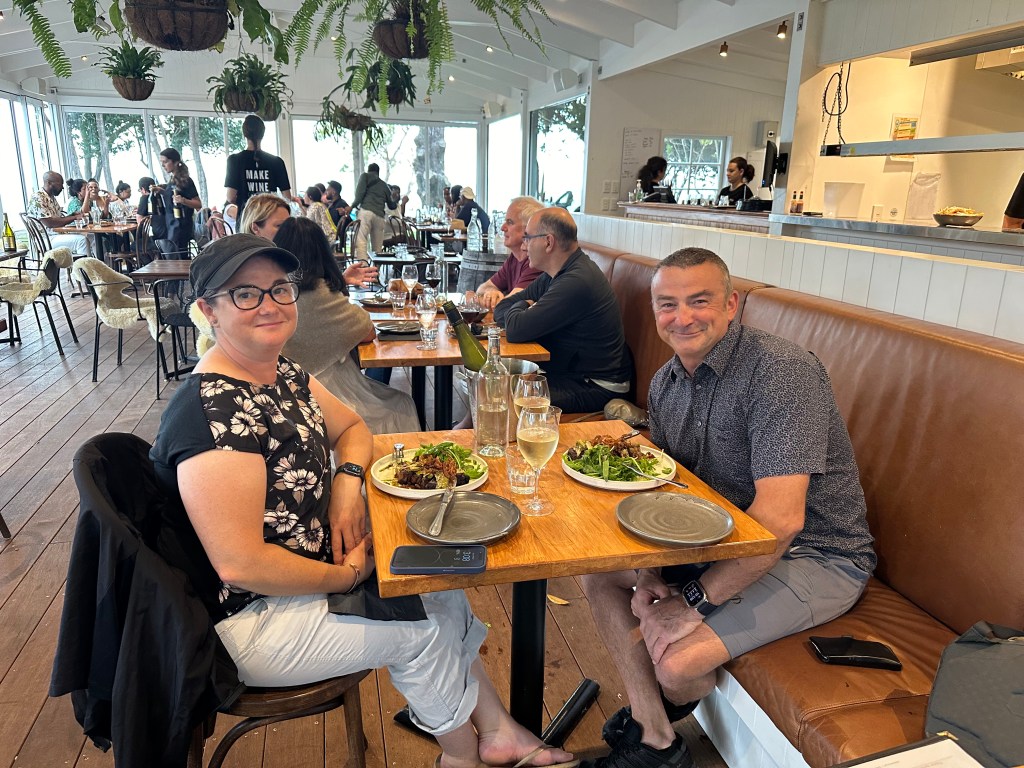
    The next day we went ashore and found that the bay contained a vineyard and restaurant. Getting a bit sick of ship’s rations we reserved a table and enjoyed a fine meal, though a bit expensive — especially as we were charged for a third meal and haven’t been able to get a refund as yet. During the meal the heavens opened and a monsoon-like rain pelted down. During a lull we made a break for the dinghy and the short ride back to Taurus, getting thoroughly soaked, though the fresh water made a nice change.

    Nice change from salt beef, dried peas, ship’s biscuit, and weevils.

    I’m a bit paranoid about leaving the outboard on the dinghy as it can be a bit of a disaster if the dinghy gets blown over and ‘pickles’ the engine in sea water. As soon as the rain let up we got the engine off and were just about to settle down when things went haywire. We experienced about five minutes of exceedingly strong winds that heeled Taurus onto her side, ripped the canvas dodger off, threw the dinghy upside down, and turned the bay into a maelstrom. The yacht next to us instantly dragged its anchor and whilst we tried to hold onto our dodger and looked down into a sea whipped into a white frenzy with pelting rain and the wind roaring in our ears we watched them try to regain control. A local weather station reported a gust of 51 knots, but I wonder if there was a katabatic effect. This occurs when wind races down a hill or cliff, like the ones supposed to shelter us, and in doing so increases in strength. Certainly this wind was the strongest I have ever experienced, and made the roughly 70 knots we had near Lyttleton pale in comparison.

    The voyage of SV Taurus, 28th of February – 3rd of March 2024.

    So we now plan to take a bit of a breather, restock, and head to Auckland in the next couple of days where we have a berth in a marina booked. Our thoughts remain with Rollo and his family at this tragic time.

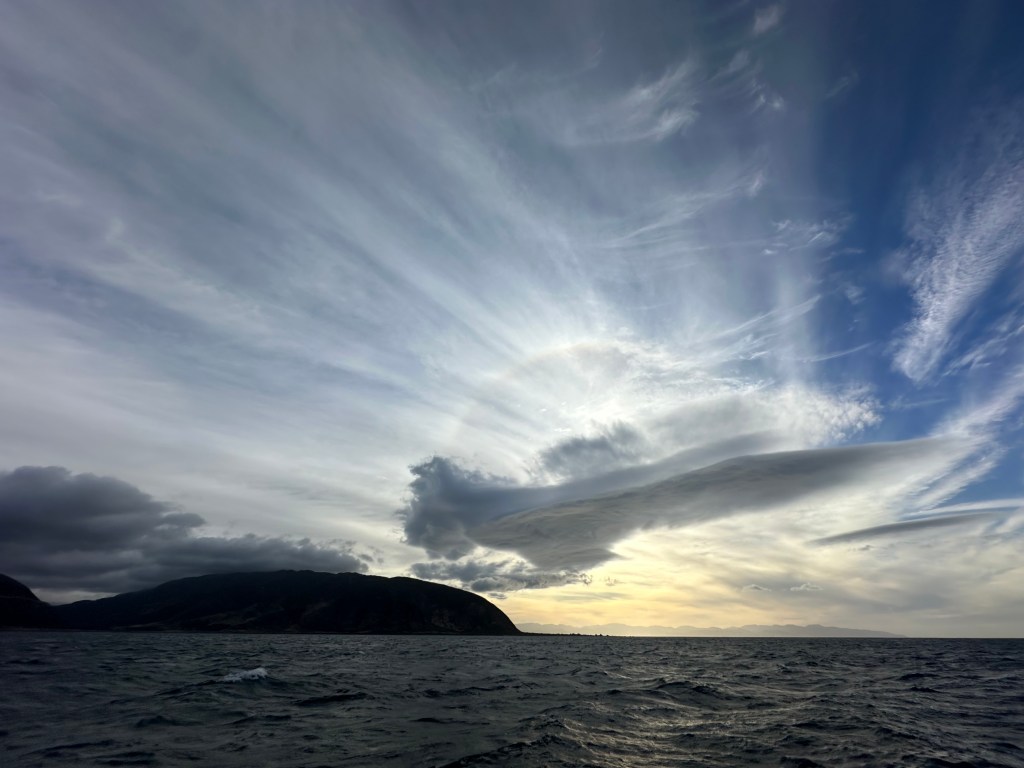
  • Turakirae Head, Cook Strait.

    Sailing from Wellington to Tauranga involves travelling some 440 nautical miles, or 815 kms, up the east coast of New Zealand’s North Island. The journey passes through some notorious stretches of water, the Cook Strait, Castle Point, and East Cape. Part of this notoriety is due to the fact that once the trip is underway there are few places to seek shelter. Napier is one option, indeed we ended up being storm bound in Napier for ten days when we sailed Taurus south after our initial purchase, but this involves a pretty major detour into Hawkes Bay; Gisborne is another, but doesn’t really cater for yachts; and after that there are a few rolly anchorages before East Cape, but the safety of these are very dependent on wind strength and direction.

    As we plan our passages using an average speed of 5 knots, 9 km/h, we were looking for a window that offered good weather for 3.5 days. Looking ahead we saw strong NW wind predicted in the Cook Strait on the Monday coming, followed by a week of northerlies which would blow right onto our nose and preclude our leaving. Sunday, however, looked like a good option, with westerly winds turning into light southerlies — provided we outran the gale predicted for Cook Strait and the area slightly north of it which was due the following day. We checked and rechecked our timings in the context of expected distance travelled and weather forecast in the area at that time, and made the decision to go.

    Leaving Evans Bay, Wellington.

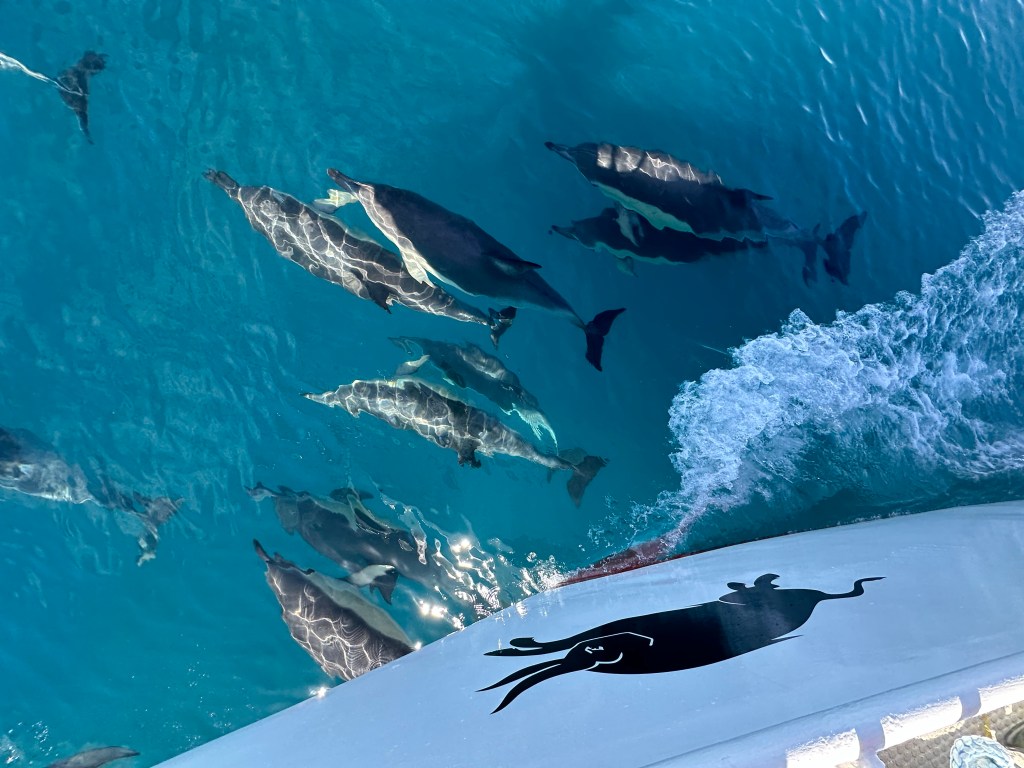
    We left Wellington with a hiss and a roar. Thirty knot winds and a strong current thrust us out of the harbour entrance at a rate of knots and we made great time for a couple of hours before the wind disappeared. The engine then came on and we kept pushing east to make sure that we weren’t caught out in the gale due on Monday. The light winds persisted all day and we passed Cape Palliser in a flat calm. A large pod of dolphins who joined us to play in the clear waters at Taurus’ bow provided the highlight of the day.

    Yes, more dolphins…

    We plugged along, turning north after Cape Palliser, and were pleased to be making ground, though disappointed not to be able to sail as the favourable winds predicted had failed to arrive. It came as something of a shock to later realise that the forecast for the area between Castle Point and Cape Turnagain had changed during the day from 20 knots to 40 knots. We would not willingly have put ourselves in this area in such winds, which could be expected to provide gusts of up to 60 knots. The Beaufort Scale categorises wind speeds of 48-55 knots as Force 10 (on a scale that ends at 12) and calls such weather a ‘storm’ or ‘whole gale.’

    Considering our options we were pretty much stuck between the devil and the deep blue sea, as the saying goes. We had nowhere to run to; we couldn’t turn around due to the gale about to hit the Cook Strait, so continuing north seemed about as good an option as any other. One bright side was that at least the winds were predicted to be westerly, so we would be pushed away from land rather than having a dangerous lee shore to worry about too. If they had been easterly I think we would have had to run off-shore to get as much space as possible between us and the coast. That evening the continuing flat calm seemed to mock our fears. It was hard to imagine strong winds just a few hours away.

    Calm before the storm?

    Modern technology can be a double edged sword. A weather routing app we frequently use has a function that allows you to see real-time weather conditions at prefixed points. As we continued to motor north we were able to watch the winds rising at Castle Point and Cape Turnagain until they were regularly recording 40 knots with 50 knot gusts. A 15 knot westerly had risen which allowed us to sail, if slowly as we were naturally reluctant to have much very much sail up in case the strong winds only a few miles away caught us out. This situation persisted until we found ourselves past Castle Point. We knew that the weather station on the coast was recording 40-60 knots (highest gust recorded was 58 knots) but we were sailing in winds of about 25-35. Looking at the various meteorological office forecasts we noticed that several appeared to show a corridor of lighter winds that ran parallel to the coast. I have no idea how this should work, but the winds we experienced were far lighter than those recorded on land. As we came to the entrance to Hawkes Bay we decided to keep going rather than heading in to Napier, and try to make the most of the window we had seen and planned to take advantage of.

    Getting my beauty sleep. Cara enjoyed videoing my snooze as I was sliding backwards and forwards, alternately being stopped by my feet and head. No sense, no feeling!

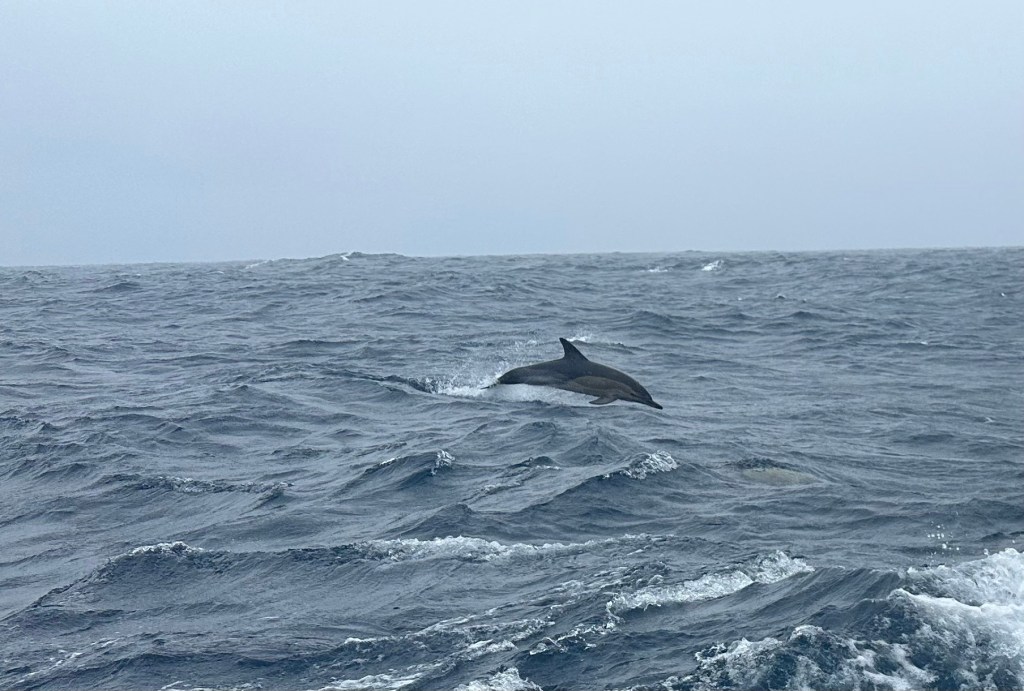
    The journey continued smoothly with light winds demanding a certain amount of motoring or motor sailing. Travelling around East Cape provided some of the best sailing of the trip. Smooth seas and a decent 15 knot breeze made a welcome change to the bumpy waves and light zephyrs that had marked a good deal of the passage. A pod of dolphins joined us yet again — this group entertaining us by leaping from the waves.

    Why won’t they leave us alone?

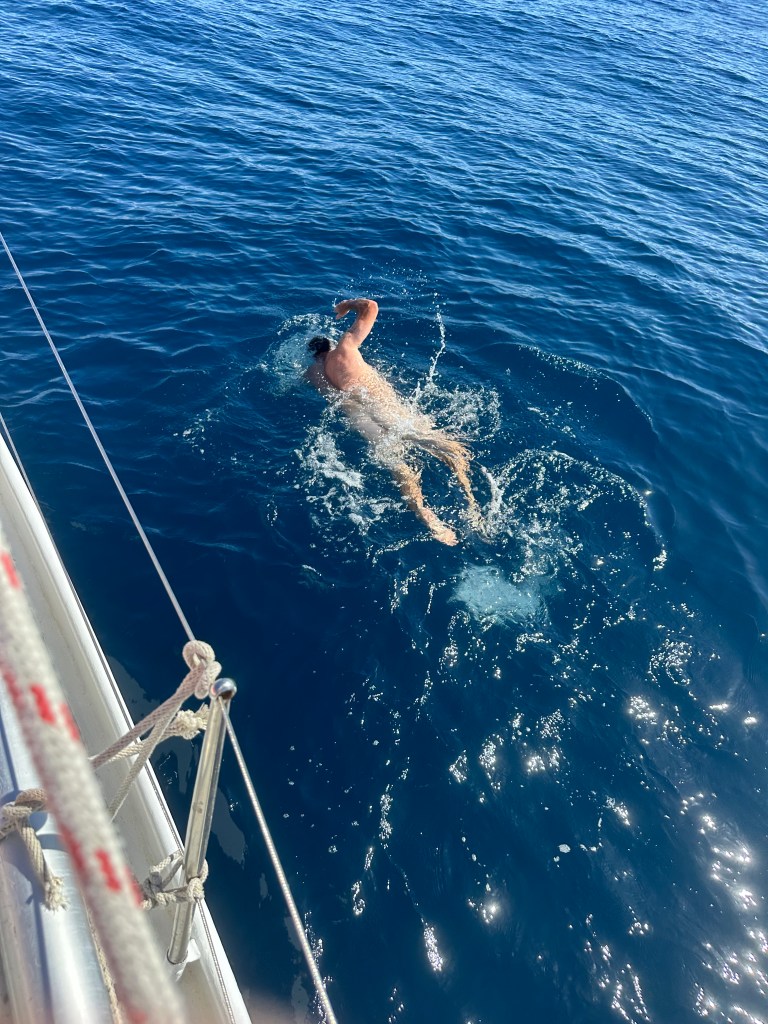
    All too soon the wind died again and we were facing another stretch of extended motoring. It was stinking hot and having been travelling for three days at this point we were feeling a bit ‘sticky.’ The sea looked oh so inviting so we threw on our togs (at least Cara did) and dived in. Being used to Dunedin temperatures the sea felt like a warm bath, and allowed us to stretch our muscles.

    Fender over the side with a line provides some guarantee that neither of us can take off leaving the other behind!
    togs, togs, undies, bum!

    After a quick swim we climbed back onboard and sought to make further headway. Our estimated time of arrival at Tauranga was about midnight, and we had no great desire to enter a busy port at night. The guiding lights that mark channels, red on the left when entering, green on the right, flash at different intervals and have a cyclical period of time in which they go unlit. Each pile’s flash sequence is unique so that it can be identified on the chart. However, in reality what this can mean is that in the pitch dark the tired mariner is faced with a confusing mass of lights: sometimes on, sometimes off, so that it becomes difficult to know which light is closest, and which light you should be guided by. In the past we have found that the best solution is to closely monitor and trust the chart plotter — essentially ‘flying’ the boat by its instruments — as what you see quickly becomes confusing and disorientating.

    Sunset on the last leg.

    We checked the local cruising guide and found a recommended anchorage in a bay at Motiti Island. Arriving just after dark we slowly motored in, very conscious of the rocks all around us that we couldn’t see. Our ground tackle (anchor and chain) had proven itself to be very reliable, but here we found the anchor dragged for some distance before it ‘grabbed’. The distance we travelled left us slightly exposed, but the weather was supposed to be very mild and so we settled down to dinner keeping a close eye on the chart plotter to make sure we didn’t start to move. Within the hour the wind had increased sharply and the boat was tugging strongly at her chain, the track recorded on the monitor showed that we were slowly moving back, dragging the anchor again. Though tired we had to spring into action and decide what course to take. It was now very dark and the wind was blowing about 25 knots, causing short, sharp waves that made Taurus’ bow continually heave up and down, rising and falling a good metre and a half every few seconds. Trying to re-anchor in such conditions, in the dark, in a rocky bay, and with the knowledge that the anchor had already dragged, seemed unpromising. Instead we brought the anchor up and motored away from land, heading for Tauranga. The trip was pretty unpleasant with strong winds and beam seas causing us to roll around despite our best efforts to angle off the waves. Eventually we reached the entrance to Tauranaga, and, as we expected, were faced with a mass of lights, some bright some dim, some flashing some not, and the lights of the port and town in the background confusing the scene further still. We had decided to anchor in another recommended spot, near a jetty on Matakana Island, just to the right of the entrance. We turned out of the main channel and found a strong current of about 5 knots, unlit buoys, an anchored yacht that appeared out of the dark and had no anchor light showing, a rapidly shallowing bottom, and driving rain and wind. Our first attempt to anchor failed as we dragged once again. When we lifted the anchor we found that we had snagged a roughly 10 metre long tree that had prevented the anchor from setting. Trying again we again failed. This time we lifted about five metres of old, discarded chain. Rather than try, try again we decided enough was enough. We allowed Taurus to float backwards and anchored away from the recommended spot in water just outside of the channel, which seemed to be intended for pleasure vessels only. Here, finally, the hook held and it was time for a wee tot and bed. We had left Wellington at 6 am on Sunday and arrived in Tauranga at about 3:30 am on Thursday, so the trip had taken almost exactly 4 days. During this time we had followed a 2 hour watch regimen every night, and been thoroughly worked out by rolly, sometimes rough, seas. It was definitely time for some down time.

    Another day, another tree in the anchor chain…

    Rising late, we decided to see if we could find a spot closer to civilisation. We contacted both of the marinas in town, but their fees, about $70 a night, were a bit much for us to swallow, whilst efforts to find a mooring to rent were unsuccessful. However, the Harbour Master advised us that many people anchored amongst the moored boats in Pilot Bay. After clearing the tree we found wrapped up in our anchor chain, we drove across the harbour entrance and looked for a decent space in the boats around us. The problem with anchoring in a mooring field is that anchors, to some extent, hold by the weight of the chain let out. The minimum ratio in good weather (for chain) is 3:1, so in a depth of about 7.5 metres, adding the height of Taurus’ freeboard, we were looking at letting out nearly 30 metres of chain. A moored boat, in contrast, has a short length of chain attached to a heavy block of concrete – the unmoving block sunk into the mud doesn’t need the extra weight of chain to hold the boat in place. As the current changes and the wind shifts a boat swinging on a 30 metre chain will naturally move much further than a boat on say 10 metres of chain, so the risk of collision is very real and demands close attention.

    Anchoring in the mooring field. Giant petri dish in the distance.

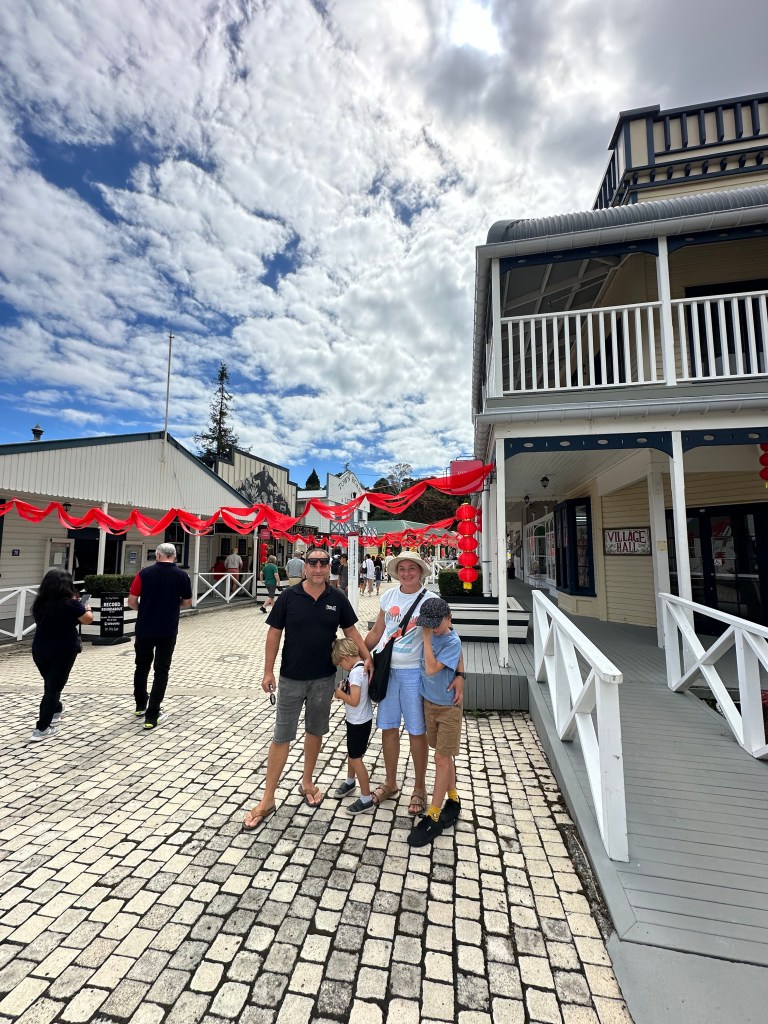
    After moving a couple of times and working out where other anchored yachts were we found a decent spot and were able to kind of relax. A dinghy ride to town earned us a dinner of fish and chips and the next day we caught up with old friends, Tony, Elena, and their boys: Alex and Martin, who took us to a Chinese food festival.

    Lovely people!

    The following day we had coffee with friends from Dunedin who also happened to be in Tauranga, Doug and Nicky Third. After brunch we decided to climb Mount Maunganui and got caught out in a monsoon like downpour. Despite the rain it was far too hot to put on jackets so we settled for getting soaked! From the top we were treated to amazing views of low cloud.

    The really heavy rain was about to arrive!

    We have now been in Tauranga for four days and hope to leave tomorrow, Tuesday, when another window of light southerlies will, hopefully, allow us to sail north. Having managed to get a fair distance towards our goal of arriving in the Bay of Islands by late April we are hoping to enjoy some day sails. Quiet anchorages and out of the way spots are calling, but just over the horizon lies Auckland where we look forward to catching up with more friends and relatives, and making some last minute preparations for the trip to Tonga.

    View from our anchor site in Pilots Bay.
  • After weeks working on the boat on the hard the sail from Dunedin to Oamaru was a delight. It was great to be sailing again, and, miracle of miracles, both the hydrovane and head seemed to work — most un-boat like. On this trip we stayed in about 100m of water so had no trouble with cray pots, and spent our time playing with the sails and wind steering. Eventually, the wind died away, so about an hour out of Oamaru we turned on the engine and motored the last leg before picking up a mooring in Oamaru Harbour, kindly arranged for us by Kevin. There was a strong temptation to get the dinghy off the deck so that we could go for pizza and beer in town, but as we wanted to leave early in the morning the hassle of lifting it off and on managed to outweigh my greed (we had beer onboard).

    We left early the next day trying to take advantage of a small weather window that would allow us to get to Lyttleton, though light winds were predicted. A fat kahawai caught en-route helped enliven the trip as the meteorology boffins were bang on.

    Nice kahawai for dinner!

    We sailed and motored and motor sailed across the Canterbury Bight arriving in Lyttleton about 28 hours after leaving Oamaru at lunchtime on Friday. Picking up the mooring in Diamond Harbour we sat and watched a Maltese super yacht called Farfalla out in the harbour. They obviously had trouble with their hydraulic vang (a strut that pulls the boom down or holds it up) as it was removed and being fiddled with. Even the super rich are afflicted with the need for constant maintenance of their boats — though their hands probably don’t get very dirty.

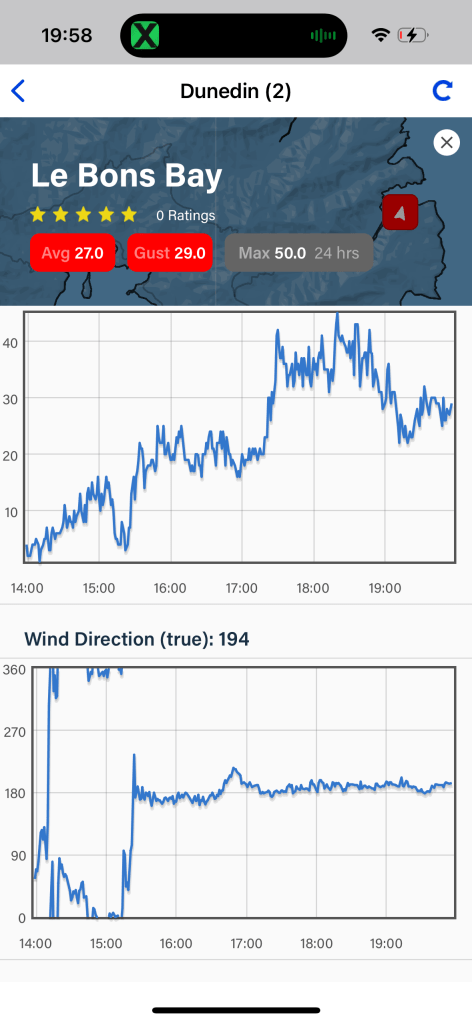
    Timing our next leg was a bit tricky. A 24 hour southerly gale was forecast with ‘very rough’ seas and wind speeds of 30 knots. This is a little more than most prudent sailors would choose to go out in, but there was nothing but northerlies for the rest of the week and this weather promised a fast trip to Wellington. It is also the kind of weather we might easily encounter when offshore so it seemed a bit woosyish to run scared of it. Nevertheless, we felt some trepidation as we set off, watching the clouds gather in the south and pursuing us north. We were perhaps a little complacent, thinking that we had everything ready, but when the southerly finally hit it came with a punch stronger than expected. The wind veered 180 degrees and the windspeed increased from 25 to 45 knots in what felt like an instant. Note that when wind speed doubles the energy quadruples, so we went from a pleasant sail in good winds to being smashed in a maelstrom, way overpowered, and having to reef in strong winds. Chaos reigned for a few minutes as we sorted ourselves out.

    Screen shot from a weather app. Le Bons Bay is at the North West corner of Banks Peninsula near Lyttleton Harbour and pretty much directly south of our position when the gale hit. We found the change of direction and increase in speed happened simultaneously – perhaps because we were further out to sea.

    The wind speed given in weather predictions is the average expected, so one can expect gusts up to 40% stronger. Unfortunately, we found that the average wind speed was higher than predicted, with the average being in the high thirties and low forties, and with a maximum measured by our instruments of 48 knots. The relative shallowness of the sea along the coast created steep, often breaking waves that were close together and which seemed to come from two directions. The first would hit us diagonally just aft of the beam and slew us round so that we were beam onto the larger wave pattern which came from directly behind and would subsequently try to lay us over. Lying beam onto breaking waves is particularly dangerous as scientific tests have shown a reasonable chance of being rolled if wave height exceeds one third of the boat’s length. The waves were predicted to be 3m but seemed much higher than that to us, but we passed unscathed and the hydrovane did sterling service through the night when we couldn’t even try to turn the boat to avoid the waves in the pitch dark. At about 3am we took the main sail down completely and continued under storm jib alone as the wind was coming from directly behind us veering slightly from our port to starboard side and threatening a crash gybe. The reduced sail area helped to depower the boat, which continued on at about 7-8 knots, a good speed for our boat, under storm jib alone. Normally we would steer off when in this position (so the wind isn’t directly behind), but we didn’t want to close with the land on our left, or head way out to sea on our right. Nor did periodically jibing from one side to the other seem like a great idea as we need to use running back stays when flying our storm jib to help support the mast. These make jibing that much harder (the stays prevent the boom from rotating from one side to the other) as they have to be connected and tensioned at the stern, and coiled and returned to the shrouds when disconnected, a bit of a hassle and safety issue in the dark in poor conditions.

    Toerails getting a wash

    We had hoped to continue to Wellington but had planned a possible stop at Cape Campbell on the north east of the South Island if we needed to wait for the correct tide or if Cook Strait was too rough. Both turned out to be the case so we edged to port in between waves to try and get into the shelter of the Cape. This turned out to be far from easy, as the wind and waves wanted to push us past and we had to turn and punch into 30 knot winds. It took about an hour to get into shelter with sheet after sheet of solid water being flung over the deck as the waves smashed against the bow. On the positive side we were able to watch dolphins leaping out of the waves and surfing down their faces.

    Dolphins off Cape Campbell

    The anchorage at Cape Campbell was only about 3m deep but still quite exposed. Cara and I spoke briefly about carrying on to Wellington or Port Underwood but in the end decided enough was enough and it was time for a breather. As it happened the weather, which had been slowly improving, blew itself out not long after and we were able to enjoy an early tea and a good night’s sleep.

    Leaving
    Cape Campbell

    The following day the sea was like a millpond, a radical change from the conditions we had endured for some thirty odd hours just the day before. We left early to time our arrival at Wellington with the ingoing tide and enjoyed 15-20 knot winds, perfect for Taurus, and the sight of half a dozen Albatrosses skimming millimetres above the waves.

    Sunrise Cook Strait

    The notorious Cook Strait provided fantastic sailing, and the cherry on top was a pod of dolphins, much larger to those we are used to at home, who joined us for the approach into Wellington.

    Dolphins!

    Our entry into Wellington Harbour went smoothly, though the numerous warnings about rip tides and rocks ensured we kept a good look out, and we headed into Evans Bay marina, where we were glad to see Max, Cara’s brother’s father in law, waiting to help us dock.

    The experience of sailing in the gale up the east coast was certainly valuable, and something we wanted to have under our belts before going off shore. Taurus certainly proved herself capable, but the soft mushy crew inside were quite challenged and are not overly eager to repeat the experience, especially in a coastal area due to all the extra issues this creates. The tactics we adopted worked OK, but in hindsight dropping the main meant that we couldn’t heave to (a safety measure that sees the jib and main placed in opposition, effectively stopping the boat) but in the circumstances of wind strength and direction it was probably the right call. Apart from that decision everything else went well and I would expect/hope to have greater distance between waves offshore which would have made life much easier. We also need to consider what drogue or sea anchor to purchase before leaving for Tonga. I had intended to buy or make a Series Drogue, but these weigh about 60kgs, and I really don’t know how we would have gone trying to launch something like that in the conditions we had — let alone in conditions potentially much worse. As seems standard with sailing, experience provides nuance rather than answers, greater awareness of issues that have to be weighed and considered.

  • Crossing the Canterbury Bight

    Our desire for a quieter passage from Lyttleton to Dunedin was granted, but as is the way with human nature (or perhaps my nature) this resulted not in a calm and relaxing trip, but rather a frustrating journey because we couldn’t power Taurus up. Nevertheless, the slow trip eventually came to an end, and we arrived home on the 16th of December.

    We had decided to return to Dunedin for a number of reasons:

    • We needed to be hauled out to do a number of jobs, including antifouling the hull, removing our old wind-steering gear, and fitting our ‘new’ Hydrovane. It made sense to do this in Dunedin as the marina is a club rather than a business – so has cheaper rates. The club also has less concern with health and safety issues (such as the constant wearing of high vis gear, the inspection and labelling of all electrical tools and extension cords, a ban on all ‘hot work’ (i.e. grinding, welding, drilling), our living on the boat whilst on the hard, and so on) which can be a bit OTT elsewhere.
    • Hailing from this jewel of the South, we also had friends and family in Dunedin which we looked forward to catching up with, and which we knew would help us out with transport, boatey advice, and alcohol consumption.
    • We have a storage garage in Dunedin and wanted to drop off some stuff and pick up some other stuff.
    • It was Christmas, and Cara wanted to see her family.
    Taurus moving onto the ‘hard’ at the Otago Yacht Club.

    Though it is impossible to beat Dunedin on a good day, these can be few and far apart, and the weather was certainly ‘changeable’ — often providing four seasons in a day. Nevertheless, thanks to Geoff, the club manager, we were soon able to grab a cradle and haul Taurus up onto the hard.

    The first job was to water blast any growth from the hull so it was nice and clean and ready to repaint with antifoul. This job is great fun as one can look forward to getting slimy and soaking wet whilst wearing ancient ‘water proofs.’ These garments, which are as water repellent as a sleeping bag sized tea bag, are typically several sizes too small, a tasteful bright yellow, and are cherished (or at least saved from the rubbish bin year after year) because no-one wants to get their decent waterproofs (expensive holy sacraments) dirty on this filthy annual chore.

    Cleaning the hull.

    Changing our old Windpilot Atlantic for the second hand Hydrovane we had bought in the Marlborough Sounds was another priority. The Windpilot is considered old technology and uses a large sail that is essentially connected directly to an auxiliary rudder. The sail is angled to ‘blade’ into the wind, and hence if the yacht wanders off course, according to wind direction, the wind applies pressure to the sail, which applies pressure to the rudder, and turns it back. However, this vertical style of wind vane provides 1:1 steering power to wind energy, and the Atlantic is only recommended for boats up to 11 metres long, Taurus is 12 metres. Our experience with the Atlantic was a bit love/hate. When it worked it was great, saving us from either having to hand steer or use energy to run the electronic autopilot, but getting it to work was often difficult and sometimes impossible.

    The Hydrovane uses a horizontal system that also utilises a sail that is bladed into the wind, but when the boat goes off course it flips or flaps rather than rotates, and through the magic of mysterious gearing provides a power to energy ratio of 3:1. Although it has been around, largely unchanged, since the 60’s, when the craze for single handed sailing made wind powered steering a necessity, the Hydrovane has an outstanding reputation as the ‘Rolls Royce’ of wind vanes. Certainly, the system was impressively ‘beefy’ compared to our old unit, and looked a bit like a transformer was breaking through the transom.

    Out with the old (Windpilot Atlantic)…
    … in with the new (Hydrovane)

    Our next chosen task was to replace the mast head light. Ours was probably original, so destroyed by forty years of UV, and sadly lacking an anchor light. Being conscientious boat owners we thought we would replace the wiring in the mast at the same time. This, we hoped, would give us the added benefit of being able to do the wiring on the deck instead of 16m in the air atop a hollow stick held in place by skinny wire. Naturally, boats being what they are, we subsequently found that we could not remove the original wire that had helpfully been crimped and then riveted in place inside the mast. Our choices were thus to either run a new wire down the mast (but as we would be unable to secure it it would slap in any kind of swell or wind and drive us quickly insane) or reuse the old wire. Choosing the latter we had to accept wiring the new light atop the mast, and then fixing the light to the mast head. Fortunately, our mast is fitted with steps so that I can climb up easily, and normally use a climbing ascender on the main halyard as a safety (it locks on the rope under pressure — such as the effect of gravity on my body). The downside of this system is that should I be incapacitated I cannot be lowered without someone attaching me to another rope and freeing me from the safety. A pre-attached second line would of course help in this regard, but would still need me to free the safety device, and would then require someone to constantly belay me. Thus, though the method we use is less safe it is a more practicable and manageable solution. You pay your money and make your choice. I find working at the top of the mast neither comfortable or fun. Initially I gripped my tools too tightly, a consequence of worrying about dropping them either onto Cara’s head or through a hatch cover, which led to odd cramps in my thumbs that prevented my being able to grip at all. When this happened I had to hang my arms down until the cramps eased before I could do any more work, or even climb down. Happily, familiarity breeds contempt, and this together with lanyards on the heavier tools and a healthy dose of denial managed to belie the possibility of my braining my one true love or of my falling to earth and dying, and eventually the job was completed. Or so we thought. As we considered the mast wiring we noted that one of the through deck grommet was placed right in the way of someone walking around the mast. This had led to the wire it held being damaged, and so we needed to move the grommet and fix the wire — a VHF coax cable. When we looked at moving the grommet we found that someone had taken the time to tap holes in the steel deck and had then used stainless steel machines screws that had of course rusted in place (dissimilar metals on boats always lead to corrosion). The damage required a small welding job and several coats of three different two-pot paints, before we could drill a new hole for a new through deck fitting, the bare metal being protected by several coats of three types of two-pot paint! Before we knew it, and with barely an incident likely to haunt us at 3am or be diagnosed as the cause of PTSD, we had a new mast light fitting.

    Doesn’t look very high, but different perspective from the top!

    Next we attacked the ‘head’ or toilet. The system had a nasty habit of becoming blocked due to the presence of a couple of 90 degree bends in the outlet system. The solution we had had to use in the past was to block the vent pipe and then pressurise the holding tank in the hope that the blockage succumbed before the tank burst. We had gotten away with this dodge a few times, but it felt a bit like poking a bear — it wasn’t something we could expect to get away with forever! The job, of course, turned into yet another mission, but I doubt anyone wants to hear the nasty details; needless to say we did away with the bends and hope to have solved the problem, but we would like to move to a composting system one day soon.

    Not a picture of the head.
    Our storage garage on a bad day. Not sure if Cara is laughing or crying!
    Changing the gear box oil. It’s nice to have a small person on-board for those tight place jobs!

    Our time in Dunedin wasn’t all work, and we took a bit of time off to hang out with friends for food, fun, and silliness.

    We came third in a yacht club race – Ross can’t believe it!
    My son’s partner, Hailey, visited from the States and came out for a sail.
    We visited the Spirit of New Zealand, a youth training vessel that my daughter, Abi, had sailed on.
    My book was published!
    This happened…
    … we met these strange guys…
    and these…
    and ultimately we got back in the water and started our journey north.

    Next time: we find out if the Hydrovane and the head works, and sail north up the east coast of the South Island, again…

  • Sunset in Ngakuta Bay.

    As previously noted, a focus of our time in the Sounds was the need to get our standing rigging replaced. We had sourced a couple of quotes from different companies, and these were so different in terms of time, cost, and work needed that it became quite an exercise to decide which firm we should choose. One company wanted to remove the mast, remove all fittings and crack test them, change all the electronics in the mast (various lights and radio aerials), as well as add new stays and shrouds (the wires that hold the mast up). The other company wanted to swop out the stays and shrouds and send us on our way. In predicaments like this I tend to ask for the advice of my wiser friends — but the split was fairly even. Eventually I contacted another rigger I had spoken to but who couldn’t do the work on Taurus due to her size, and asked him for his advice. He suggested that the extensive refit was a little OTT, and so the decision was made.

    We now had a couple of weeks before we had to be back in Waikawa to get the work undertaken. Having spent quite a bit of time in Queen Charlotte we decided to head to Pelorus Sound. After a couple of blustery days on anchor we had a lovely sail around Cape Jackson, marvelling at the way in which the sea boiled where different tides converged, and glad that it was such a placid day as the boat was pulled this way and that.

    The Cape Jackson lighthouse is a little surreal. Strong tidal currents and a deserved reputation for stormy weather make it a dangerous place on the wrong day.

    We anchored in Homestead Bay for a few days and then moved to Ketu Bay to avoid the worst of a predicted southerly change. Time was spent fishing, walking, and snorkelling and generally hanging out, but all too soon we had to head back to Waikawa so as not to miss our rigging window.

    It’s a hard job, but someone has to do it 🙂

    The trip back was uneventful and once again we were able to sail all the way, trying various sail combinations and finding out that our autopilot was much better at sailing ‘wing on wing’ (the main and jib pulled out on different sides of the boat which requires the wind to remain more or less directly astern to prevent an accidental gybe — the boom crashing from one side of the boat to the other) than we mere mortals.

    Wing on wing.

    Having returned to Waikawa we went into the marina so that we could strip all the stuff off the rigging ready for the experts to come do their thing. Happily this was surprisingly straightforward, an exceedingly rare state of affairs when it comes to boat jobs, and we had time to work on the dinghy outboard — an easy fix too! Getting too big for my boots I then succeeded in straining my back, leaving me hampered and unable to do much more than hobble around if forced. Luckily Cara leapt into the breach and finished off the last jobs that were required.

    Cara removing the stainless steel frame that our radar, compass, and generator normally sit on.

    With the rigging complete we had to decide where to next. We had several jobs that we needed to do, which required pulling the boat out of the water. Because most of the facilities in the area are businesses rather than clubs they tend to be a little more expensive and a little more health and safety conscious (meaning no living on board whilst ‘on the hard,’ which demands more $$$). We also needed to get rid of some stuff we had on board and wanted to pick up other stuff we had at home. The fact that Christmas was just round the corner helped us to decide to head back to Dunedin to use the facilities at our sailing alma mater, the Otago Yacht Club. With a good wind the trip takes about 4-5 days — naturally, however, good winds were not forthcoming.

    Ominous weather on the way out of Queen Charlotte Sound.

    Seeing a narrow window we jumped at the chance to leave the Sounds and start heading South. Unfortunately, the window proved narrower than predicted and we spent the last hour and a half of our trip to Port Underwood battling a strong southerly that reached slightly over 40 knots. Our situation was not helped by the fact that our jib refused to roll away completely so that we were a little overpowered. The jib issue was a rookie mistake. When we replaced the jib sail we thought we had enough coils around the furler to be able to furl the sail. However, attempting to furl the sail in strong winds results in a tighter furl that demands more rope to pull the entire sail in. Having a tightly furled sail we ran out of line and were unable to move the sail any further in — and obviously unable to pull it out again to try and refurl without risking serious damage to the sail and losing control of the boat. Normally in rough weather the sailor tends to look for open water, its land that wrecks boats, but we were right at the entrance to Port Underwood and with conditions deteriorating we decided to close with land and keep our fingers crossed. Fortunately, the wind, waves, and tide were all heading into the Port so that the entrance was fairly blissful after the fight to get sufficiently south of the rocks at the northerly entrance and we were soon in a peaceful anchorage enjoying a well earnt beer!

    We had intended to stay the night, but Cara noticed another window to head to Lyttleton and so after a couple of hours, in which we fixed the furler, we headed back out to find the wind had dropped drastically but was unfortunately blowing directly onto our nose. Tacking across the wind gained us little ground, so I dumped the sails and turned to the ‘iron donkey’ — the engine — for a few hours.

    Rounding Cape Campbell.

    The next 48 hours sailing to Lyttleton saw us experience a variety of conditions: strong downwind sailing, another gale that came in that night at about 3:00am, and then ferocious winds and torrential rain when we finally reached the ‘shelter’ of Lyttleton Harbour. Viki Moore, a local sailing legend, had been watching us on AIS and seeing the crazy weather called us up and suggested that we pick up a mooring in Diamond Harbour where we would find the best shelter. Needless to say we were very grateful for this advice — the normal place we anchor in Lyttleton would have been very exposed and not an easy proposition, but I wasn’t keen to try and explore unknown, confined bays in the weather as it was.

    Cara and I both felt a little battered, not least because whilst I could forget my strained back when occasion demanded, the after effects were pretty painful and debilitating. Poor Taurus had suffered too. Whilst putting the third main reef in at 30 knots the winch used to tighten the reefing lines simply fell off the boom. We were fortunate to have finished putting the reef in when it came adrift, and to be able to grab the winch barrel and caged bearings before they disappeared from the wildly pitching boat into the rain, and darkness. The next day we were able to replace the winch. It turned out that a mere circlip holds it in place, which seems a bit insufficient. Nothing was broken so I’ll keep my fingers crossed it stays where it is supposed to and try to source a replacement for a spare (about $3 boat dollars (BD) — $1 BD = $100 in normal money. Surprisingly, this strategy of self delusion does make you feel better about the constant outlay that boats demand!).

    Lovely day, but Cara is holding on for a reason. The conditions were very roly, which was pretty tiring after eight odd hours of it.
    Thirty knots plus on entering Lyttleton Harbour. Our sails were still up and we were trying to spot (and avoid) land, various piles, and a dredge that kept turning round in front of us. The master of the dredge must have had greater faith in our power to manoeuvre than we did!

    After a good night’s sleep, Viki kindly came to meet us and gave us a lift to a chandlers to buy a couple of stainless items that had broken during the maelstrom, and to a supermarket to buy some more beer. I hadn’t chosen a good time to try and cut down! It was also my birthday, and Cara spoilt me rotten with a home baked cake and lovely dinner out.

    Cheers Viki!
    Yum 🙂

    So, it is now two days since we arrived and we have a small weather window to make the 36 hour trip back to Dunedin if we leave at 8pm tonight. If competence is an outcome of experience, and experience an outcome of learning from the mistakes we make, then the trip thus far has been well worthwhile, but I’ve got my fingers crossed that the next leg lets us slumber in a little blissful ignorance…

    Taurus at Council jetty, Lyttleton Harbour.

  • Marlborough Sounds sits at the top right hand corner of the South Island. Queen Charlotte Sound is the easternmost of the sounds. The area, renowned for its natural beauty and its numerous anchorages, is something of a boating Mecca. This means that there are businesses here that cater for boats, and one of the things we planned to do whilst in the area was to try and get our rig renewed. A yacht’s standing rigging holds the mast up, and allows the winds power, caught by the sails, to be transferred to the hull which then moves through the water. If the standing rigging fails then the wind can simply blow the mast over, which is less than ideal. Insurance companies demand that standing rigging is replaced every ten years, and whilst we had had the rig inspected when we purchased Taurus and it was given a clean bill of health, we don’t know when it was last changed. Intending to head off-shore next year, it’s important that the rig is right, which means having it renewed.

    To this end we visited Waikawa and later Picton to have riggers inspect the current system and give us quotes. We also had to climb the mast and take lots of photos to send to another firm. Dangling on the end of a rope sixteen meters in the air is one thing — doing so with a grand’s worth of phone/camera and having to take one handed photos is another. I was glad, as ever, to return to ‘terra firma.’

    Picton. Taurus sits on the visitors berth on right side. Note passenger ferry, a busy wee place.
    Waikawa visitor’s berth. Time to stock up water and diesel, and get some washing done at the yacht club.

    Once the assessors had been and gone we had the opportunity to explore the area whilst waiting for the quotes. Naturally, the weather plays a big part in regard to where we decide to anchor or pick up a mooring. The wind is often strong, especially the nor’westerlies and sou’westerlies that pick up strength in the Tasman Sea, so that we have to choose an anchorage that offers shelter from the wind direction predicted. Of course, this is less science than a process of gaining hard won experience, especially as the wind has a magic ability to swirl in valleys and sounds, so that once or twice we’ve been hammered by the wind coming from every point of the compass despite being in a ‘protected’ bay.

    A bumpy day sailing round a ‘protected’ anchorage.

    Normally on nice days we take the dinghy and go fishing, but unfortunately blue cod fishing is banned in the Sounds until late December, and a warning about toxic shellfish put a bit of a damper on our gathering seafood. Denied our staple we tried our hands at catching other fish species with some luck.

    Cara with a rig. These small shark are generally served up by fish and chip shops.

    On another day we decided to walk part of the Queen Charlotte Track, a 70km walking trail, from the anchorage we were in, Schoolhouse Bay, to Ship Cove, a bay that Captain Cook visited on his exploration of New Zealand. The track is shared with mountain bikers, and I was pretty envious of their wheels and speed after a few hours of unaccustomed exercise!

    Monument to Cook at Ship Cove.
    Hot day for a walk.

    Going from bay to bay means lots of sailing, and as a group of two or more yachts is known as a race we have been getting quite a bit of a racing in. Incredibly, we win every time but then we like to keep the finish line a closely guarded secret! My friend Ross taught me this tactic. On New Years Day several years ago he won the Stewart Island race around Ulva Island, but he was the only one who knew which way round we were supposed to go…

    Taurus in America’s Cup mode
    Everything still stops for dolphins…

    The other great thing we have been able to do is catch up with friends and family who live in this part of the country. We had a couple of days hanging out in the same anchorage as Danny and Christina — friends who left Dunedin to live in the Marlborough Sounds on their yacht, Kachina, about four years ago. We also caught up with some of Cara’s family, who came sailing one day and took us to the ‘Jolly Roger’ pub in Waikawa on another. Very kindly Bruce, Cara’s uncle, left us with a couple of crayfish all the way from Kaikoura, so we continue to eat like kings!

    Lunch and beer with Cara’s family.
    Working our way through the anchorages in Queen Charlotte. Yellow dots are where we’ve stayed.

    After a few great weeks cruising around, Cara, unfortunately, had to return to Dunedin for a work conference, so for the past week I have been solo-sailing. Without having had a lot of practice in this role it’s been a bit anxiety inducing, as land is always close and the winds continue to play the all or nothing, then all again game. Still, I have had lots of time to do painting and get other jobs done….

    Thinking about painting…
    Nice coffee at Lochmara Lodge. hmm painting…
    Picked up a hitchhiker… Note the new undercoat (pink) !!!

    Cara returns on Tuesday so only a couple more days of making sure I don’t crash the boat. It looks like our rigging work will be carried out in early December, so we might head round to the next sound, Pelorus Sound, and come back. Tough decisions…

    Hard at it again…