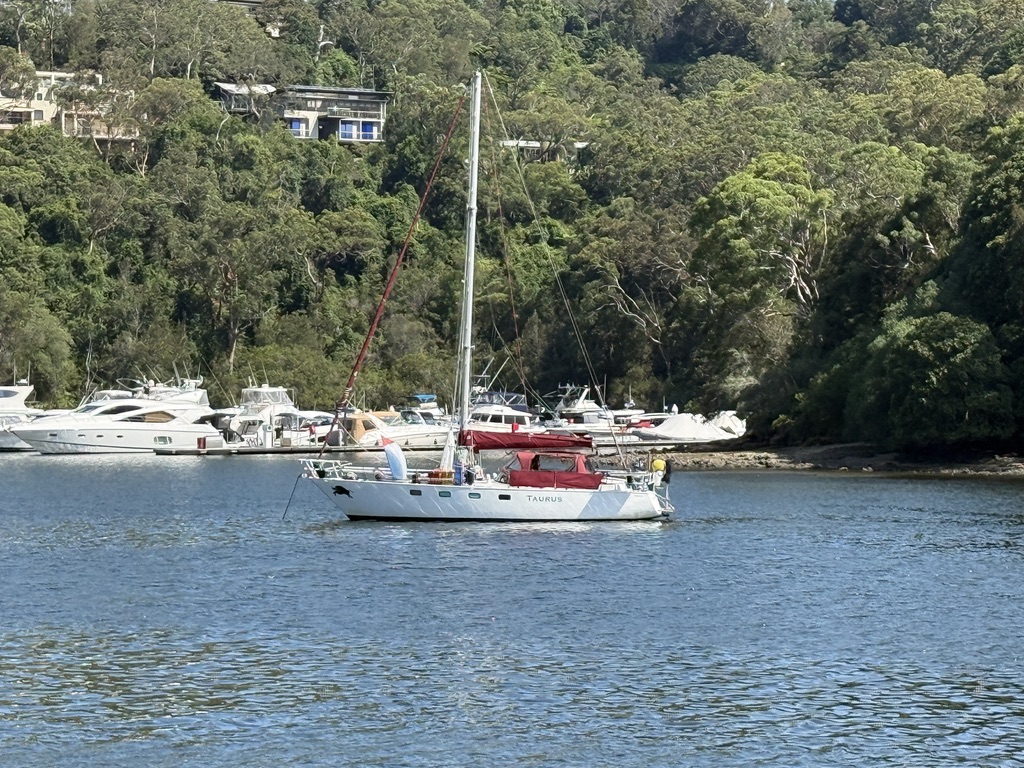
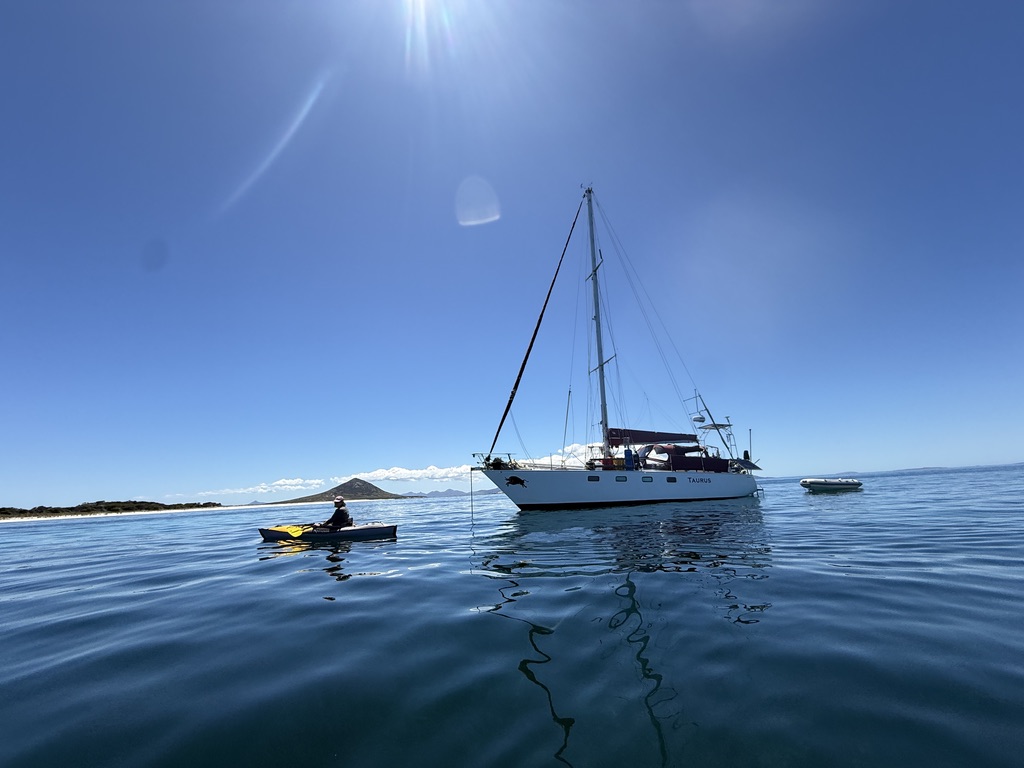
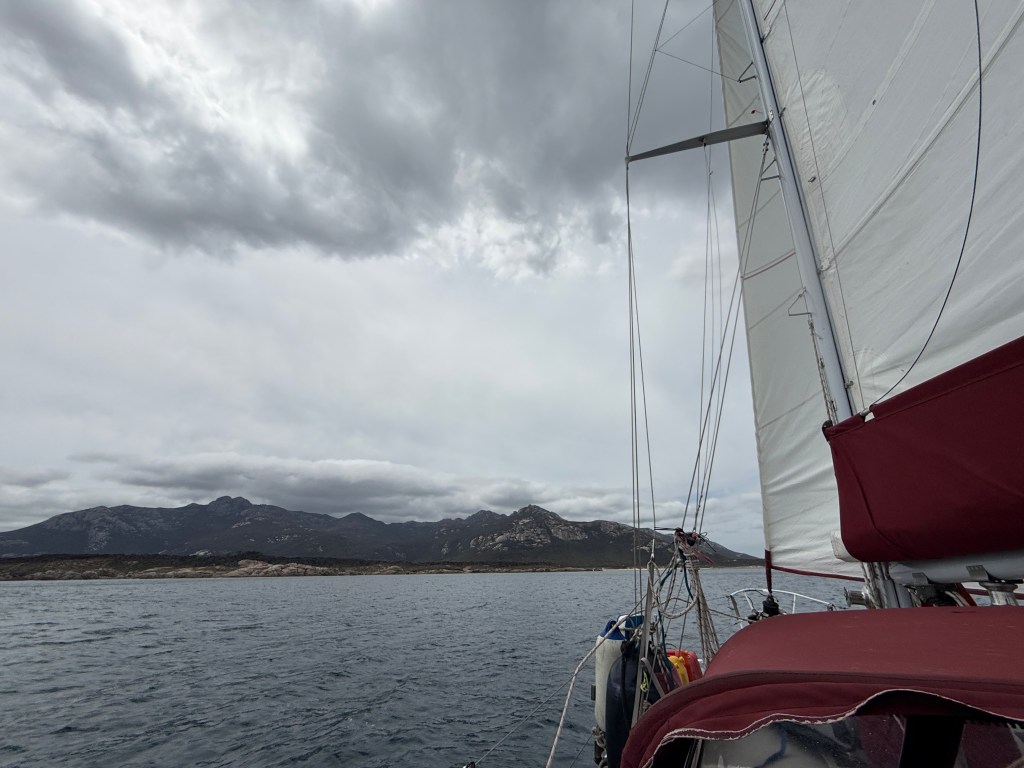
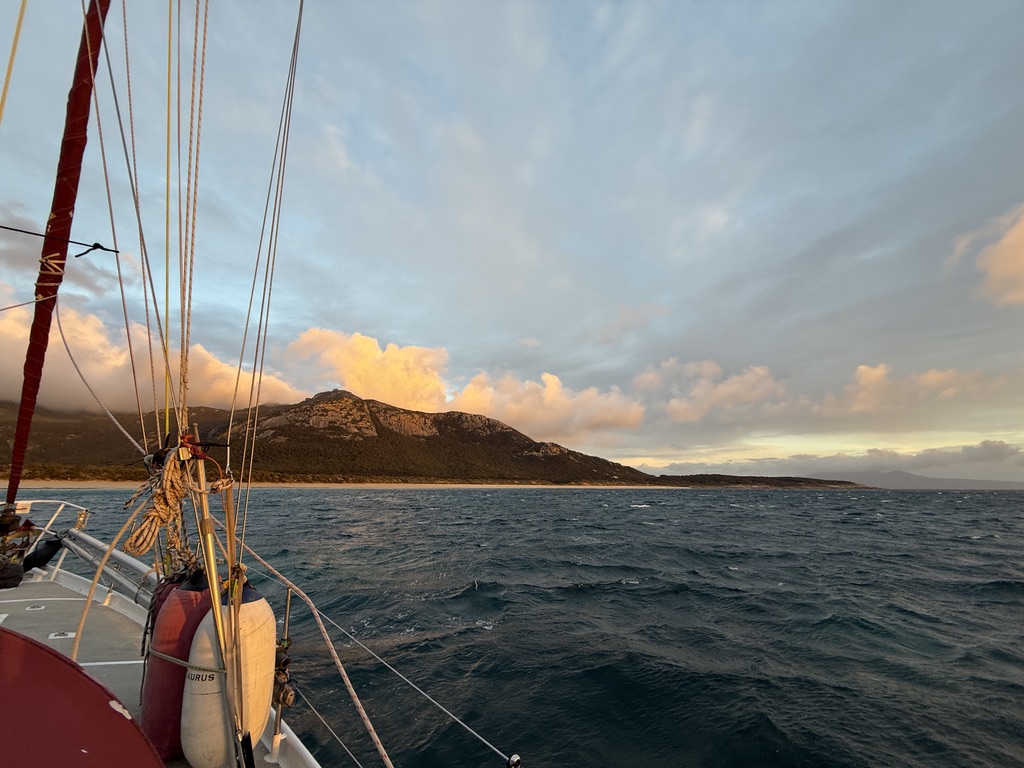
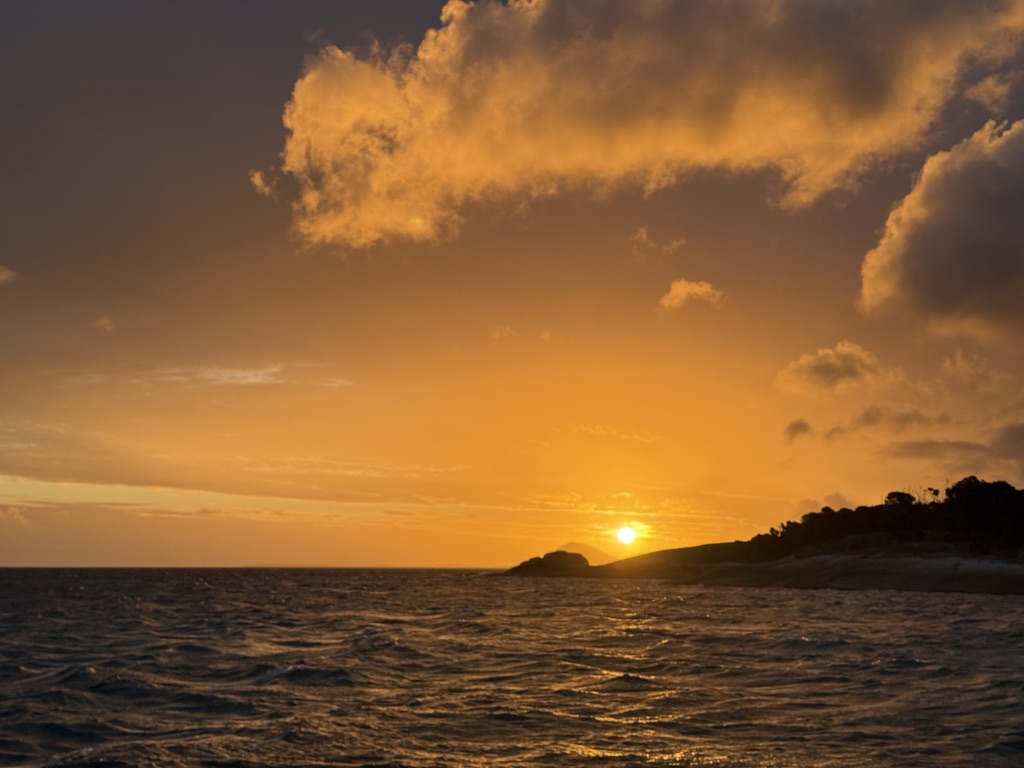
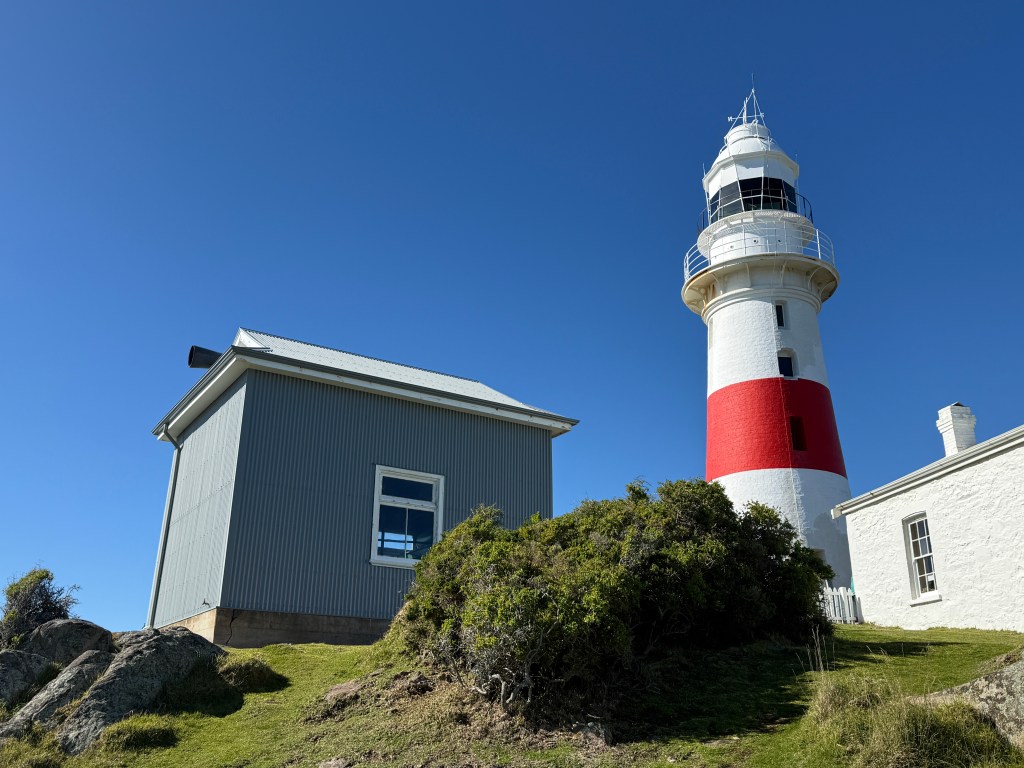
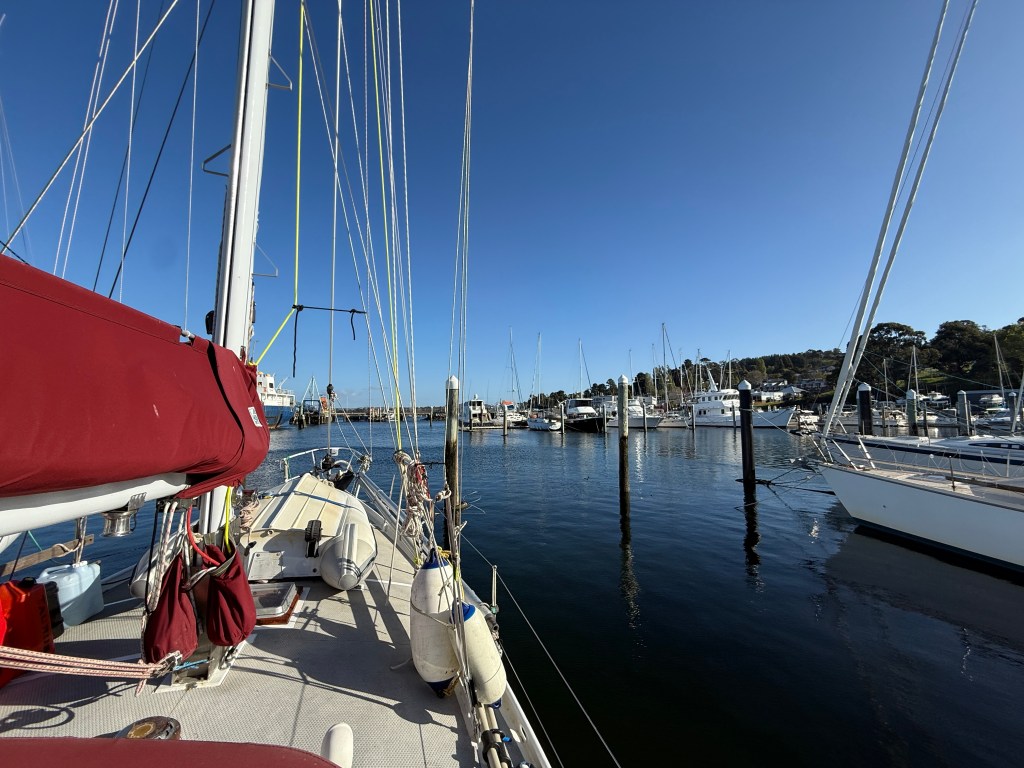
• Sydney to Pittwater

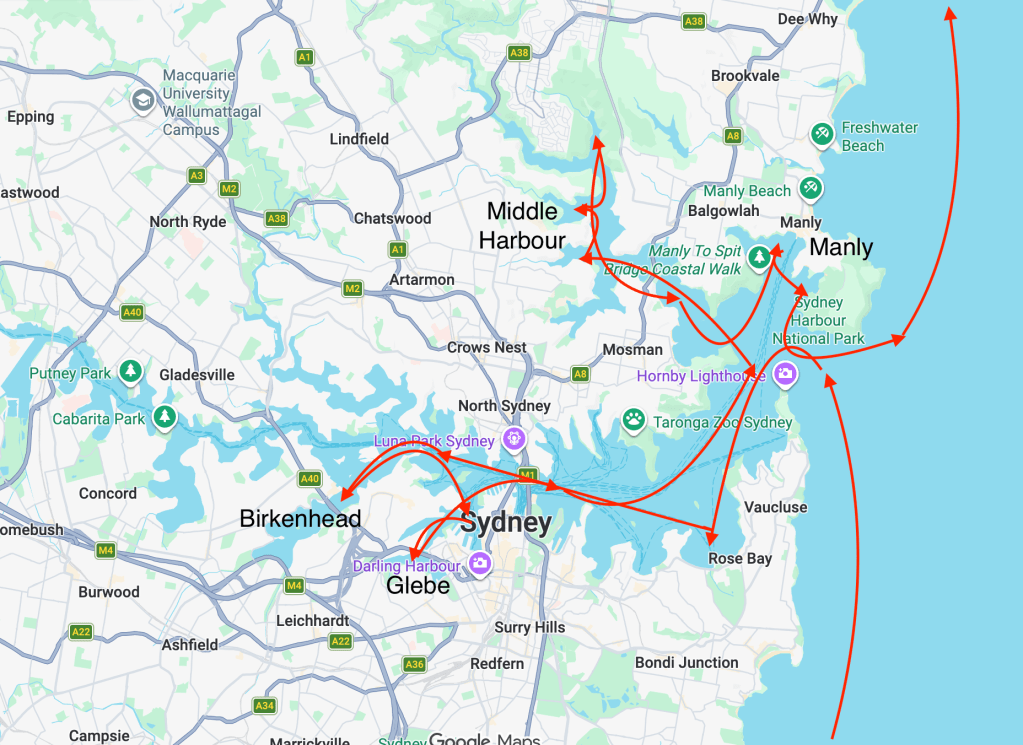
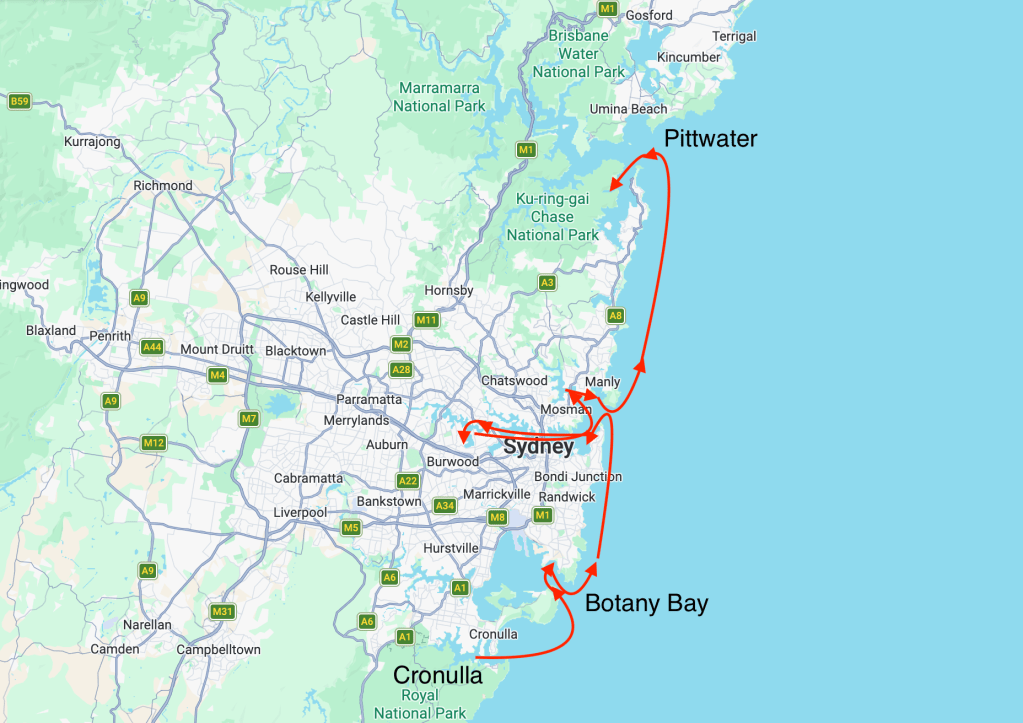
    We sailed into Sydney on Monday the 23rd of February, and headed to Rose Bay. This we knew to be a convenient anchorage: close to the heads, good access to a dinghy dock, showers at the local yacht club, supermarket and liquor store, and a good (and cheap) Thai restaurant. What more could the cruising sailor want? Well, peace and quiet. Unfortunately Rose Bay can be popular with the party crowd, and over a couple of days the number of launches that anchored nearby with music pumping encouraged us to move on.

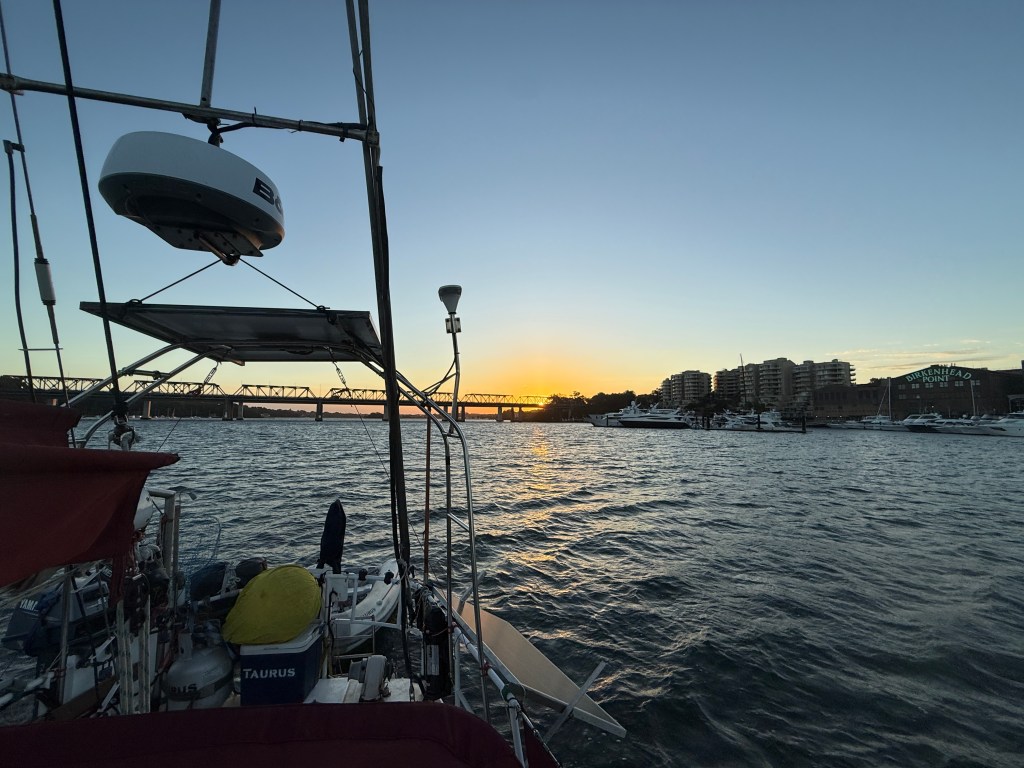
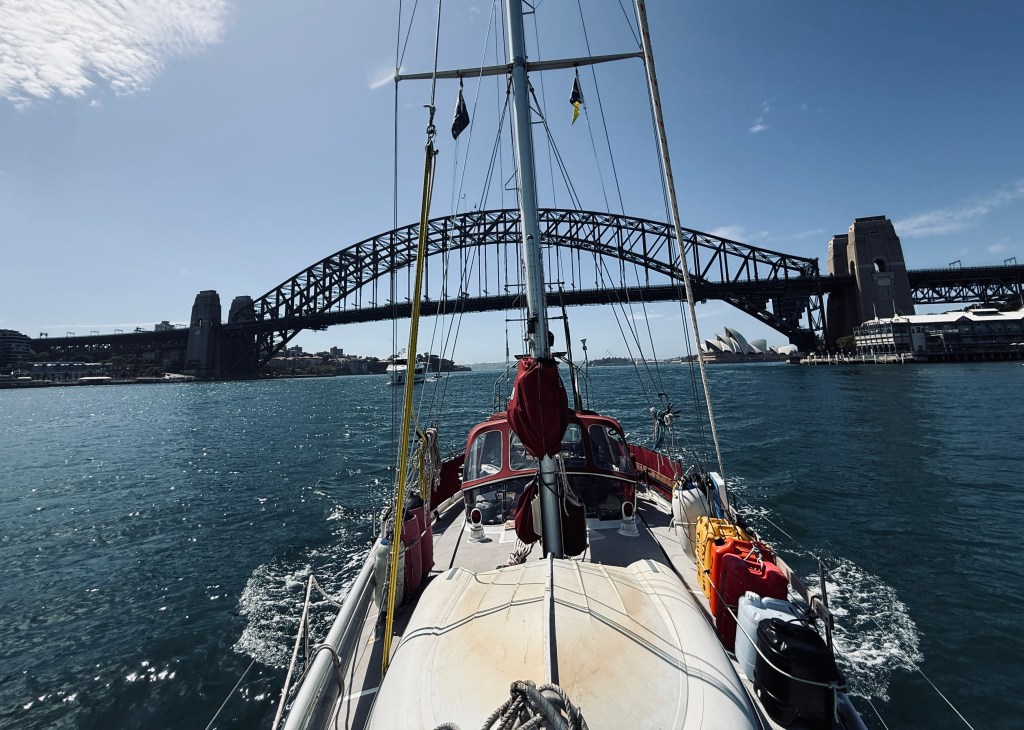
    We headed under the Sydney Bridge to anchor in Birkenhead, home to a massive discount mall and within walking distance of a laundrette and chandlery. We’d stayed here on our previous visit and knew the advantages and pitfalls of the place. Great access to amenities, but not well sheltered and difficult to anchor out of the way. The channel should be plenty wide enough to allow anchored boats and traffic to coexist safely, but the river is popular with rowers who, looking at where they’ve been rather than where they’re going, create an early morning hazard — chiefly to themselves. After being woken a couple of times by alarmed rowers yelling out “yacht!” we called it quits before someone hit us again and we had to provide first aid and counselling before breakfast.

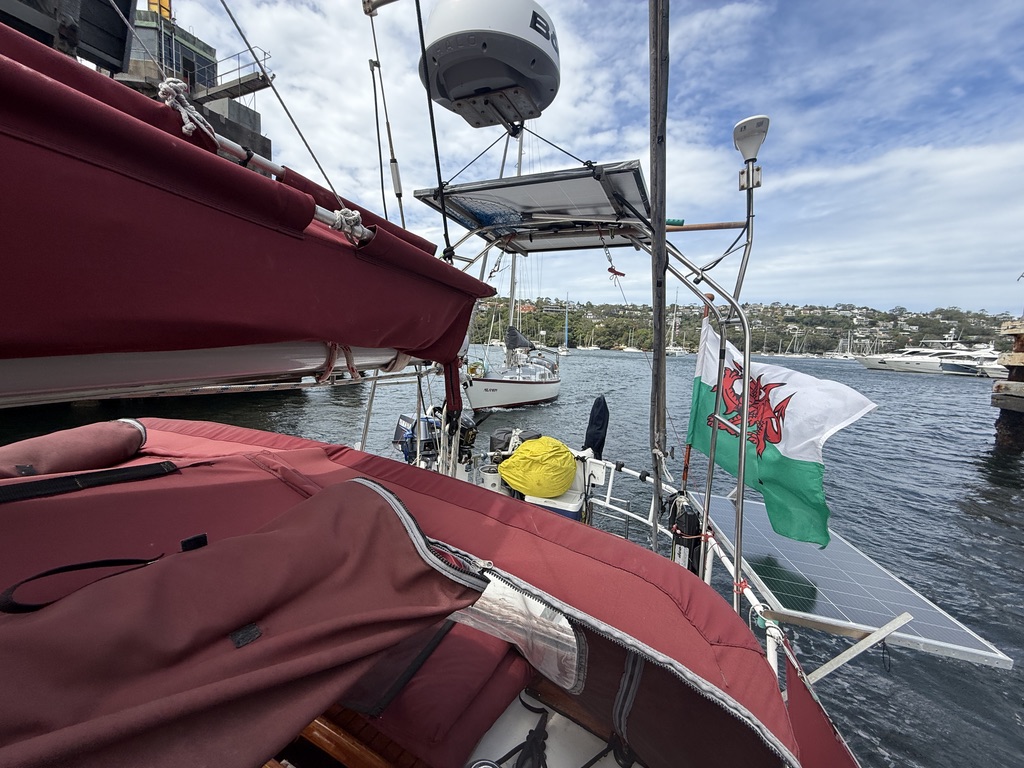
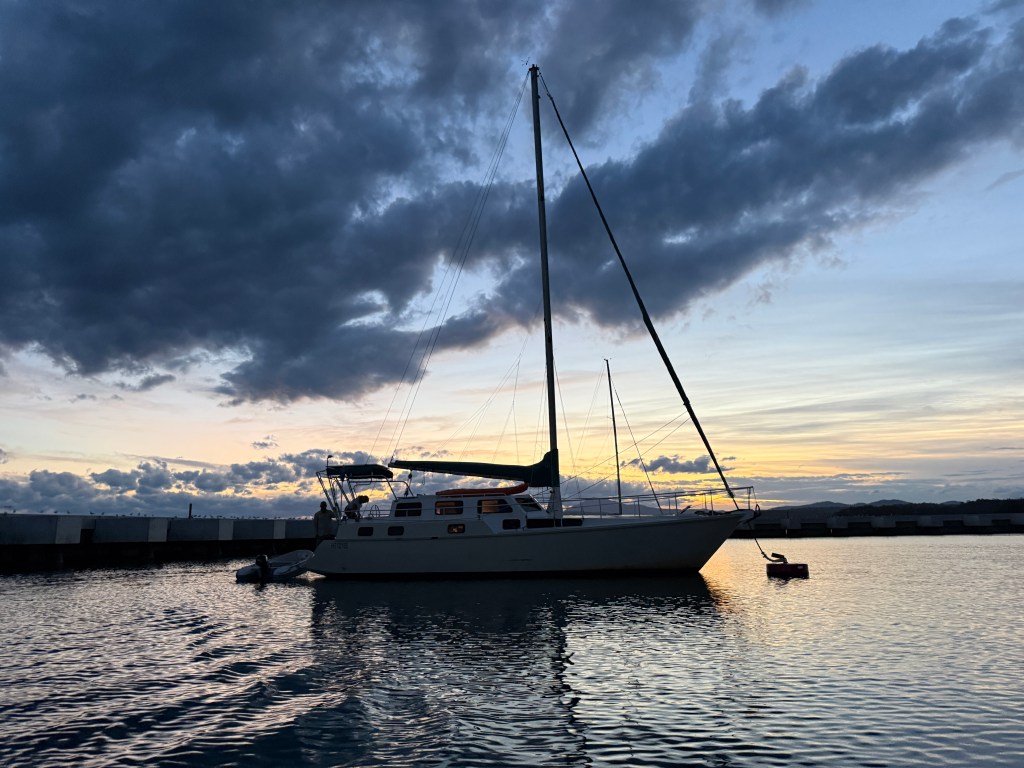
    Birkenhead anchorage.

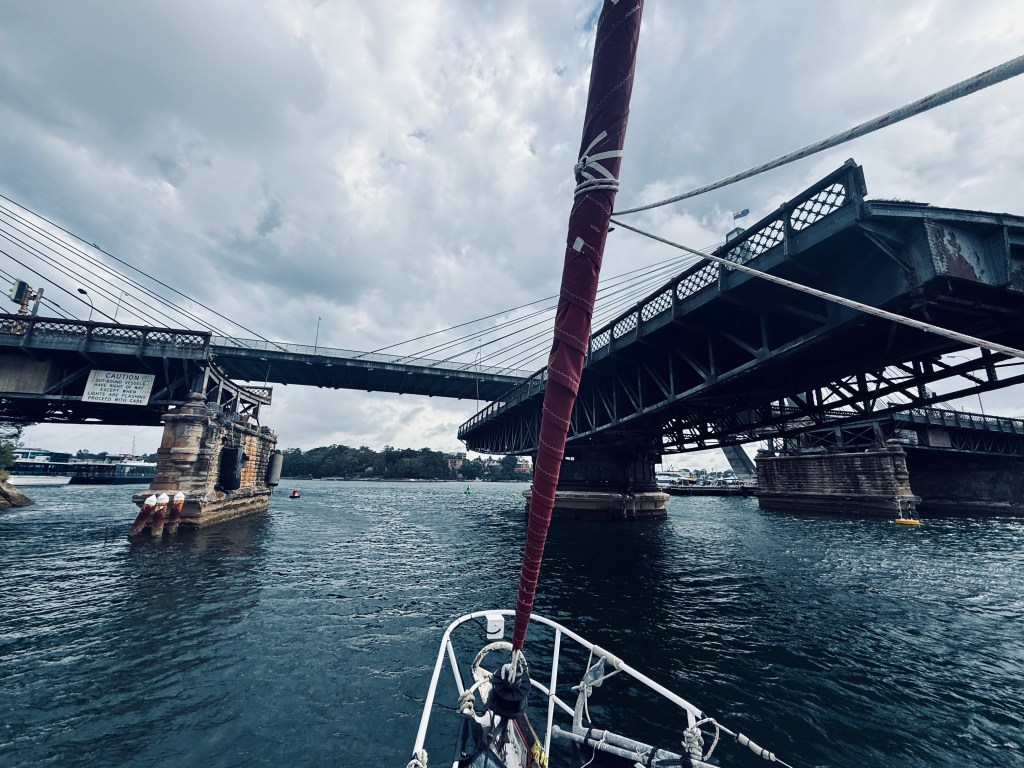
    We lifted the hook and headed back towards the city before turning down a channel to an anchorage at Blackwattle Bay in Glebe. Entering the bay requires passing a now-permanently-open rotating bridge before ducking beneath Anzac Bridge, which is second only to Sydney Harbour Bridge.

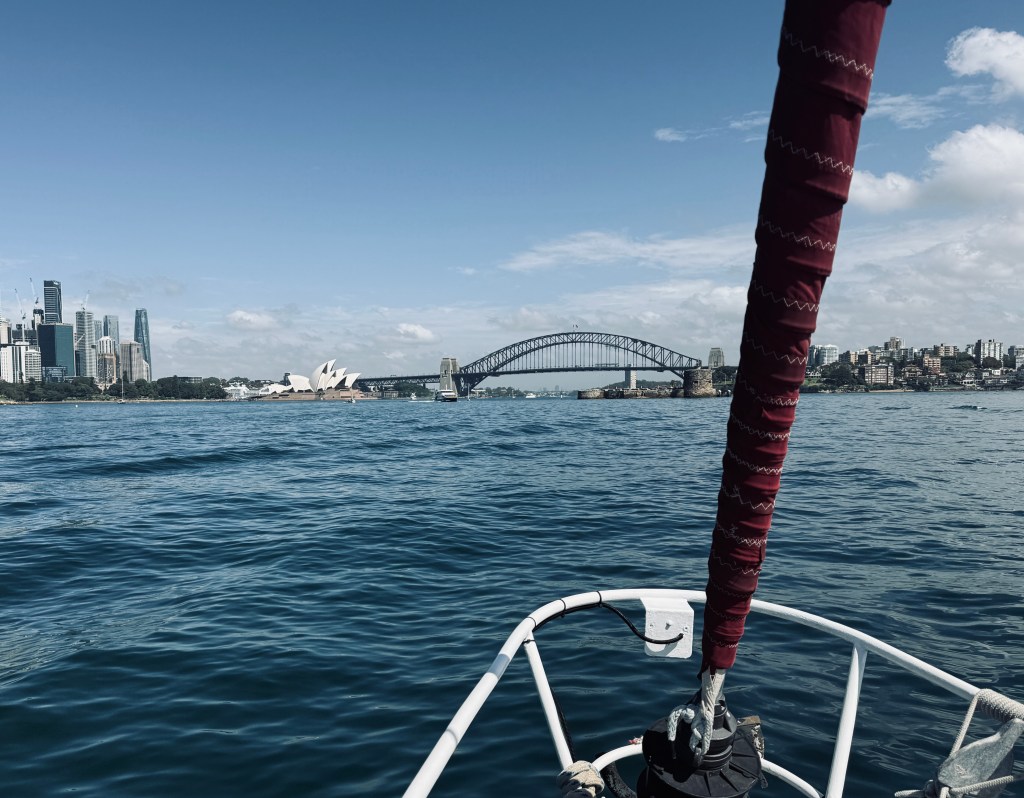
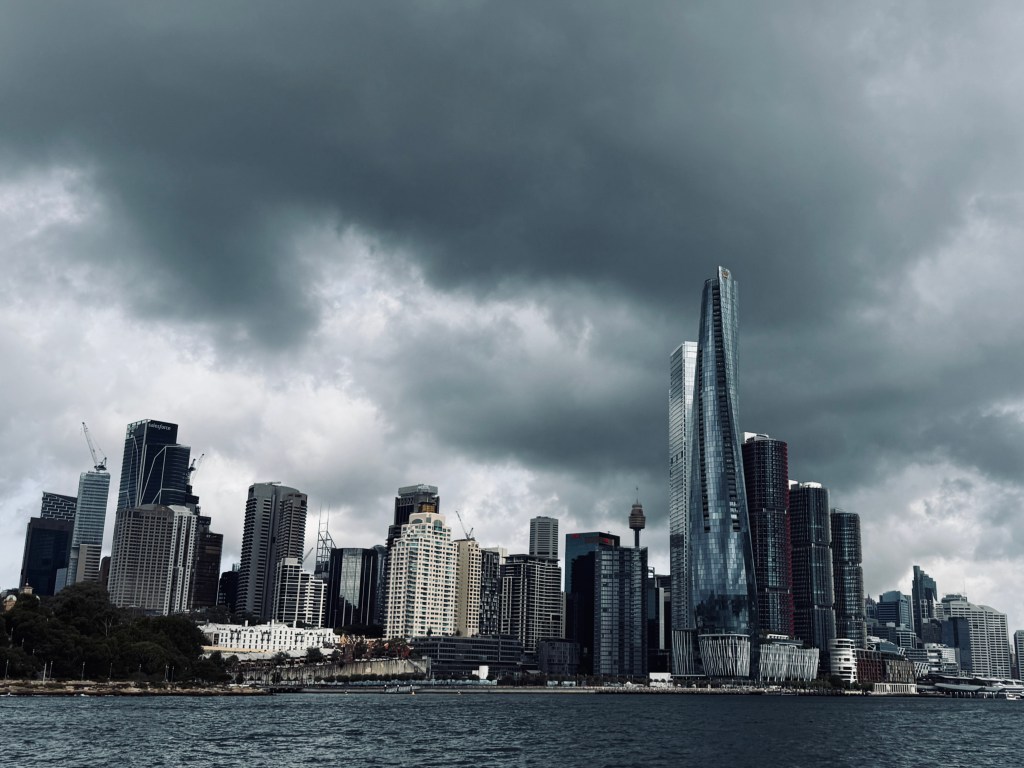
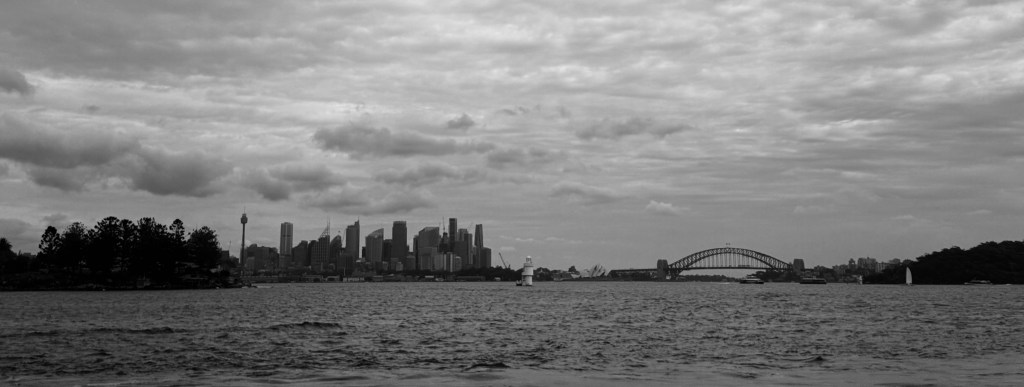
    Sydney sky line was in a bit of a mood.
    Rotating bridge. All traffic has to use the left hand channel — with vessels leaving the bay having priority. A rotating bridge of the same design as this, but still in operation, can be found near the maritime museum. Fantastic Victorian engineering.

    Serendipitously, once inside the bay we spotted a catamaran we knew. We had bumped into Joline and her crew, John and Pauline (hence the boat’s name), in Hobart one wild evening when the southerly wind and swell entering Constitution Dock seemed determined to set all the moored boats free. We spent a memorable evening with the guys, but they left for New Zealand shortly afterwards so it was great to bump into them again. Or at least to catch up with John, Pauline, unfortunately, was away trampling in Patagonia — as you do.

    Blackwattle Bay soon became our new favourite Sydney hangout. There was plenty of room for dinghies on the local ferry dock, and ashore there was a massive park, a track around the bay, and easy access to a nearby supermarket and the city.

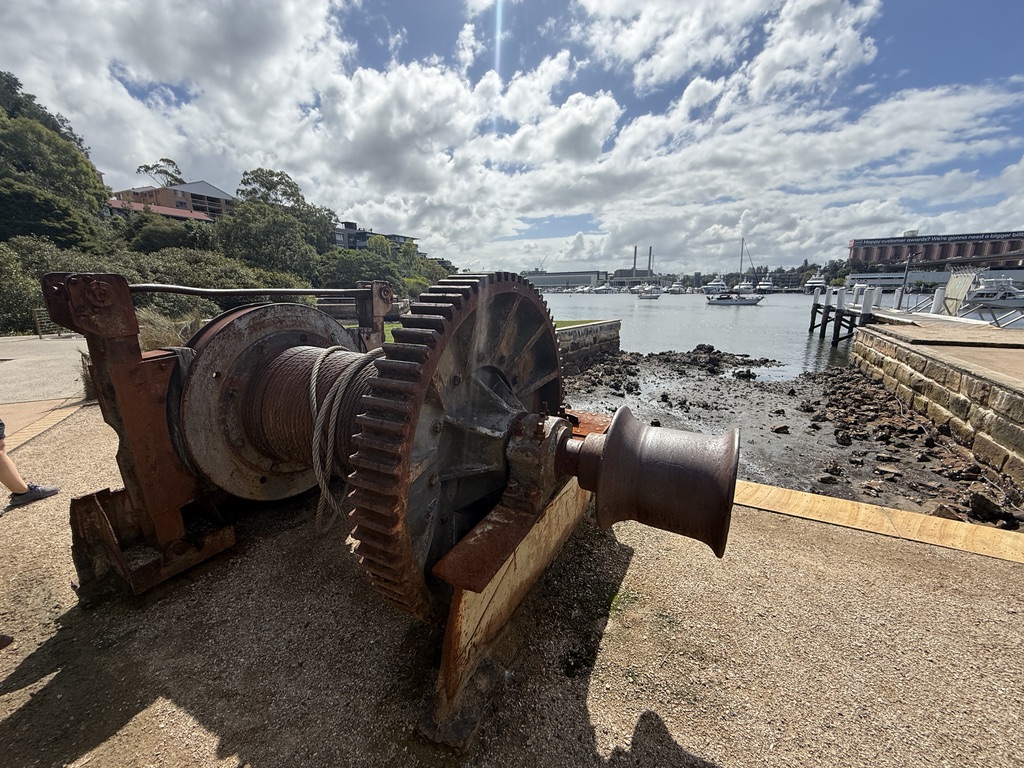
    View from the Blackwattle Bay track. Taurus in background.

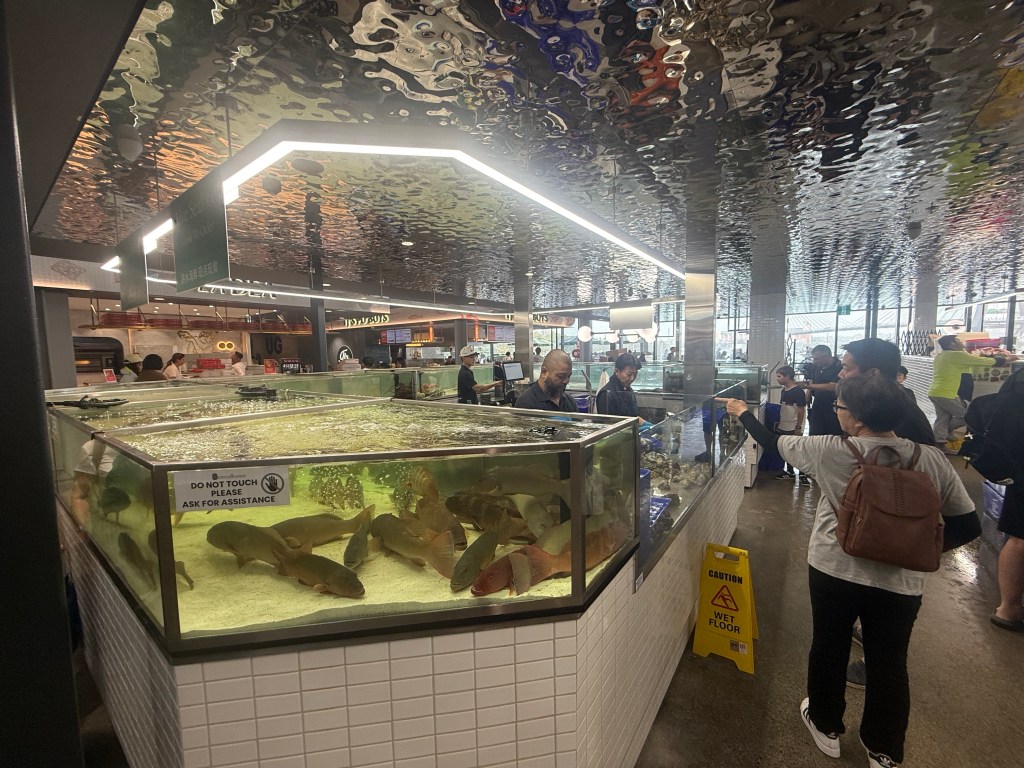
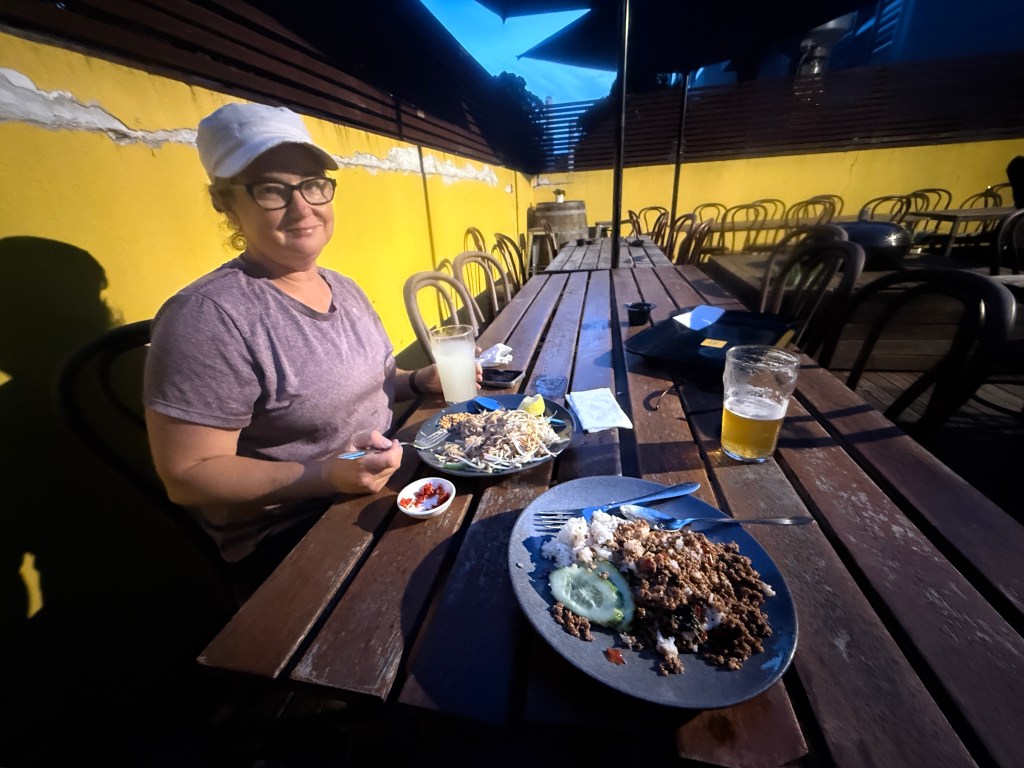
    The local area is famous for its fish market, but, whilst an interesting place to a visit, its focus appears to be the wealthy Asian tourist market. Our budget, alas, lies more towards the, well, budget end of budgets, so having had to pass on the fish and lobster we were delighted to find a pub opposite the market with a cheap Thai Restaurant attached. As the businesses are linked you can order Thai and eat it in the pub whilst enjoying a beer. This is Aussie culture at its finest!

    Fishy, fishy, fishy!
    Budget Thai. Tasty.
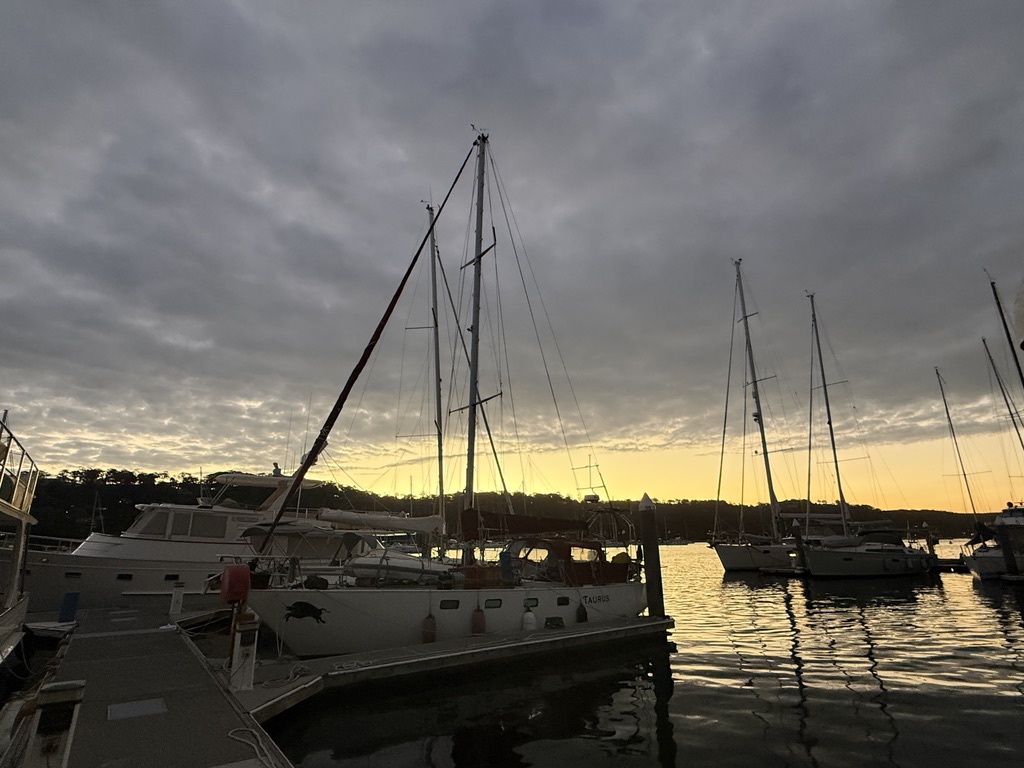
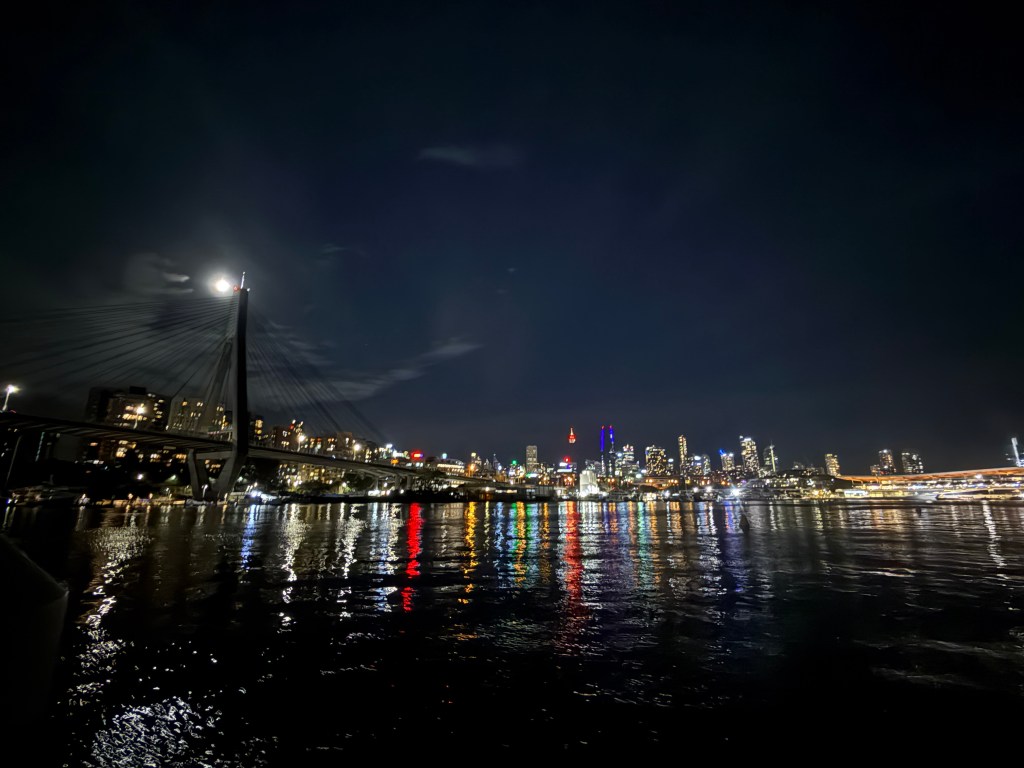
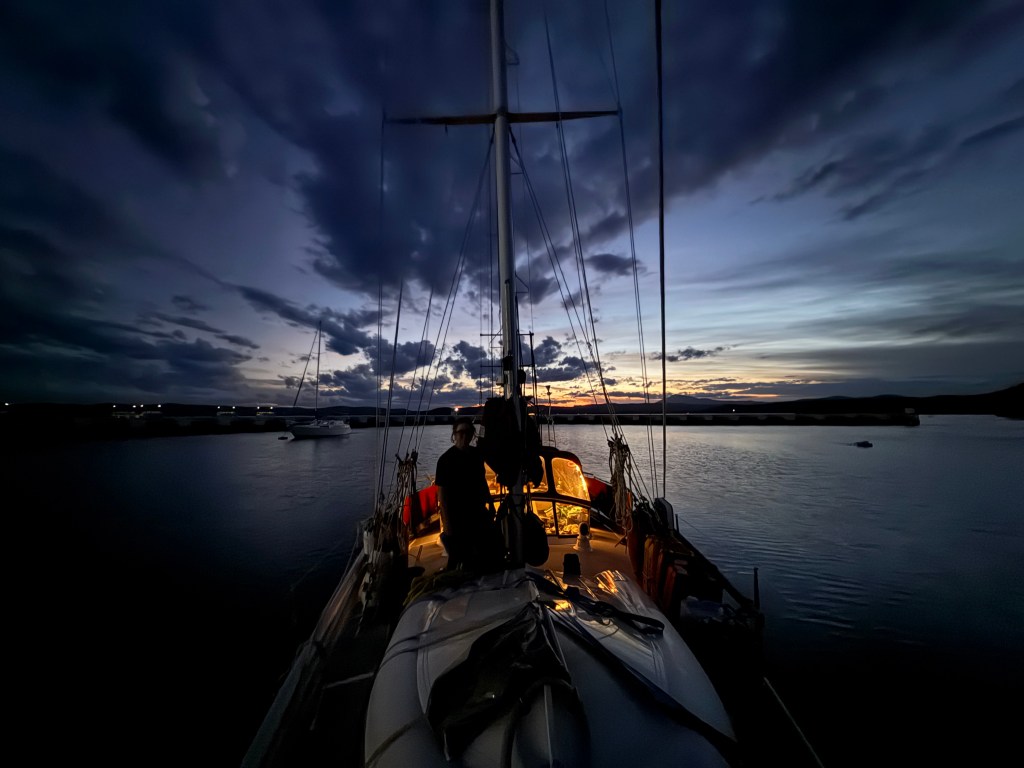
    The view from Blackwattle Bay at night.

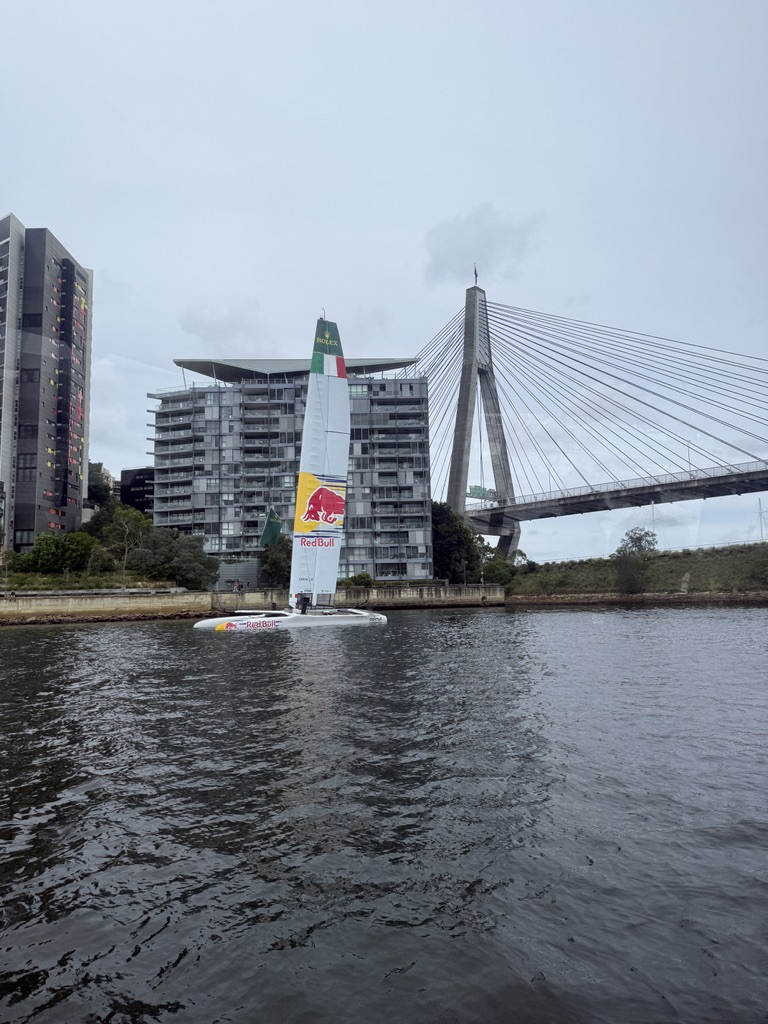
    The circus that is Sail GP arrived in Sydney whilst we were at Glebe, and the various teams set up just the other side of the swing bridge. Many of the locals were excited to see the races, and planned to anchor just outside of the race course, but we had no great desire to face the crowds and chaos. Indeed, a day or two later we met a couple who had been to the races, and who told us that one of their friends had crashed into another boat and was subsequently expecting a bill in the tens of thousands. Such games we prefer to avoid.

    The Italian Sail GP team. We left them standing… (they were on a mooring).

    Our next destination was an area known as Middle Harbour. We had heard rave reviews of this ‘hidden gem’ in Port Jackson (aka Sydney Harbour), so we had to go and explore it for ourselves. Access is governed by a lifting bridge that opens a few times a day, more or less at two hour intervals. Arriving early, we sat on a public mooring next to the bridge, and as the clock ticked closer to opening time we were interested to see a number of boats, obviously planning on passing the bridge, jostling for position. I thought that we were best to wait on the mooring until the bridge opened, but as the traffic started to thin and we released the mooring and started to accelerate towards the bridge we found it unceremoniously dropped in front of us. You could almost hear the bridge operator chuckling to himself and saying, ‘too bloody late mate!’ Needless to say, two hours later we joined the wacky races, trying to avoid other boats whilst rushing to get under the bridge before it closed again!

    chop chop under the bridge.

    Middle Harbour lived up to its reputation. We enjoyed anchorages surrounded by bush and replete with such a chorus of bird song that, against all odds, it managed to drown out the noise of the city.

    Anchored in Crag Cove. Food and fuel are available in the marina, and a small beach gives free access to a public park and local shops.
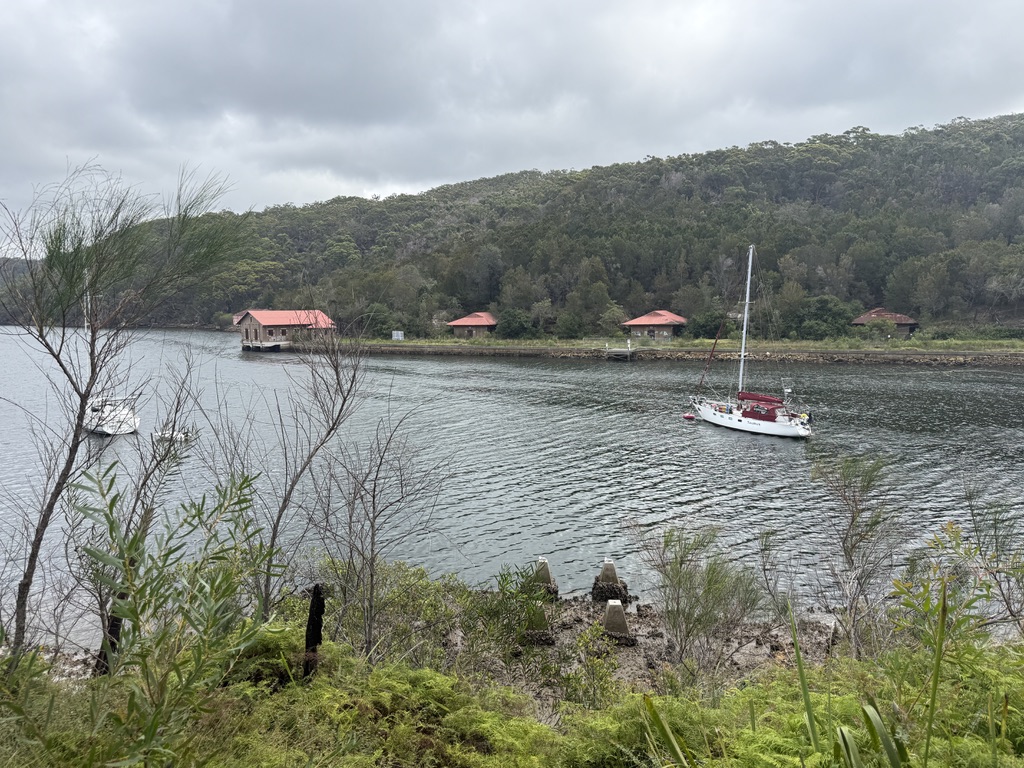
    Another day, another anchorage. This is Bantry Bay. The buildings used to be used to store ammunition and are off limits to the public

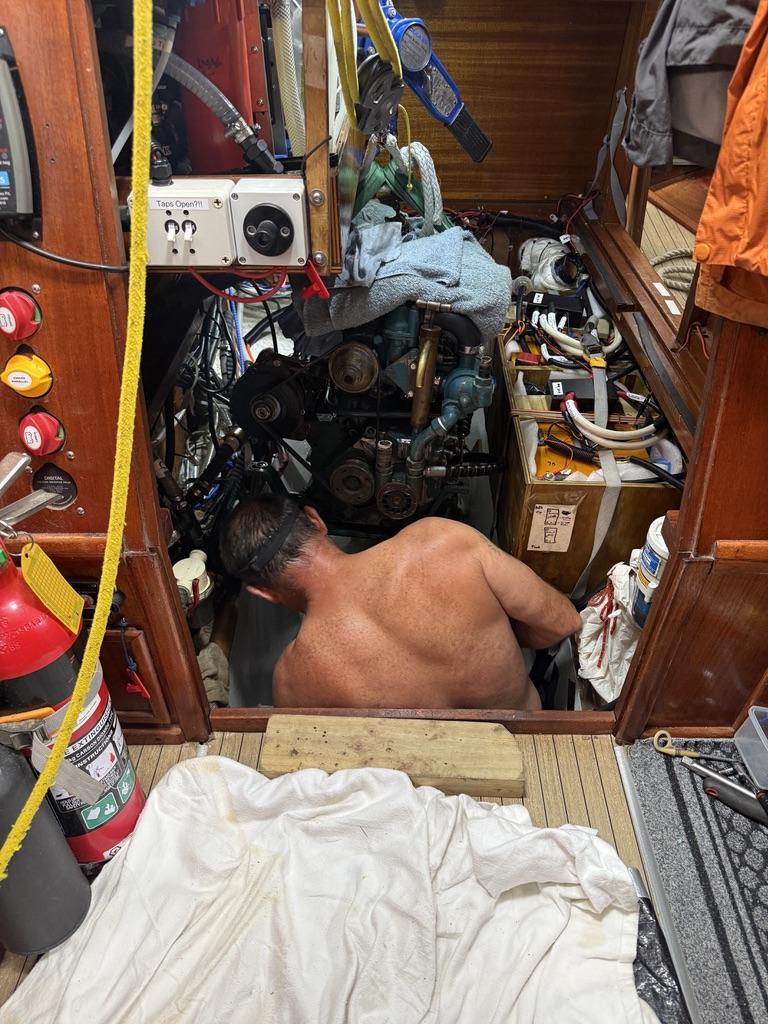
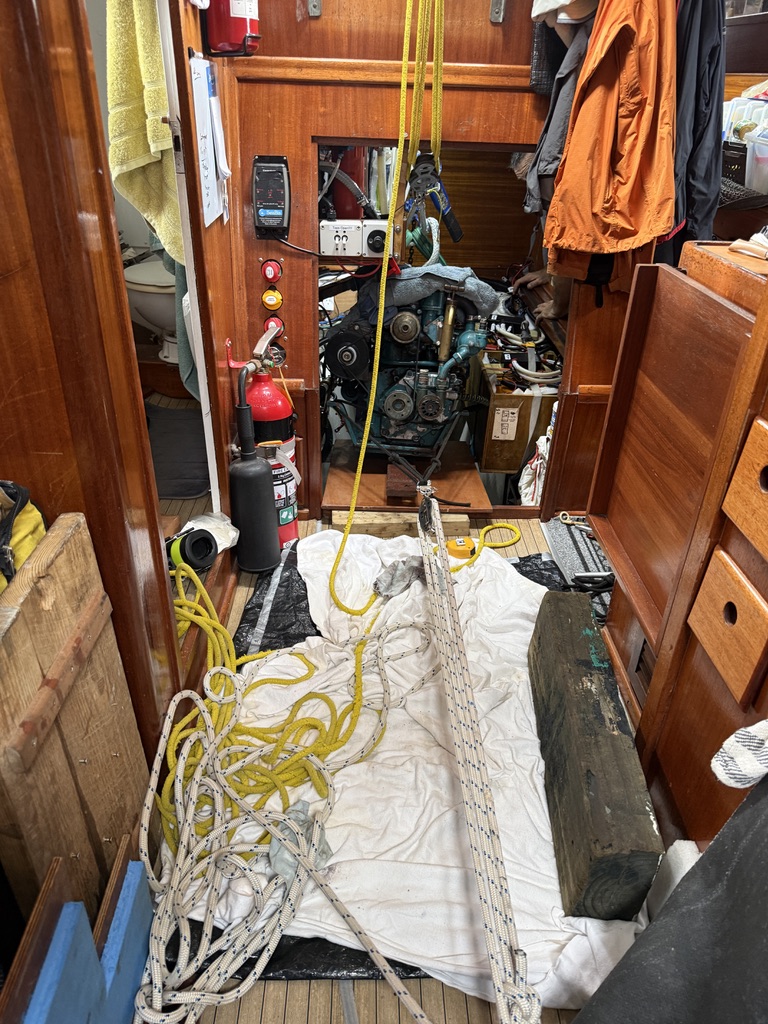
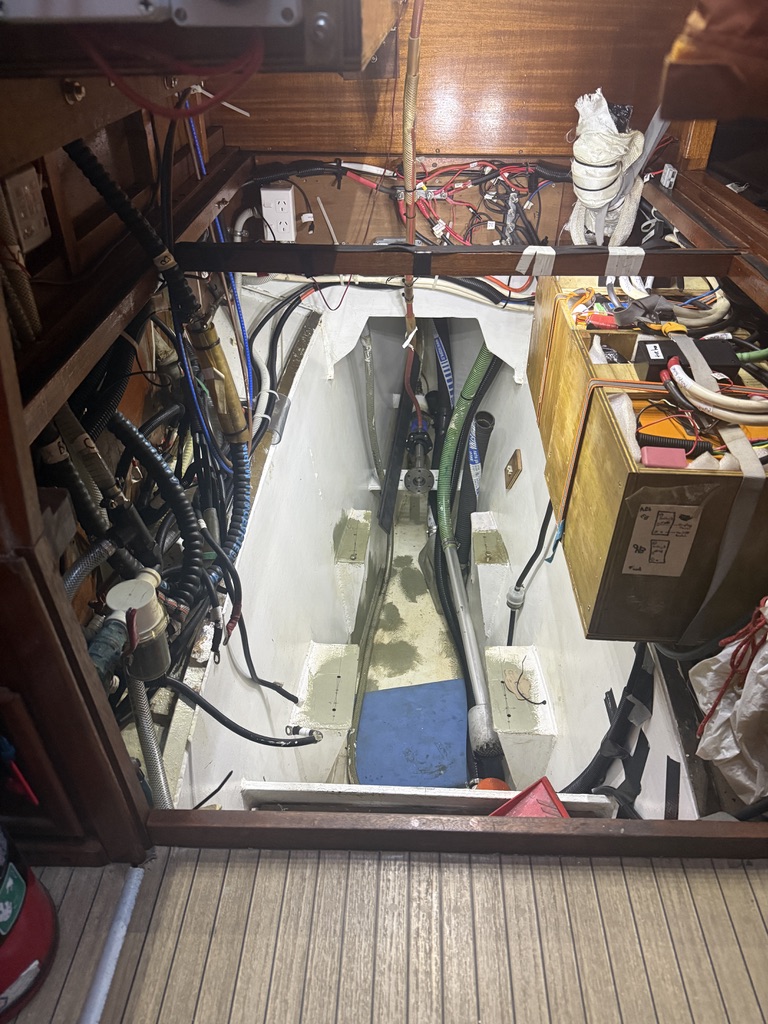
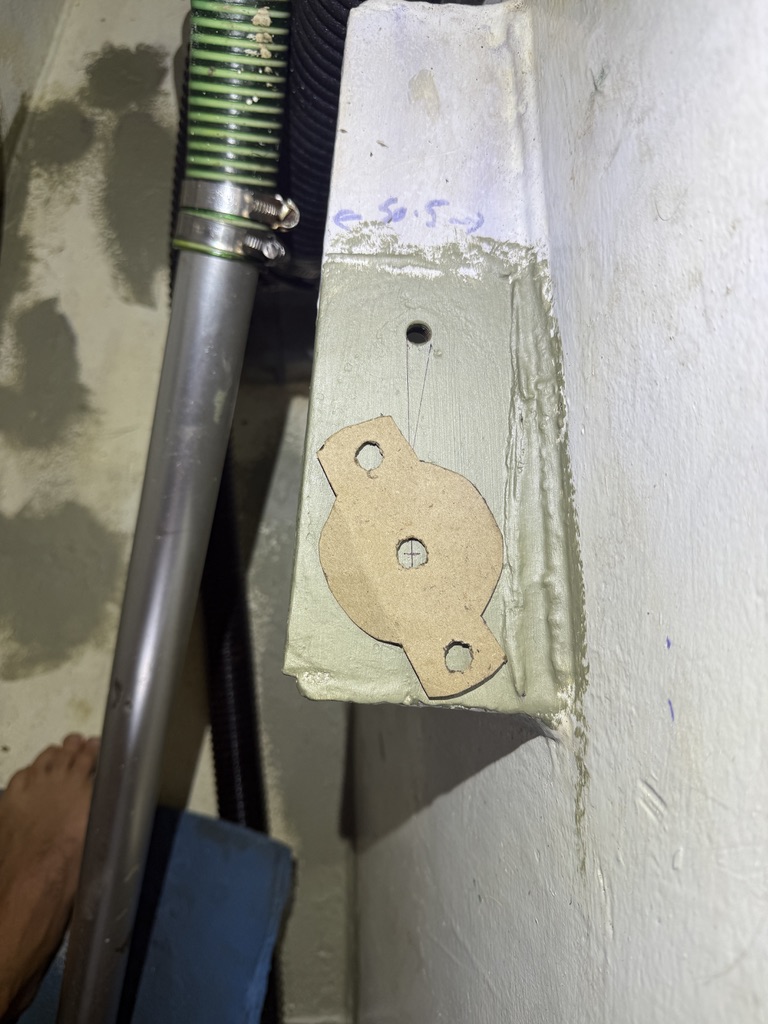
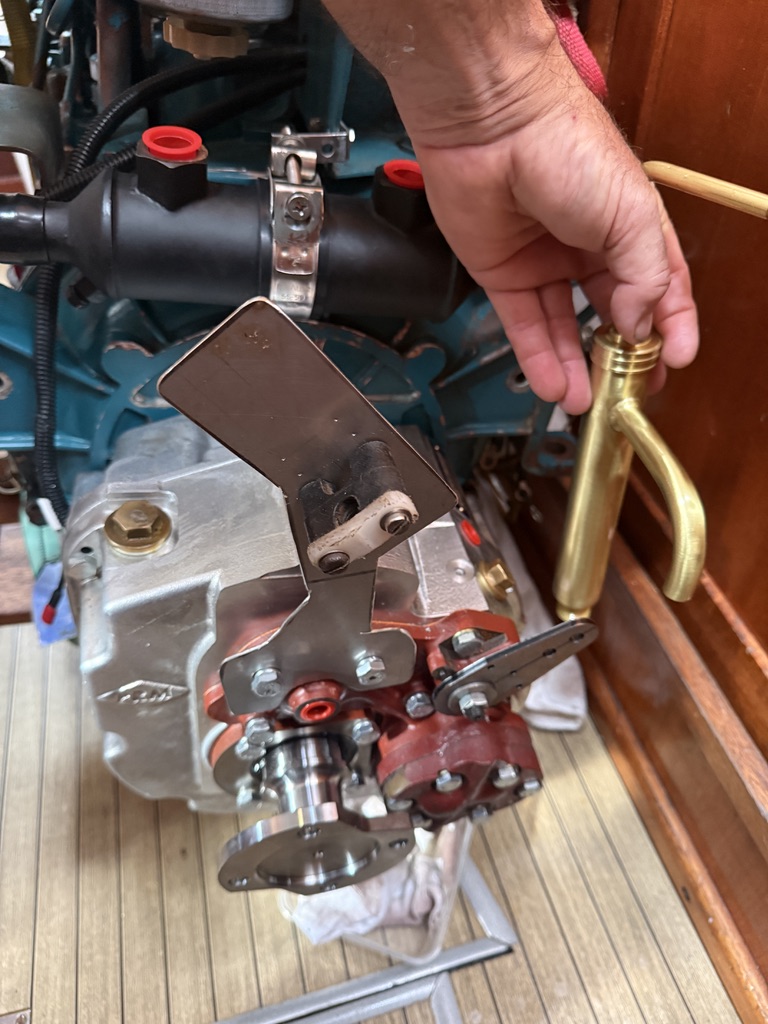
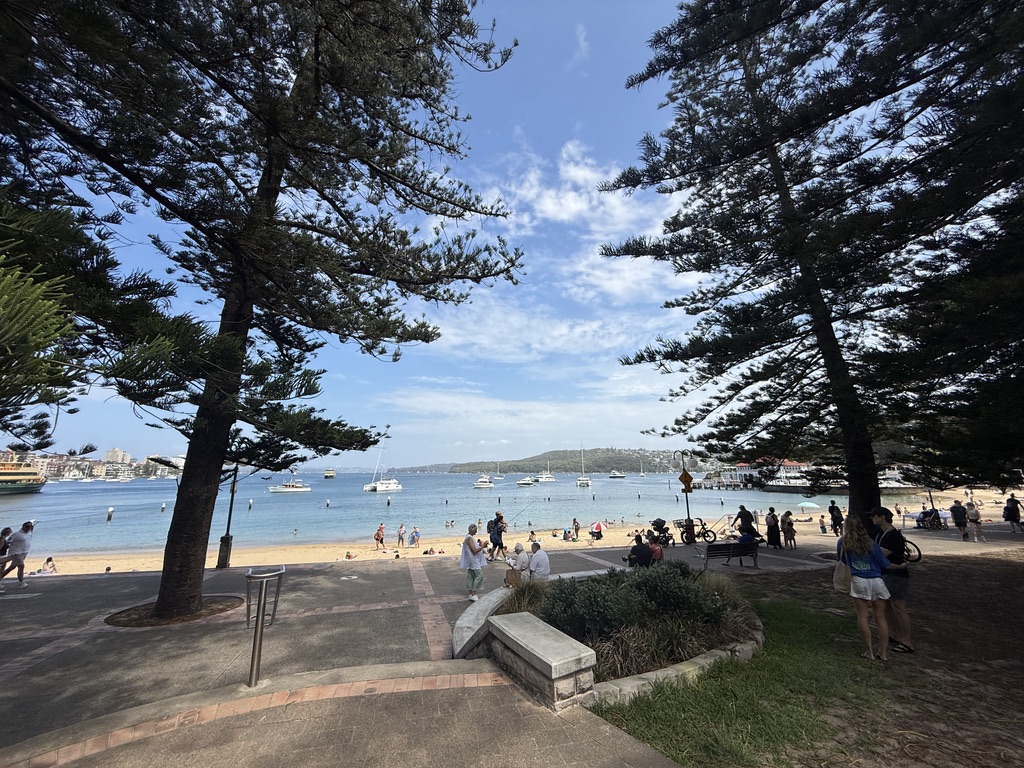
    After a week in Middle Harbour we popped over to Manly, Sydney’s playground for the young and beautiful, to stock up on groceries before heading north. We had been having an ongoing issue with the gearbox which was becoming increasingly worrisome. The symptoms were that it was becoming increasingly difficult to engage drive when the engine and gearbox were cold, but once warm the problem disappeared. As the issue worsened It became clear that this was not a minor hiccup due to something like cable adjustment, but a potentially major gearbox catastrophe. This was disappointing, to say the least, as we replaced our gearbox a year ago, and the new gearbox had only had 275 hours of use.

    We knew the cost of marine mechanics and hauling out in Sydney to be ‘prohibitive’ (read insanely expensive), and as we had an appointment to meet a water-maker chap in Pittwater, the next harbour to the north, we decided to head there and see what happened. As the old joke goes, ‘De Nile ain’t just a river in Africa!’

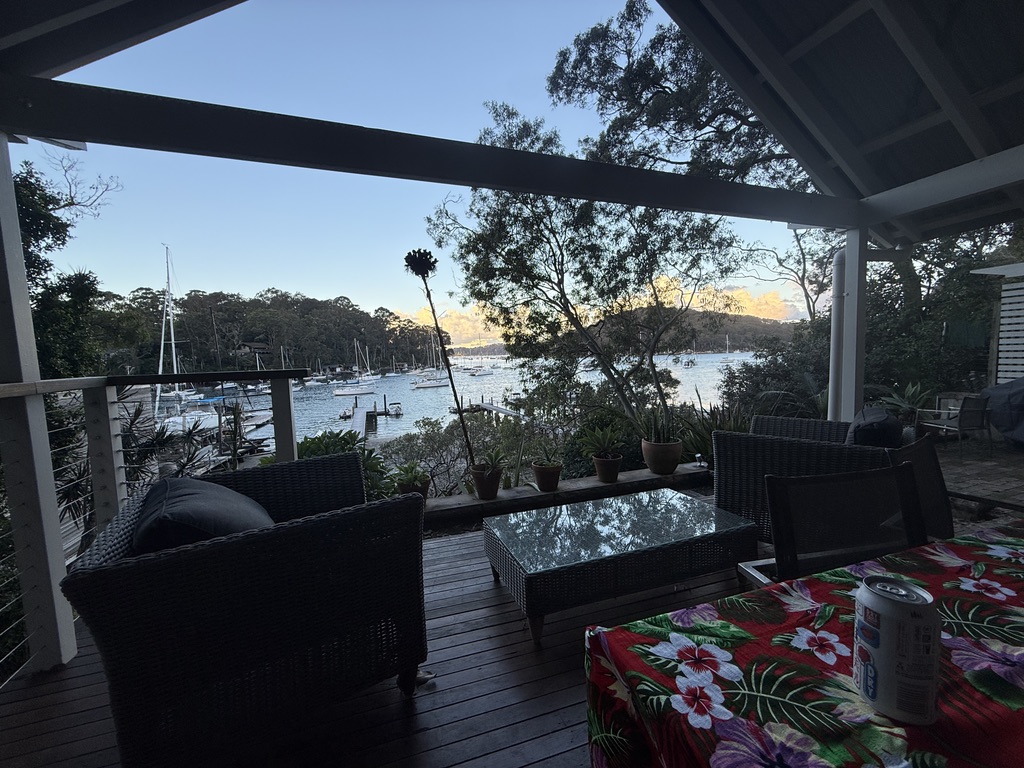
    We arrived in Pittwater safely, but the boat’s refusal to engage gear when cold had become significantly worse over the previous couple of days. The problem had to be identified and resolved. It was a bit of a shame to have the shadow of this latest malfunction hanging over us, as it put a bit of a downer on our experience of the big smoke, and our trust in Taurus.

    This, of course, is the tax that cruisers have to pay — the yang that balances the yin which consists of freedom, beautiful anchorages, and glorious sunsets. If cruising was easy everyone would be doing it, and the old saw that describes cruising as ‘working on boats in exotic locations’ is far truer than the uninitiated might expect. We all hope for a bit more yin and a bit less yang, but such things are beyond the control of mere mortals.

    Next time, isolating the problem and trying to find a solution…

    The voyage of the good ship Taurus: 23rd of February to 8th of March 2026

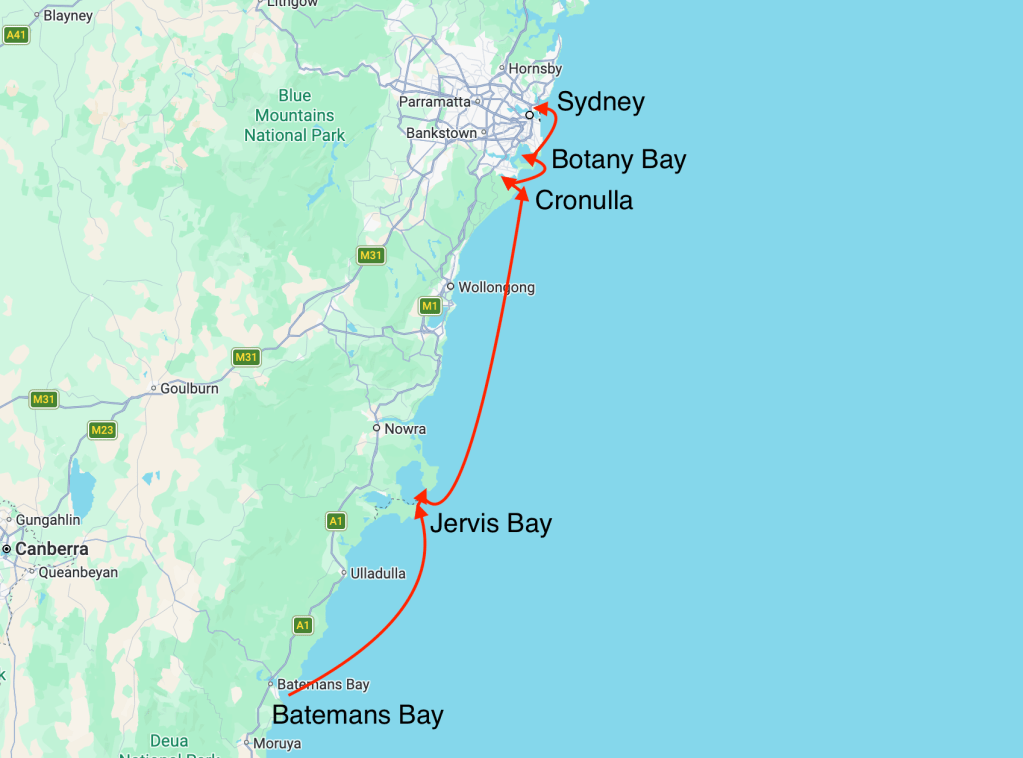
  • Batemans Bay to Sydney (via Jervis Bay, Cronulla, and Botany Bay)

    After a couple of quiet days in Batemans Bay a weather window appeared that would allow us to sail the fifty nautical miles to Jervis Bay, a ten hour trip more or less. We dropped our mooring, re-crossed the bar, and anchored in the north east at Maloneys Bay, ready to leave when the wind appeared late morning.

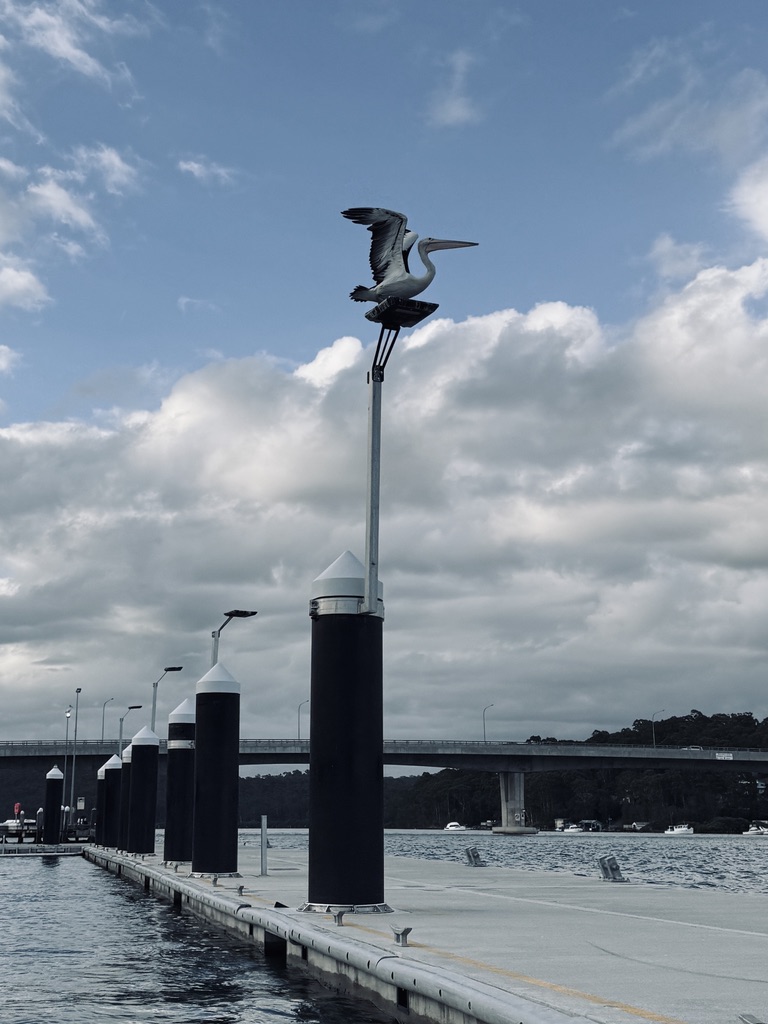
    You have to be mindful what you are walking beneath in Australia. This pelican would provide a lot of good luck!

    In the event it was one of those days when the wind appears, disappears, appears, disappears and so on, ad infinitum, ad nauseam. We were kept busy raising and lowering sails until, finally, when we were about two hours out from Jervis Bay, a squall suddenly appeared, bringing with it twenty to twenty five knots on the nose. An old weather saying has it that what is ‘sudden to arrive is soon to depart,’ but this wind kept on until we gratefully turned into Jervis to find some protection.

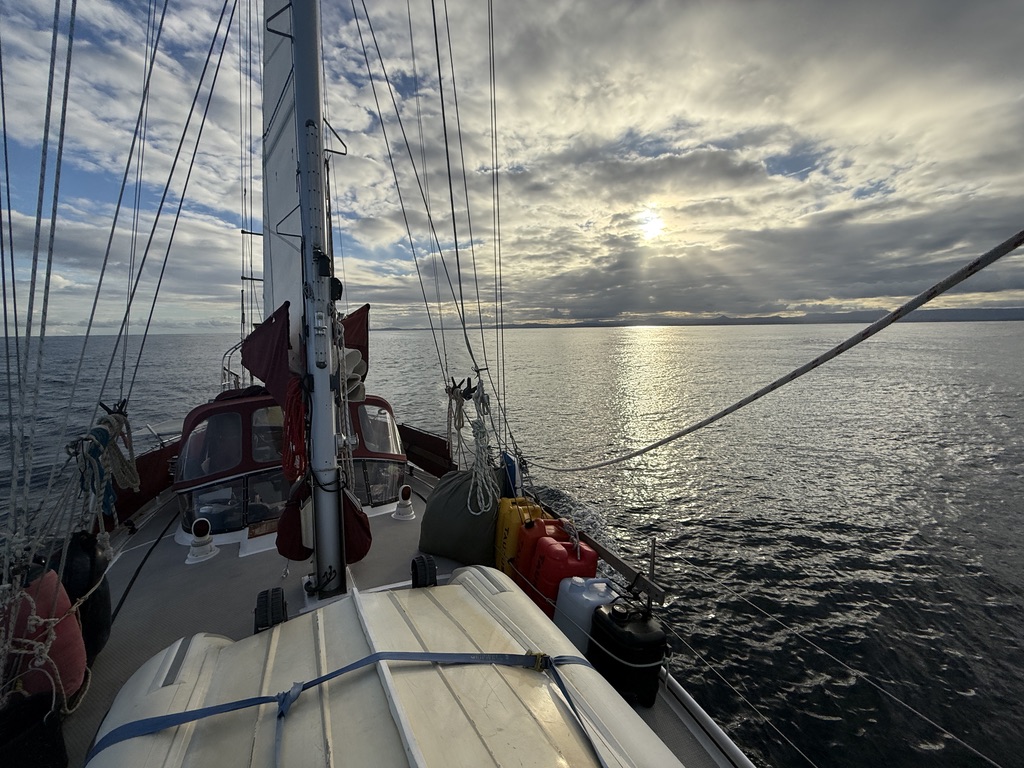
    No wind at this stage…

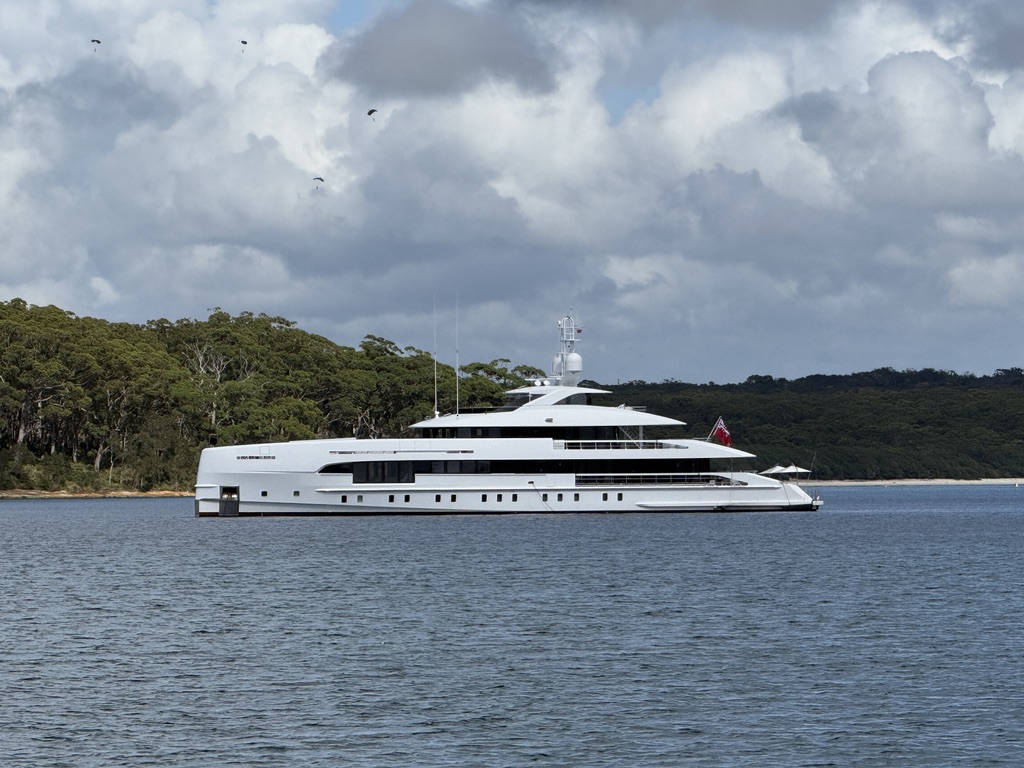
    We anchored near the Royal Australian Naval Base, and next morning woke to a spectacular, sunny day. A super yacht was anchored nearby, flying the flag of some tiny island tax haven. As I’ve said many times before, the best thing about cruising is the amazing people you meet, but I’ve never really felt the desire to meet the owner of a super-yacht. I suspect that we would have little to talk about, and as this one was also flying the flag of Israel, probably the less said the better.

    Our neighbour for the day.

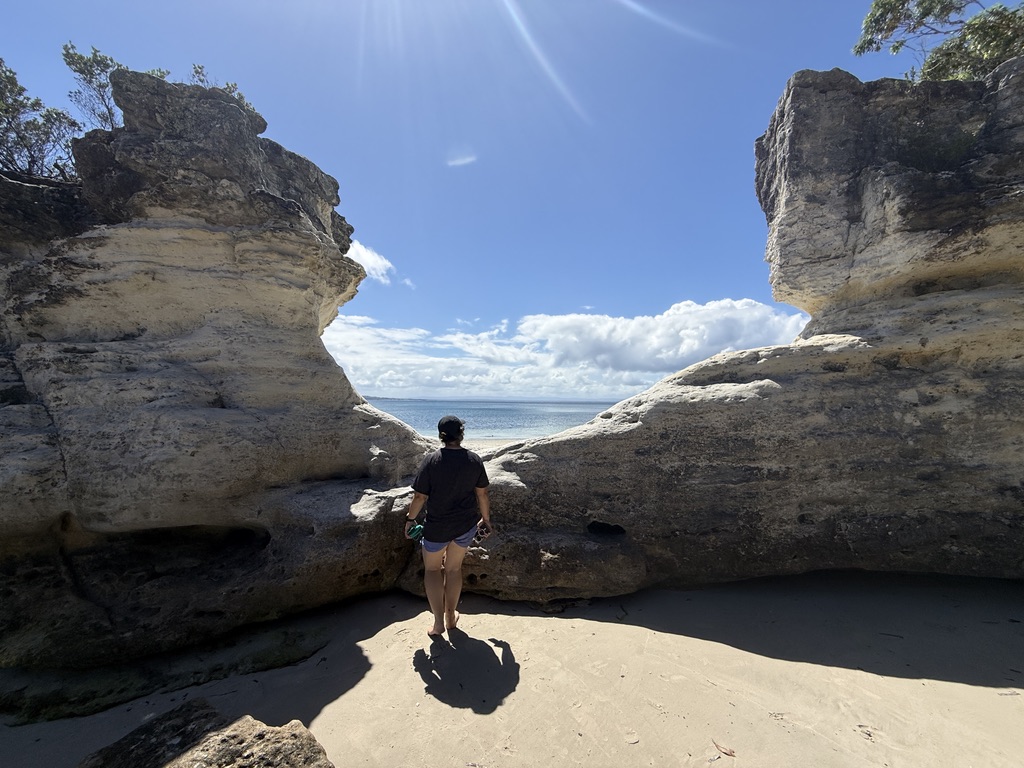
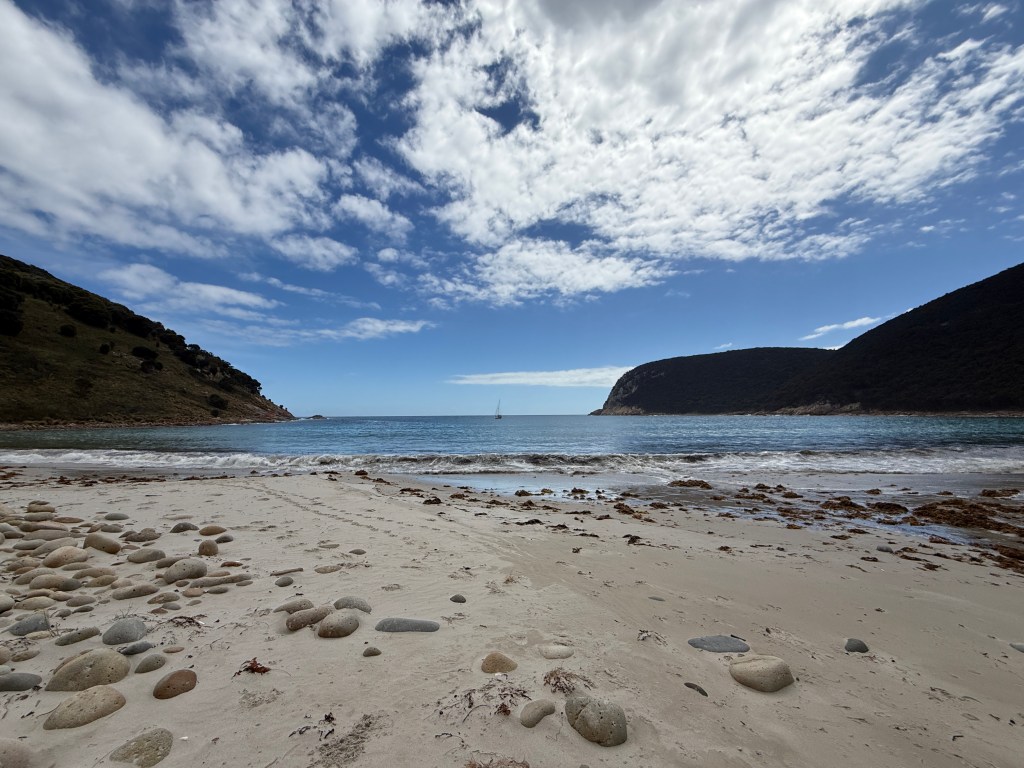
    We ‘dinghied’ ashore for a walk and a swim and to explore the local rock attraction. Known as the ‘hole in the wall,’ it lived up to its reputation.

    Strong northerlies were expected to arrive, so we lifted the anchor and headed to the north side of Jervis, taking cover in a bay called Boat Harbour. The wind blew hard all day with equally strong southerlies predicted to follow the day after — another opportunity to get north.

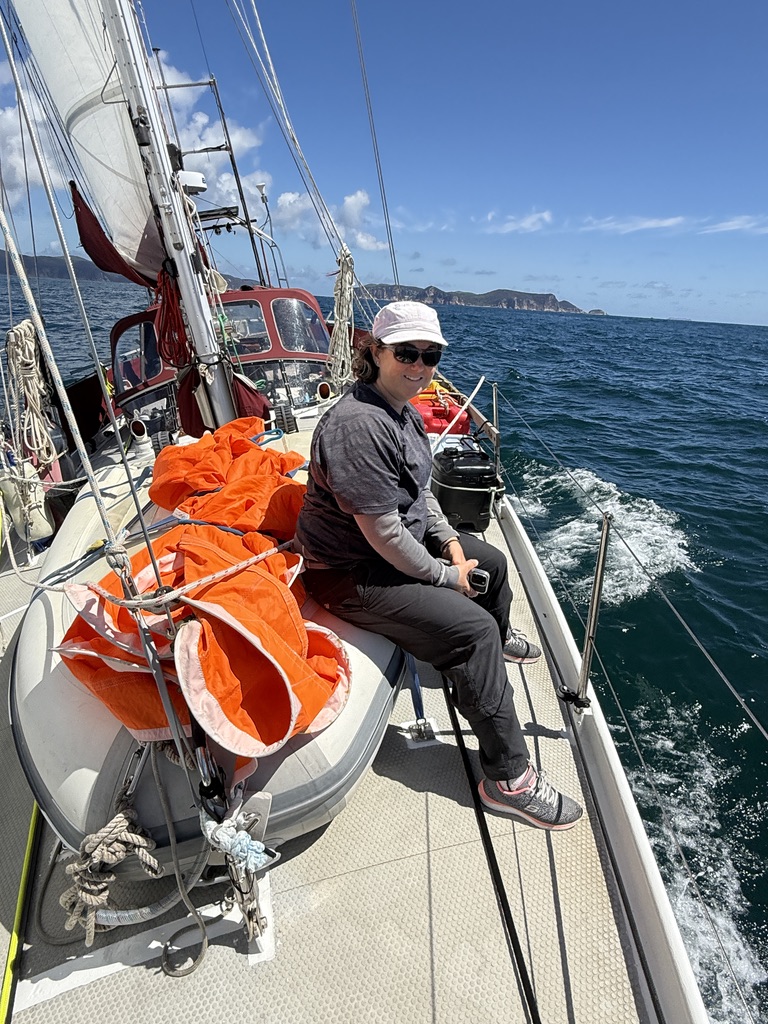
    We waited until midday, when the southerly was due to come through, and poked our nose out past the northern head, aptly named Perpendicular Point. The wind rapidly rose from fifteen to twenty five knots, and then to thirty knots! This was going to be a blast!

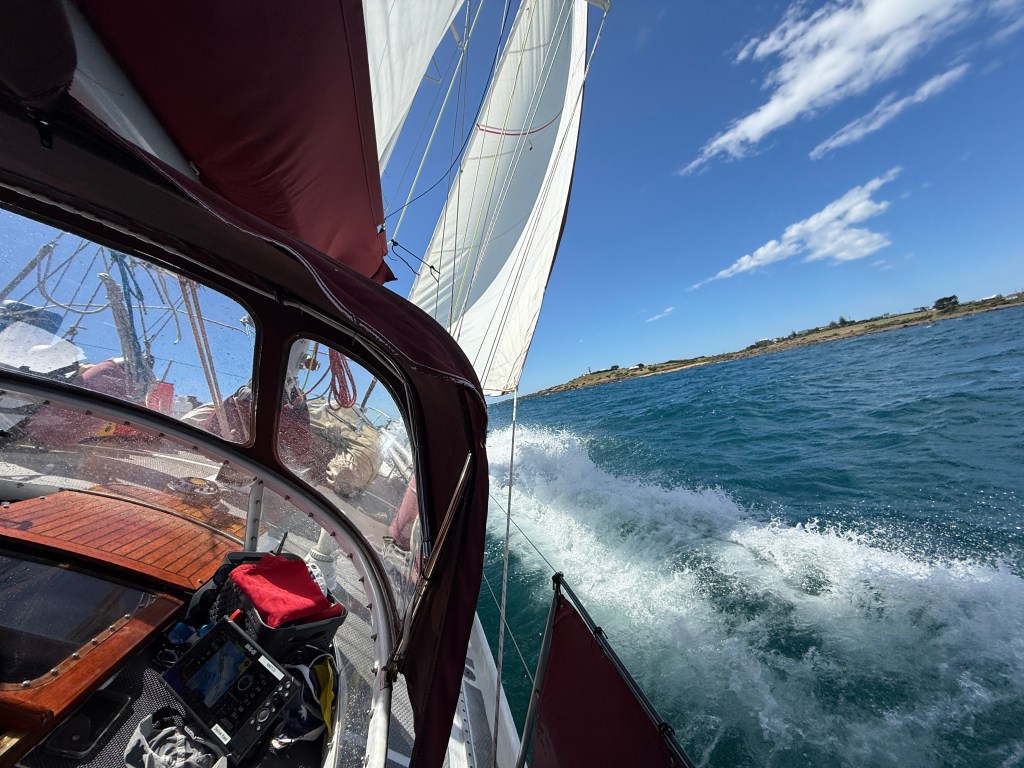
    In this video we’ve just left Jervis Bay. You can see that we’re well reefed down until we get a sense of what the wind’s going to do.

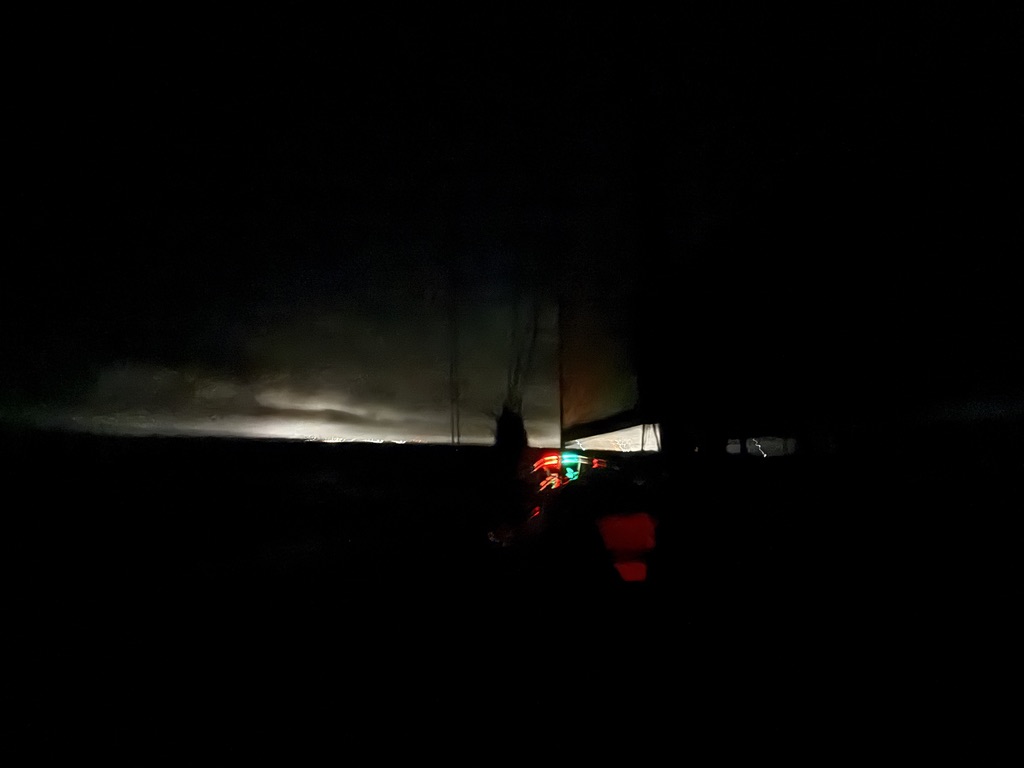
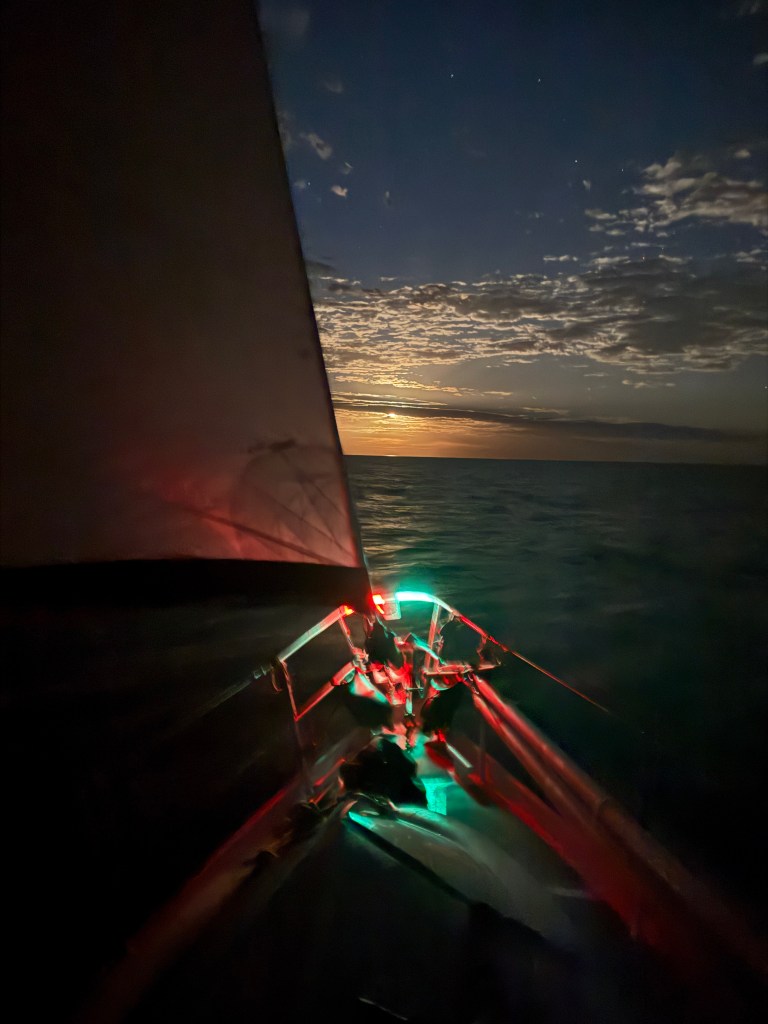
    The seventy nautical miles rapidly disappeared, and before long we could see the distant lights of the Sydney metropolis.

    Sydney in the distance.

    We wanted to try and visit some of the spots that we’d missed when heading south, so decided to head into Cronulla. This southern suburb is readily accessible by sea, and the yacht club there has a reputation for being friendly and helpful. We can confirm that this is certainly the case. After a text message to a club member he sent back details of a mooring we could stay on for free. However, as we arrived in the early hours we chose not to try and navigate the narrow and shallow channel to the inner anchorage, and instead anchored in a quiet bay just inside the heads, and hit the sack.

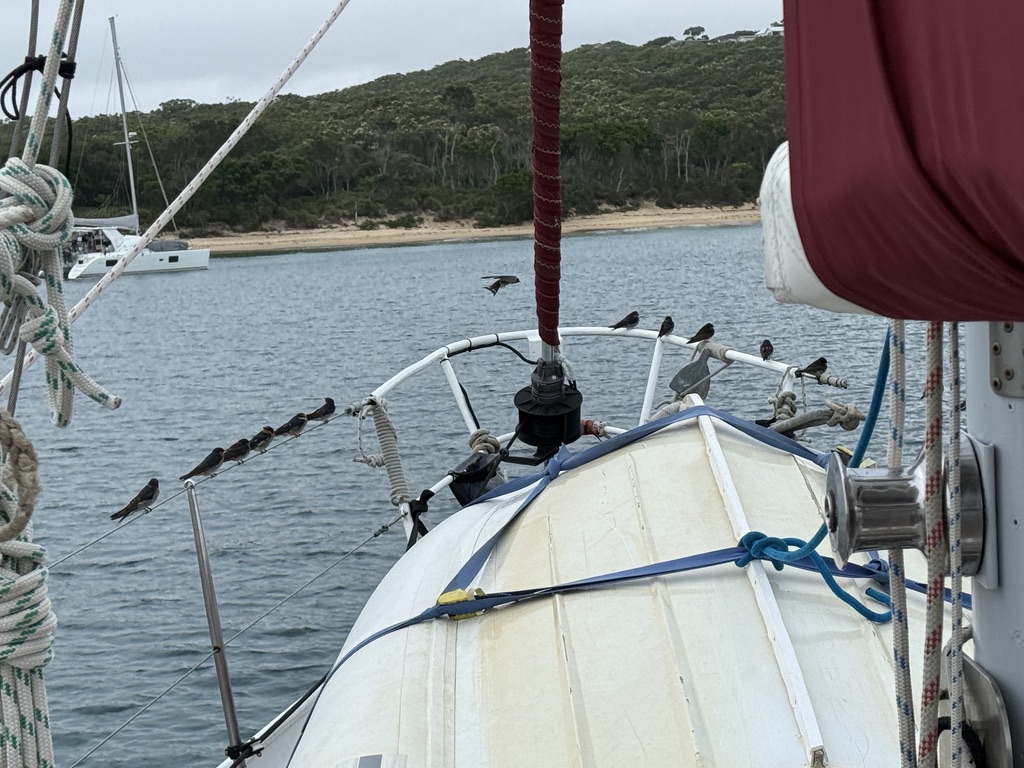
    We woke in the morning to the sound of dogs on the beach and the twitter of tiny visitors. After lifting the hook we found our way to the mooring we had been offered, which was very handy for taking the dinghy to the yacht club, grabbing a hot shower, and exploring town.

    As we looked for a cafe to grab a coffee I happened to say ‘Gday’ to an elderly couple walking in the opposite direction. They almost jumped out of their skins, which belatedly reminded me that we were back in the city. Stranger danger was again a thing, and the well mannered ignore their fellow man.

    We had been warned that Cronulla is a bit ‘rough’ by one Australian friend, and advised not to walk around the streets at night by another. I was surprised, because even though Cronulla is famous only for the race riots that took place there in 2005, it seems an affluent and pleasant place. One thing that struck me as odd as we wandered around was that most billboards were advertising real estate agents. Walking past an apartment for sale I, being nosy, looked it up on line and was a tad shocked to see that the asking price was A$3.6–4.2 million — for an apartment in a ‘rough’ suburb! I guess the commission on a property like that would pay for a few billboards. Property is big business in Sydney.

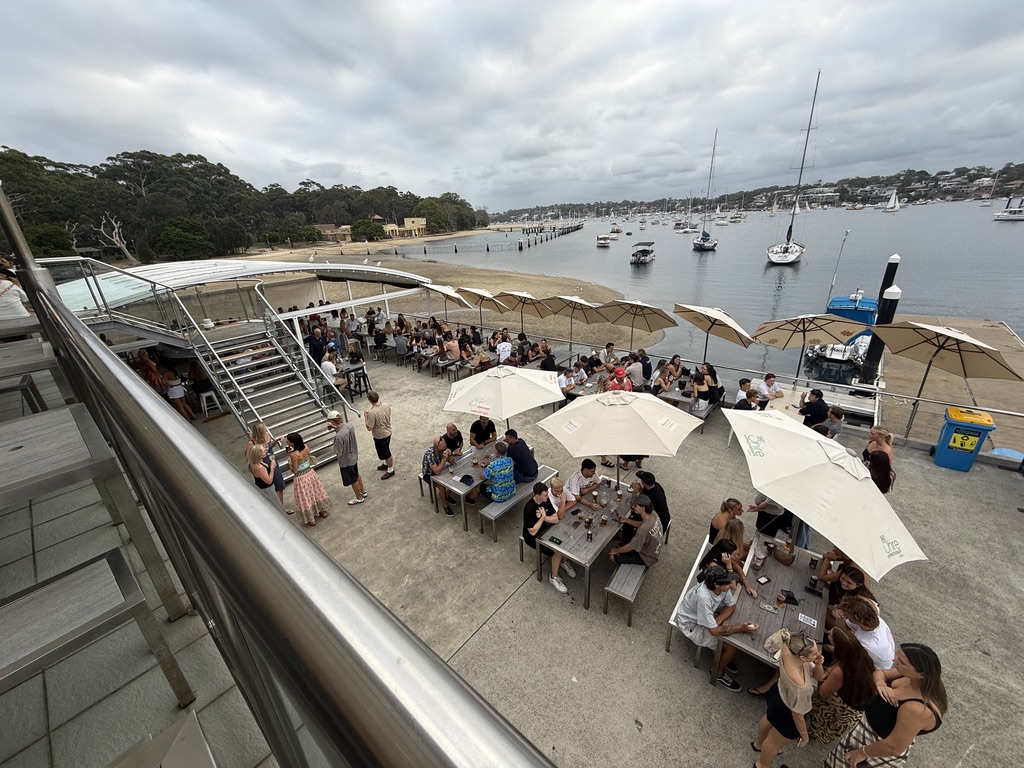
    Friday drinks at Cronulla Sailing Club. The club opens up to the public for a few days a year which seems very popular.

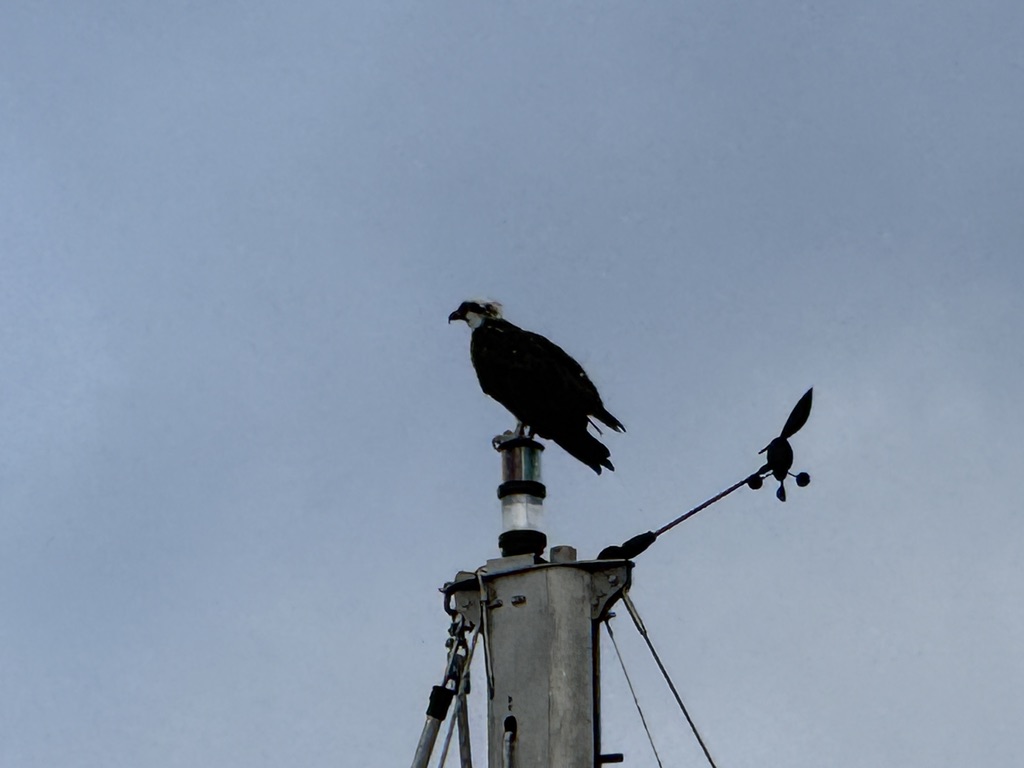
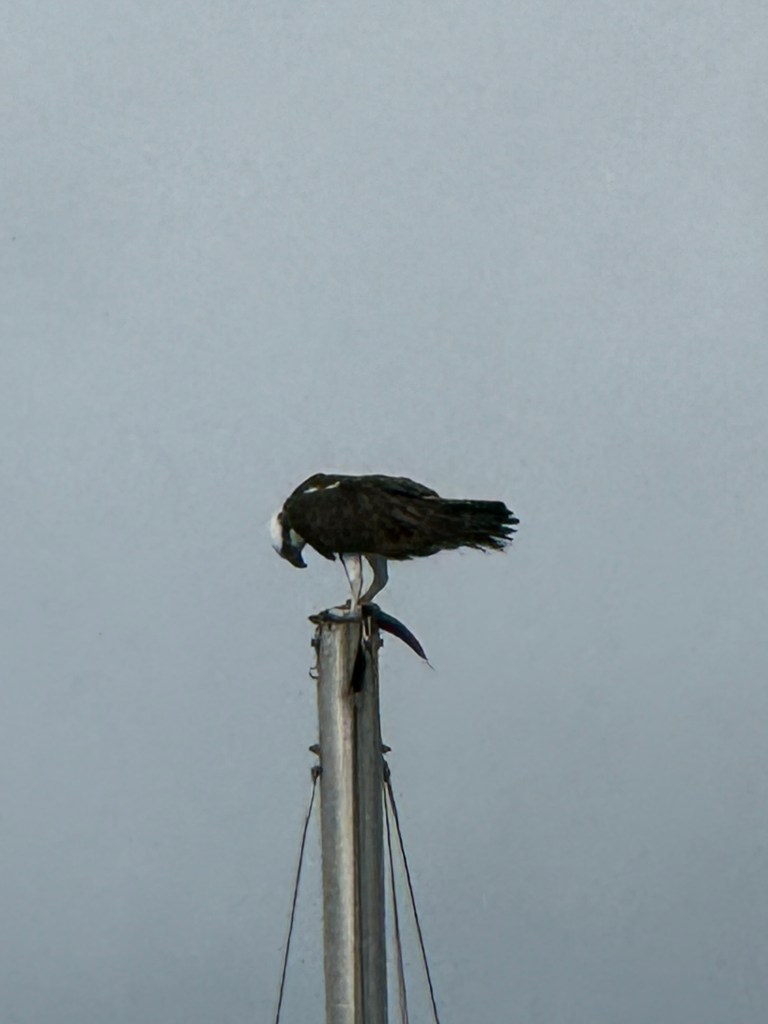
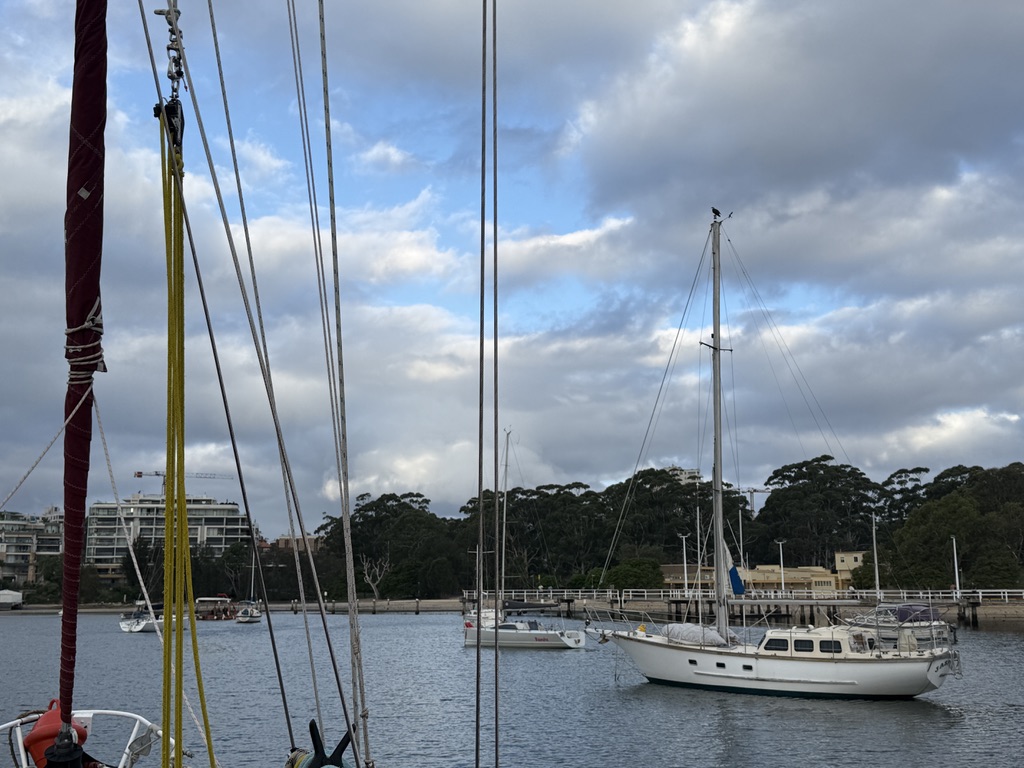
    Some of the best entertainment we found in Cronulla was entirely free. A couple of Ospreys, also known as fish hawks, were hunting in our mooring field, and would land atop the nearest mast to enjoy their meal. I hoped that our mast had enough ‘spikey’ looking things on top to make it less attractive than the boat next door, as those things are quite delicate and expensive. The birds in Australia are an amusing if real hazard to boats. Whilst in Lake Entrance I had to scare away a flock of cockatoos who perched on the mast and began attacking the halyards with gusto.

    Osprey.
    Osprey 2.
    Osprey 3.

    After a few days our feet began to grow itchy, and we left Cronulla to head towards the next bay, sitting just to the north, Botany Bay.

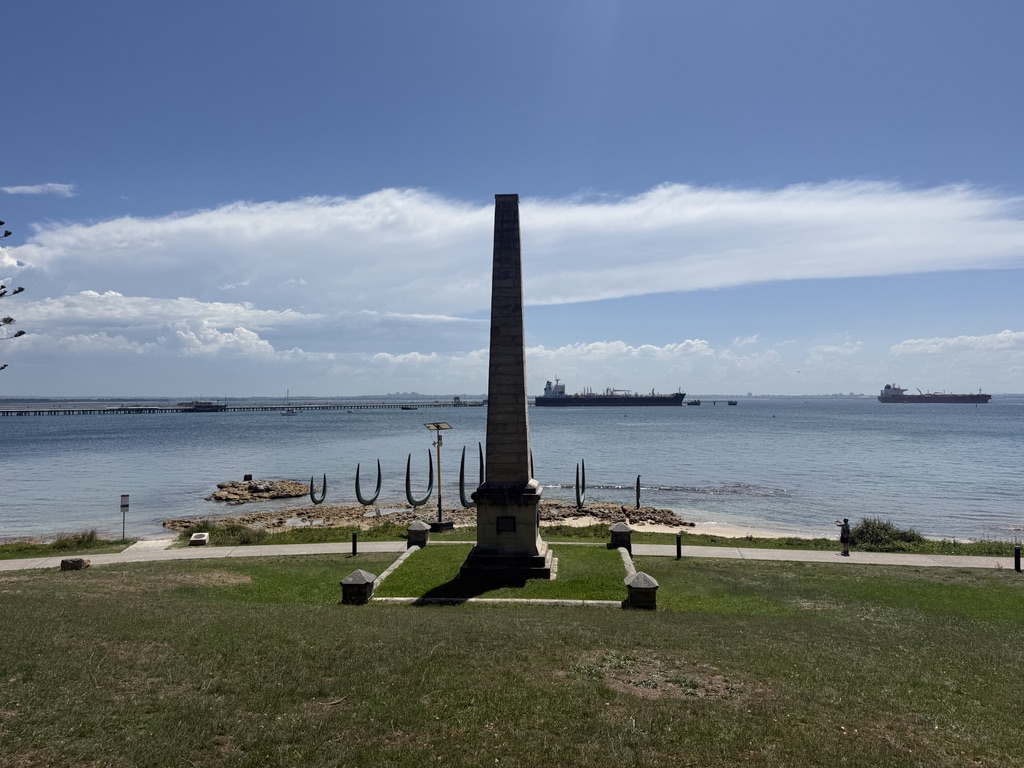
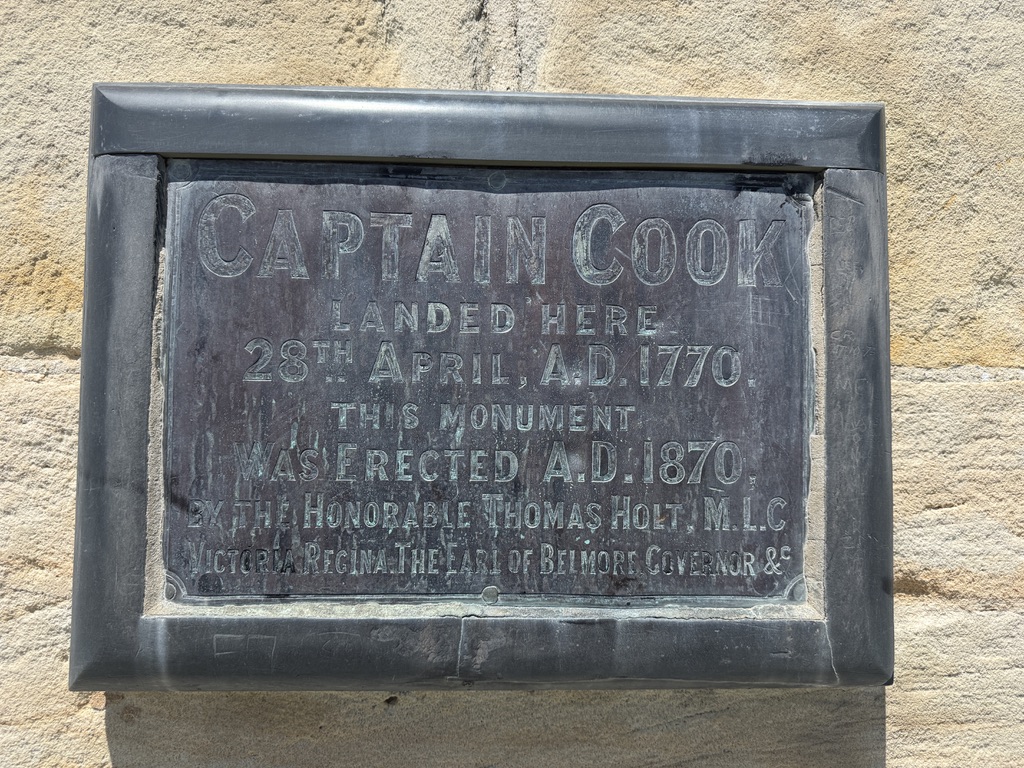
    Botany Bay today is a busy place. There is a constant stream of planes taking off and landing at the nearby Sydney airport, and an industrial complex that demands a stream of merchant vessels. It was also, of course, where Captain Cook landed on the 28th of April 1770, and subsequently, eight years later, the landing site of the First Fleet which brought 1,500 convicts and soldiers to Australia. Looking at Sydney today, it’s hard to believe that the entire city has been built in less than two hundred and fifty years. Humans are certainly busy bees.

    Happily, Cook’s landing site, is still marked by a memorial that sits in a large and pleasant park.

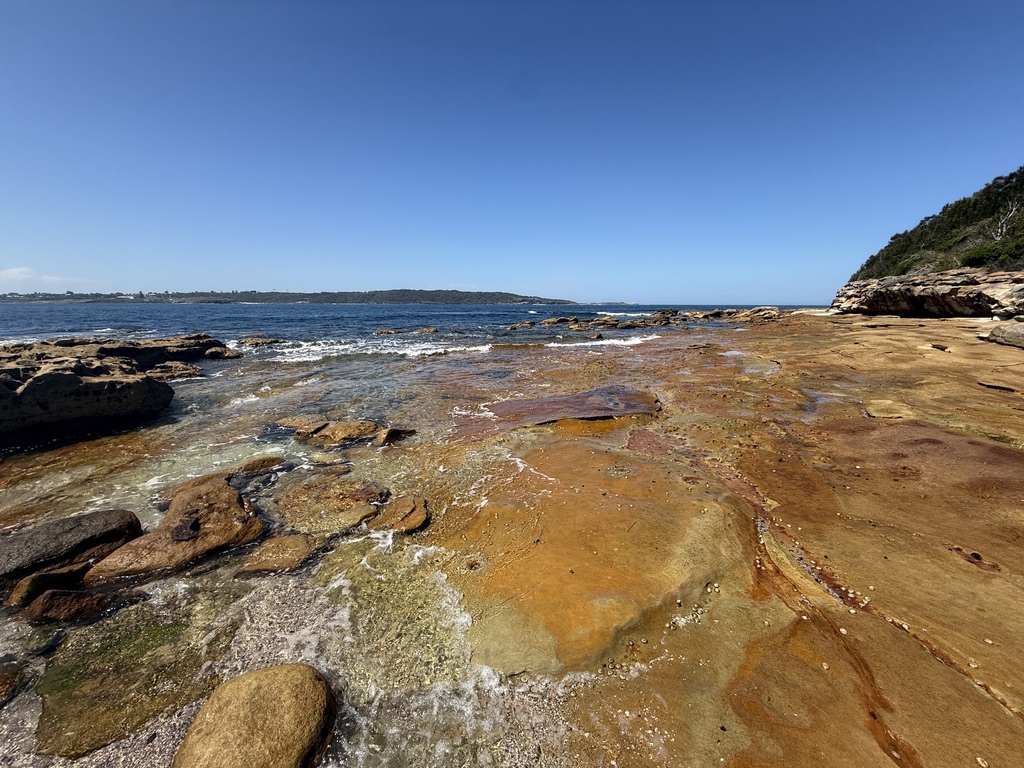
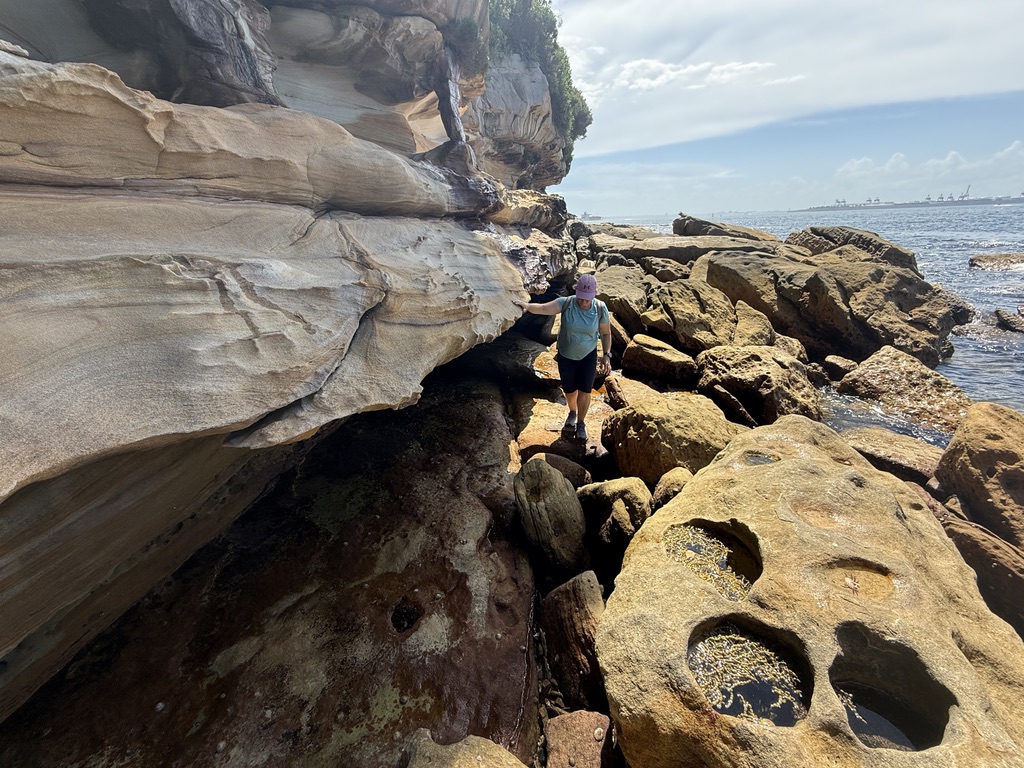
    We enjoyed a stroll around the rocks at the waterfront, through the park, and on to the local ice cream shop for a deserved cooling treat. A great day.

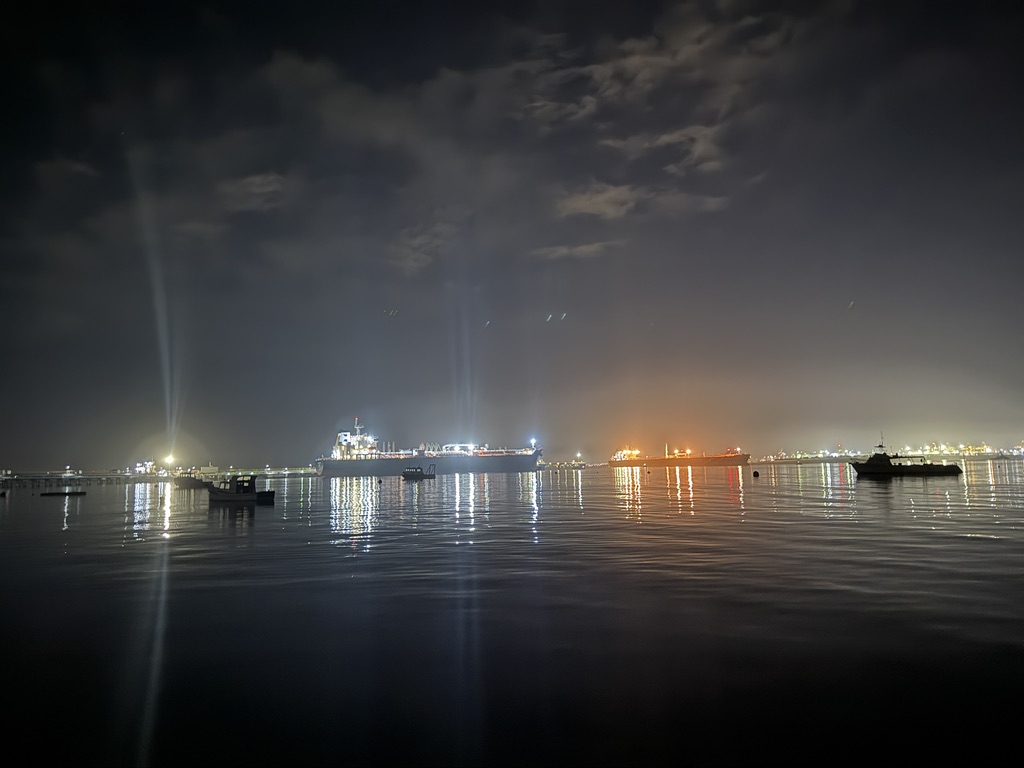
    Botany Bay by night.

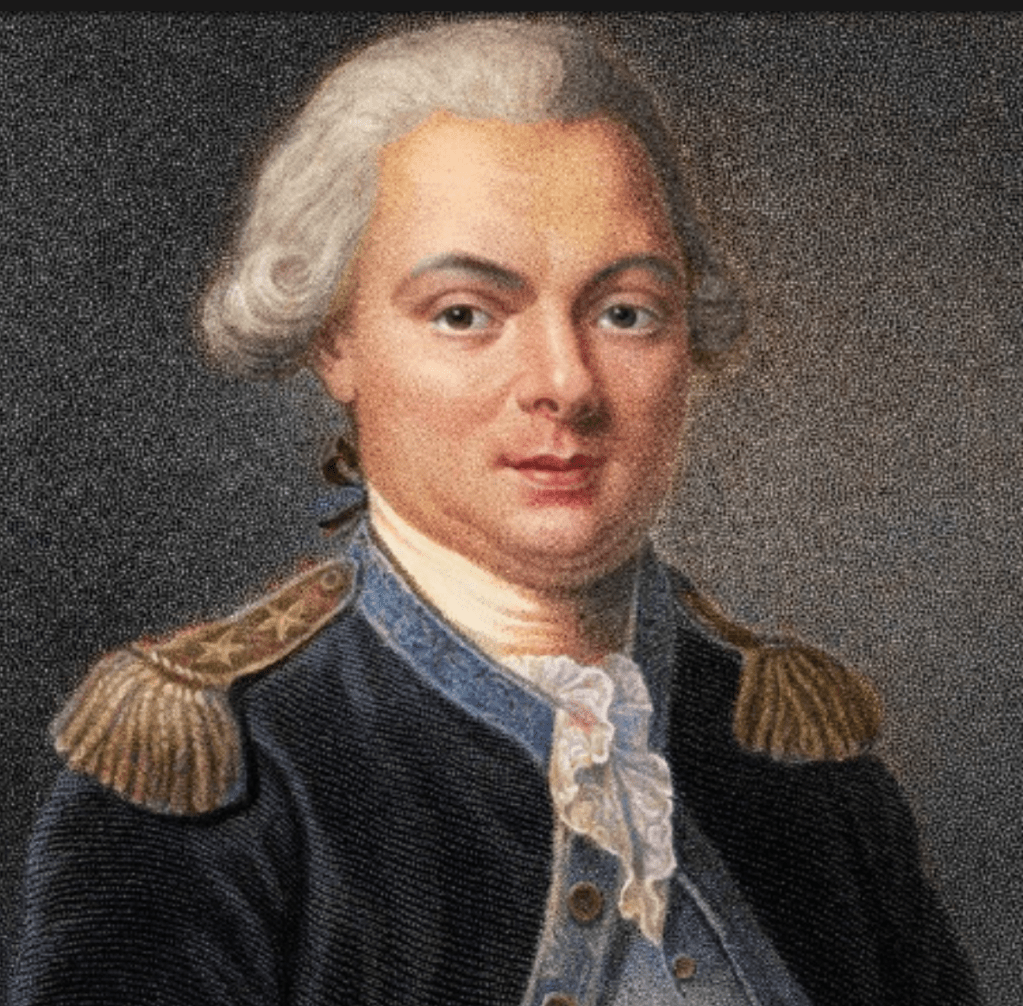
    On the opposite side of the the bay lies Frenchman’s Beach and La Perouse Point, named after Jean-Francois de Galaup, Comte de la Perouse, who was a French navigator and explorer. Perouse was tasked by Louis XVI to emulate Cook, and show the world the mettle of French sailors.

    Jean-François de Galaup, Count of Lapérouse (1741-1788). Image from https://www.historia.fr/sciences-decouvertes/explorations/la-tragique-et-mysterieuse-disparition-de-lexpedition-maritime-de-la-perouse-au-xviiie-siecle-2119196

    His expedition consisted of two ships – La Boussole and L’Astrolabe, carrying a total of 225 crew, officers, and scientists. The ships left France in August 1785 and sailed south around Cape Horn. Perouse arrived in Botany Bay only four days after the British First Fleet, which caused the British some consternation as they thought there were the only Europeans around for thousands of miles. Fortunately, cordial relations were maintained, and the French set up a stockade on the opposite side of the bay to the British. They had had violent encounters with indigenous peoples elsewhere, and were reluctant to trust the local Aboriginals.

    La Perouse’s ships sailed out of Botany Bay in March 1788, and were never seen again.

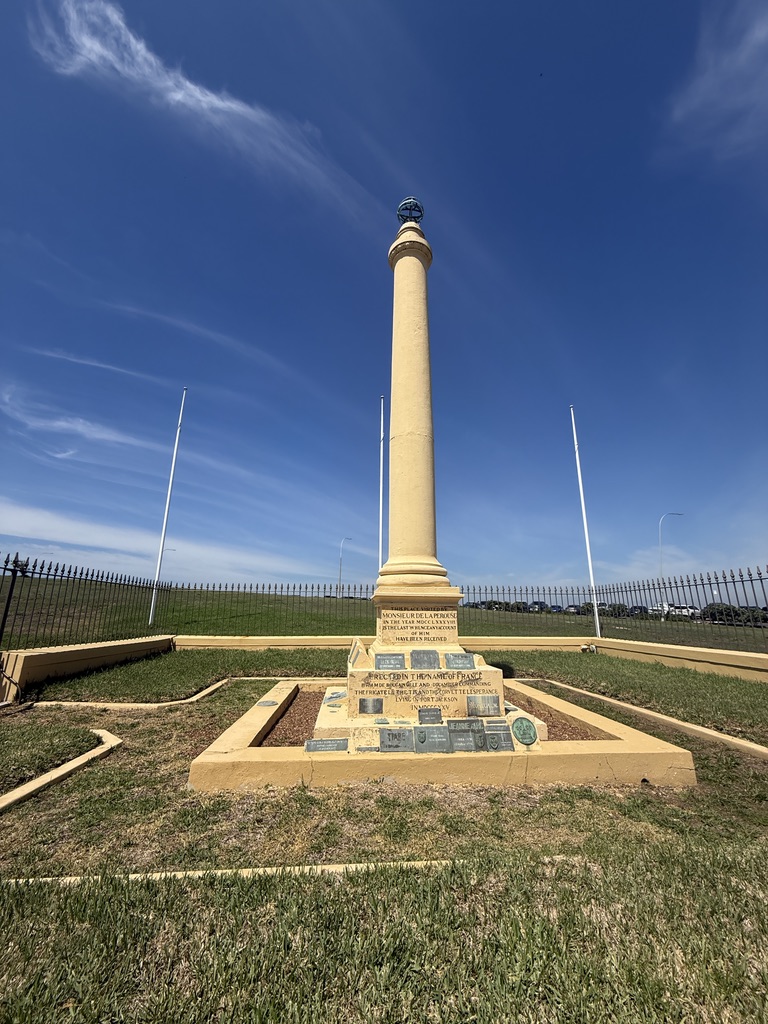
    Monument to La Perouse and his men.

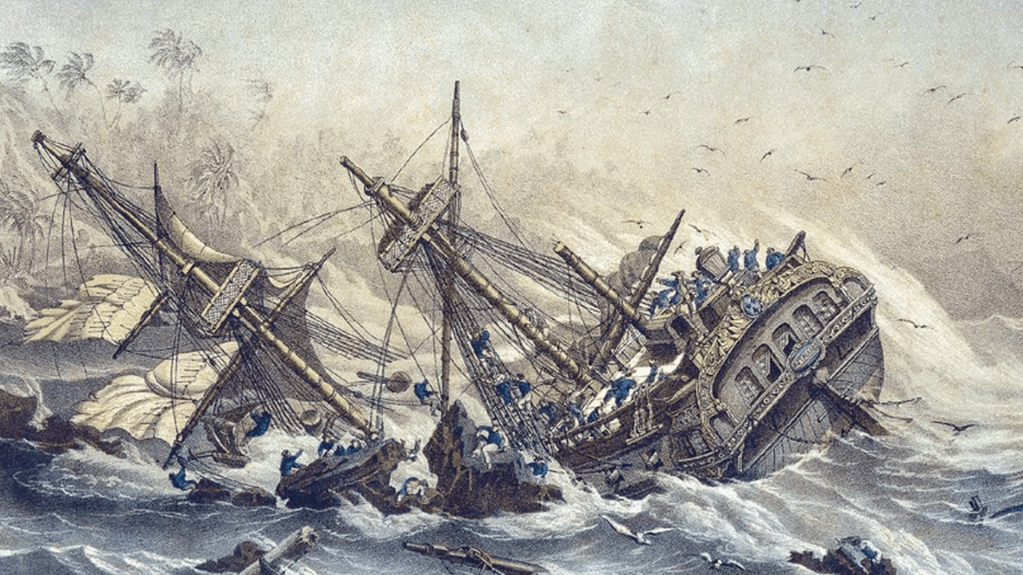
    The French government sent out a search party in 1791, commanded by Rear Admiral Joseph Antoine Bruni d’Entrecasteaux, consisting of two ships, the Recherche and Esperance. In their hunt for La Perouse, d’Entrecasteaux visited Tasmania. We had enjoyed many happy hours sailing in the D’Entrecasteaux Channel, which separates Bruny Island from the Tasmanian mainland, south of Hobart, whilst Recherche Bay was our jumping off point for our trip around South West Cape. It almost felt as if we could reach out and touch history, and indeed we did! The mystery of La Perouses’ disappearance was finally solved in 1826 when the wreckage of his ships was found on the reefs of Vanikoro, north of Vanuatu.

    June 1788, “L’Astrolabe”, caught in a cyclone, broke on the reefs of Vanikoro Island. Lithograph of Louis Le Breton (1818-1866) illustrating the work “Travel around the world of Jean-Francois de Galaup, Count of Lapérouse.” Museo civic naval, Genoa (Italy). (NPL/Opal photo)

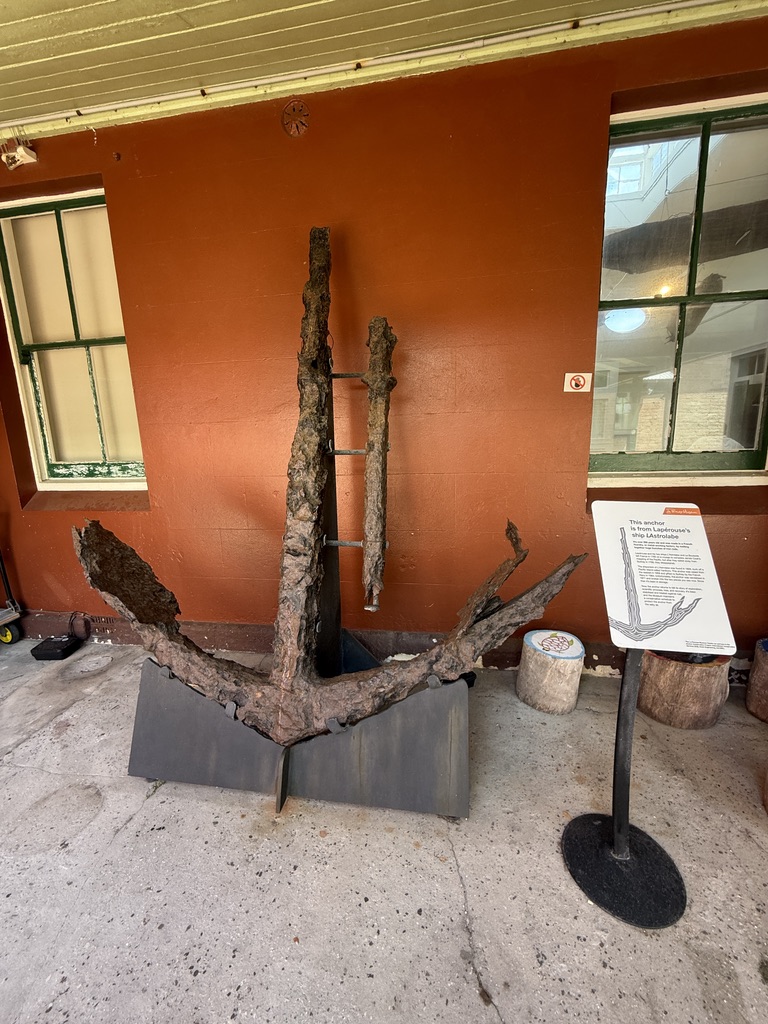
    An anchor from L’Astrolabe was subsequently gifted to Sydney by the French Navy, and is today displayed at the small museum at La Perouse. Did I touch it? Yes I did!

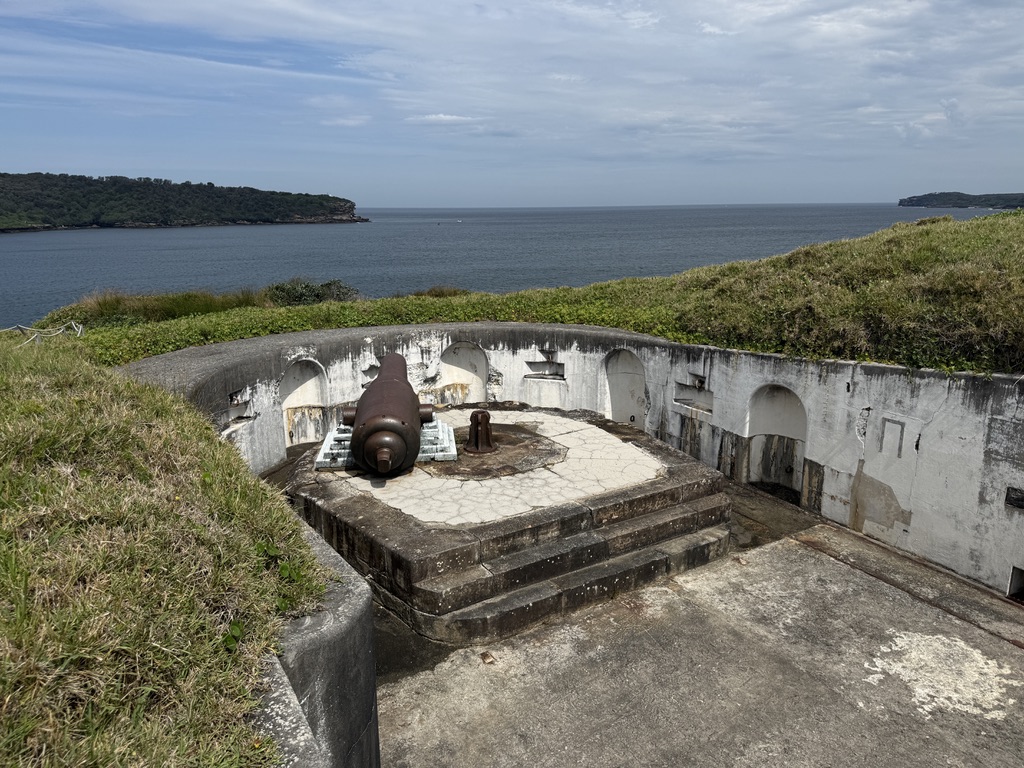
    Nearby lies Bear Island, which was fortified in 1881 to protect Sydney from the Russian threat.

    The designer of the fortifications took pains to ensure that none of the defences could be seen from the sea. To this end, a disappearing gun was mounted, which is today lost (one might say it worked!). However, a restored disappearing gun still graces a similar fort in Dunedin (our home town). The name refers to the fact that the recoil of the gun caused it to drop into a circular pit, so that it could be reloaded out of sight and in safety, and then raised again to fire.

    Armstrong disappearing gun in Dunedin.

    Several other cannon had been melted down for their scrap value, but those too heavy and difficult to move survived. One of the largest of these was almost unbelievably ‘misplaced.’ The story goes that after WWII the fort was occupied by recuperating soldiers. They decided that one of these cannon was in the way, so they dug a massive hole and tipped the cannon into it. The gun’s resting place was forgotten until a visitor to the fort confessed to a guide that he had read of the cannon’s fate in a relatives diary. The powers that be brought in a pipe detector, and got a rather large signal!

    The once lost 18 tonne cannon.. The concave ceiling panels strengthens the ceiling..
    This 12 tonne cannon was due to be scrapped and was removed from its pedestal, but proved to be too heavy to be taken across the bridge to the mainland. It was returned to its present location, but didn’t quite make it back onto its mount.

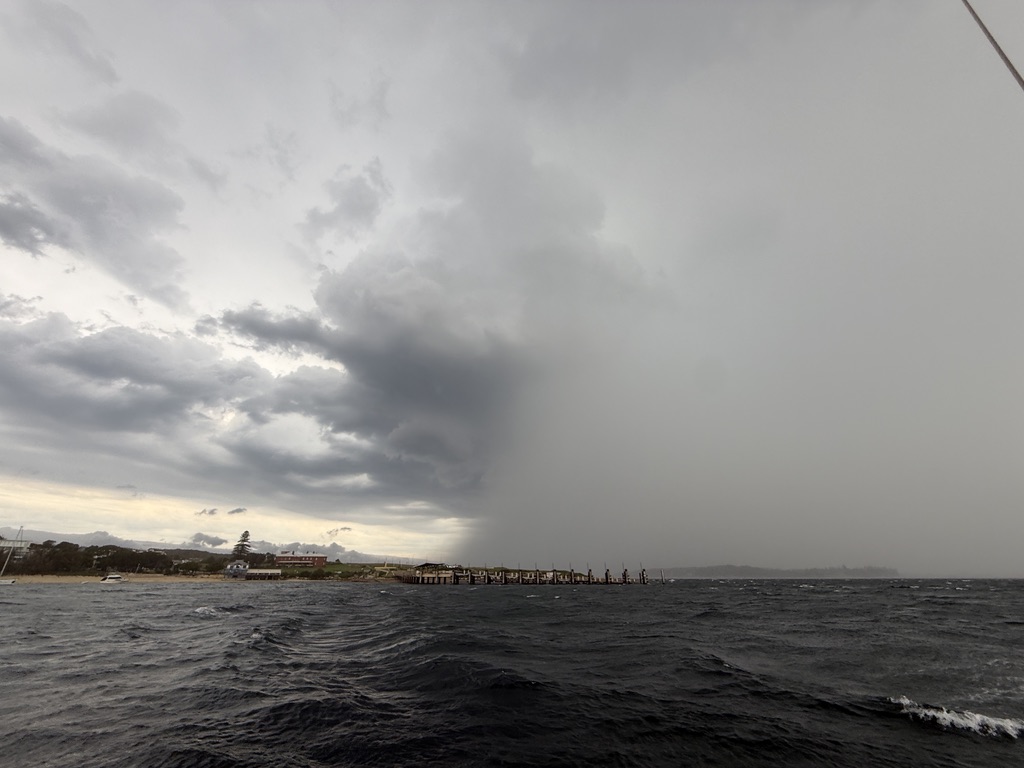
    We returned to Taurus in time to prepare for a nasty squall that quickly emptied the beach behind us. The winds approached forty knots at one point, so we were glad to be back on board and not ‘putting’ along in our little dinghy when it struck.

    Squall.

    The following day brought light and variable winds, so we motored the three hours to Sydney. It was nice to be back in the big smoke, and we were keen to explore some of the anchorages we hadn’t had time to visit last year.

    Those tales will have to wait till next time.

    Voyage of SV Taurus 14th of February – 23rd of February 2026.

    Next time: we ‘do’ Sydney, and we brake the boat (again….)

  • Lakes Entrance to Batemans Bay
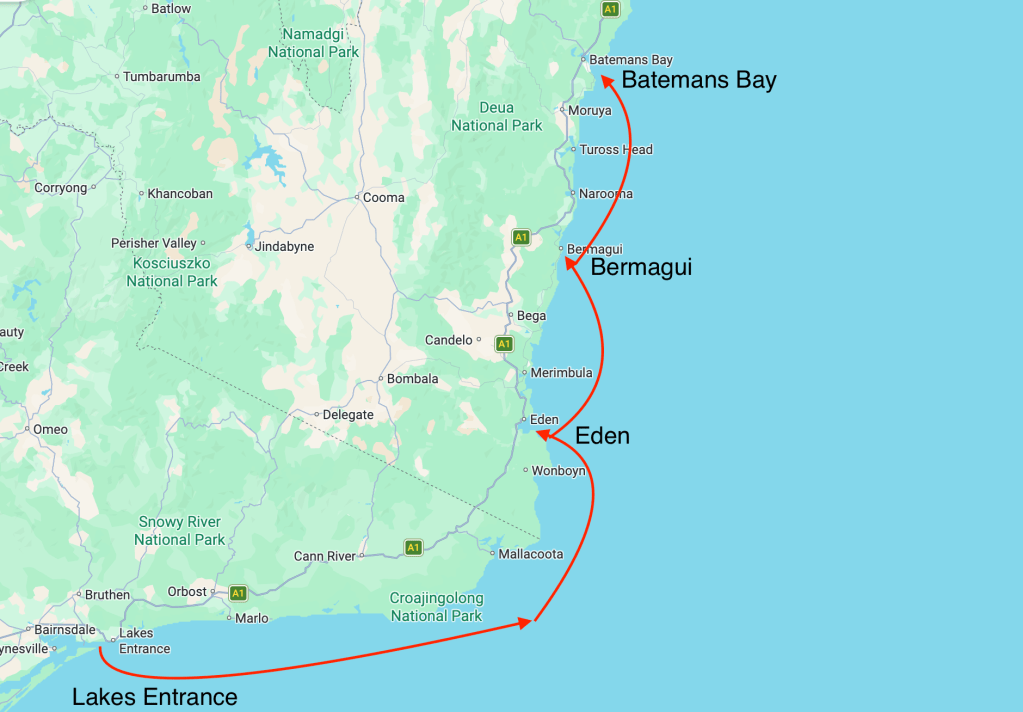
 (via Eden and Bermagui)

    After leaving Lakes Entrance we hoisted the sails and sat on a port tack to gain some room from land. This point of sail saw us heading almost due south, so someone watching might have thought that we were heading back to Deal Island. We knew that the wind was going to be light and coming from the wrong direction for a few hours before it changed into something we could use. We raised a couple of scraps of canvas and sat back to enjoy the simple pleasure of sailing for sailing’s sake.

    Before long the wind started to come round and we threw in a tack and started to slowly head in an easterly direction. As the afternoon turned into evening, and the evening into night, the imperative to gain some miles in the right direction began to exert itself. Eden is a twenty seven hour sail from Lakes Entrance at an average speed of five knots, but we were barely making two and a half knots, which, the instruments told us, meant our journey was going to take some forty odd hours from that point at that speed. We had just over ten knots of wind pushing us along from astern (which isn’t a great deal when it comes to a heavy displacement, full keel boat) but the current was robbing us of perhaps two and a half knots, at least half of our hoped for speed. This was our first experience of the East Australian Current working against us, but it was something we were going to get frustratingly used to.

    At about two in the morning, with our speed regularly dropping to around one and a half knots, I caved in to temptation and turned the engine on. Motor sailing allowed us to attain something more like a respectable speed; but I don’t like to motor sail, or indeed motor if I can help it. First and foremost, Taurus is a yacht, she’s built to sail; second, diesel costs money (though not a lot, we use about 3-4 litres of diesel an hour); third, motoring is noisy; and, lastly, motor sailing is bad for our gearbox. We were told by a very experienced mechanic in Launceston that motor sailing was probably what caused our friction plates to glaze and eventually fail — uneven and light power demand creating excess wear. So, with a view to prolonging the longevity of our gearbox, it being economically unfeasible to replace the clutch plates alone in this insane, throw away, era, we try not to motor sail.

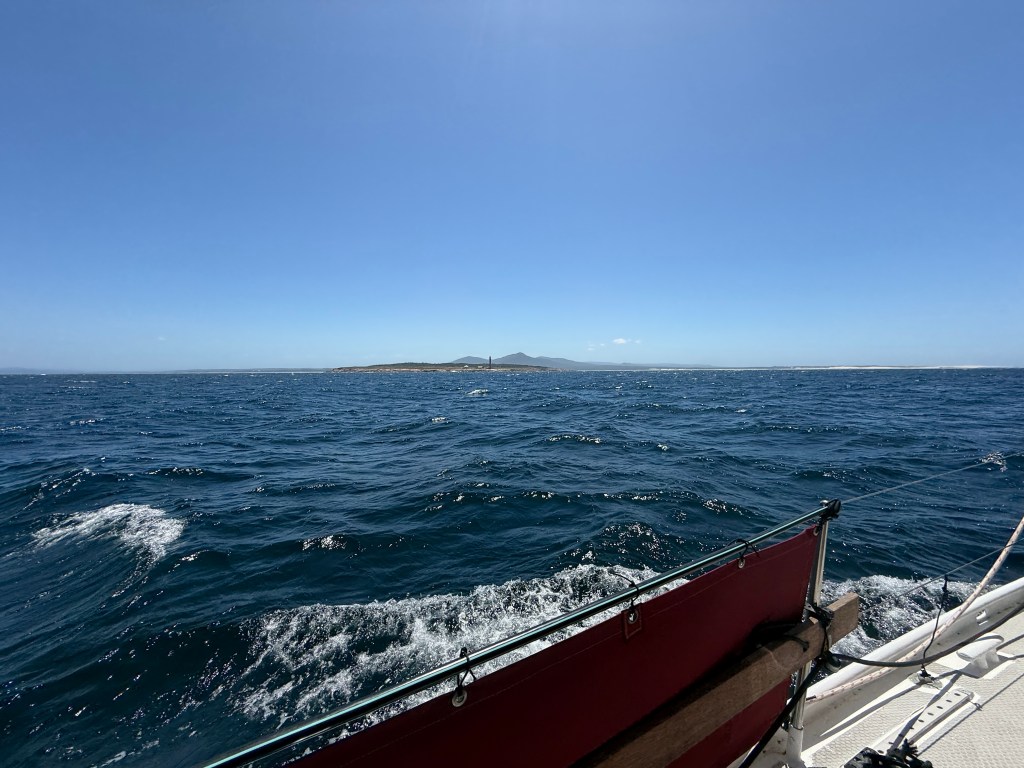
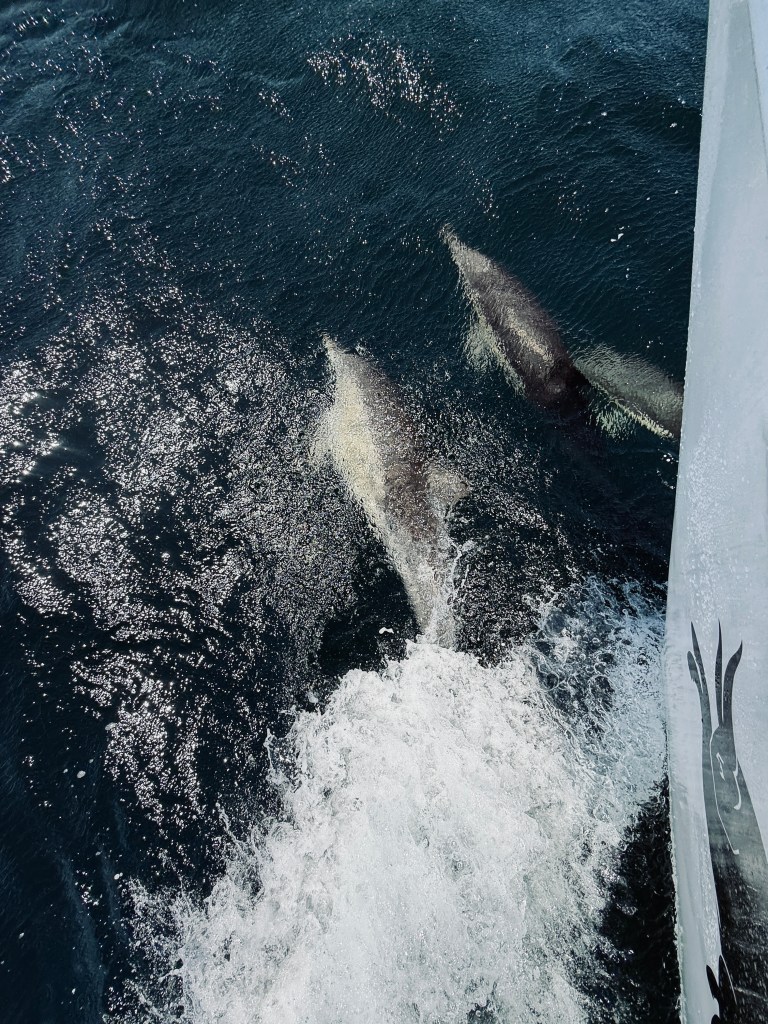
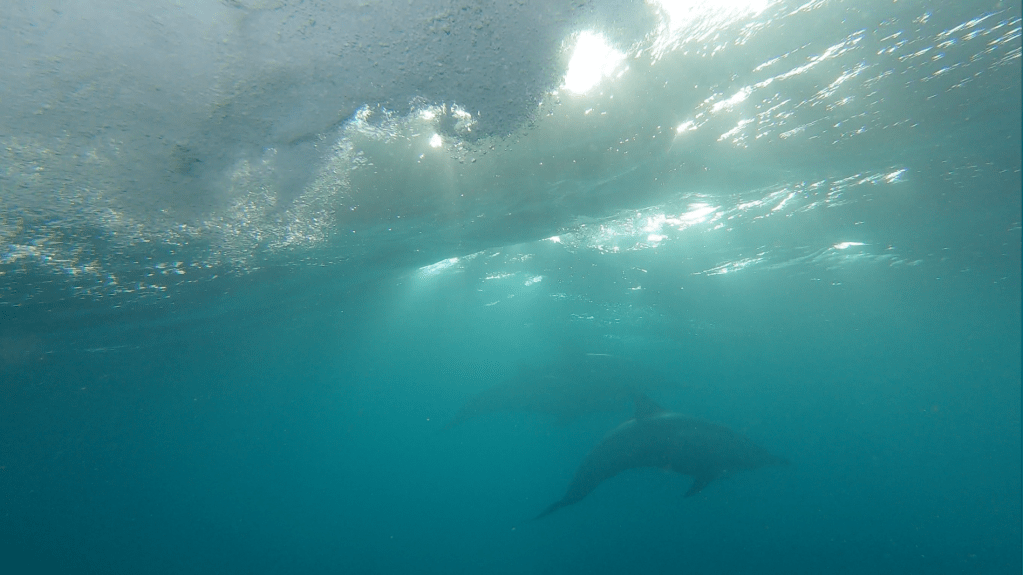
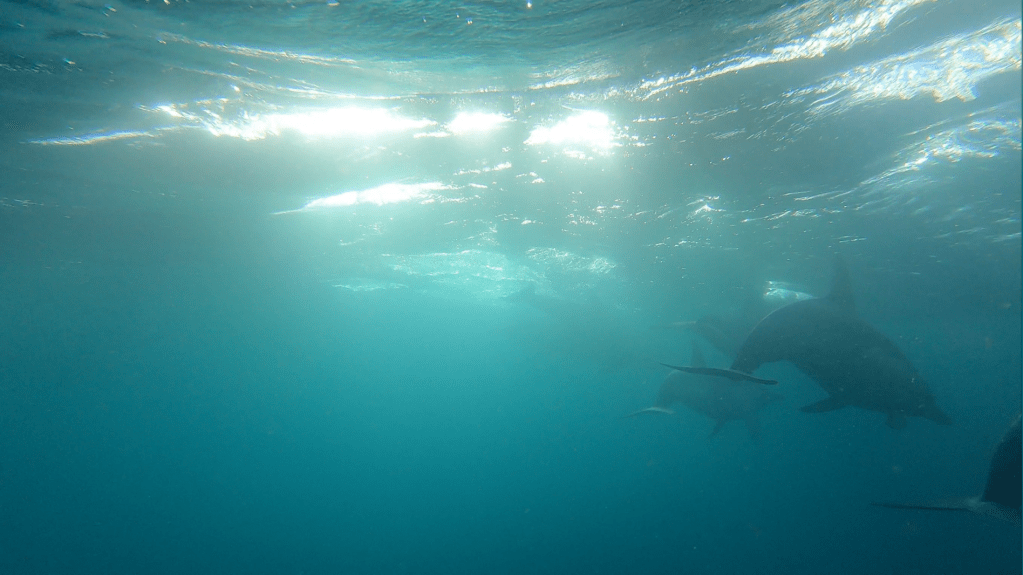
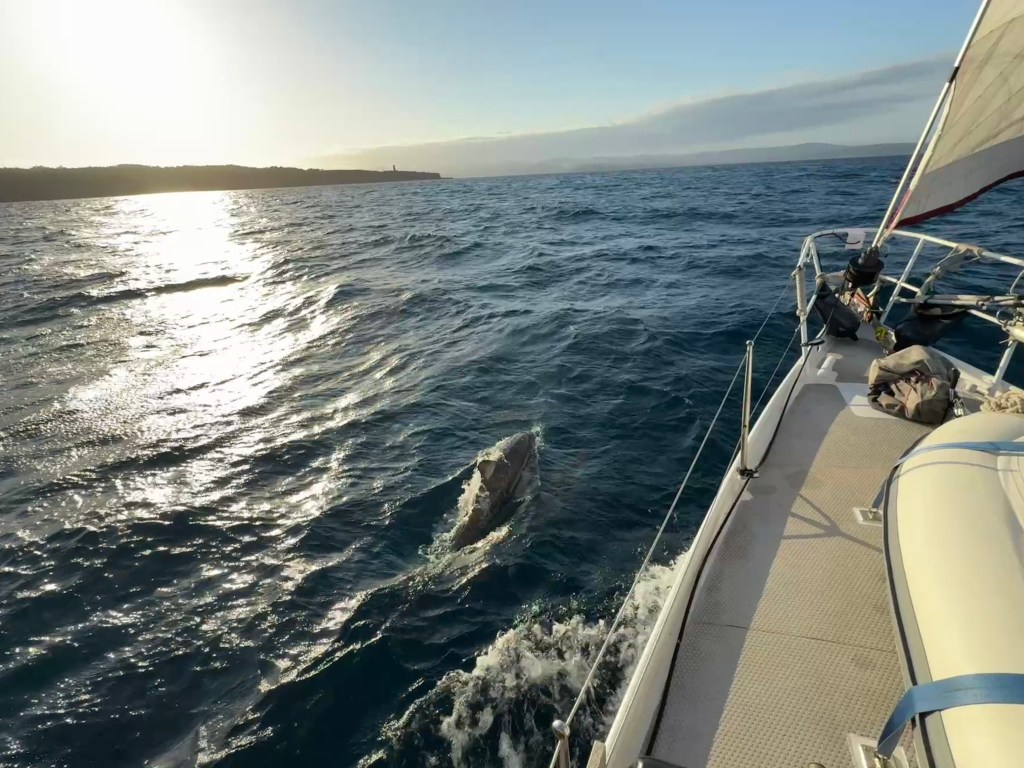
    After a few hours the wind filled in and we could turn the engine off and enjoy some peace. Still, it was a slow old slog, and it was nice to see landmarks such as Gabo Island and Green Cape Lighthouse appear and oh, so, so, slowly vanish behind us. The highlight of the trip was a couple of pods of dolphins who joined us. I had the ‘bright’ idea of trying to put a Go Pro on a boat hook to see if I could film them underwater, but the dolphins didn’t seem to take too well to it and left soon afterwards. This area was once famed for its whale hunting, so perhaps the trauma still lingers in the cultural memories of its marine mammals?

    Green Cape and its Lighthouse.
    Dolphins…
    …dolphins…
    ….dolphins…

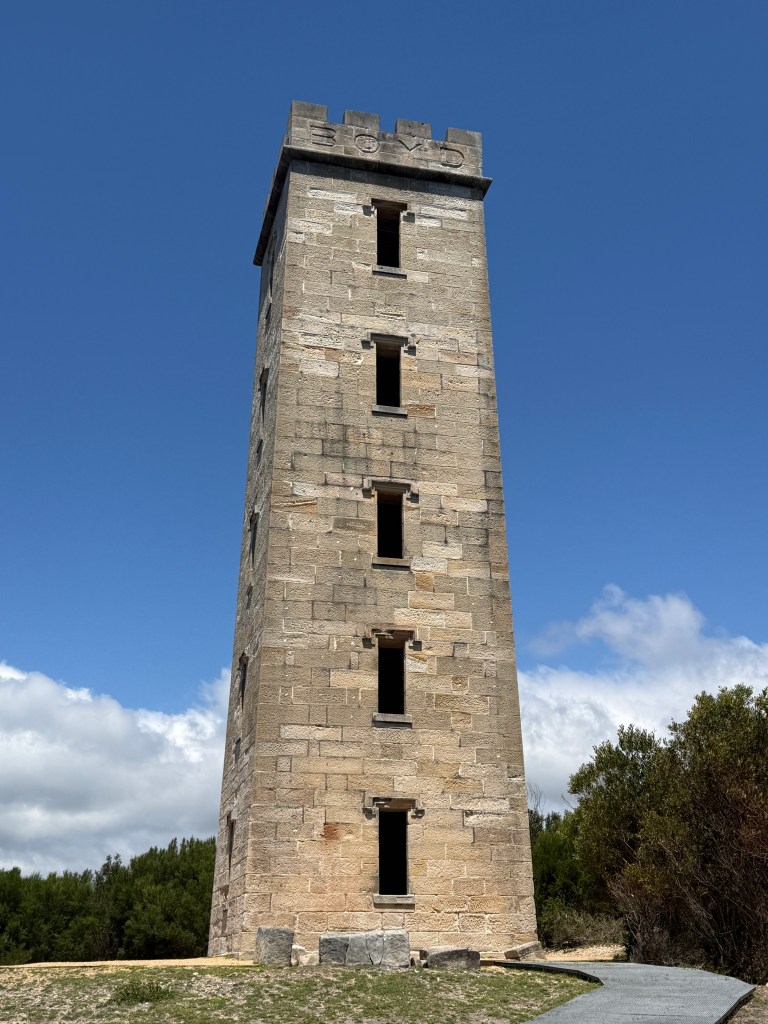
    The second pod joined us just as we sailed into Eden Bay, the setting sun silhouetting the famous ‘Boyd’s Tower,’ once used as a lookout by whale hunters.

    … and dolphin. Note Boyd’s Tower on the headland. More on that to follow!

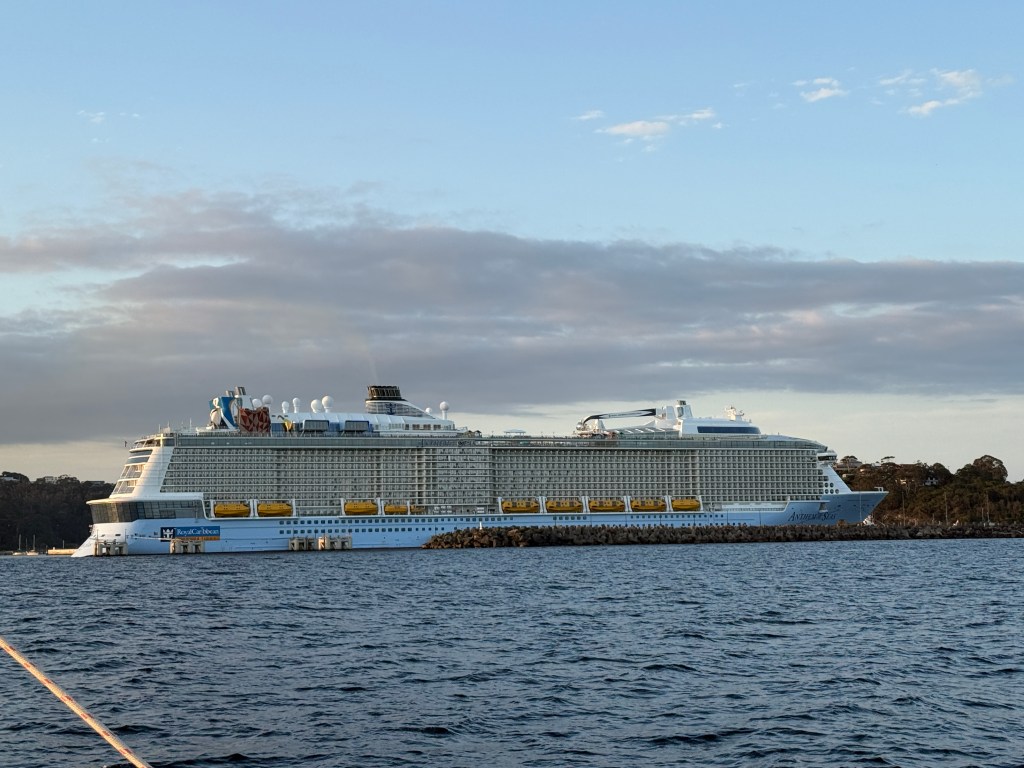
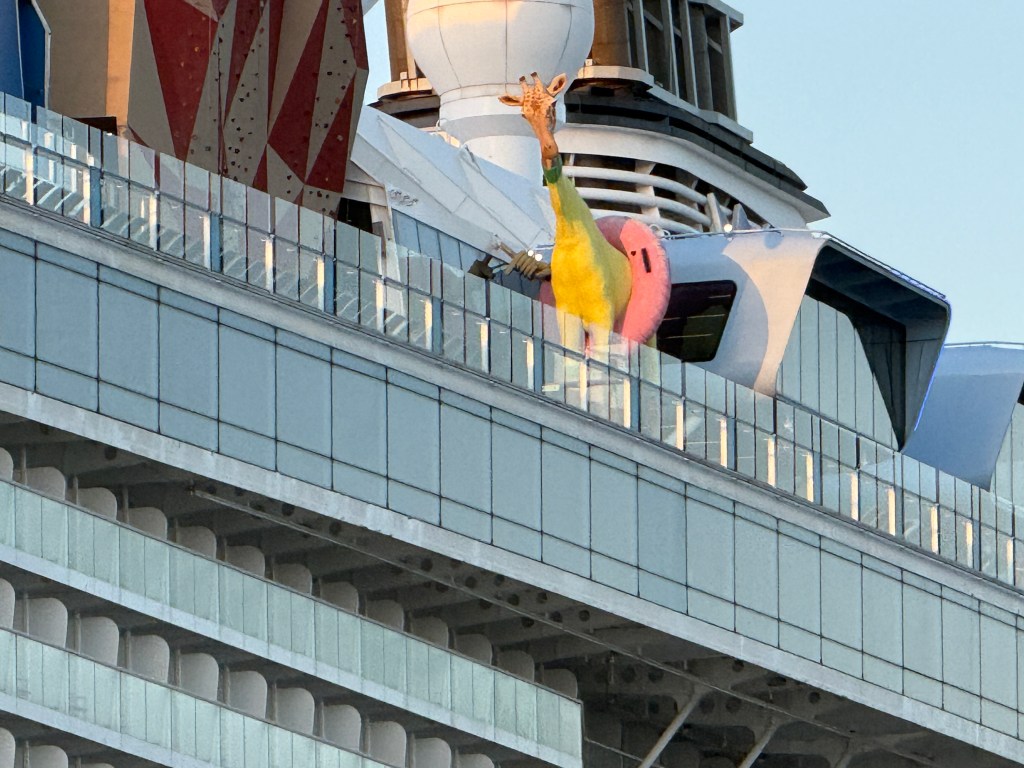
    As we prepared to duck behind the sea wall that shelters the public mooring we kept an eye on the imposing cruise liner at berth, belching smoke into the air. We later learnt that the ship had broken down and desperate efforts were being made to fix her before the next liner was due to arrive. The only ‘passenger’ we could see didn’t look too phased, a giraffe with a swimming ring, on a Norwegian flagged vessel in Australia — what on earth is that about??

    Imagine the number of people on one of these things. Mind boggling.

    We picked up a mooring and had an early night, which wasn’t that early as we’d only had a few hours sleep between us.

    We had of course seen the Eden sites on our trip south a year ago, so after a quick wander about town and a fast food fix, we packed up to visit the southern end of the bay. As we arrived we were fortunate to be joined by yet more dolphins, who wanted to play in our bow wave.

    sorry… more dolphins.

    From the bay a short dinghy ride takes you to a beach from which you can access a road that takes you to Boyd’s Tower. We hadn’t yet re-acclimatised to Aussie mainland temperatures, so it was stinking hot, and all the engine work I had had to do in Lakes Entrance had tweaked my back, so it was a bit of a slow walk.

    Cara hares ahead whilst the tortoise plods along behind…

    Still it was well worth the effort. Boyd’s Tower is one of those fascinating folly-like structures that, built to serve the hubris of man, instead makes manifest the saying that ‘pride comes before a fall.’

    The Boyd in question was one Benjamin Boyd, a wealthy Scotsman who traveled to New South Wales to speculate in various businesses, such as farming, whaling, and shipping. He is credited with being the man who introduced ‘black birding’ into Australia, the practice of kidnapping Pacific Islanders to serve as slave labour in the new colony. Intended as a lighthouse, Boyd’s Tower failed to receive government sanction, and so was used instead as a whaling watchtower. Boyd went bankrupt soon after the tower was complete, and abandoning his debts and workers fled to the Californian gold fields. In 1851 he disappeared without trace, reportedly killed while visiting the Solomon Islands (for more information on Boyd, visit https://www.visiteden.com.au/1842-wanderer/)

    Boyd’s Tower — note the name carved into the stone work at the top.
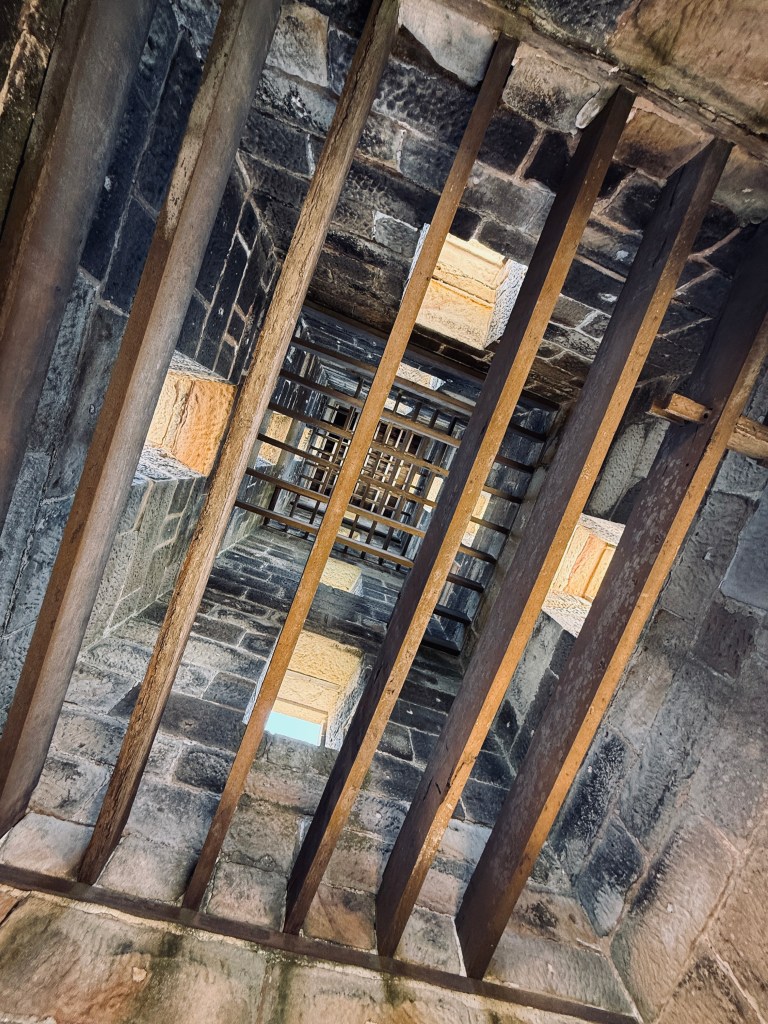
    Looking up at the interior of the tower today.

    Strong winds were due the following day, so after returning to Taurus we headed back to Eden and a sheltered anchorage. To our delight another cruising couple had arrived whilst we had been away, Richard and Annette on Heather Anne, a steel sloop. This ex-Kiwi, currently Tasmanian couple were returning home from a sojourn to the Whitsundays, so we had a fantastic evening learning about their experiences with whales, tidal races, and Australian Army firing ranges. The next evening Annette invited us aboard for a roast lamb dinner, setting a new standard for on-board hospitality! Alas, the conversation flowed so well that we didn’t take a photo of this fascinating and generous couple until we were on our way back to Taurus. Thanks guys, we hope to meet again some day!

    Heather Anne

    There was a possible weather window the next morning, a lightish southerly that we hoped would help us to get north. Wanting to leave early, we raised the dinghy and got everything ready for an early start.

    Getting the boat ready for an early start.

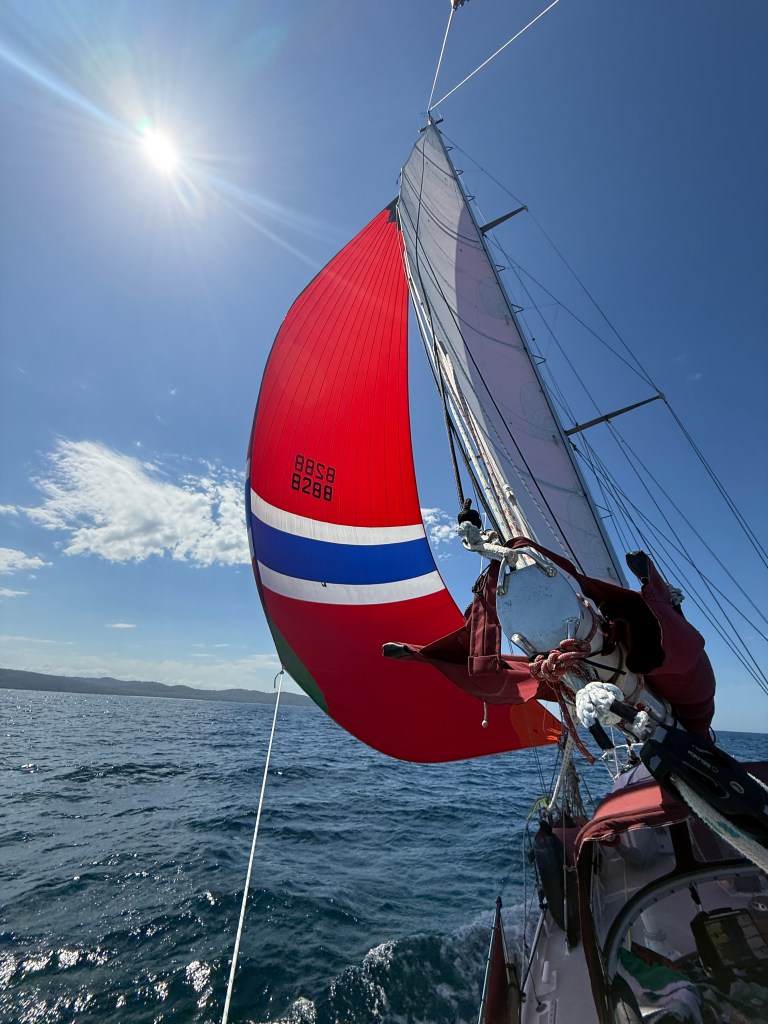
    Of course, you never really know if a weather prediction is going to be spot on, or if the wind will be stronger, or weaker. We had hoped for stronger, but ended up with the other extreme. That coupled with a two knot current against us meant that we ended up motoring most of the following day. In the afternoon the wind started to lift, so we raised the spinnaker, more in hope than expectation, but without the engine’s assistance we were reduced to a crawling pace.

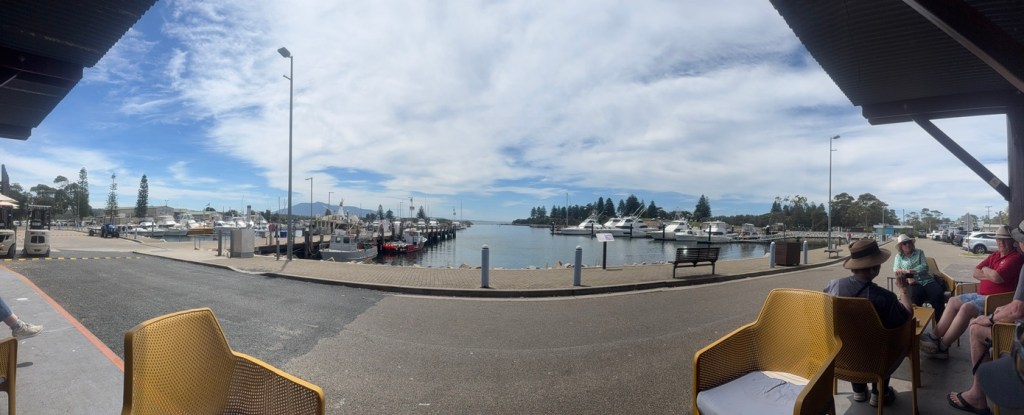
    We had hoped to make Batemans Bay, but the going was desperately slow, and my back was still spasming periodically, so we decided to quit whilst behind, and bail into a closer port. Bermagui is a quiet Australian holiday destination, entered via what looks like it might be a bar, but which in fact isn’t. The river on the other side of the entrance is too shallow for a keeler to anchor, so we had no option but to pay for a marina berth. At $80 a day, the cost of a four day stay would cover us for nigh on a month in Tasmania — there was no doubt that we were back on the Aussie mainland.

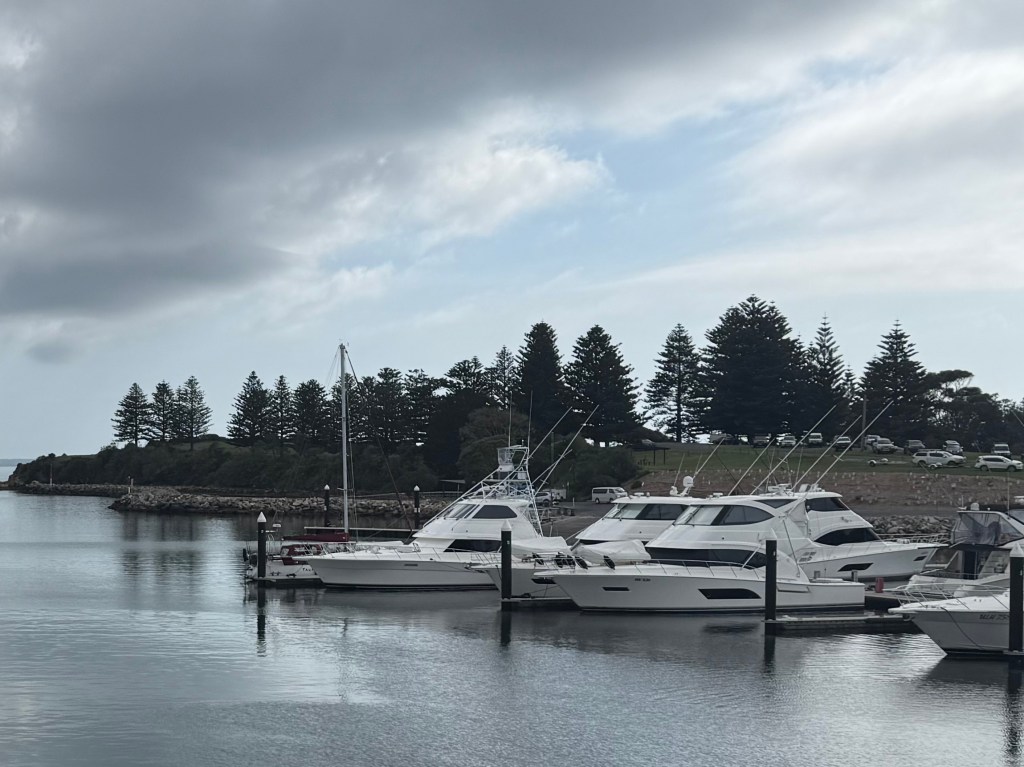
    We came to understand the cost a little better after meeting our neighbours, though to be fair the price isn’t exceptional on the east coast. Once, Bermagui was a fishing port, but when the fish failed small yachts had moved in. Now there was barely a handful of yachts, and each berth was instead occupied by multi-storey launches that towered overhead, designed for catching ‘big-game fish.’

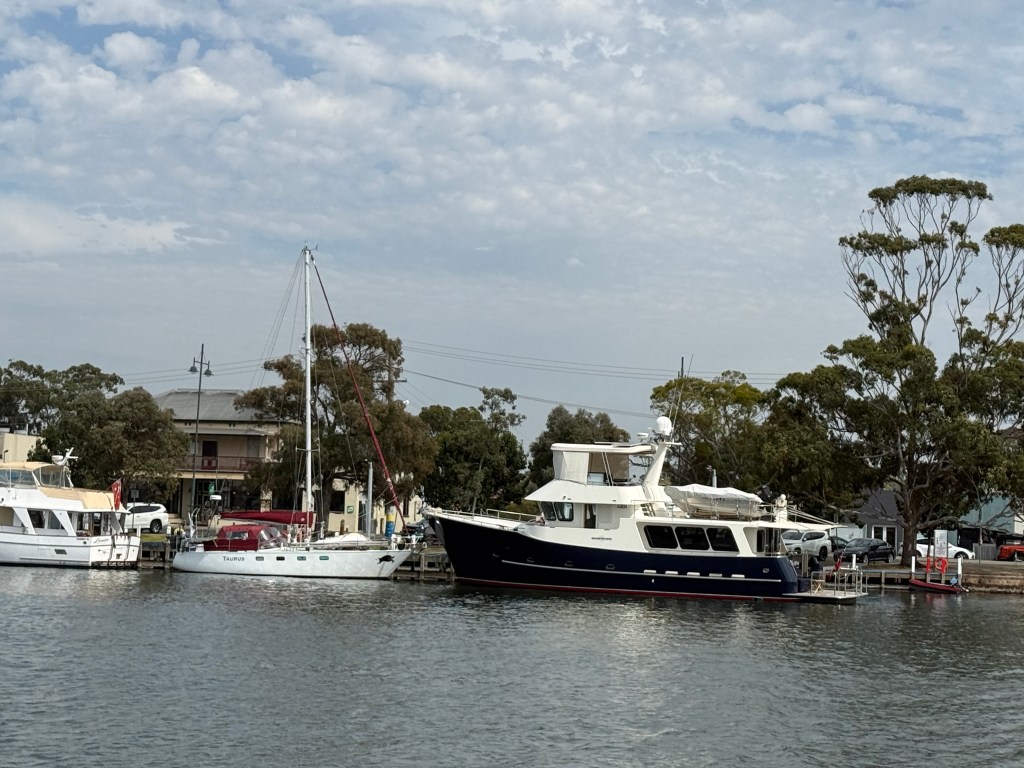
    Can you spot Taurus? Hint.. she’s behind some launches on the right hand side.
    For scale, Taurus is 12 metres long and her mast rises 15 metres from the water line.

    You can’t really comprehend the size of these boats from a photo, unless you see them next to a familiar object. Our immediate neighbour was far larger than Taurus, as you can see in the image above. I imagine the price of one of these things would easily be in the region of A$500,000 to A$750,000, but none of them moved in the few days that we spent in the marina. Seeing someone aboard one day I asked if the boat was a commercial vessel, taking paying customers out fishing.

    “Oh no” he said, ‘this is a private vessel.”

    “And what is it for?” I asked.

    “Well, were not really sure ourselves,” he replied laughing, “it’s a bit like hunting lions, a bit pointless.”

    “But what do you hunt?”

    “Marlin mainly”

    “And do you eat them afterwards?”

    “Oh no, they’re OK smoked, but not that nice.”

    Words failed me. In a country where homelessness is becoming an endemic problem and cost of living is never far from the headlines, some people are happy to spend a small fortune to own a boat whose sole purpose is to occasionally be used to try and catch a fish because it’s fun to catch. As many of the released fish subsequently die, the ‘catch’ part in the previous sentence could more honestly be replaced by ‘kill.’ After visiting Eden we shook our heads at the stupidity of the whaling industry, whose greed drove several species of whale to near extinction and caused the business itself to implode. But here, in this day and age, there were perhaps a dozen of these massive boats in this tiny port whose sole purpose was to kill (sorry, catch) a few species of fish or shark for entertainment. How long can any species survive this kind of assault? According to Google:

    Australian marlin species are not currently listed as globally endangered, but they are under significant pressure and some stocks are considered depleted. Striped marlin in the South-West Pacific are classified as “depleted,” with evidence of overfishing and high post-release mortality. Black marlin populations are heavily targeted in recreational fisheries, but their exact status is unknown due to limited data. 

    As usual, the news on the fish front isn’t great, and it’s normally much worse, and too late, when the data actually becomes known. Closer to home, with this kind of brainless, brazen, blowing of moolah it was little wonder that the marina charges $80 a night. One might expect to be charged much more.

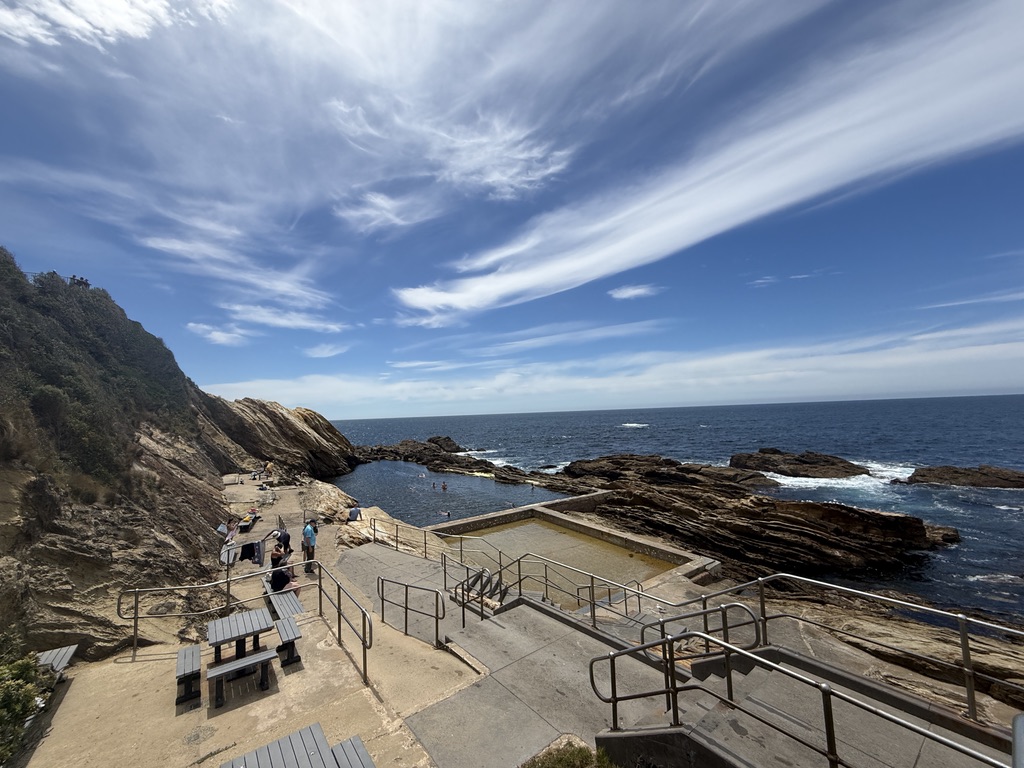
    Anyhoo.. we had a couple of days to wait for another window. We did the rounds of town: the museum, Mitre 10 (a hardware store), and the best bit of all: a swim at the salt water pool with an outstanding view and real fish (yes, really).

    Saltwater pool.

    Another southerly was due that night, so we got ready to go and stayed up till 11:00 pm, but using a weather app we could see that the ‘real time’ gusts tracking north were far stronger than predicted, in the high 40s. When the wind reached us in Bermagui it struck with a roar, and we were getting over thirty knots in the marina, which is protected from the south. You’d have to add at least another ten knots to that in unprotected water, and no-one chooses to go sailing in forty knots. We went to bed.

    Making sure everything is ready to go.

    Next day it was still windy, but a more manageable thirty knots out at sea. Batemans Bay is forty five nautical miles from Bermagui, nine hours at five knots, so we waited until early afternoon for the worst of the weather to pass, and out we went.

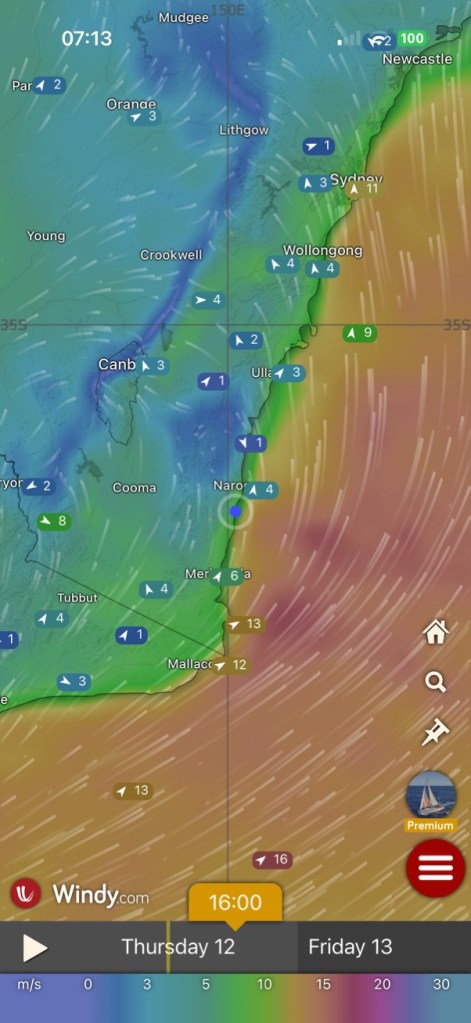
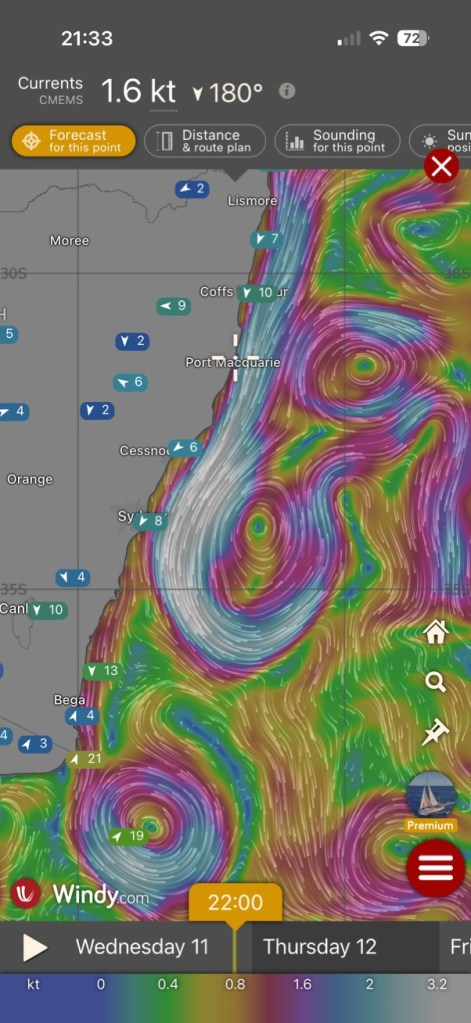
    Above are representations of wind speed on the left, and current on the right, as per ‘Windy.’ Note that wind gusts can be up to 40% stronger than average wind speed.

    The sailing was pretty fast and comfortable, though dead down wind is always a rolly point of sail. As the day wore on the wind picked the waves up so that the rolling went from bad to worse, and at the end we had to hold on the whole time or risk being violently thrown across the cockpit as the boat rocked from one rail to the other every few seconds . In these conditions you can steer off the wind — which would have seen us heading towards land or out to sea; hoist the main to try and dampen the roll — which prevents wind reaching the jib sail, so it collapses and snaps full, over and over again, killing gear and fraying nerves; or you can endure it.

    We finally arrived in Batemans Bay at 11 pm. We sailed to an island near the bar where we intended to anchor so that we could cross the shallow water at high tide next morning. We later found out that the bar has been dredged since we were last there, so we could have gone straight in. Ignorance is not always bliss! Our first attempt to anchor revealed a rocky bottom that the anchor skipped across without any realistic chance of setting. Plan B was to pick up a nearby public mooring.

    In the pitch dark we used a spot light to identify the mooring and to allow Cara to steer up to it. We had to get within about a foot of the mooring as the pick up line was far too short. At the bow, I then had to put down the torch to try and grab a rope with a loop floating in the sea with a boat hook — a two handed job. Hit the line but miss the loop and the cussed line sank. Add strong winds, a bit of a chop, and sea-sickness all round and it was pretty challenging. Third time round was a charm.

    After a rolly night on the mooring we were up at 5:30 am to cross the bar at high tide (which we didn’t need to worry about). Then we picked up another mooring in the Clyde River, and went back to bed!

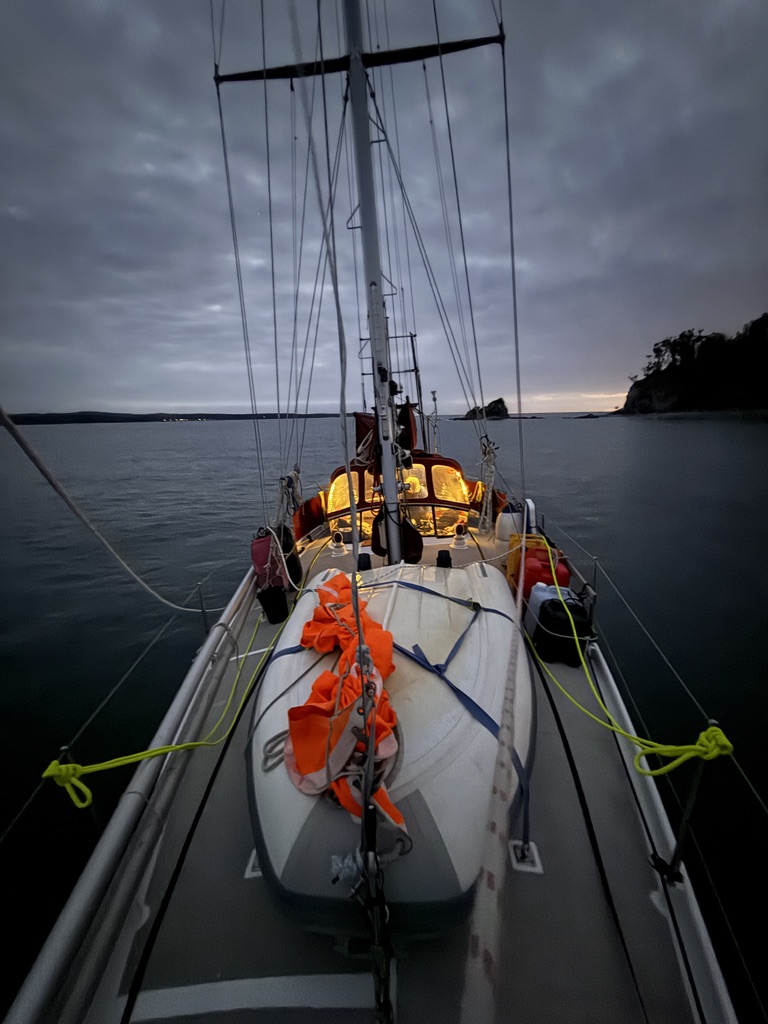
    Up at the crack of dawn. The yellow lines are our preventer lines. These are normally rigged to the bow cleats via snap shackles at one end, and to the end of the boom at the other. When tightened they prevent the boom potentially smashing across the boat in an uncontrolled gybe (only one line is used at a time, depending on which side of the boat the boom is on). In this photo the preventers have been taken off the cleats, to allow us to use them for the mooring line, and tied up so that they can’t fall in the water and foul the prop.

    We knew that getting north again would be a bit of a grind, and so it’s proven to be so far. We could make life easier for ourselves by waiting for perfect conditions, as opposed to chancing our arm when the wind is too heavy or too light, but these ‘Goldilocks’ conditions have been so few and far between that to do so could easily see us waiting weeks in each location. Unfortunately, if we want to enjoy the northern part of Australia in the brief season that our insurance allows us to visit, due to the risk of cyclones, waiting isn’t an option. We plan to spend a bit of time in the greater Sydney area, so hopefully our batteries will be recharged for the next dash north.

    One of the benefits of getting up at the crack of dawn.
    Voyage of sailing yacht Taurus: 4th of February – 13th of February 2026.
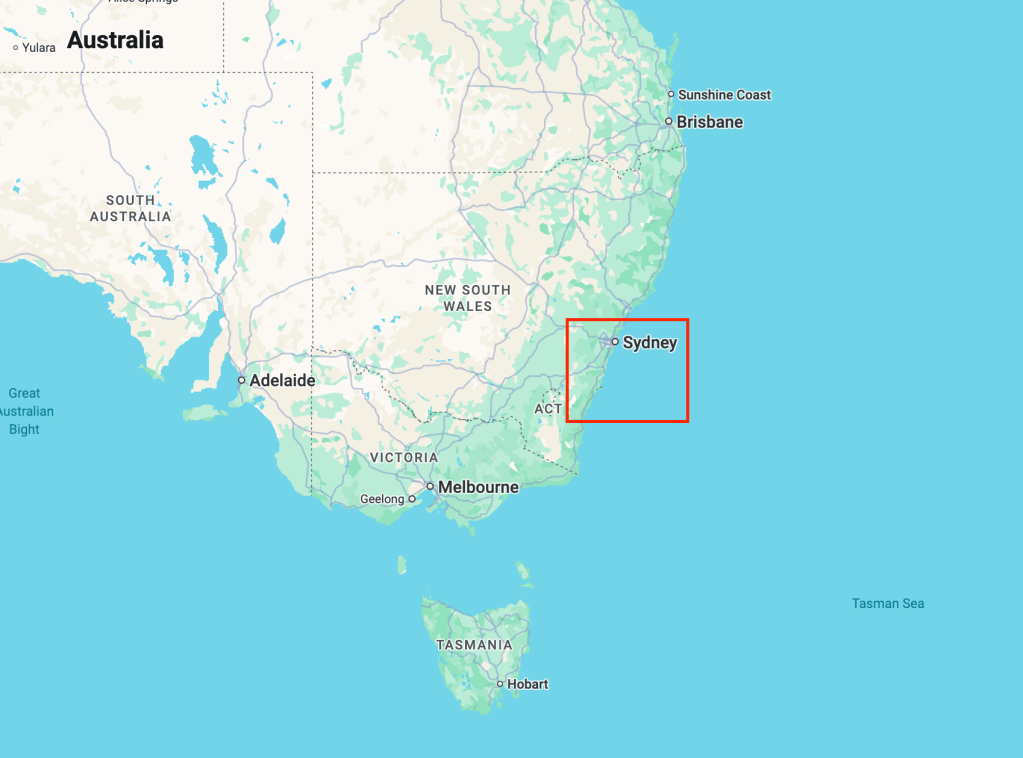
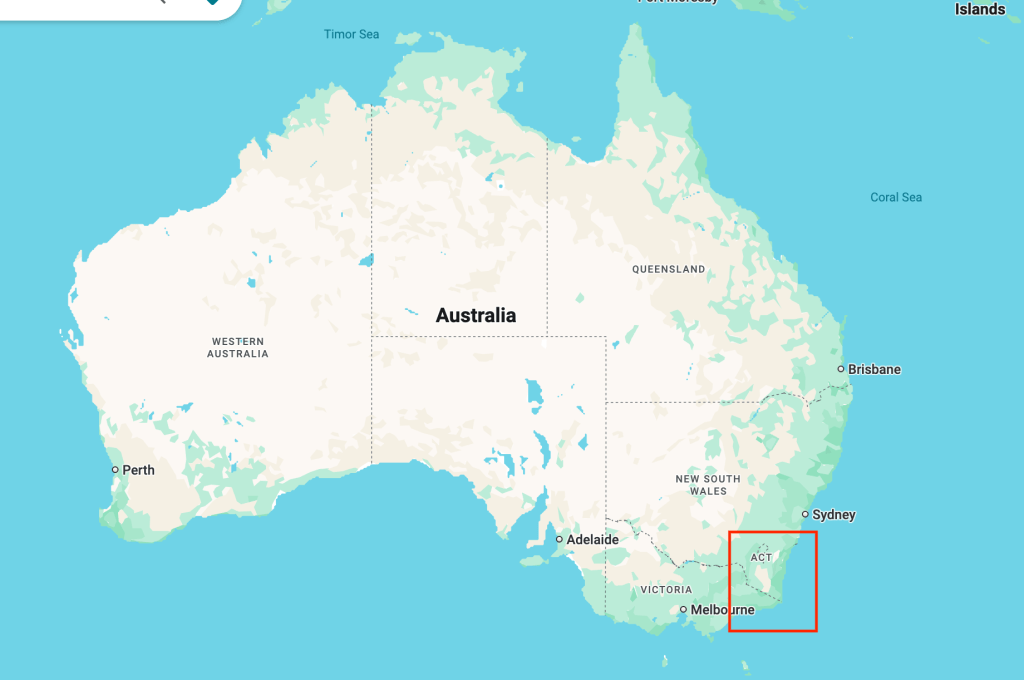
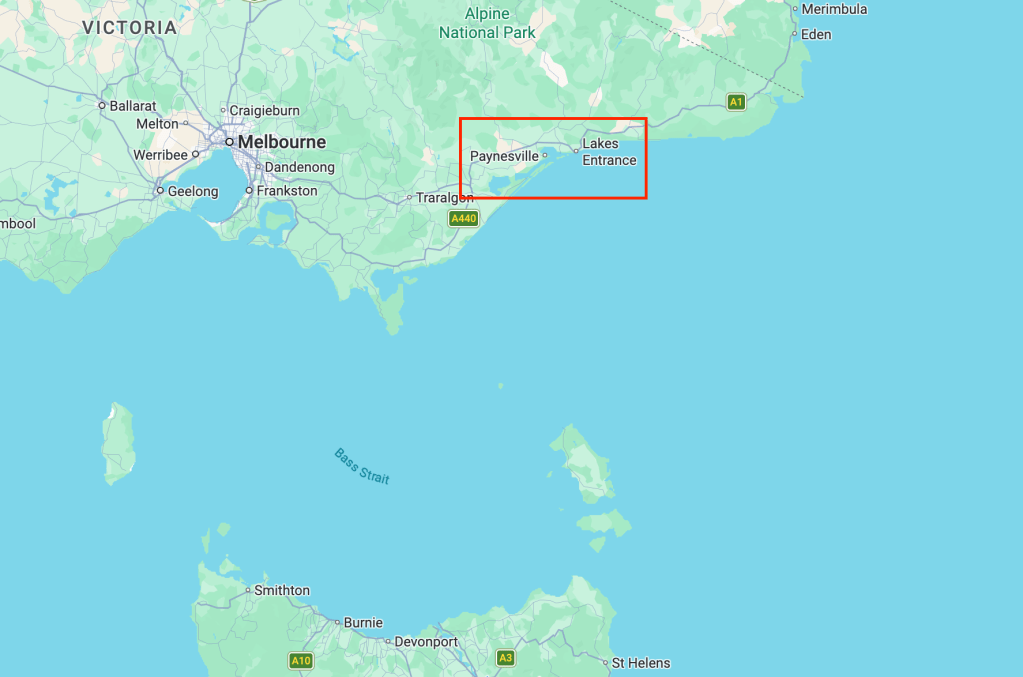
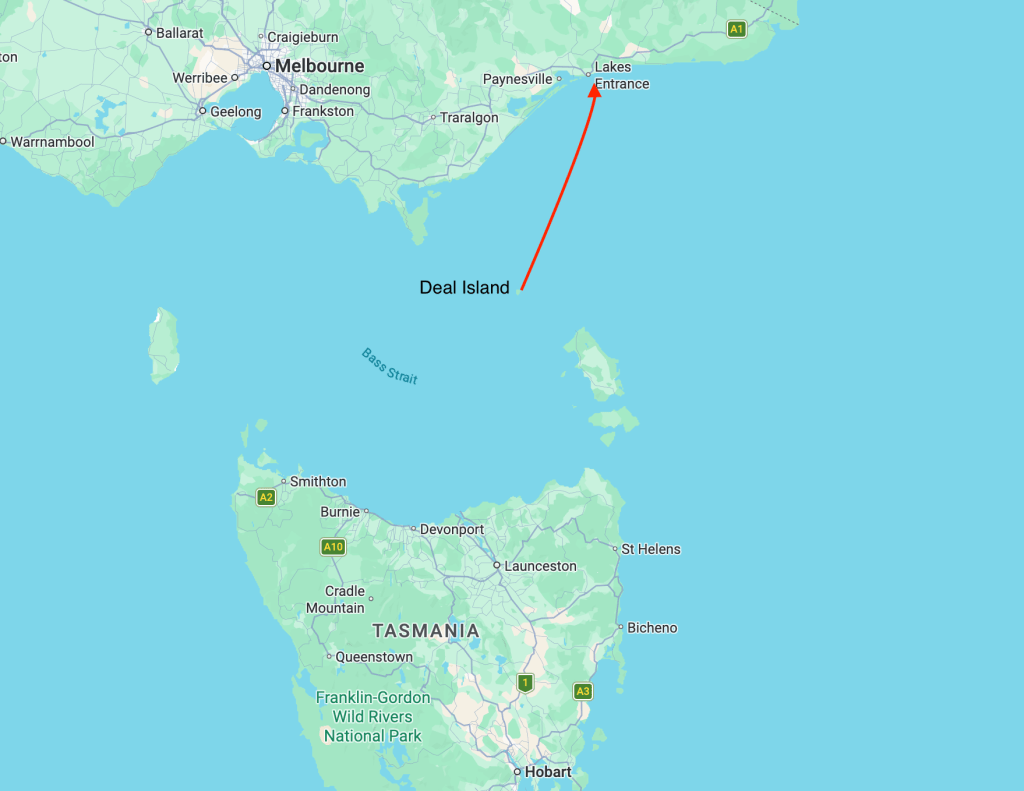
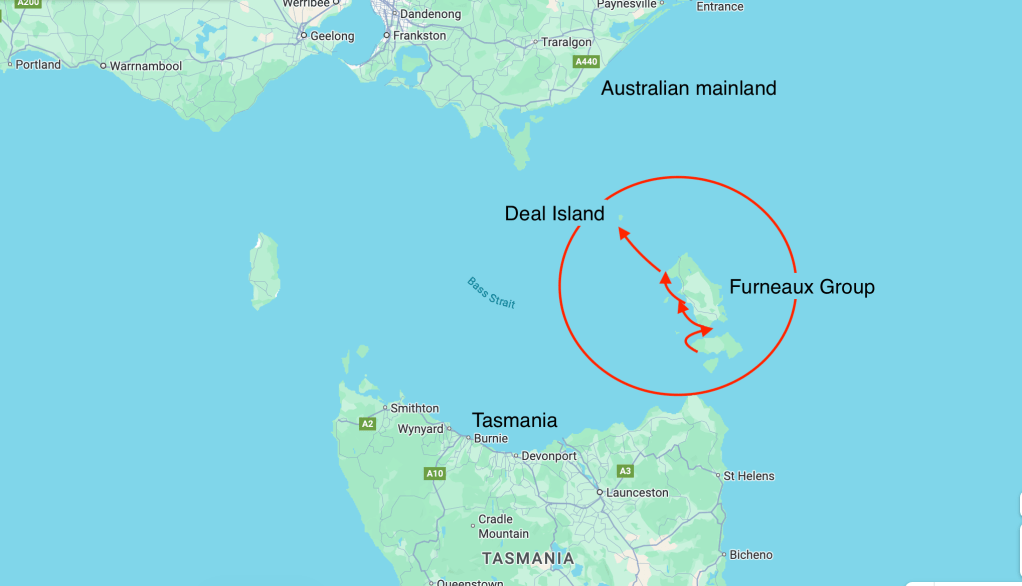
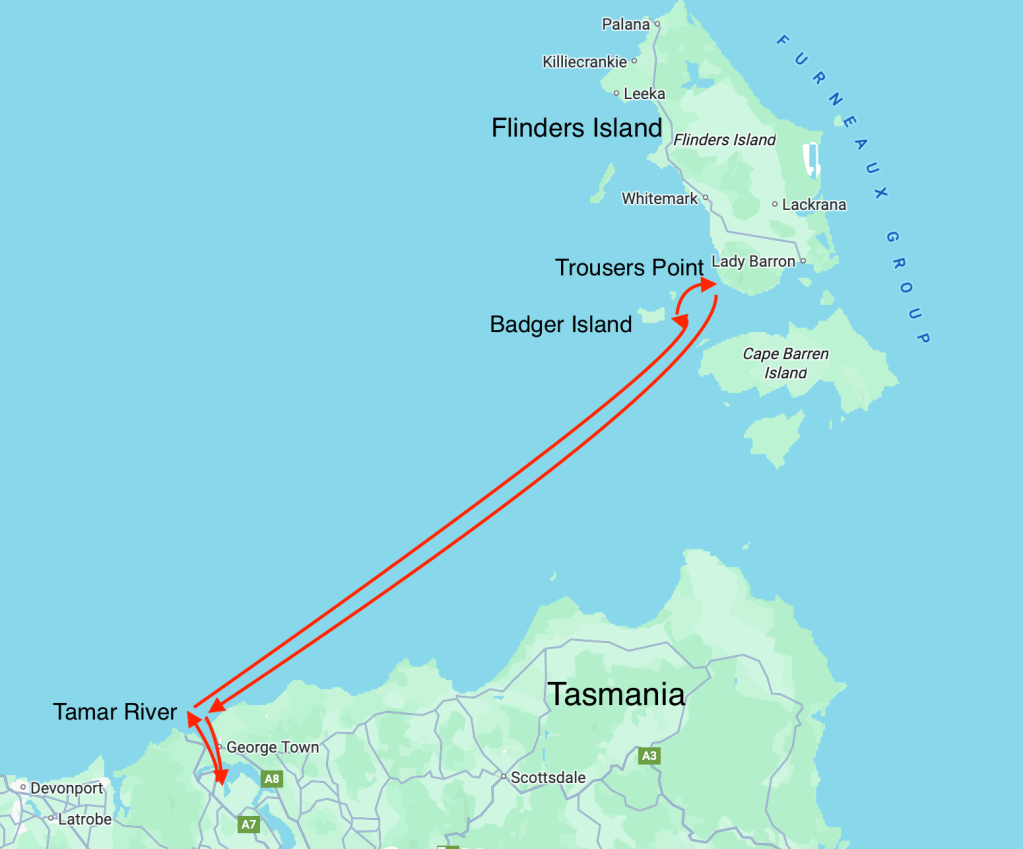
    Area under discussion.

    Next time: we sail on to Jervis Bay and Cronulla.

  • Gippsland Lakes

    We arrived at Lakes Entrance on the 22nd of January after crossing the Bass Strait and having spent about a fortnight in and around Flinders Island. As we stepped ashore we felt pretty worn out, a fatigue born of constant movement, incessantly windy anchorages, and sleeping night after night with one eye and one ear open. The Furneaux Group is an incredible place to visit, but relaxing it was not.

    Still, as if to prove the saying that there is ‘no rest for the wicked,’ Cara and I packed Taurus up the next day and left the odd sensation of a still and stable berth to head further up ‘river.’ I say ‘river’ because that is what it looked like to me, but I was later corrected by a local who told me that the river is in fact a lake — a long, stringy lake with a current.

    I confess that I knew almost nothing about the region we were visiting, having only heard vague mentions of it from other cruisers. Indeed, in my ignorance I had been describing the entire area as ‘Lakes Entrance,’ but Lakes Entrance is in fact just one of several towns in the wider area known as Gippsland Lakes. It is, however, the town closest to the bar, which it lends its name to, so it’s true to say that you enter Lakes Entrance to visit Gippsland Lakes.

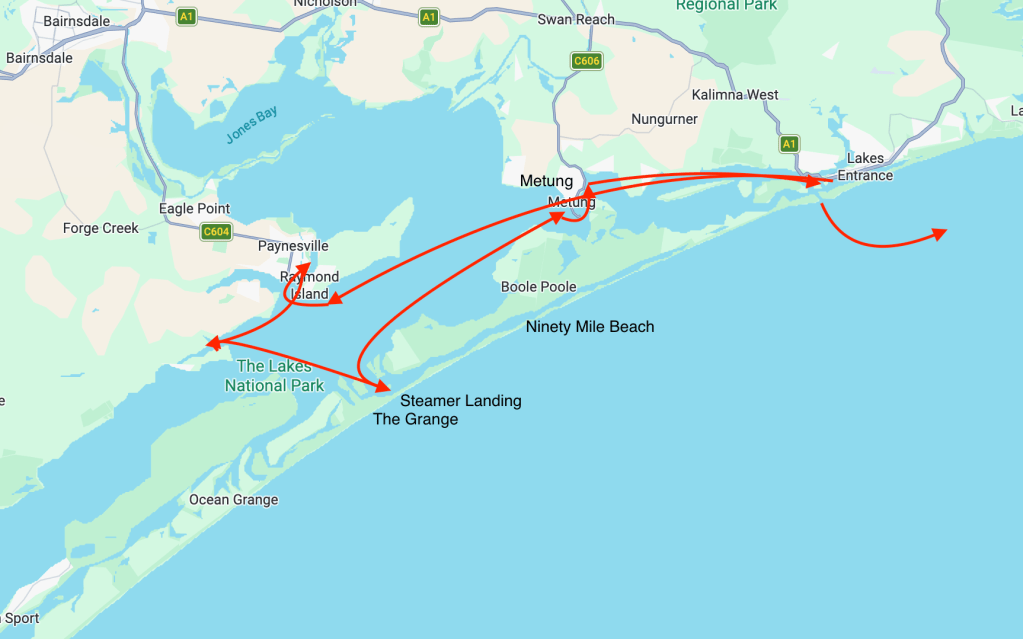
    Gippsland Lakes is Australia’s largest inland waterway system. A massive network of lakes, marshes and lagoons that cover over 600 square kilometres. Much of this waterway lies broadly parallel to the Bass Strait, separated from the ocean by a thin stretch of coastal dunes that extend for just over 151 kilometres or 94 miles. Appropriately enough, these dunes are collectively known as Ninety Mile Beach (though ‘One Hundred and Fifty One Kilometre Beach’ might be more appropriate in our metric age, though it’s a tad less poetic and lot more of a mouthful).

    We were leaving Lakes Entrance so precipitously because we had been invited to a cruisers’ get together in Paynesville, a town ‘up lake.’ Ever the social butterflies, we couldn’t turn down the offer of talking sailing with like minded souls, especially with the added incentives of pizza and beer.

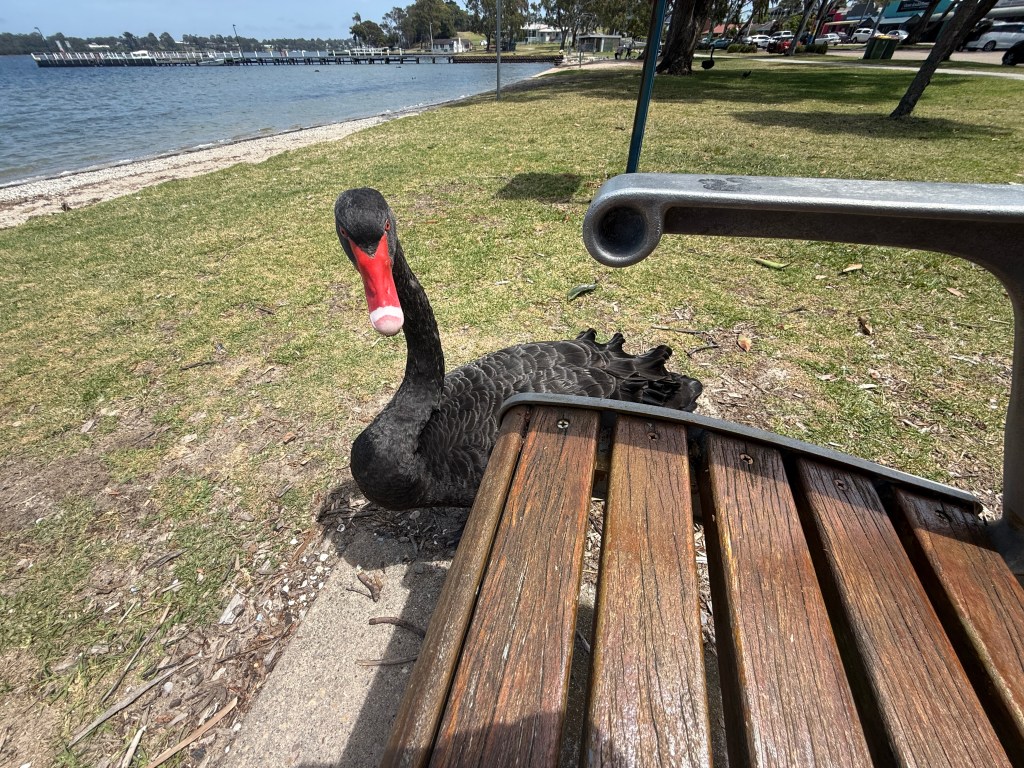
    After our recent experiences it felt strange to sail in protected water, with barely any wave, swell, or chop. With fifteen knots from astern we threw a sail out either side and glided along as smoothly as the black swans we saw all around, but without any of the frantic kicking that these icons of grace secretly resort to. It all seemed far too easy.

    Smooth sailing.

    Three hours of stress free sailing later saw us inside the Paynesville channel and tied up to a free berth in the centre of town. Paynesville is a picturesque town of some 4,000 souls and has the deserved reputation of being Victoria’s boating capital. Visiting felt a little like stepping back in time. The weather was perfectly sunny and warm, and friendly people would come to the berth to look Taurus over and have a chat. One lovely gentleman we met this way, Wilson, invited us to tea at his house the next day. Everyone seemed healthy, happy, and affluent; and the town was as neat as a new pin. It was a bit like visiting the Australia that you imagined Australia would be like back when you were a kid.

    Wilson and I. The very best thing about cruising is the people you meet.

    The easy going nature of the place was underscored by the incredible number of free visitor berths and moorings, both in Paynesville and throughout the wider Lakes area. Some of the berths are marked ‘four hours,’ but we were told that this should be interpreted as “for hours and hours.” Local boat owners happily occupy the various berths for as long as they want, with a knowing nod and a wink and a “They’ll ask me to move if they want me to.” So, when in Rome and all that.

    Approaching Paynesville.
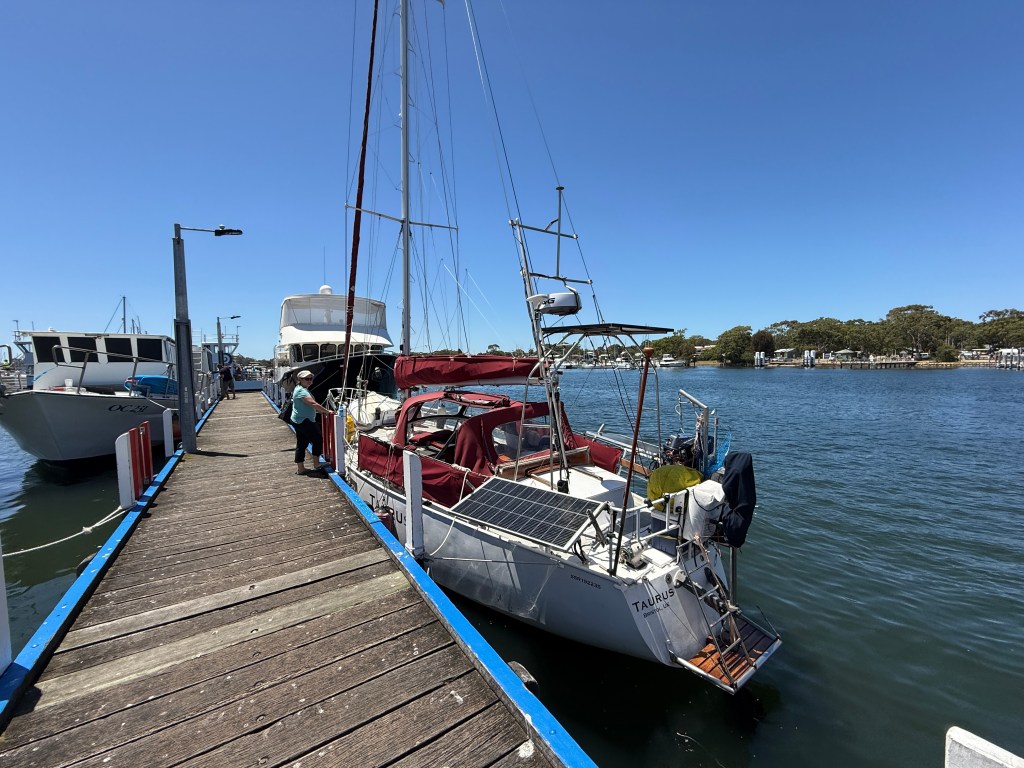
    Tied up on a free berth. The large launch in front is Blue Affinity, on which we had enjoyed the company of Mick and Dusty when in Deal Island.

    Peter, who runs the local Facebook Group for sailors, met us at the dock and pointed out the wine bar where we would be meeting up later, all of maybe fifty metres away. It was great to meet some like minded souls and afterwards we were invited to the yacht club for ‘one for the road.’ Much of the conversation focused on the impending ‘Paynesville Classic Boat Rally’ which runs from February 27th to March 1st. This biennial festival has grown quickly over the past few years and threatens to eclipse the more famous Australian Wooden Boat Festival in Hobart. This also being biennial allows the two festivals to nicely complement one another, and together they provide an annual boatey celebration. Taurus was invited to attend, easily qualifying for the over twenty five years old stipulation, but time is marching on, and we have a long way to go if we want to make the most of the season north of Bundaberg. In typical generous Aussie fashion Peter later leant us his ute so that we could hit the local big smoke of Bairnsdale. We had to try and find a new kayak paddle, for reasons described below…

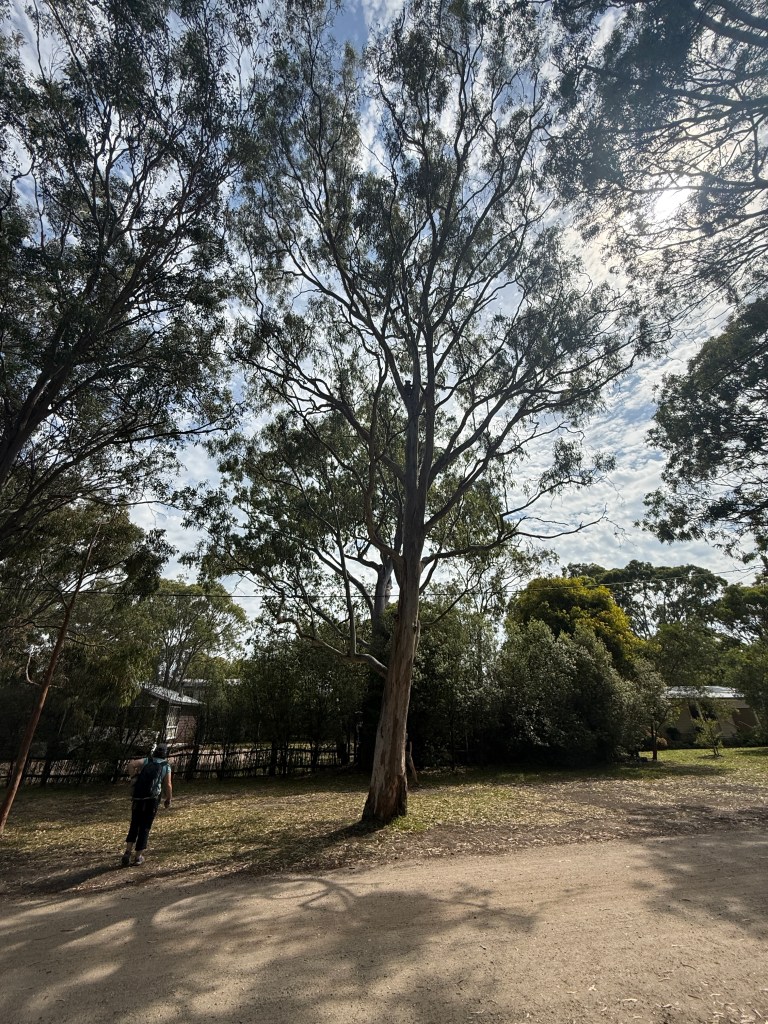
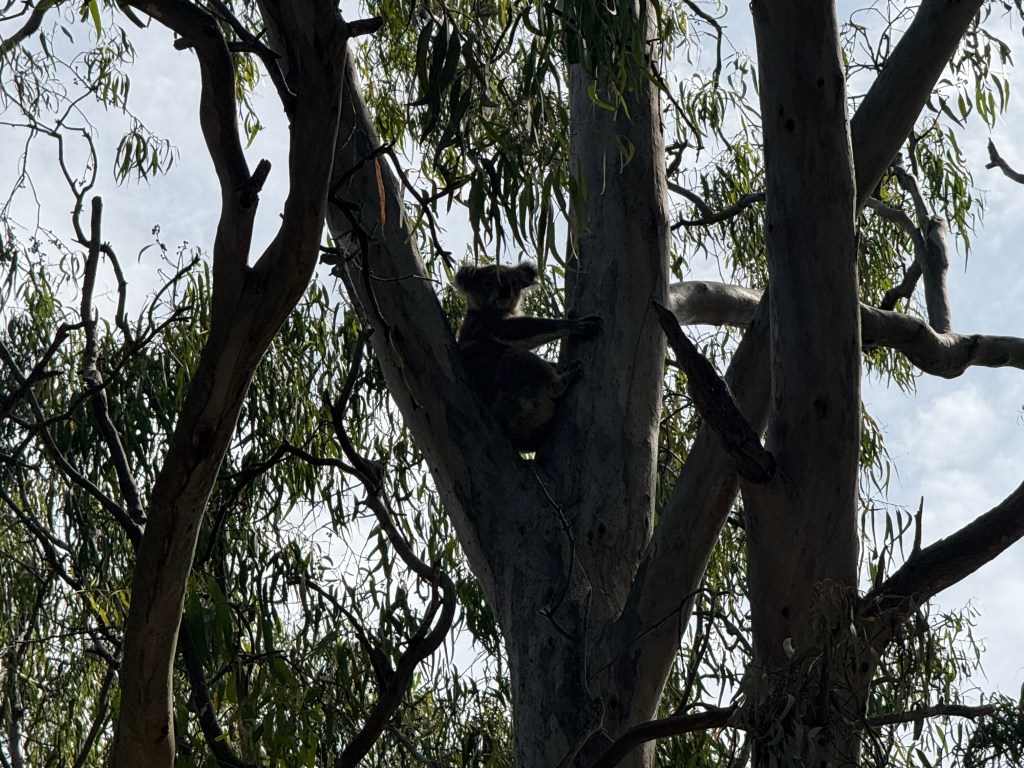
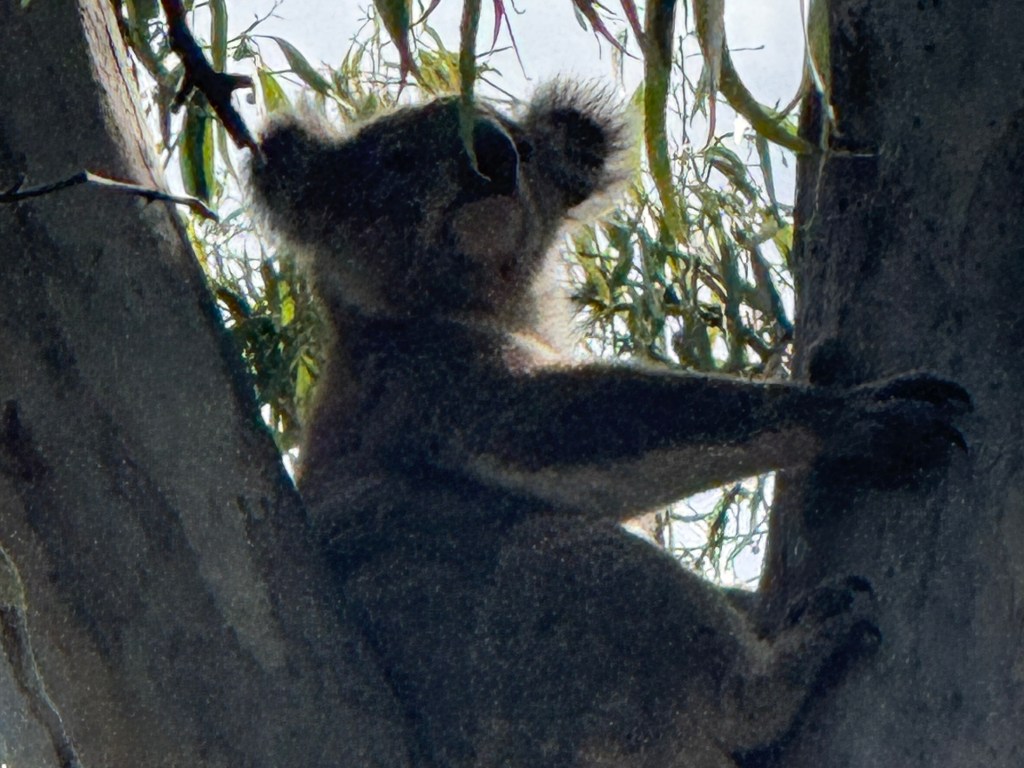
    Next morning we took the free ferry that plies from Paynesville to Raymond Island to bother the island’s most famous residents: koala bears. Visiting the bears is one of the ‘must do’ items on the Paynesville tourist trail. Worried that we might not be able see any of these elusive marsupials a local advised us not to look up into the trees, but look down for “koala shit” on the ground. In the end we simply followed the other tourists and it became pretty clear by the crowds around the trees where the koalas were!

    Can you see the koala? Watch out for pooh, Cara!
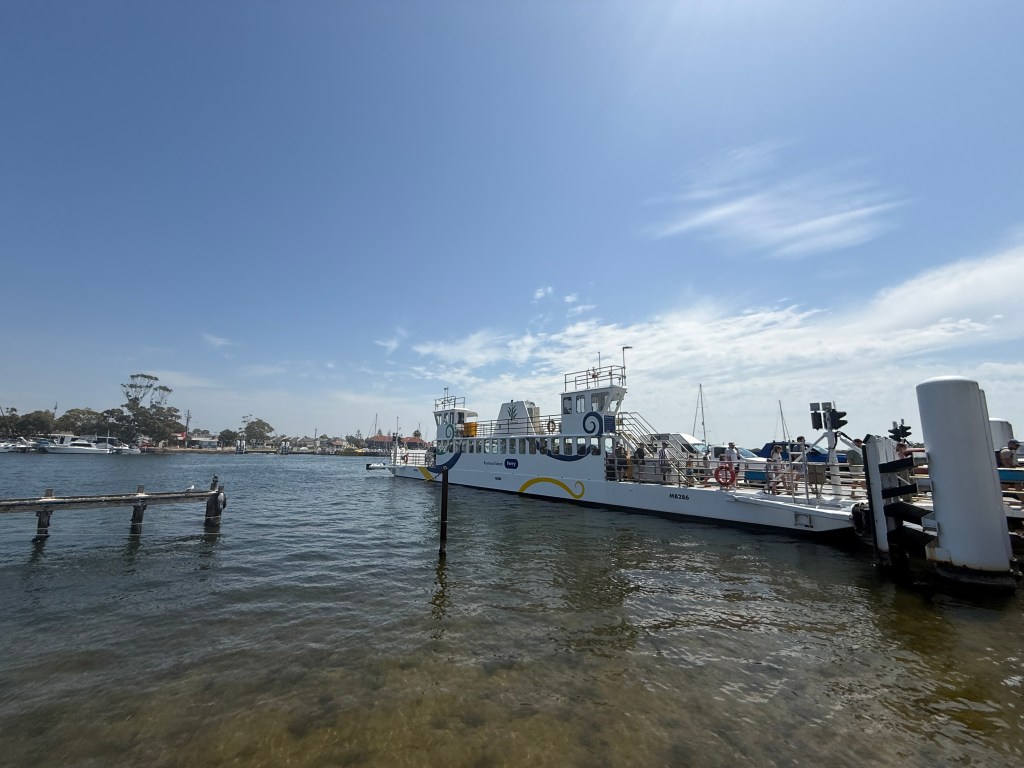
    Free ferry.

    That evening Cara and I were invited aboard Blue Affinity once more. Dusty had been replaced by Mick’s wife, Ilonka, who was visiting from their Western Australian home. The conversation and wine flowed freely, and Mick secured his reputation as an exceptional host and wine maker. It felt a little strange having drinks and nibbles on the fly bridge, so high above everyone else, but it was a strangeness that one could get used to!

    Taurus and Blue Affinity on berth together.. Someone asked me if the size difference made me feel inadequate! (only a little)
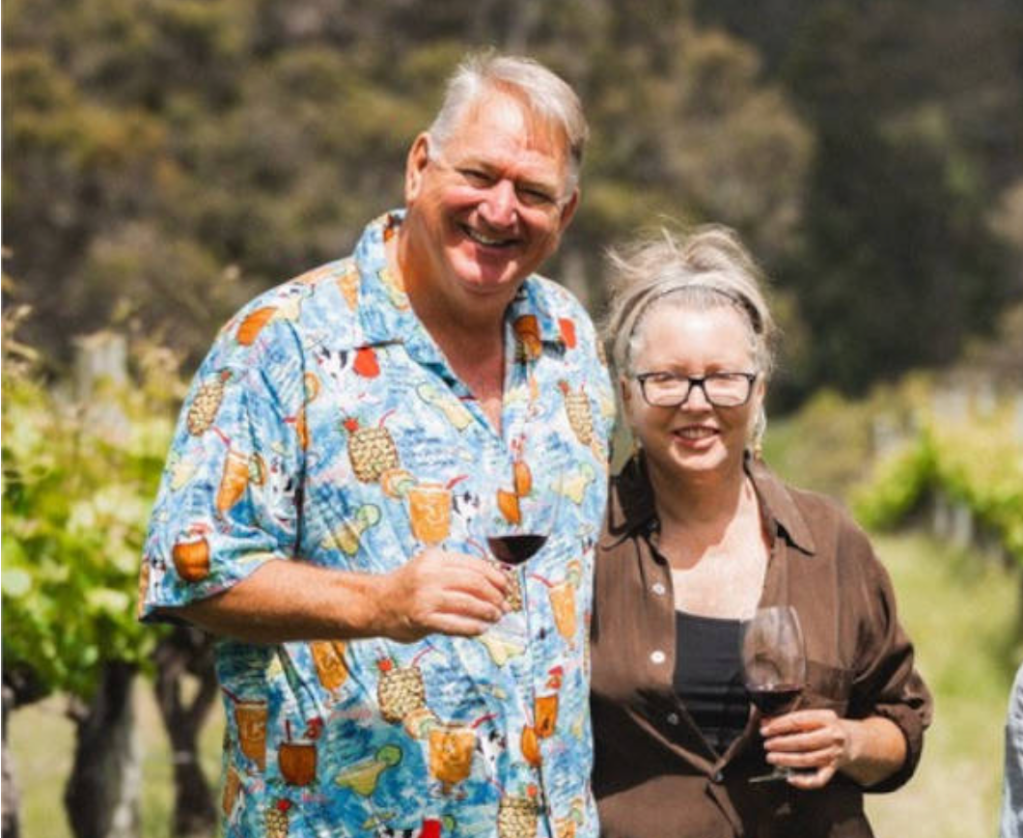
    Mick and Ilonka. Fascinating people and incredibly generous hosts. Sadly, we failed to get a decent photo of the evening, so we borrowed this one from the ‘Wineries of Western Australia’ website. https://wineriesofwesternaustralia.com.au/bakkheia-wines-michael-edwards/

    At the end of the evening we heard live music coming from the pub opposite the berth, so rather than doing the sensible thing and going to bed, we decided to go dancing! With more enthusiasm than skill we lit up the boards and pretended we were thirty years younger…

    Slightly worse for the wear the next day, and feeling thirty years older, we left Paynesville and headed out to explore some of the Gippsland Lakes area. It being ‘Australia weekend’ there were crowds of people out and about enjoying the sunshine (and not a hint of ‘Invasion Day” in this neck of the woods!). We had to avoid an unusual maritime hazard as we left our berth, a floating shed complete with jazz band! Apparently a common site in Paynesville, ‘The Shed’ ties up at various berths to give free entertainment to the locals.

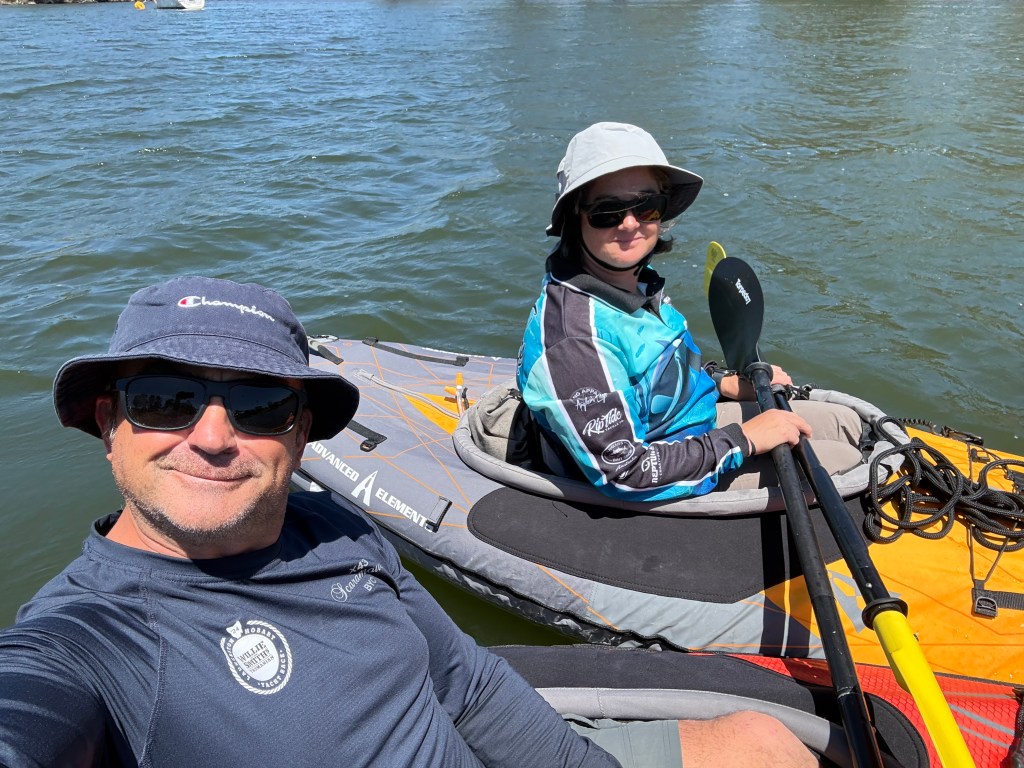
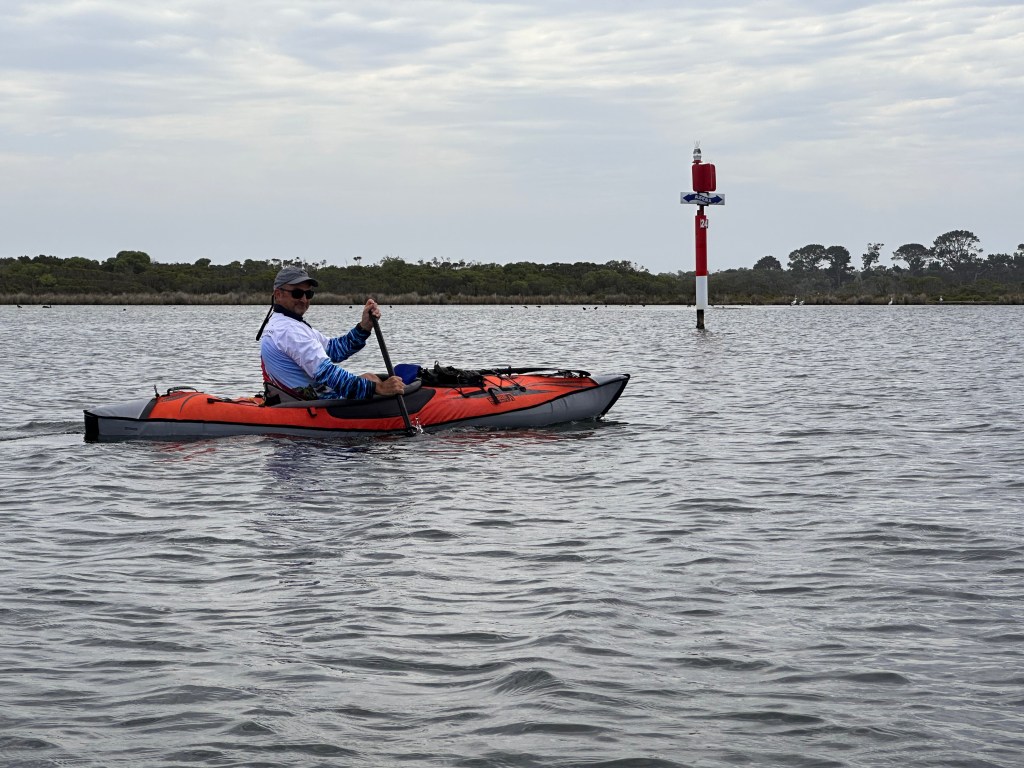
    Our first stop was Duck Arm, a short sail away and a lovely sheltered spot. We blew up the kayaks and went for a paddle, spotting pelicans, swans, and even an eagle of some kind, but no ducks with arms.

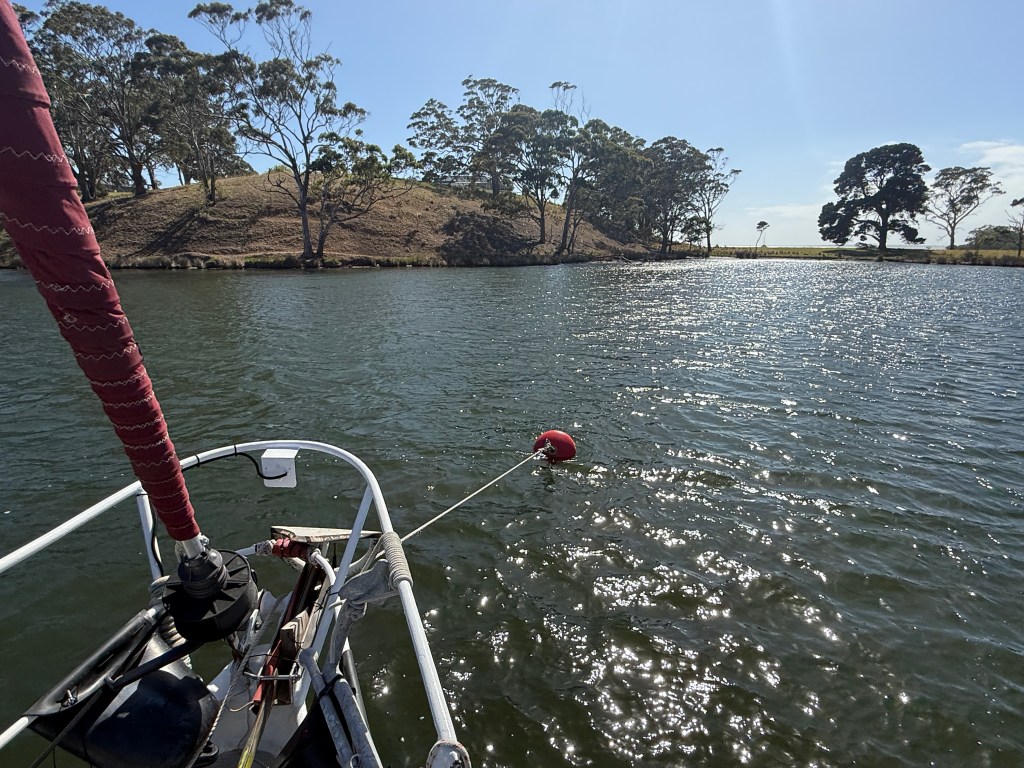
    Public mooring in Duck Arm.
    Kayaking is hard exercise..

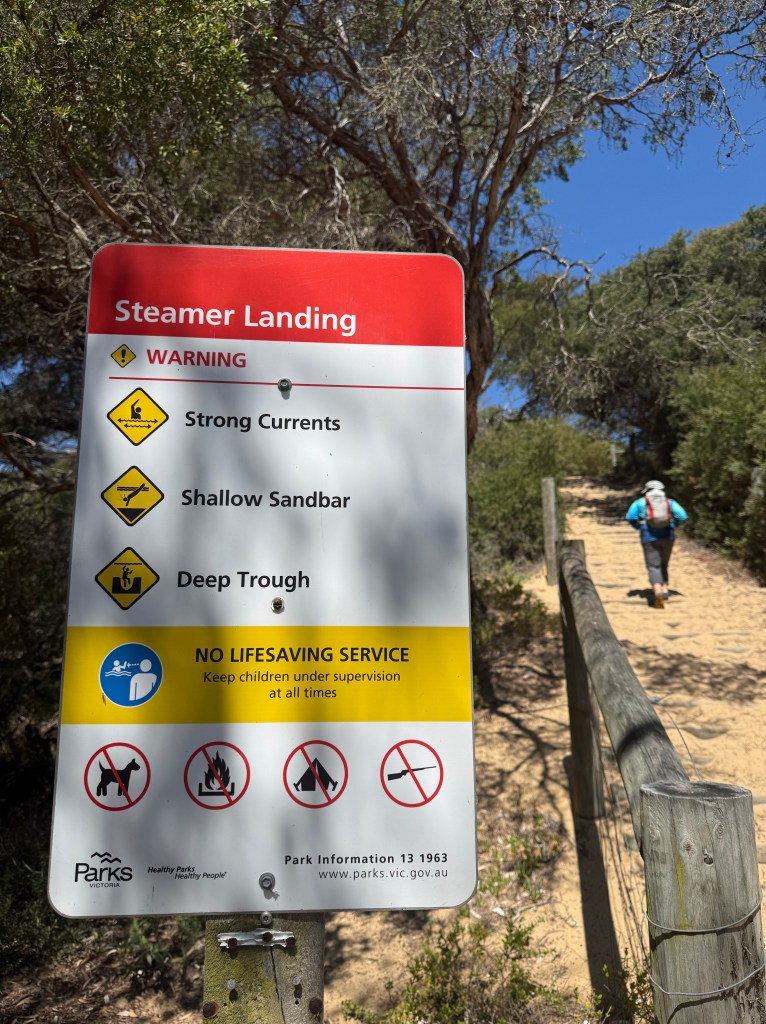
    The next day we shifted to another anchorage that we had been told we had to visit: Steamer Landing. Setting off at low tide we just squeezed through the channel, with our depth monitor recording -0.1 of a metre below us at one point. We picked up another free mooring and kayaked over to a jetty for the short walk to Ninety Mile Beach.

    Hmm, maybe swimming isn’t a good idea…
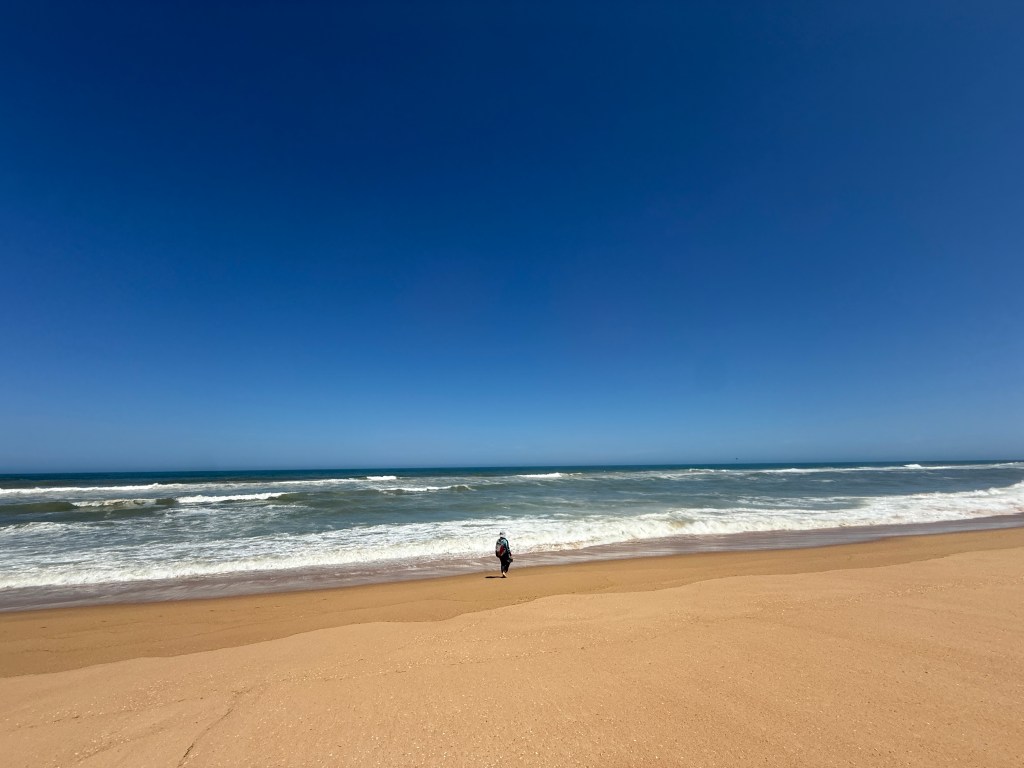
    Cara at the beach. Imagine ninety mile of this..

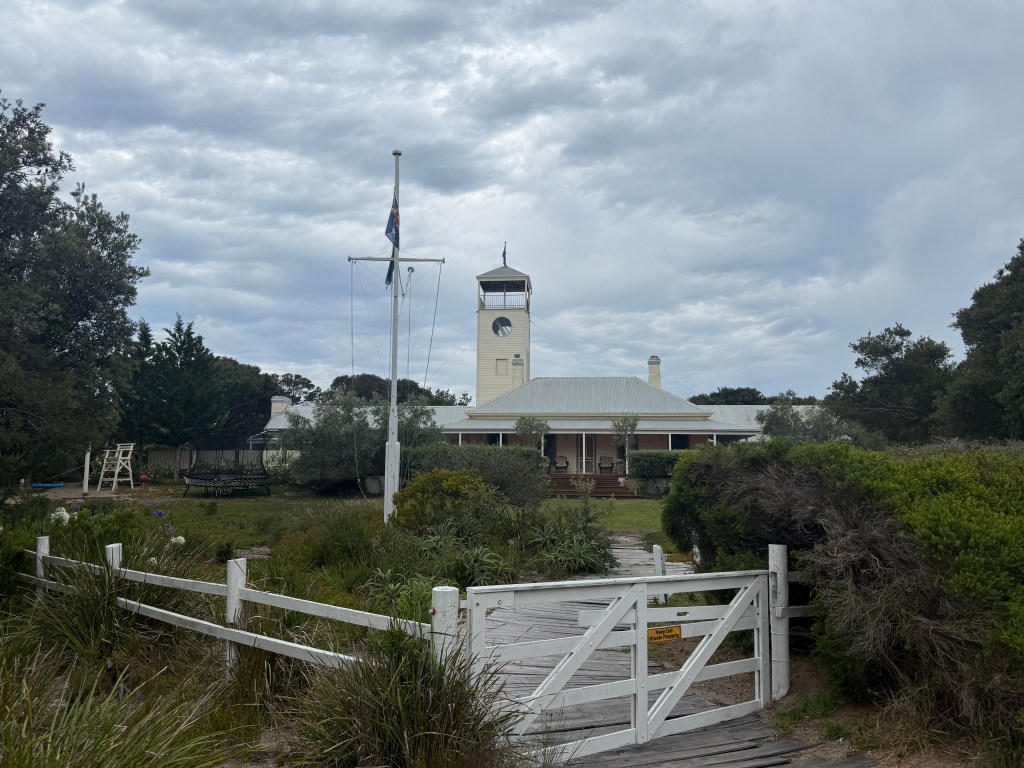
    Unbelievably, we had the whole ninety miles to ourselves, or as much of it as we could see. We strolled for half an hour and returned to the kayaks to paddle down to the next jetty at a place called ‘The Grange.’ An interesting old building lies here, but its private property so you can only gaze at the exterior.

    Upon leaving I leant on my paddle to get into the kayak and it unceremoniously snapped in two, dumping me bum first into the water. Our paddles join in the middle so have a weak spot, but I also fear I may have eaten too many pies whilst in Tasmania! Once Cara had recovered, we left and I tried to paddle canoe fashion with half a paddle back to Taurus. However, I soon found out that it was easier to use Cara’s full paddle and tow her behind me. Cara didn’t object, and looked like quite the lady of leisure!

    Up a river (lake) with half a paddle..

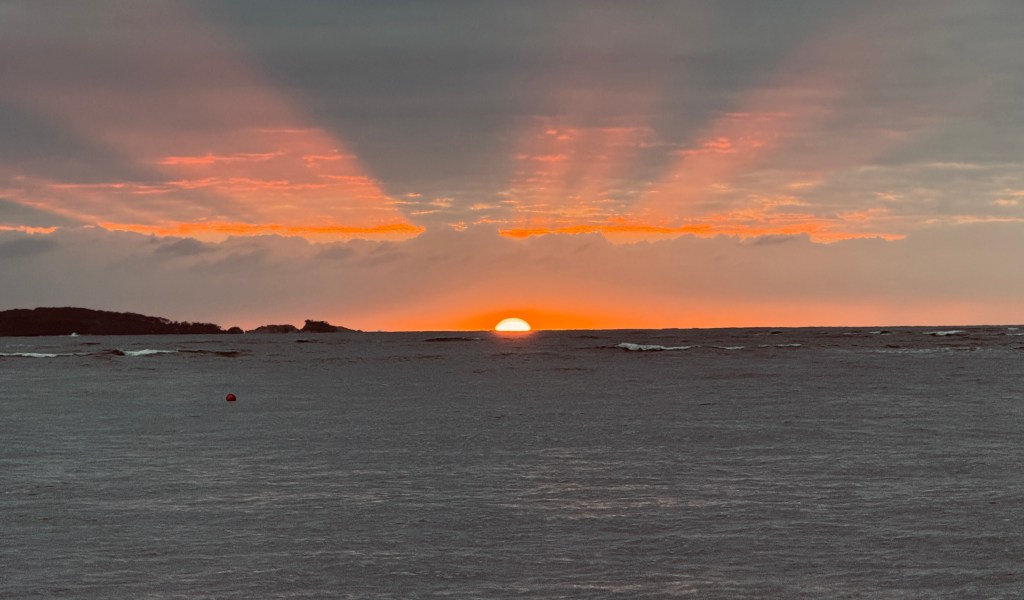
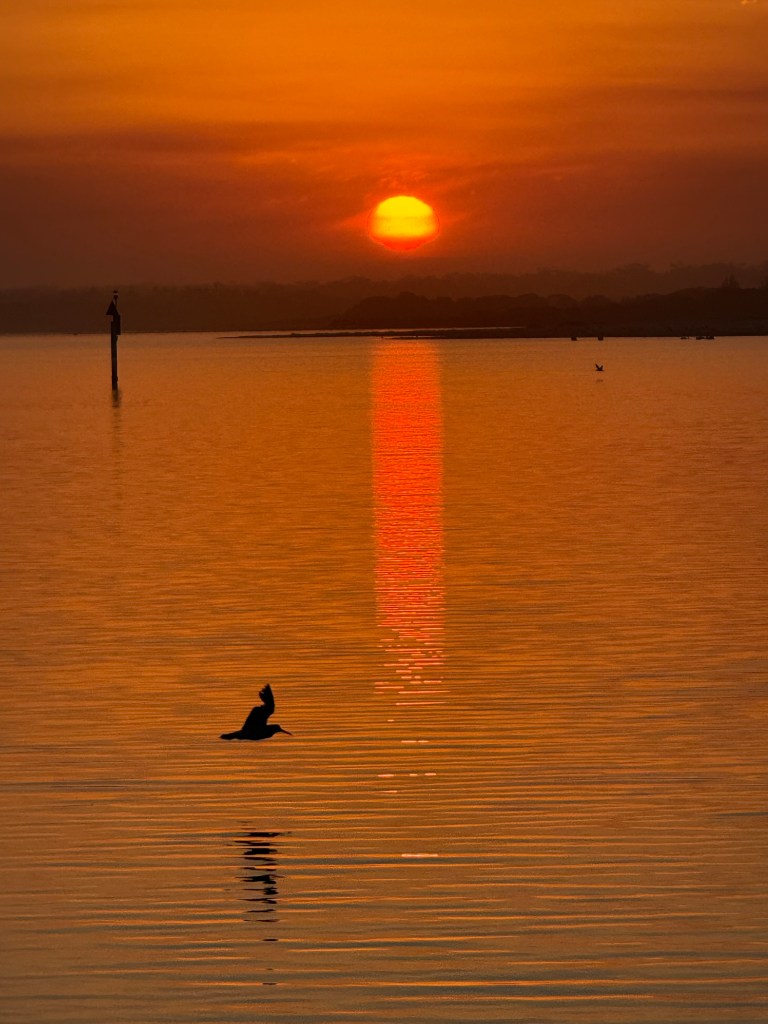
    The sunset that night was stunning, but, as a friend later commented, the red glow in the sky would have had much to do with the bush fires raging in southern Victoria. It gives the image a more sinister feel doesn’t it? Less paradise and more apocalypse over the horizon.

    Our next destination was a small town called Metung, where another free public jetty disgorges the weary sailor straight into the local pub. This is my kind of town planning!

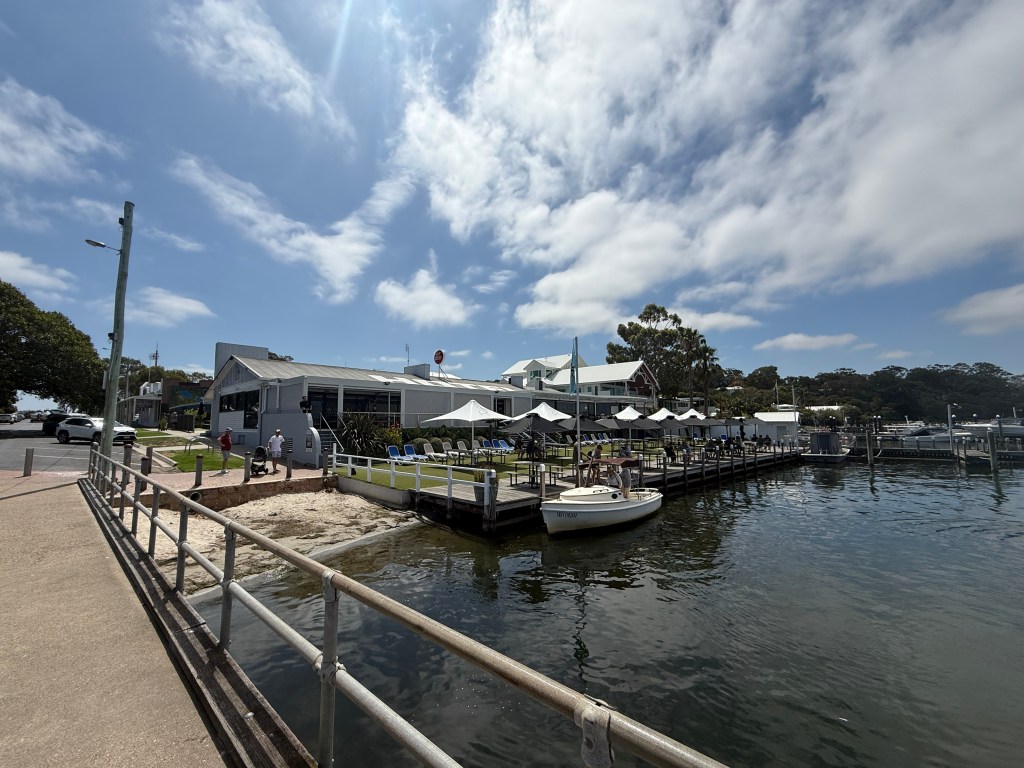
    Metung Tavern, note boats moored up next to the beer garden.

    We stayed on the jetty for a couple of days waiting for some bad weather to blow through. The launch in front of us caused us some concern as it seemed to have been abandoned. Tied up with skinny old frayed line, it had no fenders and was crashing and bashing against the wharf like a horny old bull fenced off from the cows. Because it had been left in the middle of the jetty we had to pull ourselves up close up to it (so the ferry could dock on the ninety degree turn behind us). Why they didn’t use the more sheltered and smaller berths on the inside of the jetty is known only to God and the absent owner. Eventually we overcame our scruples about interfering with other peoples’ boats and used some of our spare lines and fenders to better secure the boat for the duration of our stay. It meant that I could sleep better!

    After a pleasant evening at the Metung Yacht Club (located next to a free shower!), we headed away to another jetty in China Man’s Bay. We turned out to be a bit big and the jetty a bit rotten, so we only stayed long enough for a short walk ashore.

    Bum hanging out a bit!

    We headed back down river (lake) and picked up a mooring buoy. Now, regular readers will be wondering why nothing has broken as yet, and we were wondering much the same. So, in order to put us back on track I determined that the minor oil leak that had been bugging me for weeks was coming from the diesel lift pump. I’d previously replaced the gasket but to no avail, so I decided to take it off again and use some gasket goo. Access to this item is pretty tight, I had to cut the handle off an adjustable spanner to loosen the fuel line connector nuts, and the threads were getting a bit ‘tired’ and were on my list of things to replace.

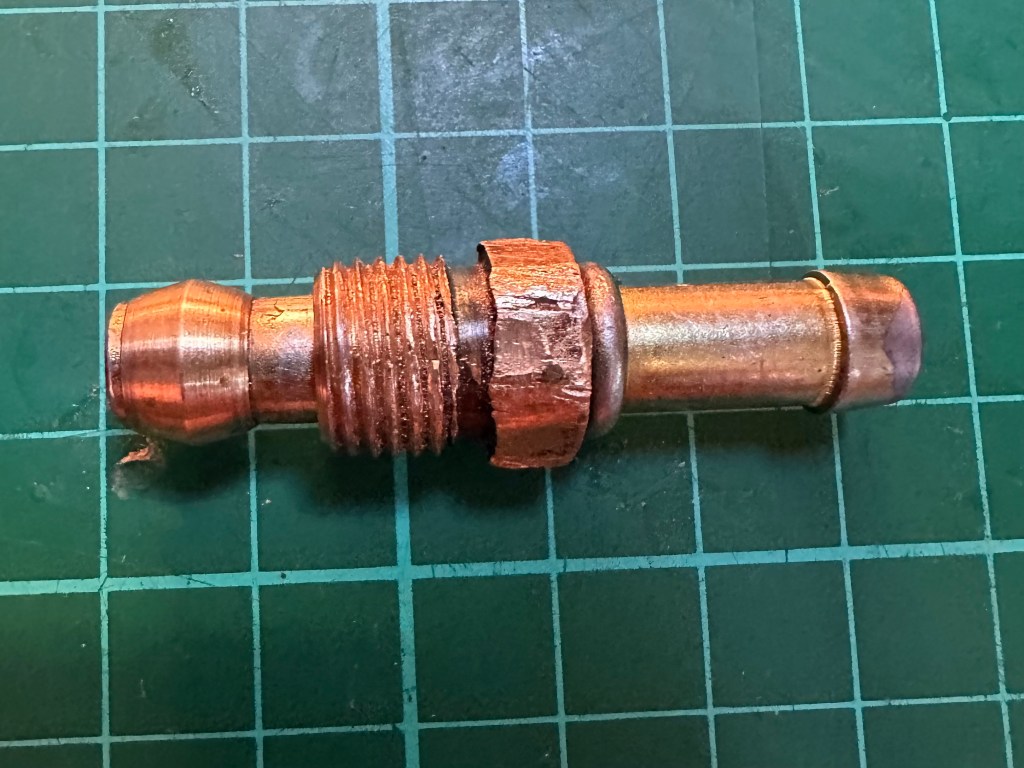
    You can probably guess that a combination of me, poor access, and worn out parts meant that something bad was about to happen — and you’d be right. I managed to wreck the threads on a small brass connector which meant that the engine sucked in large amounts of air instead of diesel, which is something that diesel engines don’t like (the clues in the name). Naturally, only at this juncture did I look for a spare onboard, and naturally we didn’t have one.

    An ex-fuel pipe connector thingy. Aka ‘sodding bloody thing ‘ — a generic engine term.

    Taurus was effectively stranded for want of a $10 brass fitting. We could try to sail, but the river (lake) was shallow, the bends numerous, and the wind fitful. Sailing wasn’t really an option. We had a bit of a miserable night trying to identify the offending part and worrying about its availability. Early next morning we had the Yamaha engine on the dinghy and we headed down river (lake) to Lakes Entrance, the closest town, to hopefully go shopping. Incredibly, the only place that might possibly sell one of these parts did have one, two having just come in. Thanking our lucky stars we bought both, and feeling much happier went for a big breakfast before the dinghy ride home.

    Wonders of wonders, the engine actually worked with the new part, and miracle of miracles, the oil leak was vastly improved. Perhaps this qualifies as a success?

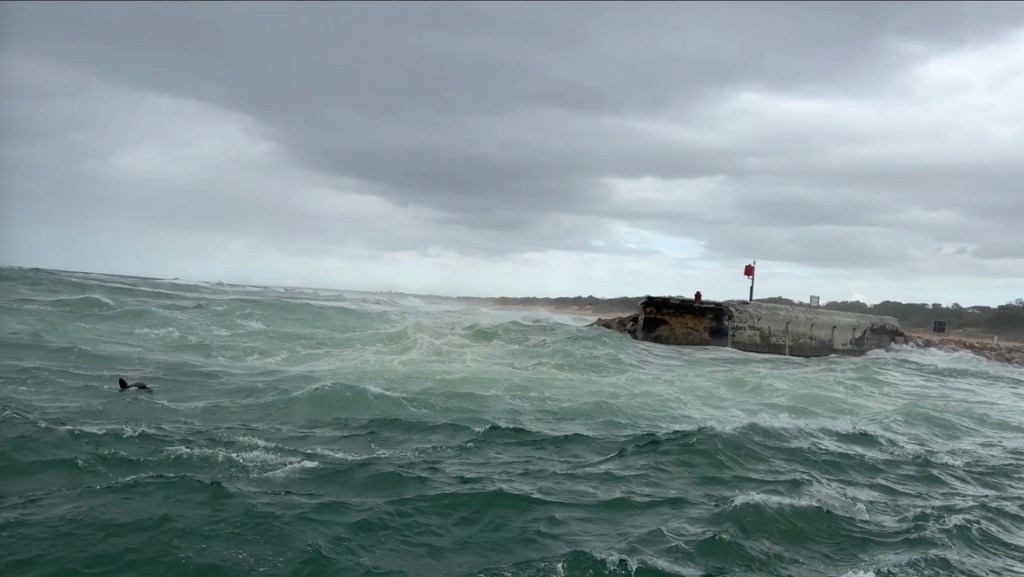
    We happily motored to another free jetty, reveling in the charming sound of a working diesel engine, from which a short walk leads to an observation platform above the bar. Intending to leave the following day to sail to Eden, we wandered up to the flagstaff to have a look. From there we could readily see the ‘overfalls’ created by waves entering the bar and the tidal current trying to escape. This is similar to the classic ‘wind against tide’ scenario that causes waves to ‘stand up’ when forces are in opposition. Local seals were having a whale of a time, but it wouldn’t be the optimal time to take a boat through, though probably not impossible in the otherwise benign conditions.

    If, however, you compare the below image, which was taken when we arrived at Lakes Entrance (with the tide entering) , to the calm conditions outside the bar in the video above, you can imagine how hairy it could get if you tried to come in at the wrong time in the wrong conditions. The point I’m trying to make is that a culmination of bad factors might easily bite you in the bum.

    Lumpy.

    Knowing that we would have light winds the following evening, we nevertheless decided to leave at slack water after high tide in the early afternoon, rather than attempting the bar in the dark. Doing these things at night is hardly a deal breaker, especially if leaving, which is much easier than entering in my opinion, but it’s not recommended, and if things go wrong you look a bit silly or reckless. Silly or reckless is not how you want to look if things go really wrong and you end up in Coroner’s Court.

    We had a pleasant evening meeting new friends, Cal and Linda on Naruny, who were tied up next to us, before getting ready again for sea. Cal and Linda kindly sent us the following video of our leaving the next day. It looks pretty easy, and at the right time and on the right day it is. Call me dull but I do like easy!

    Leaving Lakes Entrance. Many thanks to Cal and Linda for the footage.

    And so, we sailed away from Gippsland Lakes. A gem of a place if you enjoy boating, friendly people, and the finer things in life. Hopefully it won’t be too long before we have a chance to return.

    Voyage of the good yacht Taurus: 22nd of January – 4th of February 2026.
    Area under discussion marked by red rectangle.

    Next time: we sail to Eden, meet dolphins, and have more nautical (mis)adventures!

  • Deal Island to Lakes Entrance

    Having arrived at Deal Island, Cara and I had a couple of days before the next weather window that would allow us to cross the second half of Bass Strait to the Australian mainland. So, we set out to explore Deal in the time available.

    Deal is the largest island in the Kent Group, Tasmania’s northernmost national park, and incorporates 29,000 hectares of marine reserve. To visit the island you have either to sail there, or you can apply to go there as a volunteer caretaker.

    Whilst in Hobart, we had met a nice couple in a marina who were about to start their volunteer stretch on Deal. The caretakers are responsible for conservation management, which includes weed control, fauna surveys, maintenance of the historic lighthouse and heritage buildings, and visitor management. Unfortunately, we didn’t manage to get to Deal in time to meet our friends there, but we had a nice talk with the new couple. They told us that the Parks Department interviews for sufficient couples to cover a three year period at a time, this saves admin fees and there is never a shortage of volunteers. When beginning their stay, the selected lucky couple are flown onto the island with everything they think they might need for their entire stay: all their food, linen, entertainment and hobby supplies. A weight limit is stringently applied due to the limited size of the plane that can land on the island. It sounded like all the fun of living on a small boat — but with a lot weeding, strimming, and mowing thrown in. The joy of the role didn’t quite resonate with me, as surely one of the best things about living on a small boat is the fact that you don’t have to do weeding, strimming, and mowing!

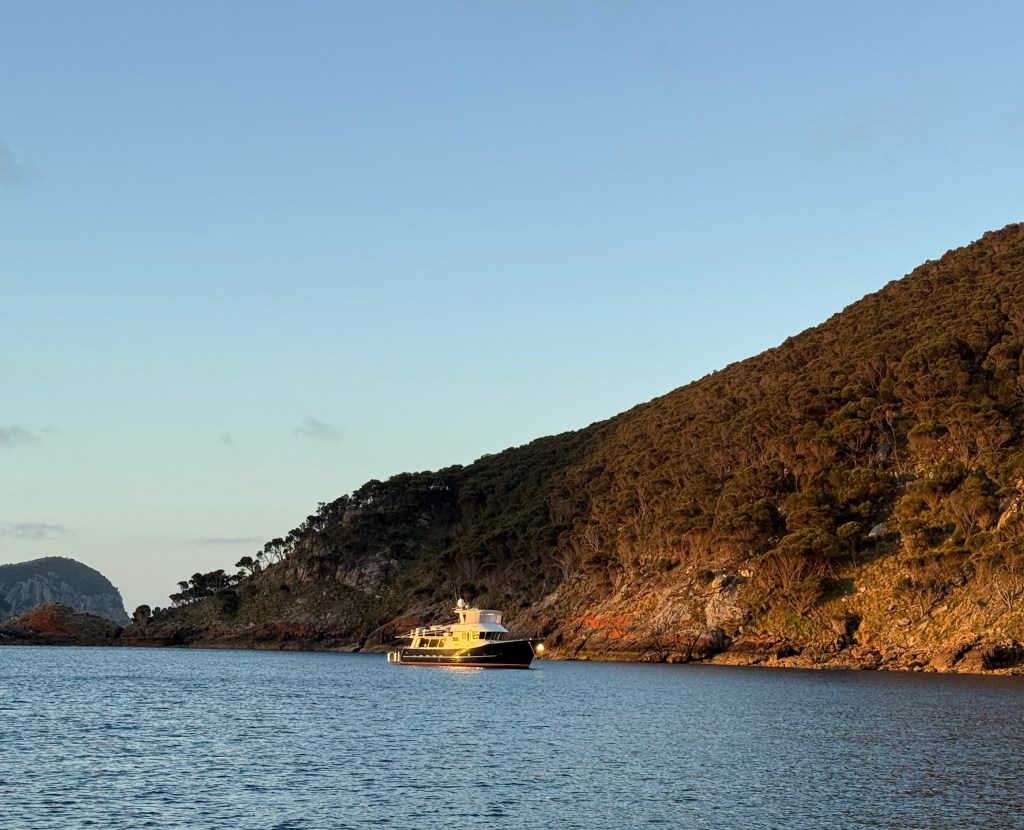
    East Cove, which is where we were anchored, is perhaps the best anchorage from which to explore the island.

    East Cove

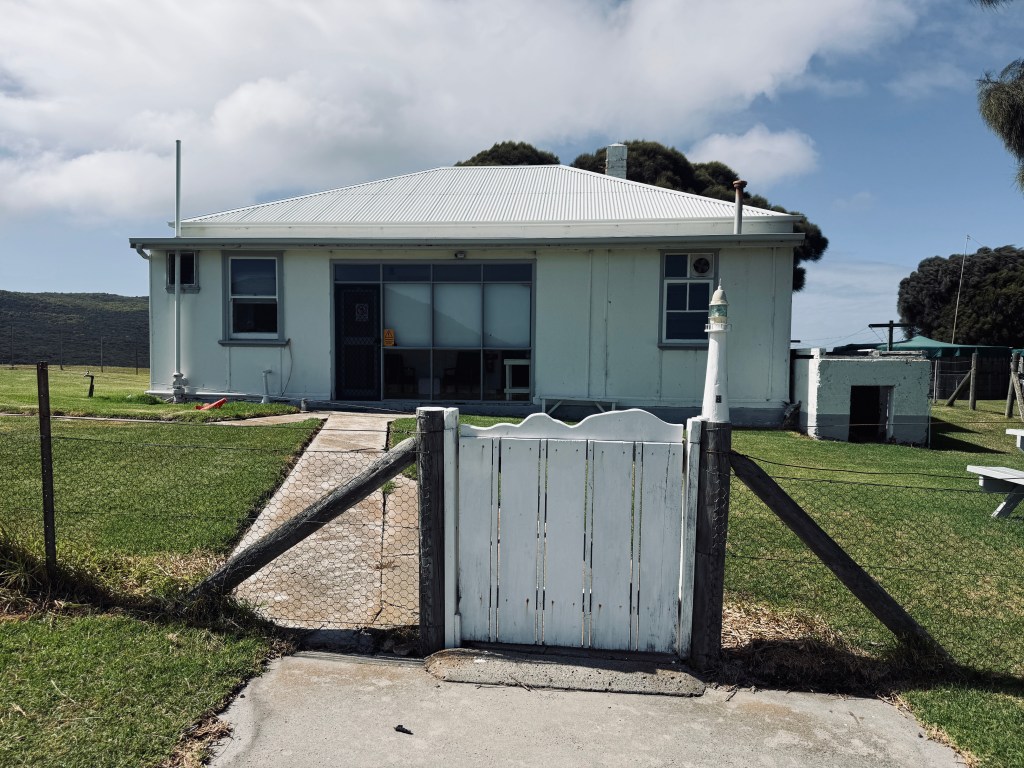
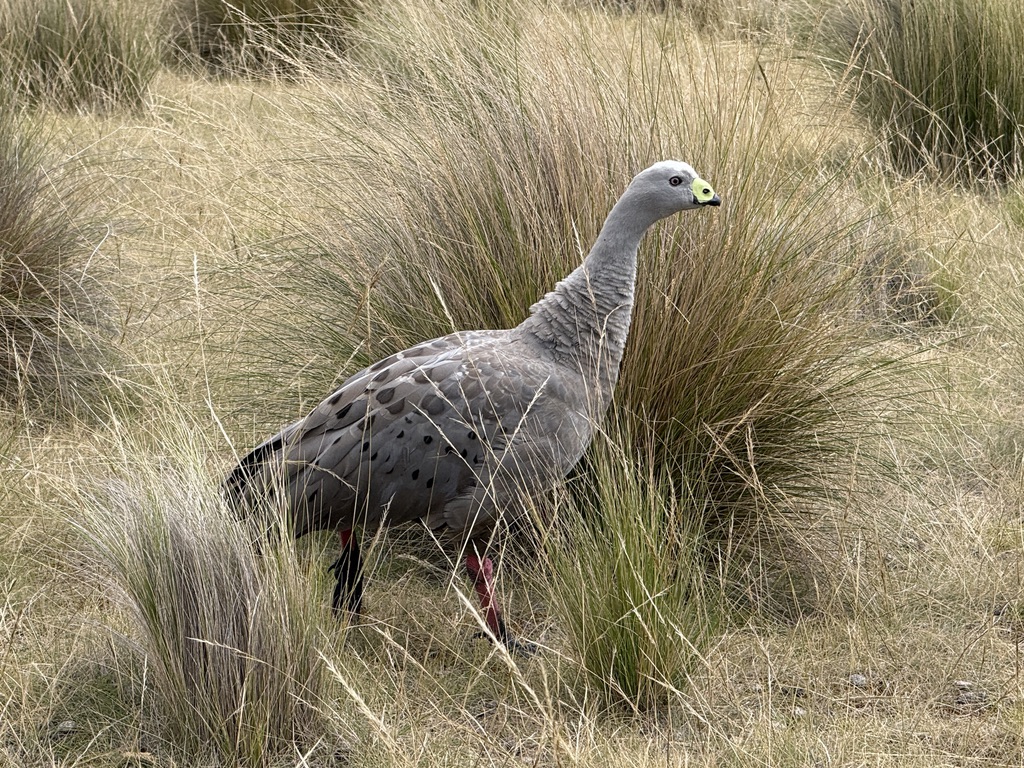
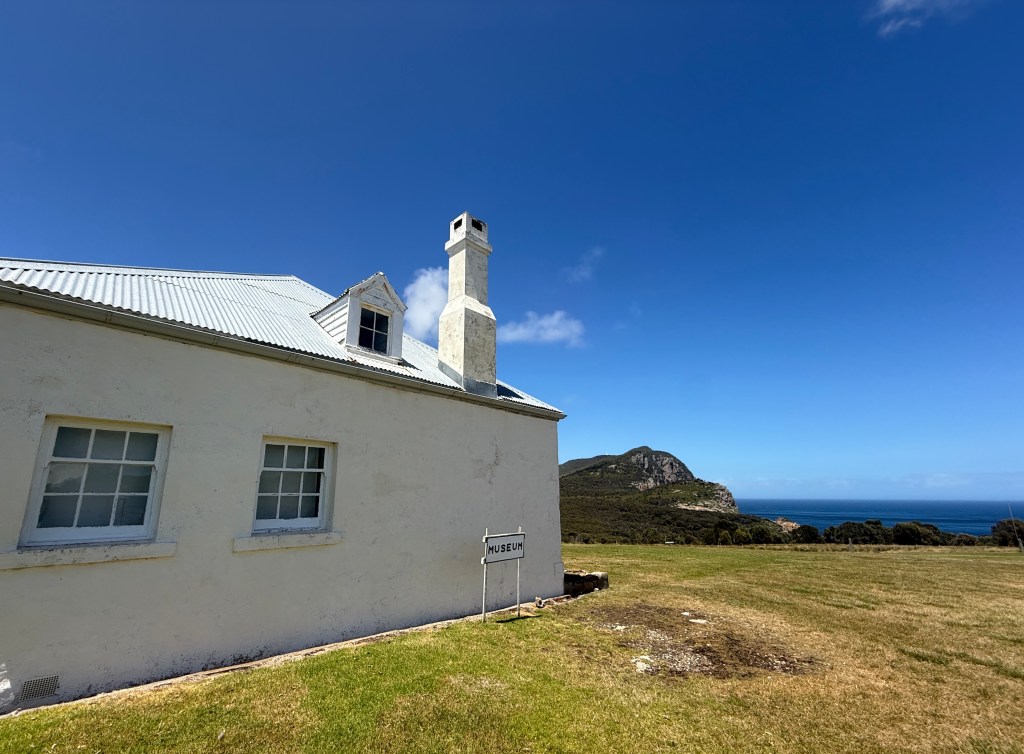
    From the beach a steep concrete path leads to a fenced area that is kept manicured by tame wallabies and Cape Barron geese. In this precinct can be found a small museum, the old lighthouse keeper’s cottage, and the cabin occupied by the island’s caretakers.

    The walk up the hill to the cabins.
    Caretakers cabin. Note the lighthouse model and silhouette of the island incorporated into the gate. Someone had some time on their hands…
    Cape Barron goose.

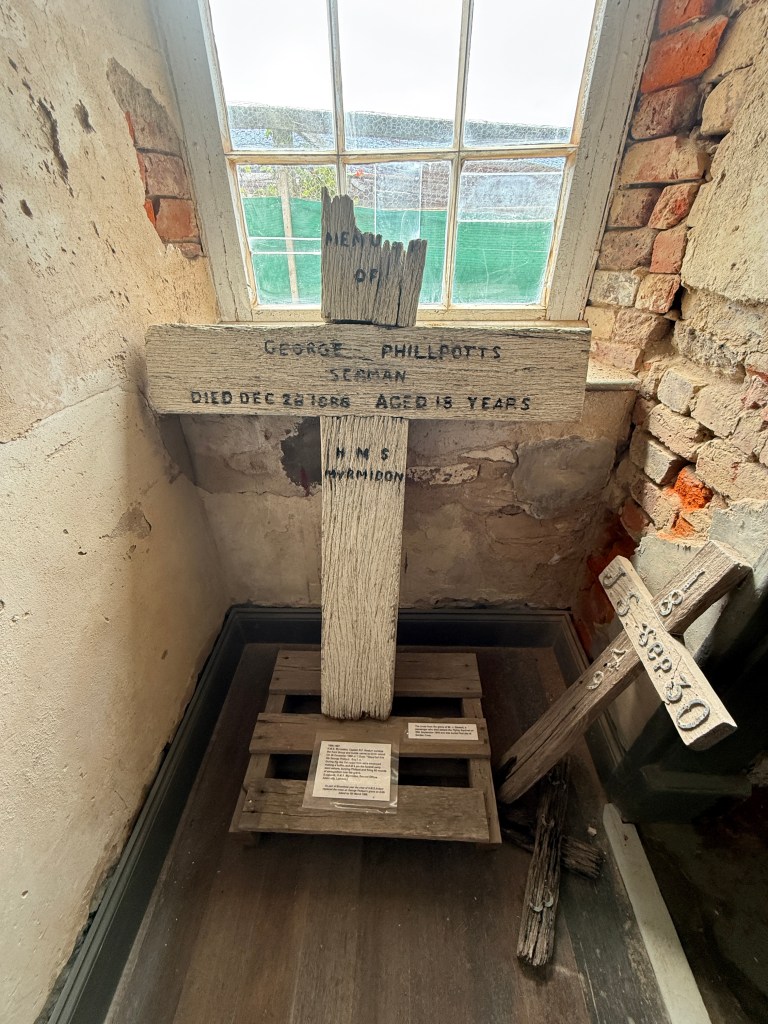
    As you might expect of a small island museum in the middle of Bass Strait, many of the exhibits related to maritime disasters and ship wrecks.

    The real magnet for those that visit Deal is the isolation and wild scenery, and from the caretaker’s cottage there are a number of tracks that you can take to various coves, beaches, and scenic spots. Feeling ambitious, we chose to walk to the lighthouse, which we could just see from the museum, a 6 kilometre round trip. In the photo below the lighthouse is just to the left of the highest point visible.

    Deal museum and lighthouse in the distance.

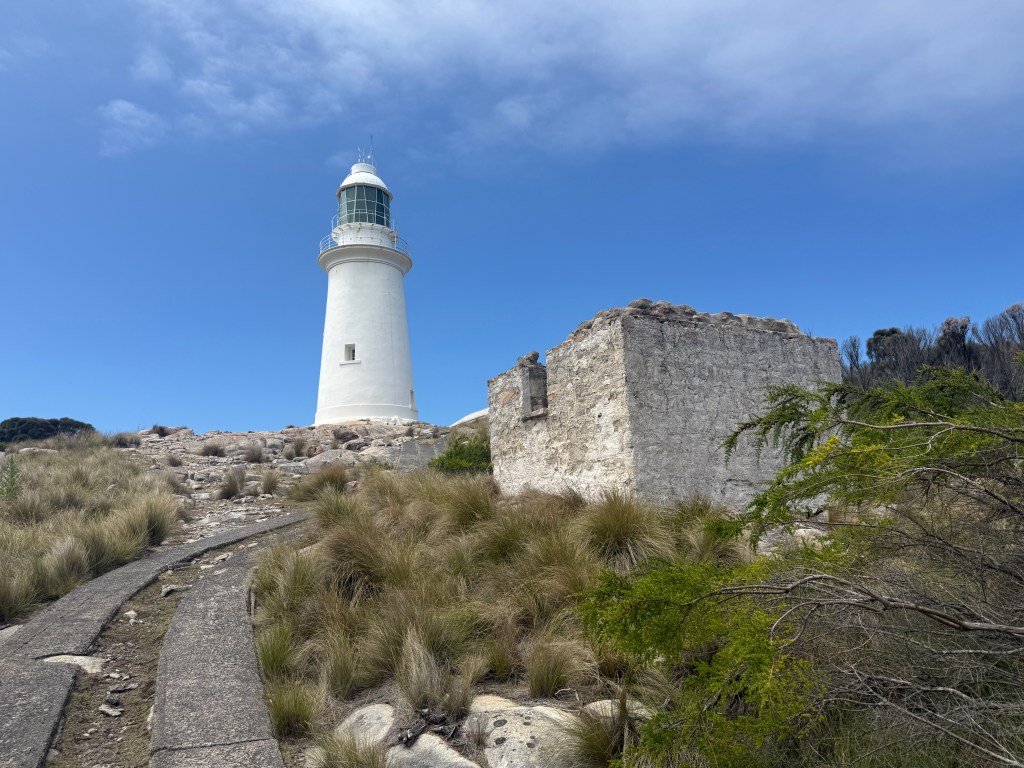
    The lighthouse, built in 1848, was once the highest in the southern hemisphere, sitting some 305 metres above sea level. The elevation meant that on a clear night the lighthouse’s signal could be seen as far away as Wilsons Promontory, some 75 kilometres to the north. However, the height also created unexpected problems, with the light often being shrouded by low cloud.

    The walk is a pretty pleasant stroll through forest and bush, though steep at the end (as advertised). It’s a shame you can’t enter the lighthouse as the views would be incredible from the top, a 360 degree vista across the island and out to sea. Abandoned in 1992, it was possible for visitors to climb to the top in its early years of retirement, alas a lack of maintenance means that the door is now locked for safety reasons.

    Deal Island Lighthouse. The small square building was the paraffin store.

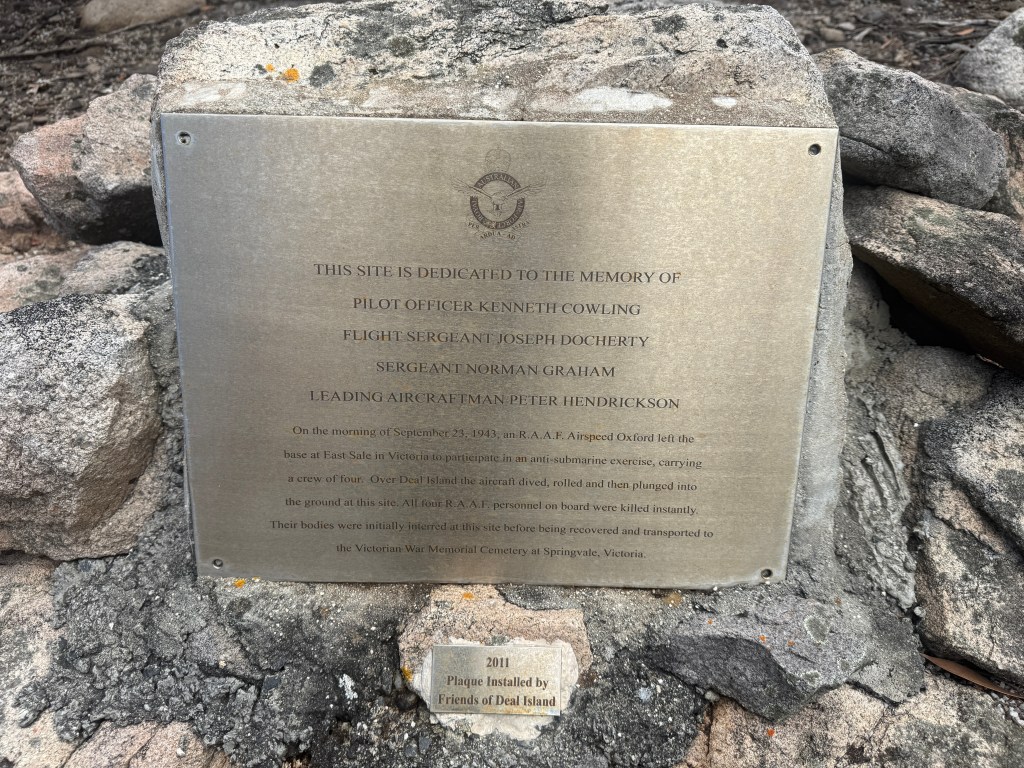
    A further 400m walk from the lighthouse brings you to the site of a WWII RAAF accident site. Beware if you found the climb to the lighthouse hard — the 400m is straight down and the return straight up!

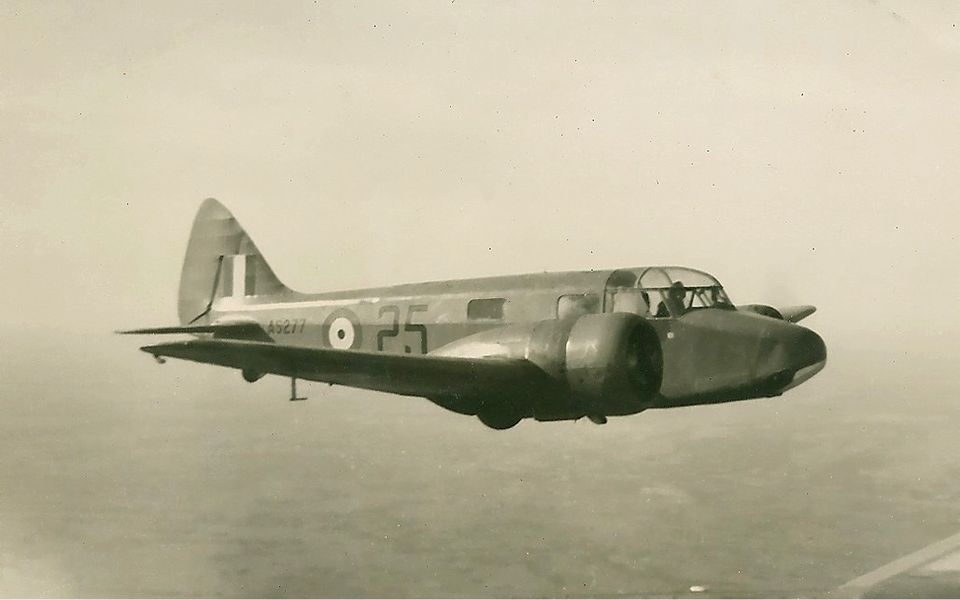
    The crash was witnessed by the light house keeper, Henry Ford, who saw the plane suddenly do three or four rolls, straighten out, and then dive at an acute angle from 1000 feet into the granite cliffs of the island. All four crewmen were killed instantly.

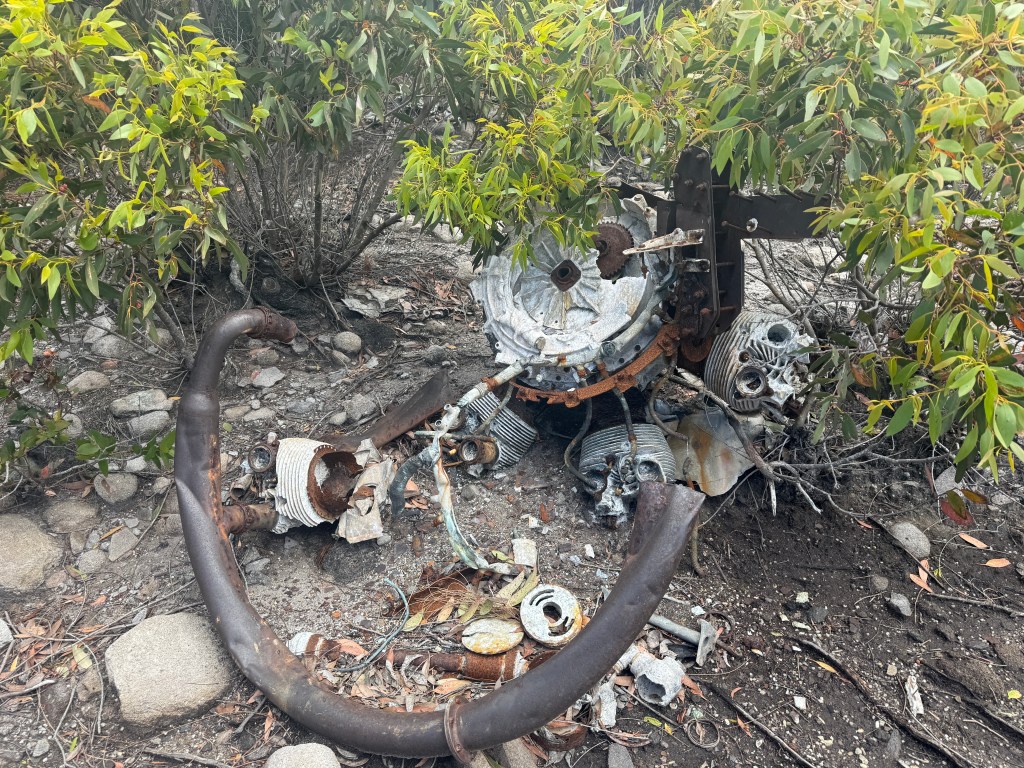
    Wreckage from the plane can still be seen today, along with a plaque that records the names of the men and the bare facts of what happened. Not far away is a cache with a document showing where the men were initially buried before they were exhumed and taken to a military cemetery in Victoria. The cause of the accident is still unknown, but one of the leading theories suggests that strong wind currents forced the plane down.

    Airspeed Oxford. The plane was a respected trainer aircraft used throughout the Commonwealth.

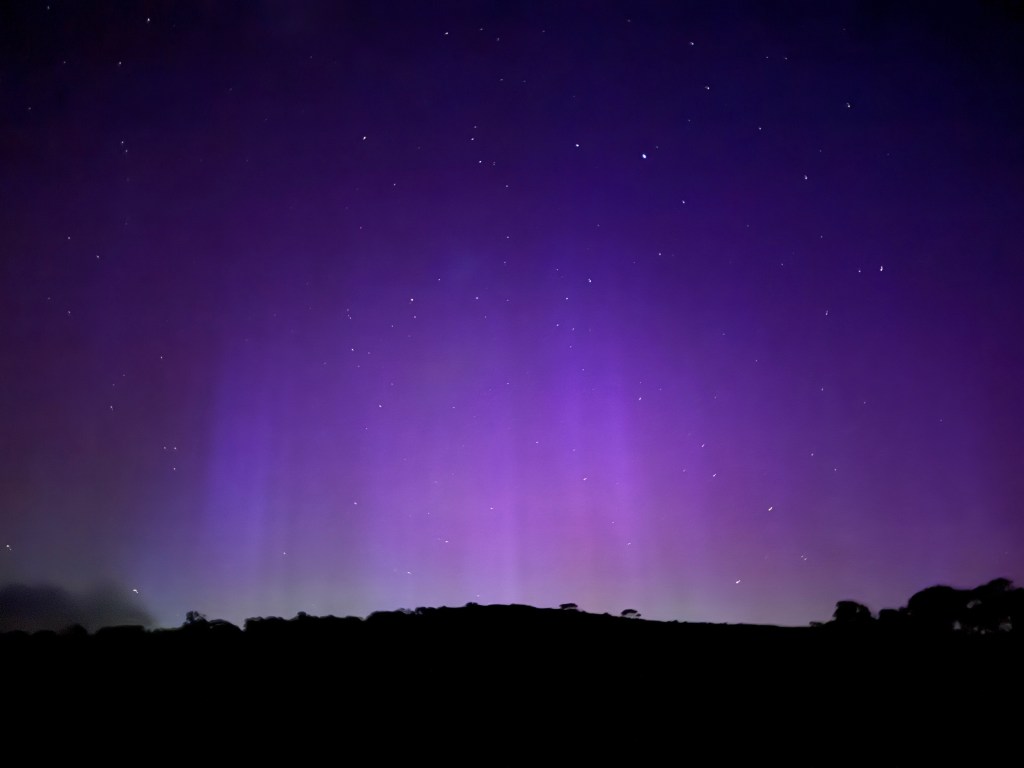
    We returned to Taurus and were later invited over to Blue Affinity, a 65 foot launch anchored nearby, for sun-downers. We should have known that it would be a big night when the skipper Mick proudly informed us that he had ice, and definitely should have twigged when we discovered that Mick and his crew-mate, Dusty, were ex-Australian Navy Recovery Divers. Ex-members of the forces have a certain affinity for one another’s company, and you know that when you meet up a good night is in store, and it certainly was. After the gin and tonics we moved on to beer and then had to round off the night with a few glasses of wine. These were the produce of Mick’s own Western Australian vineyard, called ‘Bakkehia,’ so it would have been rude to say no. The night was topped off by a stunning Aurora Australis that saw us off to bed.

    Blue Affinity.
    Aurora Australis (southern lights)

    Incredibly, the boys managed to leave at 2am for the sail across the Bass Strait. Being a launch they wanted to make the trip with as little wind as possible, whilst we had to wait for the wind to fill in later in the day — which was just as well.

    To speed our recovery we went for another walk, this time heading north to Garden Cove. We had intended to anchor here originally, but were glad we hadn’t when we saw the swell coming into the bay, and the boat anchored there rocking and rolling around.

    Garden Cove, Deal Island.

    We returned to Taurus and got everything ready for our 100 nautical mile, twenty odd hour passage. We knew that we would have light winds to begin with, but that they would build during the evening with about 30 knots expected during the night. In case things got worse than predicted we had the storm jib ready to go, a habit that has proved its worth once or twice in the past. So, we were ready to go, and off we went…

    Cara watching dolphins.

    To give an idea of the experience I’ve added three videos of the crossing. In the first, we have just left Deal in winds slightly under ten knots. In the second the wind has picked up to about fifteen knots, and in the third the wind has risen to just over twenty knots. As predicted, the wind got a little stronger during the night, with the strongest gust about 35 knots, but it was dark, so there wasn’t much point trying to video the conditions.

    Leaving Deal Island. Wind under ten knots.
    Crossing the Bass Strait. Wind about fifteen knots.
    Crossing the Bass Strait. Wind just over twenty knots. We’re well reefed down because we don’t want to arrive too early.

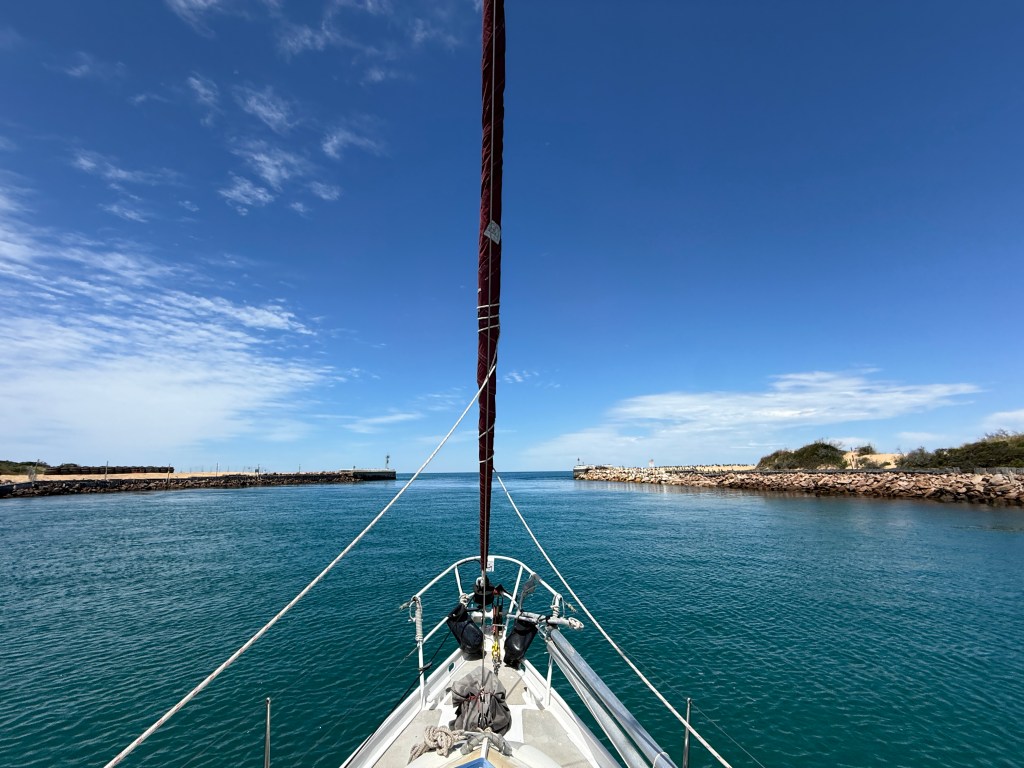
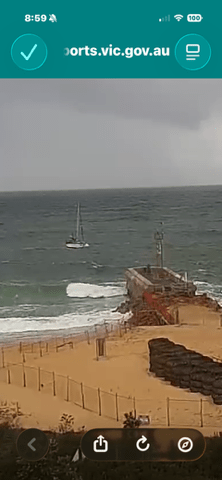
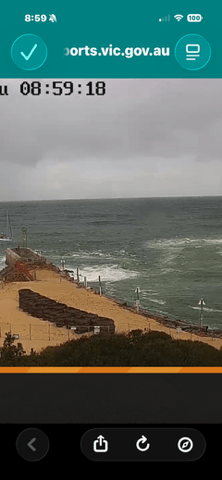
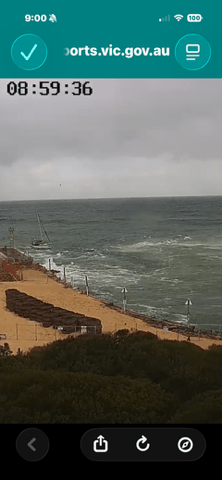
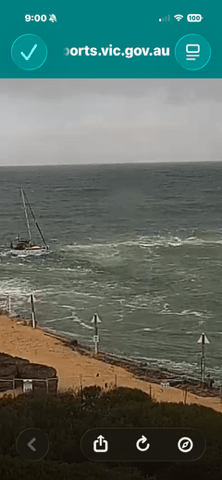
    We had timed our departure so that we would arrive at Lakes Entrance between 8 am and 2 pm on an incoming or slack tide. In the event we made the earlier end of our schedule, arriving at 8:30 am. The wind had dropped to about 25 knots from the sou’ west, so that it and the waves were travelling at a slight angle across the face of the bar. We lined up the approach markers and headed slightly left of centre of the channel that runs between the concrete walls projecting into the sea, to take into account the likelihood or our being pushed to the right by waves. The bar used to be fairly notorious and has claimed some 220 souls, but it has been radically improved over the last twenty years. Today, frequent dredging ensures that the minimum depth is about 7 metres, and the entrance is approximately fifty metres wide. We picked up a couple of decent sized waves, thankfully not breaking, as we lined up our approach to keep things interesting (just before Cara started recording the entry), but Taurus tracked through without any real drama.

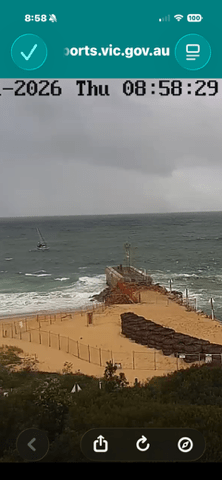
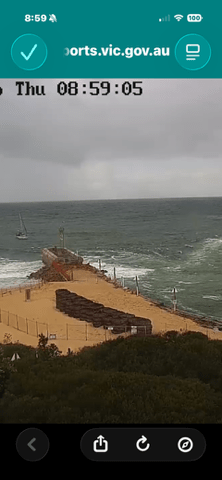
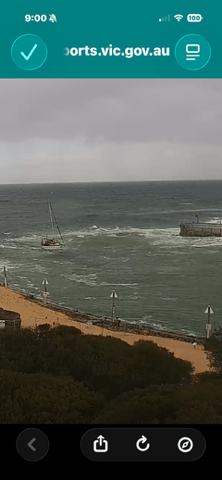
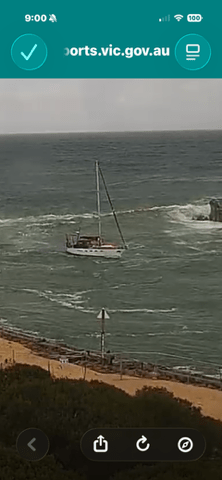
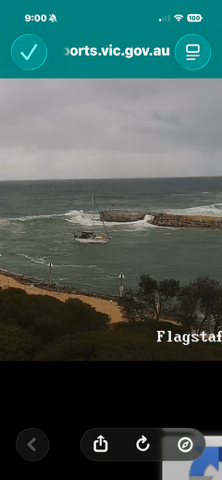
    Lakes Entrance bar. As always, our camera (and the webcam below) somehow flatten the waves, so don’t give a true impression of the actual experience.

    The local sailing community has a pretty active Facebook group (“Sailing Tasmania, Bass Strait, and the Beautiful Gippsland Lakes”), and a member posted a series of pictures of Taurus from the live webcam as we made our crossing. Thanks to these, and the video that we later shared, we became what felt like minor celebrities for a few days. Everywhere we went people would say, “you’re the guys that did the bar crossing!” As is the way with sailors, everyone had an opinion on the wisdom (or not) of our decision. One old fisherman told us that he wouldn’t have attempted the bar in the conditions we faced, whilst others said it was a good day and we were lucky the weather had been kind to us. In the end, we were the only ones there to make the call, and entering seemed like a much better option that staying out. There is no shelter outside Lakes Entrance in which to try to anchor, so our alternatives were to motor in circles, hoping that the weather would improve, or continue for another twenty four hours to Eden. In the same circumstances I would definitely go for the bar again, it was a bit hair raising but fell short of actually being dangerous.

    Having accelerated to power through the bar, and with the tide pushing us along, we found ourselves doing nine knots once in sheltered water. We turned to the right to enter a waterway that would take us to Lakes Entrance… and nearly ran aground. With no channel markers to guide us we relaxed a little too much and failed to check the depth on the chart. Luckily Cara was awake and turned the boat in time.

    We moored up alongside a free public floating jetty, and Dusty from Blue Affinity appeared to catch our lines. Sadly the boys were about to leave, so we didn’t have time to catch up properly.

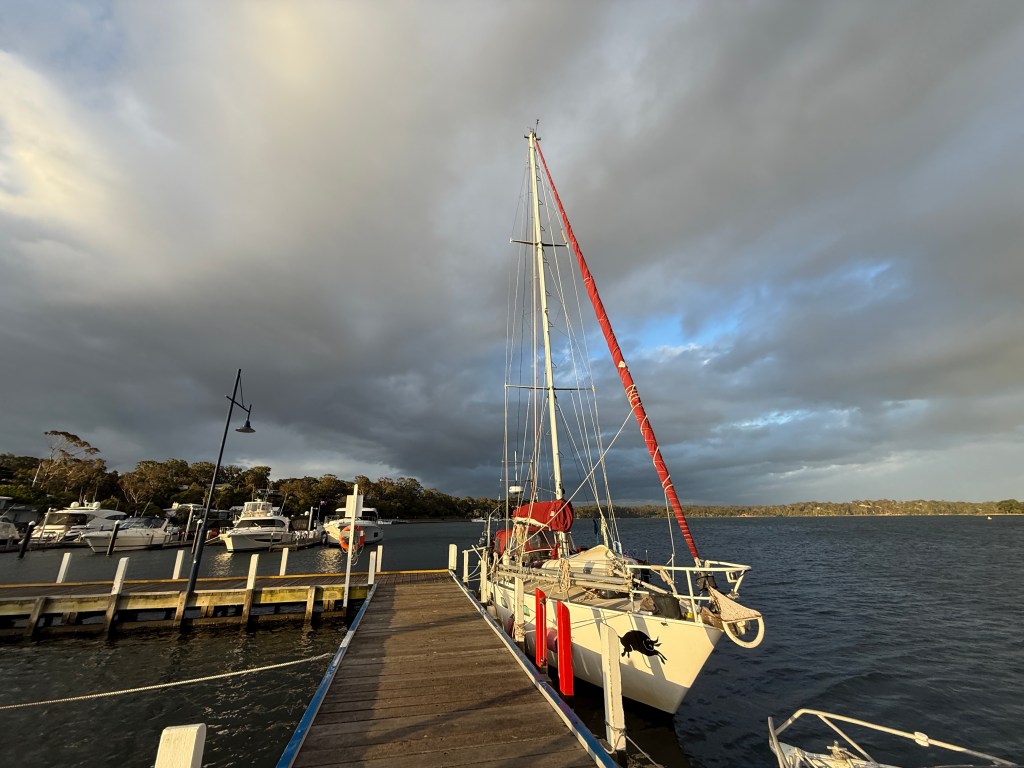
    Back on the mainland. Taurus takes a break.

    We were pretty tired after a bit of a bumpy crossing, but too wired to sleep and needed to stretch our legs. Then we fell in with a couple of Canadian cruisers and ended up at the pub. After winding down with a couple of beers and pizza it was time for a good night’s sleep.

    The voyage of the good sloop Taurus: 21–22 of January 2026.

    Next time: exploring the beautiful Gippsland Lakes.

  • Preservation Island to Deal Island

    After a couple of days exploring Preservation Island it was time to get moving. The spell of fine weather that we had enjoyed was about to be abruptly terminated by strong westerlies that were predicted to blow at around forty knots. As with all forecasts, the figure given is the expected sustained wind strength, gusts, however, can be up to forty percent stronger, so winds of fifty knots plus (100 kmh) were a real possibility.

    Having seen the forecast we’d spoken to Luke at the Beauty Point Marina, and he kindly offered us the use of his mooring at Lady Barron. One of the oddities about the Furneaux Group is that, despite it consisting of more than fifty islands, it can be surprisingly difficult to find good shelter. In other places, if the wind blows from the west you find a bay on the east in which to hide, and all is right with the world. In Furneaux, the wind has a knack of racing across the land, and should there be any hills in the way it accelerates down their lee slopes rather than being diverted. These strong gusts are variously known as katabatic winds, bullets, and williwaws, but in effect they make the world an uncomfortable and sometimes dangerous place until the wind chooses to cease and desist. This lack of protection, combined with weedy anchorages, makes finding a safe and comfortable anchorage in the area something of an ongoing challenge. So, if someone like Luke, who has lived in the area for thirty years, tells you that you better hide on his mooring, you say ‘thank you’ and go and hide on his mooring.

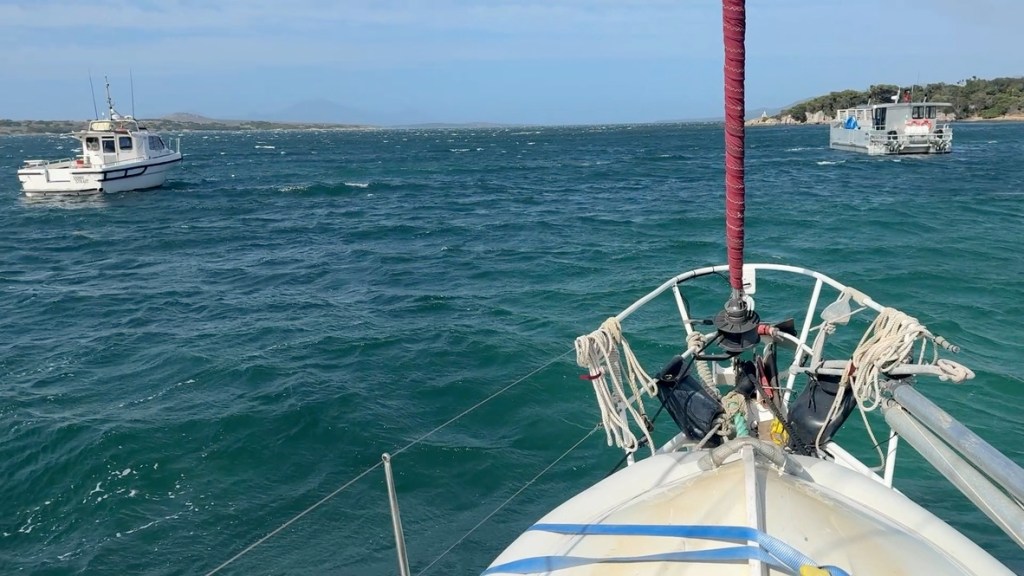
    Entering Lady Barron requires a trip up the Franklin Sound. This channel experiences strong tidal currents and has several areas of shallow water to catch out the unwary. Cruising guides we referred to mention the currents, but failed to inform us of the current direction in relation to the tide, which is a bit hopeless. Thankfully, the Cruising Yacht Club of Tasmania fills this gap with a very useful website, which can be found at the following address:

    Even though we entered on the correct tide we still found strong tidal currents working against us, and at one point, east of Little Green Island, our speed was reduced to about one and a half knots. We considered anchoring for a while, but in the end struggled on and soon found our way into Yellow Beaches and picked up Luke’s mooring.

    From the bay there’s a nice walk along the waterfront that leads to Lady Barron. The views are spectacular, and the rock formations unworldly. 

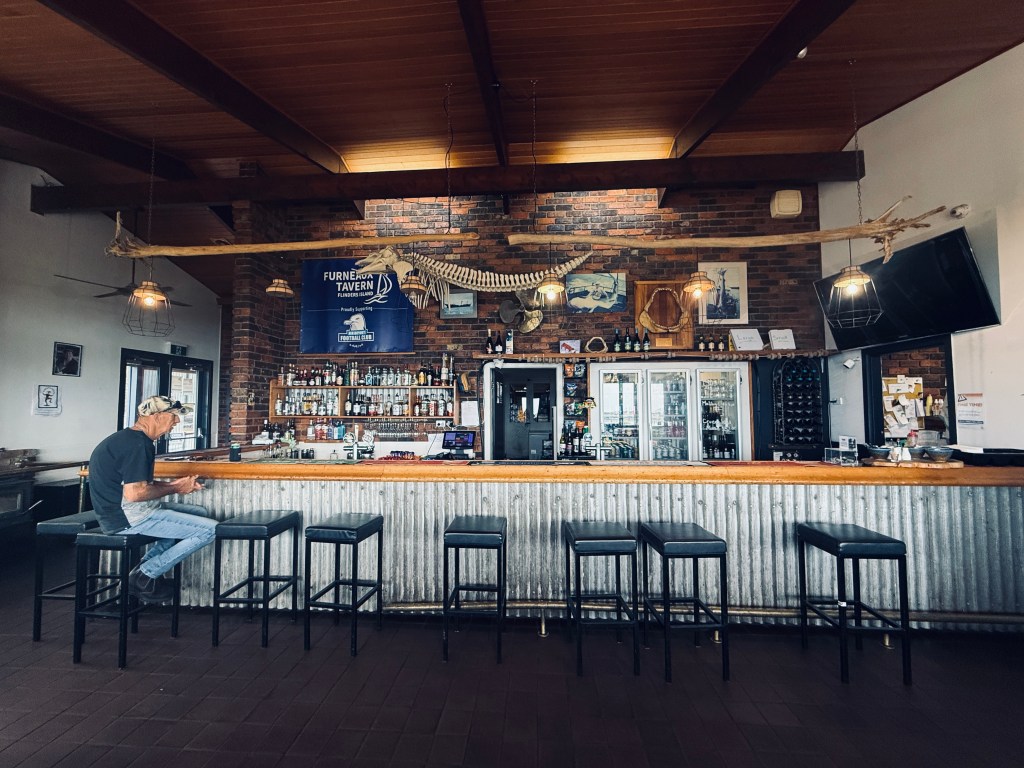
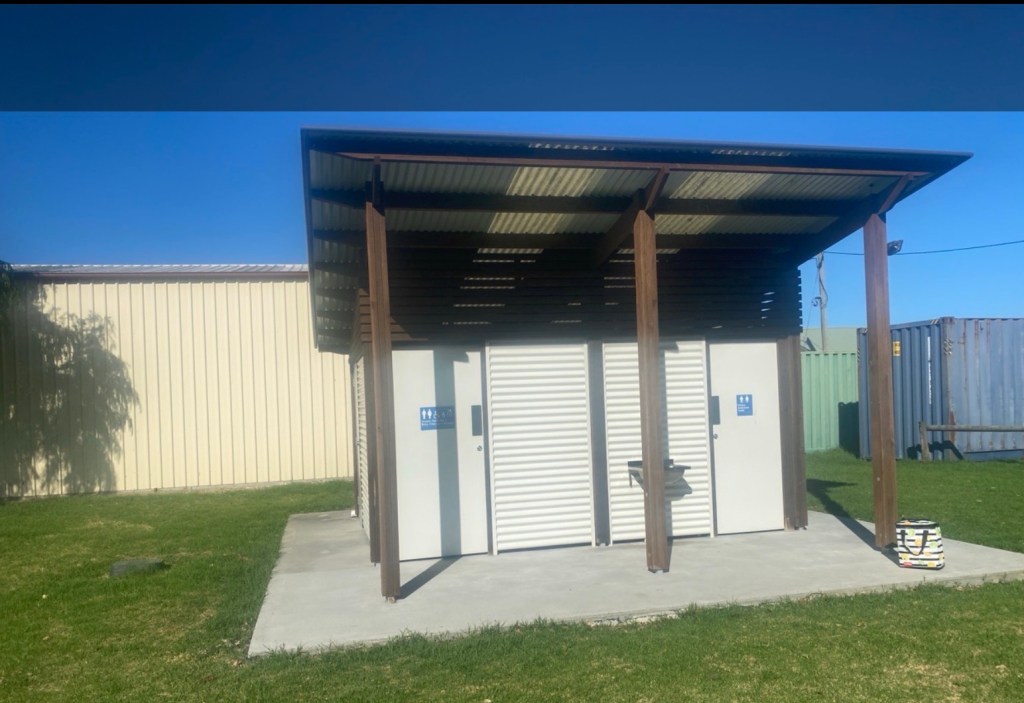
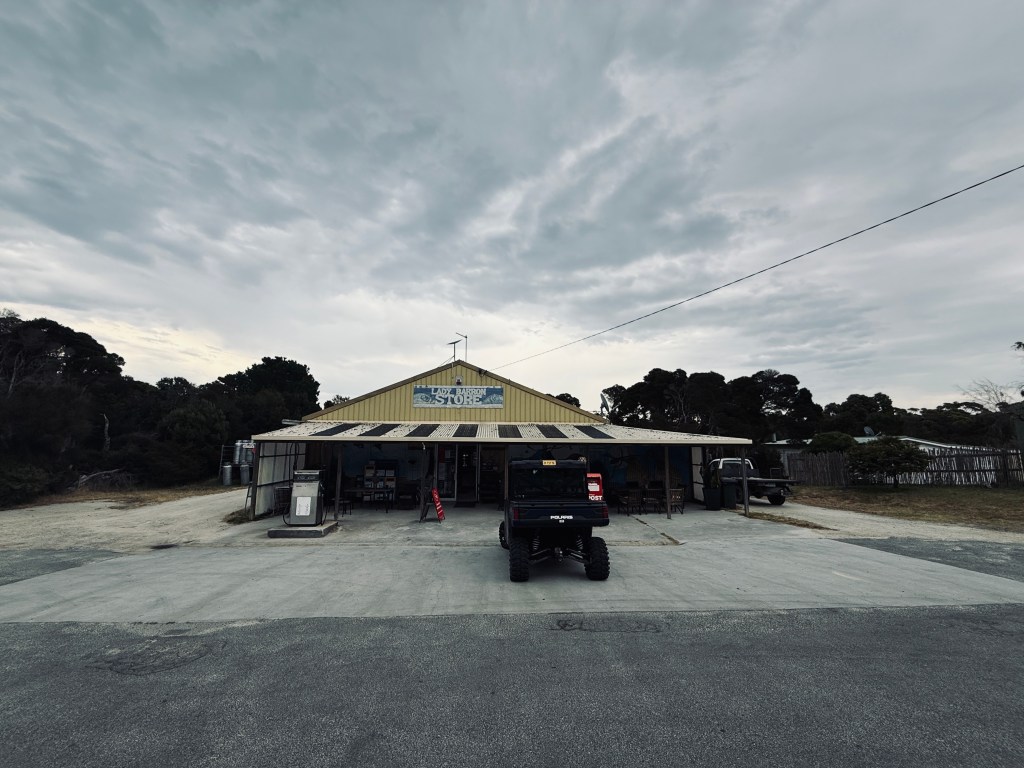
    Lady Barron is a pretty quiet destination, with one pub, one public toilet with a hot shower, and one shop (in order of importance). It wasn’t long before we had seen all the sights, so ended up returning to the pub (Cara said it would be weird to hang out at the shower or shop). 

    Pub…. (note the pilot whale skeleton and shark jaws — the plaque states that the shark was a Northern Tiger Shark, 14 feet long, 7 feet round, and weighing 1 tonne).
    public toilet with shower (image courtesy of Lynda Shelley, published on the ‘No Foreign Land’ website). 
    shop…

    We met some cruisers in the pub and ended up having dinner with them. Much of the conversation centred around where best to hide from the strong weather due the following day. In the end one crew decided to stay where they were, moored up alongside the fisherman’s jetty, and one solo sailor decided to sit on a public mooring just behind them. Neither spot afforded much in the way of protection from the west.

    Next day in Yellow Beach, tucked behind a headland, the wind fairly howled at times and we saw speeds of nearly forty knots. We were pretty comfortable, but wondered how the others were fairing. Unfortunately they all left early the next day, using the tail of the storm to cross Bass Strait, so we didn’t see them again. I imagine it would have been a miserable day for them. We later spoke to another couple who had anchored behind Preservation Island, Craig and Lindie on Addictive. They told us that they had had a pretty awful time and dragged anchor twice. Naturally we were very grateful for Luke’s advice and the use of his mooring.

    Tucked in on Luke’s mooring at Yellow Beach, Lady Barron. You can see the white caps out in the channel. The other two crews had essentially no protection from this wind. It’s only blowing about 20 knots in this photo. At forty knots you get four times the power from the wind. 

    We were so impressed with our dinner at the pub that once the storm had passed we had to go back. The food there is seriously good, in fact some of the best I can remember eating. If you go to Lady Barron you have to have dinner there. The views were pretty damn impressive too!

    View from the pub veranda (note fisherman’s jetty). We are looking south here. The jetty is essentially exposed to the east and west. 
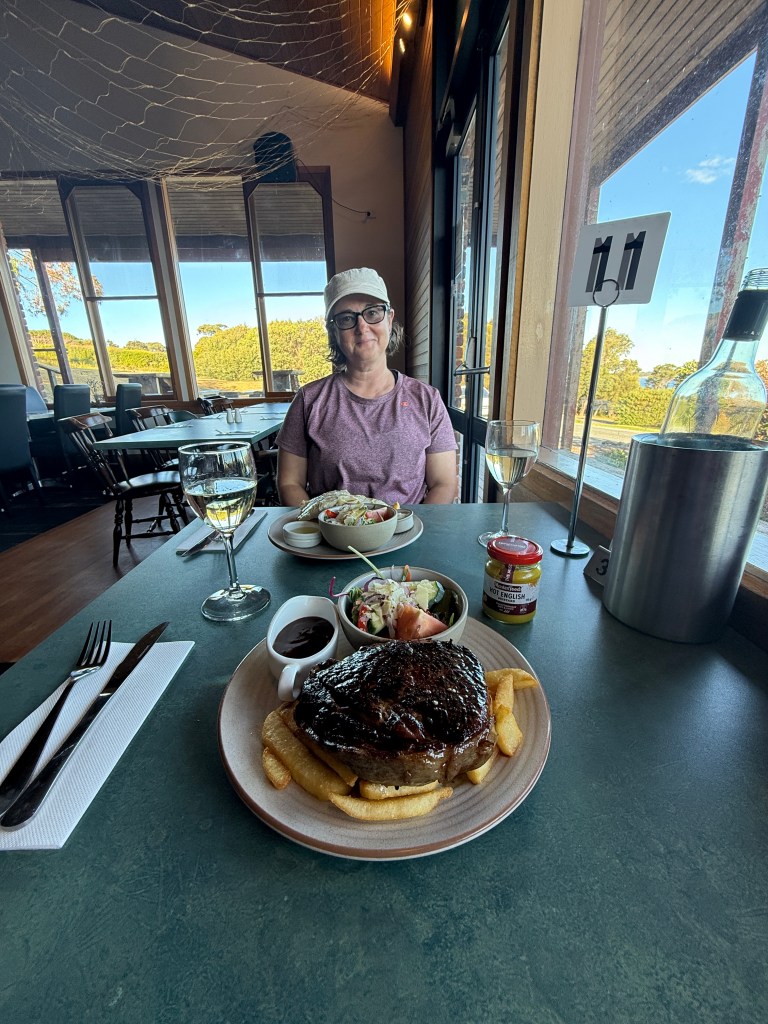
    Before… 
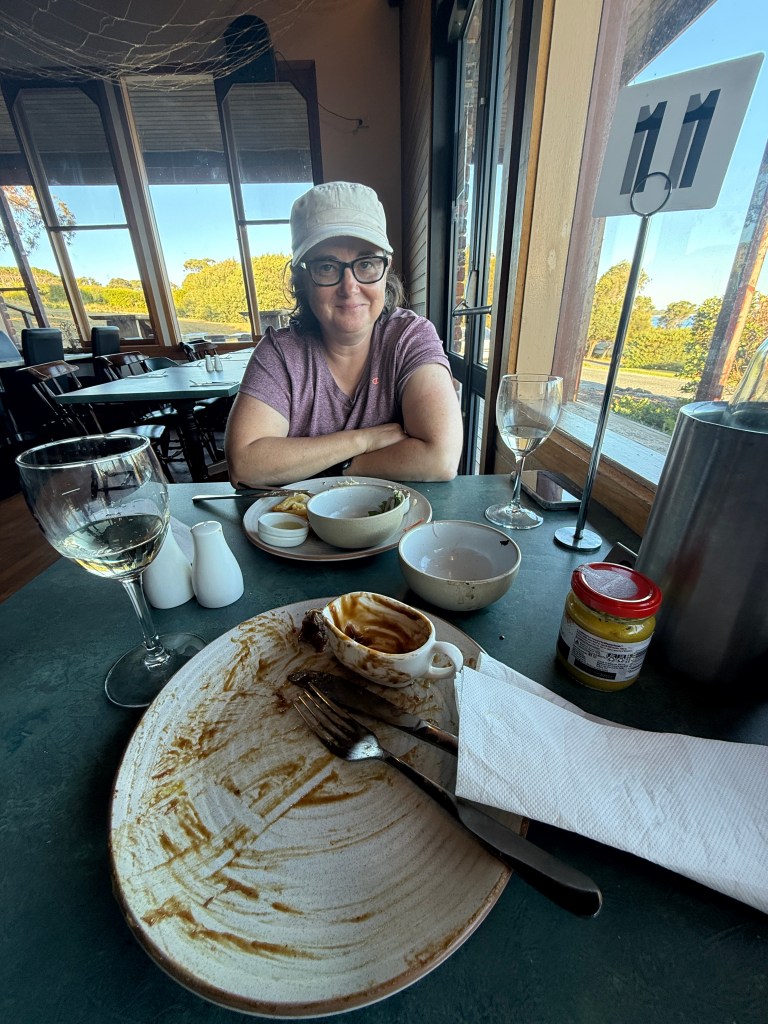
    after… (mustard model’s own)

    We left the following day, and experimented by leaving on a falling tide, the same as that which we had used on the way in, but we were now going in the opposite direction. We also took an alternative route, one that runs between the Great Dog and Little Dog Islands (and which can be a little shallow in places). Of course we found the tide was still against us; sometimes you just can’t win.

    The calm after the storm. 
    Leaving Lady Barron. All the wind had been used up! 

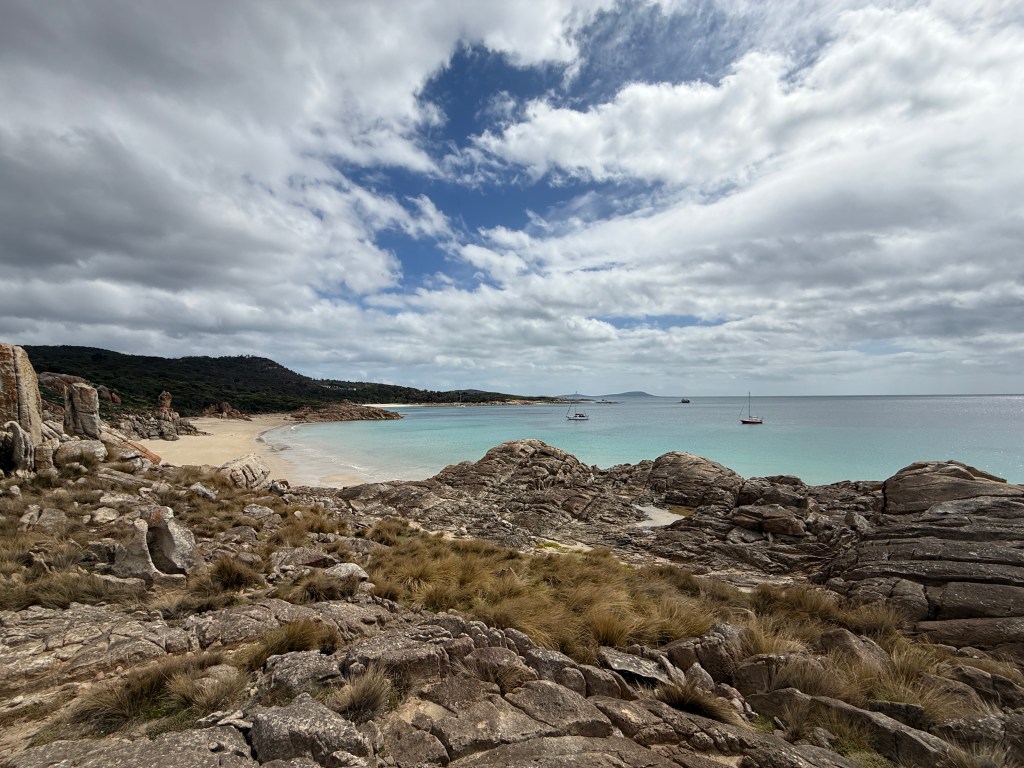
    We picked up the mooring at Trouser Bay, the spot where we had stayed on our previous visit, but what a difference a change in the weather makes. This time around we were able to get off the boat and enjoy a coastal walk around the point.

    Trouser Bay mooring from the beach.
    Coastal path.

    Jim and Angie, friends from Launceston, were heading towards Flinders Island on their steel yacht, Malibu, and we decided to pop into Whitemark, the main town on Flinders Island, before meeting them at Port Davies (not to be confused with Port Davey, on the west coast of Tassie, like I continually did).

    Without wishing to be too blunt, Whitemark is a swine of a place to visit by yacht. The bay is so shallow that you have to anchor a loooong way from land, and there is so much weed that finding somewhere for your anchor to grab is an exercise in patience. We ended up with just 0.8 of a metre of water below us, which is very shallow for anchoring, and had to reset the anchor four times before it held.

    We then had to motor in the dinghy for about a nautical mile to the beach, and drag it up very soft sand (the tide was out) as the jetty has been condemned and is fenced off.

    Jetty at Whitemark. Way in the distance on the left you can see Taurus’ mast. 

    Even though we were there mid-afternoon, midweek, during the height of the tourist season, everything but the supermarket, dairy, and pub was closed. The town is frankly kind of depressing. Admittedly, the supermarket is better than the shop at Lady Barron, but not that much better. If you only need basic groceries and you have to choose between Whitemark and Lady Barron, go to Lady Barron, and go to the pub for dinner!

    Whitemark — depressing.

    After dragging the dinghy back across the sinking sand and motoring the several miles back to Taurus, we lifted the dinghy back aboard and headed towards Port Davies.

    Port Davies.

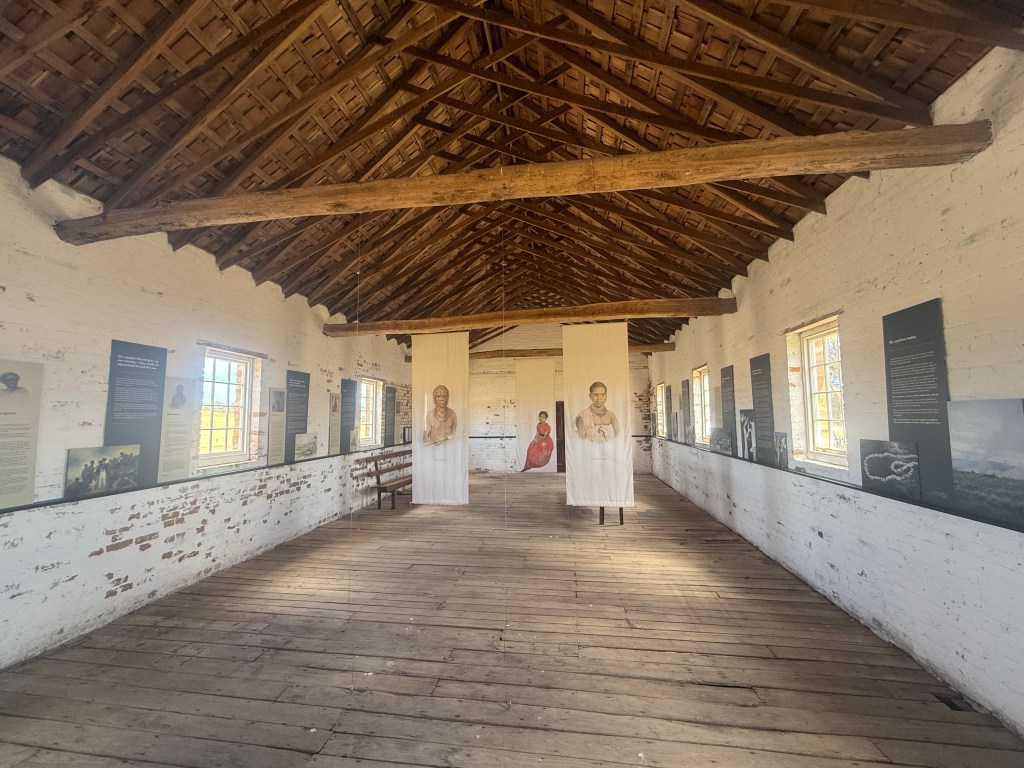
    Not far from this anchorage is a museum that commemorates the aboriginal people who were forcibly removed from Tasmania and re-settled on Flinders. The chapel at Wybalenna has been restored, and is all that remains of the settlement that some have described as a ‘concentration camp.’

    Wybalenna Chapel.

    The stories were pretty sobering and it was in a somber mood that we walked back to the dinghy dock. 

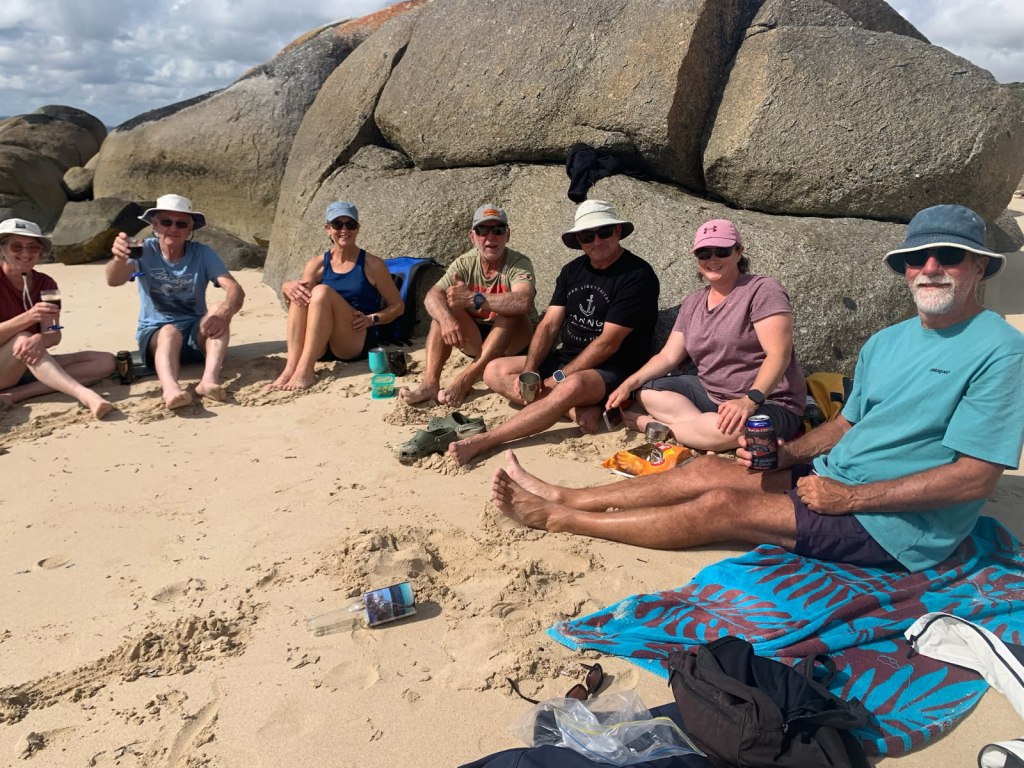
    That evening all the cruisers in the bay got together on the beach for a few sun downers.

    Beersies.. 

    We found the anchorage to be a little windy, so later moved to Allports Bay with Malibu. From here it was an easy walk to the local museum and an iconic rock formation, known as Castle Rock.

    Taurus and Malibu in Allports Bay. 
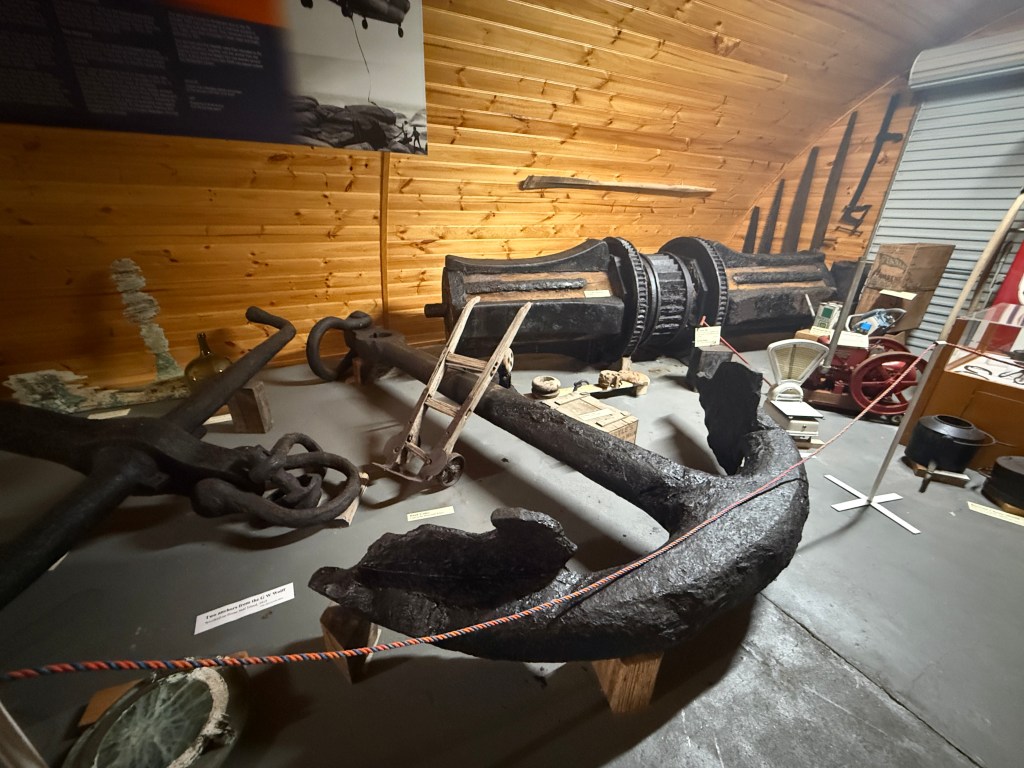
    Artefacts from various wrecks, including Sydney Cove, on display.
    Cara and rock(s). 
    Flinders Island is renown for its stunning scenery. 

    We sadly had to bid adieu to Jim and Angie as we were continuing north, and they had to head back to Launceston. We first met these guys when we were both on the hard, and they kindly leant me a compressor and needle gun, gave me some paint, later gave me a fisherman’s anchor, and were all round generous, lovely people. Hopefully we’ll meet again somewhere soon.

    Jim and Angie. Diamond geezers. 

    We had expected our sail to Killiecrankie to be fairly short and sweet. But this was one of those times that Tasmania decided to give us a boot up the bum to remind us not to become complacent. We left Allports with about twenty to twenty five knots from astern and had to thread our way carefully through a narrow pass between islands. We then turned round Cape Frankland and thought that we would be protected by the land and be able to motor in. Instead the easterly wind accelerated down the hills and we were suddenly beating into thirty knots. We had to run the engine and motor sail to make headway, and had to sail almost past Killiecrankie to ensure that we would be able to tack into the bay with room to avoid the rocks. It was a pretty unpleasant couple of hours.

    Who doesn’t hate beating into the wind?

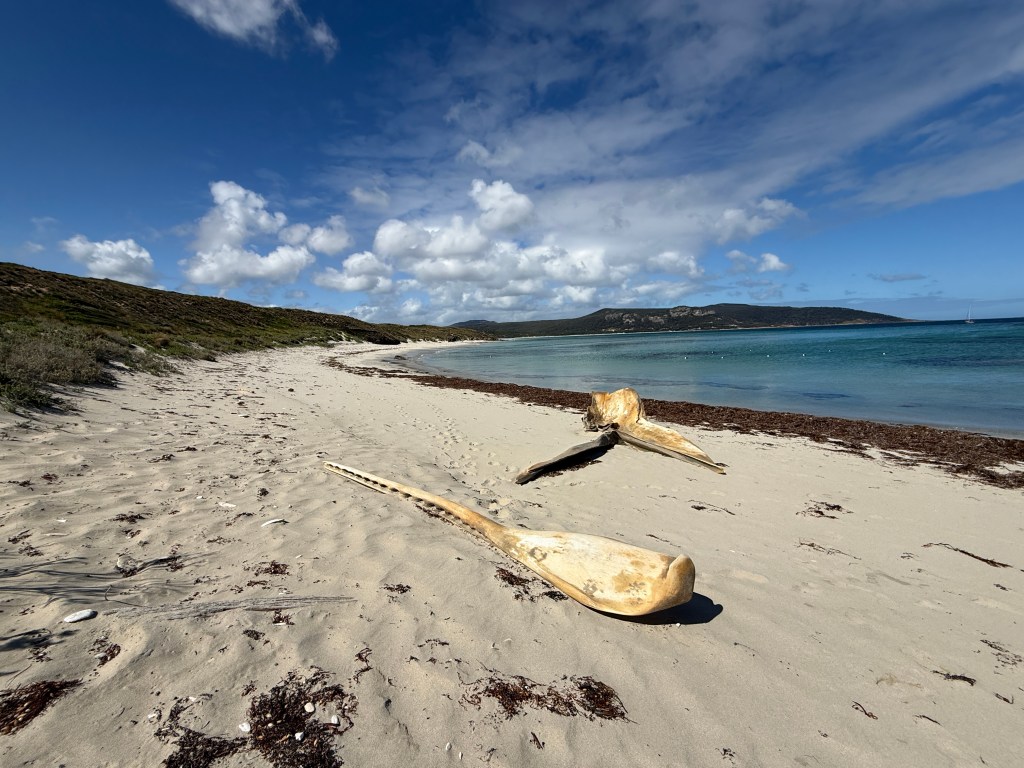
    We anchored in the northern part of the bay as there was a slight northern edge to the wind, but found only marginal shelter. It wasn’t until the next day that we could get the dinghy off deck and go for a walk ashore. There, to our surprise, we found a decomposing whale. Apparently a twenty ton sperm whale had washed up a few weeks earlier and had been gradually rotting away on the beach. A local advised us not to go swimming as the whale would serve as burley and attract sharks from miles around.. 

    Sperm whale jaw bone. Alas all the teeth were gone. I’d like to try my hand at scrimshaw…

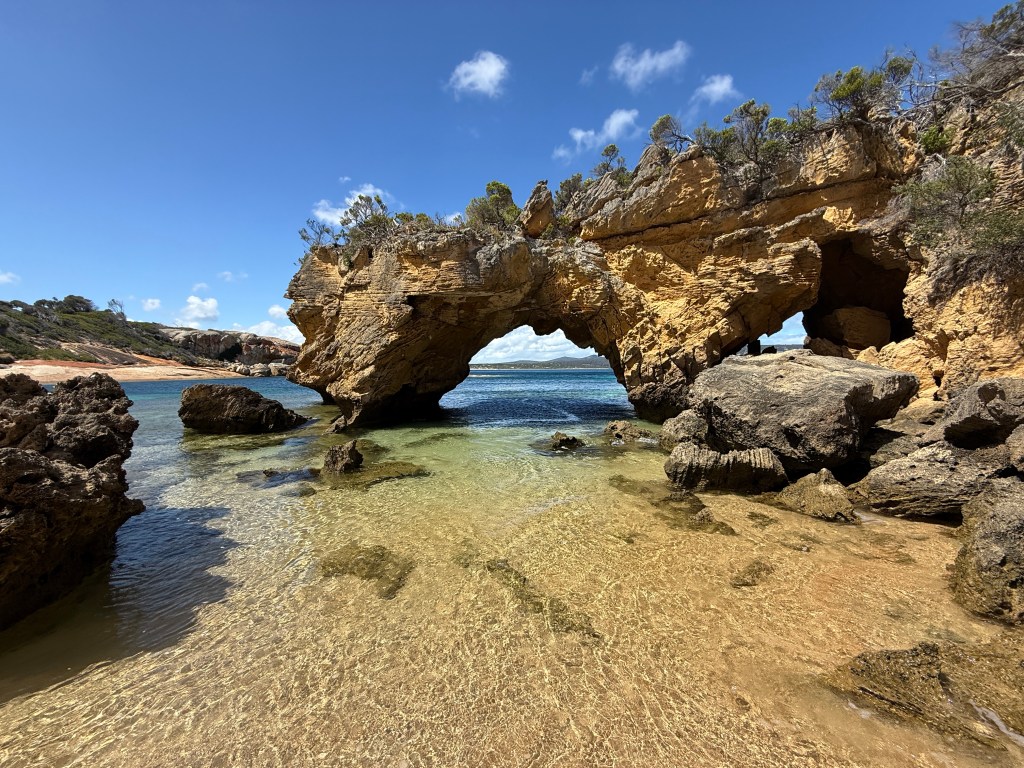
    In the end we got so hot walking to Stackys Bight (the local tourist attraction rock formation), and the flies were such a PITA, that we did end up going for a swim. But only in clear and shallow water! Shark attacks have been in the news a lot recently in Australia, with something like five attacks in four days, although centred around Sydney rather than Tasmania. It’s certainly not the way I would choose to go, so we take the advice of locals seriously.

    Stackys Bight. 

    We had headed north to Killiekrankie because there was a weather window that would allow us to get to Deal Island, half way across Bass Strait, followed by a further window a couple of days later that would take us to Lakes Entrance in Victoria.

    After our recent hiding we were a little nervous about sailing into Bass Strait, a notorious body of water at the best of times. In the event we had a beam reach for six hours in about twenty five to thirty knots of wind, with a swell of maybe a couple of metres. It was pretty pleasant, though the wind shifted behind us as we approached Deal so we ended up rolling a wee bit (or a good deal?).

    Deal is actually two islands with a passage between them, known as Murrays Passage. Because of the strong currents in Bass Strait, it’s important to ensure that you don’t end up in a wind against tide situation here, which would create dangerous standing waves. As such, you have to work out whether to enter from the north or south. We used the Cruising Yacht Club of Tasmania site (listed above) to make sure we got it right. We had intended to anchor in Garden Cove on the north coast, but I suspected that the easterly winds and northerly swell might curl round the headland and straight into the bay (we later walked to Garden Cove and in similar conditions it was very rolly). We had been watching a large motor launch that had left Flinders at roughly the same time as us on AIS, and they had headed to the south of Deal. We decided that they might have local knowledge and chose to follow them. 

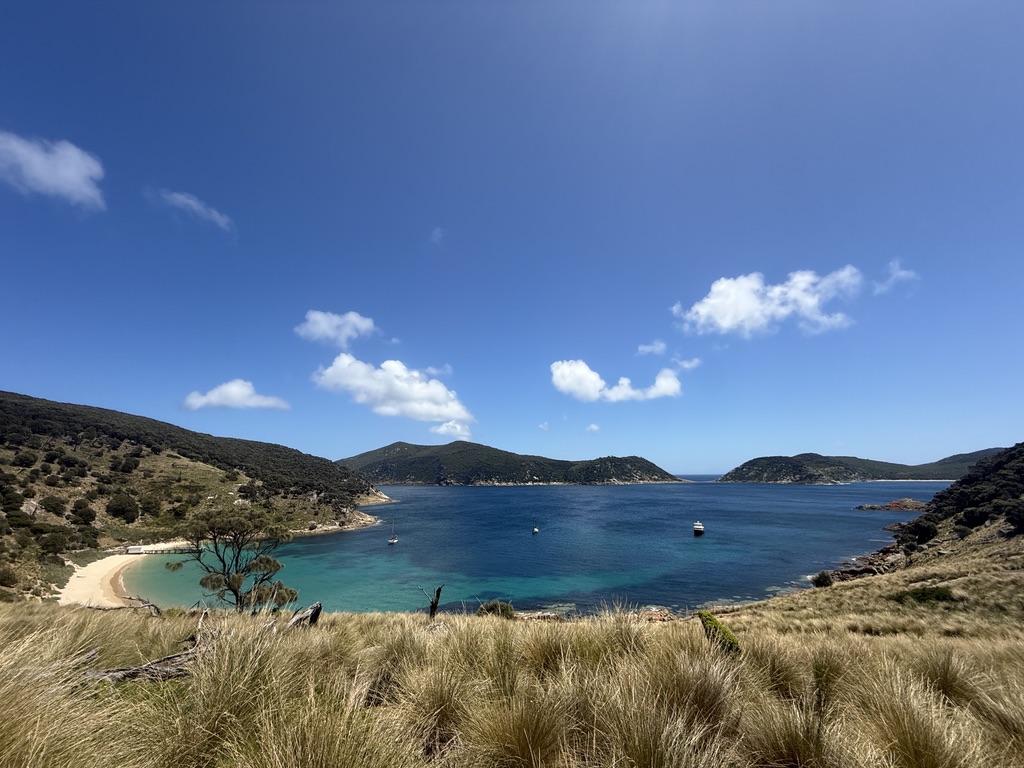
    We all ended up in the same beautiful anchorage, a place called East Cove, and later met the crew of the launch, called Blue Affinity. But our adventures in Deal, and subsequent crossing of the rest of Bass Strait, will have to wait for next time. 

    East Cove. Taurus on left, Blue Affinity on right. 
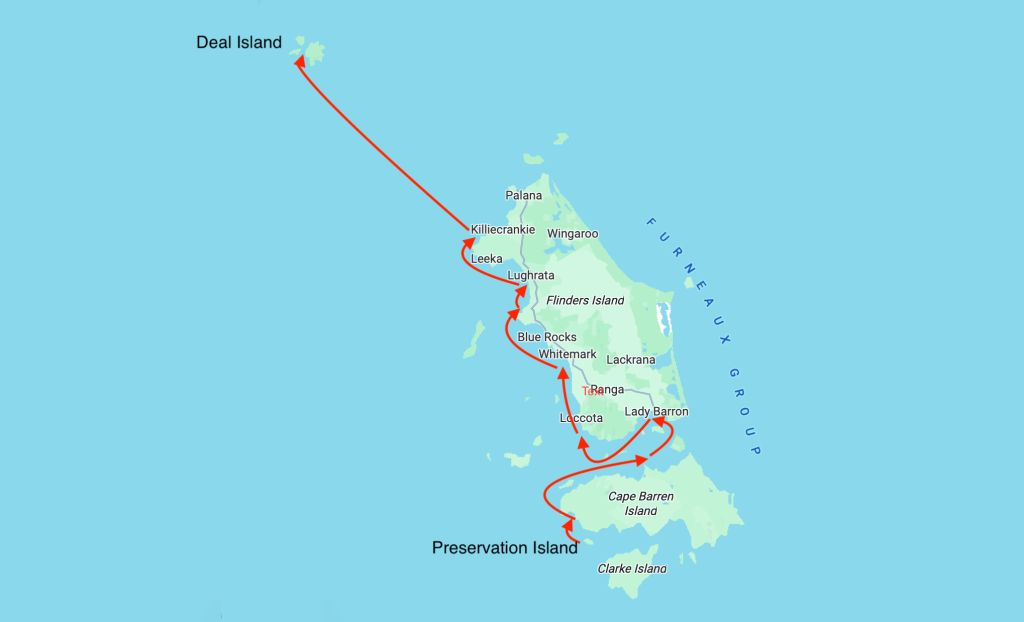
    Voyage of the good yacht Taurus: 8th – 19th of January 2026. 
    Wider view of area discussed.
  • Beauty Point to Preservation Island
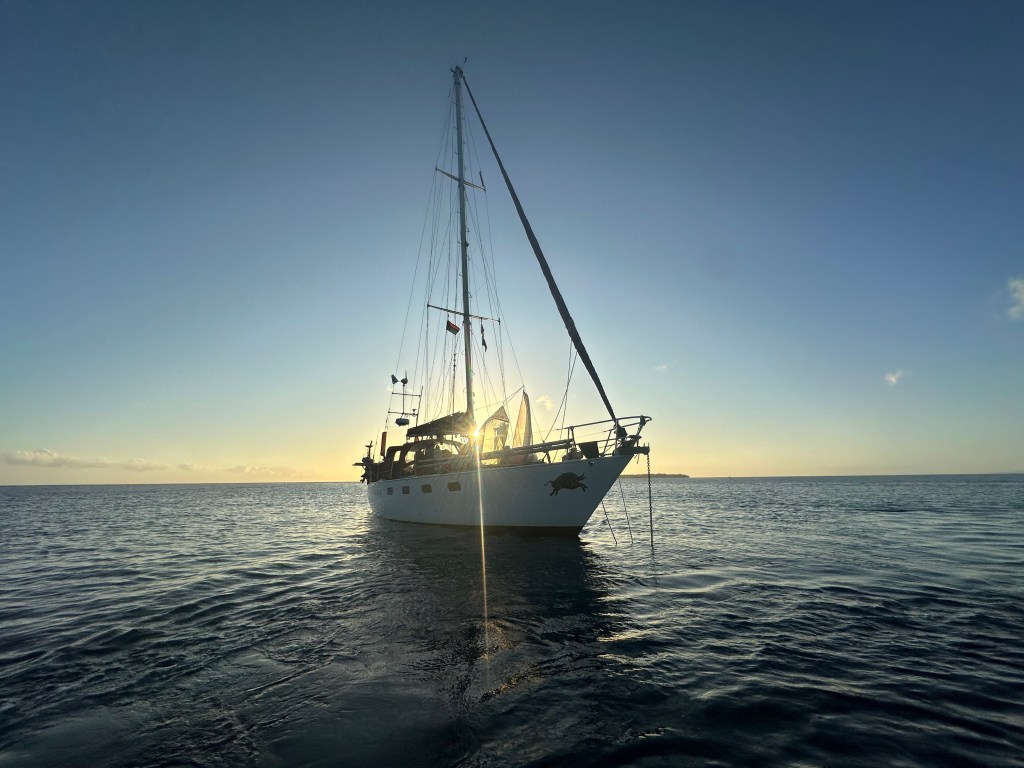
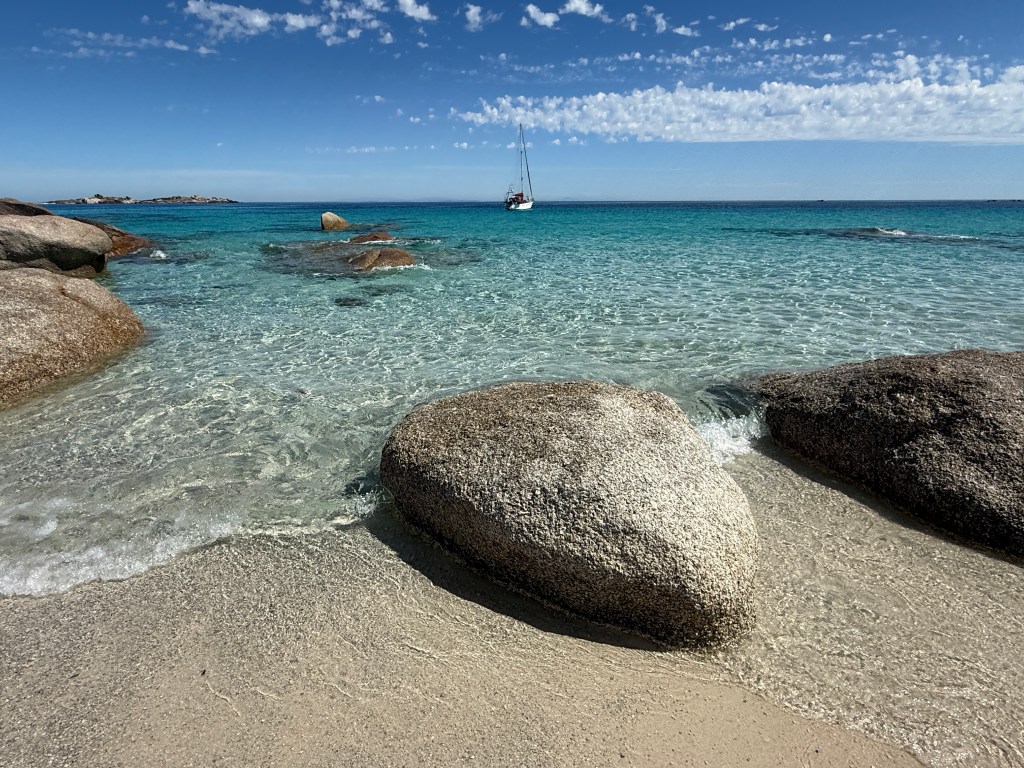
    On anchor at Preservation Island.

    After returning to Taurus at Beauty Point we got stuck into finishing a few projects so that we were ready to leave when a weather window presented.

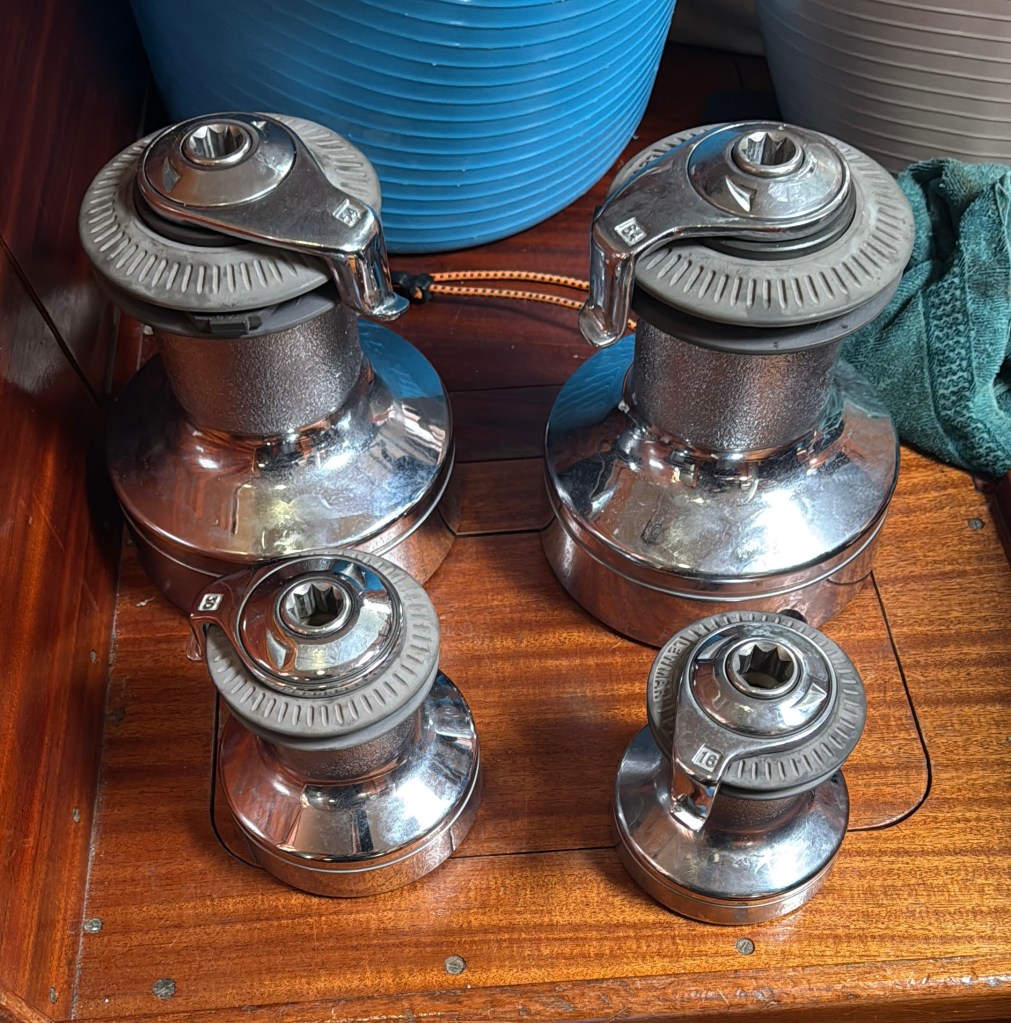
    Amongst the jobs to do were replacing a couple of original winches with self tailing winches, re-bedding the diesel filler cap in the deck, and replacing our inner forestay. Of these the latter was the most interesting and challenging.

    We use our inner forestay to fly our hanked on storm jib — ‘hanked on’ meaning that the sail is attached with clips (known as hanks) as opposed to a furling jib (which is stowed by being wrapped around itself and left permanently in situ) which is standard, at least for main jibs, nowadays. We have resisted moving to a second furling sail for a few reasons: at 39 feet we don’t have a lot of deck space for the extra hardware, we don’t need a second jib to be permanently in position, and we like to remove the inner forestay when it’s not in use as it makes tacking and gybing much easier (as the main jib sail doesn’t get caught around it).

    However, our existing inner forestay was attached about three quarters of the way up the mast, which demanded that we support the same point with running back stays to prevent the mast being deformed, or pumping, when pressure was applied by the sail. The running back stays are only rigged when the storm jib is used, but they have to remain attached to the mast ready to go all the time, so that most of the time they lie coiled up near the shrouds, adding weight to the rig and getting in the way. The other, and more important, downside of our running back stay system is that when rigged they get in the way of the boom, so that they have to be taken down in order to tack, gybe, or heave to. This all creates extra work on deck when the conditions are poor (thus the storm jib is being utilised) and when being on deck is innately hazardous.

    So, after talking to a rigger we ordered a new inner forestay that would attach to the head (top) of the mast and would allow us to do away with the running backstays as the top of the mast is supported by the permanently in place rear stays. We carefully measured the distance with a long tape measure and hoped that we hadn’t stretched the tape or allowed it to sag, so that our A$450 length of stainless steel wire wouldn’t prove to be too short or long, and thus useless! In the end it was slightly long by about a centimetre, but we were able to get around this by drilling a new hole in the attachment point.

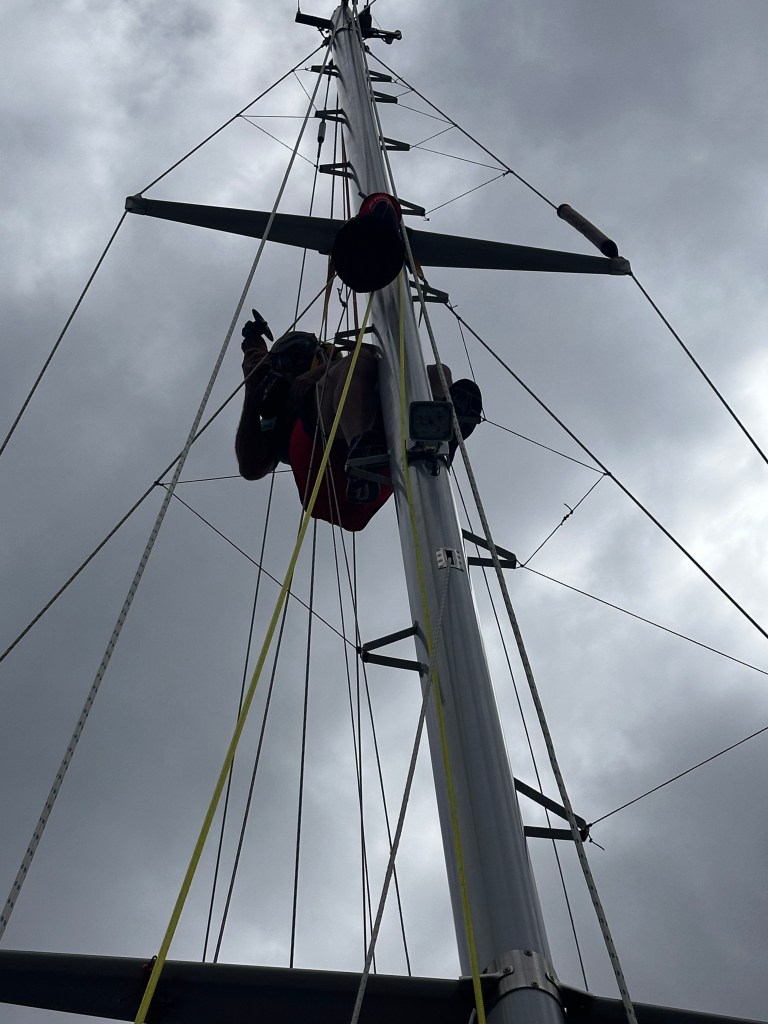
    We then turned to removing the running back stays, only to find that the wires had been attached with the fat part of the pin against the mast — meaning the pins couldn’t be withdrawn. Now I could rail against the rigger in Fiji who committed this act of folly, but I have come to realise that the skipper is responsible for his or her boat, and everything that goes on in it or to it. It was my responsibility to check the rigger’s work, for I most assuredly know, after various experiences, that professional qualifications and extortionate fees provide absolutely no guarantee of quality of workmanship. Removing the pins, which would have taken a few seconds to sort out whilst the mast was down, now required me to climb the mast and cut the pins with an angle grinder. Obviously, a tool capable of cutting through 10mms of stainless steel would have little trouble cutting through a 12mm piece of rope, like that which I was hanging off some ten metres above the deck. It was one of those jobs most people would prefer to avoid, and one that certainly focuses the mind.

    Angle grinding near the top of the mast. Thankfully, no lives or fingers were lost during this operation.

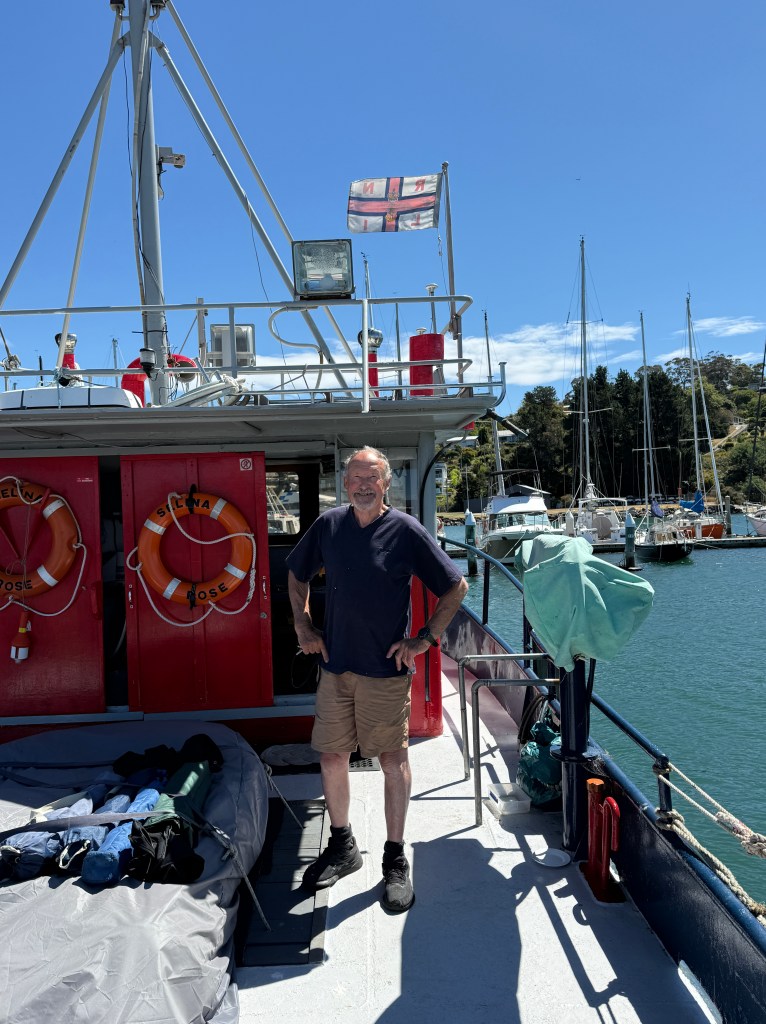
    With most of the jobs taken care of, Cara and I celebrated New Years Eve with one of the many characters at Beauty Point Marina, a gent called Rowlie Walker, and his wife Gail. Rowlie used to captain ships that resupplied rigs in the north of Australia. With marine qualifications coming out of his yazoo, he now works as a delivery skipper, and runs a rescue service inspired by the Royal National Lifeboat Institution. I had a chance to jump aboard Rowlie’s boat as a deck hand for a rescue, though he didn’t need the help, but fortunately (if disappointingly) the skipper had managed to self-rescue himself before we arrived.

    Rowlie Walker – top chap.

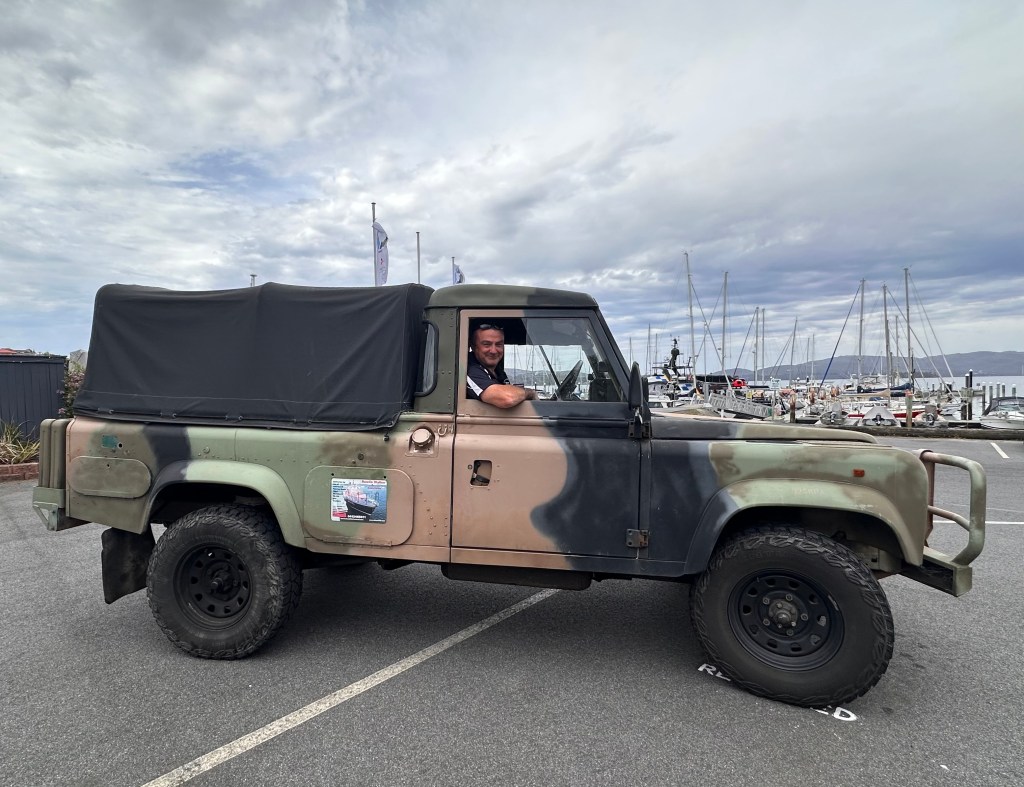
    Rowlie also leant us his car a couple of times so that we could go to the supermarket; his car being a 110 ex-Australian Army Land Rover. I passed my driving test in an army Land Rover way back in the mists of time, so it was quite nostalgic and great fun to have a chance to drive another one. I’d forgotten how much they wander, the weight of the steering, and the need to keep them rolling if possible, but it all came flooding back. Like riding a bike you might say!

    Broom, Broom! The most fun you can have on the way to the supermarket?

    After about a fortnight our window to cross to the Furneaux Group appeared. We left Beauty Point fairly early in the morning to make the most of an outgoing tide and headed east. In the end we had spent about five months in the greater Launceston area. We’d had the pleasure to meet some very kind and generous people, (Cara had) made some money, and made a few improvements to Taurus, now it was time to go.

    Our destination for the night was Waterhouse Island, which we reached after a fast ten hour sail. The anchorage there was a little rocky and a little rolly, but we slept well and were on our way again first thing in the morning.

    Waterhouse Island anchorage.

    We had to motor across Banks Strait as there was no wind, and that afternoon dropped the hook on the western side of Preservation Island. The island has an interesting history. On the 10th of November 1796 a cargo ship called the Sydney Cove, left Calcutta loaded with rum and other supplies destined for sale in Sydney. Taking on water, she was grounded before she foundered on the island. The stores were taken ashore, and the rum put out of reach of the sailors on an adjacent island that they named, appropriately, Rum Island.

    Banks Strait on a good day.

    A party of seventeen men attempted to sail to Sydney for help but were wrecked on the coast and had to walk over 600 kilometres to safety. Only three men survived the trip. Two schooners were subsequently sent to rescue the thirty men that had been left behind on Preservation. One of these ships was wrecked on its return voyage with the loss of all hands, including eight men from the Sydney Cove.

    Exploring Preservation Island.

    The Master of the Sydney Cove subsequently reported his belief, based on currents and wave patterns, that there was a channel between Australia and Tasmania, linking the southern Indian Ocean and Pacific Ocean. This suspicion was later confirmed by George Bass and Matthew Flinders in 1798. At Flinders request the passage was called Bass Strait; its discovery meant that ships no longer had to travel around Tasmania to reach Sydney, but could take a shorter and safer route.

    Rum Island, alas sans rum..
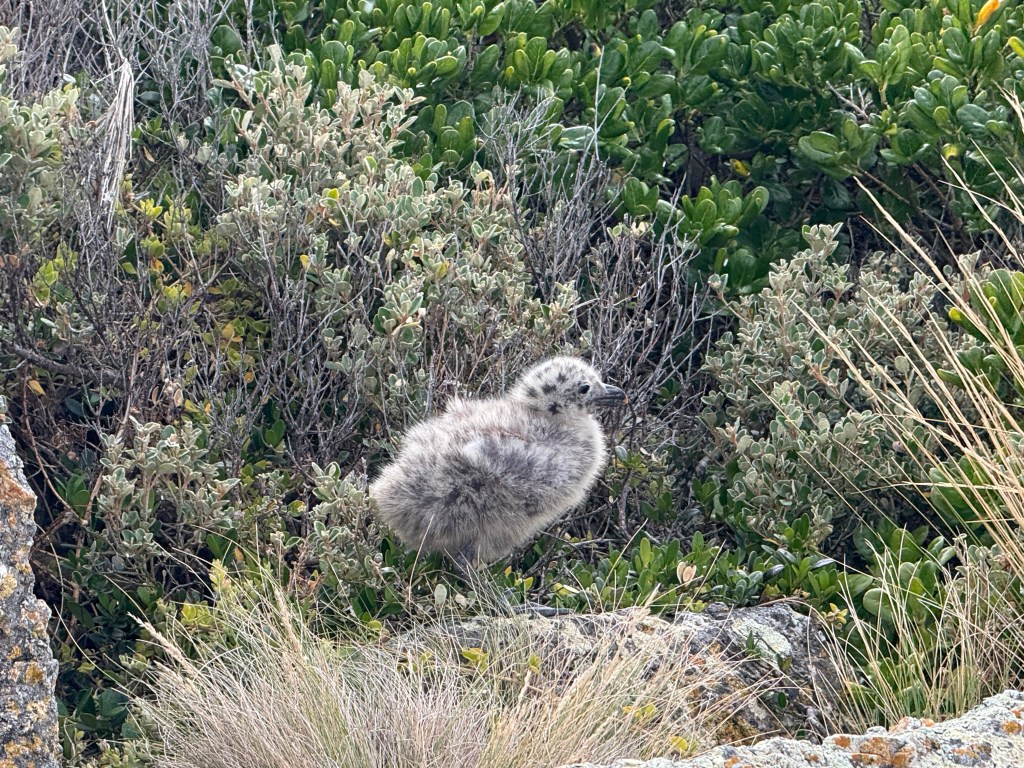
    Seagull chick, Rum Island.

    We enjoyed a mini-heatwave whilst at Preservation, and an entirely deserted anchorage. However, an impending westerly gale meant that we couldn’t linger for too long. We had been offered the use of a protected mooring in Lady Barron, but further adventures will have to wait for the next instalment!

    The voyage of the good ship Taurus: 6th of January 2026 – 8th of January 2026.
  • The last blog concluded with Taurus in a berth at Beauty Point on the Tamar River. We had a limited amount of time to fill because Cara had been asked to cover a colleague’s work roster in Dunedin for a week. The trip home to help a friend and put some money back in the sailing fund happily coincided with our daughter, Abi’s, graduation on the Gold Coast (via a slightly circuitous route) and also meant that we could enjoy Christmas with Cara’s family.

    With a month or so up our sleeves we kept a close eye on the weather whilst finishing off a few more of the endless boat jobs — such as installing a new solar panel on the new solar arch, fitting tank senders into the diesel and water tanks, and so on and so forth. As usual, the weather in Tasmania wasn’t particularly helpful, but eventually we detected a hint of a window that would allow us to sail to Flinders Island to the north east of Tasmania.

    Sailing out of the Tamar River.

    It may seem odd after all the sailing we’ve done over the past few years, but we both felt a little anxious about casting off the mooring lines and heading out to sea again. This might have had something to do with the rough weather we’ve frequently encountered around Tassie; the fearsome reputation of the seas around Flinders Island itself (the gap between Flinders and Tasmania is known as Banks Strait, a place where the Southern Ocean is forced into a narrow bottle neck); and not sailing for nearly four months whilst Taurus was on the hard.

    So, it was with some trepidation that we cast off the lines and headed out of Beauty Point. A twenty knot wind with strong gusts from the north east meant that we needed to make a series of tacks to force our way up the channel of the Tamar. Constantly tacking a yacht in a narrow stretch of water can be pretty tiring, but the new winches proved their worth, and we finally made it into open water where we could relax a little.
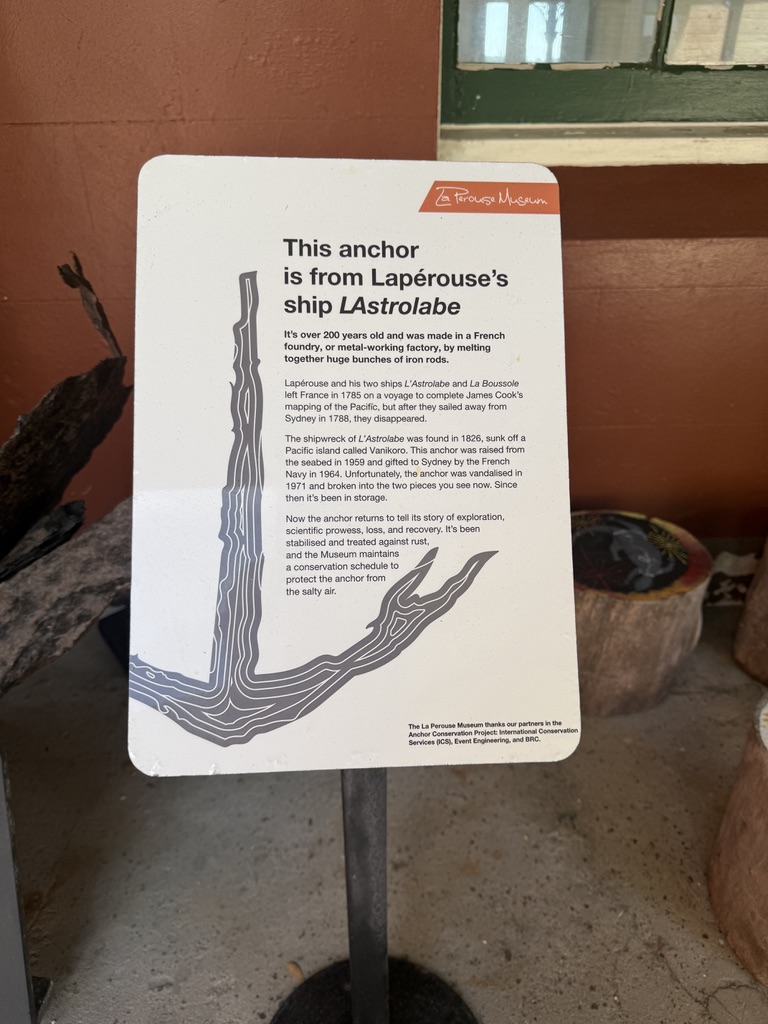
    The sail to Flinders from Beauty Point takes about eighteen hours. The gusty NW wind meant that we enjoyed a beam reach (the wind coming from 90 degrees to our direction of sail) which allowed Taurus to fly along with comparative ease. The warm weather and effortless sailing was made even better when a large pod of dolphins joined us to play in our bow wave. As usual, everything else stopped so that we could enjoy the spectacle of these incredible animals. Suddenly the nerves were forgotten and it felt fantastic to be out sailing again.

    The approach to Flinders Island from the SW is guarded by Badger Island. We chose to anchor here for the night rather than keep heading towards Flinders, and try to navigate the shallow water, strong tides, and rocks in the dark. So it was that we found ourselves at 3am trying to find a patch of sand amidst the weed so that our anchor would have a chance to set. On the fourth attempt we struck gold, got a good hold, and could turn in for what remained of the night.

    Off Badger Island.

    In the above photo you can see the sand and weed that often forms the sea floor in this region. You might think that a decent anchor should be able to penetrate a bit of weed, but the species here forms a thick layer of material, much like a mattress, that prevents the anchor finding anything to dig into. Later, after we had returned to Beauty Point, a friend gave us an old fisherman’s anchor to try. This traditional design (like that which Popeye has tattooed on his arm) has a reputation for working better than any modern anchor in weeds and rock. If I can organise a second rode I’ll definitely be keen to give it a go.

    The following day off Badger was a cracker. Bright sun, warm breezes, and calm conditions. We inflated the kayaks and headed out for a paddle.
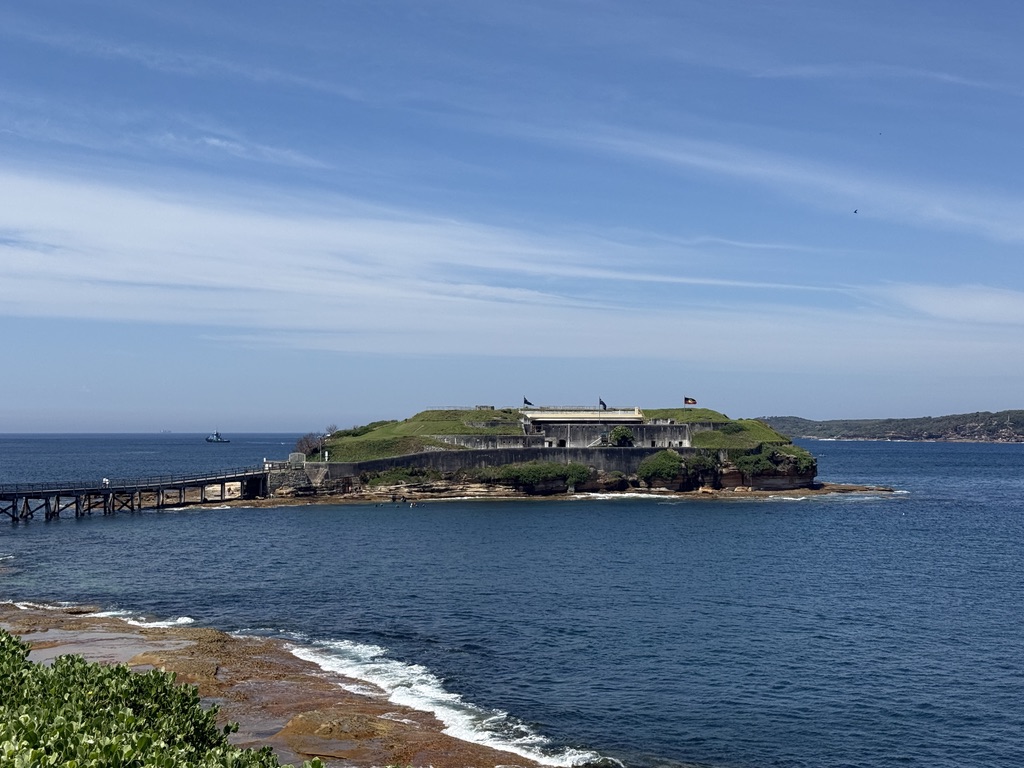
    We had a fantastic time exploring the rocks, and walking ashore, but the wind was due to change to easterlies next morning. We reluctantly departed, and sailed Taurus to a mooring at Trousers Bay on the western side of Flinders Island. This mooring is one of the free state moorings and has a thick, long line. Over time we have developed a system of pulling these types of moorings up and connecting them to the mid-ship cleat. This limits our potential to swing whilst, more importantly, preventing the mooring buoy from banging against the hull during periods of calm. As it turned out we were to see little of the latter. In front of us lay the highest peaks on Flinders Island, the Strzeleki Peaks. These we thought would give us good protection from the east, but in practice the wind accelerated down the leeward slopes and raced across our ‘sheltered’ bay.
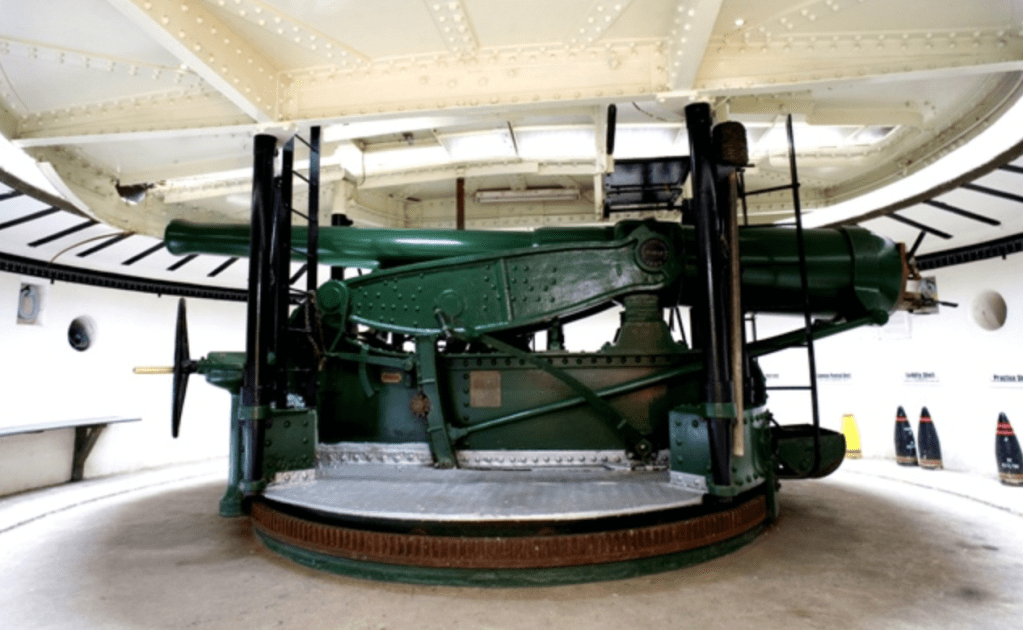
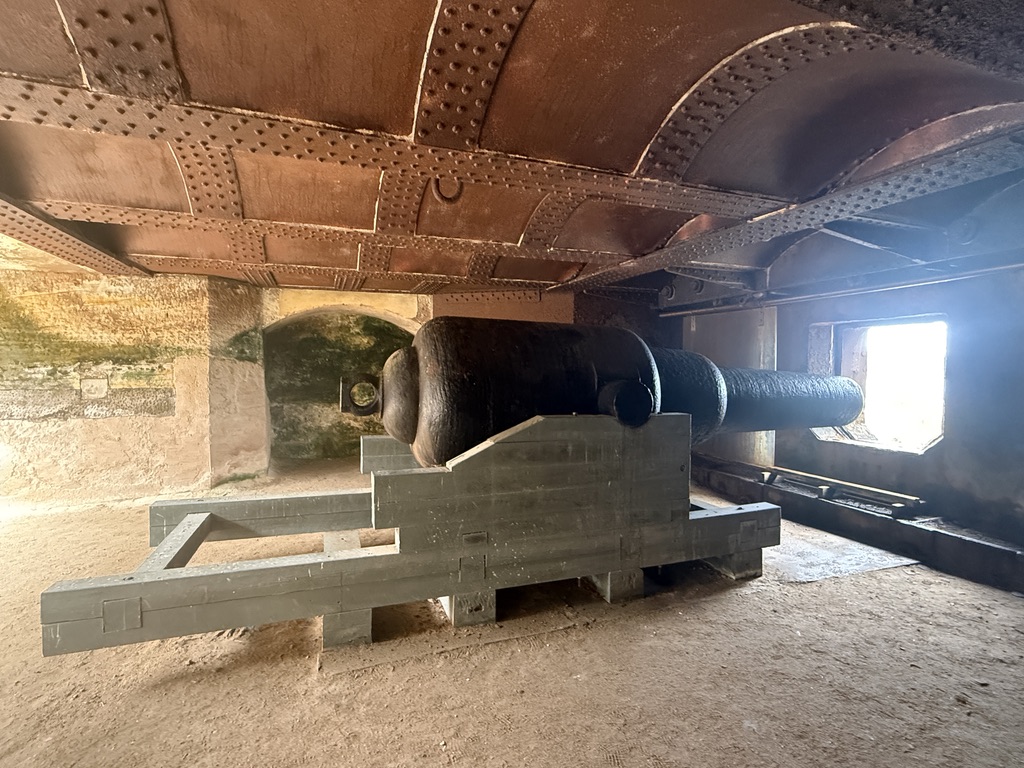
    The Strzeleki Peaks as seen from the entry to Trousers Bay.

    We had intended to walk a track that leads to the top of the peaks, but the strong winds meant that it was impossible to get off the boat. The winds were generally in the 25-30 knots range, but reached as high as 40 on occasion. The thickness of the mooring line became quite reassuring as a lee-shore lay close behind us.

    Looking on the ‘No Foreign Land’ app we could see another boat, called Sea Eagle, on anchor further north of us in Parrys Bay. We sent the skipper an email, his address being on another app called Marine Traffic, with our phone number, and he later gave us a a call. The conditions where he was located were little better. He told us that some of his crew had made a herculean effort to go ashore to the local town, boats having to anchor some way out due to the shallowness of the water, only to find that everything was shut as it was a Sunday!

    Keen to explore all possibilities, and get off Taurus if we could, we also contacted Luke, the manager of the Beauty Point Marina who had been a long time resident of Flinders Island. He told us that we certainly shouldn’t try to get into Lady Barron in the current conditions, and said that we were probably as sheltered where we were as we would be anywhere nearby. As we were on a secure mooring it seemed foolish to abandon it in the possibly forlorn hope of finding a calmer anchorage, especially as the holding might well be ‘a bit dodgy.’

    Gusty times in Trousers Bay.

    Keeping a close eye on the weather forecast, we realised that we had one more day of easterly winds before a series of strong westerlies were expected to kick in. These westerly gales were predicted to last for at least a couple of weeks, for the entire fore-casted period in fact, and would effectively prevent us from returning to Beauty Point. So it was that on the morning of our third day at Trousers Bay we woke at 6am. A strange lull in the wind had caused us to wake in a start, and noticing the calmer conditions we raced to deflate our kayaks (stored on the deck) whilst the going was good. We then waited till midday in a bid to time our arrival at the Tamar River for first light, dropped our mooring and headed back to the Tasmanian mainland.

    Looking west from our mooring.

    As luck would have it, Sea Eagle had grabbed the same ‘last chance’ weather window and departed the same day. Although we were the only two vessels for miles around we still managed to find ourselves on a collision course as we threaded our way through the islands to Banks Strait. Fortunately, Cara was on the wheel and did the considerate thing by slowing us down and refusing to heed my remarks about it being a race…

    Taurus under sail, taken by Michael, the skipper of Sea Eagle.
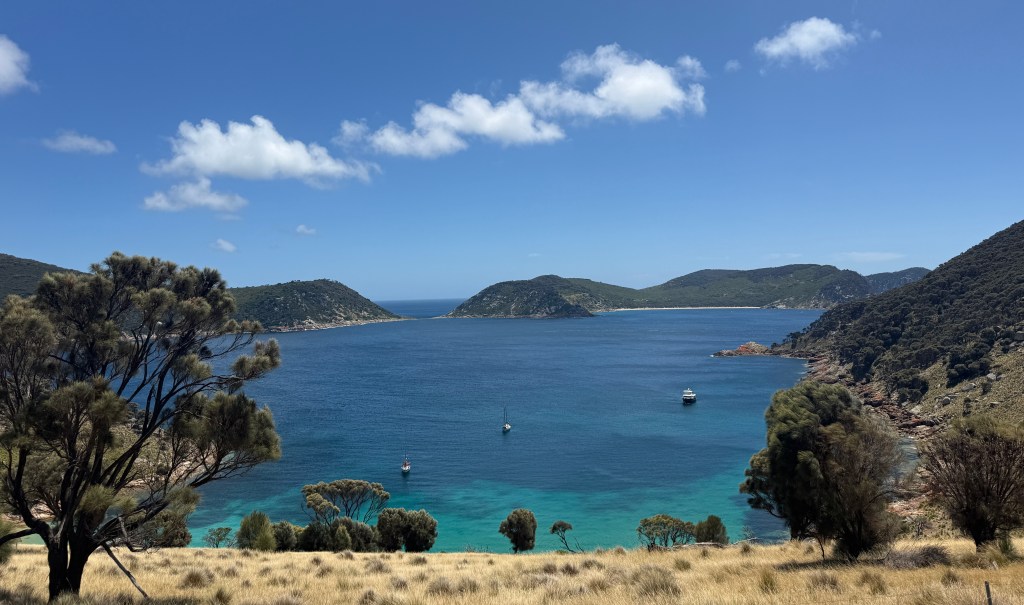
    The passage back was uneventful and fast. The only real excitement occurred when we came to re-enter the mouth of the Tamar River. This stretch of coast line has some notorious reefs and the entrance itself can be a fairly unpleasant place to be in the wrong conditions. We had timed our arrival to beat the westerlies which were due in the morning, but as we approached, the easterlies picked up to 30 knots plus. We intended to motor up the Tamar to Beauty Point, about an hour away, due to the twists and turns in the channel which would see us heading up wind at some points. We dropped the main as we approached the leading marks, leaving out a scrap of jib out to stabilise us and maintain some speed, and started the engine to ensure that it was nice and warm when we needed it. The oil pressure was giving me some concern and I wanted to know that it was definitely going to run okay.

    So, we were all set, and as we lined up our entrance we put the engine into gear… only to find it wouldn’t engage. We tried some fruitless pushing and pulling of the lever, and then when I looked at our course I saw that we were beginning to head towards the Hebe Reef — so named after a ship that ran aground and sank there in 1808, the first of many. I said to Cara that we needed to head to windward, and she replied that she was hard-over! This meant that we had insufficient steerage to sail away from the reef. If we couldn’t get the engine into gear our options were to gybe and try to head back out to sea, or try to sail with the wind around the southern edge of the reef and then back out to sea. Neither option was particularly appealing in the conditions.
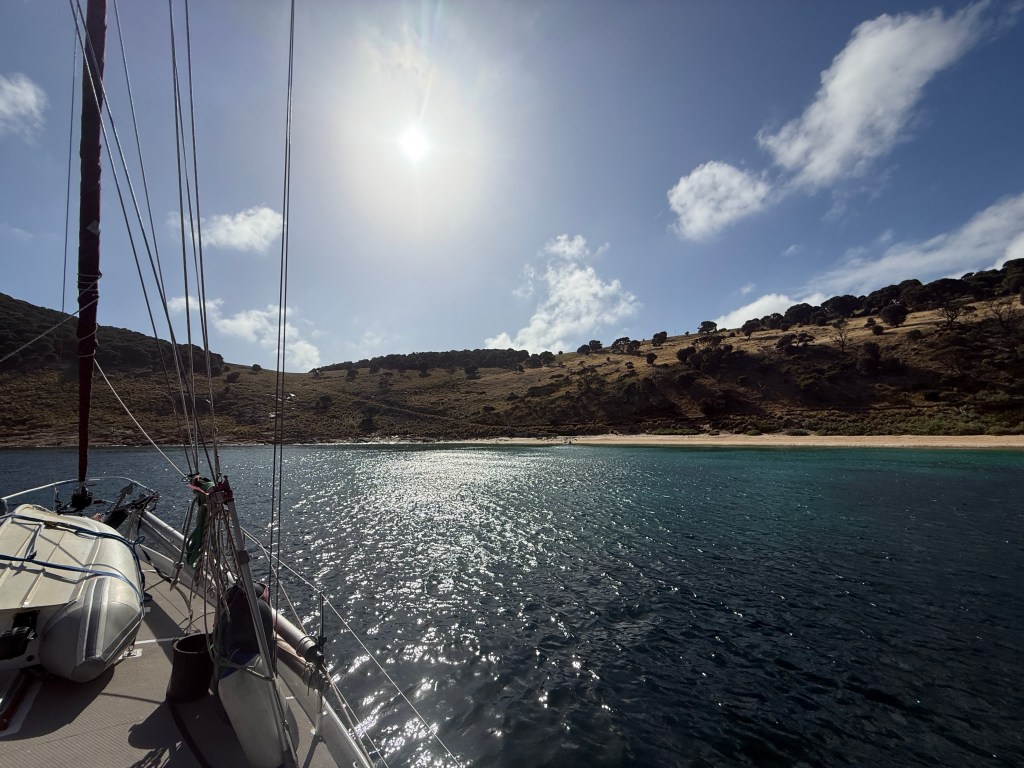
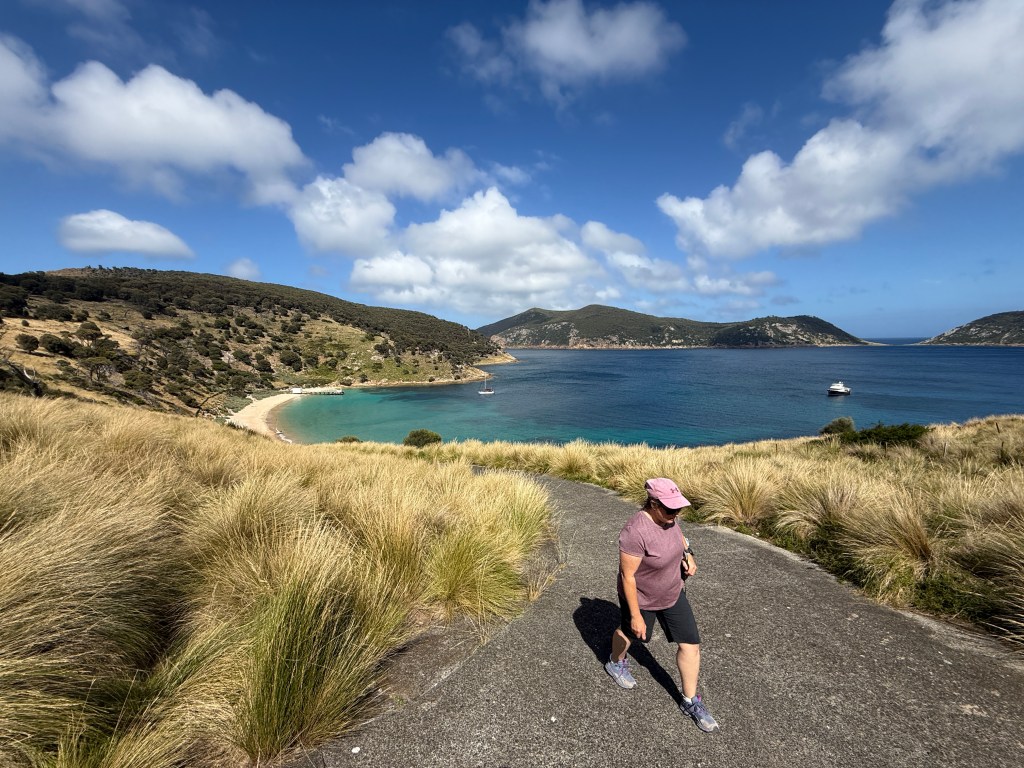
    I jumped down the companion way and threw everything on top of the engine covers off, dove on top of the engine, which was still running, to reach the gear select lever on the gearbox. With barely any effort it snuck into gear with a satisfying ‘click.’ I sometimes feel that Taurus, if not actively trying to kill us at times, certainly enjoys testing us. We had never had this problem before, and haven’t had it since. Naturally, should such a problem decide to rear its head it would be at the end of an 18 hour sail, following several tiring days being blown around an anchorage, approaching a narrow channel in 30 plus knots of wind, at 3 am, in the pitch dark, surrounded by reefs.

    The motor up the channel was child’s play after the fun and games at sea, and we dropped anchor outside Beauty Point Marina, rather than push our luck any further in the dark. We tested the gear select numerous times before attempting to reverse into our berth, and found it to be working perfectly. Bloody thing.

    With no time left to go anywhere else, we tidied the boat and faffed around fixing things. Departure day came around and Luke kindly gave us a lift to Launceston airport. After a brief stop in Melbourne we arrived in Brisbane, where old sailing buddy Julian picked us up and took us home. He and Tracey, his wife, then generously lent us a car so that we could drive to the Gold Coast where we caught up with daughter Abi. It was fantastic to be able to catch up and celebrate her big day with her.

    Champagne breakfast with Abi.
    Abi and proud parents!

    Early the next day we drove back to our friends’ place to drop off their car, they drove us to the airport, and we were off to Christchurch. Looking down upon the Tasman from 30,000 feet it was hard not to reminisce about the time we sailed across that sea with friends Dave and Jackie. That had been an epic mid-winter trip with gales, breakages, and a quick dip mid-sea whilst becalmed; our three hour flight with in-flight entertainment, pre-packaged meal, and free glasses of wine was certainly more comfortable, but hardly as memorable. One of the running clubs in Dunedin used to have a sign that read something along the lines of, “I might not be able to run a marathon every day, but having run one once, every day I will know that I have run a marathon.” I know that every time I fly across the Tasman Sea I will look down and know that I sailed across that sucker!

    Approaching the coast of New Zealand. The Tasman Sea below us.

    Back in Dunedin, Cara quickly fell into a work routine whilst I did DIY at her mum’s place and caught up with friends. We had agreed to talk about our adventures at our local yacht club’s last get together of the year — which was slightly terrifying, but well received, according to some polite members of the audience. I felt that we had proven the old adage, known in the forces as the ‘seven p’s’: Prior Planning and Preparation Prevents Piss Poor Performance. There had, however, been little time for rehearsal, so we did our best on the day. If any masochists out there want to watch the talk you can find it online at the following address:

    https://www.otagoyachtclub.org.nz/newsarticle/161032?newsfeedId=2228401

    Like having a toe amputated, I don’t recommend it.

    “and then the bishop said….”

    With Christmas behind us we had time for a bit of work at one of our rentals, a bit more catching up with friends, some cat-sitting, and then packing up ready for departure back to Tasmania.

    Ah, good old Dunners (Dunedin). The view from Cara’s mum’s place…
    Hard to beat on a good day….
    but they can be few and far between…. rain and hail on Christmas Day…
    The Dude, aka son Daniel, provided Christmas entertainment.
    Catching up with friends. Pat, pictured here in his garage, is an internationally renown expert on Alexander the Great. He also likes motorbikes, and once famously rode a classic Triumph into a lecture theatre.
    Feed me, stupid human… cat sitting for Mr Mud Cake. His ‘owners’ leant us a car for the duration of our NZ stay. Many thanks Adrian and Jen xx

    So, it is with some sadness that tomorrow we bid adieu to family, friends, and New Zealand once more, and return to Taurus in Tasmania. Home, after all, is wherever we drop our anchor, and a new sailing season and new horizons beckon.

    The voyage of the good ship Taurus, 20th of November – 25th November 2025.
  • A yacht on the largest cradle at the Tamar Yacht Club. Launceston is a good day’s travel down the Tamar River from the sea.

    our last blog post ended with Taurus caught on a foot bridge as we attempted to enter the Seaport Marina. Access to the berth we had been given required that we make a ninety degree turn parallel to the footbridge to enter the fairway, and a second ninety degree turn immediately afterwards. Taurus‘ turning circle being what it is, we had to hug the bridge to have the maximum amount of room to turn and have a chance of getting into the berth. Boats are not like cars when it comes to making three point turns, and trying to manoeuvre a full keel boat in a confined, dark, and unknown space is an experience best avoided if possible.

    Approaching the ‘bridge of doom.’

    All was going smoothly. Cara was on the wheel and I was at the bow to ‘help’ with directions. Alas, I thought we were going a bit fast, so I yelled to Cara to slow down. What I didn’t know was that she had already placed the engine in neutral, so in order to slow down she put us into reverse. Propellors in reverse can create a phenomenon known as ‘prop walk.’ This essentially means that the stern steps out (to left or right depending on which way the propellor turns). As we were hugging the bridge this ‘step’ was enough to put us alongside the bridge which caused us to catch our rigging on a steel protuberance that greatly resembled and perfectly functioned as a cleat. The rig bent alarmingly and I had visions of the mast coming down and fouling the bridge — an embarrassing spot on the Tasmanian news seemed to beckon! Happily, however, we had timed our arrival for slack tide, so we were able to push ourselves free without too much effort and gain our berth. It was a stressful end to a long day, and an even longer few days that had seen us race around most of Tasmania’s west and north coast. .

    Looking down from the bridge on the ‘boat catcher.’ Heaven knows what it’s for, but it’s good at catching boats.

    The Seaport Marina is nice enough, cheap, and run by friendly people. It has, however, three serious downsides: the tricky entrance, the hike to the toilets, and the mud. The Launceston end of the Tamar River is gradually silting up, so that at low tide a good deal of the marina is simply a quagmire. Our berth, one of the closest to the river, had about a metre of free water at low tide, so the lower half of the keel sat in a muddy hole. This has the potential to cause a major issue. As the boat cyclically rests in the muck, mud can be forced further and further into the through holes which provide water for things such as engine cooling. If blocked this can obviously cause the engine to overheat.

    Of the various options locally available (moorings, and other berths outside of the marina) none apparently have sufficient depth to let a decent sized keeler float all tide round. We had been speaking to the Tamar Yacht Club about using their hard standing facilities, and as the cost of being on the hard was the same as being in the marina, and as there was no-one else waiting to use the cradle earmarked for us, we decided to escape the mud by sitting on the hard for the duration of our stay.

    The club’s facilities are much the same as we are used to in Dunedin, with steel cradles lowered on tracks into the water and the boat driven into them at high tide and secured. As the tide drops the yacht comes to rest on the cradle and the whole shebang is pulled onto land by winch.

    Out she comes. Cara supervises as Pete finds Taurus a temporary home.

    The bosun of the yard is, a self-effacing kind of guy called Pete. Pete started work at his family’s boat building business at the age of ten, and went on to run his own engineering business for thirty five odd years. As you might imagine, Pete is a mine of knowledge, but without knowing him you won’t know how generous he is with his time and skills. On a couple of occasions he even managed to squeeze himself into Taurus’ engine compartment, something I wouldn’t have thought possible if I hadn’t seen it with my own eyes! Getting him out again proved that miracles do happen!

    Pete Fogarty, aka ‘Tadpole’. A good egg.

    The yard, unsurprisingly. was full of boats, and populated by the interesting characters that own them. Our initial neighbour was a Swiss German chap, a solo sailor with a You Tube Channel who had run his yacht onto rocks entering the Tamar. We were keen to talk to him, but the experience seemed to have dented his sense of humour. He determinedly refused to engage with us, or indeed anyone else. He was so taciturn that after a stay of some months many of the other boat owners thought he spoke no English (his You Tube channel is provided in German and English versions). It seems odd to set out to travel the world and yet deliberately forego opportunities to interact with people, but each to their own I guess.

    The Swiss chap left shortly after, and his cradle was taken by a guy called Ken Gourlay, who holds the Australian speed record for a solo circumnavigation. Ken was helping his son, Tristan, get his boat ready for an intended challenge to beat his record. At time of writing Tristan is a few days into his challenge and going great guns. You can follow his journey on Facebook at https://www.facebook.com/profile.php?id=61581996164631

    Another interesting guy was Michael, whose boat, Serida, had sunk at the Beauty Point Marina, also run by the Tamar Yacht Club but some five or six hours up river. The fibre glass keel of his boat had badly cracked causing the boat to sink. According to the gossip mill, the stays holding his mast up had been overtightened, which had driven it through the hull. Later, however, the keel was cut from the boat in order to transport it to the tip. It transpired that ferrous metal had been used for ballast, and, as it slowly rusted over many years, it vastly expanded and may simply have burst the keel apart from the inside out.

    Once Serida had been condemned by the insurance company, Mike was allowed to sell off what parts he could. The potential for cheap goodies was too good to ignore, and we ended up buying a set of Lewmar winches and all manner of other things that we don’t really have room for. Later the poor old girl became fair game for stripping by whoever had the time and energy to take what they wanted. Cara and I spent a day or two taking out hinges, catches, blocks and such like. The older bronze and stainless steel items are often nicer than the modern stuff (which is uber expensive) and it would be a terrible sin to see it thrown in a hole in the ground.

    Shiny goodness!
    Serida off on her last journey (note the dry carpark!).
    The boats get crammed in on the hard.

    As usual, the strangers in the yard quickly became a community, friends who would bend over backwards to give a hand. Jim and Angela, A & E nurses and the owners of Malibu, the red steel boat you can see in the background of the above photo, leant us a compressor and needle gun, and even gave us some surplus paint. However, it wasn’t just the sailing community who went above and beyond. Gregg, Cara’s manager at the Launceston General Hospital, leant us a car for the duration of our stay, an act of generosity that saved us hundreds if not thousands of dollars. It’s often easy to be cynical of people, but since we have been travelling we have never received anything but kindness from strangers. Perhaps Jean Jacques Rousseau was right when he argued that people are inherently good and kind — although he did die alone, driven mad by the belief that people were conspiring against him… hmmm.

    The car Gregg generously leant us.. life would have been much more difficult without it.

    One of the more unusual aspects of the Tamar Yacht Club’s hard standing is its tendency to transform from land to lake. I was working in the shed on the pillar drill one evening when I realised my feet were getting wet. The tide was rising through the floor boards and kept going until it was several inches above the floor. Another evening I had to take off my shoes and socks to get to the car in the carpark which had become a large pond — complete with swans and ducks. After this experience I tried to remember to keep my gum boots handy!

    The sinking shed..
    Carpark or lake?
    Going, going, gone! You quickly learn where the best carpark spots are!

    With Taurus on a cradle it was time to get to work. We had a long list of jobs to do, and a couple of months to get them all done. As is the way with boat jobs, you start one thing and it leads to something else, and something else, and something else, and suddenly the list of jobs you started with is a distant memory. I, for example, wanted to re-varnish the galley whilst we were living off the boat (Cara’s job came with a free apartment), but after several months it sadly looks as shabby as ever. Other jobs kept cropping up and had to take priority.

    One day we started emptying the bilge and noticed a line of paint that had lifted at the bottom of the keel where the plates join. This line of lifted paint had led to some minor rust which led all the way to the anchor locker. To gain access to repaint we had to remove the anchor chain, remove the bespoke anchor chain box (happily designed to be removed in several pieces) and the anchor locking lining. Then, whilst working in this tiny steel box we noticed that the deck below the windlass was badly corroded. The beauty of steel boats is that it is relatively easy to cut out corrosion and replace the old material with new steel. The welding part can take just an hour or so, but the headache is cleaning up the mess and repainting. At a minimum we normally aim for two coats of antirust, two coats of primer, and as many topcoats as required for a decent aesthetic finish. As each coat requires a day to dry, the painting can easily take a week — or more if you don’t have decent weather.

    The rusty deck below the windlass has been cut out… (leaning against the lifelines)
    new steel waiting to be welded in… (the holes are for the anchor chain and the electrical cables that power the winch).

    We also noticed another small area of corrosion in the bottom of the anchor locker (we were warned about this during our pre-purchase survey) so cut out that out too. It made sense to do the work whilst the anchor locker was accessible and we had access to Pete, a very experienced welder who charged a reasonable price, as well as all manner of paint suppliers, engineers, and so on. Within a few days, all the rust in the anchor locker was replaced with 6mm of brand new cortan steel, and I proceeded to smother it in epoxy paint. Naturally, the process wasn’t entirely straightforward, and weeks of gale force winds and squalls whistling straight down the Tamar River and into the exposed boat yard became a bit of a bore. On one memorable day the wind was blowing over forty knots and I turned up to find the three metre aluminium ladder that we used to get from ground level to the deck trying to take off. As it was tied on at the top (to prevent us falling backwards on the way up) it was flying up and down Taurus’ hull in the gusts. Apparently the weather was exceptional, everyone was sick of it, but finally the painting was done.

    Small patch of corrosion removed….
    … patch cut out and fitted…
    Pete welding the patch in….
    and better than new… (the green paint is primer).

    Another job undertaken was replacing the spare sureseal seal on the prop shaft (the previous spare having been used to stop the shaft leaking in Recherche Bay) This proved to be a real PITA of a job, due to poor access and the refusal of the universal joint to release from the shaft. After a three day battle with it I eventually found a clamp in an engineer’s scrap bin that was a perfect fit, and by smacking the clamp with a large hammer I was able to jar the joint free. I withdrew the shaft, put everything back together, and then realised I had forgotten to replace the sureseal cap. It all had to come apart again. How I laughed! The bright side was it came apart far more easily second time around.

    We replaced the throttle and gear cables, and then thought that the steering cables might as well be replaced too. Should a movie ever be made on this decision it might be called “A Job Too Far.” It was another swine of a project, but one that needed to be done. We found that the sprocket that the steering chain runs on (which is then joined at either end to a cable) was made of plastic, so it had of course worn quite badly over its years or even decades of service. A couple of times when sailing under pressure the wheel had alarmingly slipped — now we knew why. The local engineers made short work of machining a a new metal sprocket to fit the shaft, and we could move on to trying to remove the steering quadrant. Now this particular lump of metal and I have ‘history.’ I had spent about a week trying to remove it when we first bought the boat so that I could paint beneath it. It sits on a tapered stainless steel shaft and had refused to budge despite copious amounts of lubricant, heat, increasingly large hammers, jacks, and anything else I imagined might make the difference. Eventually, wiser heads told me to leave it alone before I broke something, and worry about it when I actually needed to remove it. So, I wasn’t looking forward to renewing my acquaintance with this bloody minded inanimate object. However, with some advice from Pete, the judicious use of a gas torch, and a big hammer it popped apart in less than an hour. I could barely believe it.

    Quadrant removed. My face reveals what a relief it was to budge the thing!

    With the quadrant removed it was a simple matter to rig a new chain onto the cables and run them through the boat. As luck had it, Cara had a day off when I was running the cables, little people are good for small spaces.

    Head down, bum up, as they say!

    There are various euphemisms associated with working on boats that seek to capture the sheer bloody awkwardness of most boat projects. ‘Boat yoga’ is heard a lot, or the saying that ‘if you can see it you can’t reach it, and if you can reach it it’s only by being upside down and with one hand.’ Boat builders seem to delight in making jobs more difficult than they need to be for future owners. One gem is putting bolts into holes from which they can’t later be withdrawn. When faced with roadblocks like this you can either keep pulling the boat apart or go medieval — we opted for the bolt croppers.

    Other jobs we tackled included removing and rebedding the two deck hatches (as well as replacing their acrylic ‘glass’), rewiring the windlass, adding several new electronic goodies that allow us to better monitor boat systems, repairing the dodger, adding a solar arch (taken from Serida) renewing the antifoul, cutting and polishing the topsides of the hull, servicing the engine and (hopefully) fixing a minor, intermittent oil leak, and so on and so forth. We also had a local rigger check the rig after our brush with the local infrastructure. Happily it passed inspection and as an added bonus the chap suggested a different lay out for our inner fore stay. This will allow us to do away with our running back stays, a way of strengthening the middle of the mast when under storm jib (which pulls from mid-mast), but which prevent us tacking, jibing, or heaving to without removing them first, which isn’t always easy in a big sea. We’re still waiting on the new stay to arrive, but fingers crossed it works as promised. So, with everything going on at once it was a busy time. Our apartment quickly became a secondary workshop complete with varnish station and winch strip down area, and resembled a crappy chandlery full of second hand boat bits and a charming bouquet of thinners.

    Taurus after the tie coat had been applied to the hull…
    …and later with two coats of black antifoul. I would have like to use red again but it was almost twice the price. I don’t like red that much.
    Cara working with the sewing machine in the shade of Taurus’ hull.

    We did manage to take the odd day off. One of our best day trips was to the Low Head Lighthouse on a Sunday when they fire up the fog horn. After a long and interesting chat with the volunteers who run the beast we learnt that this the only operational ‘G’ type diaphone in the world. Who doesn’t love steam, brass, and loud noise?

    According to the free leaflet, “The diaphone consists of three parts. The outer casing and two sections making up the piston. The driving and external parts of the piston are machined with annular slots and as the air passes through it is chopped 180 times per second to create the characteristic ‘groan-grunt’ sound.”

    For those eager to experience the ‘groan-grunt’ click on the following link: https://youtu.be/HmC4PiGH6hY (remember to turn your volume up loud for a realistic effect!)

    Low Head Lighthouse and siren hut.

    Eventually, Cara’s contract ran out, and it was time to finish up the boat yard jobs and get Taurus back into the water. Rather than stick around in the mud (hoho), we headed straight back up the Tamar for a few hours to the Beauty Point Marina. We had previously stayed at the marina a couple of years ago after crossing the Tasman Sea with our friends Dave and Jackie in their Hanse 370e, Hansel. It was nice to return in our own boat.

    Entering Beauty Point Marina.
    At Beauty Point. The large freighter in the background never moves — it’s part of the local Marine Training College.

    Luckily, we had time to finish up a few last jobs at the marina while we waited for a weather window to sail to Flinders Island across Banks Strait. Thursday, in two days time, is looking good. We don’t have a great deal of time up our sleeves to explore as we plan to visit the Gold Coast for my daughter, Abi’s, graduation, before flying to New Zealand for Christmas. After so long working on the boat we’re looking forward to actually sailing again. But, that having been said, I’m mindful that after fiddling with so many systems this will be a bit of a shake down cruise. Hopefully nothing important fails, but if so we’ll cross that bridge when we come to it, or smash into it — we’re getting good at that!

  • Albatross flying over the Southern Ocean. In our short trip up the West Coast this stretch of sea lived up to its fearsome reputation.

    As we left Sir John Falls to return up the Gordon River, the rain fell and the temperature seemed to plummet. We had grown used to bright sunshine and still conditions, so this grey, damp, and cold new world muted our enjoyment of the scenery somewhat. We were also apprehensive about our batteries’ charge state (with the alternator still providing a weak charge) and the likelihood of meeting the big commercial ferry around some bend of the river.

    Chilly.

    Happily, we avoided the ferry, and the big wave we received from its crowd of passengers, braving the rain on the exposed deck, made us forget the rain for a while. Eventually, we escaped the river and could raise the sails to enjoy a fast trip back to Strahan. Alas, when we turned the engine back on to anchor we found that the alternator had given up the ghost completely, and was providing no charge at all.

    Short, wet days became the norm.

    The isolation of Strahan was brought home to us again as we tried to find a replacement alternator for our old(ish), British engine. The search was further hampered by our need for an ‘above ground’ unit — one that doesn’t ground to the engine and cause potentially harmful stray current. To cut a long story short, we eventually found an auto-electrician in Launceston with the knowledge and willingness to help, and we had two units freighted out to us. Why two you may ask? Well, a wise boatey saying has it that “one is none, and two is one,” a maxim that emphasises the importance of having redundancy aboard.

    To compound matters, the incredible weather we had experienced for our first week in Strahan soon became a distant memory. The rain fell in sheets, and every night seemed to provide a fresh gale from one quarter or another. Power rationing doesn’t come easy during long, cold, wet days. In the end we got in touch with the local council and arranged a berth on the town jetty so that we could plug into the mains, and walk on and off the boat. The only downside was that the northerly gales blew us against the jetty and the wide piles, designed for large fishing boats, required some creative fender work. Nevertheless, life was much easier that it had been on anchor, and the chap in charge of the jetty kindly decided not to charge us for our short stay.

    We used the time whilst waiting for the alternator to arrive (and subsequently, for a weather window) to check out the local tourist trail. One night we attended the play (perhaps pantomime is more accurate) The Ship That Never Was. This fun drama is Australia’s longest running play (at thirty odd years) and recounts the last great convict escape from Sarah Island. Wrap up warm and try not to sit in the front row if you don’t want to participate!

    The Ship That Never Was.

    Another day we took the old mining railway along the King River with William from Sea Eagle. It was nice to get a different view of the area, and to again marvel at the hardiness of the pioneers who tried to tame this rough terrain.

    Hello Ivor! Choo Choo!
    William checking out the scenery on the Westcoast Wilderness Railway.

    An expedition to Queenstown kept us out of mischief another day. We took the school bus to the local ‘big smoke’ to see what we could find. The alien landscape surrounding the town, created by decades of mining, provided mute testament to the power people can wield over nature, whilst the shabbiness of the town itself, now the mine is shut, speaks volumes about the vicissitudes of human endeavour. The ruined land remains, but most of the people and the wealth are long gone.

    The wisdom of our trip was looking a bit dicey when we had ‘finished’ the town by 10 am, with the return bus not leaving till mid-afternoon, but then we found the local museum. Its eclectic collection is so large that we ended up spending several hours there and still missed a good portion of it. Cara even found an old operating theatre and anaesthetic equipment to play with!

    Quiet in Queenstown.
    ‘Just lie here’ Cara said. ‘No’ I replied.
    Queenstown Railway Station. They do a fine roast lunch!

    With the new alternator installed we began looking for a weather window in earnest. However, even the weather guy on ‘Weather Watch’ (a useful internet resource) was surprised by the never ending sequence of storms rolling across South Australia and Tasmania. Rather than risk a nasty Southern Ocean experience we were happy to wait.

    Day after day of this nastiness. The colours show wind strength. Green good, purple bad; South good, north bad!

    Out of the blue one afternoon we received a call from Michael from Sea Eagle. A little cryptically he asked if we had dive gear on board and if one of us could dive. It turned out that the lads had run over a mooring line at Birches Narrows, which had become wrapped around their propellors. Michael had been diving on the boat all morning with a 2mm wetsuit and a dolphin torch, but hadn’t been able to free the boat. Sooner or later anyone who goes boating ends up in this predicament, and we have certainly been in the club ourselves once or twice. We had the gear and were happy to help, so Michael, wanting to get free as soon as possible, hired Sophia, one of the local tour operators, to bring us to them first thing in the morning.

    It was exhilarating to race down the Macquarie at 30 knots, a rather different experience to Taurus’ more stately 5 knot average. However, our mission of mercy almost became mission absurdity when my dive regulators began free flowing a couple of minutes after I entered the water. This can be caused by cold water freezing small parts in the regulator, as well as by fresh water such as is found near the river’s mouth. A further factor might be plain lack of use. I last dived in Noumea and the gear was overdue for a service. Anyway, as I was all dressed up with diving thermals and an 8mm wet suit on I felt duty bound to do what I could.

    Fast trip down Macquarie Harbour.

    I have to say that I really dislike free diving under boats. Having smoked for many years my lungs aren’t great, and having almost drowned in a kayaking accident I have a residual fear that doesn’t help me conserve what little air my lungs can hold. I can never quite shake the idea of getting caught on something and being unable to surface. The 10 degrees water, pitch dark only a metre or so beneath the surface due to the tannins from the peaty soil, did little to help me relax. The cold seemed to prevent me catching my breath, and all I could manage was lots of short dives.

    Even with a decent dive torch I literally swam into the propellors before I saw them. The lack of visibility meant that I used a good deal of air just finding the props each time I dived, and then had to desperately surface before I could really achieve anything. Eventually, I freed one propellor and moved on to the next. The rope was tightly wrapped on the second shaft, but I was able to loosen enough rope to tie it to a fender so I could use it to guide myself back to the propellor, and avoid wasting time and air. After what seemed a long time the rope was finally cut away. I couldn’t help but admire Michael who had been trying to do this with a thin summer wet suit and a crappy old torch. Bugger that!

    Me, papping myself.

    Eventually the propellors were clear and I had another quick dive to check that the rudders were clear — another bump on the head as I swam into them blind. Michael suggested I check the stabilisers too, but after a couple of dives in which I couldn’t even find the stabilisers I felt that enough was enough. The exercise had been way out of my comfort zone. Of course, being challenged isn’t necessarily a bad thing, and no doubt the experience will be helpful when we next ‘catch’ a rope ourselves. The upshot was a cruise with William, Michael, and Steffani, Michael’s wife, back down the Gordon River before being treated to dinner at the Strahan pub.

    Dinner with the gang.

    Our wait for a decent weather window finally seemed to bear fruit, and a predicted 20-25 knot sou-westerly looked like just the ticket for our 24 hour sail to Hunter Island on the North West corner of Tasmania’s coast. We left Strahan a day early to take advantage of the outgoing tide through Hell’s Gates, and anchored in Pilot Bay. In the afternoon we took the dinghy ashore for the short walk to the Cape Sorrel lighthouse.

    We didn’t leave till midday the following day, a Monday, so as to arrive at Hunter Island with the strong tides in our favour. Once clear of shelter the wind and swell increased dramatically, and we were soon flying along with 25 knots on the beam in a swell of 1-2 metres. The wind and swell in these waters can travel thousands of miles before it reaches Tasmania. It’s only obstruction, possibly South America or Antartica. As a young man I printed maps for the army. I recall a course I attended in which the instructor tried to make us understand that the wetness of water can vary. In my ignorance I scoffed at such silliness, but he was of course correct. Our trip up the West Coast made me wonder if the strength of wind can also be tied to more than its mere speed. Can air be more or less dense, a swell be more powerful than its mere size suggests? I don’t know, but as conditions worsened the power of wind and wave seemed way beyond that suggested by the instruments.

    As anyone who films the sea will tell you, video flattens the sea, so it doesn’t really provide a true idea of the actual experience. The clip above was taken just after we had left Hell’s Gates. You can see in the footage of the chart plotter that the wind is about 25 knots. In the subsequent video the wind has only risen a couple of knots, 27 is indicated, but there is clearly a good deal more power in the breeze. Taurus is no longer rolling, but is heeled to leeward and we are racing along at 7.5 knots according to the instruments.

    The wind and swell continued to increase, and we shortly afterwards furled the jib and raised the storm jib, the orange sail that you can see in the videos stowed in readiness on the dinghy. We hadn’t expected to need it in the 20-25 knots predicted, and the main reason we had it set up was because we hadn’t used it for a while. It was a good job it was ready to go. Decreasing the sail area and bringing the centre of effort closer to the mast allows the boat to better cope with strong winds. And strong they got. Before long the wind was sitting on 35 knots with sustained gusts of forty. If all the predictions hadn’t clearly stated that the wind was going to drop it would probably have been prudent to have turned around. The Beaufort scale offers a useful guide for context: 22-27 knots is classed as Force 6 and entitled a ‘strong breeze;’ 28-33 knots, Force 7, and called a ‘moderate gale;’ 34-40 knots, Force 8, and a ‘fresh gale;’ and 41-47 knots, Force 9, and a ‘strong gale.’ The scale tops out at Force 12 with 66 knot winds and over, classified as Hurricane force. Promised a strong breeze we found ourselves verging on strong gale conditions — and the weather was rapidly deteriorating. You can see why we were concerned.

    Happily, sustained gusts of nearly forty knots was as bad as it got. However, the sea state had altered with the elevated wind, and as we were heading north and the swell is predominantly from the west we were beam on to the powerful waves. The strong winds from the sou’ west also created a seperate and decent sized wave train that rose from a different direction from the swell, making for confused seas and short gaps between peaks and impacts. We conservatively estimated the swell at 5-6 metres, which is far from unusual in this area. The current wave record holder for Cape Sorrel was a monster that measured 19.83 metres, in winds of 83 knots (154 km/h), in 1982. Yikes!

    Memories of sailing in difficult conditions seem to consist of snatches of images. I recall Taurus being thrown so far over to starboard that the sea threatened to flow over the cockpit coaming, and then another large wave smashed into the port beam, crashed across the dodger windows and seemingly half way up the mast. The sailing conditions were not ideal. Still, when we weren’t being chucked about by the waves we were sailing well, so we decided to maintain our sail plan of storm jib and three reefs in the main. This kept us powered up and moving quickly in the rough sea state. We kept a close eye on the waves to make sure they didn’t start to break, which makes the risk of capsize far higher, and would have forced us to adopt more rigorous storm tactics.

    The wind was supposed to drop by midnight, but ultimately it kept us on our toes until about 3am. It was a memorable night and probably one of our worst weather experiences. The big positive was that Taurus swam through the conditions without ruffling a feather — to mix my metaphors, or perhaps she has penguin DNA. We did manage to break a couple of things, such as a solar panel that we should have strapped down. You can imagine what happens when a boat the size of Taurus is thrown onto her beam and tries to sit on a flimsy piece of glass and aluminium — nothing good. In similar fashion our canvas dodger on the port side had its grommets ripped out — the material unable to withstand the resistance of the water as it was pressed against it.

    There are several downsides to owning a full keel, heavy displacement, steel boat, but when the pooh hits the fan the inherent strength and seaworthiness of the design more than makes up for them. We have been asked in the past if such experiences put us off sailing. Well, they aren’t pleasant, but they strike at the heart of why we chose to go cruising on a small boat. Robert Pursig, author of Zen and the Art of Mortorcycle Maintenance, and a sailor, explained it better than I can. He said,

    Those who see sailing as an escape from reality have got their understanding of both sailing and reality completely backwards. Sailing is not an escape but a return to and a confrontation of a reality from which modern civilization is itself an escape. For centuries, man suffered from the reality of an earth that was too dark or too hot or too cold for his comfort, and to escape this he invented complex systems of lighting, heating and air conditioning. Sailing rejects these and returns to the old realities of dark and heat and cold (‘Cruising Blues and Their Cure,’ originally published in Esquire, May 1977).

    The world also used to be frightening and dangerous (and of course remains so for those born in unlucky places). The opportunity to be scared and experience the elemental nature of our world is also therefore something of a privilege. It is far too easy for life to slip away in a blur of work, tv, shopping, and so on. That at least was my experience. One year blurs into another, and another, and another, with little to tell them apart. In the year that we have been sailing we have had so many experiences, high and low, that the difference between our old comfortable existence and our current life is chalk and cheese.

    An ex-solar panel.

    Cara needed to be in Launceston for the Monday coming to start her short term contract. We therefore had to concoct an itinerary that allowed us to avoid the now regular sou’ easterly winds. Having arrived at Hunter Island earlier than expected (we had been sailing at 9.5 knots thanks to the strong winds, almost double our standard 5 knots) we dropped anchor and went straight to bed. We were up at 5am to beat the predicted easterlies and arrived at Stanley mid-morning, we left at 11pm that night to arrive at Davenport at dawn. We spent that night at the Mersey Yacht Club and left the next day for the six hour trip to George Town. The following day we headed down the Tamar River, a full seven hour trip that we ultimately completed in the pitch dark — having had to wait for the strong tide to turn.

    Enroute to Stanley.
    Chilly overnight sail to Davenport.
    Voyage of the good good ship Taurus: Sunday 27th of July – Saturday 2nd of August.

    As you can imagine, we were pretty tired by the time we got to Launceston at 8pm on Saturday night, and our fatigue perhaps helps to explain our hitting a pedestrian footbridge trying to get into the marina. But it’s past time to wrap up, so that tale will have to wait for the next instalment!