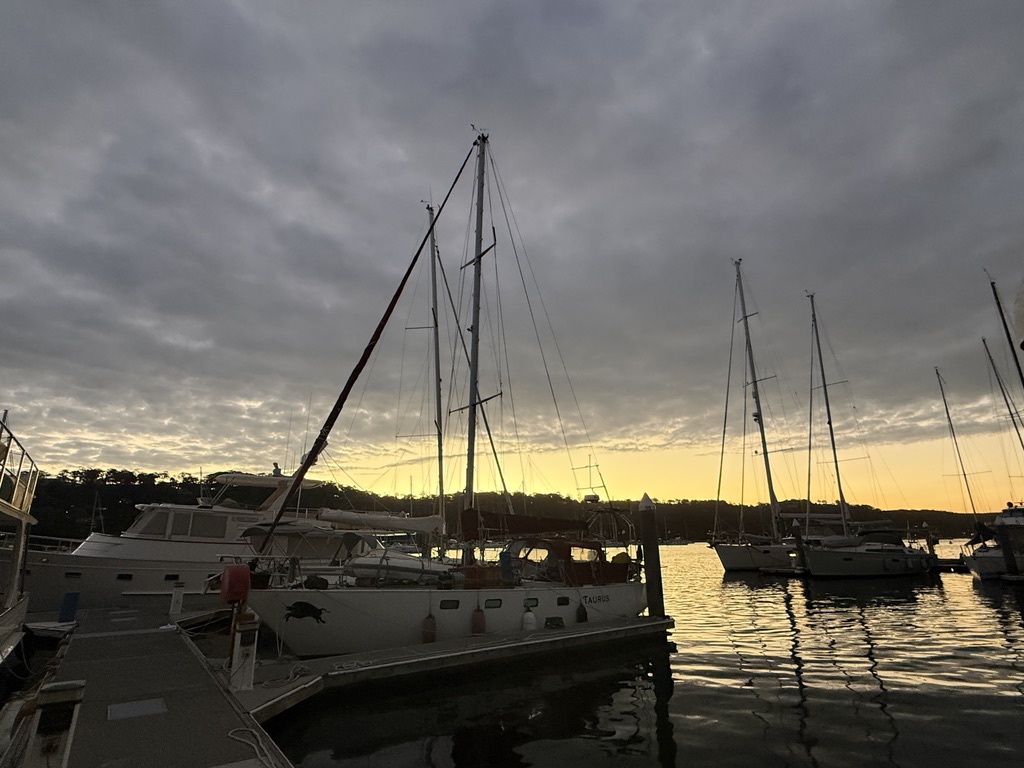
We arrived in Pittwater on Saturday the 8th of March and picked up a mooring in an area known as ‘The Basin.’ Next morning we moved to a berth at the Royal Prince Alfred Yacht Club. Our focus had shifted from enjoying cruising in Australia, whilst trying to get north whenever the weather allowed, to trying to work out what was wrong with Taurus.
As mentioned in the previous post, we had been having increasing difficulty engaging drive when the engine and gearbox were cold. Once warm the problem disappeared. We had hoped the issue was something simple like cable mis-adjustment but it had become apparent that we were facing something more serious, and potentially expensive. This was disappointing as we had replaced our gearbox almost exactly twelve months earlier when it failed in Jervis Bay. At that time we had opted to replace it with a brand new like for like: which confusingly meant swopping our Hurth150 for a ZF15M, ZF having bought Hurth out. At the time, we were informed that fixing the gearbox would cost us something like $2,500 and could take months, whilst a new gearbox was $3,000. It wasn’t a tough decision. Since then, we’ve only used the new gearbox for some 275 hours, so it was frustrating to find the ZF failing.
The first thing to do was to isolate the problem. We spoke to several marine gearbox specialists, diesel mechanics, and, of course, the local ZF agents that we had bought the new gearbox from. None of the news was good.
One gearbox specialist asked us if we ever motor-sailed (using engine and sail power at the same time) which of course we do. “That’s your problem” he said, “You can NEVER motor-sail with these gearboxes.” Another expert told us that the ZF should never be coupled with a folding prop (which is what we have), and a ZF representative informed us that the ZF15M is not intended for “prolonged use,” whatever that might mean.
It quickly became apparent that our gearbox was probably a bit of a dog, and not really fit for the purpose of full time cruising — though the Hurth 150 (the predecessor of the ZF15M) lasted at least five years.
We then discovered that few gearbox specialists are willing to work on the ZF15M. The gearbox, apparently, requires very careful shimming, and if this isn’t done properly it will quickly fail. Several mechanics told us that they won’t work on the ZF as they can’t guarantee the longevity of the repair, and, as another failure isn’t unlikely, the disgruntled customers and ensuing hassle aren’t worth the trouble.
As if all this ‘bad press’ wasn’t sufficient, it turned out that there were no spare parts or replacement ZF15M gearboxes in Australasia, and anything we ordered would have to come from either the States or Italy — at our expense. As for ZF, to activate the warranty process we had to get the gearbox to them. The courier they recommended was going to cost us $150.00, and if their mechanics decided that the issue wasn’t due to a manufacturing fault they would then charge us $450 for the inspection. As we weren’t sure we wanted to keep the ZF gearbox, after all the inherent problems we’d heard about, it seemed a bit like throwing good money after bad. Also, the process seemed likely to take a lot of time as we would have to wait for parts to arrive from the US or Europe.
In the circumstances we decided not to send the gearbox for inspection, and to this day we don’t know what the issue was. The friction plates appear to have been fine as there was no slippage and the oil in the gearbox was in pristine condition. Our best guess, supplied by a marine engineer friend and ex-marine gearbox dealer who visited one day, is that a nut controlling preload on the gear shaft had slipped, allowing the gears to incorrectly mesh. This is apparently a known issue with these ZF gearboxes.
During the process we spoke to a New Zealand gear box supplier, Moon Engineering in Auckland, who advised us to change to a PRM150 gearbox, a hydraulic rather than mechanical gearbox and therefore a more robust system.
Oddly enough, there were no PRM150 gearboxes, perhaps the most popular gearbox used by modern marine engine manufacturers, available in Australia. When in New Zealand I had always imagined that it would be easier and cheaper to buy things in Australia, it being a bigger market and so on. However, we frequently found more items to be available in New Zealand, and often for a cheaper or similar price. To cut a long story short, we ended up ordering the PRM from Moon Engineering. James, the owner, had been very patient and answered all our questions intended to ensure that the gearbox we were buying would actually fit our engine and prop shaft connection. I was perhaps a little obsessive about this, as various painful and expensive experiences have taught me that the chances are things won’t fit — no matter what the supplier tells you!
Once we were as sure as sure could be without physically matching up the various parts, we were able to arrange the purchase GST free, and then a friend, Viki Moore, kindly offered to bring the gearbox to Australia for us, thereby saving us $500 in postage. Many cruising sailors in this region will know Viki, the owner of Island Cruising NZ, the Lyttleton Port Officer for the Ocean Cruising Club, and wearer of numerous other hats and roles in the world of sailing. As the gearbox is an awkward size and weighs nearly 25 kilograms it was a very generous offer. Thank you Viki!
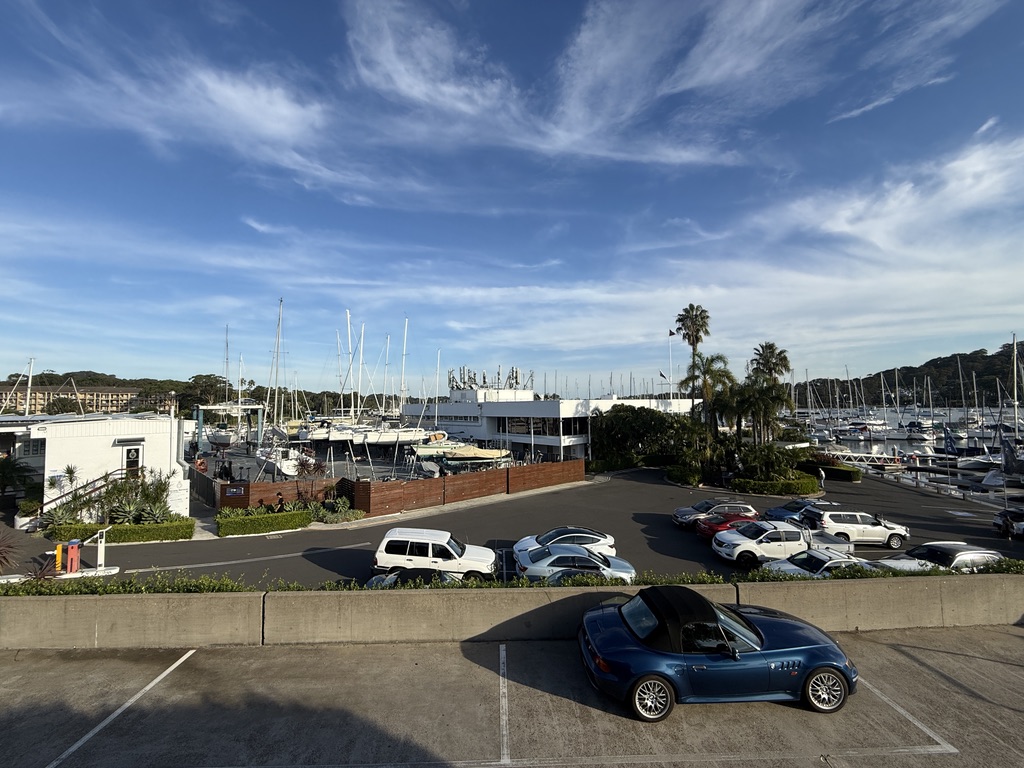
With the gearbox on the way, we had to decide where to try to fit it. As a first port of call I approached the yard at the Prince Alfred Marina to see what they charged to go on the hard. The price was eye-watering, blood curdling, and toe curling — all at once! I limped painfully out of the office by feel alone, and went for a lie down.
The cost to be hauled out at the RPAYC is a little over A$4,000 as well as an additional $319 per day for the first five days. The fee then increases to $354 per day for the following five days, and then increases again to $386 per day subsequently. In addition, the owner is not allowed to work on their own boat. Instead they have to pay yard mechanics who, we were told, charge $180 per hour and who like to work in packs of two (so they don’t get lonely). So, paying others to work on your boat could cost you $320 per hour, or a touch over $2,500 per eight hour day. All, however, is not lost, if the boat owner joins the Prince Alfred Yacht Club they are allowed to work on their own boat during the weekend — the price of membership? A snip at $2,000 per annum.
To put these prices into context, we paid a couple of hundred dollars to be hauled out in Launceston and $350 a month to stay on the hard. Whilst at the yard we could have lived on the boat if we wanted, and there was no-one telling you who could and couldn’t work on your vessel. Of course, Launceston, Tasmania is not Pittwater, New South Wales, which is the local playground for Sydney’s well-to-do and uber wealthy. Nevertheless, you get the sense that yacht clubs such as these are cutting their own throats. The sailing community constantly bemoans the lack of young people in the sport (indeed, locals refer to the RPAYC as the ‘land of the living dead’ due to the average age of the members), but how many young people can afford to maintain a boat, and therefore own a boat, at prices such as these? To add a slightly surreal foot note, the club proudly displays posters that announce the fact that their boat yard won a ‘Highly Commended’ award from the Marina Industry Association (MIA). The Marketing Director of MIA is quoted as saying “Its about putting your customers at the core of everything you do and building trust through integrity and reliability.” Not a word about eye-watering prices and not being allowed to work on your own boat here! One suspects that the MIA is one of those self-congratulatory bodies that exist to dish out awards to their (fee paying) members so that they can stick up posters that ‘prove’ how awesome they are with a veneer of inauthentic authenticity… but this I can neither confirm nor deny.
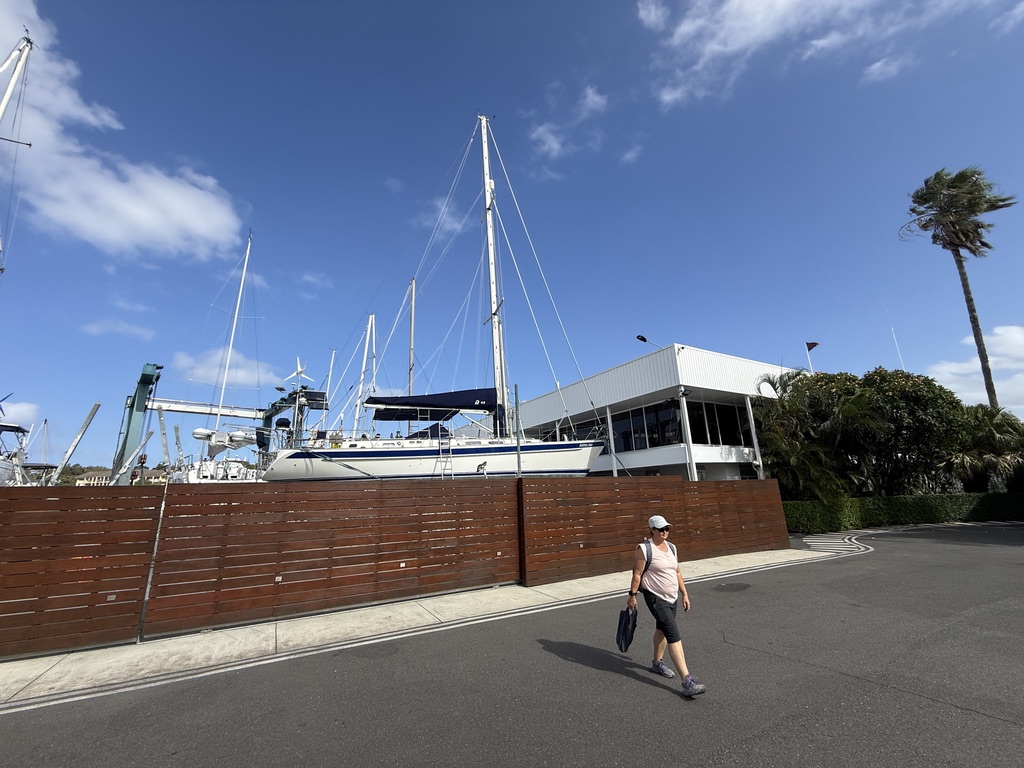
Taking Taurus out of the water to fit a new gearbox had always been unlikely, but given the local prices it was totally unfeasible. Even staying on a berth was quite expensive, at $77 a day. Once again, for context, in Beauty Point, Tasmania, we were paying $350 a month, so four days in RPAYC was roughly equivalent to the cost of 30 days in Tasmania, but then the Tamar Yacht Club doesn’t have ‘Royal’ in the title, so there’s that.
If I sound a bit ‘down’ on the RPAYC then it’s probably because I did indeed get frustrated with what I perceived to be their snooty and unwelcoming attitude. The staff were by and large very helpful, but because we were unable to give a definite end date to our stay (because we were trying to find out what to do regarding our gearbox problem) we were phoned every day by the office and asked when we were leaving — as if they suspected we were going to fly by night without paying our bill. Of course, in the circumstances I wasn’t in the most positive frame of mind, but I still feel that if I had worn a cravat into the club, had the right kind of boat (an expensive but essentially unseaworthy plastic fantastic thing that never left Pittwater), and had a great deal of money, then we would have had a much more agreeable stay.
Ultimately, our stay at RPAYC was a means to an end, and once we had a plan it was time to move on. Knowing that we were going to be in Pittwater for some time we wanted to try and find somewhere cheaper to stay. We asked around and friends recommended that we give Colin Beashel a call.
Colin Beashel is a legendary name in Australian sailing. A crew member on the winning America’s Cup team Australia II in 1983, and a sailor who competed at six Olympic games between 1984 and 2004, winning bronze in 1996. He also owns a private boat yard and rents out moorings in Elvina Bay. Happily he had a mooring that would hold Taurus, so we left the marina and motored the short distance to what would become home for the next few weeks.
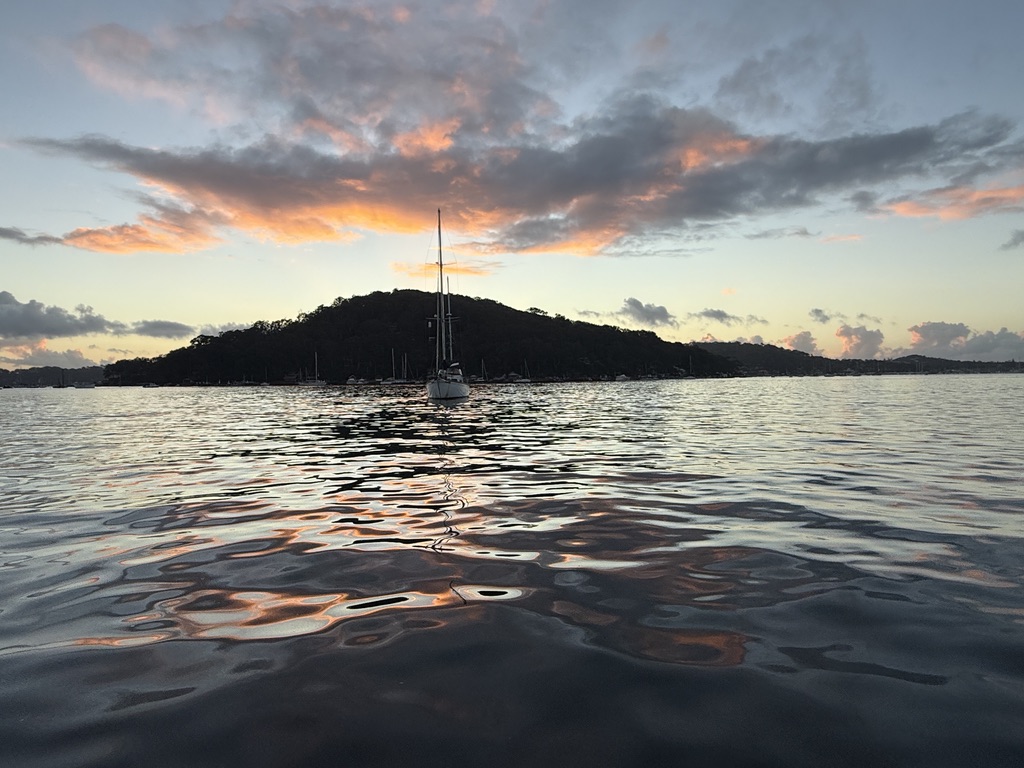
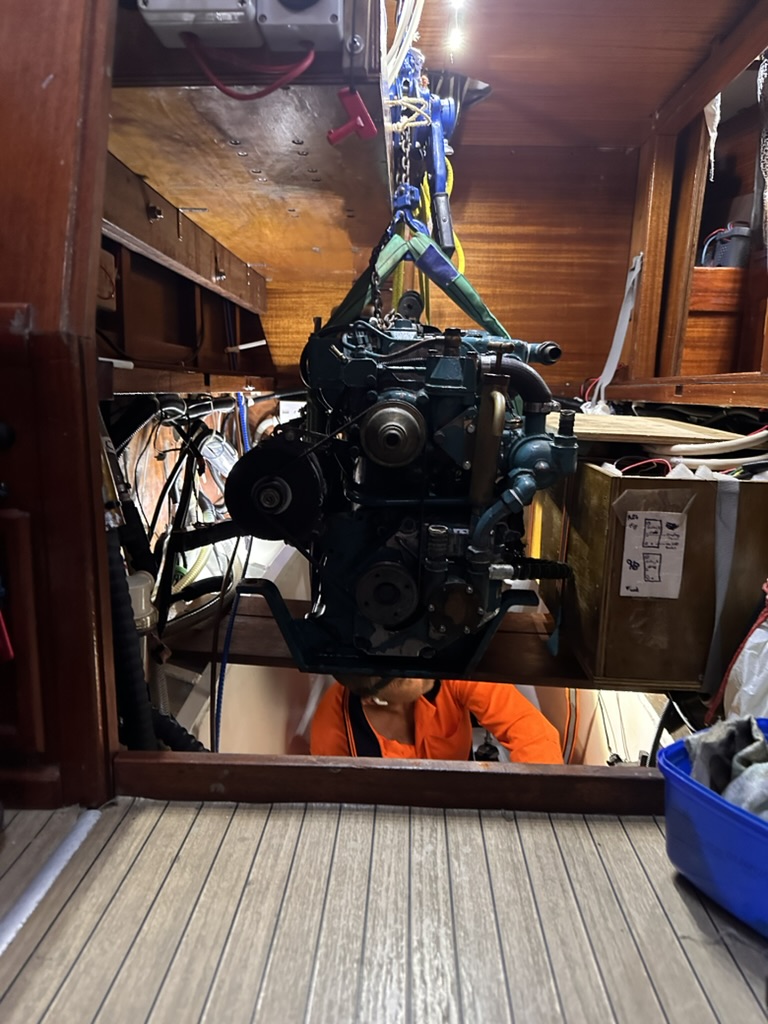
With a new base and a new gearbox soon to be enroute, it was time to get the old one out of the way. As we had a bit of time, I decided to lift the engine completely so that we could tidy the bilge, replace the engine mounts, reroute some wiring, replace some of the engine loom which was getting old, and have another go at sealing the crankcase door that is the source of a minor but irritating oil leak. First we had to remove the starter battery and battery boxes, the raw water hoses, heat exchanger, and so on and so forth. We thought about removing the house battery bank as well (on the right in the photo below) but leaving the house batteries in place meant that we could continue living on the boat.
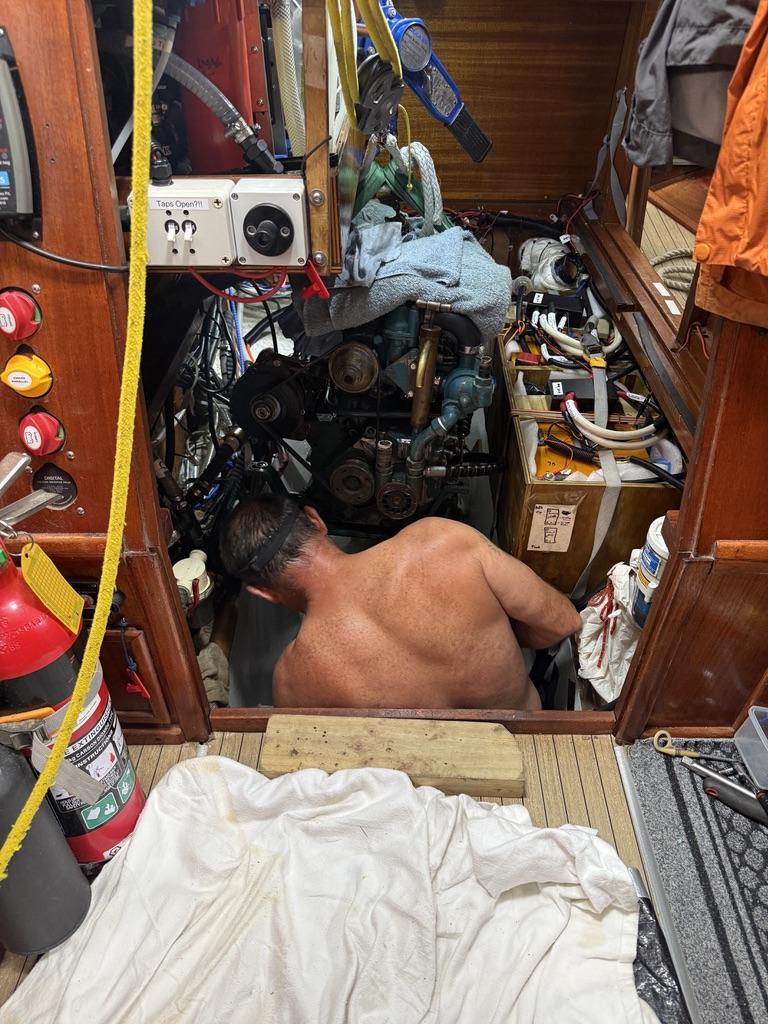
We’re fortunate that Taurus has a lifting point above the engine. Why it wasn’t placed in line with the engine is a bit of a mystery, but it works if you don’t mind the engine coming out a bit skew-whiff. We used a come-a-long to lift the engine, placed boards under it to rest it on, and then used a handy billy to pull the engine forwards and into the cabin. If it sounds easy or simple, believe me it wasn’t — but Cara and I got the engine out within a couple of days.
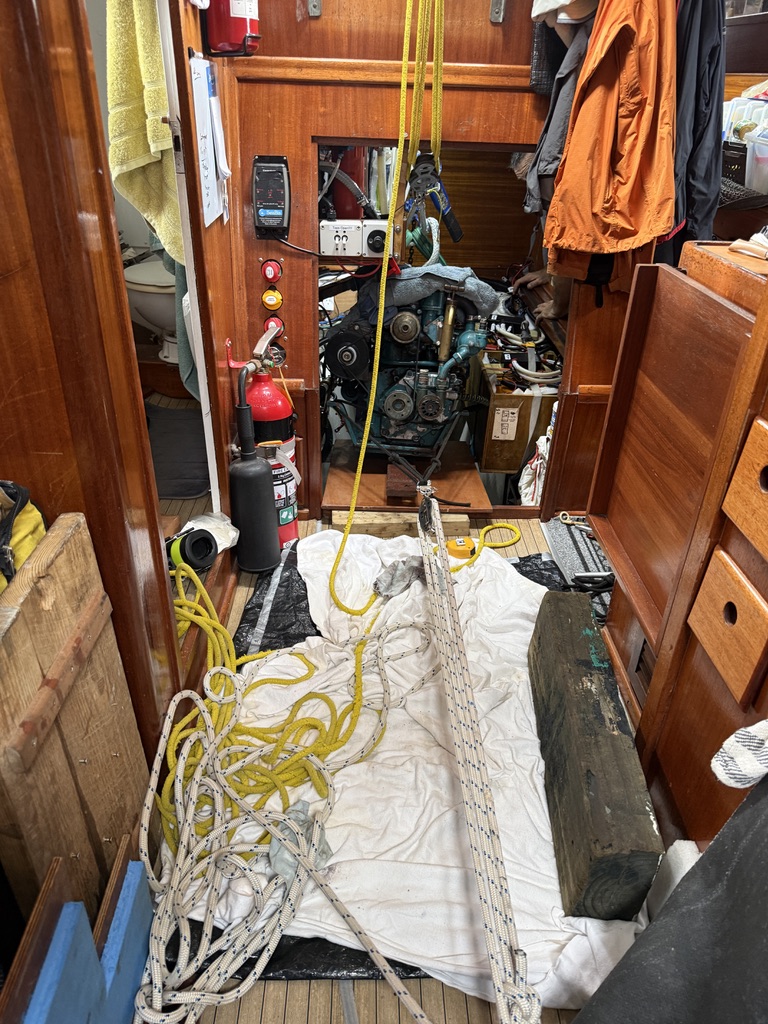
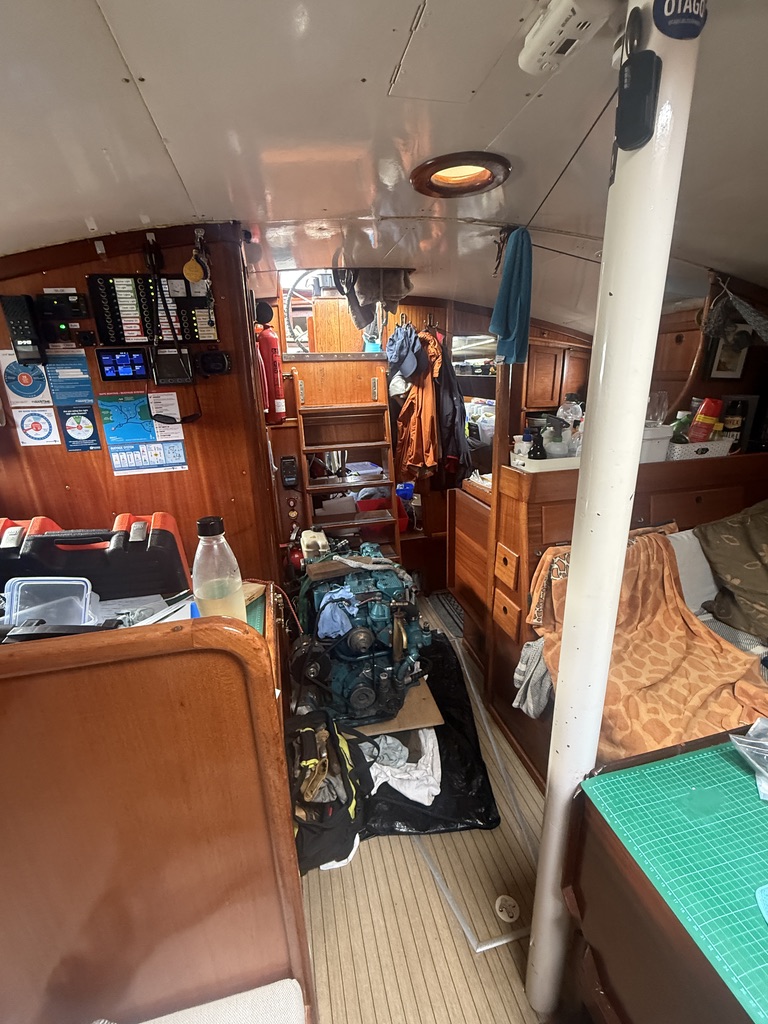
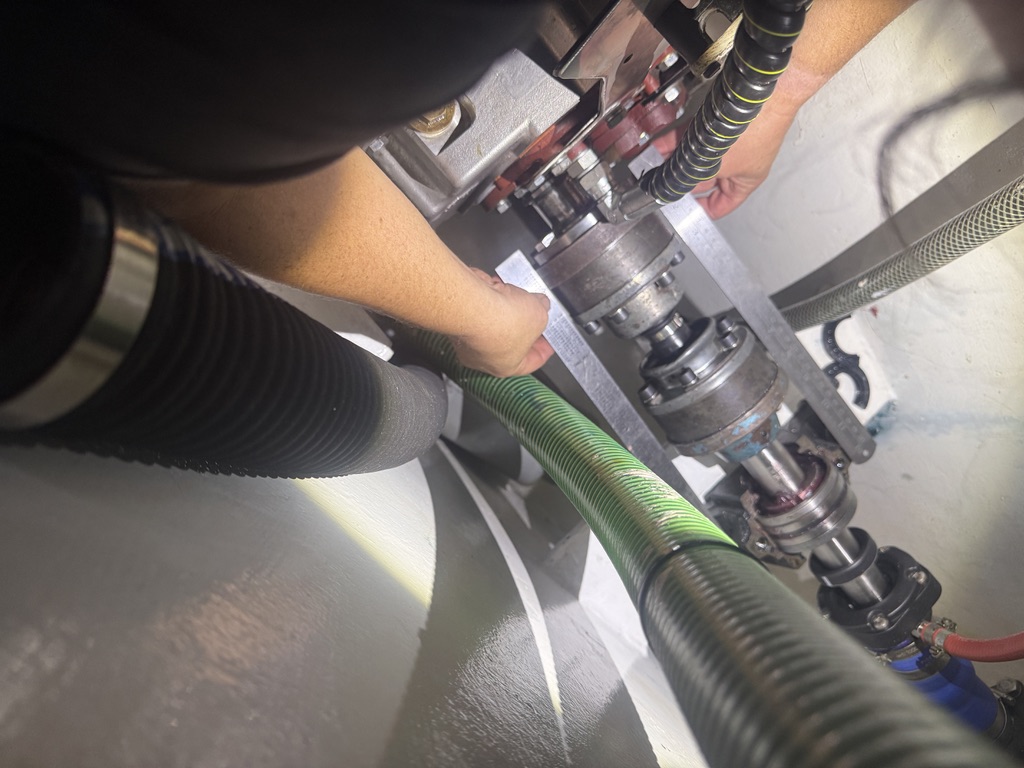
With the engine out of the way it was time to tidy up the bilge. Because the new gearbox is 25mm longer than the old one I had to move the engine forwards. I spent a lot of time trying to ensure that the engine would sit in the centre of the keel. The new engine mounts I ordered didn’t have a slot on one side for fine adjustment, a common feature I hadn’t realised was missing, so the holes I drilled had to be exactly right.
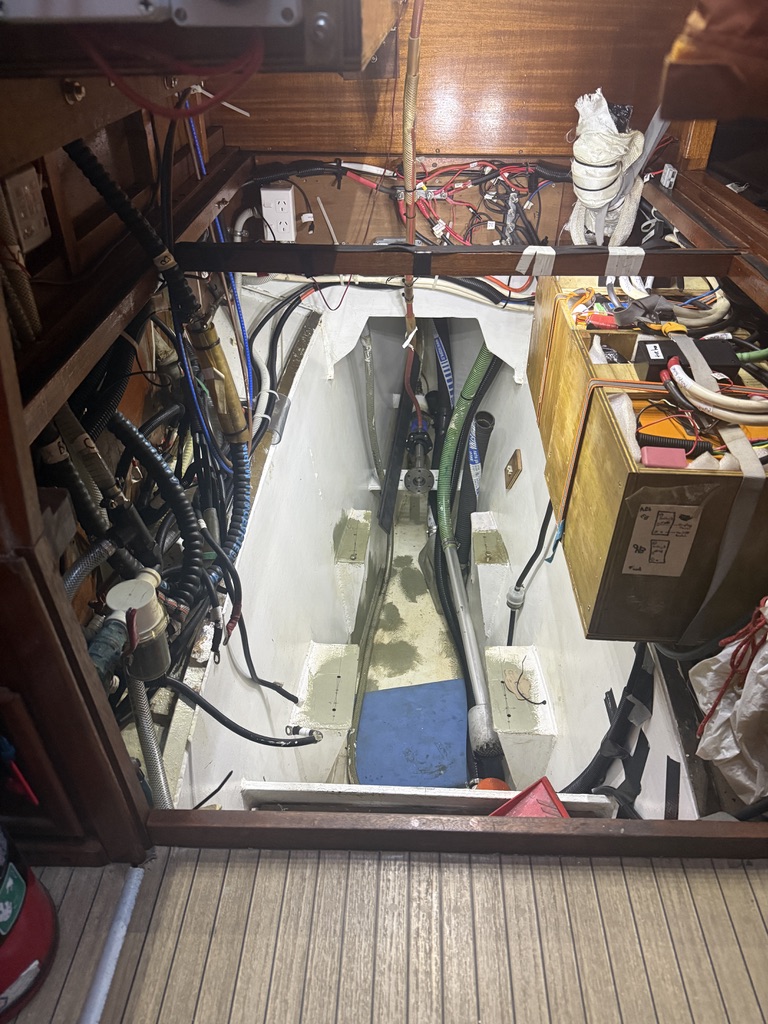
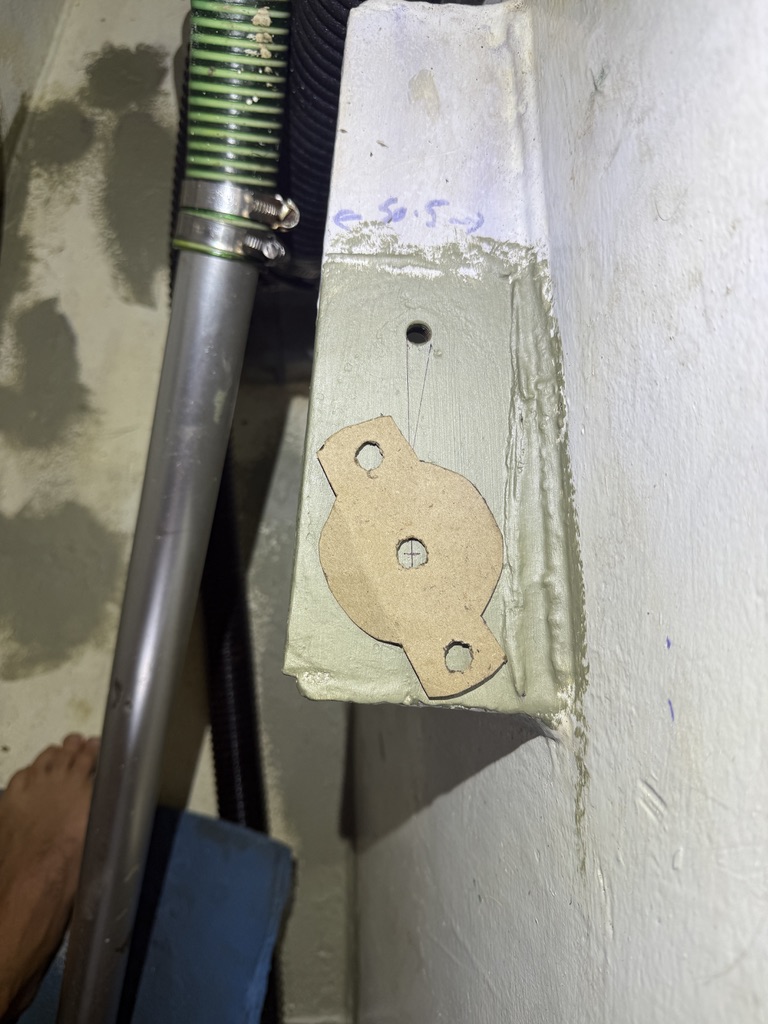
Our new gearbox turned up at about this time, so I dry fit all the bits and pieces to ensure everything was going to mesh, and to work out placement for the oil cooler, bracket for the gear change cable, and manual pump for oil changes (as reaching the sump bolt would be very difficult in situ).
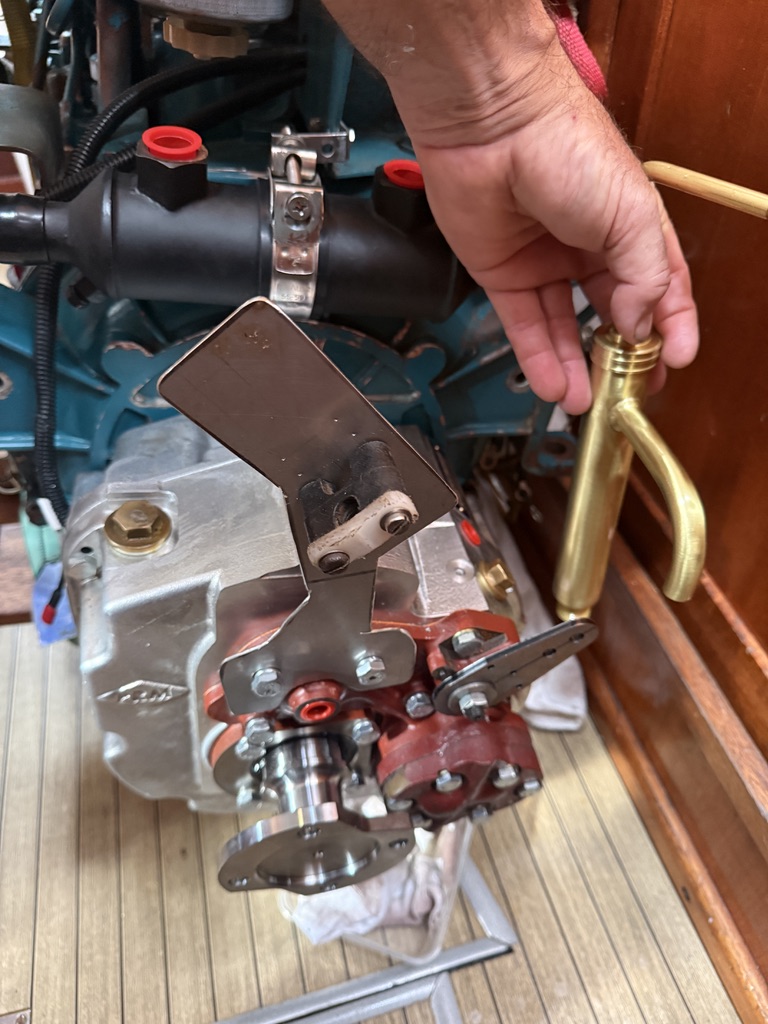
The oil cooler, the black cylinder above the gearbox in the photo above, is an important element that prevents the gearbox oil overheating. As straight forward as it should have been to fit, it caused a series of headaches, and ultimately a major issue.
We were advised to use crimped on hydarulic hoses, so headed into town where we found a supplier of stainless steel to yachties who could supply such things. Sometimes you get a sense that the person you are dealing with doesn’t really know their business and couldn’t give a damn about their customers, and so it was with the chap who owned this shop. But, as it was the only source I could find that was within public transport distance I ignored my internal warning system. We were promised the hoses before the end of the week, but it was halfway through the following week before they were ready, so I had several frustrating days of sitting on my hands waiting for things to turn up. When they finally appeared we found that the end pieces had no swivels, so that the very stiff hoses were nigh on impossible to fit. The unsurprising cherry on the cake was that we were charged far more than we were quoted.
The hoses proved to be so bad that we had to borrow a car to take them to EnZed, a hydraulic supplier, who was able to retroactively fit swivels so the hoses could be used, though it was still a struggle to get them to fit. Fortunately the EnZed guy was very knowledgeable and helpful, and if we had just borrowed a car and given him our business in the first place we would have saved ourselves hundreds of dollars and at least a week of hassle. Unfortunately, its only through experience that you learn who can be trusted. We should have thrown the hoses away and started again. Persisting with them later caused me to almost destroy our new gearbox and created a major headache in New Caledonia, but I get ahead of myself.
Whilst some people can cause you to despair of the human race, the other side of the coin is the incredible kindness of strangers. One day whilst we were on our mooring we heard a tap on the hull and someone calling out, ‘hello!’ When we went outside we saw a young lady and her son in a tinnie holding onto the toe rail. The lady proved to be Suse, whom we had met in Fiji whilst she was cruising with her husband, Mike, and her family. We had had drinks one evening, but had not kept in touch and had no idea that they lived in Pittwater, or that their house over looked Elvina Bay. The guys kindly offered us the use of their workshop, washing machine, shower, made us dinner, and even leant us their cars — basically providing all the things that make living on a boat in reduced straits far, far easier. Sadly, we didn’t get a photo of the guys, but we owe them a massive debt of gratitude for their generosity.
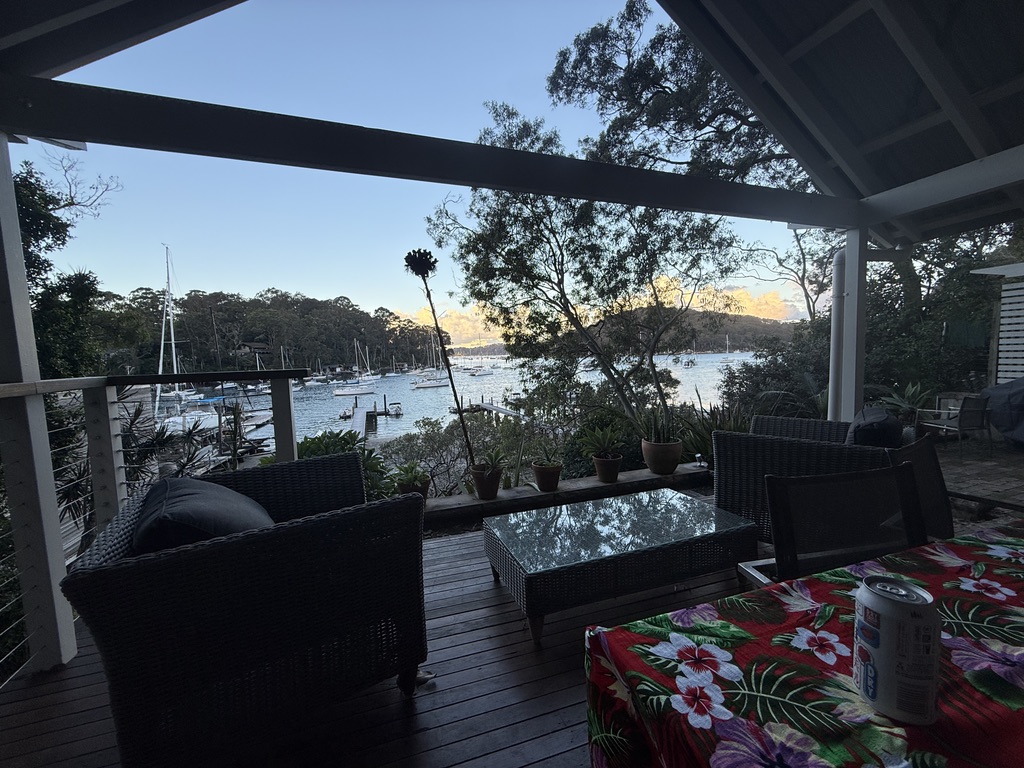
As luck would have it, another couple we had briefly met in the Pacific turned out to be living on their boat in Pittwater as well. Karl and Elaine invited us over for dinner and drinks, leant us their van, and even crawled into the engine compartment to lend a hand. The guys later sailed to New Caledonia just before us so that we’ve happily had a chance to get to know them better. Thank you Karl and Elaine!
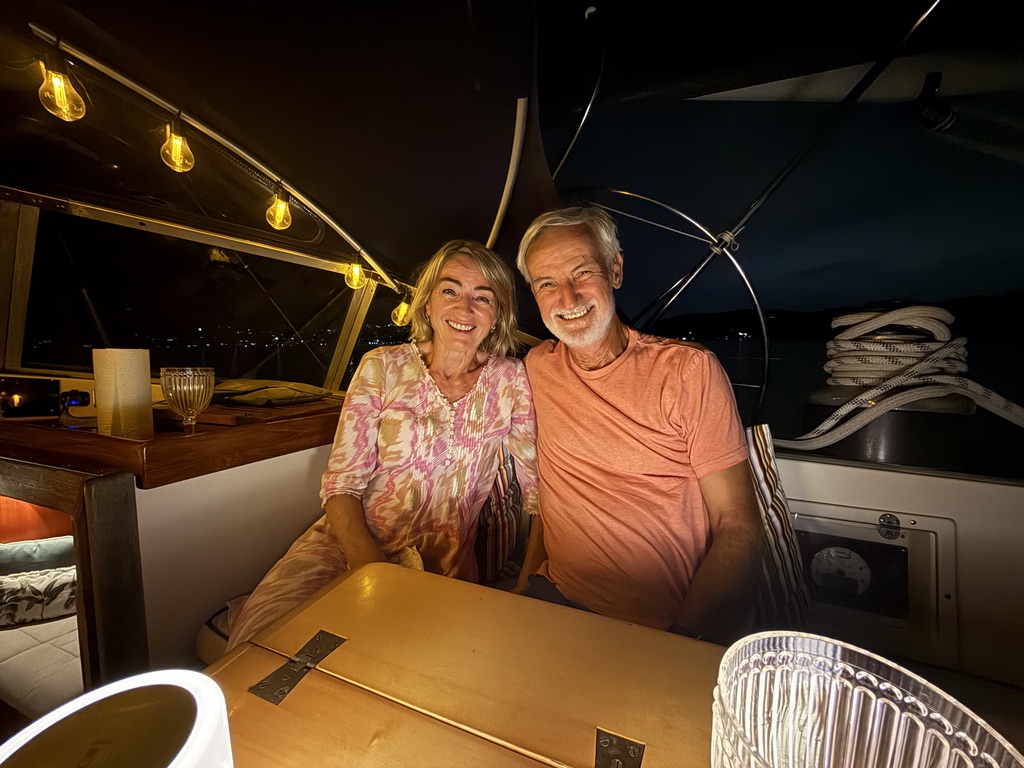
We were also blessed to have remade the acquaintance of John and Pauline on Joline. We first met these guys on a stormy night in Hobart, Tasmania. We bumped into John again in Sydney and later in Pittwater. John, it turns out, is a highly experienced marine engineer with a knack for finding simple and practical solutions to thorny, apparently insoluble, problems. I was initially reluctant to ask him for help, because everyone who owns a boat has their own problems and their own stuff to fix. But Pauline persuaded me to swallow my pride and ‘use’ John as he loves to problem solve and help others. Getting John involved in our project was one of those serendipitous moments that we later had cause to thank our lucky stars, guardian angel, and deity of choice for, because without his help we would have been well and truly screwed when my ham-fistedness created a big problem in Noumea (I get ahead of myself again).
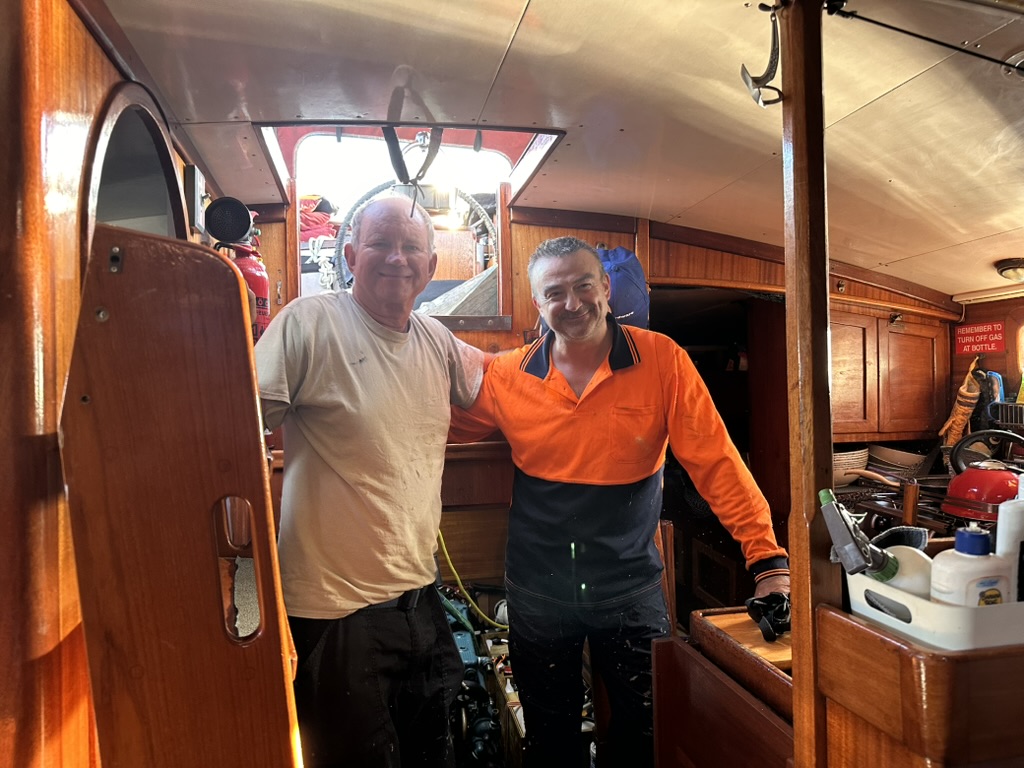
As our stay in Elvina Bay lengthened we came to know other local residents. Lucy and Andrew (the latter better known as Cutts) invited us for dinner a couple of times, spent a day driving us around so that we could buy boat parts, and gave us a tour of Pittwater in their runabout. We later found out that Cutts is one of those humble guys who has no right to be humble. A world class sailor who has competed in umpteen Fastnet Races, Sydney to Hobarts, and all manner of other things, as well as being a very successful business man. Not to be outdone, Lucy also runs her own business and is a big shot in the IT world. She also makes a mean Dark and Stormy cocktail (rum and ginger beer — do try it).
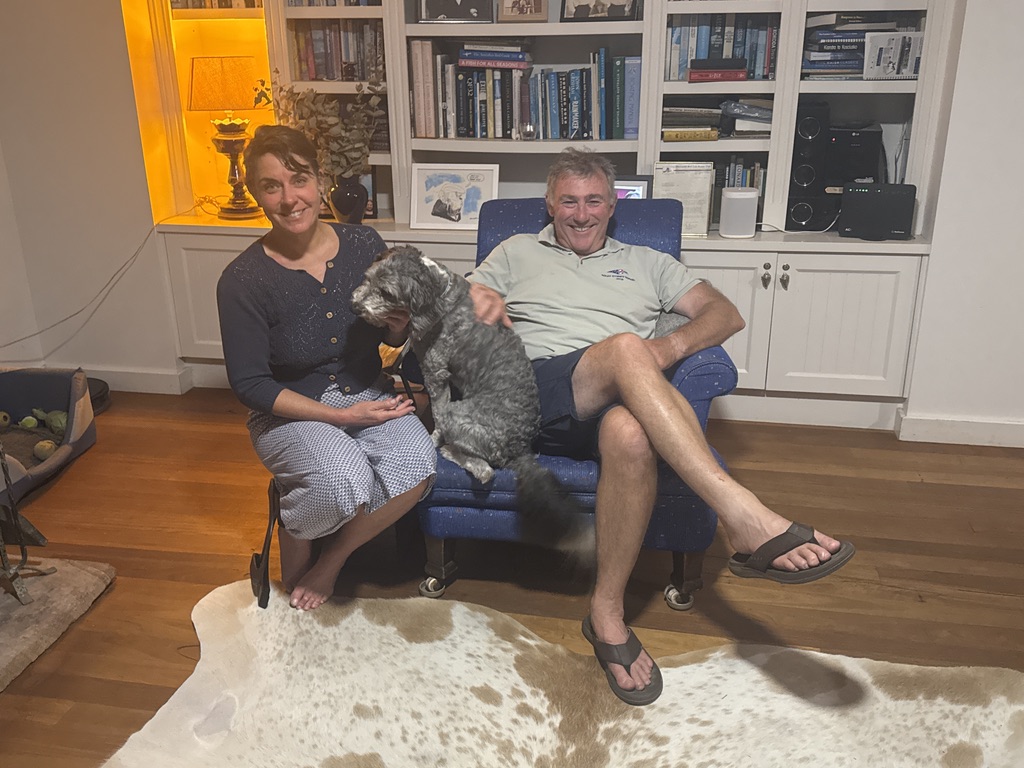
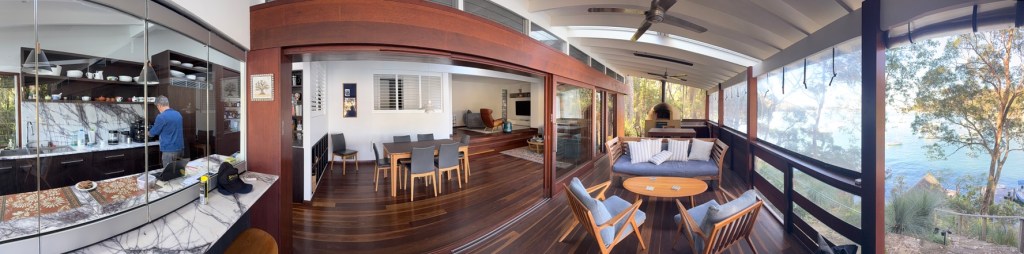
We also met Alistair, an engineer who gets sent all round Australia to fix things, and who likes a natter and a beer. Alistair gave us free access to his deck shower and invited us into his home. This proved to be a beautiful mid-century style place that I greatly envy, but you don’t get to buy beautiful property in one of Sydney’s most desirable suburbs by quitting work and going sailing, so I will have to lie in the bed I made for myself and be happy with my lot!
Another night, a couple of surgeons (general and plastic) who also live in the bay came over for drinks but brought dinner with them as well. So, you can tell that we were thoroughly spoilt by all the support that the local community showered on us, and we were quite sad when it came time to leave.
But, before we could leave we had to finish the job in hand. Needless to say it was a protracted affair, as doing such things without a lot of experience has to be. With the gearbox fitted it took us three days to tweak the engine alignment to the point that I was happy with it. Then we spent another two days trying to get the gear select lever just so, only to be told by a couple of mechanics that the advice in the workshop manual can’t always be achieved and not to bother about it. How Cara laughed!
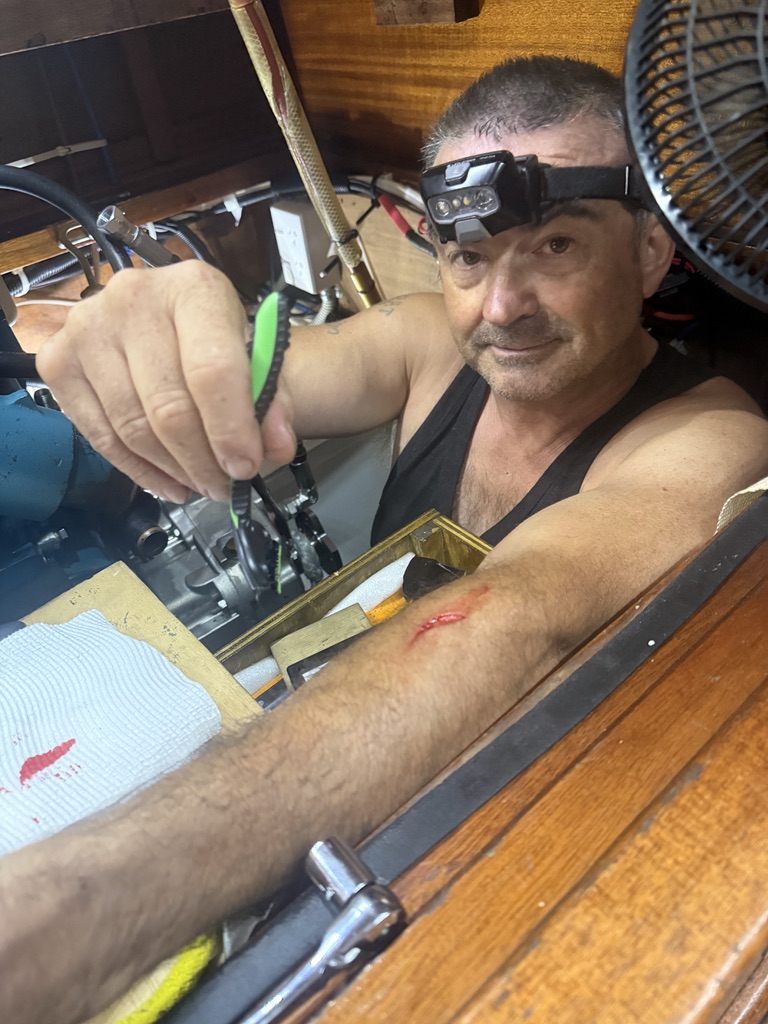
I have a bad habit of becoming ‘focused’ on a project, and so it was that I was willing to work all day, everyday, until it was done. At one point I sliced my arm open with a knife when trying to cut conduit (Cara had just told me to use scissors), and as it wasn’t bleeding too badly I carried on working whilst Cara steri-stripped the gash together. The approach means that the job maybe gets done faster than it would otherwise, but it’s not easy, or fun, or great to be around. I find I can rationalise it, and tell myself that fixing broken things is just as much a part of cruising as sundowners and deserted tropical beaches — which is absolutely true — but it’s also true that it’s not what people sign up to cruising for!
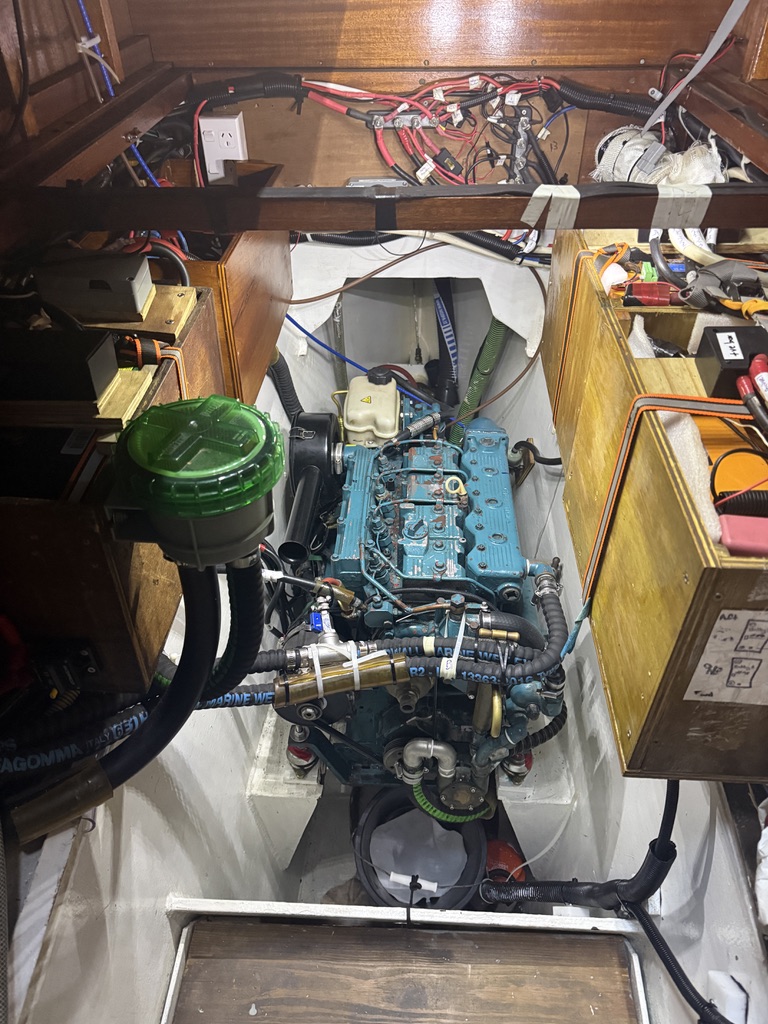
Ultimately, some six or seven weeks after arriving in Pittwater, we had the engine and new gearbox back in their hole, the shaft aligned, and everything looking quite pretty. It was time for a test drive.
It was with some trepidation that we started the engine up. Everything seemed to work so we dropped the mooring and went for a spin. However, we didn’t get far before a problem reared its ugly head. Our old gearbox had a ratio of 1.8, but the new gearbox’s ratio is 2.1 (the ratios reflecting the number of engine revolutions to shaft revolutions after being translated via the gears in the gearbox). We had been told by a couple of people that the difference would be negligible; but of course it wasn’t. At the same engine RPM we were about a knot and a half slower than before. It appeared that we would need to find a new propeller, which was a bit daunting as they cost in the region of $5,000 plus, or try to get our current propeller re-pitched — which would mean a haul out and cost Lord knows what.
Feeling a tad low, we started making inquiries and started trying to work out what size propeller we already had. We then discovered that our existing prop, a Variprop, has a natty feature that allows you to change the pitch of the propeller in the water. Never having needed to use this function I had no idea it existed until we downloaded an English user manual (all the information we had on the propeller was in German).
It was time to go diving! A rough guide to check if the pitch is similar for the two gears (forward and reverse) lies hidden beneath the anode. In trying to remove this one of the machine screws rounded off, so I had to cut it off with a hacksaw. Then it was ‘simply’ a matter of diving on the propeller, undoing two locking grub screws, altering two independent adjusting screws, tightening the grub screws, and going for another test drive.
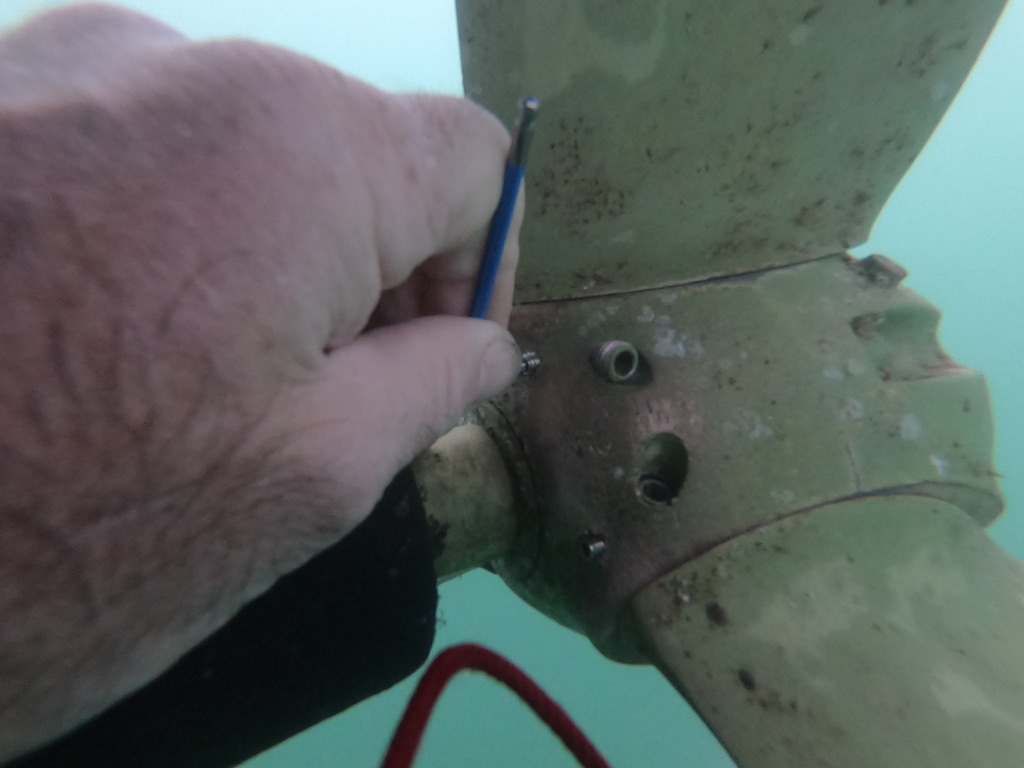
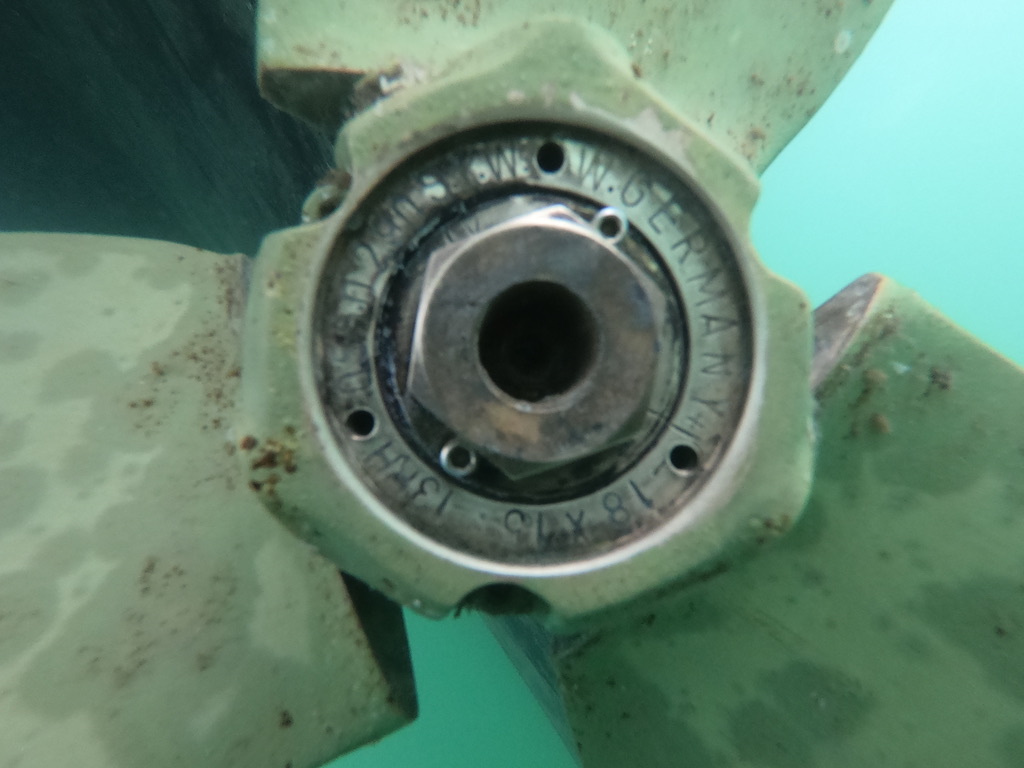
During the process a local asked me if I had the theme music to ‘Jaws’ running through my head whilst diving, which was not as funny or as fanciful as you might think given the number of people attacked by sharks in the Sydney area this year, and even less so given the warnings we’d received of a big bull shark that lives nearby. In the murky water there was little chance of seeing any threat before it was all over. To be honest, I didn’t worry too much because the job had to be done, and I decided to believe that there aren’t any sharks in Pittwater. The latter, of course, is complete nonsense, but it did make me feel oddly better about being in the water. I’ve lied to myself about other risky jobs I’ve had to do, things like ‘the mast can’t collapse’ or ‘the engine won’t fall on me’ and although I know that I’m spinning myself a total line of wishful BS, I find that I can still convince myself enough to take the edge off the fear. What would Freud make of this I wonder??
After half a dozen dives, alterations, and test runs, we ended up with something that felt very much like it did with the old gearbox. We were over the moon. The chances of our having a propeller that could be adjusted in the water was so small that it felt like we had won the lottery. We were back in business and it was time to leave Elvina Bay to explore the rest of Pittwater.
Next time: we explore the rest of Pittwater and head to Newcastle.


Leave a Reply