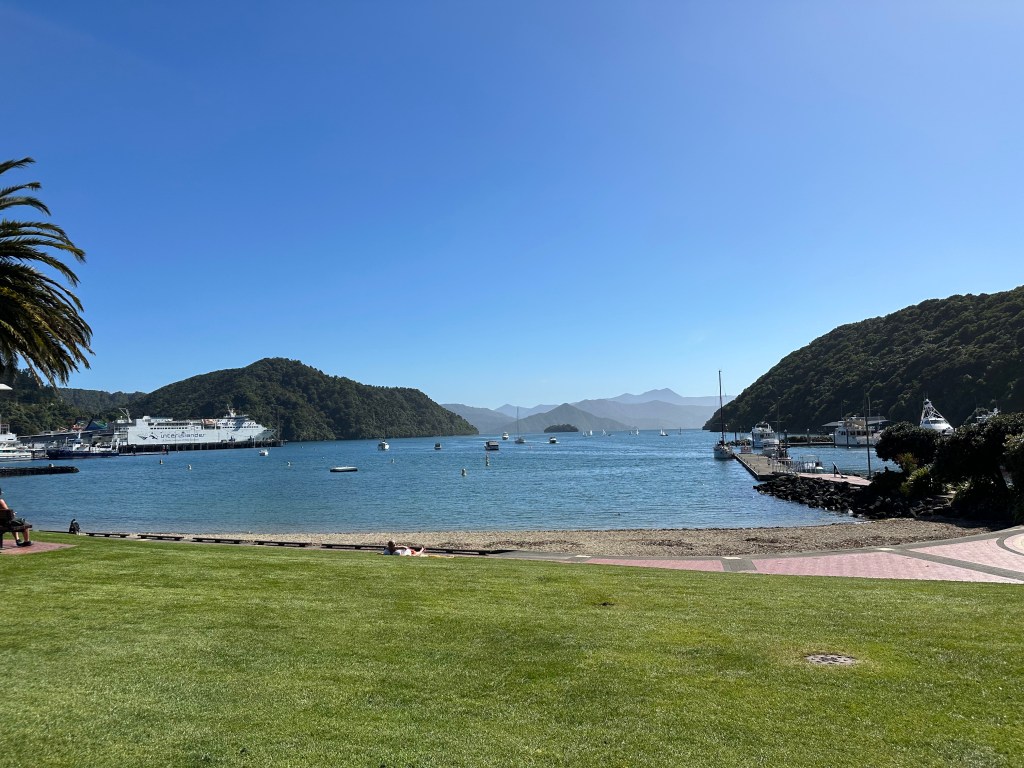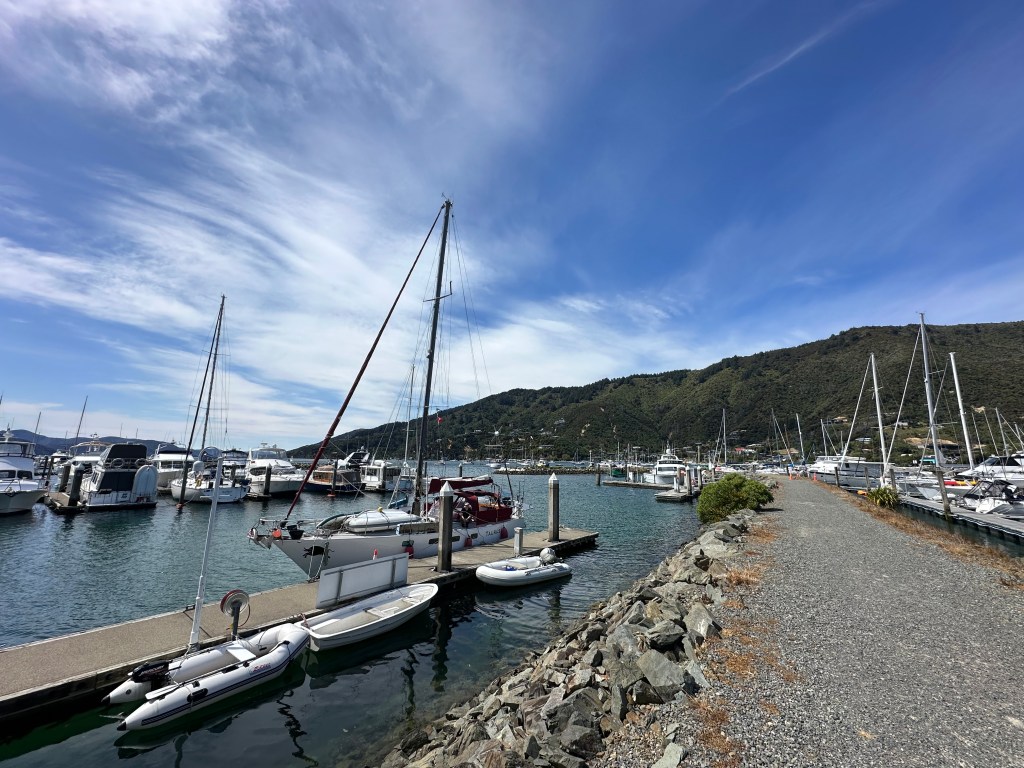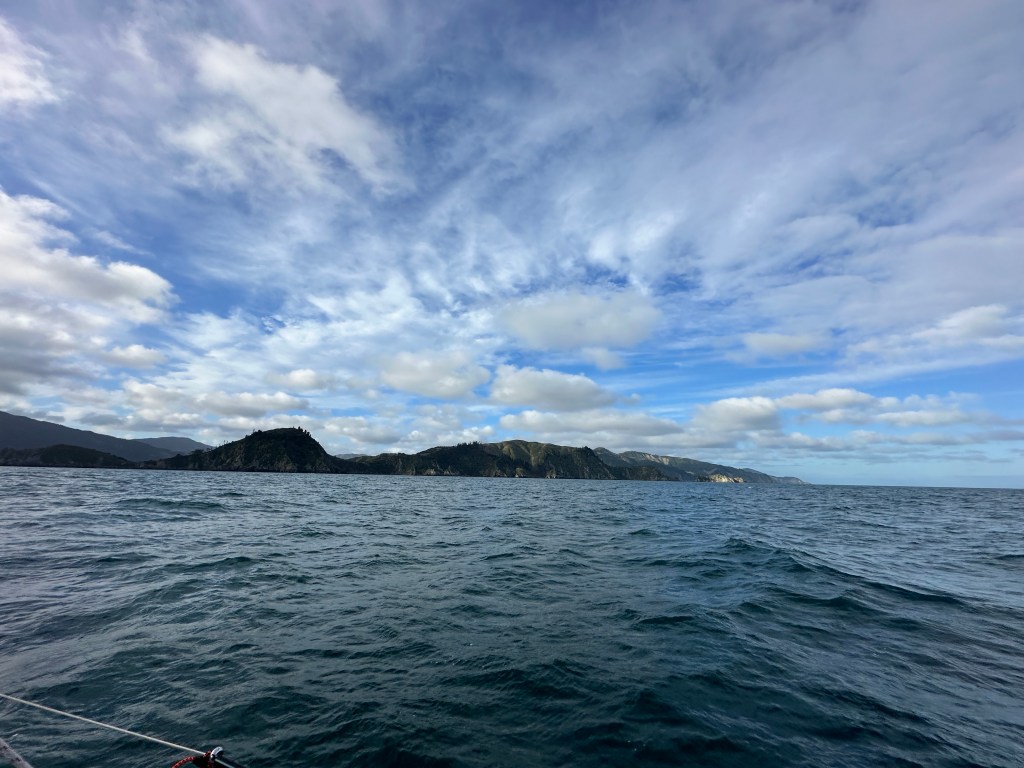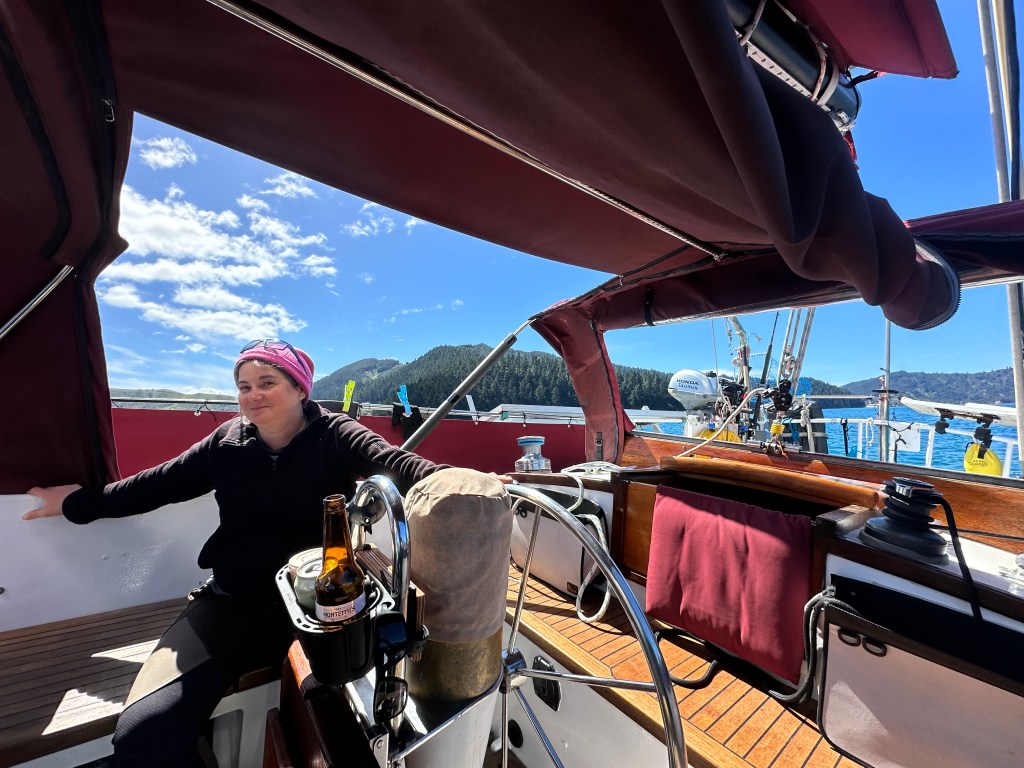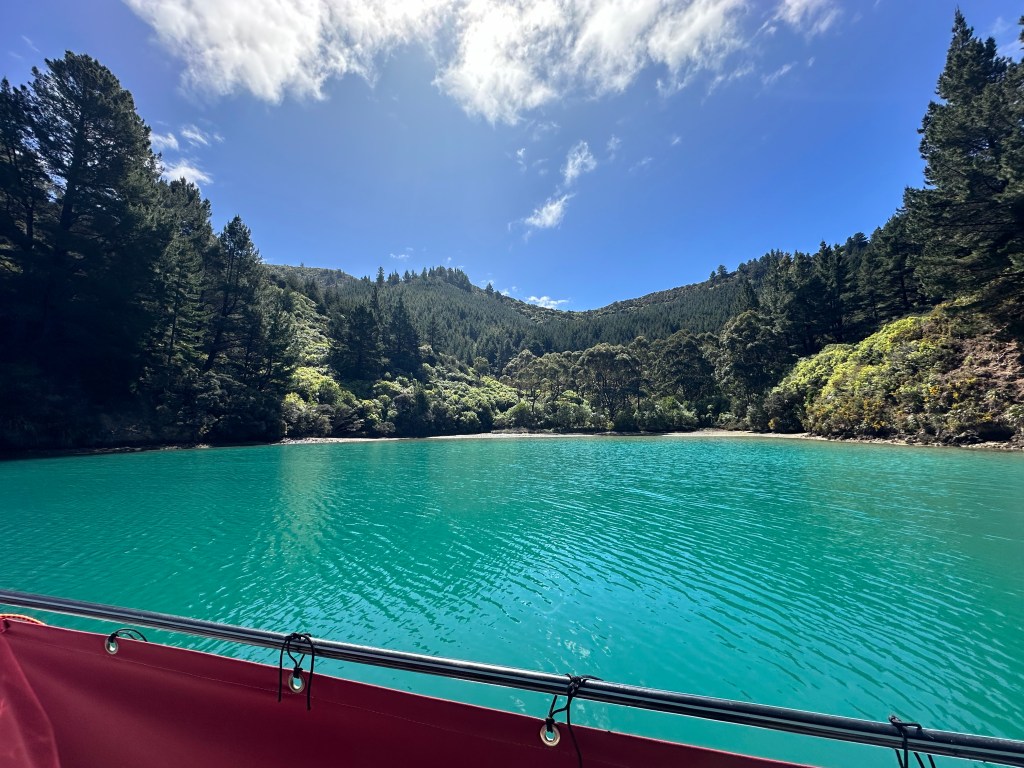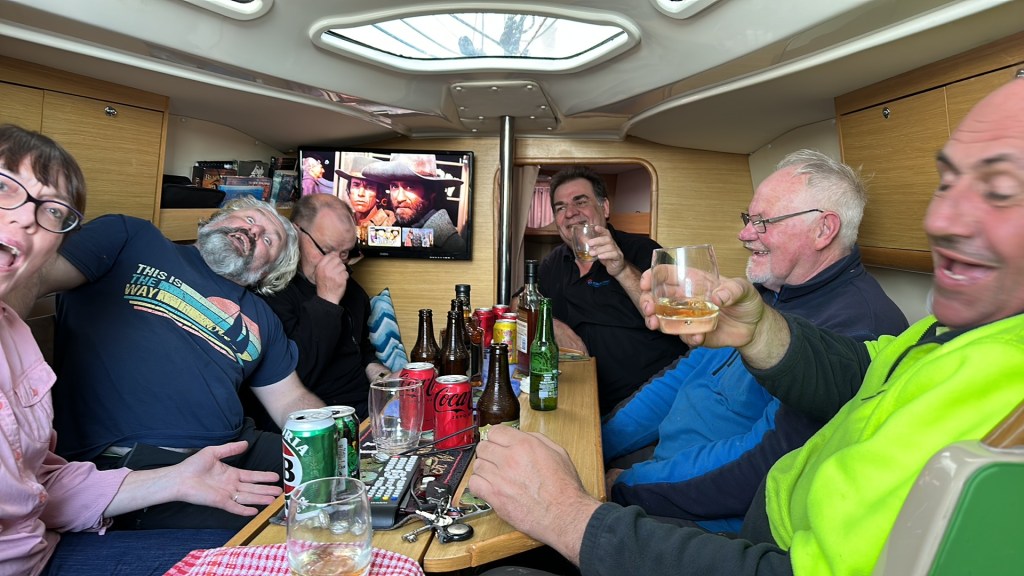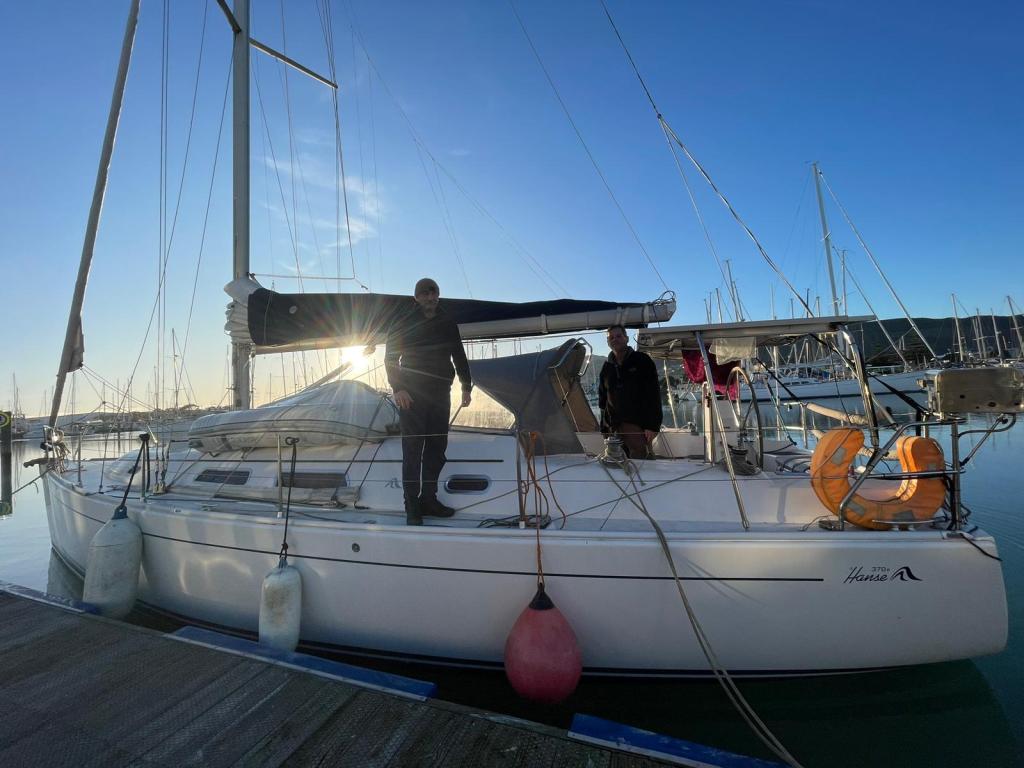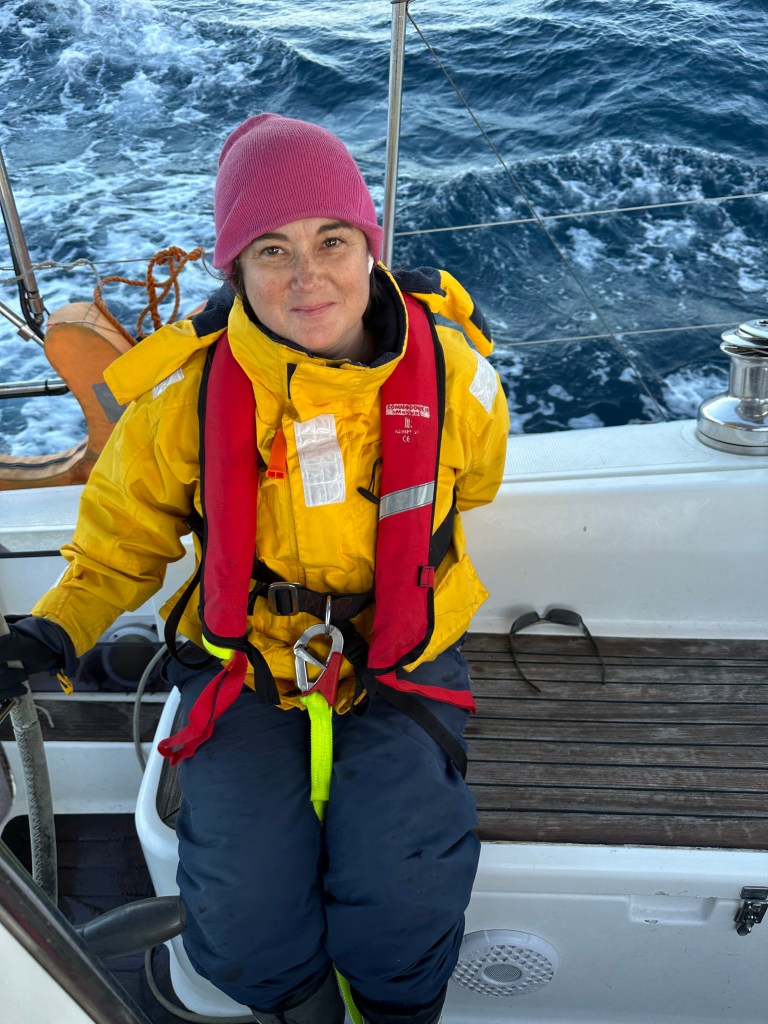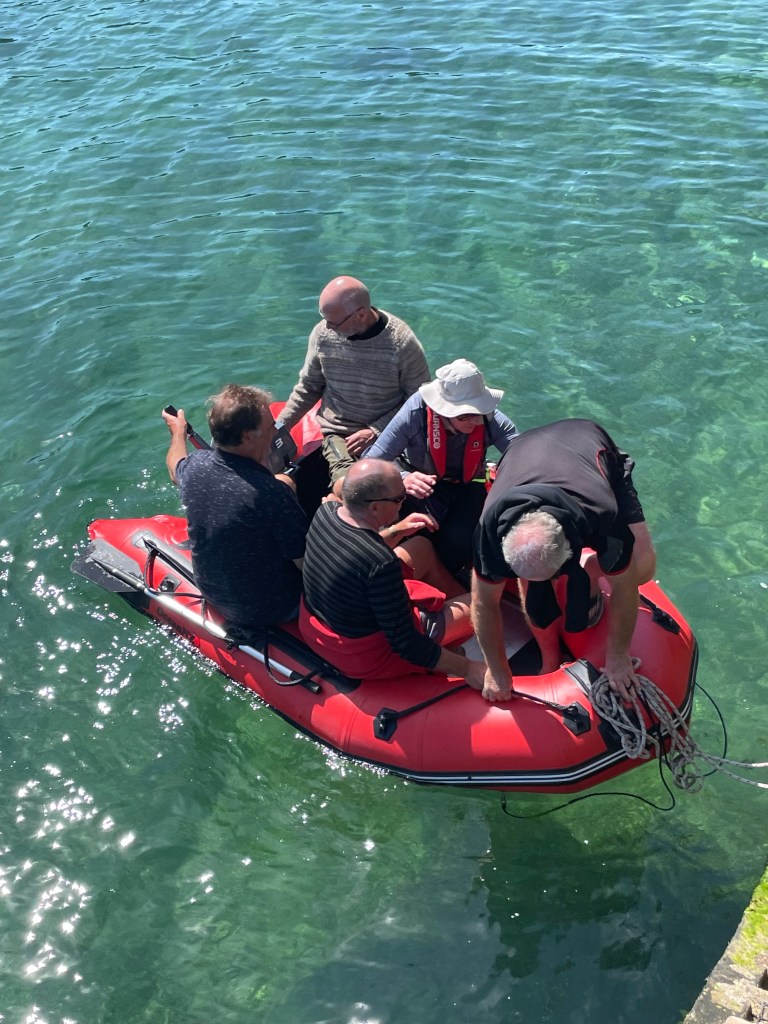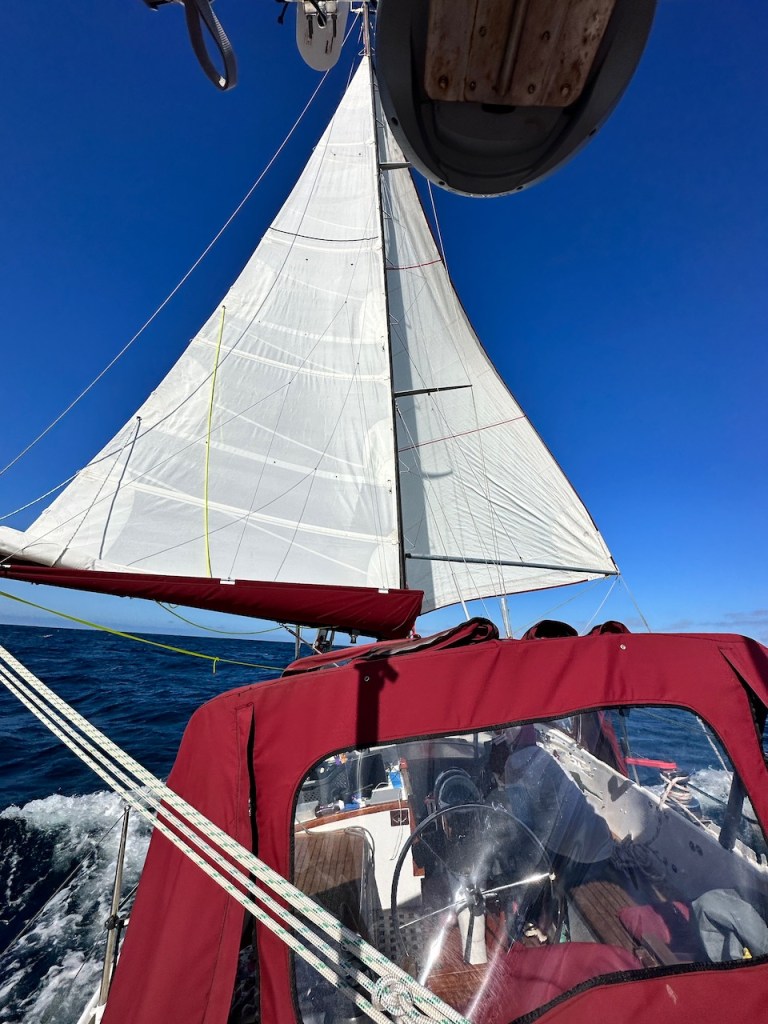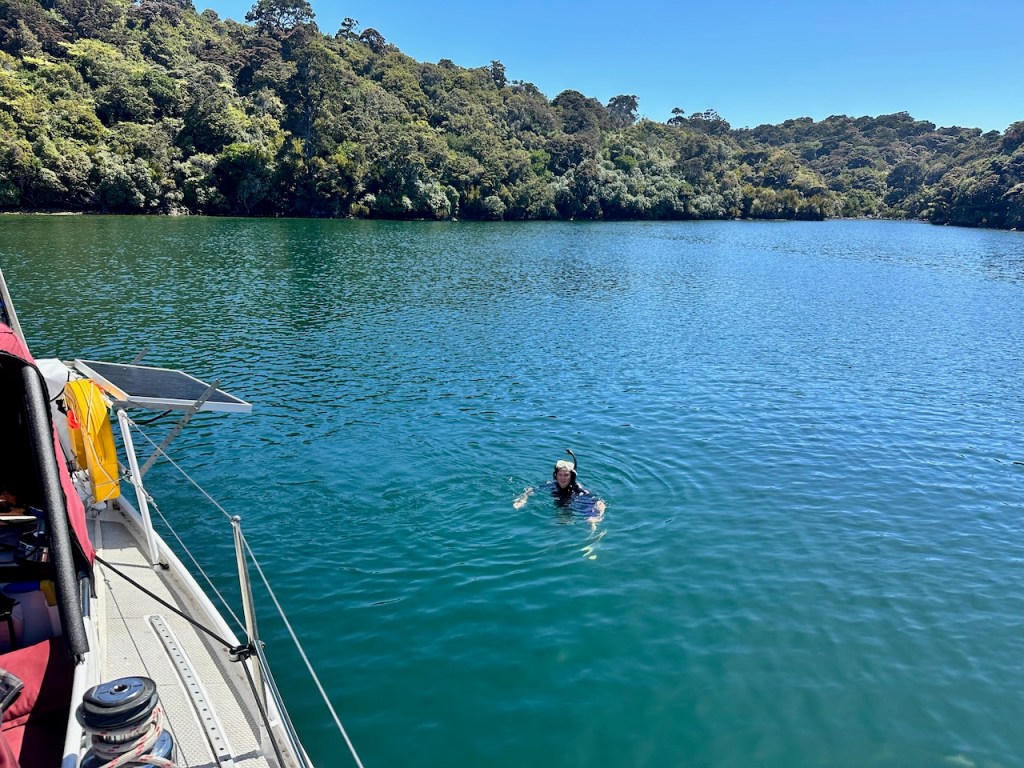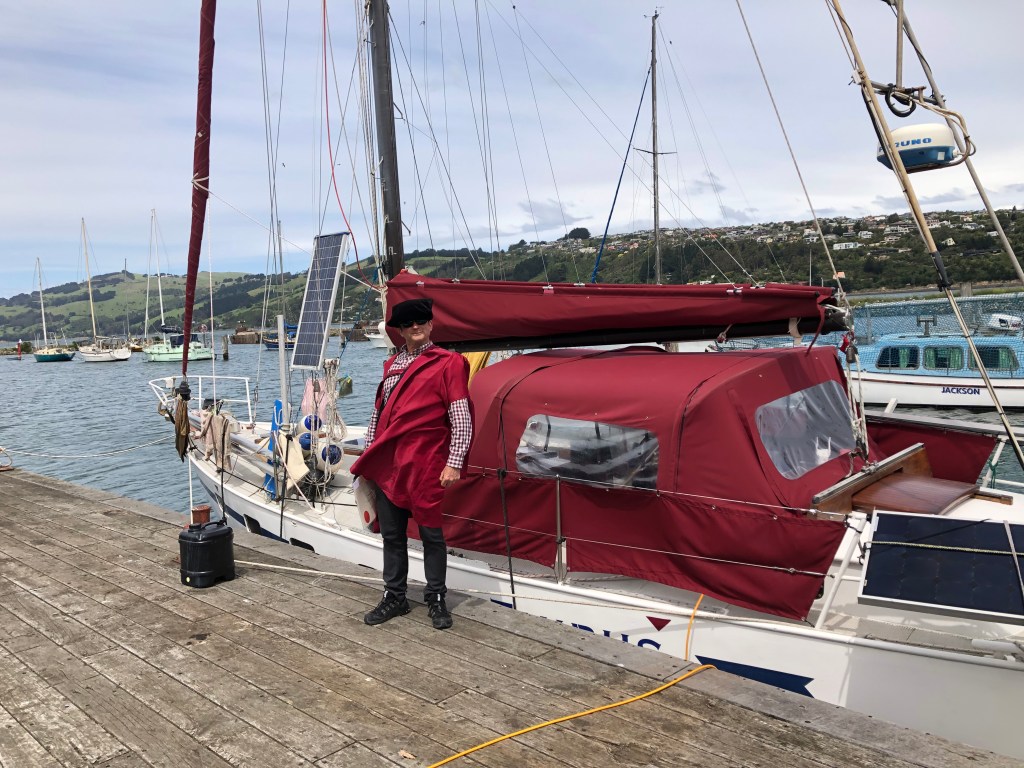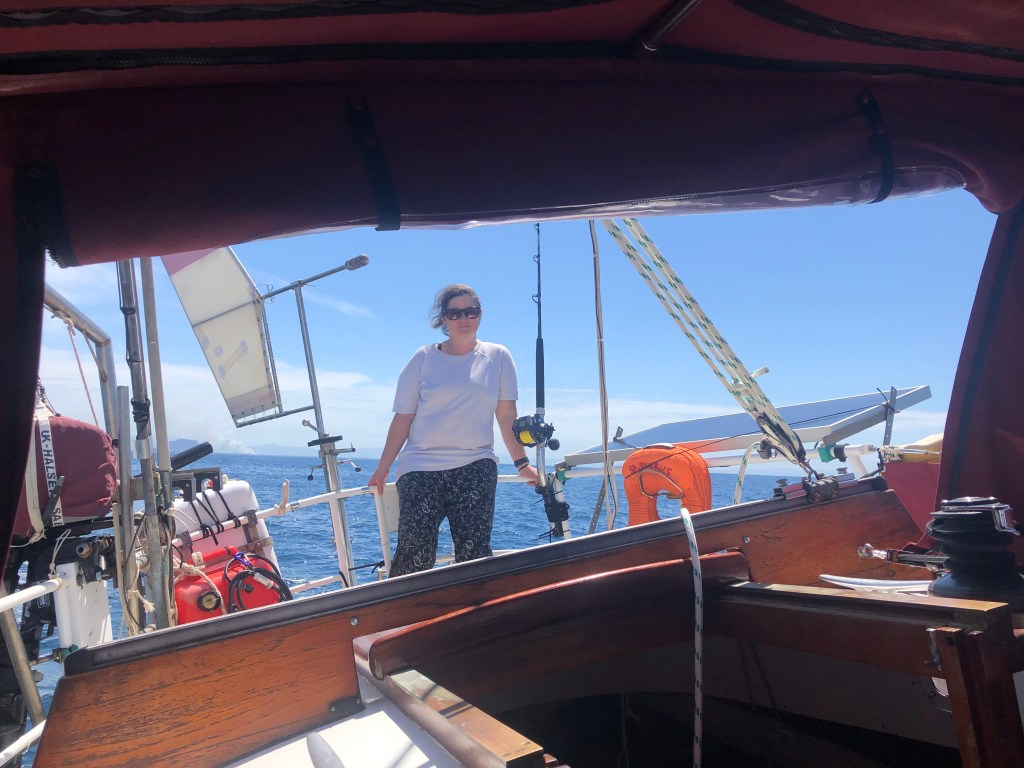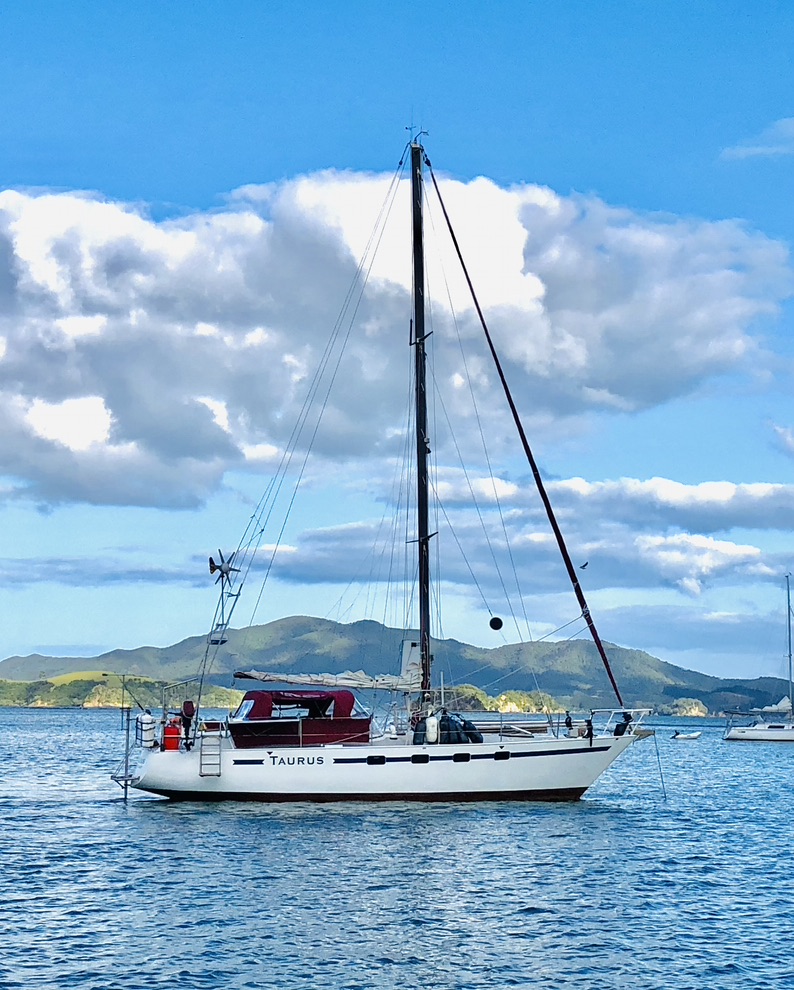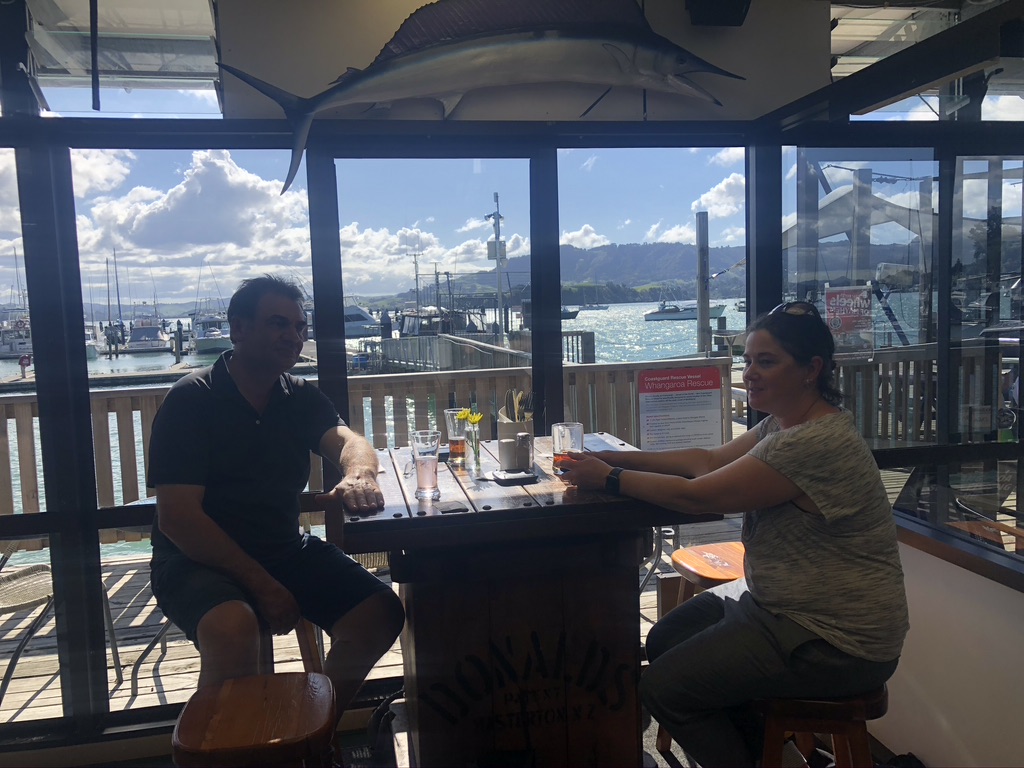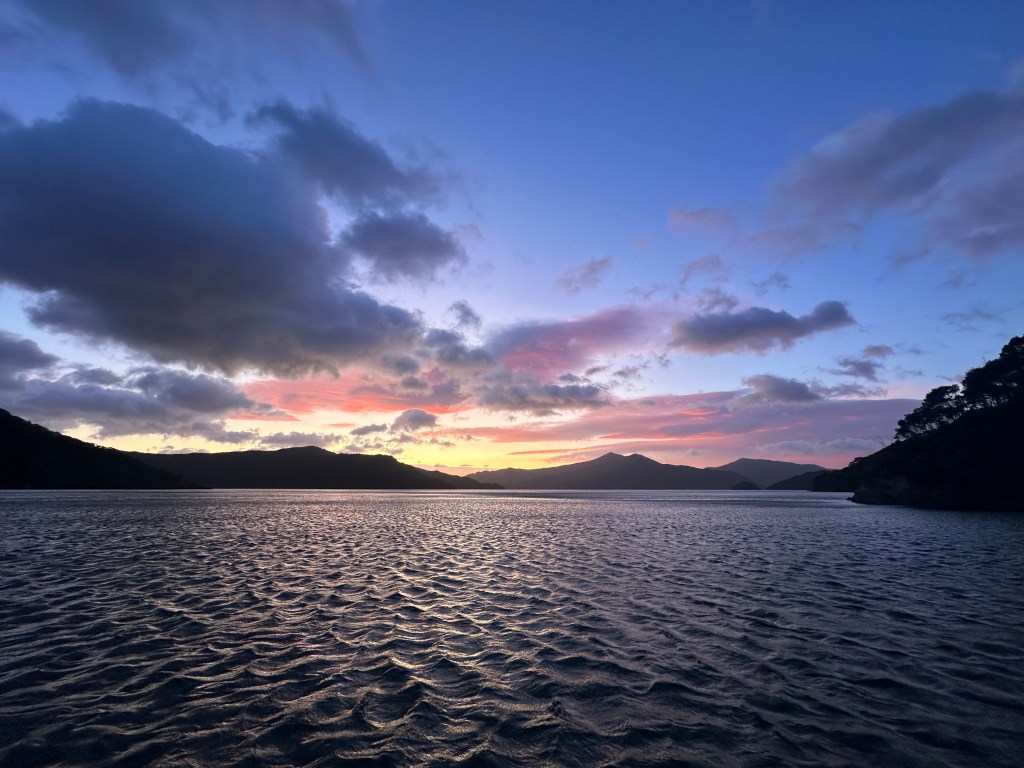
• We left Lyttleton early on the 7th of October heading to Port Underwood, a sheltered area that would allow us to wait for suitable weather to get through the notorious Cook Strait and into the Marlborough Sounds.

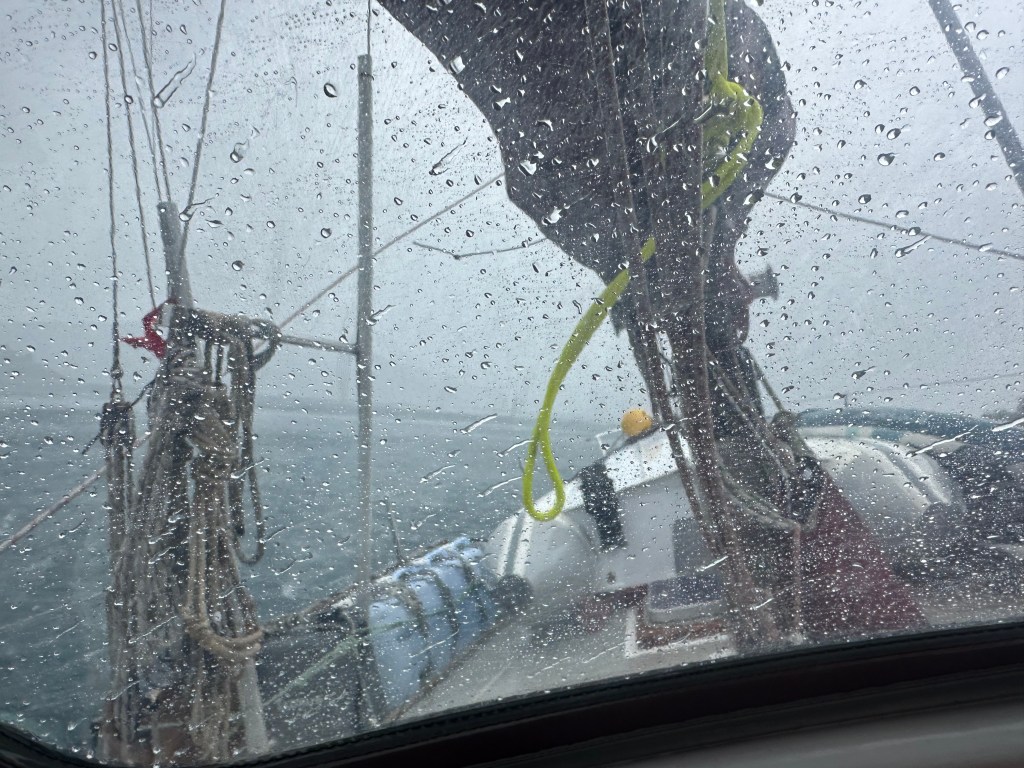
    The weather was flukey in the morning, with sails up, sails down, sails up, and eventually two reefs in the sails (reefs are a way of reducing sail canvas so that the boat doesn’t get overpowered in stronger winds). The route from Lyttleton to Port Underwood requires sailing up half of the east coast of the South Island, with nowhere really to stop along the way. Kaikoura is about halfway, but a recent earthquake lifted the seashore and made charts unreliable, and there had been many reports of trees and debris floating miles out to sea in the area after the various storms. We decided to stay well away and do the trip of about 160NM in one go, which would take us about 36 hours.

    The day passed pleasantly with easy sailing, and the fair winds continued on into the night. One memorable incident occurred when a fishing boat, not on AIS but whose lights I had spotted, called us up on VHF. He warned us that we were approaching two fishing lines that he had set and rattled off four lat and long references to tell us where the lines were. This was a lot of information to take onboard at 3am, and not knowing how much time I had I woke Cara who was quickly able to plot the positions whilst I reduced sail to slow down. It turned out we had plenty of room and time, and were going to pass well to the west of the lines. Still, it was good practice to have to plot a lat and long co-ordinate on our electronic chart, something I was unsure of how to do.

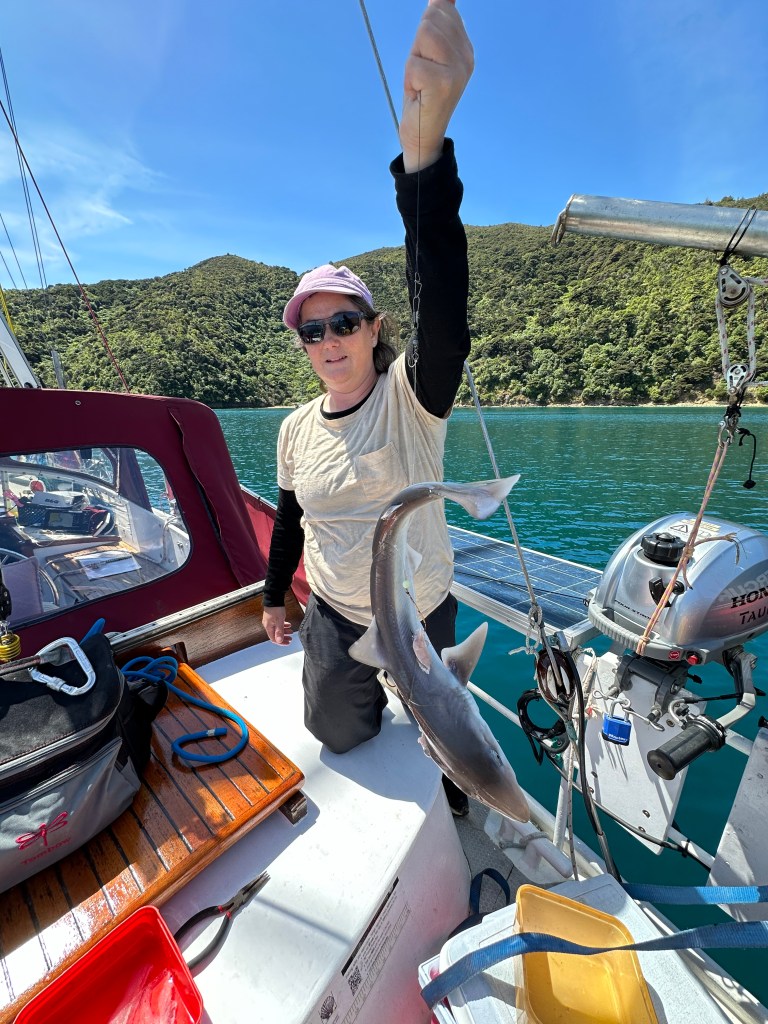
    The next day we calmly continued, streaming a couple of trolling lines behind the boat in hope of catching supper. Unfortunately, the only thing we caught was a petrel, who tried to seize the small fish shaped lure and ended up being seized itself. We brought the bird aboard, wrapped up in the line but without any hooks sticking in him. The petrel was not best pleased about being dragged through the water and I was glad I had asked Cara to bring some gloves as it attacked my fingers with vigour and had a surprisingly powerful bite for such a small thing. I was able to painfully wriggle my finger out of the glove, but the glove was stuck fast in the petrel’s maw. It was interesting to see that inside its beak there were rows of what appeared to be small teeth angled backwards, obviously to prevent fish, or gloves, from escaping. Eventually the bird was untangled and he reluctantly released my glove in return for freedom.

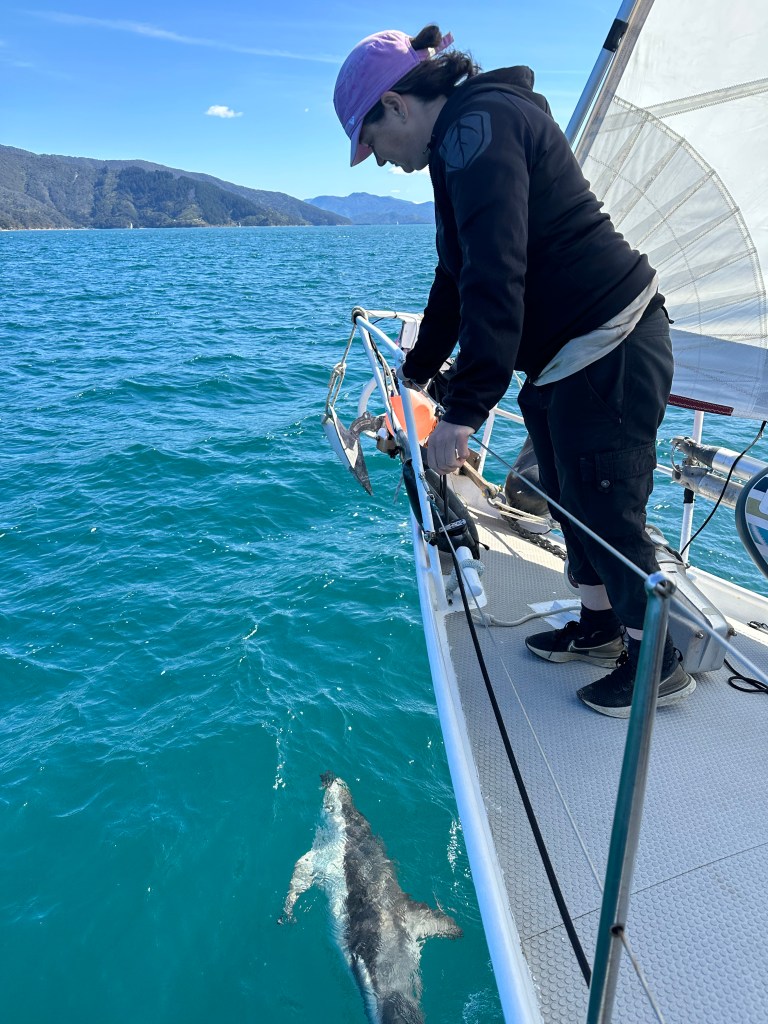
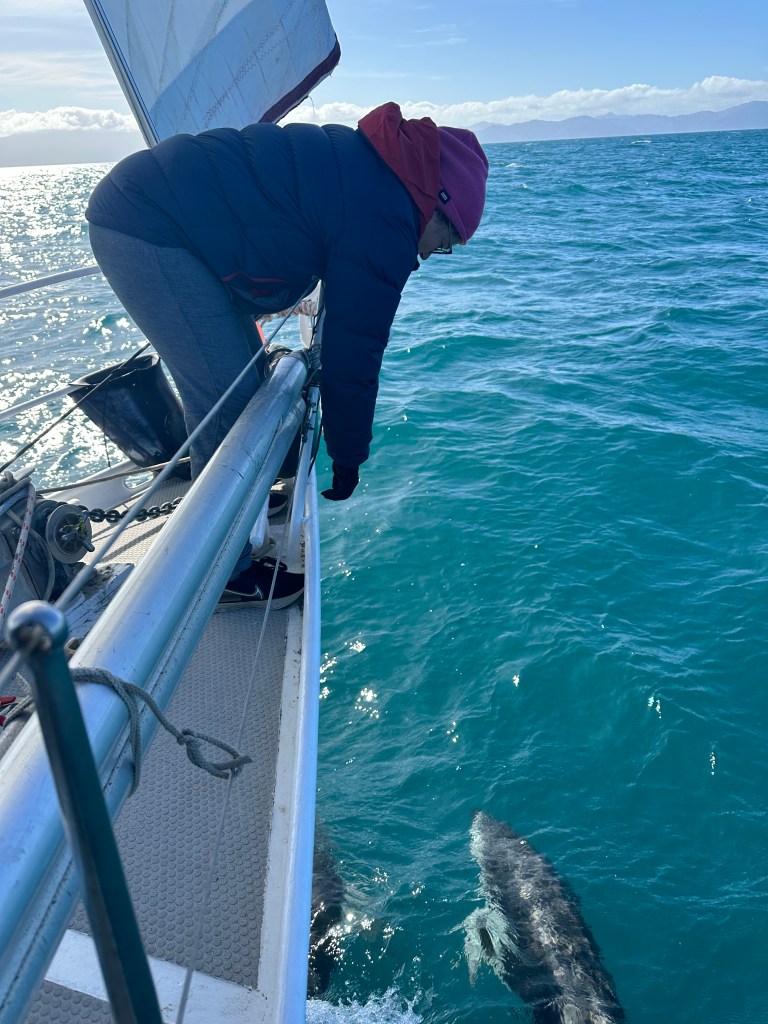
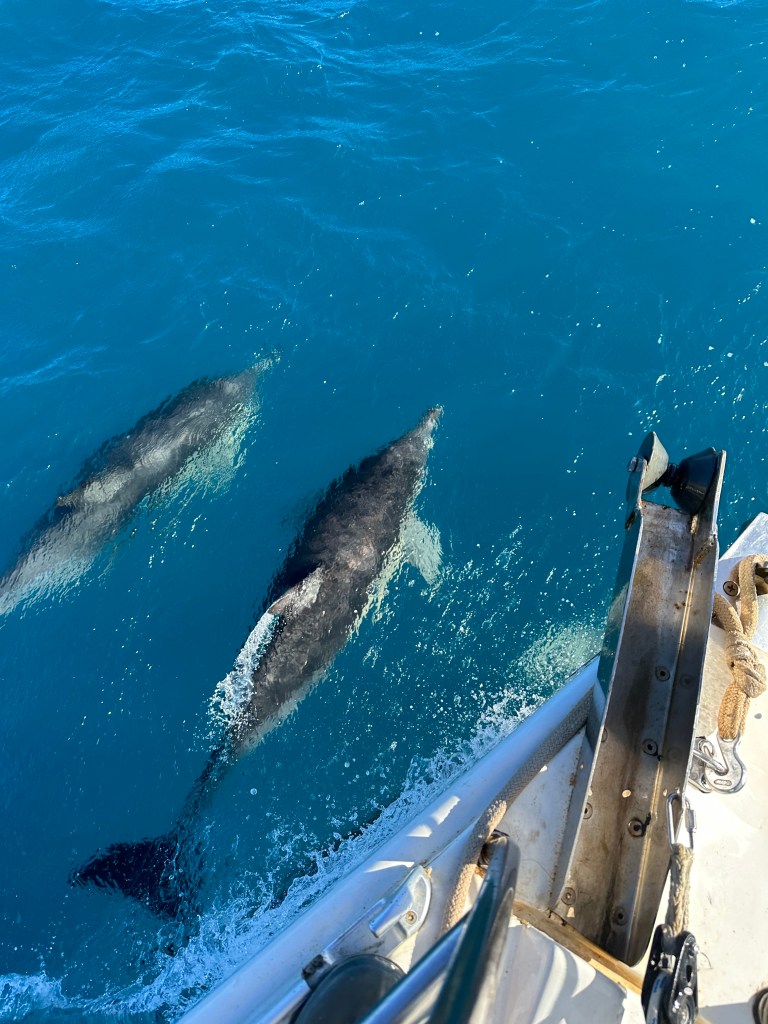
    As we rounded Cape Campbell we began to see more sea-life, being joined by different species of dolphins (Hectors and Bottlenose) who rode along with us on our bow wave. Later we managed to catch a fish, a nice kahawai, which was to make a delicious supper.

    I’ve read old accounts by early settlers, sealers, and whalers that tell of how easy it used to be to find fish and whales. Apparently in Dunedin in the nineteenth century a line with a few rusty nails was all it took to catch fish; one ship took 60,000 seal skins from Port Pegasus in Stewart Island; a whaling station in Pattersons Inlet, also Stewart Island, processed 90 blue whales in a season; and the people of Hobart used to boast that they could cross the river by jumping from whale to whale. Those days are sadly long gone. The paucity of fish nowadays is telling, with the capture of a decent fish cause for celebration. We might have to rethink the old saying about there being ‘plenty more fish in the sea,’ because maybe there isn’t. Even though we try to live a low impact, minimalist life aboard our boat, we are very much part of the problem, and to live is to consume and contribute to the world’s demise in one way or another. The apathy of our global leaders is depressing, and I can’t help but think that we might as well dance whilst the band can play. It’s the next generation that will carry the can, but they seem more intent on consuming than any generation that has gone before, so what can be done? I guess my answer was to ‘sail away.’

    We reached Port Underwood at 6 pm, almost exactly 36 hours after leaving Lyttleton, and anchored in Pipi Bay, a sheltered spot not too far from the entrance so that we could get away early the next day. We had to try to time our arrival at the Tory Channel, entrance to the Marlborough Sounds, to take advantage of the ingoing tide which can reach speeds of up to 7 knots, more or less our maximum hull speed. With this in mind we were up at 6 am the following day and set sail once again.

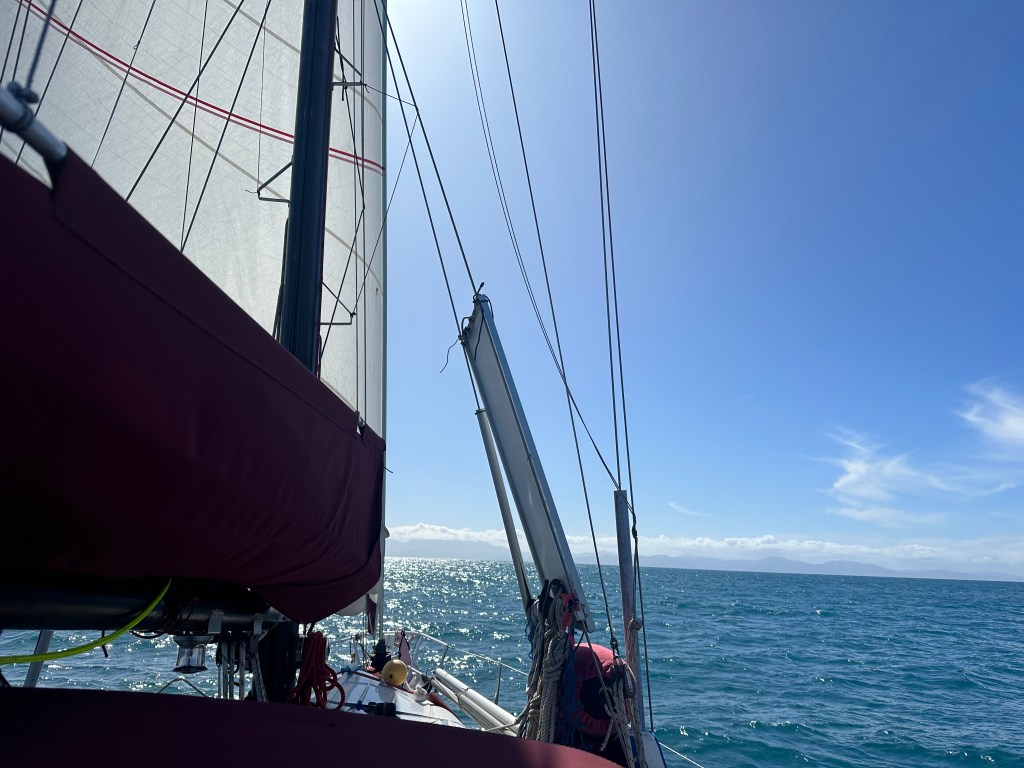
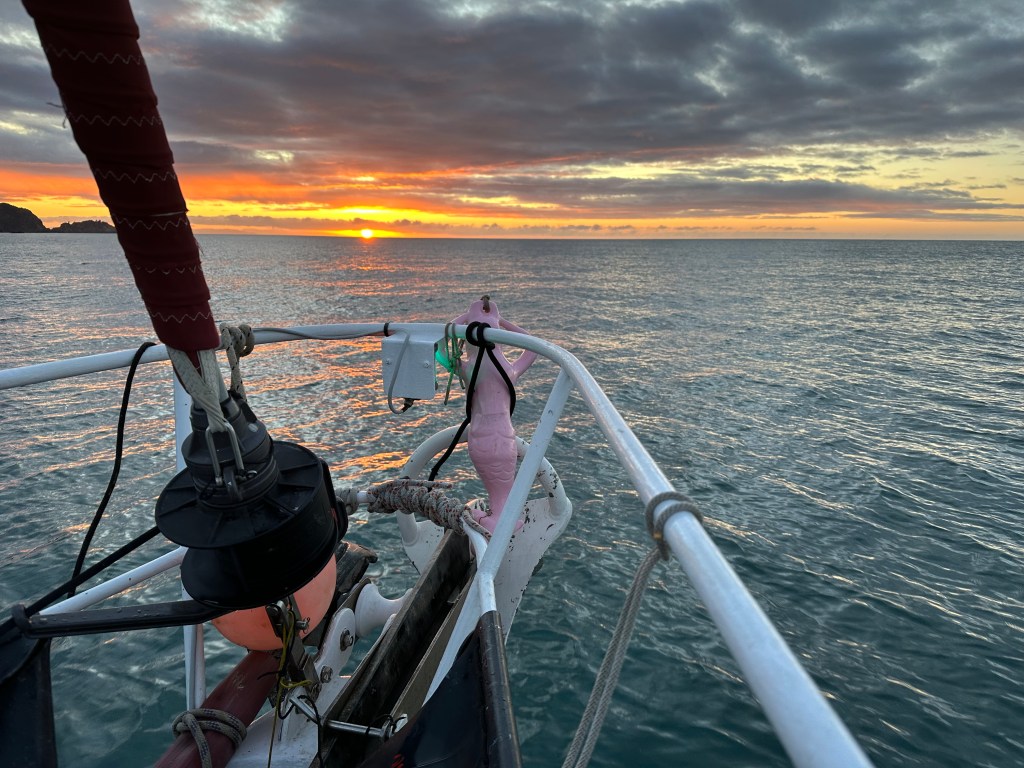
    Leaving Port Underwood. The ‘figurehead’ is normally removed for night sailing so as not to obscure our lights.
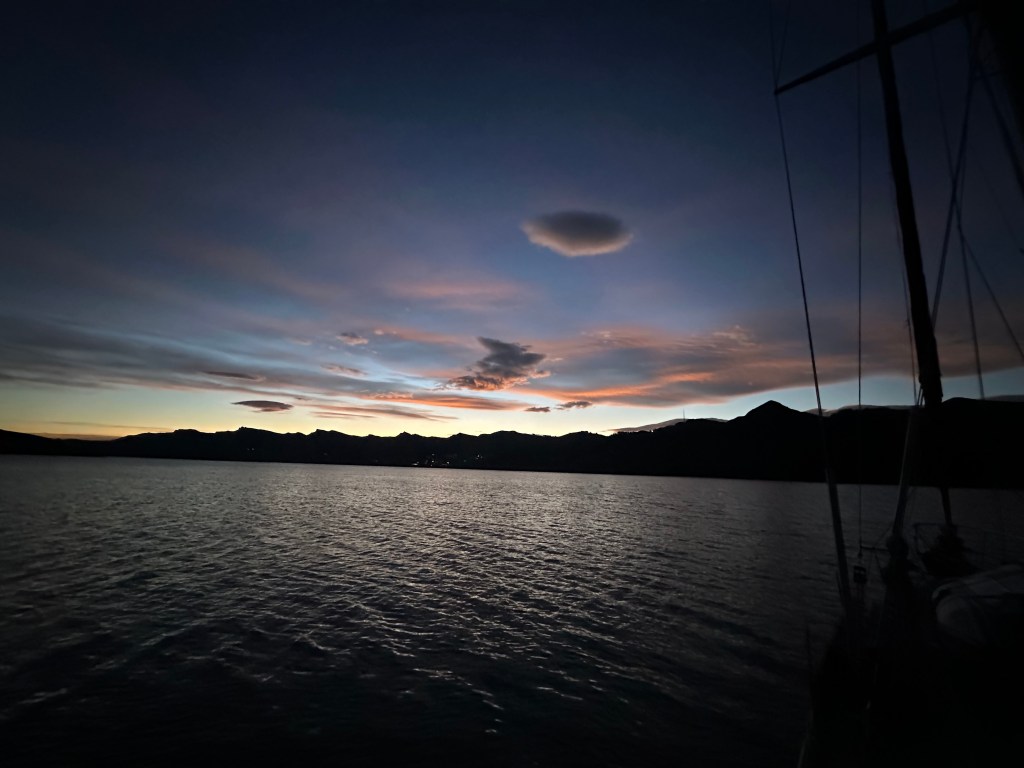
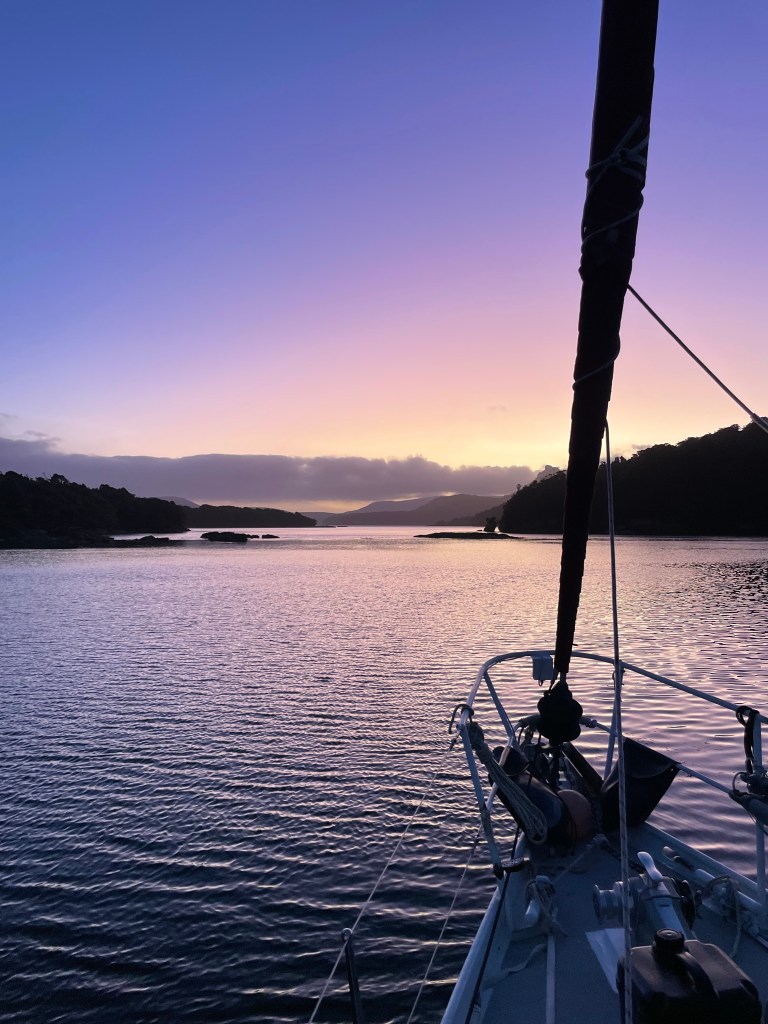
    Daybreak, Port Underwood.
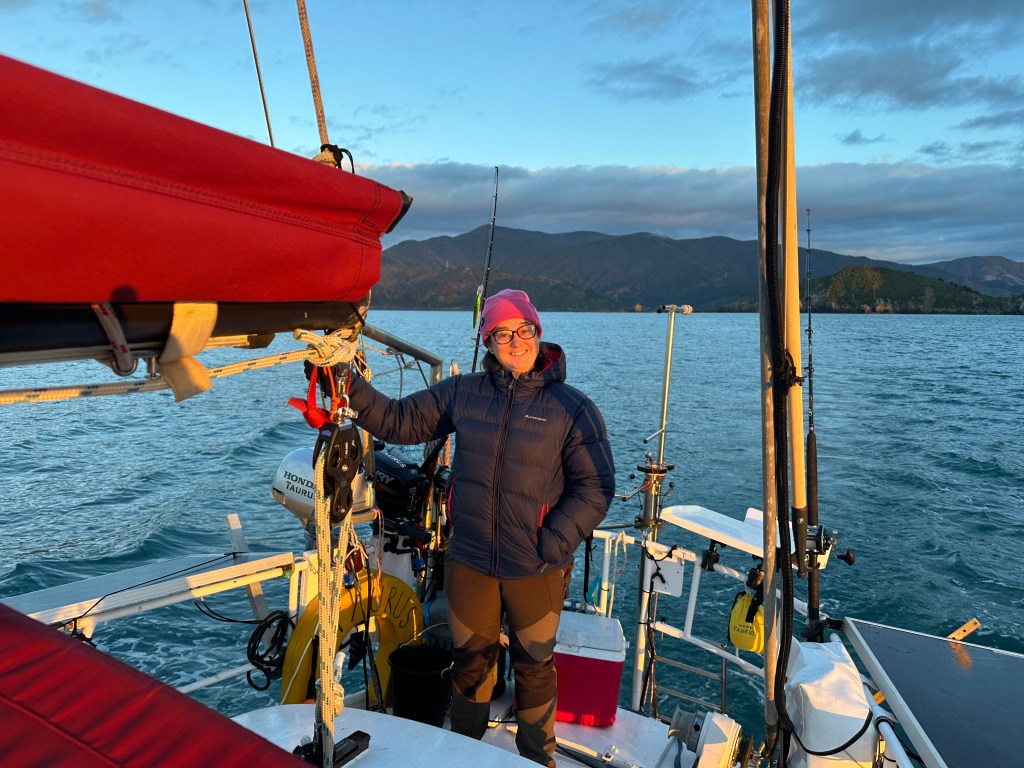
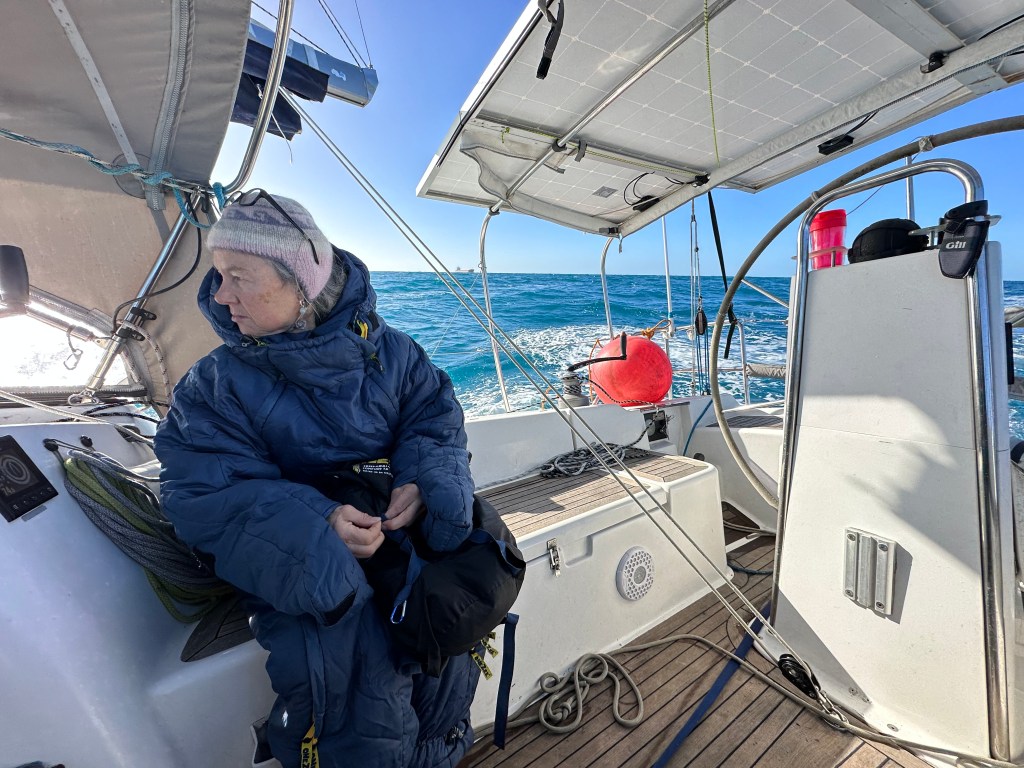
    Cara enjoying the early morning sun.

    The weather gods continued to be kind, and we were able to sail the 15 NM to the start of Tory Channel. Just as we approached we were called on the VHF by a ferry that had crossed the Cook Strait from Wellington. These ships are a vital lifeline between north and south islands and have right of way through the sounds. We had been watching the ferry approach and trying to time our entry either before or behind him, but the window was pretty narrow and so we offered to ‘heave to’ to ensure that he would have plenty of room.

    Heaving to is a way of stopping a yacht in the water. The boat is tacked across the wind but the jib, the sail in front, is not pulled through so becomes ‘backed’ by the wind. The result is that the main sail and jib work against one another, and the boat gently bobs along. This worked well but increasing gusts of about 25 knots meant that we had to work to get underway again, Taurus refusing to tack back from a standstill. Soon we were approaching the channel once again and once committed realised that another ferry was heading out of the sounds. Luckily we had plenty of room and were able to watch the behemoth race past from the shelter of a bay at a speed some three times what we are capable of.

    Sailing in the sounds was a new experience for us. The wind is unpredictable, with light winds typically followed by a series of strong gusts. The trick is to sail at a shallow angle and then head up during the gusts to try and make headway up the channel. In this environment sail management becomes problematic. You tend to be underpowered in the light air, and overpowered in the strong, and it’s still something that we are learning to deal with, especially, the way in which the winds change direction as you move along the channels.

    Beersys to celebrate our entry into Marlborough Sounds.

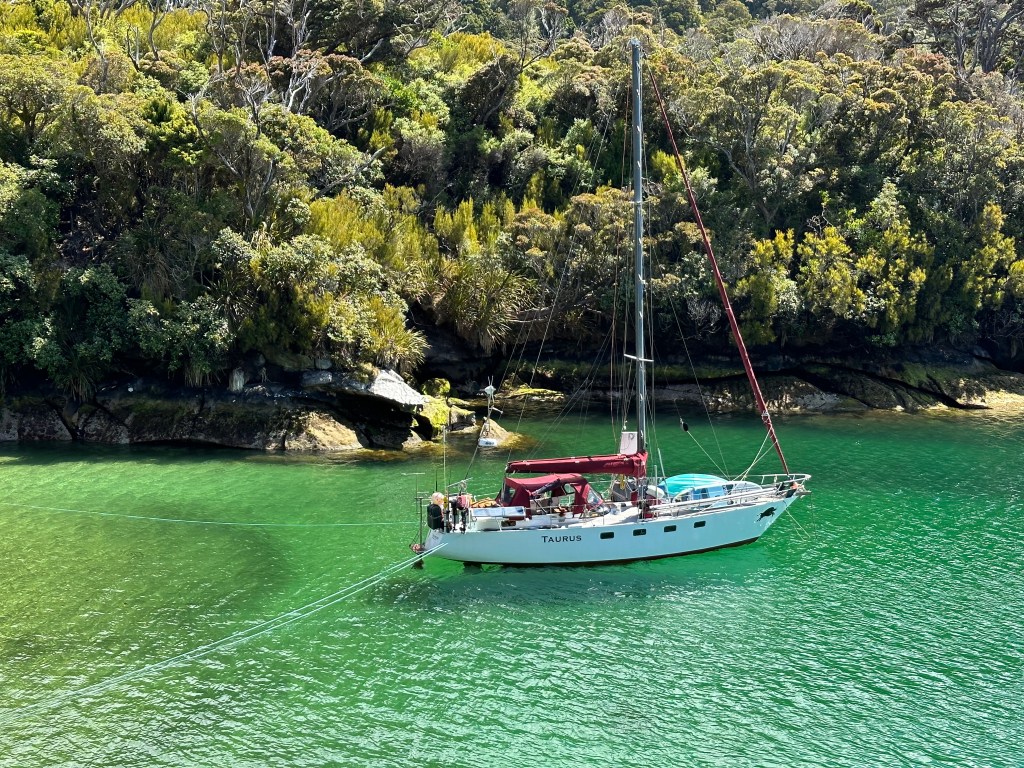
    We decided to stop in Ngaruru Bay, where a local club that we had joined had a mooring. There are three clubs with a presence in the Marlborough Sounds who join together to offer their members a great number of moorings throughout the area. To show that the boat is a member of one of these clubs the crew is required to fly two small flags, known as burgees, one for the club, and one showing the year of membership. We had joined Pelorus, the cheapest, and so flew a flag showing a white dolphin on a black background. After a pretty long trip we were glad for the chance to stop and collect ourselves, and sit in the sun for a while.

    Tawa Bay.
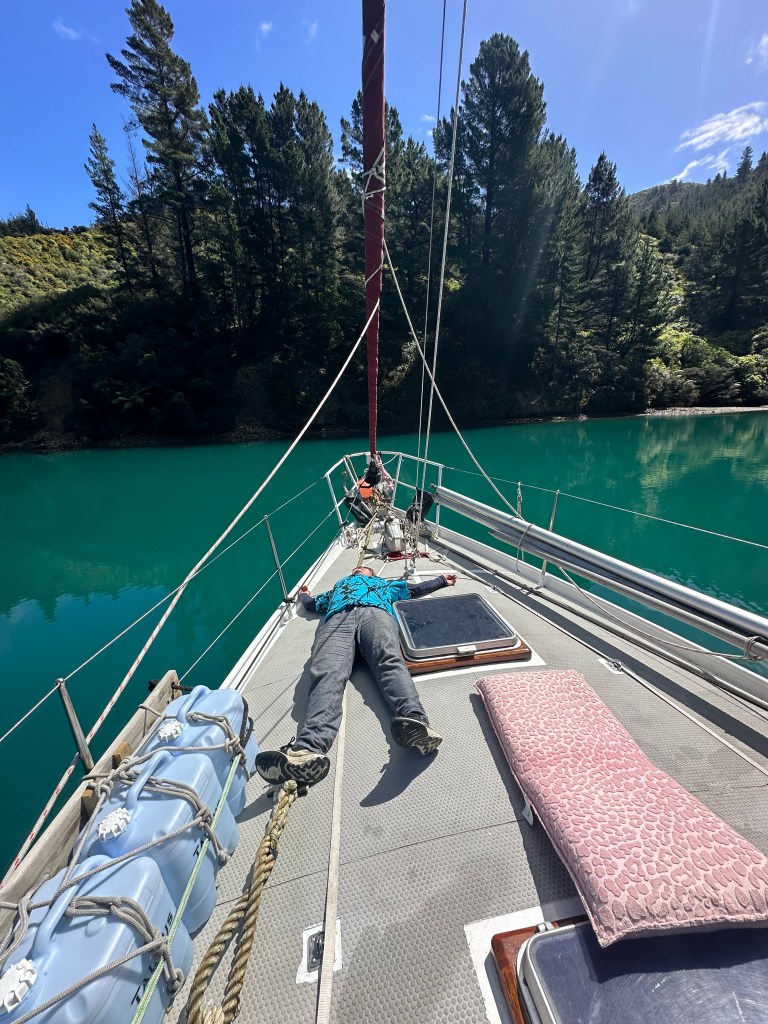
    Couldn’t quite make it to the mattress…
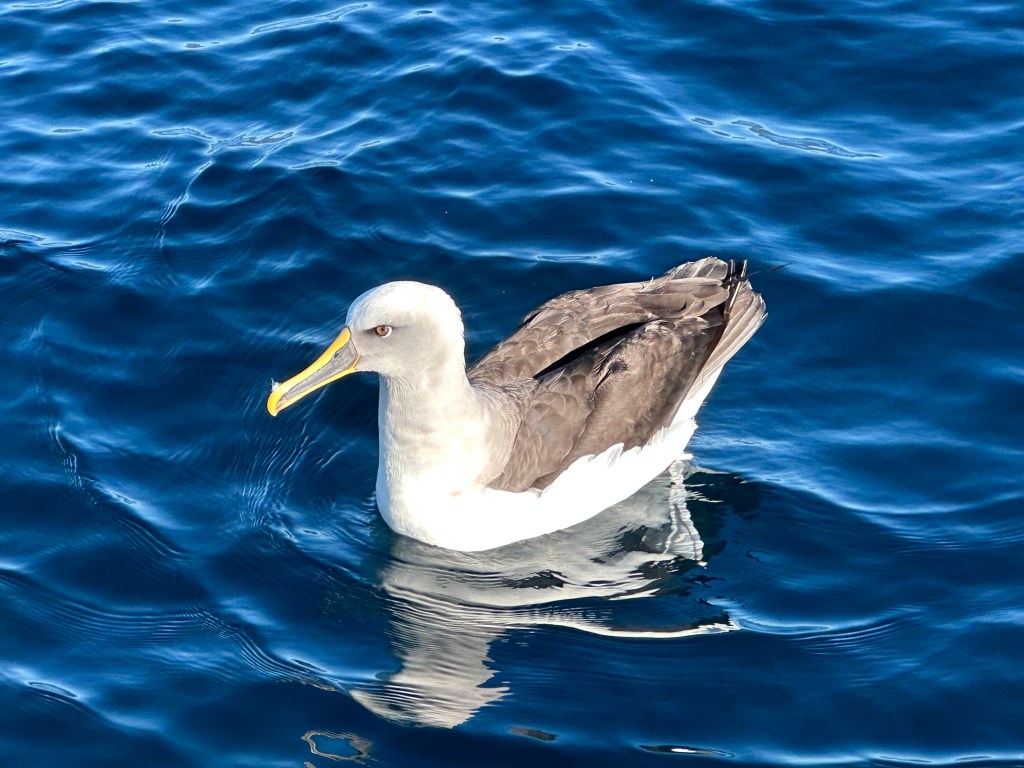
    Cara goes paddle boarding whilst Taurus hangs on her mooring. Lots of rays and small fish to be seen.
    Beauty and the Beast!
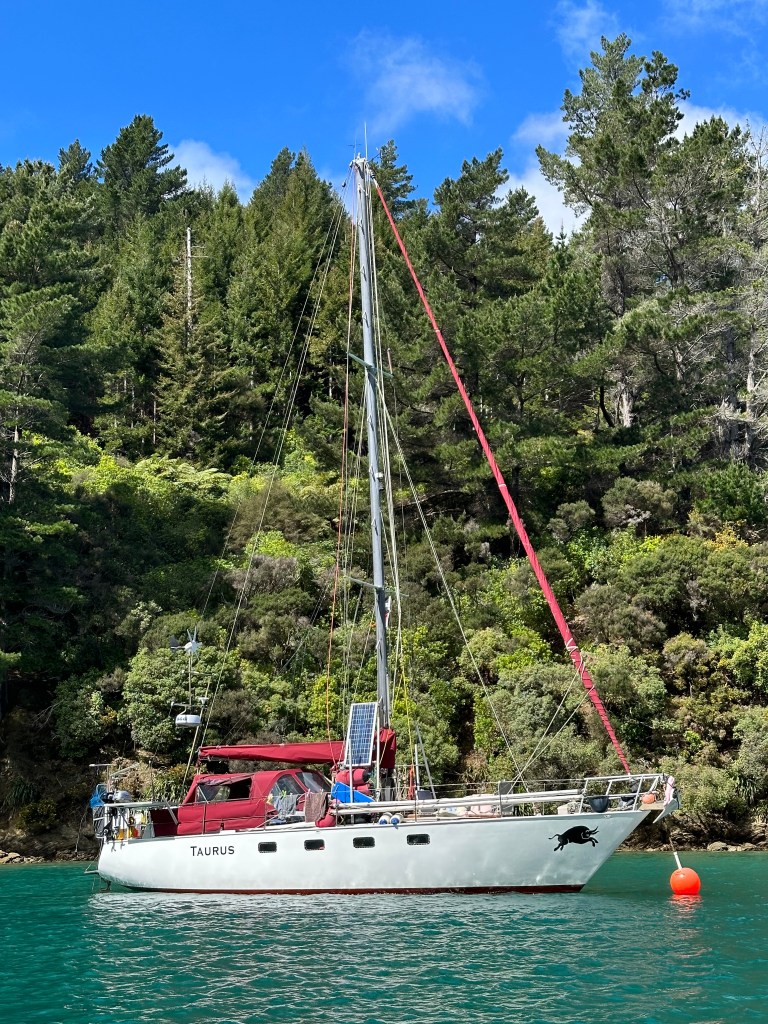
    I may be biased, but what a thing of beauty.
  • We left Akaroa in weather that wasn’t ideal for our sailing plans, but was, once again, the best window available to us. As we left the protection of the harbour the wind settled into what often seems its favourite position, ‘on the nose.’ Wind from directly in front of the boat is disliked by all sailors as yachts can’t sail directly into a breeze, but rather need to sail at minimum of about 30 degrees to either side, depending on the design of boat. This is because sails act like aeroplane wings, they need a pressure differential on either side to create the ‘lift’ or pull that moves the boat forward. With even amounts of wind on either side the sail shakes like crazy, whipping its sheets around (the ropes that control the sail), and try to destroy themselves and anything in the near vicinity.

    The weather was beautiful though, so we left the sails down and began motoring north, hoping the wind would swing and we could sail. Our destination for the night was Pigeon Bay, a protected mooring close to Lyttleton that we had been told about, and where we hoped we would find good shelter from the storm expected the following day.

    Beautiful Canterbury day

    As the day wore on the wind speed increased to 20 knots and above, so that we were making slow going under engine alone. We decided to abandon our course and sail out to sea, tacking as necessary (changing direction so that the wind fell onto different sides of the sails) so that we could turn the ‘iron donkey’ off.

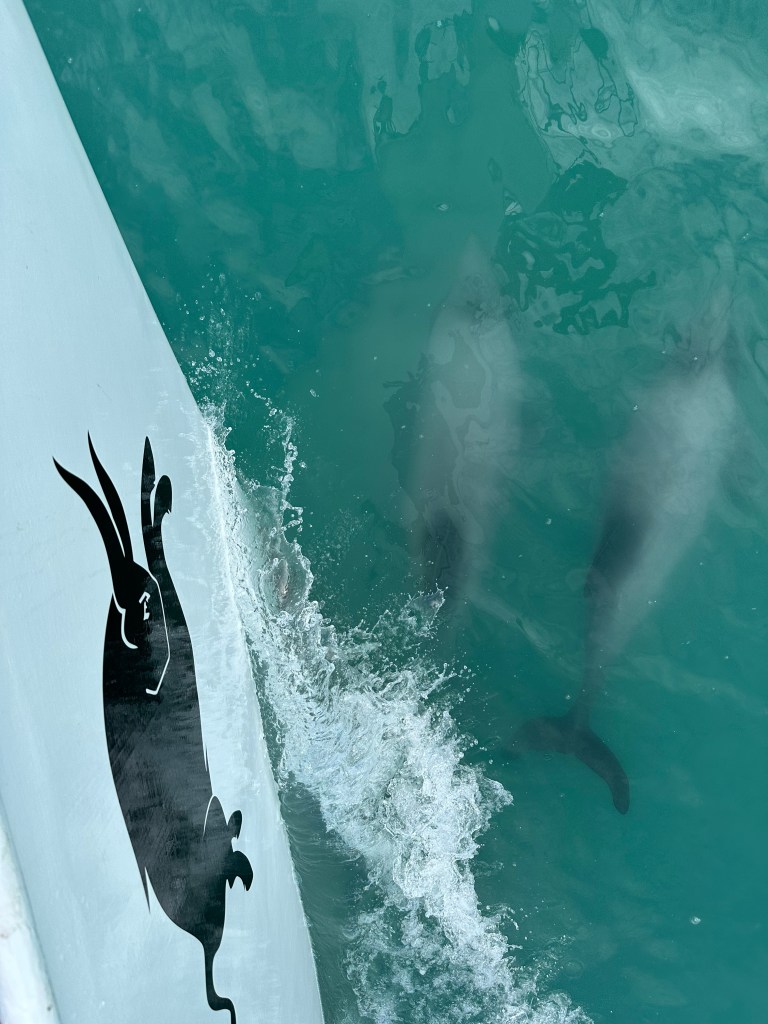
    Akaroa is known for dolphin spotting, and it soon lived up to its reputation as we were joined by several pods of dolphins. A hull moving through water seems to have a magnetic appeal for dolphins, allowing them to surf and apparently play. It’s always a joy to watch them gliding along at the bow, and then speed ahead of the boat without any obvious effort or even motion. When dolphins appear everything else stops as Cara and I love to watch these labradors of the sea, whose mere presence always lifts our spirits.

    Watching dolphins. The scruffy line on deck is a new improvised painter, far too long.
    Hectors dolphins came to play

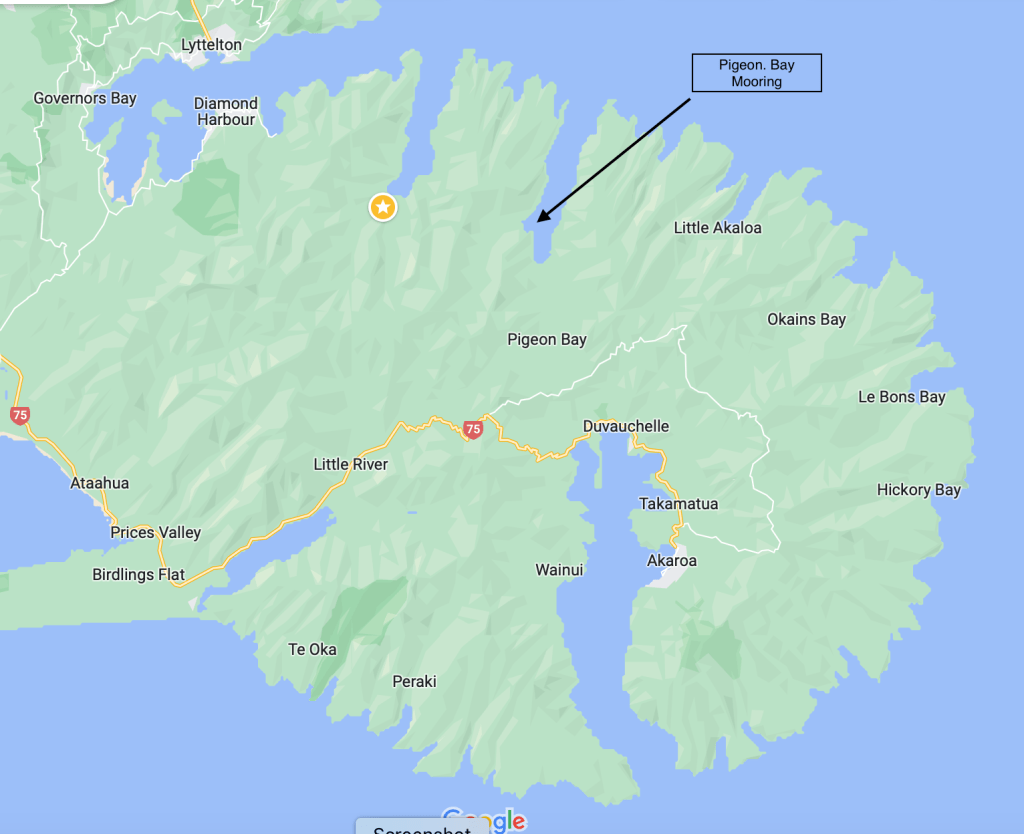
    At about 6pm we sailed into Pigeon Bay and picked up a mooring belonging to the Naval Point Yacht Club. We had been told we could use the mooring by a member and advised that Pigeon Bay was perhaps the most sheltered spot in Banks Peninsula. We needed an unusually sheltered place to stay as strong winds of up to 70 knots (approx 130kmh) were predicted from the NW, veering to SW as the day progressed.

    Courtesy Google Maps

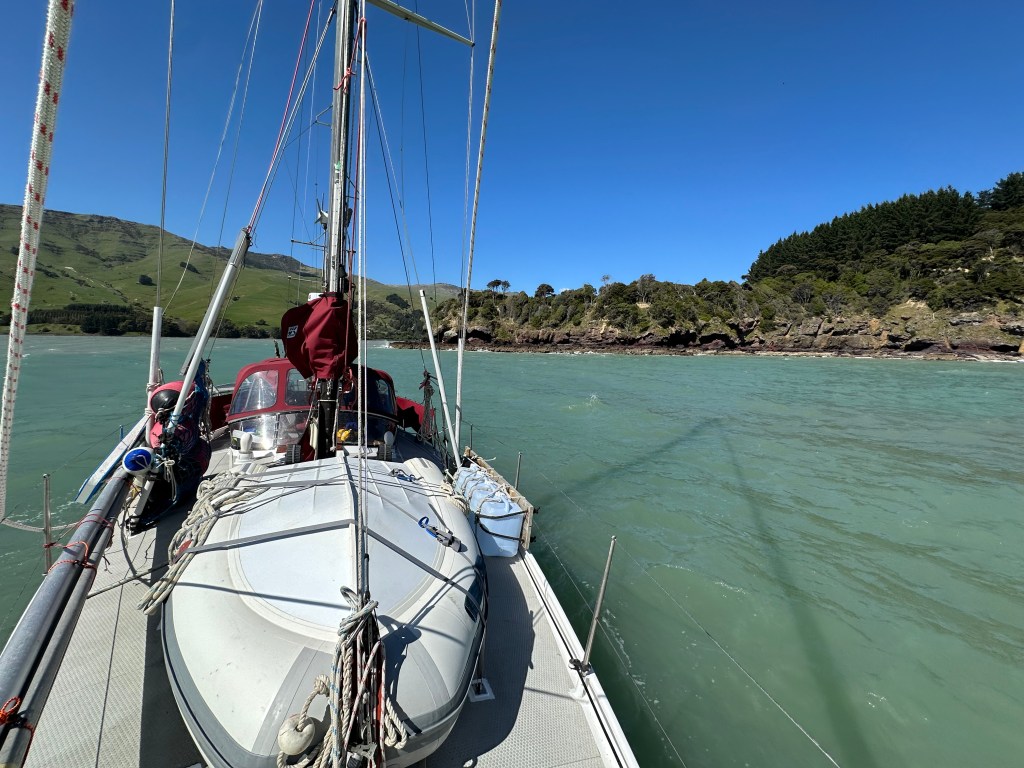
    We secured everything on deck and settled down to see what would come. Next day the wind began building early until gusts of 30-40 knots were commonplace. Unfortunately, rather than coming from the NW the wind was channeling straight down the sunken valley from the N, or even NNE. This meant we were being blown directly onto a lee shore that was alarmingly close, perhaps 15 metres behind us. This meant that should the mooring fail Taurus would be on the rocks almost instantly. For some time we ran the engine, so it could be immediately put into gear to drive the boat away from land, but the slim time saving this provided seemed outweighed by the unneccesary wear to the engine. We had made our bed, and now we had to lie in it, hoping that the wind would shift as predicted so that the surrounding hills could protect us. The following day was pretty tense, but eventually in mid afternoon the wind slowly changed direction. However, our situation wasn’t greatly improved as it picked up strength as it moved. At one point I had gone forward to check the mooring line for chafe and a gust came through that heaved Taurus onto its side, so that I was standing on the side of the windlass with the boat almost 90 degrees over. The roar of the wind was deafening, and this with a cliff protecting us from the wind! As I quickly made my way back inside, I found Cara picking up pieces of broken crockery. She had chosen a bad time to start the washing up! We got ‘thrown onto our ear’ another 2 or 3 times during the evening and night, but by next morning the wind had died away.

    Lee shore behind Taurus. As the wind picked up, stretching the mooring line, we got much closer.

    We left Pigeon Bay early the next day for the short sail round to Lyttleton with a welcome 15 knots all the way. In the harbour we saw a few spots that we thought might have been more sheltered, but it is not easy to know as the wind veers round depending on the local topography.

    Recorded weather in Lyttleton, next couple of bays round the coast from where we weathered it out.

    We anchored in Magazine Bay and met a friend for dinner and drinks in Lyttleton, a short walk from our anchorage. The township is quite alternative, with lots of organic food, micro breweries, and interesting characters.

    The next day we picked up our life raft, which had been serviced in Invercargill, and stocked up on groceries. The Harbour Master came to see us on a flash looking jet ski, wanting to see who we were and what we were about. He told us that one boat had sunk and another broke its mooring during the bad weather.

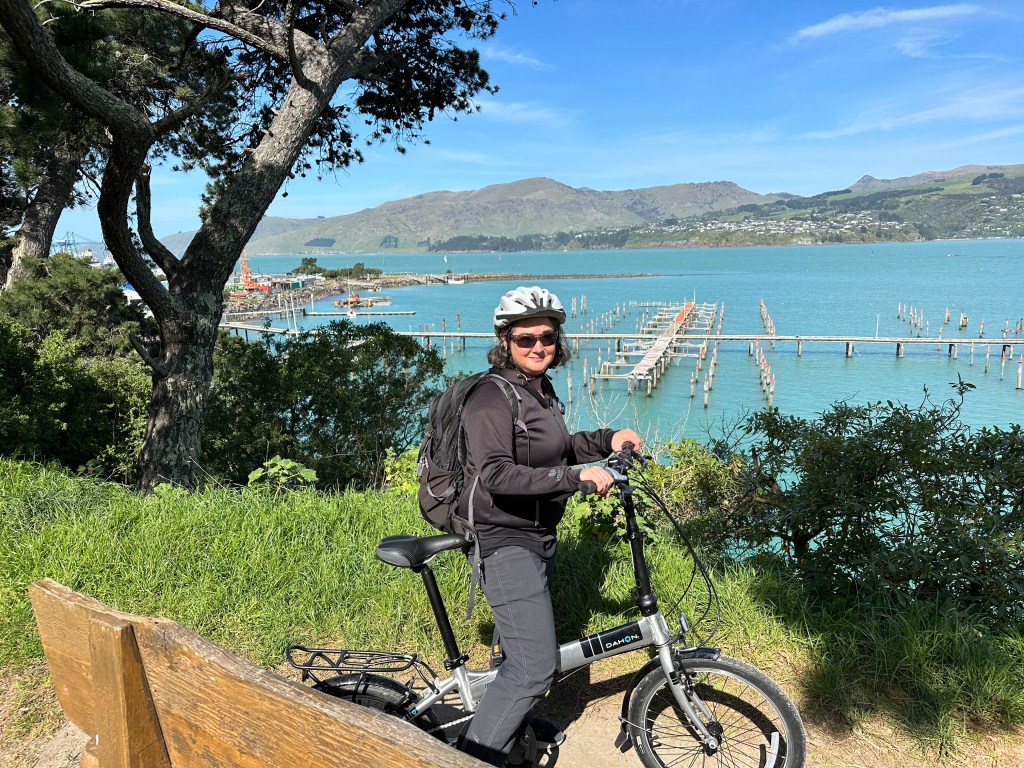
    As was becoming standard, the storm was followed by warm sunny days, and we were able to take the folding bikes ashore and cycle along a track next to shore — until fallen trees blocked our path.

    Folding bike fun. Behind Cara is the old marina, destroyed in a storm and slowly being taken apart.
    Council jetty, Lyttleton. Very pleasant spot.

    Later that day we took Taurus onto a council jetty and met Cara’s aunt and uncle for dinner at a local pub. It was great to see them, catch up, and show them round the boat.

    The old marina next to the anchorage was wrecked in a storm about ten years ago, and was only now being demolished. Speaking to one of the contractors we found that he was responsible for the local club moorings. When he heard that we had stayed on the Pigeon Bay mooring he told us, ‘Better you than me, that mooring hasn’t been serviced in years.’ There is always a danger staying on moorings that you don’t know. The concrete block, earth screw, or what have you might be good, but shackles and ropes perish, and they can part with no warning when placed under strain. In hindsight we might have been better to anchor further into Pigeon Bay away from land, but we would have had less shelter and anchors can drag. In the winds we experienced it would have been difficult to reset. So often in sailing there is no black and white, but only shades of grey in which you make a decision, often ill-informed and based on ‘predictions,’ and then have to live with it come what may. I’m often a little shocked by comments on social media that criticise a sailor’s decisions after he or she had met some unfortunate outcome. Hindsight is always 20/20 as they say, and there but for the grace of God go I. One of the things I value most about sailing is the self sufficiency it demands; the need to make important decisions that routinely and directly impact upon our homes and personal welfare, decisions typically denied us by bureaucrats and nanny states that think they know best on land. In this world, at the mercy of the wind and sea, we engage in margins, hoping that the mistakes we make don’t become major, and instead allow us to accrue valuable experience so that we might do better next time. Of course, in an uncaring universe there isn’t always going to be a better choice. Sometimes it’s just a matter of luck. In any case, as Cara’s diary entry says for the storm at Pigeon Bay, we ‘survived the night.’

  • Finally, a weather window appeared that allowed us to leave Oamaru and head to Akaroa. The window wasn’t great with light variable winds that threatened a good deal of motoring, but it was the best we’d seen and the best predicted to come.

    We left Oamaru on Friday 22nd September at about 10:30 am in a 15 knot southerly on a wet and cold day. Fortunately, Taurus has a dodger that gives all round protection and means that rain and temperature are not so big an issue. Our previous yacht, Casino, was far more of a racer and meant that pretty much every trip involved getting seriously wet and cold. For cruising, especially in temperate climates such as New Zealand enjoys, protection from the elements is really a must, and one of the many factors that separates racer/cruiser style boats from true blue water cruisers.

    Bit yucky…
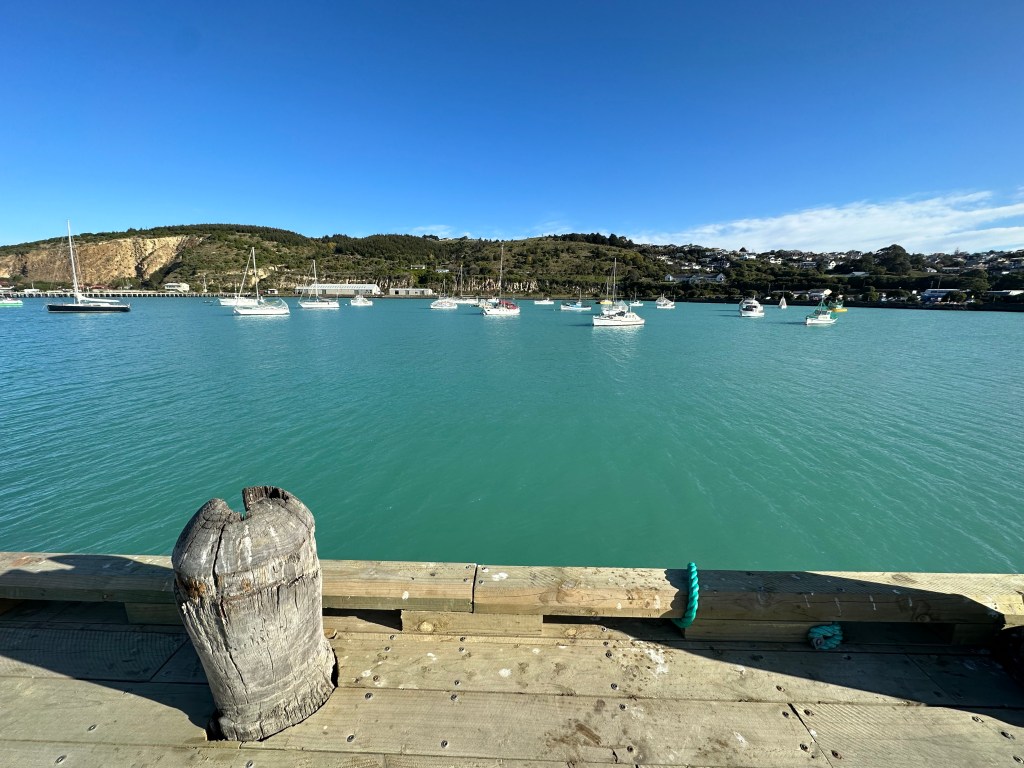
    At five knots the sail from Oamaru to Akaroa should take about 26 hours. The wind came and went during the night so that we had stretches of motoring, raising and lowering sails, and lots of sail adjustments. Normally on night passages Cara and I try to get into a 2 or 3 hour shift pattern that changes depending on how tired we feel. When we are only expecting a passage to take a single night this becomes even more flexible. With AIS (Automatic Identification System) that broadcasts your boats position and monitors other boats in a fairly wide vicinity, warning of close proximity or converging headings, the danger of collision is greatly reduced. However, leisure boats don’t have to have this system onboard, so they don’t generate a signal, and fishing boats are notorious for turning theirs off so that their competitors don’t know where they are…

    Unless experienced it’s hard to realise just how dark the night is at sea, and how little can be seen. There would be no chance, for example of seeing a container floating in the water. The on-watch crew can see their own navigation lights, and look for other lights at sea that warn of other vessels, or lighthouses and beacons that warn of land. For this reason many single handed sailors sleep for 20 minutes and then look around for a few minutes before getting 20 minutes more sleep — the rationale being that it takes the fastest ship 20 minutes to get over the horizon and be close enough to be a hazard. Typically on our watches Cara and I watch videos or read books, keeping an eye on what’s happening around us as best we can, and making sure that every 20 minutes we have a good look around. In this way the night soon passes.

    The variable wind continued the next day so we were glad to see the coast appear out the morning mist, and know that we were almost at the entrance to Akaroa.

    Land Ho! Banks Peninsula appears through the gloom.

    Captain Cook famously mistook Banks Peninsula (named after Joseph Banks, his botanist) for an island, and Stewart Island for a peninsula. It’s easy to understand why, as the coast disappears and appears isolated from the mainland. Having spotted land we settled back to the long wait that is perhaps the most frustrating part of sailing. When you see your destination you tend to want to get in, but the slow speed of sailing dictates that landfall remains several hours distant. Finally, we passed the headland and entered the natural harbour in which Akaroa sits.

    An hour or so later we finally dropped anchor in French Bay, Akaroa spread out before us.

    The next day we took the dinghy to shore for a walk around. We were keen to find a way to replenish water and diesel if possible, and to find somewhere to do some washing and have a shower. On the big commercial jetty that the tourist operators use we were lucky to ask a local fisherman if we could come alongside to use the hose. The fisherman, Gavin, turned out to be a real legend who couldn’t do enough to help us. Before we left we had solutions for water and fuel, and he had told us some good fishing spots as well as loaning us a craypot, which came complete with two crayfish! He also offered us use of a brand new mooring he had had put in. Gavin steadfastly refused any payment, even the standard NZ ‘thank you’ of a box of beer, or block of chocolate. Later he gave us several blue cod fillets. A genuinely generous and salt of the earth Kiwi, Gavin just wanted us to enjoy his corner of paradise.

    Akaroa’s point of difference is that the French originally settled the area, and the town proudly celebrates its Gallic foundations. Naturally, the coffee and baking on sale are a treat.

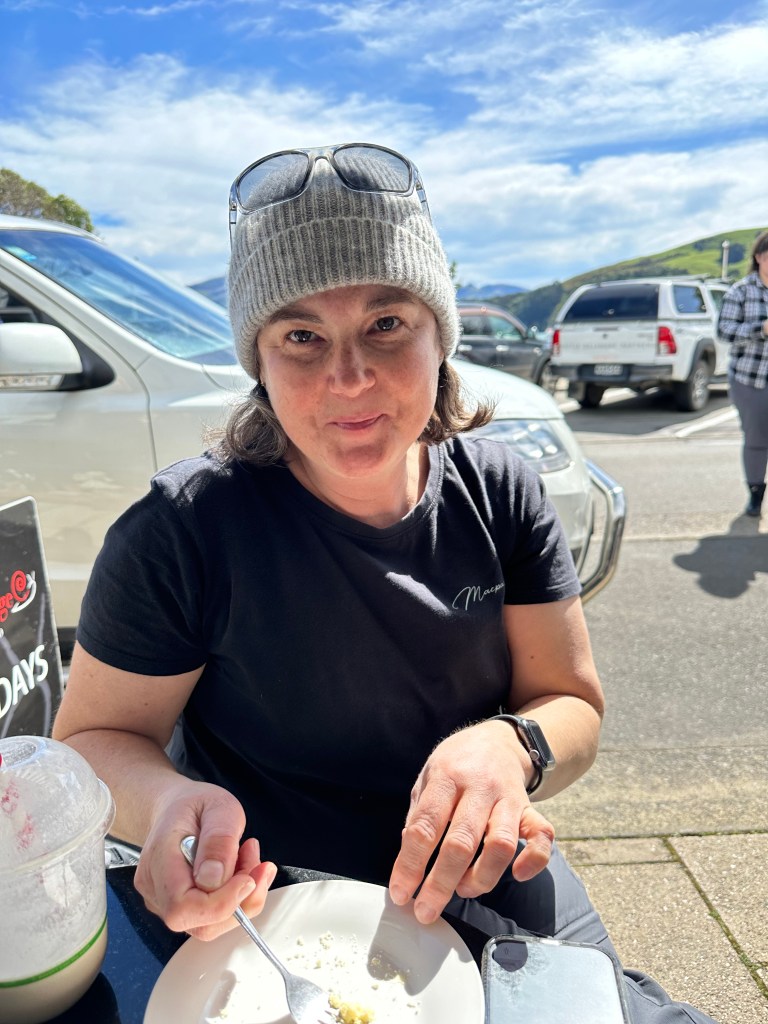
    Great macarons and beautiful day.

    The weather continued to be very changeable and had a couple of bumpy nights on anchorage, both in Childrens Bay and later in Takamatua Bay. We also had a lot of fun trying to retrieve Gavin’s claypot from a bay near the heads as the weather turned quickly in the few hours it was down and we had to get Taurus close in to some rocks to pick it up. Another lesson learnt!

    As a storm was predicted we took Gavin up on his offer and made use of his mooring. Childrens Bay wasn’t protected from this wind direction and we had a pretty rough 24 hours. We’d managed to refill our diesel jerrycans just before the storm hit, planning to leave the next day. The timing meant that we couldn’t get the dinghy back on the deck in the wind (they tend to take off like kites as they’re being raised in decent winds) so left it tethered behind. The next day we had a knock on the hull and looked out to find someone had brought our dinghy back before we even realised it was gone. The new 12mm painter (line that holds dinghy to boat) had chafed through and allowed the dinghy to escape. Fortunately it had gone straight ashore and escaped any serious damage.

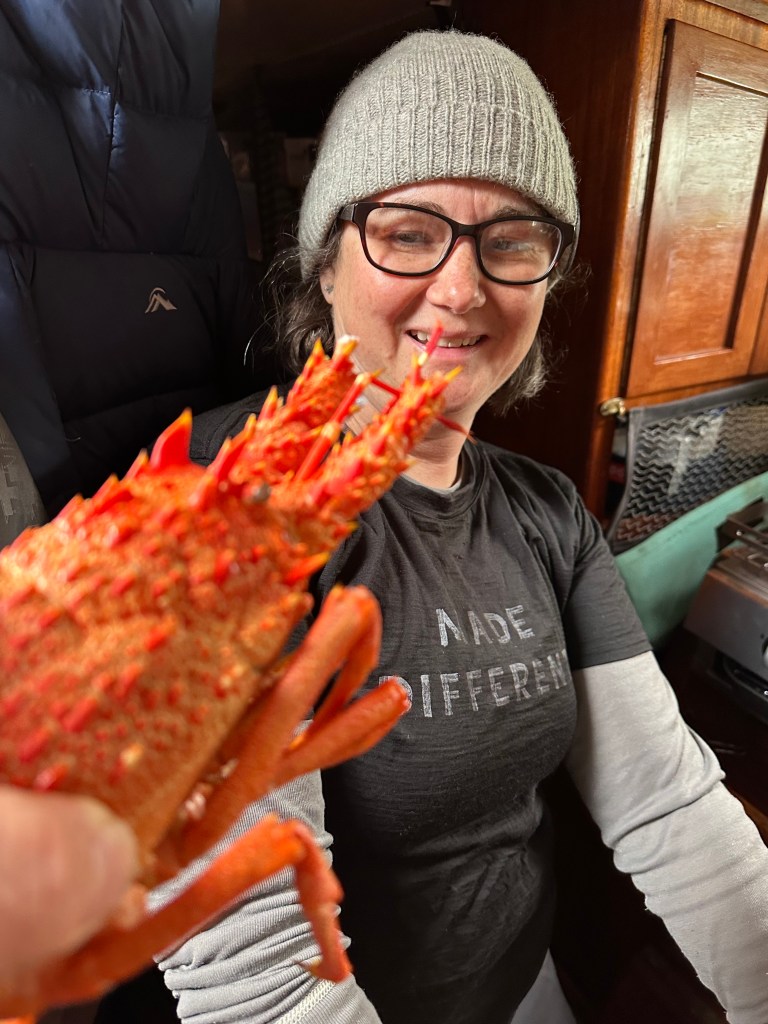
    Cara meets crayfish. Rarrrr!
    Crayfish and paua patties. A sight to delight all Kiwis.
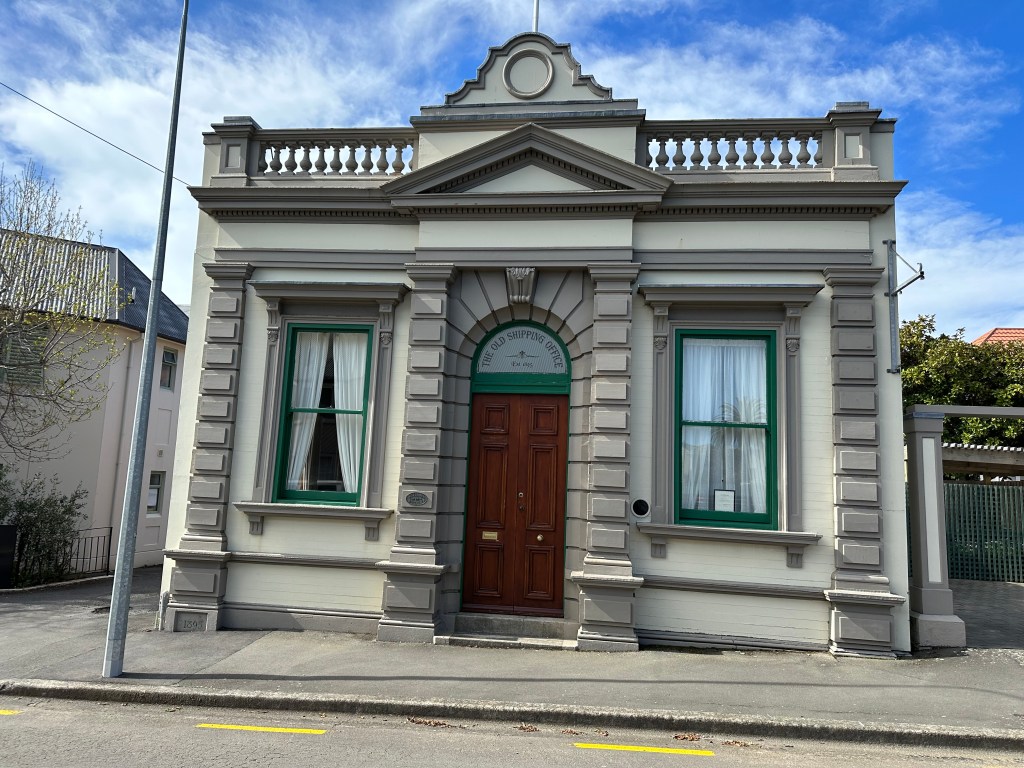
    Lots of historic buildings in Akaroa
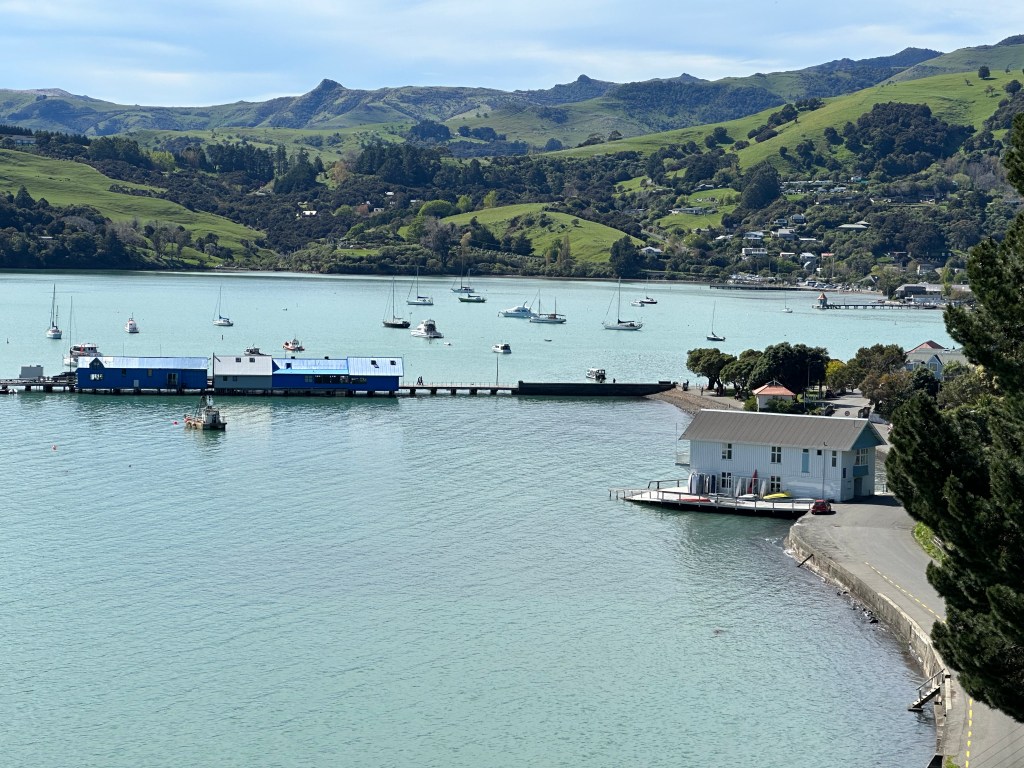
    Akaroa. Taurus sits on Gavin’s mooring, furthest boat, centre of picture.

    With the prospect of another storm coming through, Cara and I had to decide what to do next. This storm was predicted to be worse than any of the others we’d recently experienced, and was to veer from the North West to South West, which meant finding a sheltered anchorage particularly difficult. We’d been told about some spots further round Banks Peninsula, so took Taurus to the jetty to fill up the water tank, bid farewell to Gavin, and headed out to sea with Pigeon Bay our destination.

  • Otago Yacht Club at sunrise

    The longed for day finally arrived and the house we had been building for about two and half years was finished, in our possession, and ready to be rented out.

    By this time we were living aboard in Deborah Bay, having given up our live aboard status at the Otago Yacht Club when we left in January. The Otago Yacht Club committee subsequently decided to ban live aboards, a decision that had been in the wind for some years due to various club personalities and politics, and which hopefully will be reversed soon. Being able to live aboard is a great opportunity for those wishing to go cruising on their boats for any length of time, as it lets you work out what you need (and don’t need) and allows you to get the boat ready. The club also seems much quieter without people around, but perhaps that’s how some people like it.

    We were waiting for a weather window to head north to Akaroa, but, predictably, the weather wasn’t playing the game. Akaroa is about a 36 hour sail from Dunedin across the Canterbury Bight, a serious body of water, especially as a direct line takes one about 40 nautical miles (about 80 kms) off shore. There are lots of cargo ships and fishing boats in this area and we had previously met an experienced sailor who got knocked down several times in a storm and barely lived to tell the tale. It’s not somewhere we wanted to be if the weather wasn’t right.

    Having waited about a week we decided to stick our nose out of the harbour and see if the weather predictions matched reality. We found the weather wasn’t too bad and thought we might head north to anchor for a night or two around Karitane, a local community just up the coast. However, once we started sailing we thought we might as well keep going and head to Oamaru, about 8 hours away.

    Quiet few drinks before departure aboard Kintyre

    The weather was pretty variable switching from nothing at all to 30 knot plus gusts, so we were kept on our toes. Then about six hours into our sail we were fortunate to be called up by a local fishing boat who warned us of a number of cray pots in our path. Cray pots can be the blight of passing vessels. Essentially a welded steel cage dropped to the seafloor with a rope attached to a float so they can be pulled back to the surface, the idea is to catch crayfish (a NZ delicacy, like lobster but minus claws) but craypots can be equally adept at catching yachts. Should the rope get tangled in the propellor or rudder the boat can be trapped, and the only remedy may be to go for a swim with a knife, which is easier said than done in cold water and with a steel yacht bouncing around above your head. We were sailing, which is good on one hand because the line is less likely to get wrapped in the propellor, but not so good on the other as the boat is much less manoeuvrable.

    We were surprised by the number of pots, which ranged in the dozens, and went on for what seemed several NM. If nothing else, trying to spot pots is a great reminder of how hard it would be to spot a man over board, as even though often brightly coloured, they can be very hard to see until close to, and, if spotted at a distance, they have a disconcerting habit of disappearing as they get knocked around in the swell, or dragged under water if the line is too tight.

    Some squally weather livened the sailing up

    Weaving through this minefield took a good deal of time and meant that we wouldn’t be able to get to Oamaru until after dark. Instead, we decided to call into Moeraki, a very pleasant spot where Cara and I used to go camping when were first courting, and a contact in Oamaru was able to hook us up with a fisherman’s mooring to use for the night. 

    Sunset approaching Moeraki

    The next day we left early and threw a line over the side as we headed back out to sea, quickly catching a barracuda. These fish aren’t usually eaten in NZ because their flesh contains worms. However, they’re fun to catch and they make very good bait. We reasoned that there may be some good fishing to be had near where we found more cray pots, so stopped to see if we could find some blue cod. As usual, Cara quickly hit the jackpot and brought tea on-board. 

    Nice blue cod
    Silly gull

    A crowd of mollymawks soon joined us, hoping to be fed. These birds, whose name comes from the Dutch for ‘silly gull,’ belong to the albatross family and are incredible in the air, sweeping along millimetres above the surface of waves.

    The rest of the sail to Oamaru was pretty uneventful. We had stopped there several times before, so knew to make our entry parallel to the shore and as close to the right hand of the seawall as one dares. The left hand side of the entrance is silted up so that it is easy to run aground there. The commodore of the Oamaru Yacht Club had found us another mooring to use (thanks Kevin) so we weren’t plagued by the roll that can get quite bad if you aren’t tucked in. Though we didn’t know it at the time, Oamaru was to be home for the next 9 days, as we were unable to find a window to continue north to Akaroa. Strong winds, veering 180 degrees in direction every 12–24, hours meant that we were happy to stay put. Little did we know how bad this unpredictable weather pattern was to get and how many weeks it would last…

    Next time: we head to Akaroa for French fun and frolics!

    Taurus in Oamaru Harbour
    Steampunk…
    Belgian micro brewery. Mmmmm beer.
  • Hansel at the Customs Dock clearing out of NZ

    Cara and I had met Dave and Jackie when visiting Oamaru in 2021. They were living aboard their Hanse 370e Hansel having been trapped by the Covid lockdowns. Dave was from Melbourne Australia, Jackie a Kiwi, but as the boat was registered in Australia the tax man decreed that they had to leave or import their boat and pay GST on it.

    The easy decision was to leave, and Cara and I were quick to put up our hands and offer ourselves as crew. Unfortunately, the lack of flexibility with dates meant crossing the Tasman in mid-Winter, which is less than ideal, but was still too good an opportunity to sail off-shore with experienced cruisers.

    We left Nelson on 15th June on a bright and sunny day and Dave soon had the spinnaker flying. The weather picked up that first day and I came down with the dreaded mal de mer, something I rarely suffer with. Whether it was lack of recent sea miles, the livelier movement of a more modern yacht, or the Thai we had for tea the night before, it was a miserable 24 hours.

    The voyage was a mixture of fresh winds and doldrums. Being becalmed in the middle of the Tasman allowed one of the coolest experiences with Dave and I stripping to our undies and going for a swim. The closest land was about 1,200 km’s away, and the depth of the water was about 5kms. Dave had an old mask and when he handed it to me and I looked down into the depths I will always remember this incredible blue light that seemed to radiate up. The experience was also pretty sobering. I’m not a great swimmer and I’ve been suffering with a torn shoulder muscle for the past couple of years, but even in my ‘togs’ I could barely keep up with the boat slowly drifting along at about a knot and a half. If I ever fall overboard catching up with the boat is unlikely to be an option.

    Dave in his happy place.

    The days passed and on day nine we caught sight of Tasmania. A Westerly gale was predicted but we were all keen to press on, a decision that led to a memorable eighteen hours. Just on dark and as we were approaching the channel between Tasmania and Flinders Island, which gives access to Banks and Bass Straights, the winds rose almost instantly from about 15 knots to 35 knots. Poor Hansel took an absolute hiding for the rest of the night as we tried to maintain headway and a safe distance from the various islands that pepper the route. The boat banged from one side to the other, water began leaking in a top hatch, the bilge alarm was going off, the steering seat jumped from its mount and got wedged in the wheel. It was an eventful end to the trip.

    Cara, happy in her work.
    End of night shift.

    Early afternoon the next day we saw the welcome sight of the lighthouse at Low Head that gives access to the Tamar River. The passage had taken ten days and made us realise how much we had to learn, whilst giving us confidence that we had a good base knowledge to take our own boat off-shore and continue accruing experience.

    Back on terra firma at Beauty Point

    The trip wasn’t quite over as Hansel needed to be taken to Port Phillip. Cara and I had a couple of weeks free whilst Dave and Jackie sorted their boat ready for the next leg, and whilst we waited for a weather window to cross the notorious Bass Strait. We decided to get a camper van and have a look around Tasmania, somewhere we had always wanted to visit. The depth and quality of history, nature, and food in this Australian state is second to none, and if you haven’t been we would thoroughly recommend you go. Summer might be a better time for living out of a van though…. we were lucky to find a couple of cheap sleeping bags in an op shop to bolster the pretty minimal offerings the rental company provided!

    Hobart historic area.
    Tall ship, Hobart.
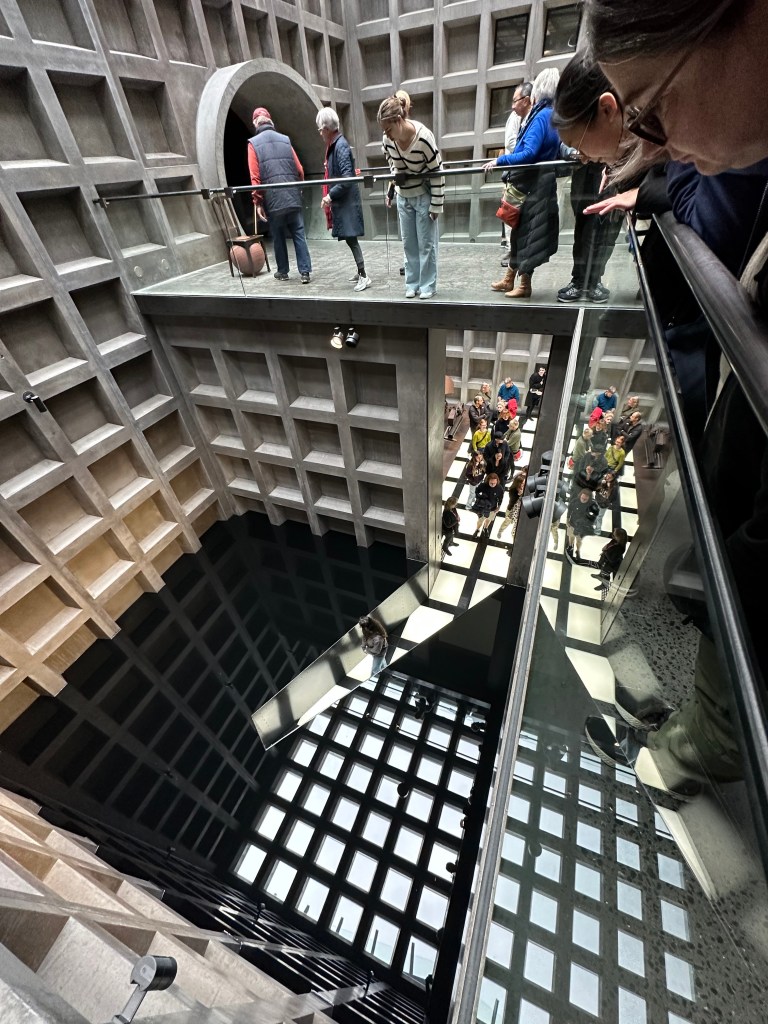
    Installation at MONA, Hobart.
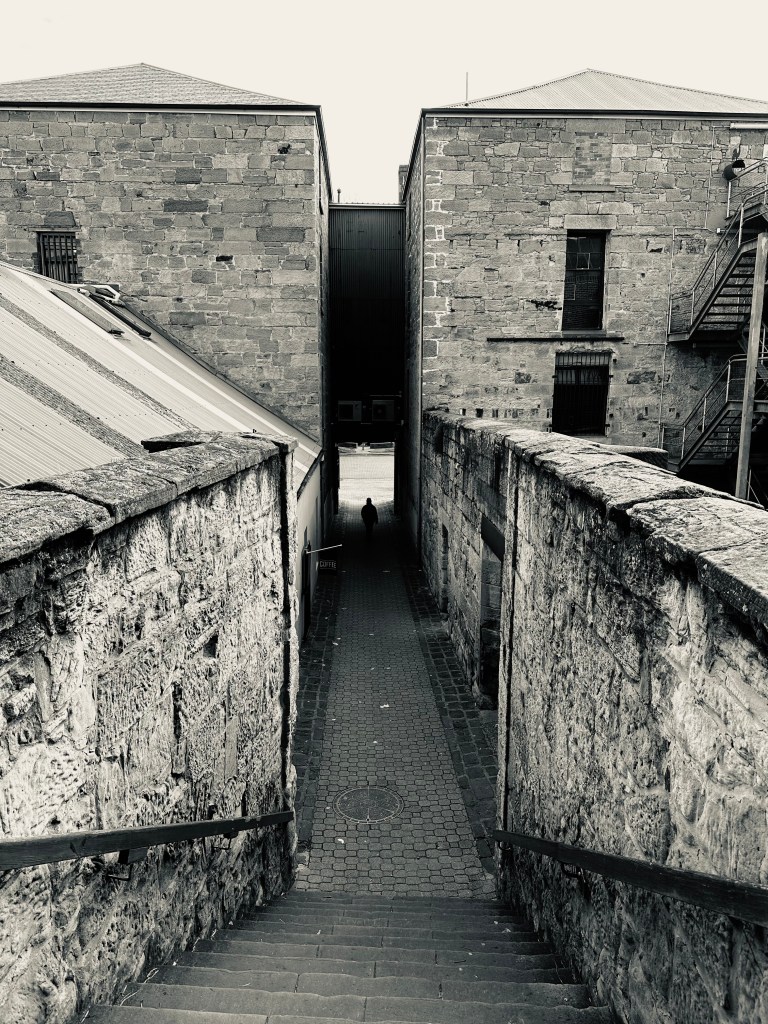
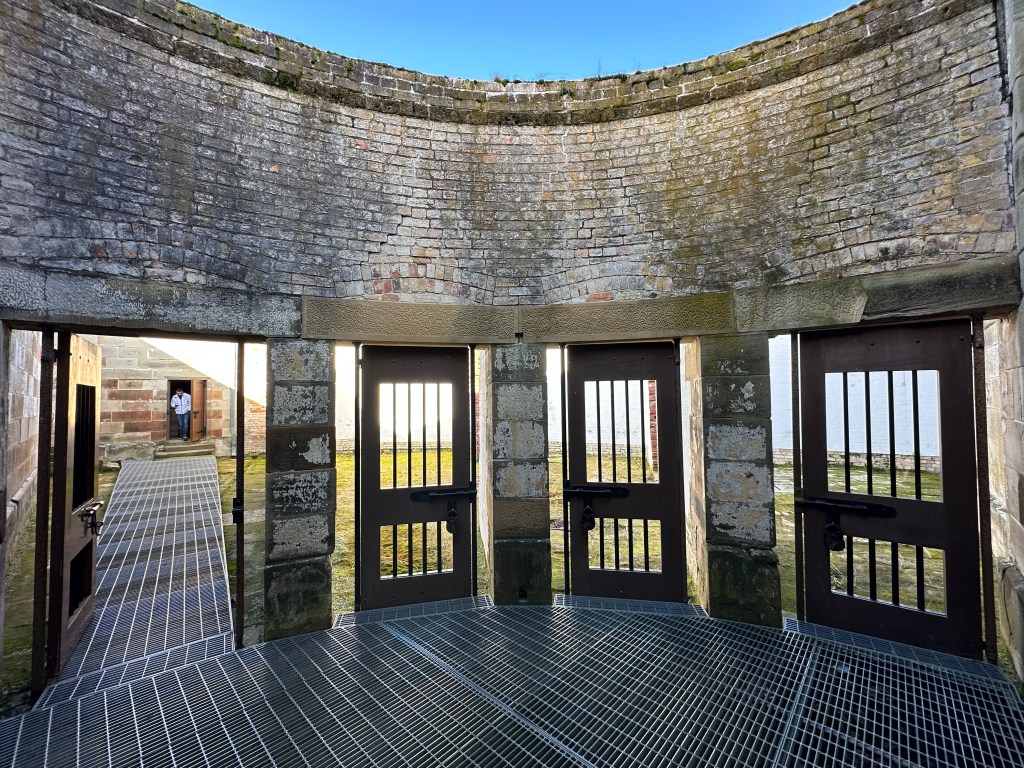
    Port Arthur Historic Convict Site
    Lucky girl at House of Anvers Chocolate Factory

    The final leg to Port Phillip was pretty uneventful as the weather gods played ball. One embarrassing incident occurred when I went to make a sandwich after my watch at about 2am. The boat was heeled well over so I had to lean on the bench top to keep upright. When I went back to the cockpit to talk to Cara who had relieved me, she noticed my pocket was flashing. Somehow I had managed to set off my PLB which was in my jacket pocket. Never having set it off before we briefly wondered if the flashing lights warned of a low battery, but we quickly realised that we had to try and turn it off, the only way to do so being to extend the aerial… Hoping that no signal had been sent, the unit only having been set off for a minute or so, mainly inside, and without the aerial raised I decided not to wake anyone. However, an hour or so later the Australian Coast Guard called us up on the VHF to make sure we were all OK. We had only just got back into VHF range so presumably they might have sent a helicopter to find us if we hadn’t answered… It’s nice to know that these things work, but clearly they aren’t sufficiently idiot proof to be entrusted to me!

    Playful dolphins near Port Phillip.
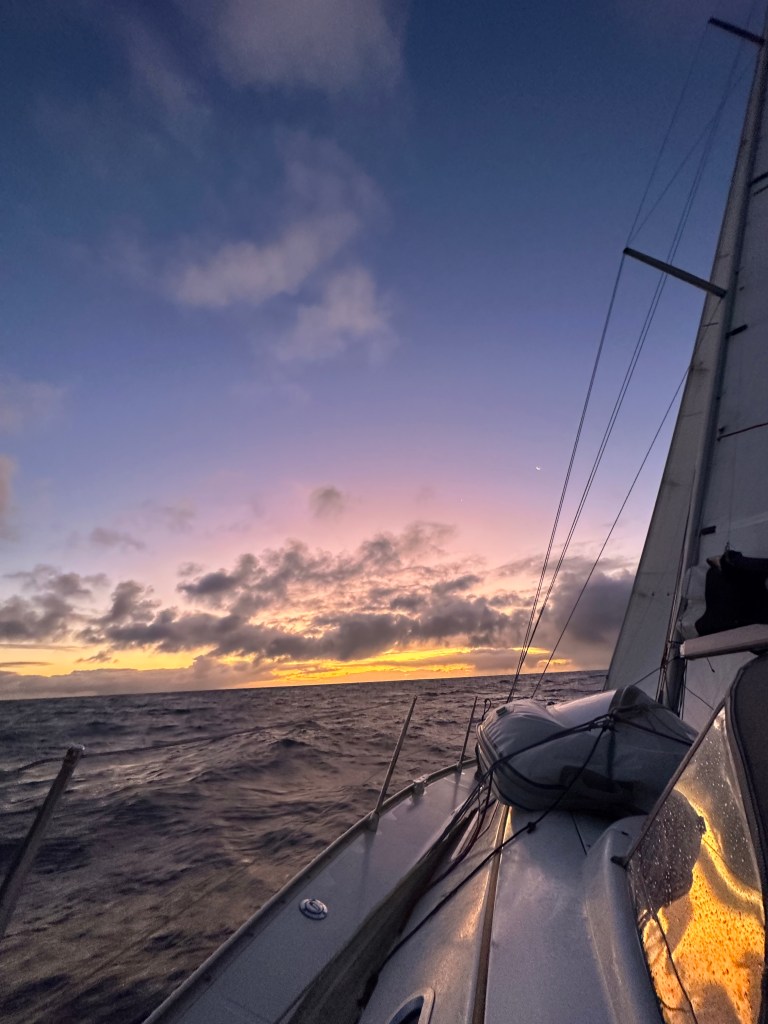
    Sunrises and sunsets always seem more beautiful at sea.
    Jackie in her ‘onsey’ sleeping bag. The envy of all!

    The entrance into Port Phillip is very narrow and sees massive amounts of water racing through with the tides, as well as the massive container ships that supply Melbourne. We had a leisurely sail waiting for the right tide and then a calm journey to Sorrento where Cara and I were to disembark. We had plans to visit relatives in Melbourne and catch up with friends at the Sydney Boat Show, so our our journey wasn’t quite over yet, but the sailing element was sadly done.

    Many thanks once again to Dave and Jackie for imparting so much knowledge and making us feel so welcome in their home.

  • Broad Bay, Stewart Island

    At the time of writing this blog our trip to Stewart Island is some eight months in the past. Cara and I had started the process of building a house in 2021 and, despite using a national company that advertises itself as “NZ’s most trusted builder”, the process had gone well and truly pear-shaped. Constant delays and obvious build quality issues led to a communication breakdown. As the house was unfinished and the builders were refusing to do more work we had decided to head away on our trip. Neither of us were working as we were supposed to be travelling, lawyers were involved, and there was nothing that we could do beyond stressing about the lies, incompetence, and double dealing. Our builders were refusing to honour the contract we had signed and essentially told us “if you don’t like it take us to court.” Unfortunately, taking builders to court takes years, costs hundreds of thousands of dollars, and would have prevented us taking possession of our house. Ultimately, we were forced to return to Dunedin to try and sort the mess out. Having been forced to swallow our pride and accept a pretty one-sided agreement, our builders promptly went into liquidation, leaving us to deal with our building ‘insurance’ company, Master Builders, and the liquidators. I can’t adequately describe how bad Master Builders are to deal with, and how corrupt they appear to be as an organisation, suffice to say they cost us months of stress and thousands of dollars. But, enough of that! Stewart Island was so amazing that I have to add some more information and photos here for anyone else thinking of heading that way, and Port Pegasus is the jewel in its crown.

    Taurus lies in Shipbuilders Cove. This was our fist time using stern lines, a technique which allow boats to anchor in small anchorages.

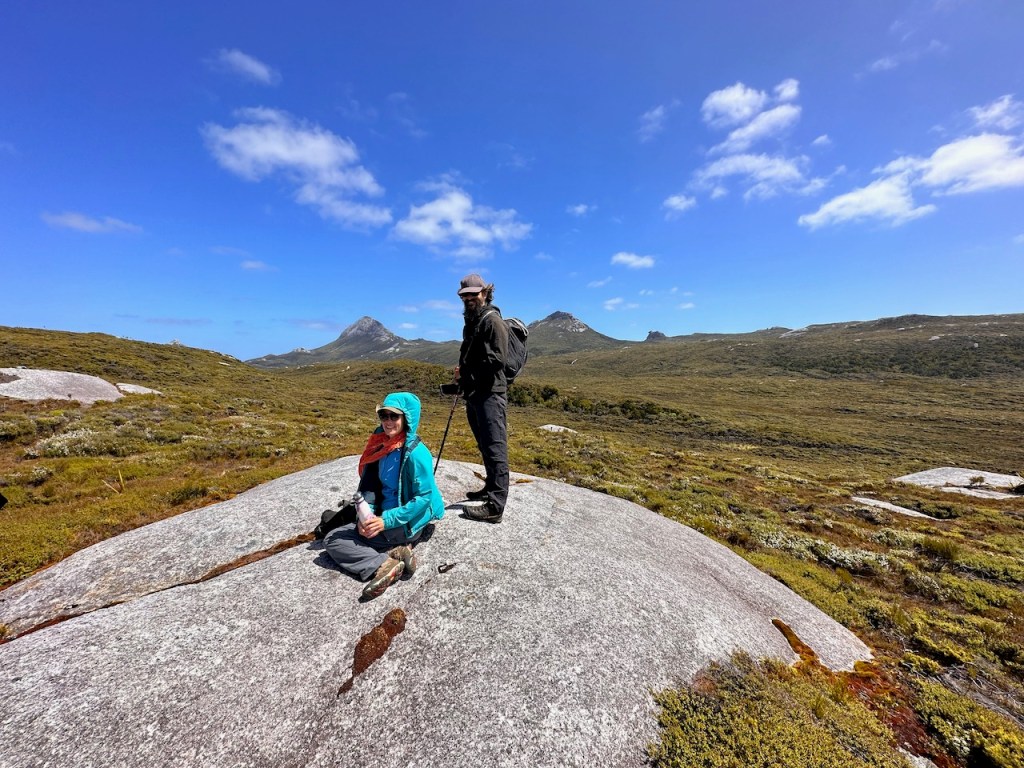
    Shipbuilders Cove in the South Arm of Port Pegasus provides access to a track that takes the intrepid walker to one of the local landmarks: Bald Cone. The walk is steep but short and gives incredible views of the surrounding area and amazing rock structures.

    It was hot day so I was eager for a refreshing dip in the crystal clear water. My ‘bath’ saved me from having to bare all having a deck shower later on too!

    There were other numerous memorable events in the following weeks. Like meeting Gert and Christine, a couple who had lived on the land for years and were now travelling around NZ on a converted trawler. They taught us how to process and cook paua, scollops, and kina. It’s one thing to gather these NZ delicacies, that are crazy expensive in shops, but relatively common in Stewart Island, but another to know how to clean and cook them!

    Sealions are another feature of Port Pegasus. These amazing creatures are completely unafraid of humans and whilst often aggressive if approached on land are relaxed and curious in water. The first couple of times sealions approached when we were snorkelling there was a general scramble for the dinghy! We soon learnt not to panic however, and instead learnt to welcome interactions with these gentle giants. They would swim up to us and turn and pirouette in front of us, clearly trying to work out what these weird things were with their yellow fins! Though I have heard they sometimes nip divers, the sealions we interacted with always kept a respectful distance of an inch or two, and never came across as threatening.

    DCIM\100GOPRO\GOPR4439.JPG

    After a few more weeks fishing, snorkelling, and hiking we left Pegasus to meet friends in Port Adventure. Pete, Ross, Gary, and Tony have been taking their trailer sailers to Stewart Island for the past twenty odd years for an annual pilgrimage. We had a great time catching up, but all too soon it was time to head north to Pattersons Inlet and then back to Dunedin to the ‘real world’ of bills, lawyers, and arguments.

    Safety first! But not too far to swim if you fall in…
    Pete’s hospitality is legendary — and hangover inducing!
  • Wing on wing for nearly thirty one hours.

    So, the big day was finally upon us. Cara had finished her last shift and December 31 2022 saw us throw off the lines and head up Otago Harbour. At the heads we turned right and enjoyed a northerly breeze of ten to fifteen knots. Our destination was Port Pegasus at the South East corner of Stewart Island, a Mecca for local sailers but not easy to get to due to the sou-westerly that prevails in the area and the often rough conditions.

    Rather than try to arrive in Pegasus at night we decided to stop in Lords River, a beautiful spot with plenty of anchorages. The trip had taken thirty one hours and we had ‘celebrated’ New Year’s Eve at watch changeover with a quick peck and a mumbled “Happy New Year!”

    The water at Lords was stunningly clear and cold, and the sealife far more abundant than we were used to in Dunedin. Orca whales turned up in the evening, splashing and frolicking in the sheltered waters.

    Cara takes the plunge

    After spending one night and meeting fellow cruisers on Noomie and Wild Bird we carried on to Port Pegasus. Just before we arrived an un-forecasted westerly sprang up giving us about twenty knots on the nose and making our entrance via the aptly named Narrow Passage quite exciting.

    Narrow Passage, Port Pegasus

    Once in the Port we headed to a recommended anchorage at Cod Fish Reef, in Evening Cove, South Arm. The anchorage demanded a fairly tight turn around some submerged rocks and didn’t have a huge amount of swinging room. Pegasus is well known for needing stern lines at most anchorages, a new skill that Cara and I had yet to try, let alone master. Not surprisingly, Cod Fish Reef was a decent spot for fishing, and we soon had a couple of fat blue cod for dinner, though the presence of an inquisitive sea lion kept us on our toes. Over the next few weeks we felt fortunate to see plenty of these animals. Graceful and beautiful in the water, bulky and ungainly on land.

    Stewart Island is a dark sky reserve, though we were so far from any town that that fact hardly mattered. Other than the presence of a couple of hunting huts, with no electricity, and some other well-spread out cruisers in various anchorages we were in the wilderness, one of the last truly wild places left in New Zealand. Here, if you get into trouble you have to get yourself out.

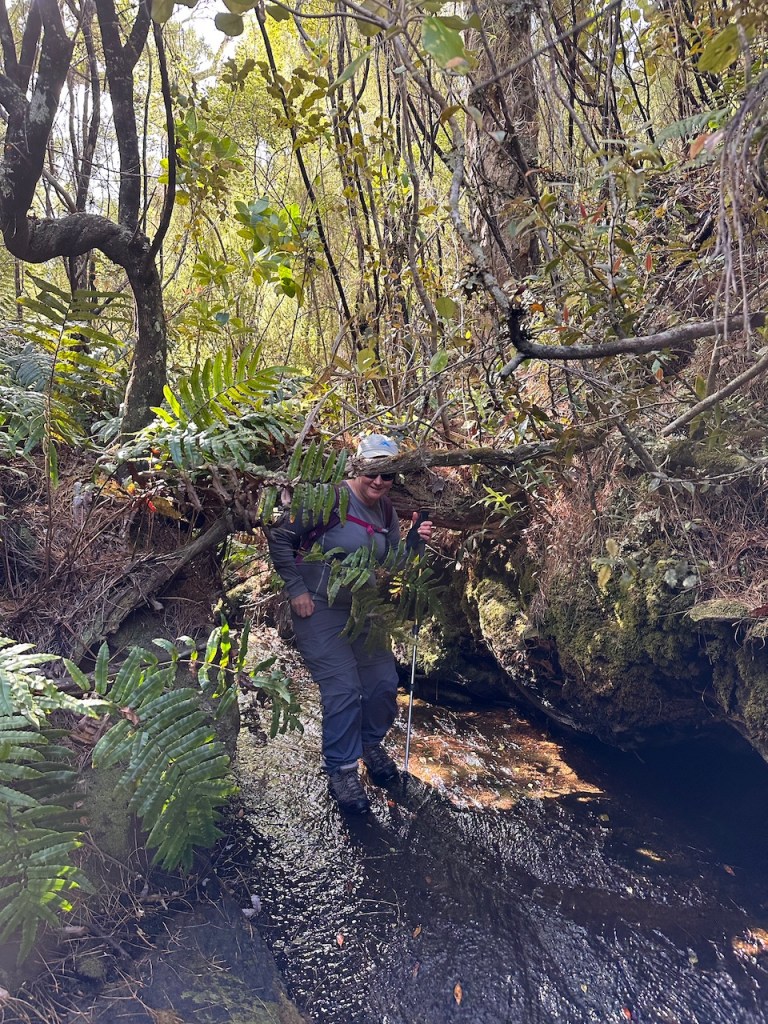
    This point was underscored when we decided with the crew of Noomie, Daniel and Anna, w to try and climb Magog, one of the famous peaks in the area, the other being Gog. The cruising guide reported a track but this had long disappeared, and the Manuka was dense and had to be literally fought through. Foolishly, I had worn shorts, normally de rigeur in NZ tramping, but my legs became badly scratched so that forcing one’s way through the scrub became increasingly painful. Progress was also painful, and having reached a point about an hour from the base of Magog we realised that if we didn’t turn around we would have to spend the night out. We returned with new respect for the land, and those who had tried their hands in the early industries here: sealing, whaling, timber milling, and tin mining.

    Daniel and Anna enrolee to Magog – mountain to the left of Daniel.
    The start of the ‘track’ to Magog.

    Next time: more adventures in Pegasus…

  • Another snowy day as live boards in Dunedin. At least we had a heater installed for the second winter!

    Hiatus

    We successfully sailed Taurus home to Dunedin in the month’s leave that we had before having to return to work. The trip was a mixed blessing: beautiful anchorages, stunning weather, and meeting all manner of friendly folk who went above and beyond to help us; on the negative side we found a number of issues with our new purchase that the surveyor had not noticed and the vendor had kept quiet about. We were also pretty rushed and after being ‘storm stayed’ in Napier for ten days and in consequence had to sail directly first to Lyttleton and then Dunedin. 

    In many ways we’d ‘enjoyed’ a baptism of fire and if Taurus needed a bit more work that anticipated, at least we also knew that she sailed beautifully, and would repay a little work in spades. Our belief that ‘we look after Taurus so Taurus can look after us’ has become a bit of a mantra, and sometimes the hardest thing has been to know when to stop working on her, because a boat, especially an old steel boat, will soak up all the money, time, and effort that its owners, or slaves, are willing to throw at it!

    Over the following two years we welded up a hole that I punched through the hull in the anchor locker when chipping off rust (it was above the waterline and we were on the hard thankfully), pulled out the engine and overhauled it, swapped the drive shaft out, installed a new dripless stern gland, painted the bilge, sorted out stray current issues that caused electrolysis and then sanded the hull back to steel because the paint was delaminating (which is caused by electrolysis), installed a new electronics package including auto pilot, (something that kept breaking down on our maiden voyage), added a holding tank, purchased a new main sail and anchor chain, and so on. The only major job left to do is overhaul the standing rigging, and the only system we haven’t been through is the fridge. The standing rigging will be sorted when we get to a centre that hosts riggers (the rig was checked during the purchase and only a couple of minor jobs recommended) which Dunedin does not, and the fridge when it chooses to crap out. 

    The joys of boat ownership. The engine doesn’t normally live in the middle of the cabin…
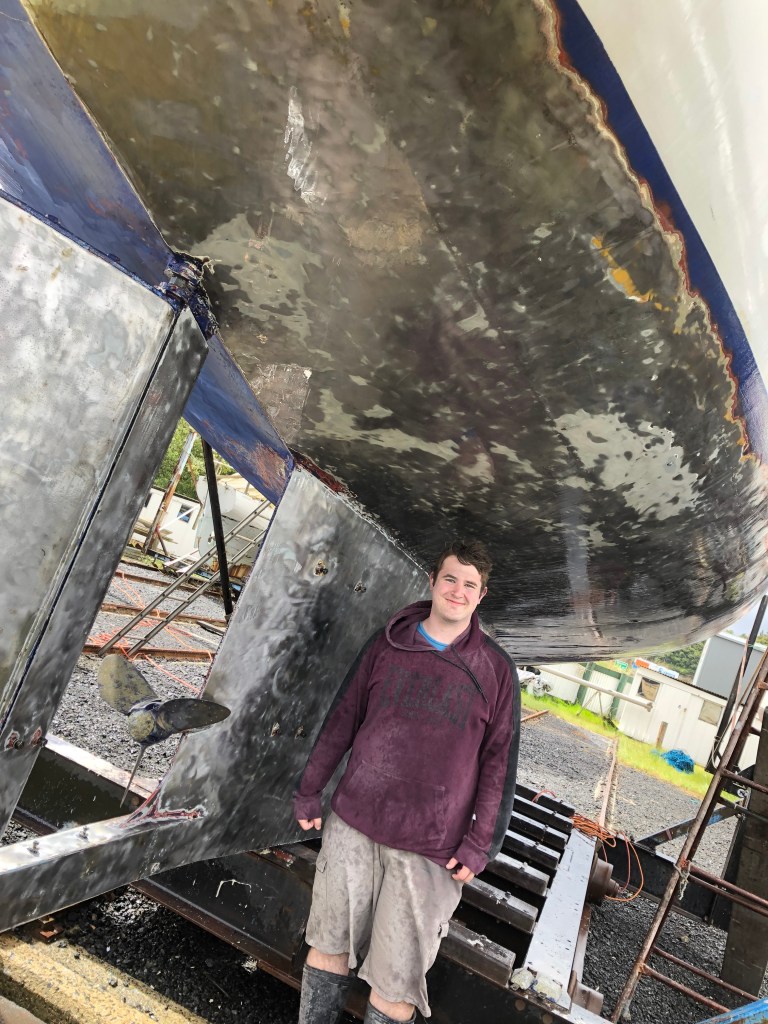
    My son, Daniel, helped to grind the hull back to steel as we couldn’t sand blast at our yacht club. An awful job, but we found that Taurus is remarkably fair and a credit to her German fabricators.

    So, two years later, we are finally ready to set off again! To be fair, the delay wasn’t just about fixing the boat, but more about getting our lives organised. We had to sell a house, build another to try and enjoy passive income (this has proven to be a nightmare — don’t ask!), finish a PhD, make some money, and arrange unpaid leave. Naturally, as everyone says, the hardest thing is to cast off, to leave the security of jobs, home, and family, and take a leap into the unknown. To do that thing that so many of us wish we could do, but don’t. To risk trying to find an identity beyond job titles, and see if our relationship can cope with 24hour a day contact, the boredom of rainy days in a tiny space that won’t sit still, and the stress of making the sea our home, and anchorages and strange marinas our common place.

    PhD graduation. Nice of the University of Otago to colour match their ceremonial robes with Taurus’ dodger and sail cover.

    Of course, one person in a partnership is generally the driving force, and it was certainly easier for me (Julian) than Cara to cut the ties. My father had carried a cartoon in his wallet for many years, which showed two tramps walking down a road. One says to the other, ‘why spend your life working at a job you hate, to buy things you don’t need, to impress people you don’t like.” It had been his dream to move onto a narrow boat and potter around England, but though he retired early he also retired too late, as two months later he died of a heart attack aged only 50. His death, when I was 18, had a profound effect on me and I resolved to never be trapped in a job or situation that I disliked or that bored me. In consequence, I have serially quit several good careers, emigrated from one side of the world to the other, and have a habit of ‘searching’, as one friend put it, for I know not what. Now, as old as my father was when he died, I found myself chafing against the restraints that held the (latest) dream at bay, and increasingly anxious to get away. I was also unemployed having quit my last job to work on the boat (and because I found I hated it), and felt near unemployable thanks to a crap attitude that refused to put up with the BS that comes will all jobs. Cara, on the other hand, had a well paid and respected job that she had worked decades to achieve, as well as close family living nearby, and a more sober disposition. Bless her heart, for unfathomable reasons she agreed to take the plunge…

  • Taurus

    We travelled up to Opua in the Bay of Islands to take possession of ‘Taurus,’ a 12 metre steel Feltz Skorpion IIa, on the 10th of October, and spend a week getting to know her. This trip allowed us to take advantage of a friend’s local knowledge, as he and his partner had chartered a yacht for the week. Somehow the trip up went smoothly, despite the massive weight in baggage we were taking, and we caught up with Elias, the previous owner of our yacht and went through the boat’s contents and systems with him. A long day took an unfortunate turn that evening when we manged to scrape our new (to us) dinghy against some rocks which were covered in oyster shells. These managed to puncture the dinghy — as well as Cara’s feet when she jumped overboard to push us off.


    A few days idyllic sailing followed with Peter and Penny, our friends from Dunedin. We spent one night anchored in Waiwhapuku Bay, Moturua Island, and watched three of four dolphins play for hours on end. The next day we set sail for Whangaroa, stopping for lunch at the Cavalli Islands. Both are beautiful spots, and big thanks to Peter and Penny for introducing us to them.

    Whangaroa Marina, Bay Islands
    Peter and Cara in Whangaroa Fishing Club — very good fish and chips!

    At Whangaroa we visited the local sports fishing club and after a few beers and a very good meal spent the night anchored in Pararako Bay, which is just round corner. Next day Peter and Penny headed back and Cara and I sailed back to Cavalli Islands where we spent the night. Thinking we should check the engine over — no easy task as you have to removed a number of sails, spare dinghy, and various sailing ephemera to access it — we were surprised to find a fair amount of water swilling round the bilge. A pretty miserable few hours followed as we tried various ways to get rid of the filthy water — a sponge on a boat pole, a rag under feet, a hand pump with extended tubing. Needless to say we ended up hot and filthy, and not a little concerned about where the water had come from. Elias had told us that we needed to pump grease into the stern gland every hour or so when running the engine, and empty a tank in the bilge at the end of every day. Thinking we had been a bit slack in this we made sure to do this religiously the next day… only to find water in the bilge again!
    Removing the water was pretty straight forward now that we were seasoned pros — though it was still a filthy job, and we discovered that a pipe that took water from the stern gland to the bucket had come loose. So now we knew where the water was coming from, which is always nice if you have to have water in your boat!

    Stern gland and bucket minus pipe..

    We returned to Opua and after a great night out with Peter and Penny in Russell bade them farewell. We now had to get organised for our departure, which was not straight forward. We had a number of containers full of filthy water, but all the bins in the marina were locked so than only marina berth holders could use them. Having no transport meant that there was no way for us to get rid of the containers and dirty rags, and we had to arrange to somehow leave our deflating dinghy on ‘Taurus’ and get ourselves and our bags to shore.. Luckily Tim, who had done the survey on ‘Taurus’ came to our rescue, and we were able to fly back to Dunedin having experienced some great highs (sailing and dolphins!) and frustrating lows (hours spent in the bilge)! Other problems that had arisen were a stripped bolt that held the outboard to the dinghy, finding out that the jib sheets were so short they couldn’t be used to pull the sail around when tacking, and a few other bits and pieces that added up to quite the ‘to do’ list for our return.

  • Having spent a little time living on board our current yacht, a C&C 34 called ‘Casino,’ Cara and I weren’t too worried about living on ‘Taurus,’ which is a little bigger at 39 feet long.

    Living on ‘Casino’ in Dunedin

    We had applied for and gained ‘live aboard status’ at our local yacht club, the Otago Yacht Club, which was important for Cara to be able to get to work for her anti-social shifts and to be able to respond in time for her on call role. Another alternative was live on our swing mooring at Deborah Bay — an hour up the harbour by boat (twenty minutes by car), but this option is far less convenient, as on top of the extra time it also means a row ashore, which is not always easy or dry.

    With the boat designated our new home we went ahead and rented out our house, and stored everything we didn’t want to sell in a detached double garage on the property. Having found nice tenants who signed a two year lease it was at this time that we found out that our live aboard had only been granted for three months. This was quite a surprise as the agreement we had signed was open ended, and even more so as as club members, many of whom were on the committee that signed off on our application, had followed our search for a new boat to live on, and the process of renting out our home as avidly as some follow a juicy soap. It appears that the misunderstanding started with the fact that the berth we were offered is normally occupied by another boat which was away for a three month period, but we had been given the impression that we would be able to move onto another berth when she returned (several other berths are in the process of being built) and our approved application had made it very clear that we wanted a long term arrangement. Anyway, the confusion has now been recognised and will hopefully be worked out, but it certainly made a stressful time more stressful.