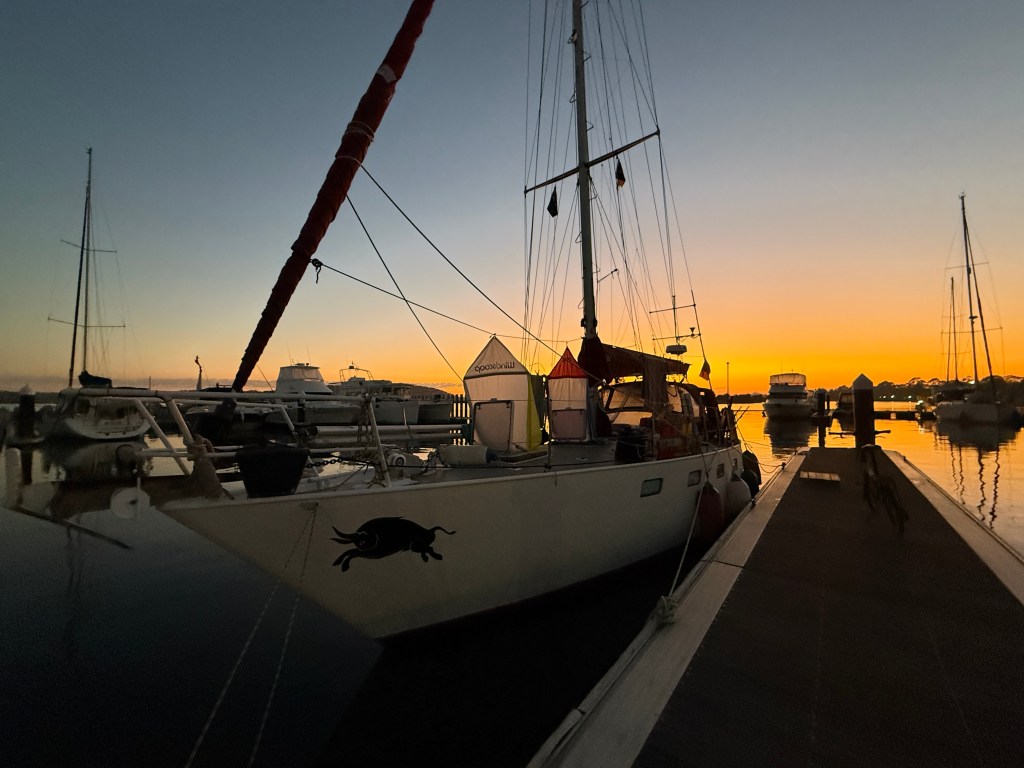
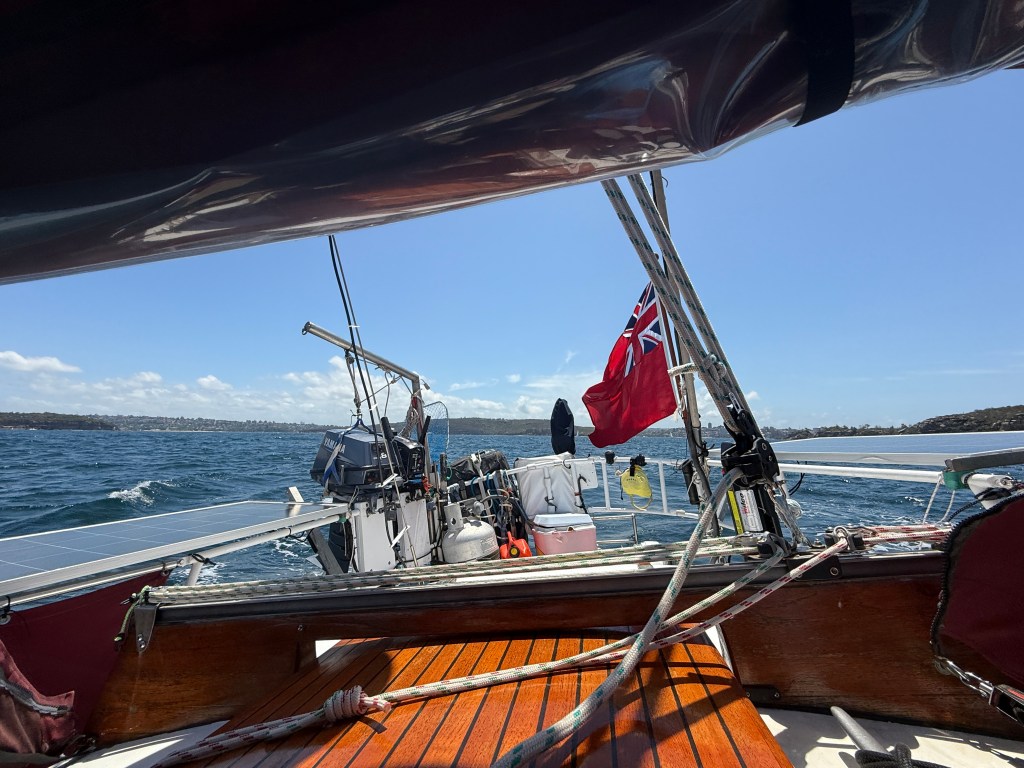
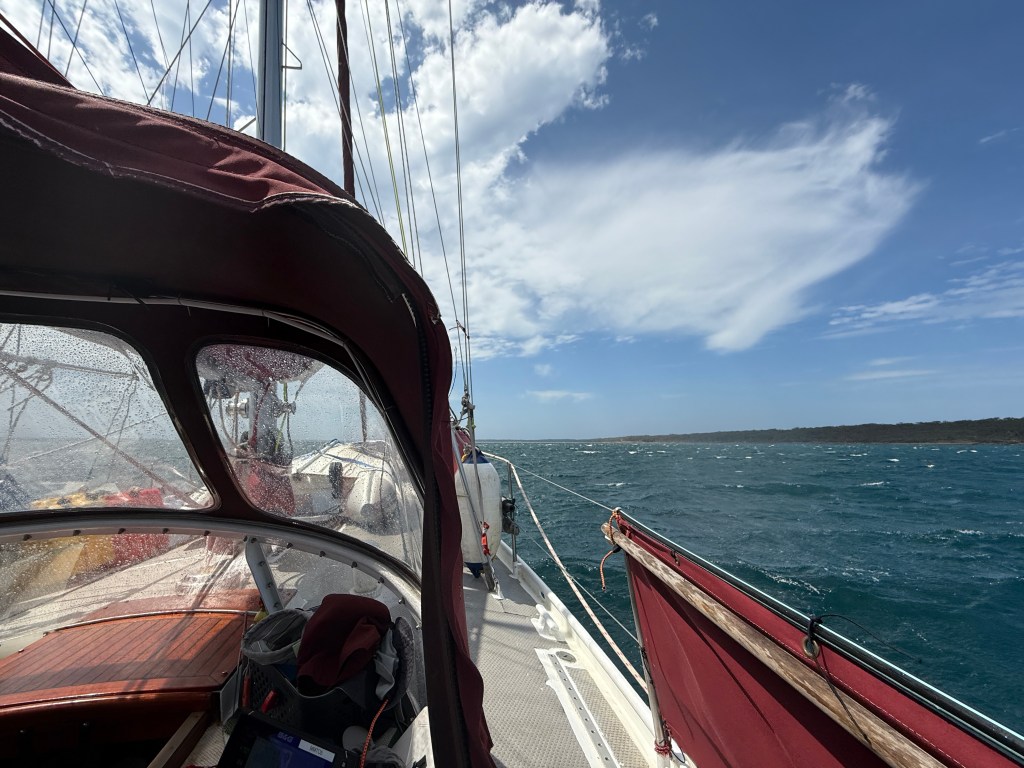
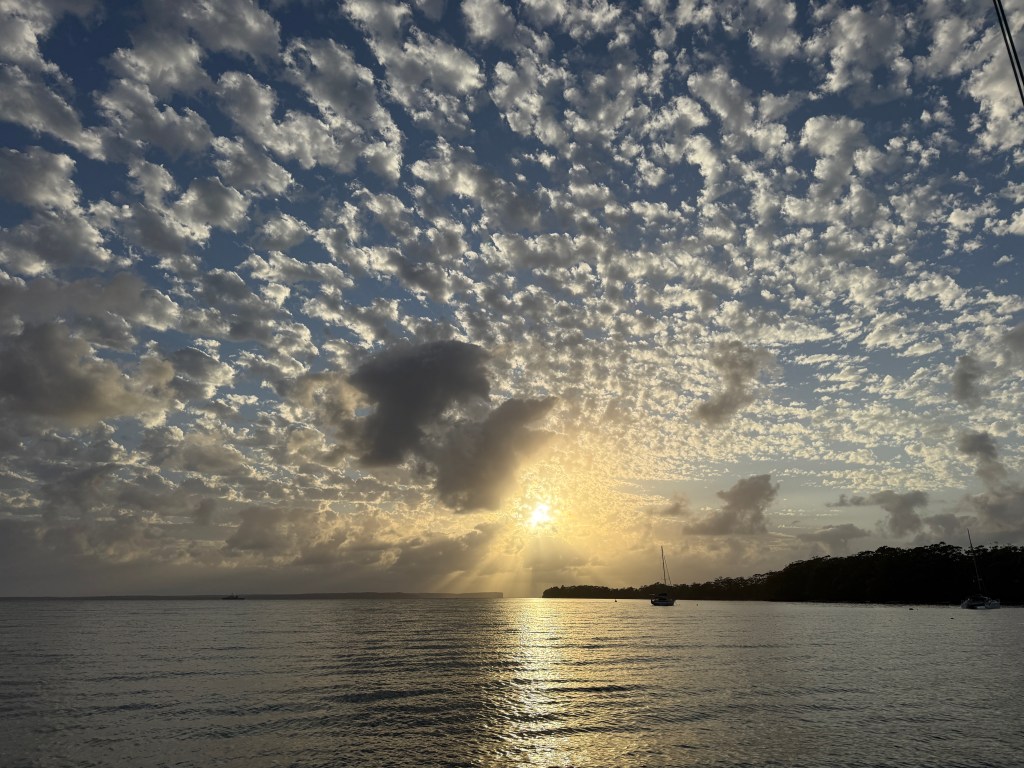
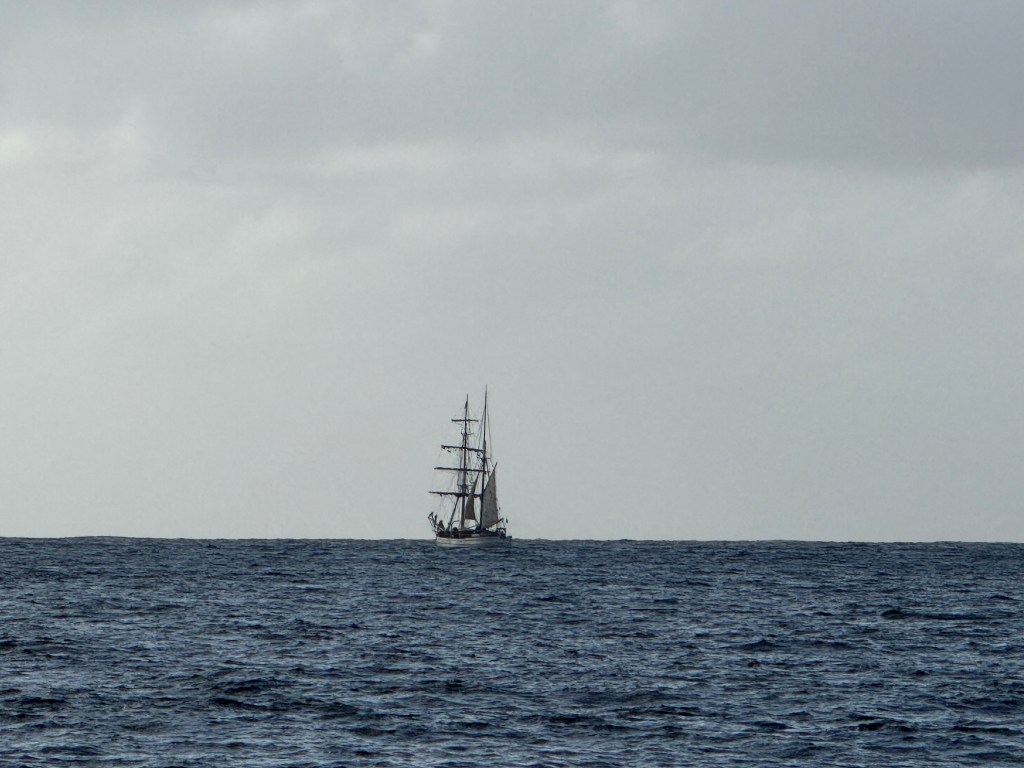
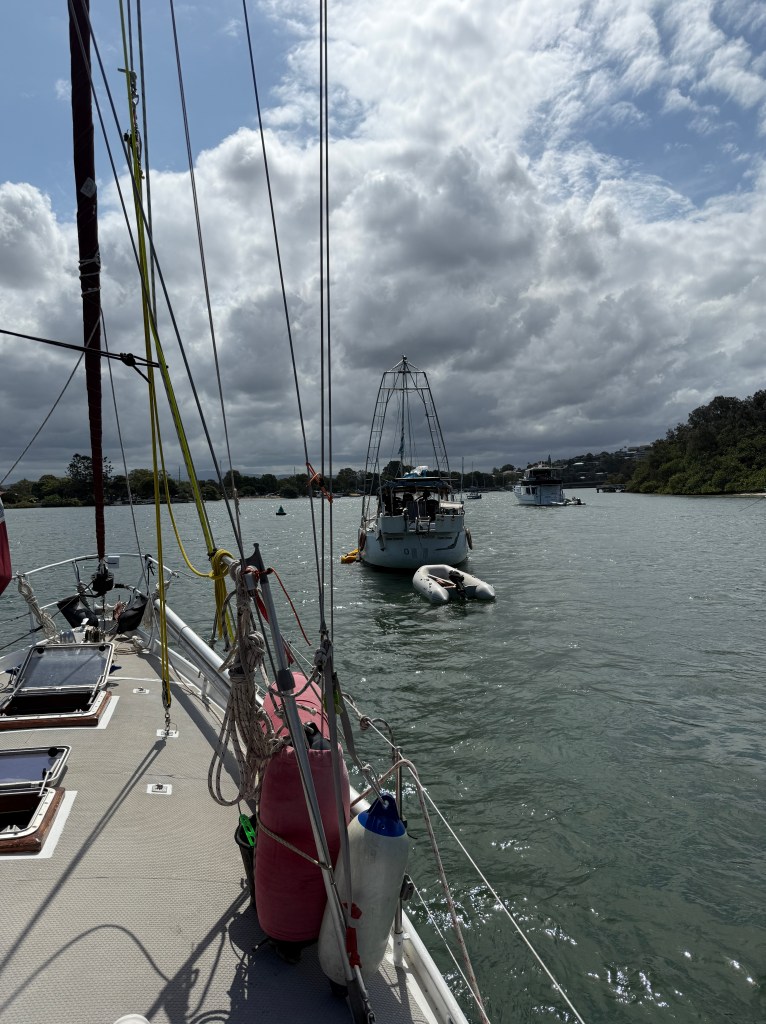
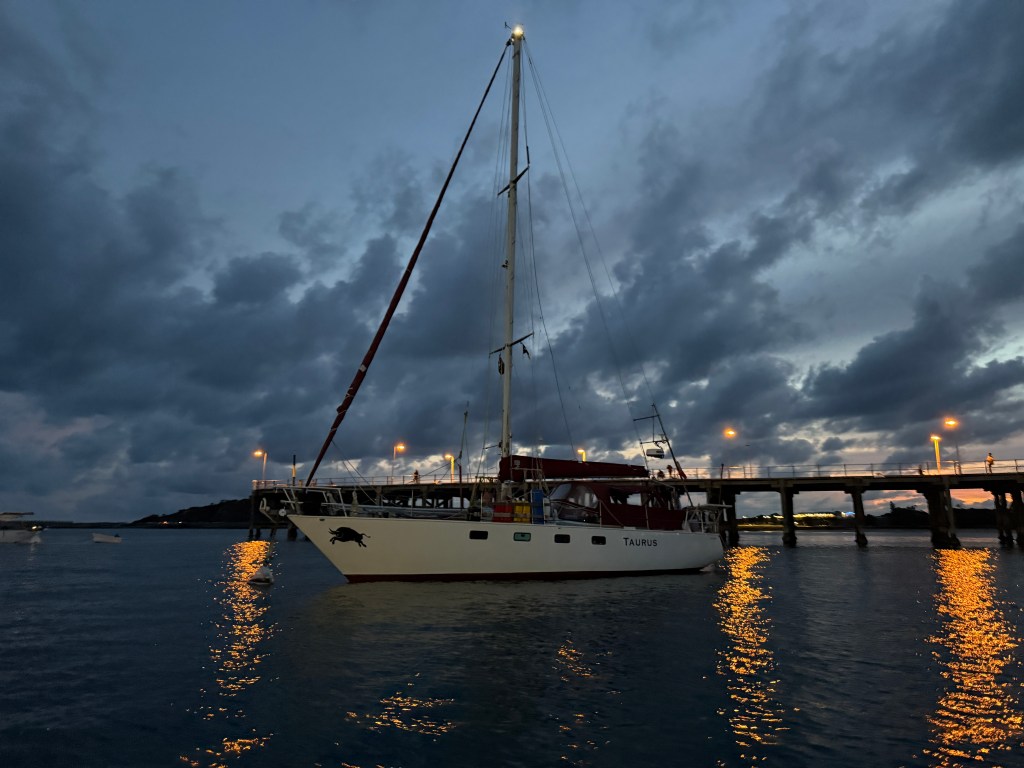
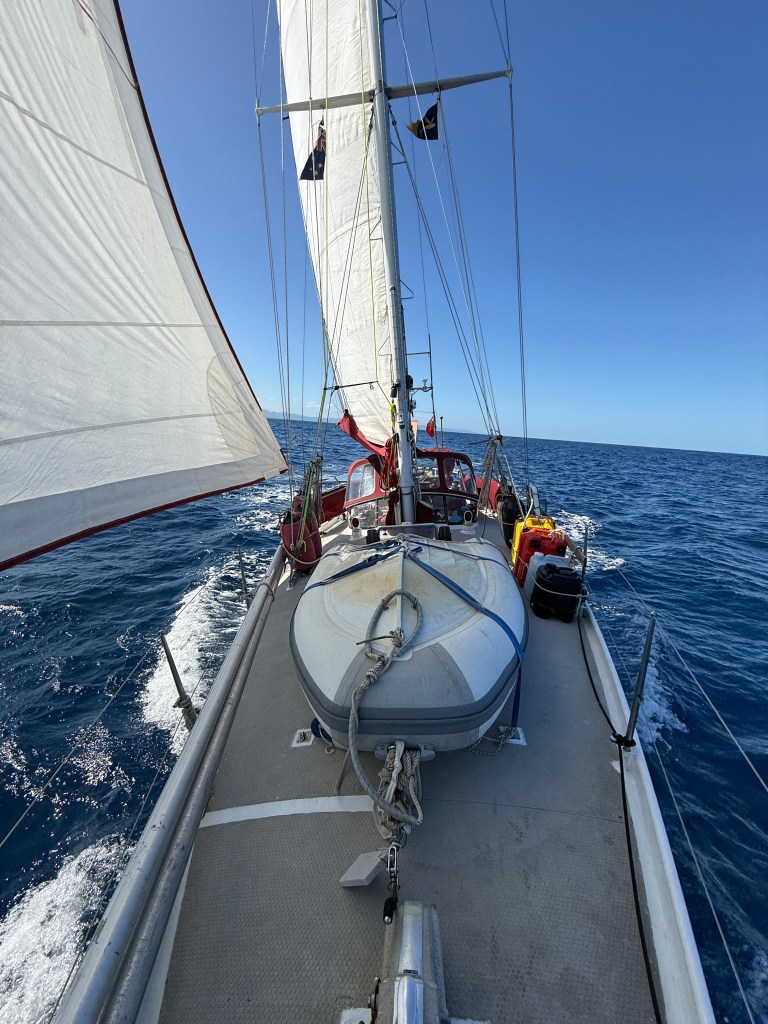
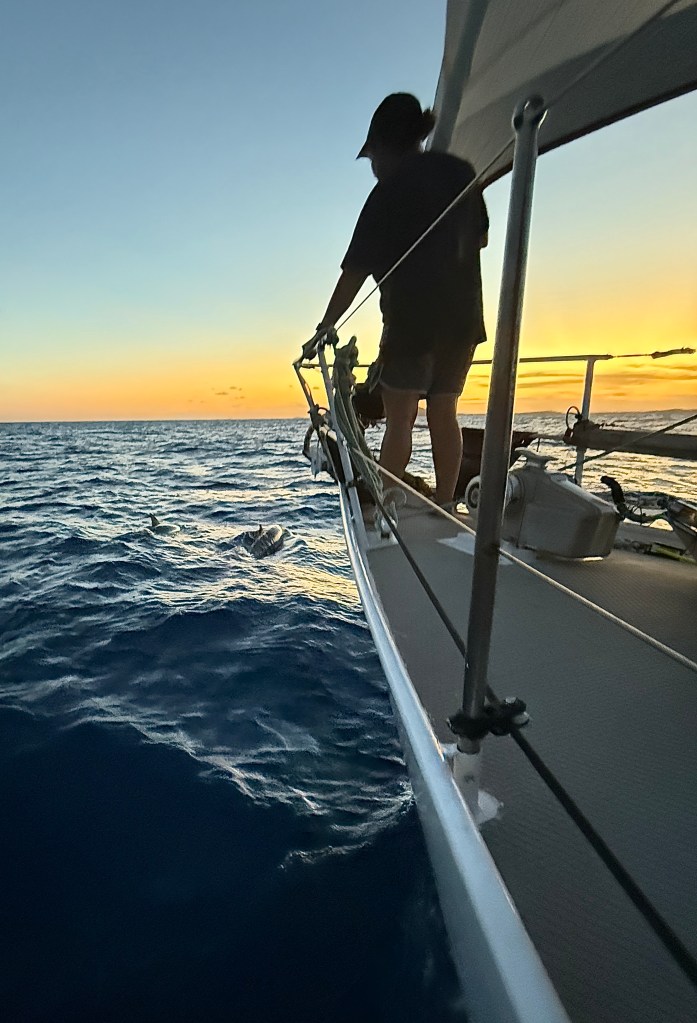
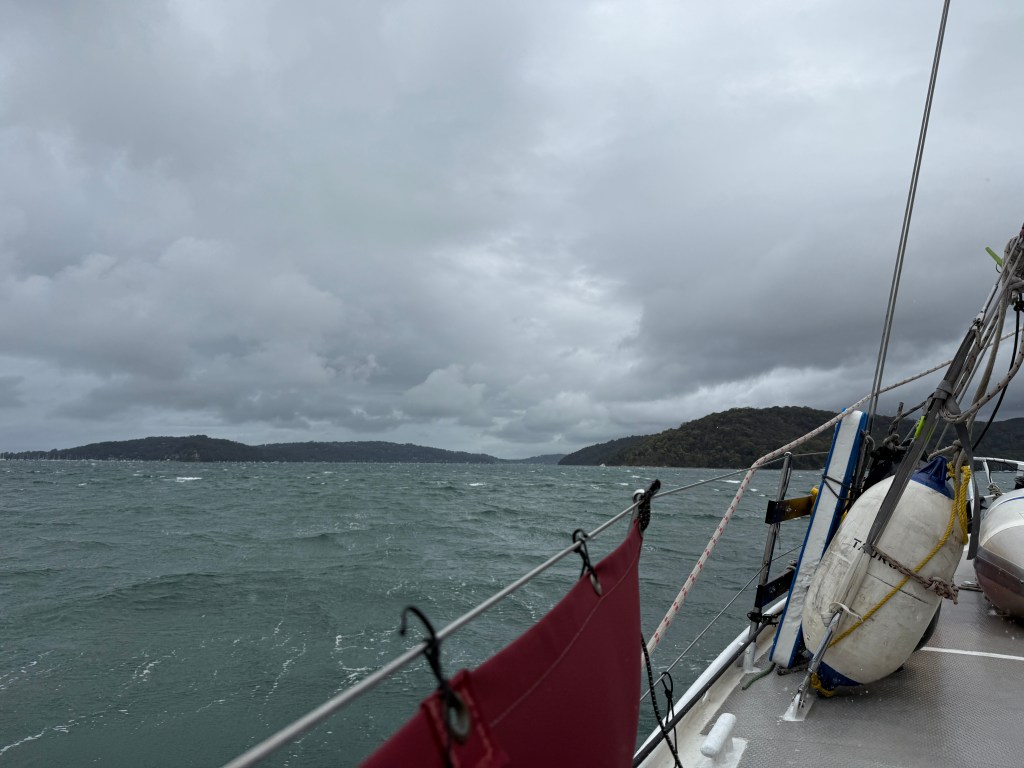
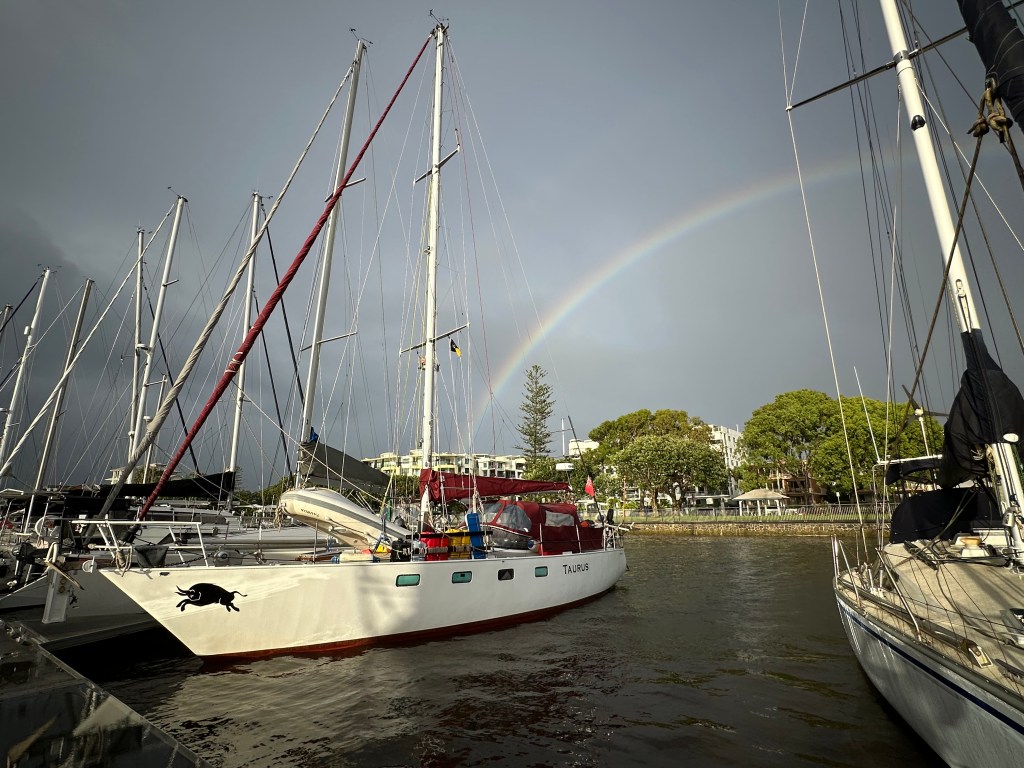
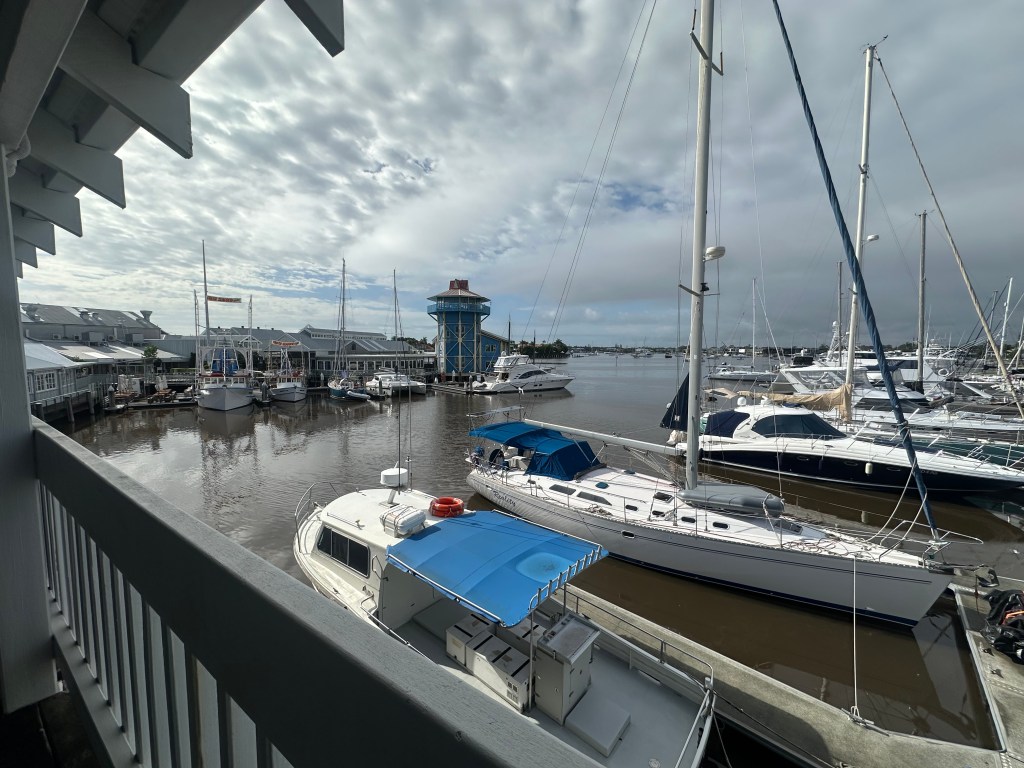
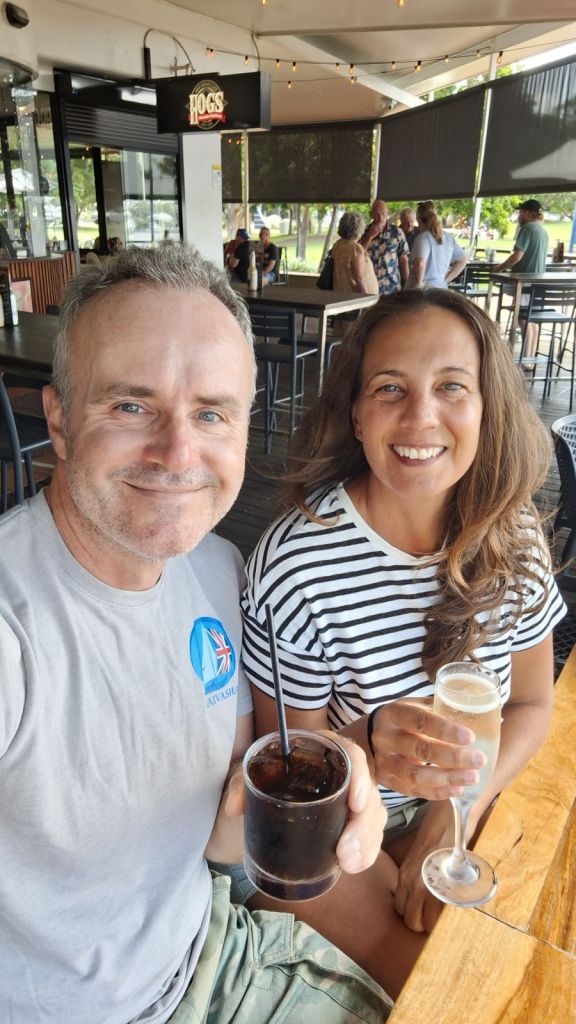
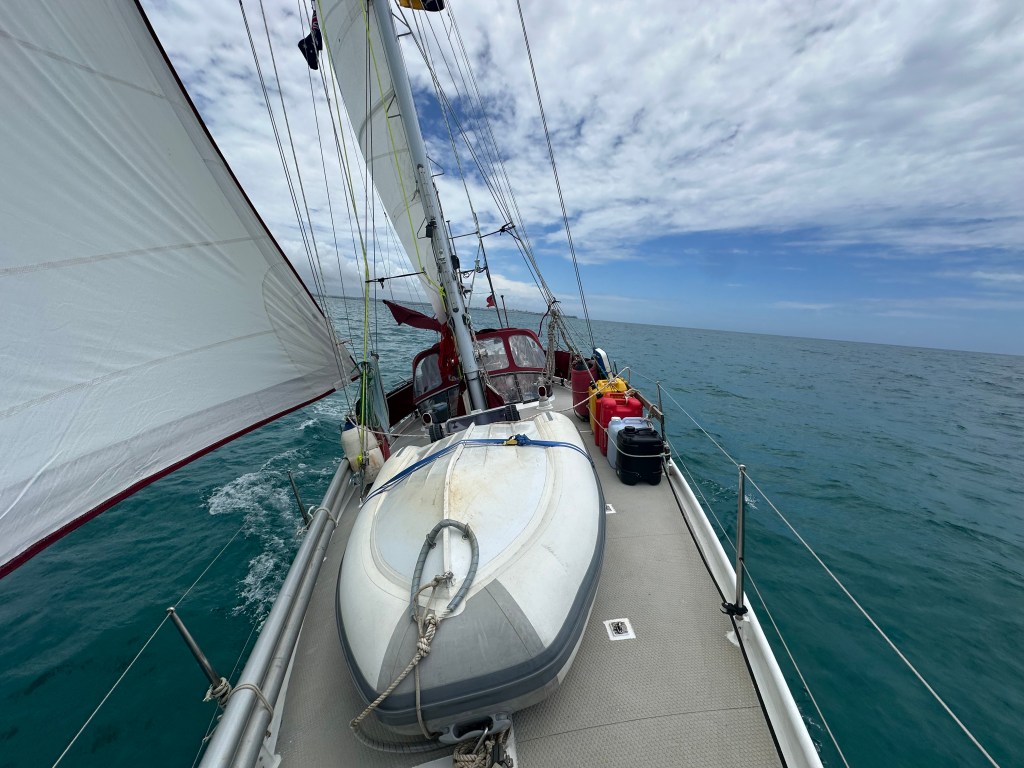
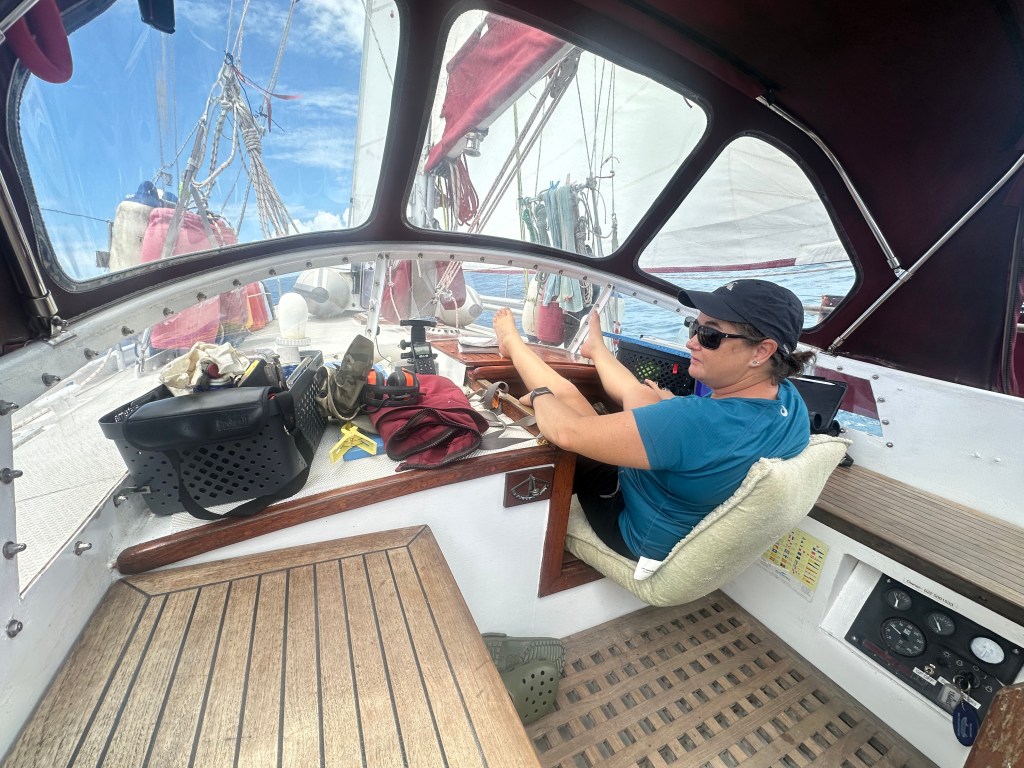
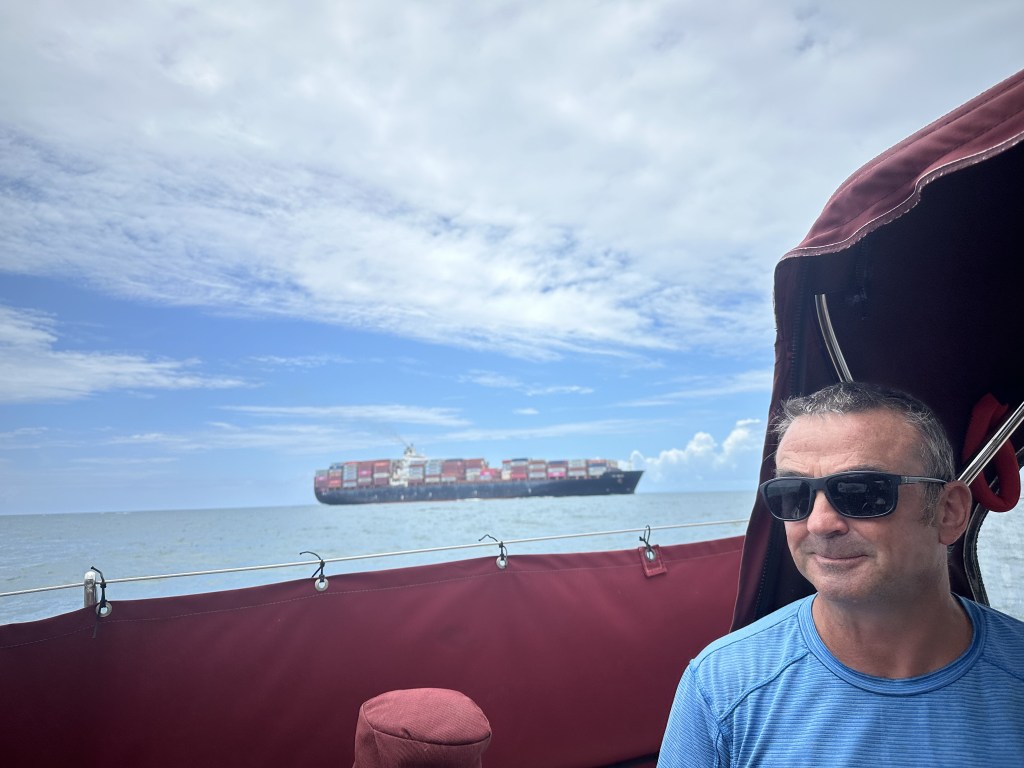
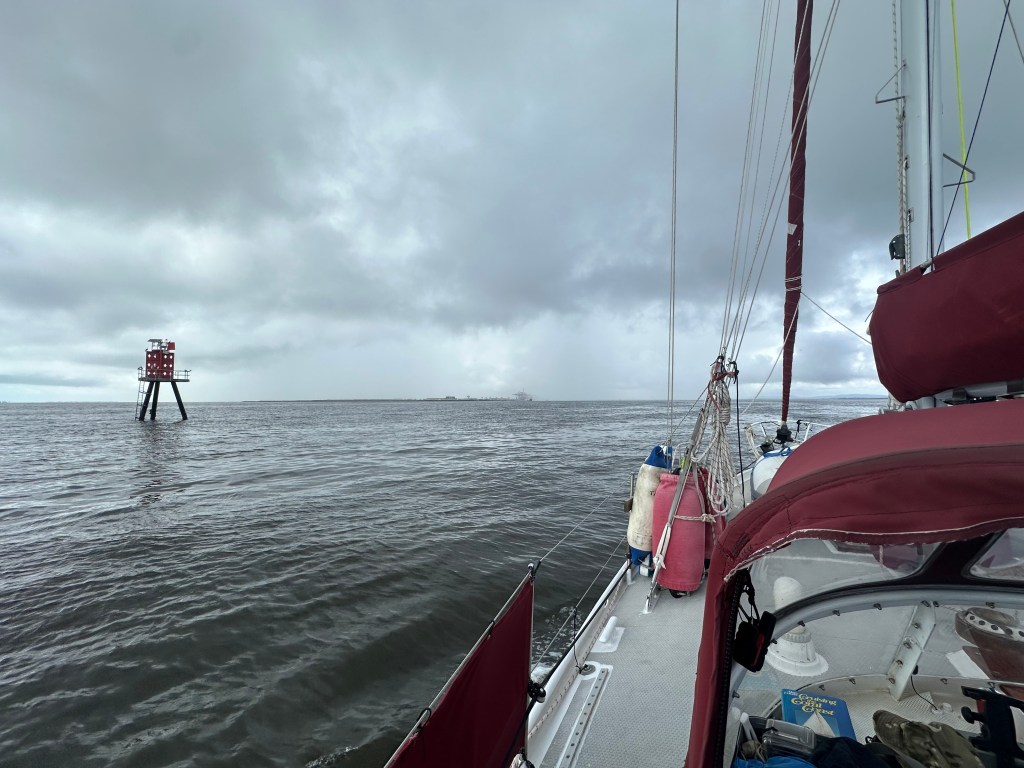
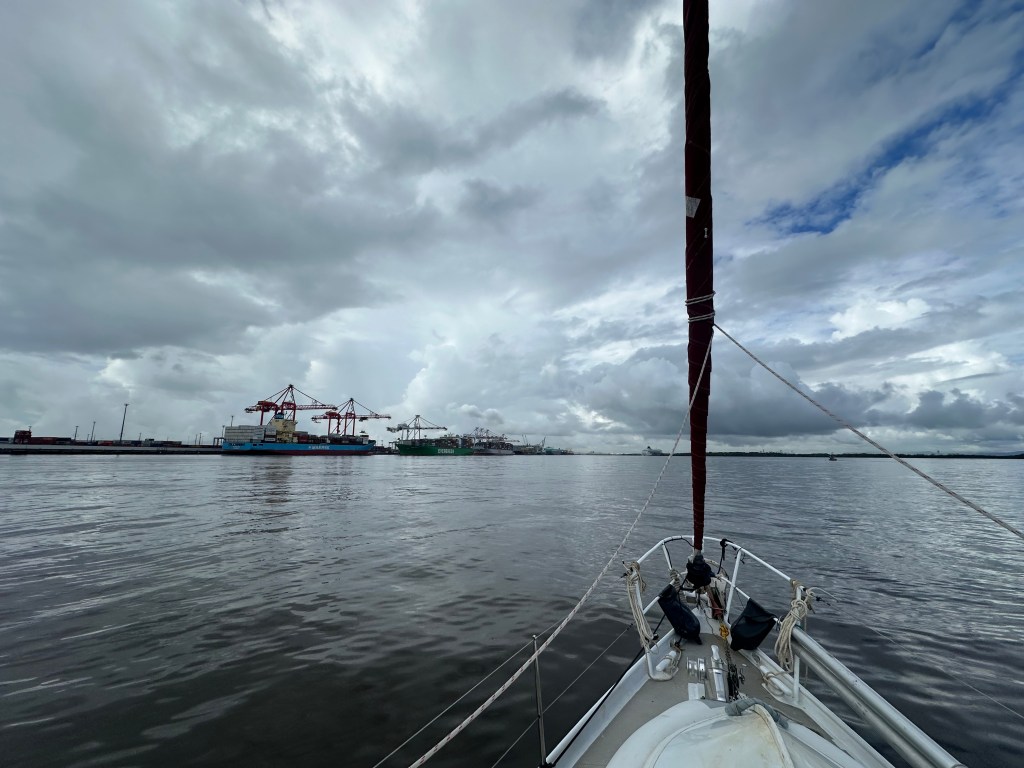
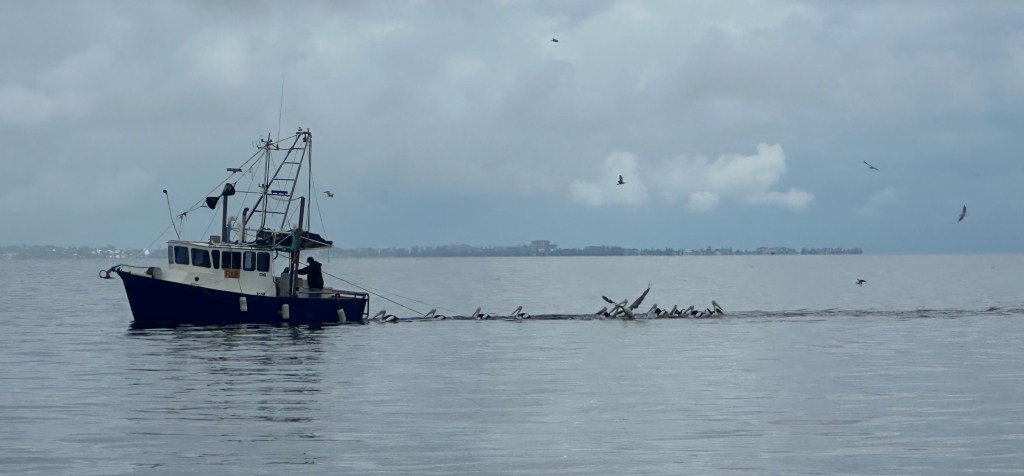
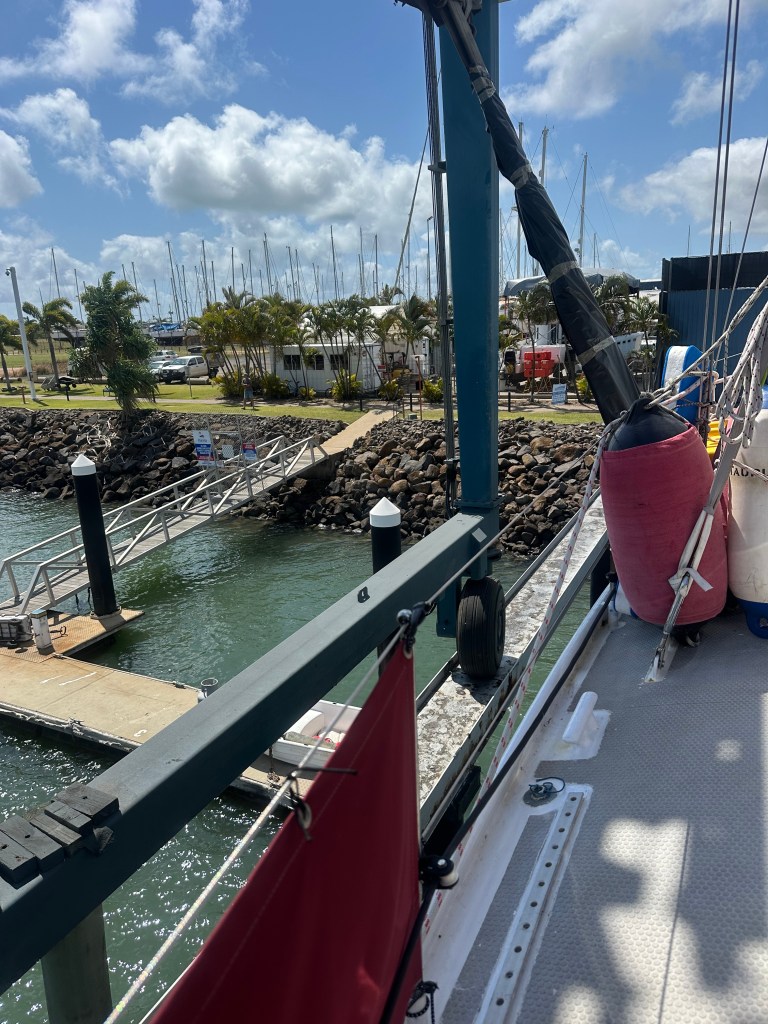
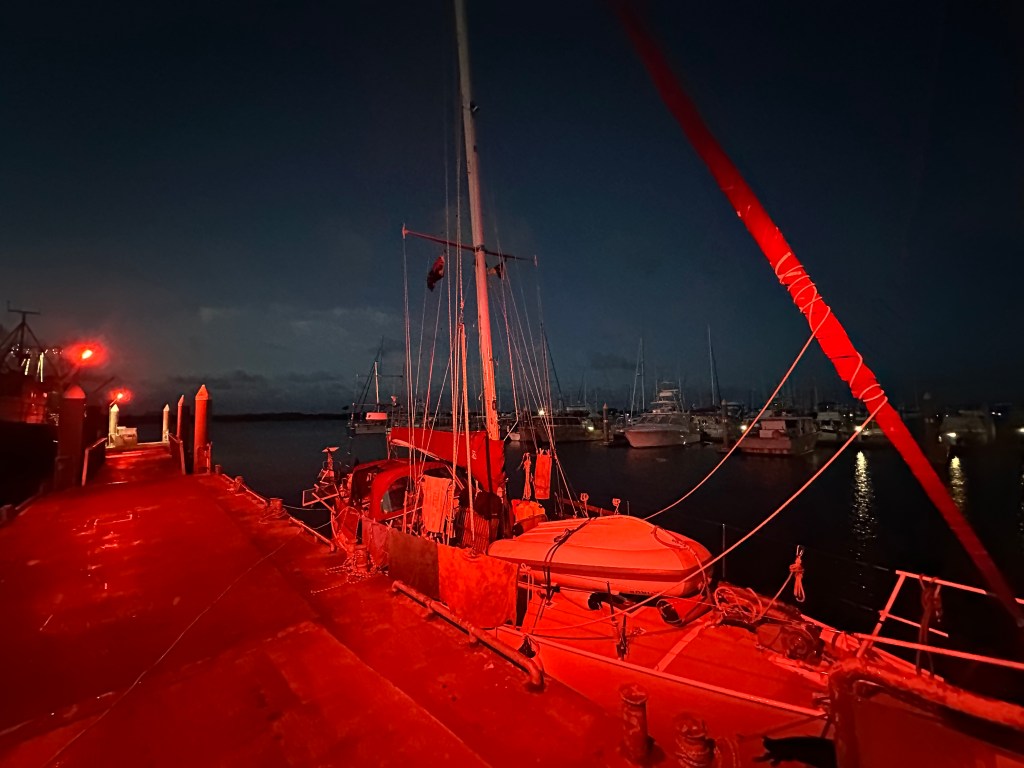
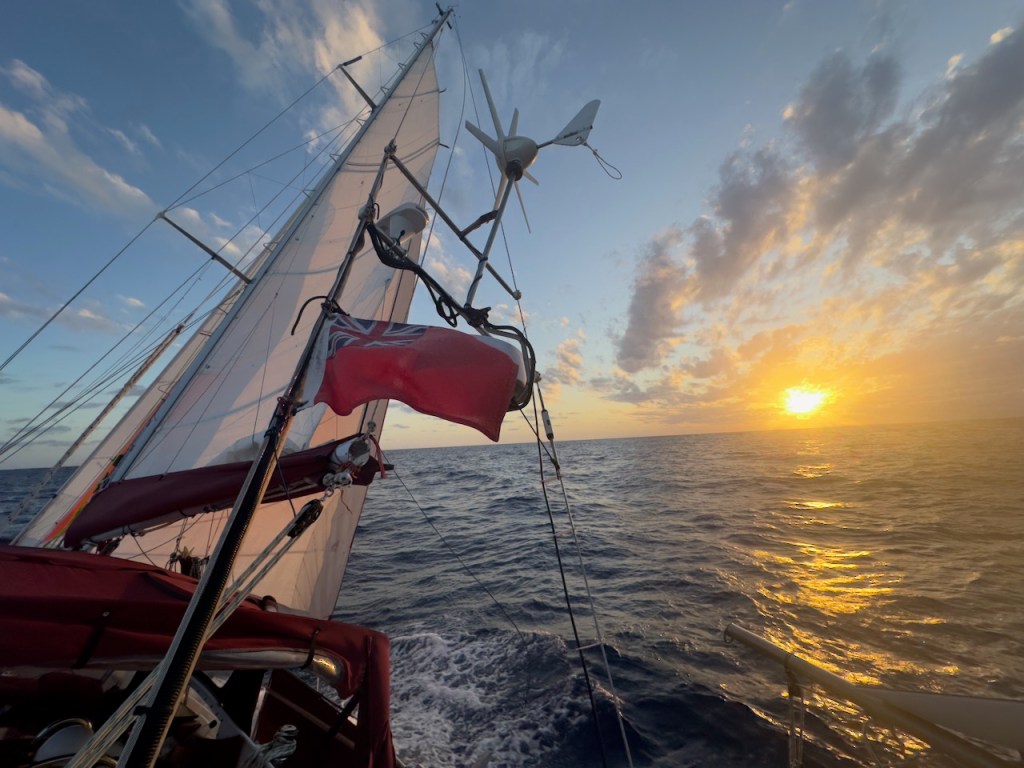
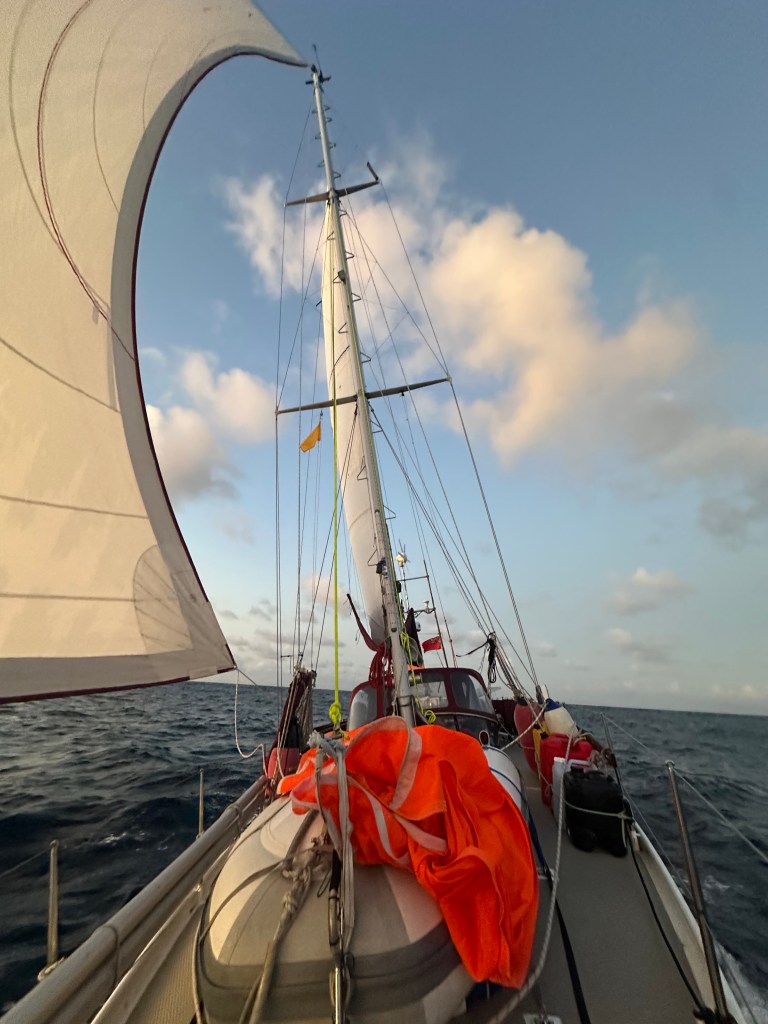
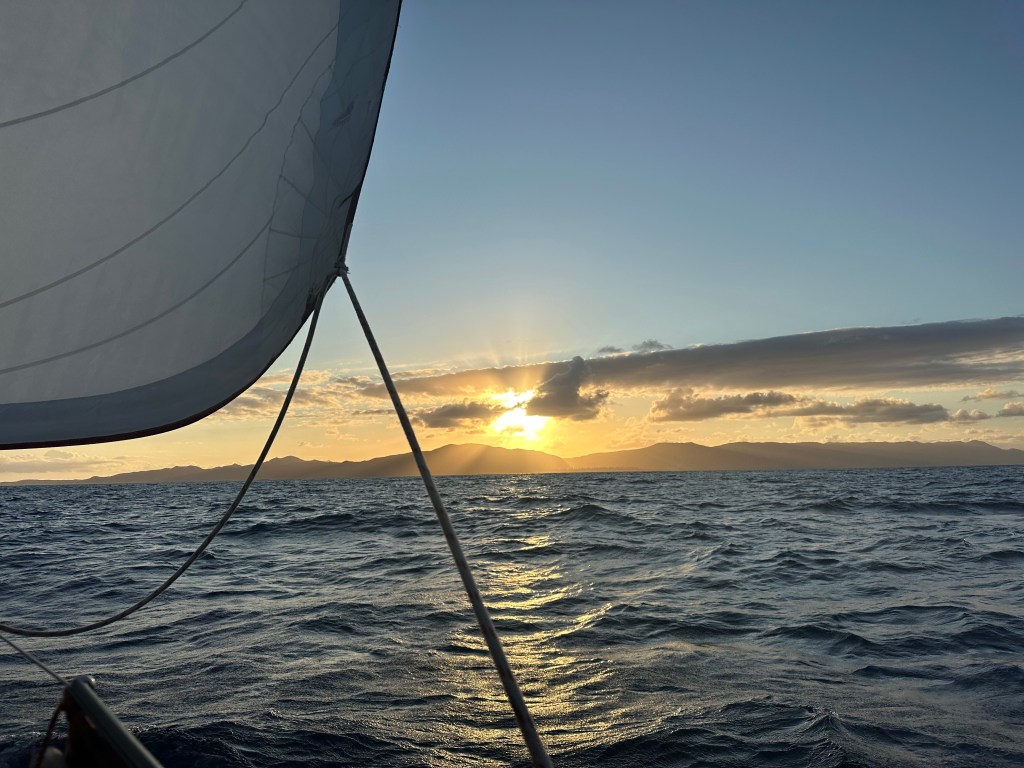
We arrived at Batemans Bay Marina a little after midday on Monday the 3rd of February. Owen, one of the marina staff, and his wife and two children met us at the jetty to take our lines, give us keys, and tell us where the showers and toilets were. We later met the manager, Mitch, who was another decent guy and helped us out as much as possible with lifts to the local hardware store and so on.
The marina is owned by the d’Albora Group, who own thirteen marinas throughout Australia. The companies mission statement reads:
At d’Albora, we believe every experience on the water should be lived to the fullest. Our extensive end-to-end marine and hospitality services are carefully designed to create effortless boating lifestyles for our members.
Of course, the gobbledygook corporate speak really means:
At d’Albora, we seek to extract every possible cent from our customers whilst giving them the bare minimum that we can get away with in return.
We knew the double speak routine well enough. But sometimes it can be fun to act like you naively believe such nonsense. Cara and I challenged the company’s zeal for their customers’ “effortless boating lifestyle” by having the temerity to ask for another key to the gates that give access to the berths. With only one key you either have to go everywhere together, someone has to wait on the boat if the other has gone out, or you have to co-ordinate arriving back at the marina at the same time to avoid someone having to wait outside the gate like a school kid whose mum has forgotten to pick them up. Two keys, for two adults, is much more convenient, and allows for a measure of (gasp) independence.
We didn’t know at the time but the great Victorian author Charles Dickens had previously been a guest at a d’Albora marina. He later altered the subsequent conversation to appear in one of his novels:
‘Please, sir, I want another key.’
The master was a fat, healthy man; but he turned very pale. He gazed in stupified astonishment on the small rebel for some seconds, and then clung for support to the copper. The assistants were paralysed with wonder; the boys with fear.
‘What!’ said the master at length, in a faint voice.
‘Please, sir,’ replied the paying visitor, ‘I want another key.’
The marina staff member aimed a blow at his head with the ladle; pinioned him in his arm; and shrieked aloud for the beadle.
The d’Albora board were sitting in solemn conclave, when Mr Bumble rushed into the room in great excitement, and addressing the gentleman in the high chair, said,
‘Mr Limbkins, I beg your pardon, sir! A marina visitor has asked for another key!’
There was a general start. Horror was depicted on every countenance.
‘For another KEY!’ said Mr Limbkins. ‘Compose yourself, Bumble, and answer me distinctly. Do I understand that he asked for another key, after being given the allotted one?’
‘He did, sir,’ replied Bumble.
‘That sailor will be hung,’ said the gentleman in the white waistcoat. ‘I know that sailor will be hung.’
To be fair, poor Owen to whom we addressed our request is far from fat. But to our surprise he did express something very much like Mr Bumble’s shock and awe. He told us that even the permanent live aboard couples only get one key (and he should know as he and his family are live-a-boards) and added that a fishing competition was taking place soon (after we were due to leave), and that all the spare keys were needed! After the week we had had these all sounded like not our problems, and we politely pointed out that for $107 per day we would like two keys. Apparently, the giving out of two keys doesn’t gel with d’Albora’s ‘effortless boating lifestyle’ vision, so Owen, being a good guy, smuggled us another key under the counter. Sadly he couldn’t do anything about a second key for the toilet block, but a win’s a win and Cara and I could co-ordinate our bowel movements.
Our ‘impertinence’ vis-à-vis two keys stemmed in part from the feeling that d’Albora were taking us for a bit of a ride. There was nothing great about the marina (apart from the staff who went out of their way for us, sometimes in direct opposition to d’Albora policies), little that was good, and quite a lot that was kind of average or crappy. Given the price we were paying the experience left a bit of a sour taste in our mouth. I won’t go on about it, but if you are thinking about heading there send us a message and we will fill you in. Unfortunately, the d’Albora corporate experience seems to be becoming normalised in Australia. Hopefully people will vote with their feet so that the law of supply and demand swings back into the users favour.
Of course, we were in the marina for a reason, to fix our gearbox, so our priority was to get it done as soon as possible and move on. We certainly didn’t want to have to pay for another week.
Imagine our delight when we found that our gearbox was waiting for us when we arrived. We picked it up that very afternoon and brought it back to Taurus as gently as if it were a sacred relic.
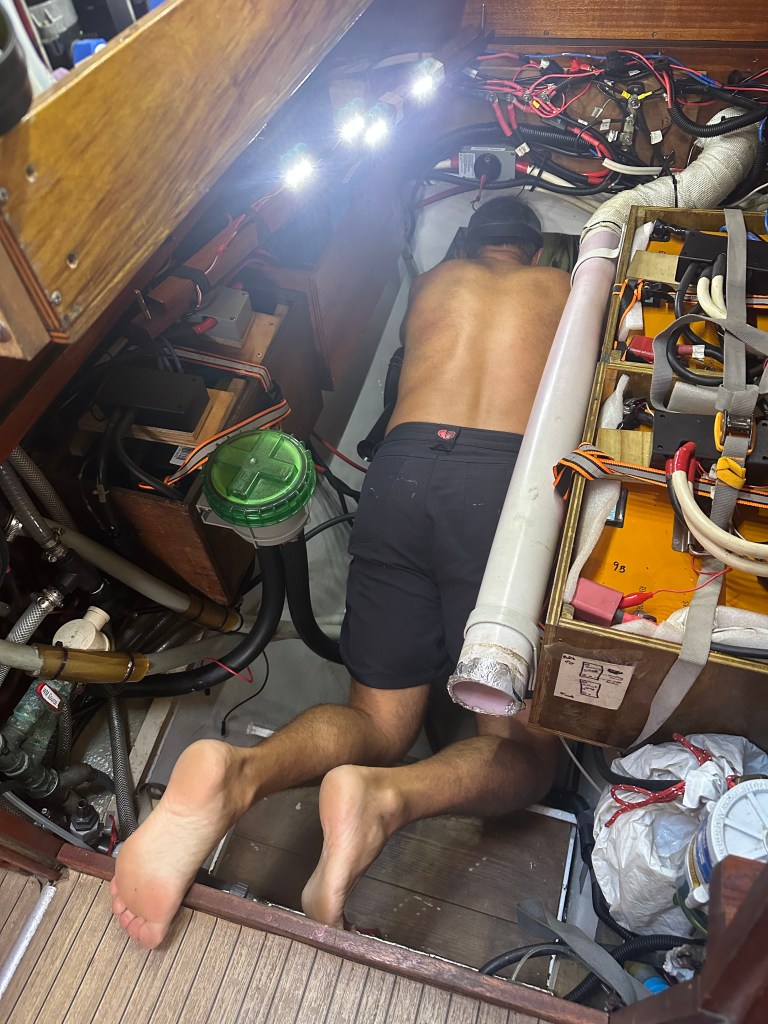
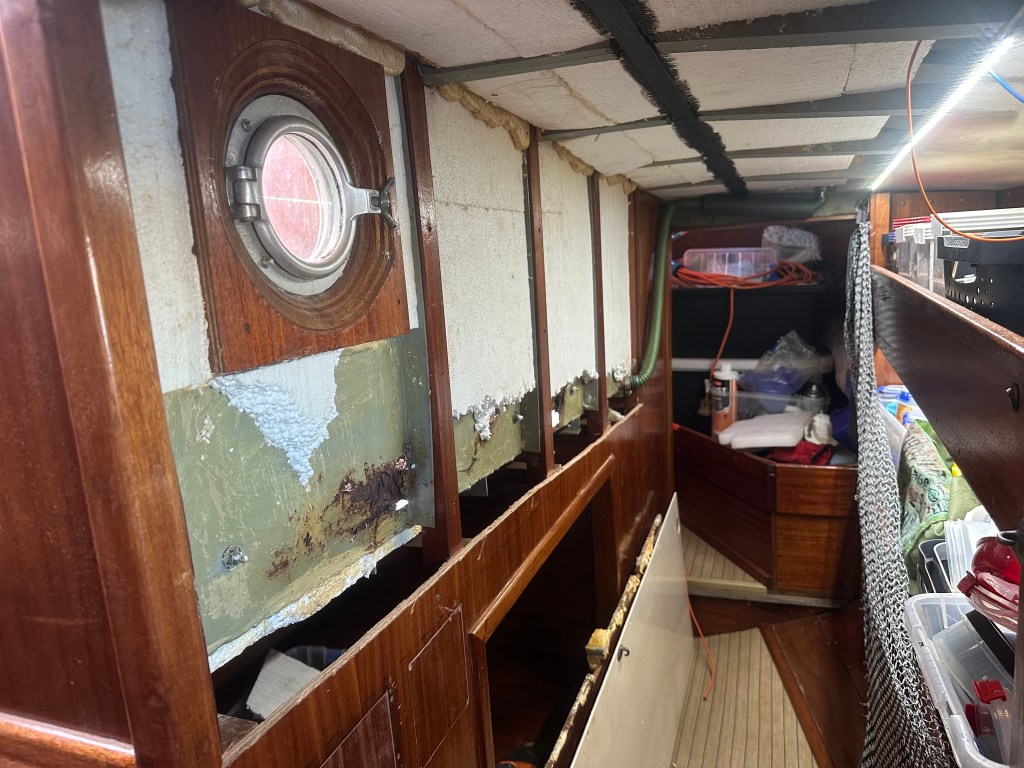
Our best access to the broken gearbox still installed came from lying on top of the engine and reaching down and behind it. Our plan was to disconnect the Constant Velocity (CV) joint and lift the engine just enough to be able to take the weight from the rear engine mounts that form part of the bell housing. We had to remove the bell housing as the gearbox was bolted onto it from the inside. We had discussed lifting the engine further so that we could get better access to try and fix a minor oil leak from the engine, but getting this extra access required the removal of the water maker, the batteries, the battery boxes, and a good deal of the engine’s plumbing. Ultimately we decided against it because it made what we needed to do a much bigger job. This might well bite us in the bum later on, but sometimes you just have to cross one bridge at a time.
Fun times. Shortly after we removed the ducting on the right, which serves the diesel heater, for more room.
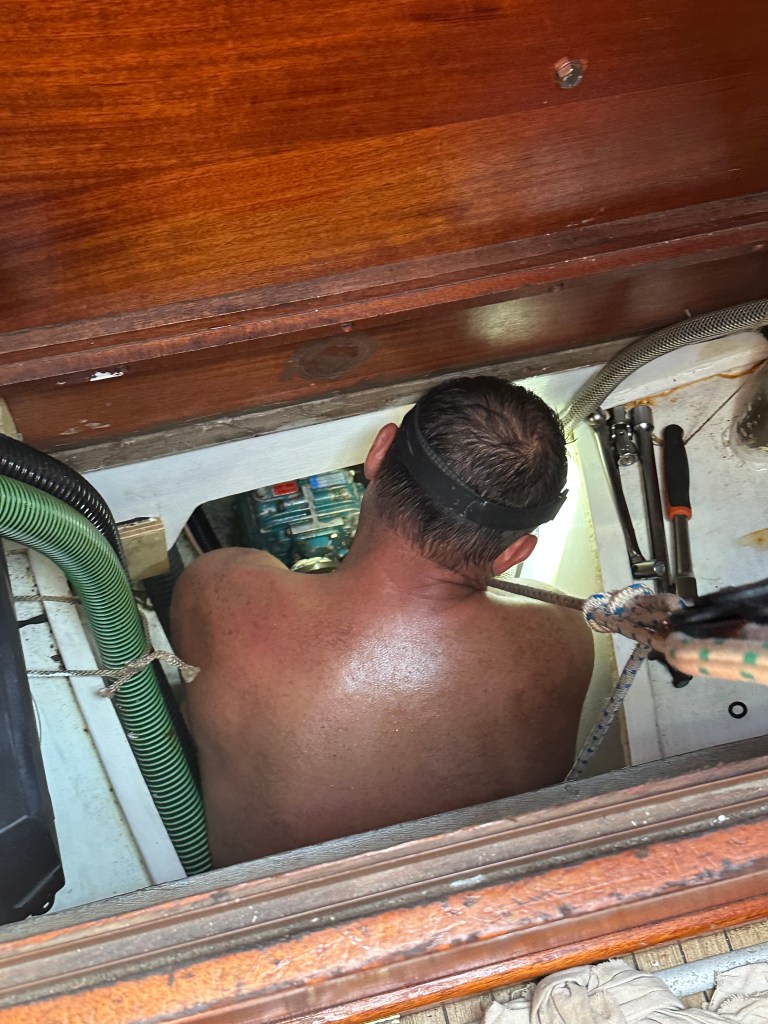
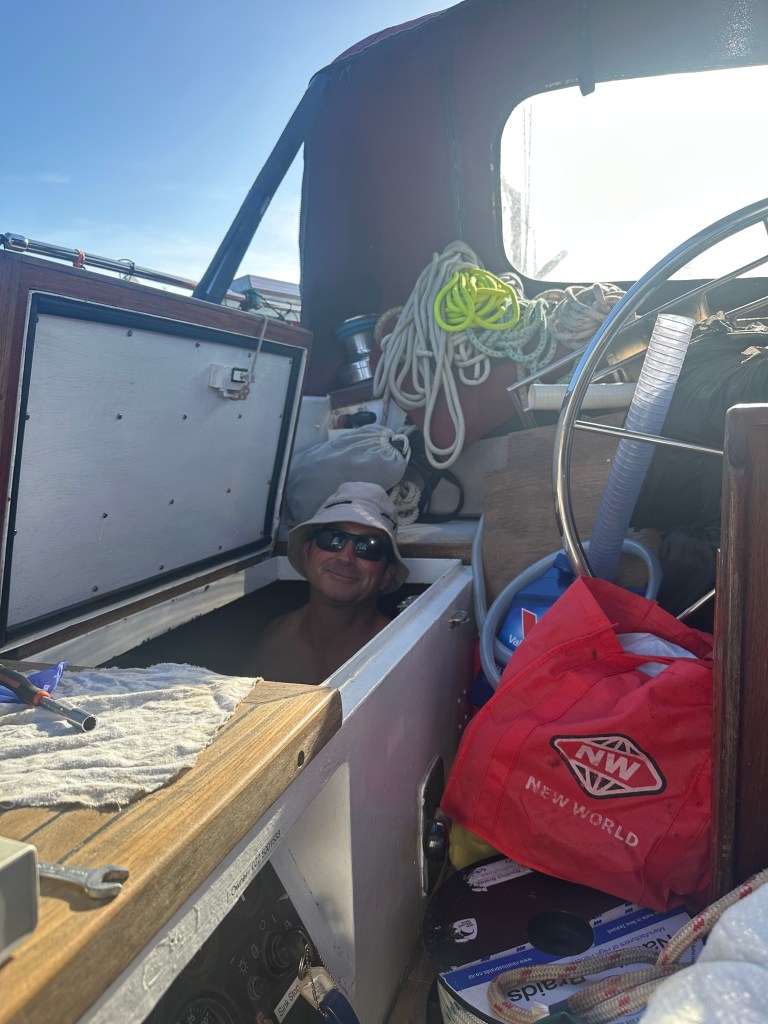
Thankfully, when we removed the engine a few years ago we cut a head sized notch out of a steel brace that lies above the gearbox. This is the white steel panel above my head in the photograph above. This notch greatly improves access, and without it the entire job would have had to be attacked from the tiny space entered from the rear of the engine. In this hole one has to balance on one foot above the prop shaft and be careful not to stand on the dripless seal that doesn’t take kindly to such treatment and squirts sea water everywhere to register its displeasure. Stand on it too much and the sea water might not stop squirting in, so best to give it plenty of room.
We were able to release the forward part of the CV joint fairly quickly, but the aft portion was unwilling to come apart, no matter the blood, sweat, and strong language employed against it. I’m reluctant to say that I’ve grown older and wiser (which is only half true), but I can safely state that I have broken too many things by trying to force them to automatically reach for a bigger lever or hammer. In this respect I am a great believer in the Hippocratic Oath, which starts with the advice, “First do no harm!” This I take to mean ‘when trying to fix something don’t break anything else!’
After having spoken with a marine engineer friend in New Zealand at some length (cheers Luke!) we were pretty happy that the prop shaft wouldn’t disappear into the sea, and that the dripless seal was secure and wouldn’t start letting the ocean in. With one side of the CV joint released we could now move to the second stage and try to raise the engine. This was as far as we got on the first day, which, if you remember our last blog, had been pretty long and eventful.
For those who aren’t diesel mechanics or marine engineers, in the above photo the blue bit on the left is the bell housing, which forms the aft part of our engine. The silver block behind it is the gearbox, the egg timer looking thing attached to the rear end of that is the CV joint. The prop shaft joins to that, and runs through a pillow block (the black thing) inside of which is a thrust bearing that keeps the shaft running true and doesn’t let it disappear out the back of the boat. Beyond that, the blue bellows thing is the dripless stern gland that allows the prop shaft to exit the boat without letting water in. Simple innit?
What we now needed to do was lift the engine so that we could take the weight off the engine mounts and bell housing, and unbolt it. To do this we ran a nice thick rope under the engine and tied a good knot. This was attached to a ‘come along,’ a handy device which provides heaps of mechanical advantage, which was attached at the other end to a lifting point above the engine. Pretty soon we had the engine swinging like it was the 1960s again.
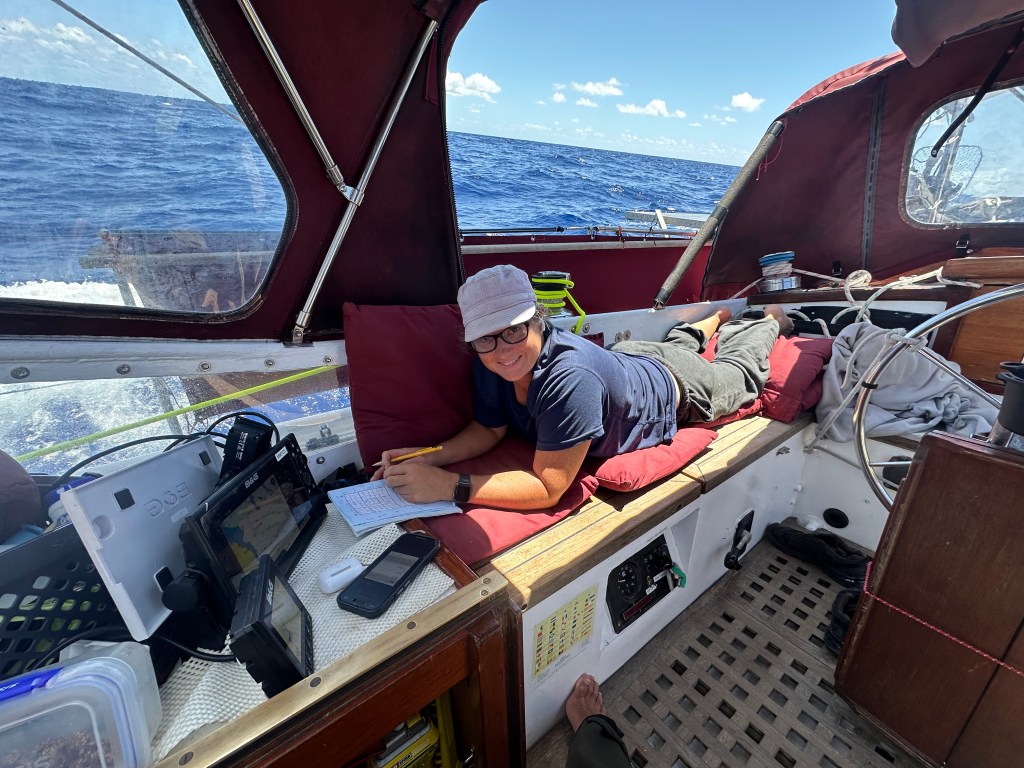
In the above image the engine sits in its rope cradle. You can just see my belly on the far side of the engine where I am balanced on one foot whilst trying to undo the bell housing. Before taking out the last bolt out I made sure another rope was attached, so that as the weight came on there was no way I could drop it — remember Hippocrates! The other end of that line was attached via the rear companionway to the boom (in fact we tied the boom off and used the main sheet as a handy billy which we attached to the line attached to the gearbox). One of the few benefits of doing this kind of work on a boat is there is normally plenty of rope around. As Cara would tell you, I really like rope. As a young sapper in the Royal Engineers we received a lecture on basic engineering principles, and I remember the lecturer telling us that the simplest machine in the world was a rope. I’m not sure I agree today, it depends on your definition of ‘machine,’ and perhaps a lever is simpler? Anyway, I remember it fired my imagination and the more I learnt about the various systems that allow a rope to provide mechanical advantage the more enamoured I became of it. Rope is great!
Gearbox is coming, rope attached to it runs over my right shoulder.
It was a bit of a squeeze getting the gearbox and bell housing past me, but in short order we had the pair sat in the cockpit for inspection.
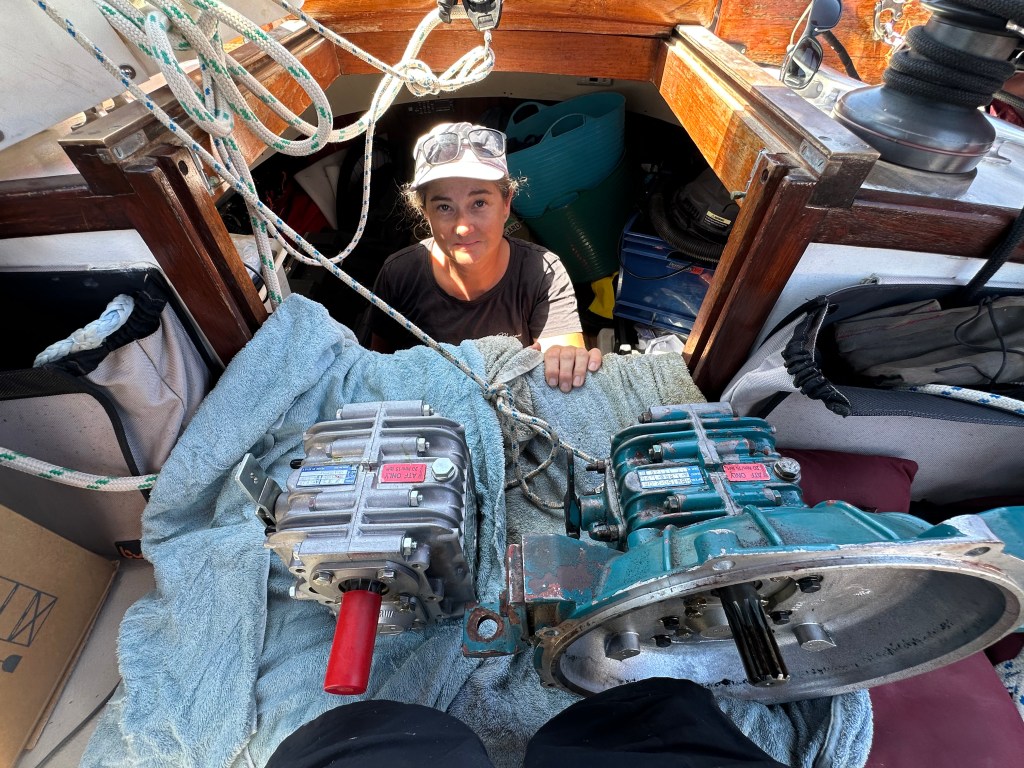
New and old gearboxes. You can see the bell housing with bolts holding the old gearbox on the right.
With the old and new gearbox side by side we could compare the two units. We had been warned that the new one might be some 25mm longer than the original, and that the shaft might exit 25mm lower. If this had proven to be correct we would have had a big headache and all sorts of issues getting the new gearbox in and aligning it with the prop shaft. Thankfully the units proved to be identical as ZM, the manufacturer, had promised.
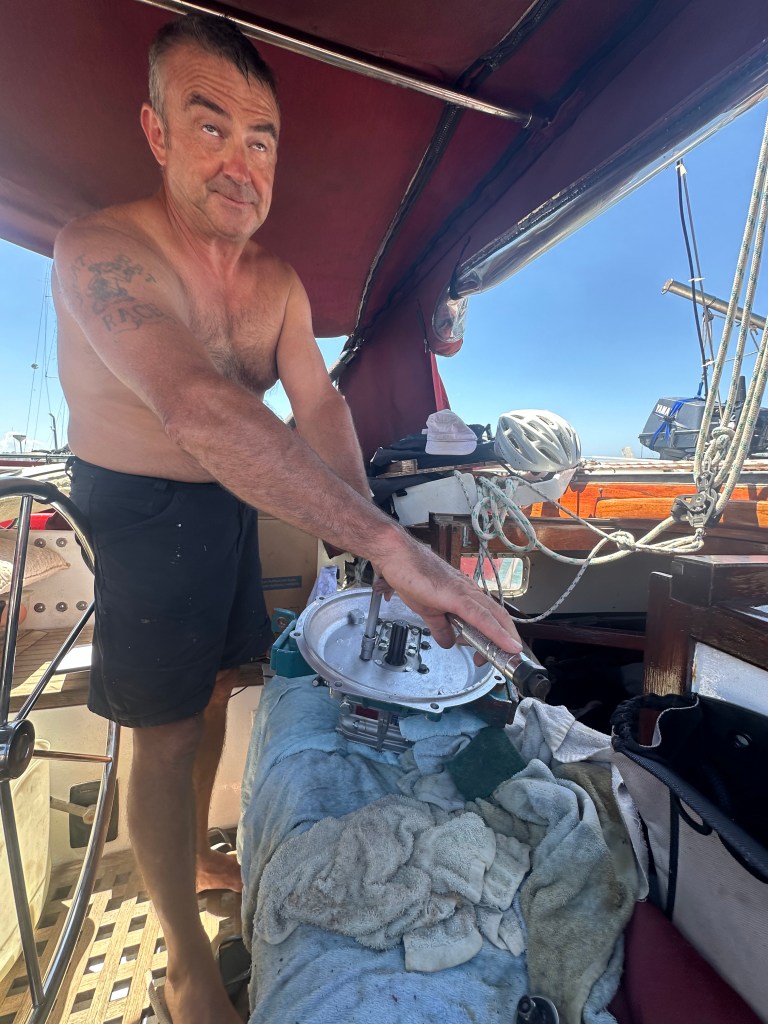
Saying a silent prayer that things go back together OK. Note the torque wrench. Fancy eh?
All we now had to do was remove the bell housing and attach it to the new gearbox before reversing the dismantling procedure. By the afternoon of the third day we were done. You beauty!
On the fourth day we gingerly tried forward and reverse on the dock, and when nothing went BANG! we cast off and motored out to the river for a quick run up and down. So far so good. Having paid to stay in the marina for a week we now had a few spare days to put Taurus back together. As if to remind us that work on a boat never ends the galley foot pump chose this moment to fail. We didn’t have a spare pump and couldn’t buy a new one, so we had a nice afternoon taking our old, previously failed, pumps apart to try and bastardise a working one. Eventually we succeeded and water returned to the galley sink. We were on a roll!
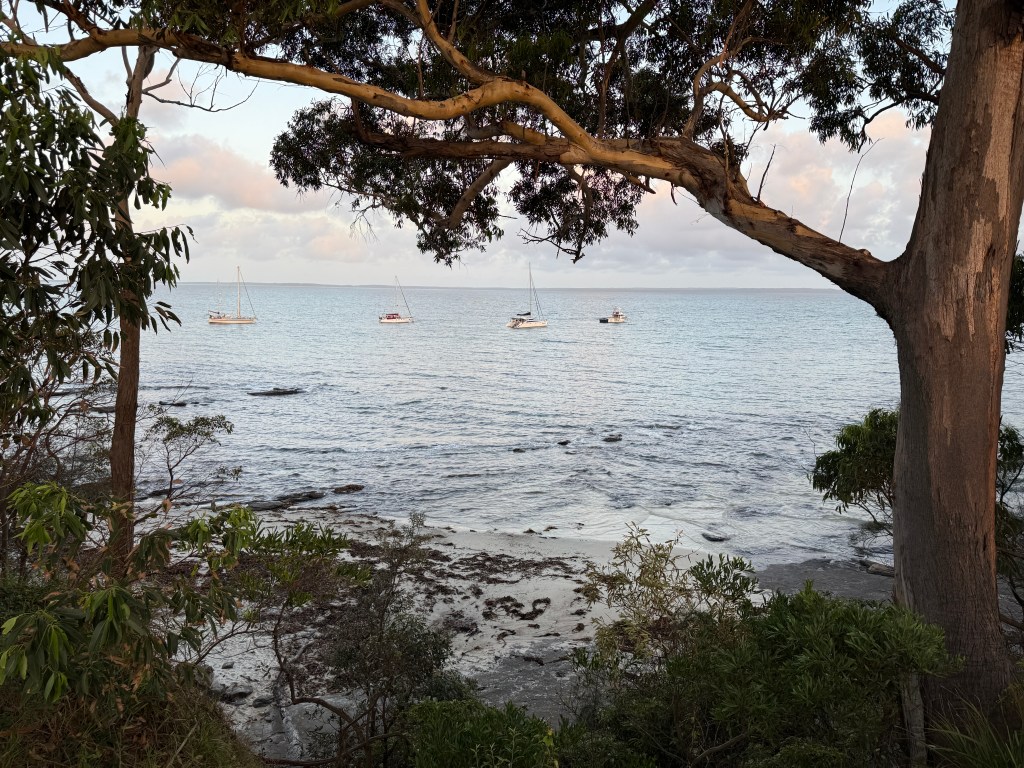
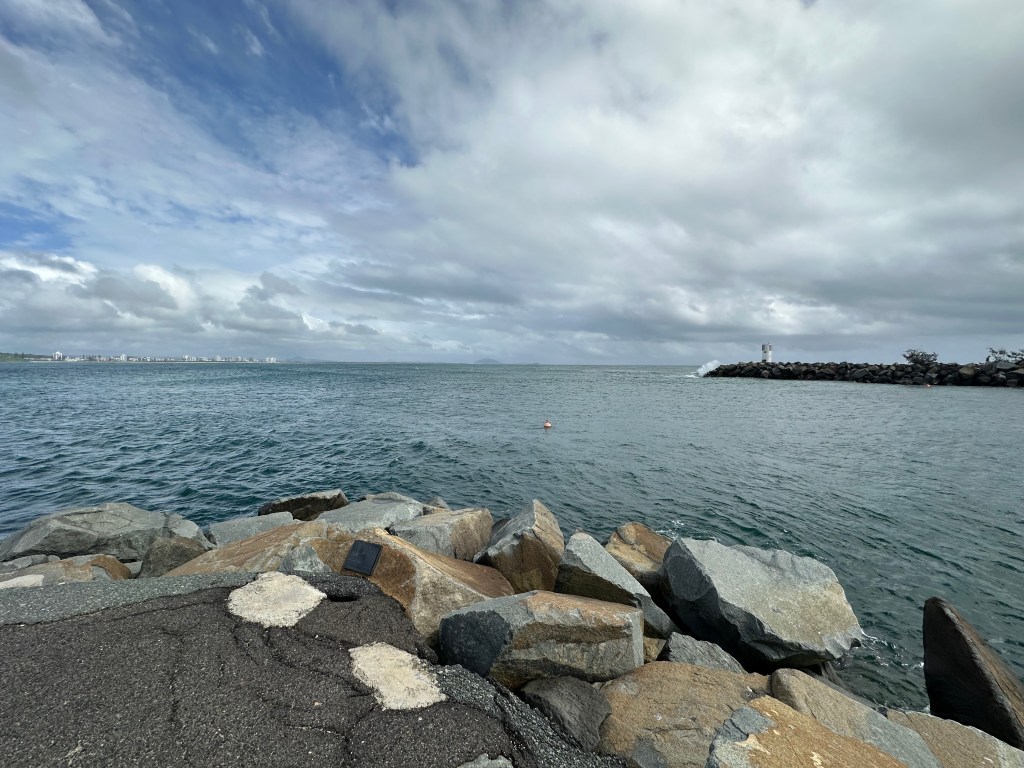
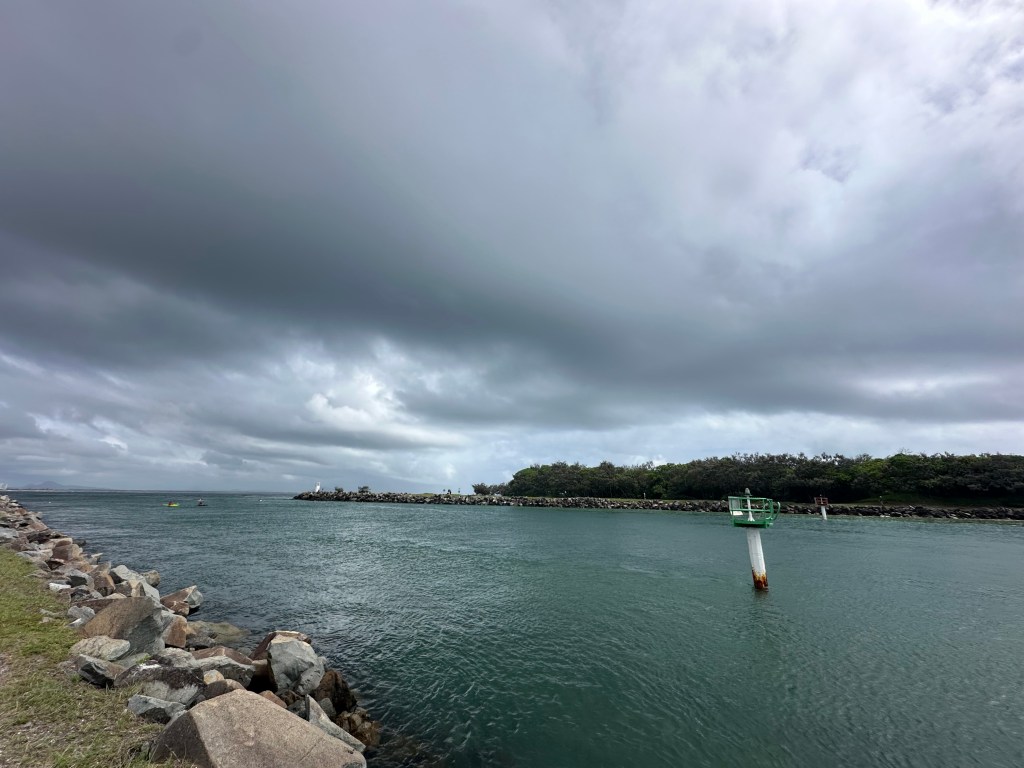
Looking to seaward from Clyde River bridge. The marina is near the centre of the photograph, the bar entrance just to the left of it. Note shallow area to the left of anchored boats.
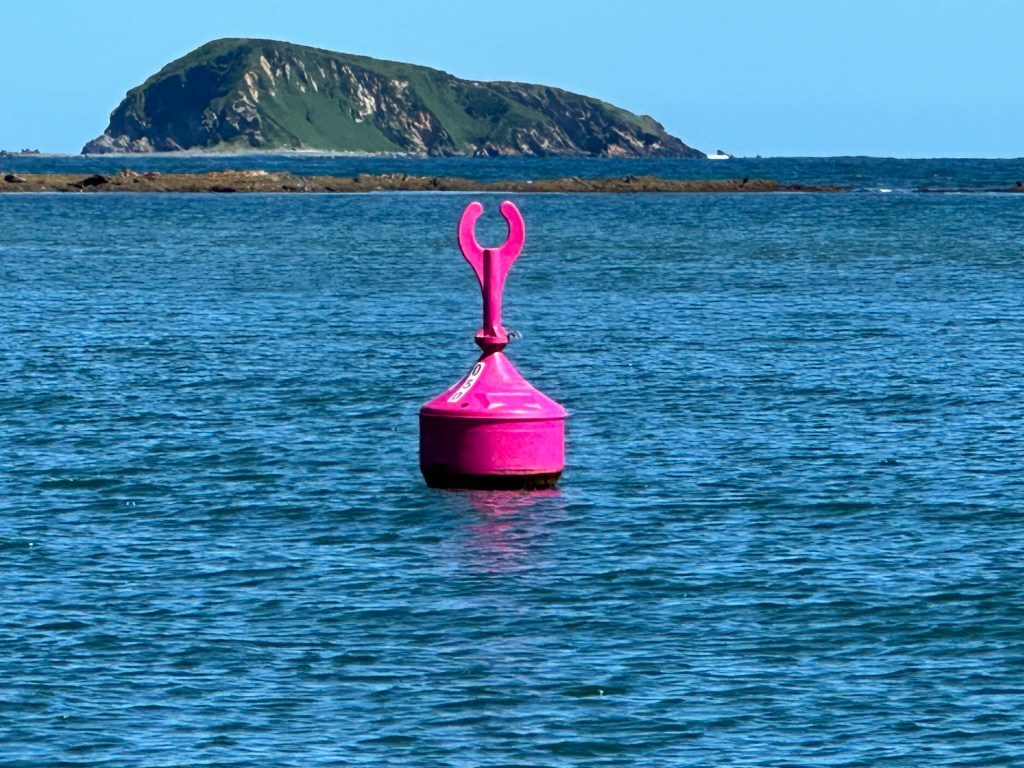
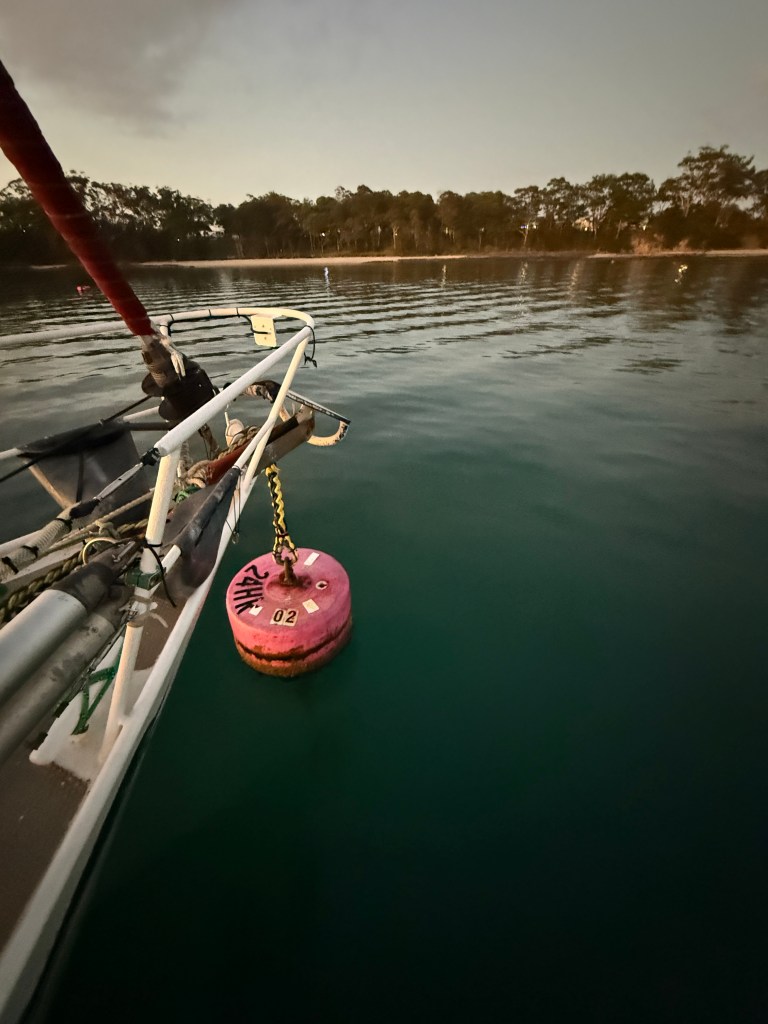
On the seventh day we departed Batemans Bay Marina and returned to Maloneys Beach, where we had anchored when we first arrived without an engine. On arrival the public mooring was free, so we hooked up to it without really considering the odd design (photo below). Apparently, the mooring rope is supposed to be draped through the horns, but in practice the horns prevent the mooring being pulled in tight because they catch on the anchor, pulpit bars, and whatever else they can grab onto. We let out plenty of slack and hoped that the swell would be sufficient to keep us a safe enough distance away.
El diablo.
The following day it seemed like that might be an opportunity to leave as some meteorological models had the wind swinging from the south to the east. As we watched, the wind moved from 180 degrees to 110, so after a while we headed out, only to see the wind switch doggedly back to 160-180 degrees. With no possibility of sailing to Eden, about seventeen hours away, we turned round. Once ‘home’ we ignored the mooring and dropped our anchor, so no more buoy horns to worry about. Friends who were watching us via AIS commented that we seemed to be doing the Hokey Pokey. We had to laugh, and there is certainly some truth in the remark. We have made a habit recently of putting one foot out, one foot in, one foot out and spin around again (apologies to creator of the Hokey Pokey). After leaving Pittwater we had turned around because the wind was much stronger than predicted; we turned round after leaving Jervis Bay due to our failed gearbox; and we had now returned to Batemans Bay when the wind didn’t change direction for us. Still, As JRR Tolkien said, “not all who wander are lost,” and who said a journey has to be made in a straight line?
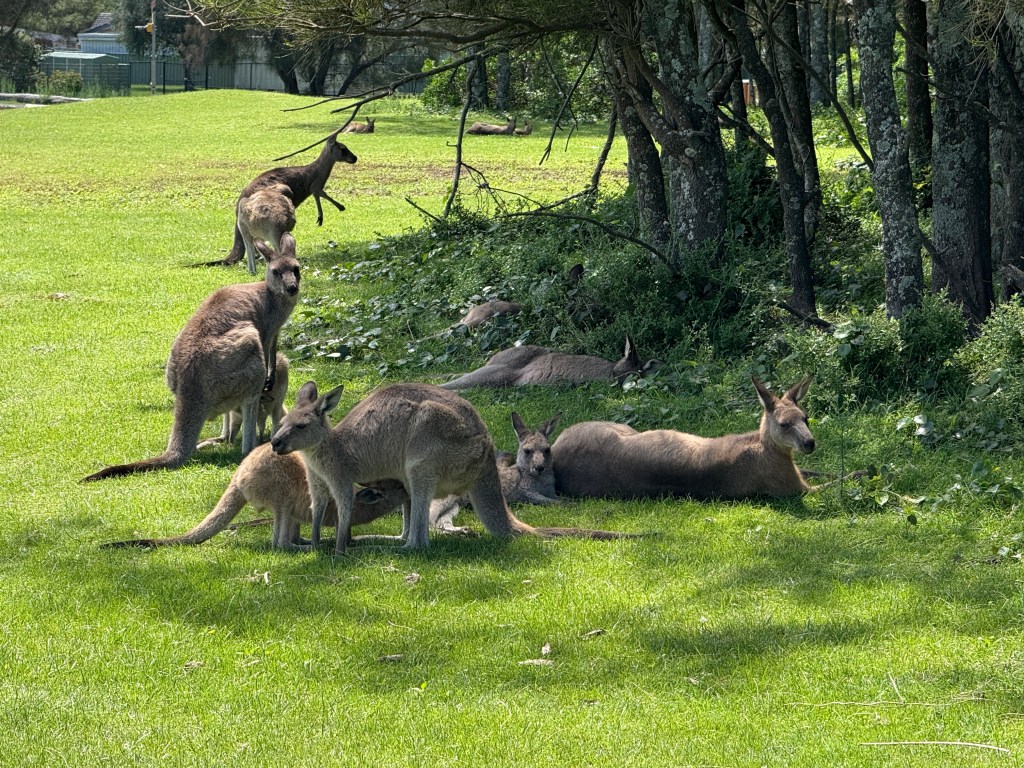
With another day to wait for the wind to shift we took the dinghy to shore. To our delight there was a ‘mob’ of kangaroos, lying round scratching themselves in the sun — yes, ‘mob’ is the collective noun for kangaroos. ‘Shore’ turned out to be part of the Murramarang National Park, home to a large number of eastern grey kangaroos, amazing bird life, and a number of tracks through the bush and along the coast.
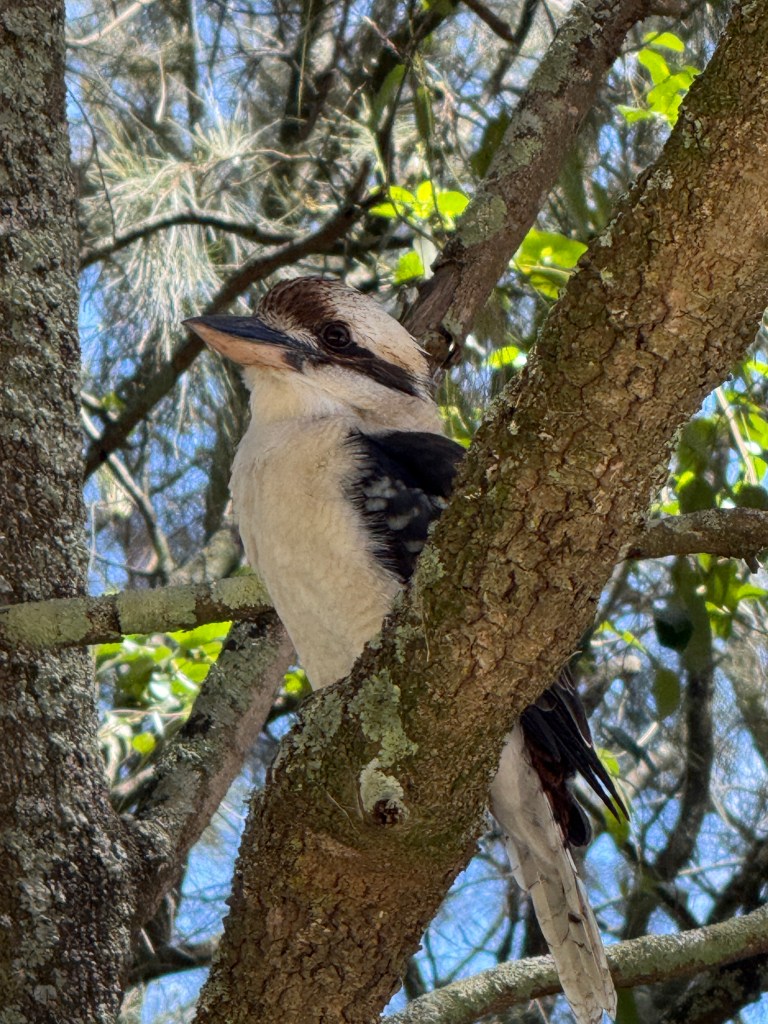
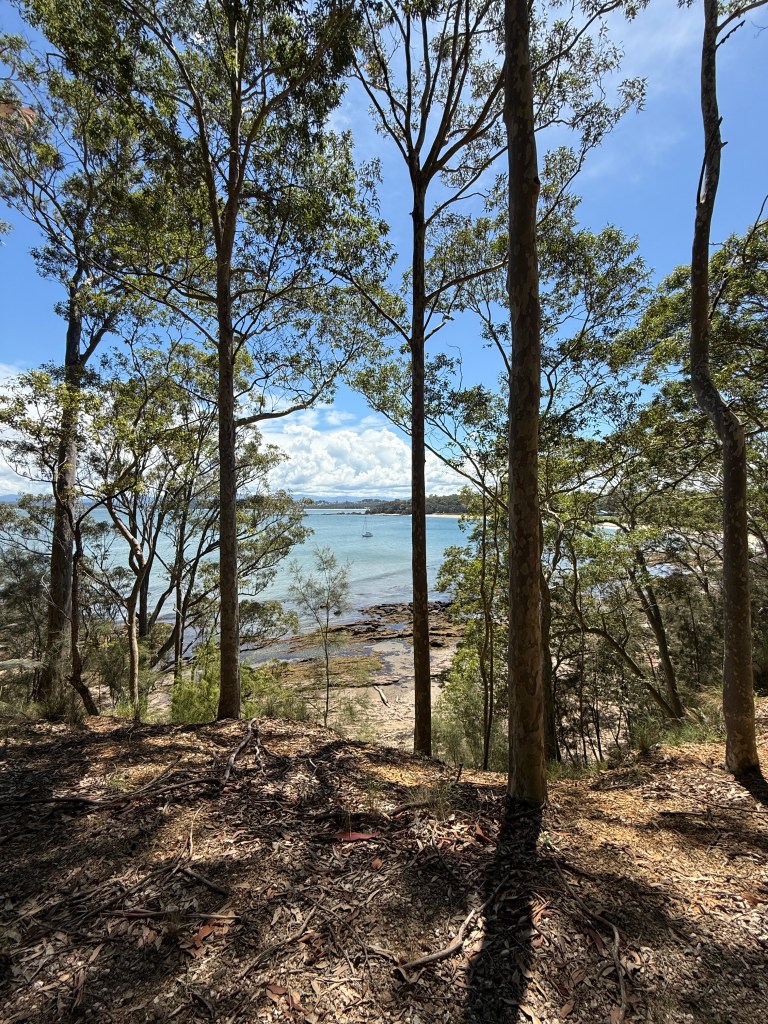
Kookaburra. View from one of the tracks.
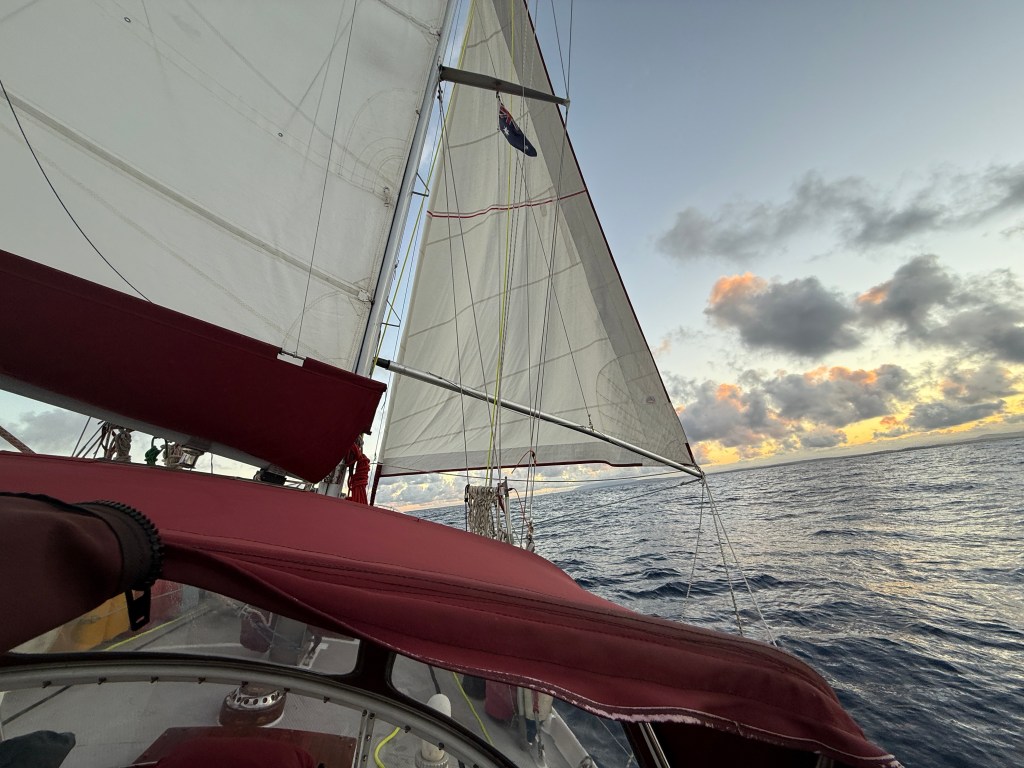
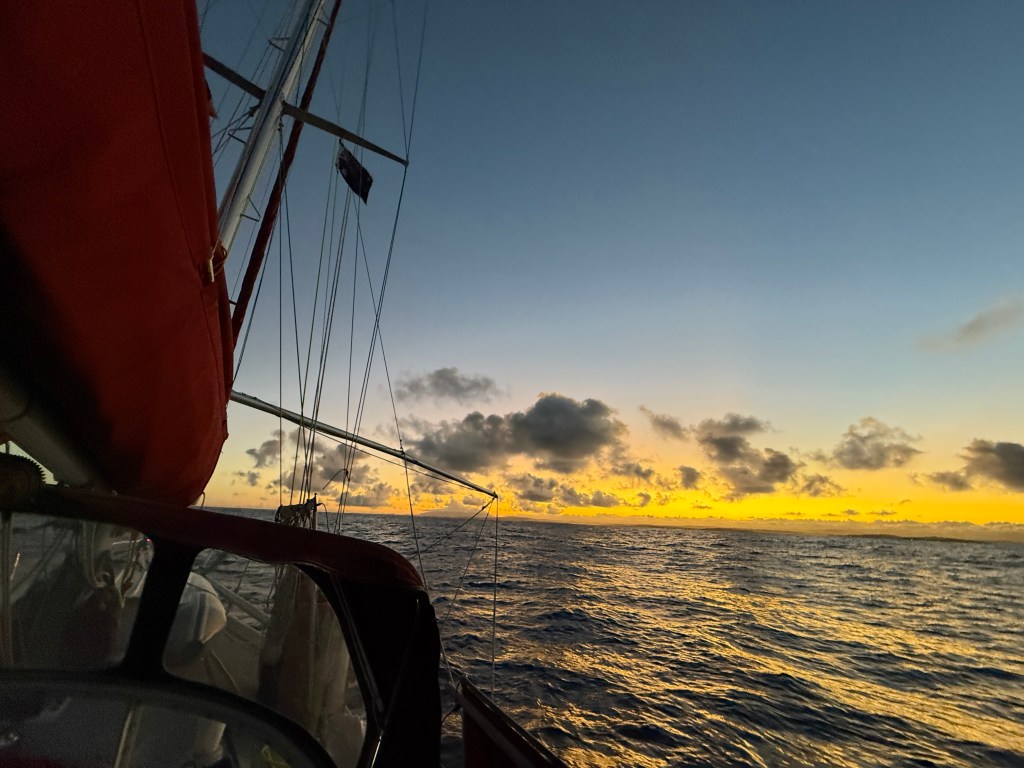
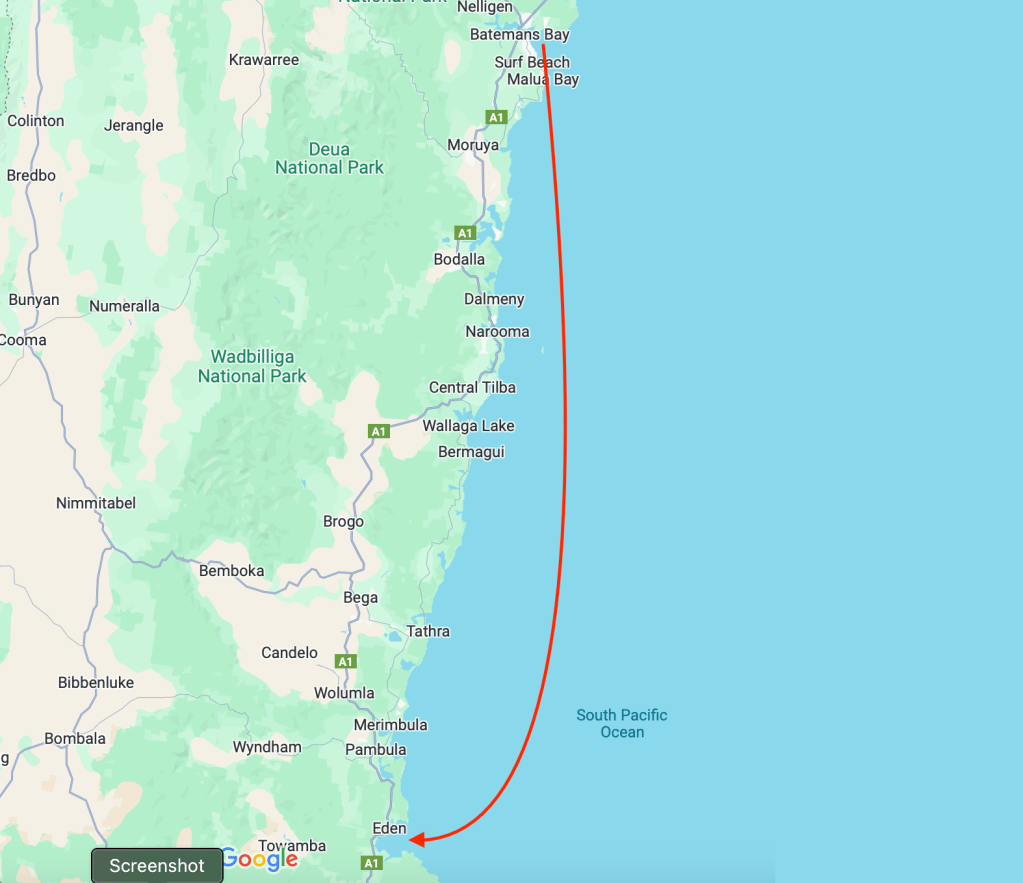
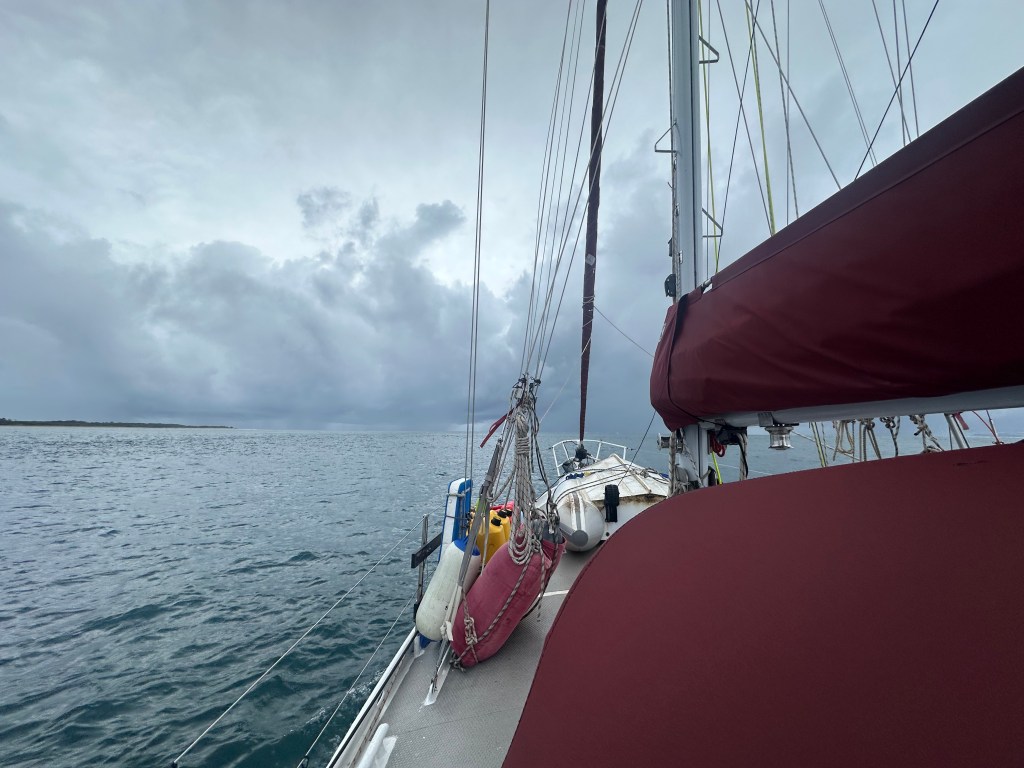
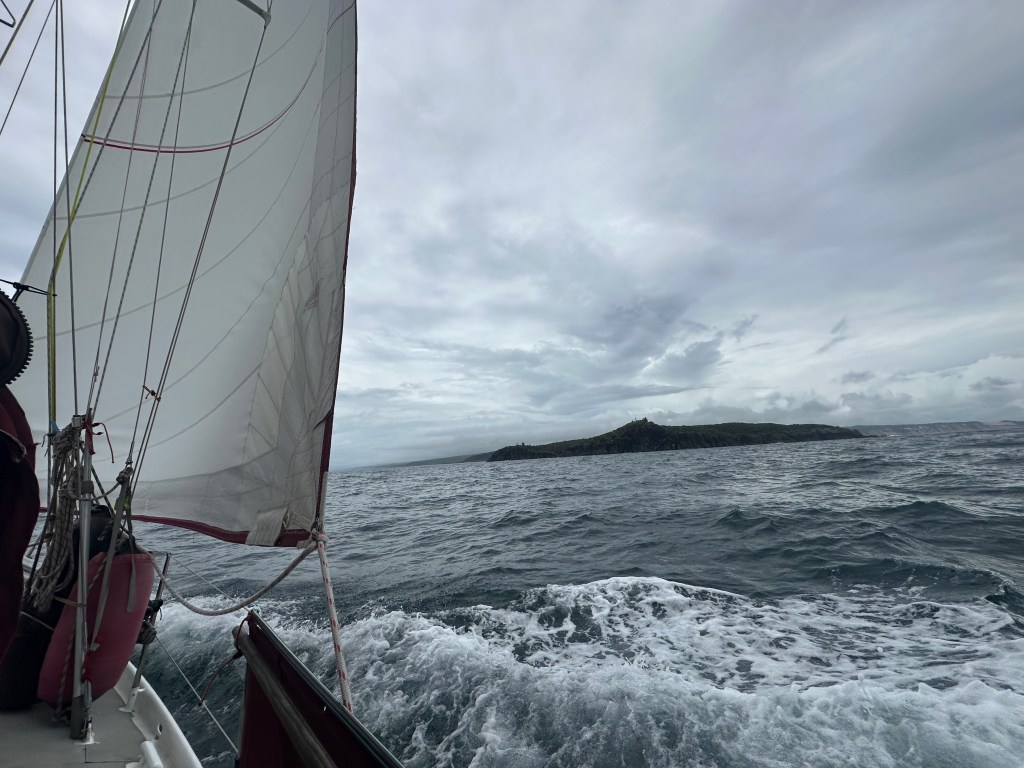
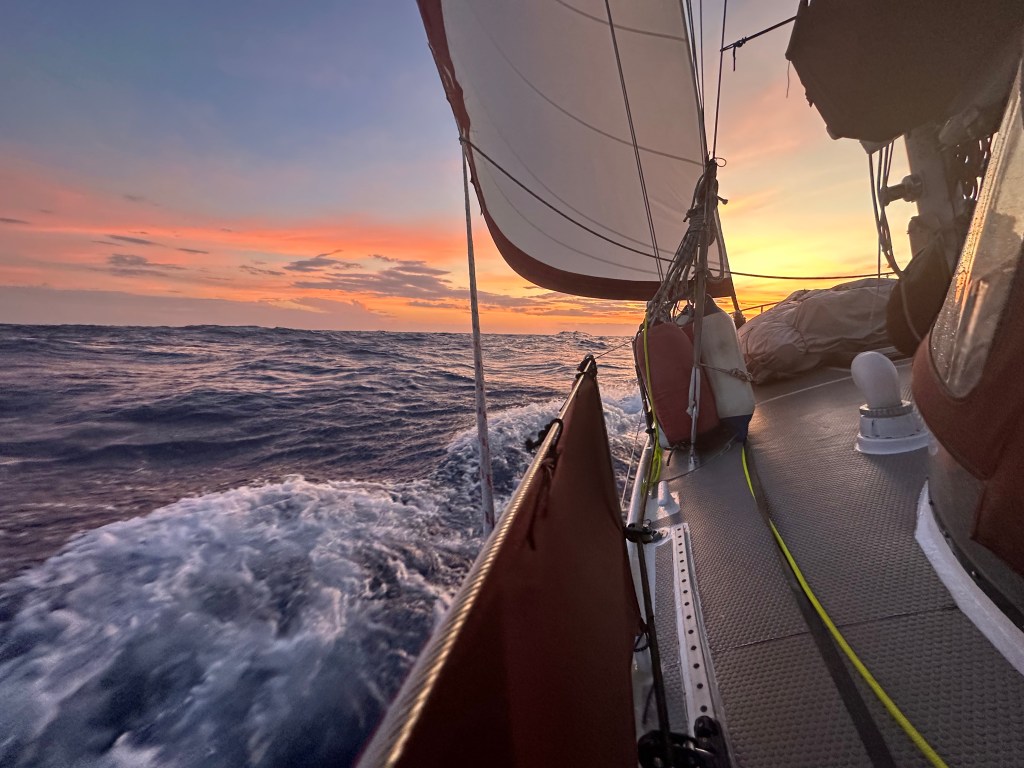
The following day the wind finally swung into the east and we left Batemans Bay to head south. The wind played ball for the first few hours and we enjoyed decent sailing, but as it eased the speed of Taurus in the current caused the sails to flog and collapse. Ultimately we had to motor for several hours, a test for the engine and gearbox which we seemed to pass (I’m still touching wood that I didn’t do anything wrong in the rebuild).
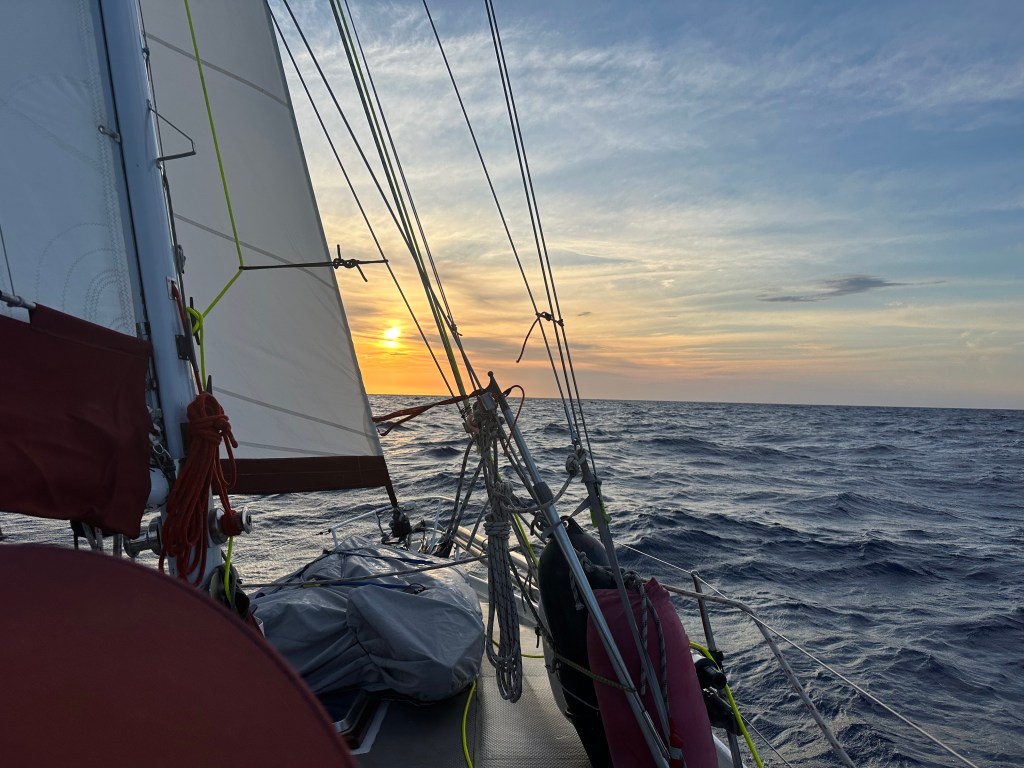
Sails up…Sails down… Sails up… …. do the Hokey Pokey and you turn around, that’s what it’s all about!
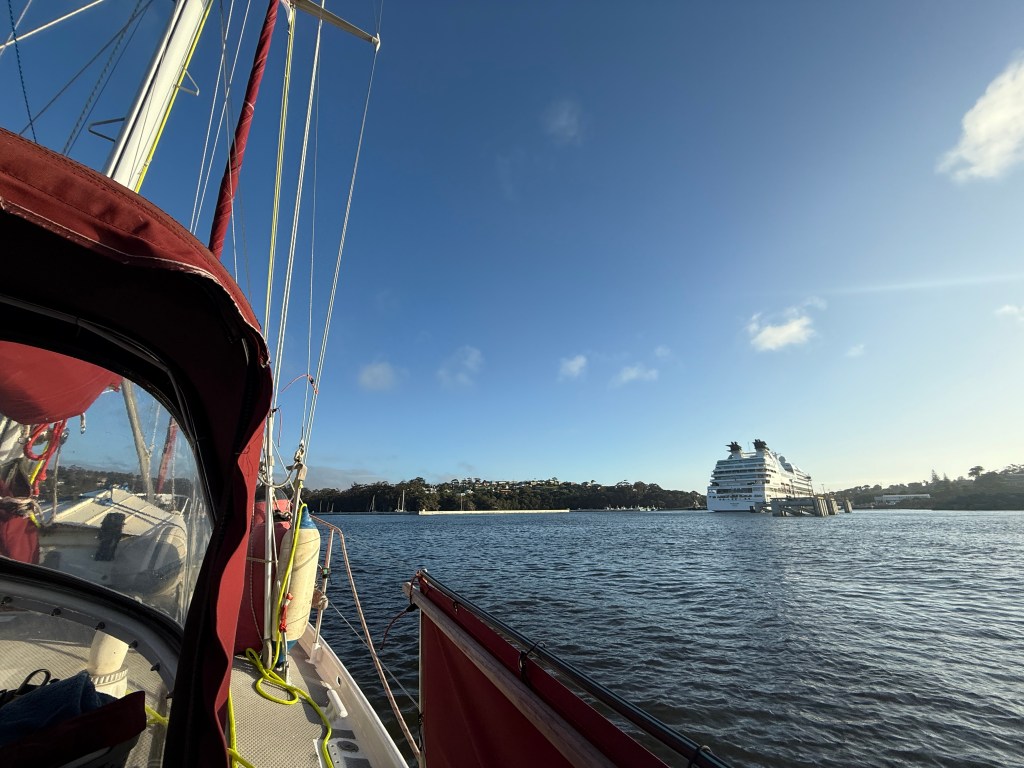
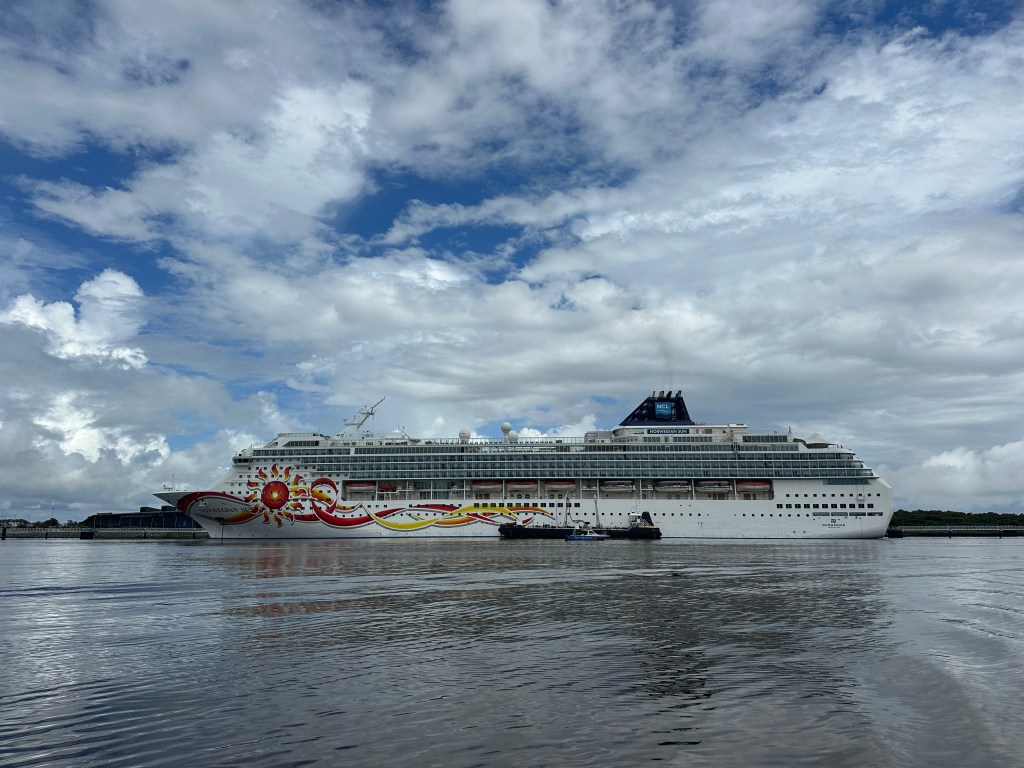
Shortly after dawn we arrived off Eden and watched as a cruise liner raced in ahead of us. The wind had finally built and we could sail easily, so we headed towards the public moorings just outside of town.
Checking the charts before entering Eden. last leg… On the public mooring outside of Eden.
There were a number of boats on the other public moorings, belonging to cruisers intending to go in various directions. Pretty soon we had arranged to meet over a few drinks, but that tale will have to wait for another day.
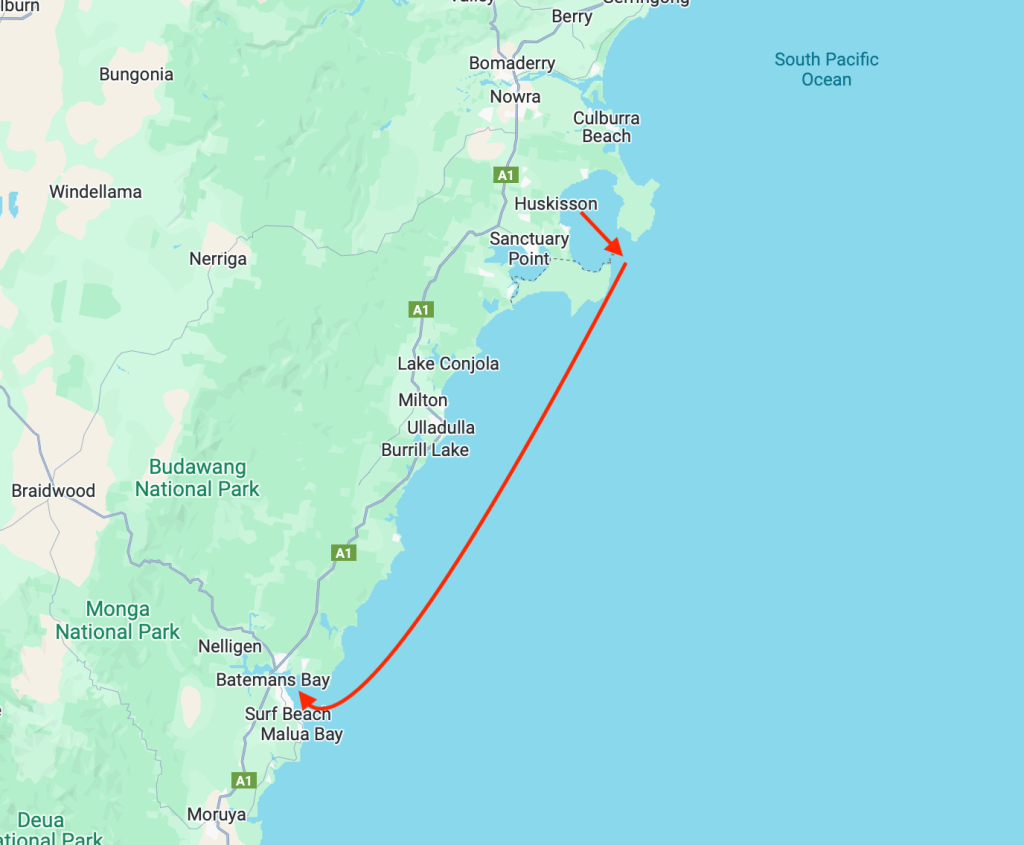
Voyage of the good ship Taurus: 2nd of February to 13th of February 2025.
Next time, we meet our neighbours, we explore Eden, we plan our three day journey across the notorious Bass and Banks Strait!
We departed Sydney on Australia Day, the 26th of January, and sailed south, still hoping to get to Tasmania for the Wooden Boat Festival, starting in Hobart on the 7th of February. Our next port of call was Jervis Bay, some eighteen hours sail away at a speed of 5 knots.
Once again we raced south with the help of an easterly wind and a benevolent current, and arrived earlier than expected in the early hours of the morning. Target Beach, an anchorage in a small bay close to the heads, had been recommended as a good place to stop, so we slowly motored the last mile or so, feeling our way in the dark to the spot where our chart showed people had anchored before us.
Next morning we were glad we had been cautious in our anchoring as there was quite a swell running that turned into surf not far in front of us. A handful of surfers had camped on the beach and were out enjoying the waves. The swell wasn’t particularly uncomfortable and as the wind was blowing thirty knots outside we happily sat in the shelter of the bay. However, around midday the tranquility was shattered by a ‘gang’ of jet skiers, there’s really no other word you could use to describe them. As usual they raced around at max speed and max noise before performing a trick we hadn’t seen before. Taking these powerful and heavy machines through the surf, they turned and accelerated back towards the incoming waves, which caused them to take off and fly several metres into the air before crashing down again with a great splash.
The scene was chaotic. Several skiers would take off at the same time and land close to one another, whilst others raced around just outside of the surf line. Looking on we watched as fishermen on the rocks packed up to go home, and the surfers were forced from the water to avoid being run down or crushed. I must admit that I watched these selfish adult children with the secret hope that one of them might get hurt, which is very un-Christian of me and clearly demonstrates room for self improvement.
As the day wore on the swell increased slightly and we noticed that according to AIS (the system that allows us to see where other boats are on our electronic chart, and them us) several other boats were anchored round the corner at a place called Long Beach. Thinking that perhaps this was a better spot to wait out the wind we decided to up anchor and head around the headland, only to find that ‘the grass isn’t always greener on the other side.’
Getting to the new anchorage turned out to be a long and arduous struggle against a strong headwind, that made the engine and gearbox strain, and probably encouraged its later demise (more on that later). After an hour or so we finally crawled back into protection from the wind and dropped anchor in conditions very much like those we had left earlier.
The long pull to Long Beach.
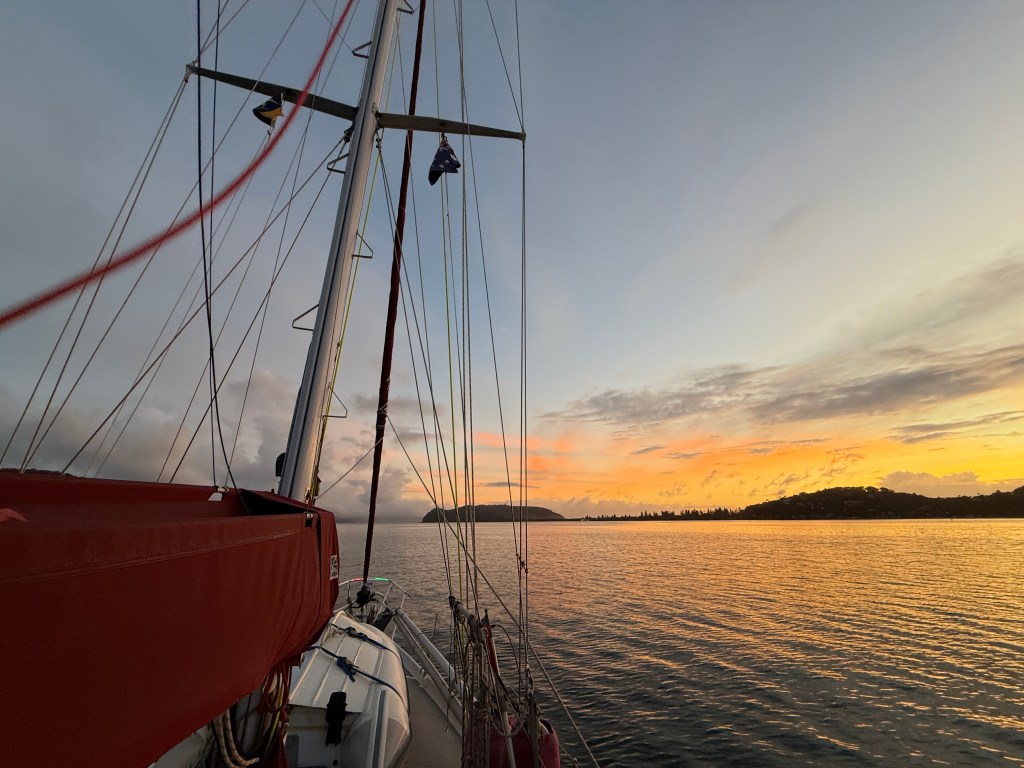
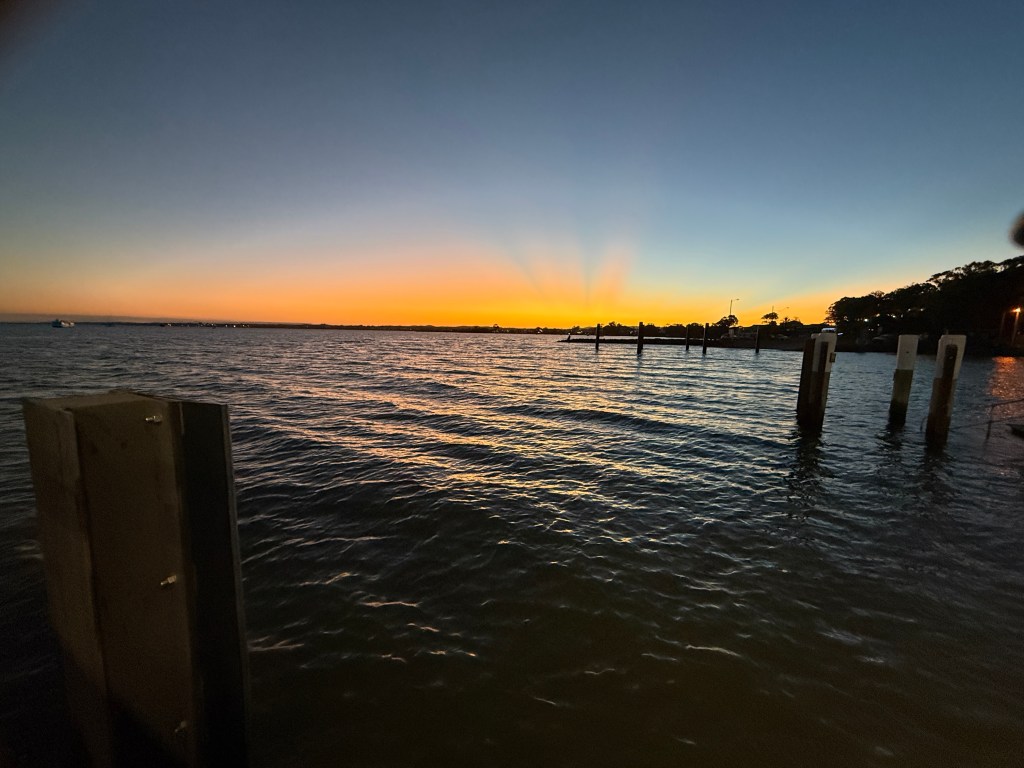
That evening the wind finally eased and we were treated to a gorgeous sunset for sundowners.
Our move to Long Beach was fortuitous in one way as next to us in the anchorage we saw a ketch that looked familiar, and it later turned out that we had briefly met Ambrosia and her crew in Vanuatu. Guy, Cassie, and their daughter, Rona, hail from the States but had emigrated to Tasmania and were on their way home. These guys would later save our skin.
Next morning a light breeze was blowing from the north and as we had plenty of room we took the opportunity to sail off our anchor. Yachts don’t really ‘need’ engines, and people like Josh Slocum, Lin and Larry Pardey, and many others, have circumnavigated the world without one, but as engines became cheaper and more commonplace so skills have degraded, and as the average boat has increased in size, and the average crew aged, so modern sailor’s reliance upon them has increased. It would be a rare yacht today that ventures out without an engine, and many people look upon the lack of one as irresponsible and unsafe. Certainly engines make it much easier to manoeuvre a yacht, especially one of a decent size, at slow speeds, and can be a massive boon to safety when the wind pipes up and a lee shore lies nearby. Without one you have to be much more careful about where you go and when, and yet the ambivalence they encourage can be misplaced, because engines can fail.
We sailed south enjoying the light winds, but strong gusts of over 30 knots suddenly blew up making us scramble to reef and maintain control. At one point when trying to ease a sheet I succeeded in creating a riding turn, a situation in which a line (rope) wraps around itself on a winch so that it can’t be released or eased. The solution is to take the strain from the line, normally by attaching another line with a rolling hitch to the first and taking this to another winch which takes the burden. However, in light winds one can often manhandle the line oneself, which is much quicker. As the gust died this is what I tried to do, but as I took the load and released the riding turn the wind suddenly picked up and ripped the line through my pudgy fingers. In this situation if one doesn’t immediately let go a friction burn is the result. Despite knowing this my automatic reaction was to try and grip the rope harder. We seem to be hardwired to think that because we could hold a rope we can continue to hold said rope, the fact that the line is suddenly under two or three times the load takes a critical moment to register. As so often in life, pain is an excellent teacher, making evident lessons that we really should have known already.
Blisters not formed yet, but on their way.
The treatment for burns is to cool them, and friction burns are no different. Luckily, due to Cara’s good management, we have an ice pack in the fridge and this was soon put to use, followed by numerous ice cubes that had to be constantly renewed to keep the stinging away. One handed crew members in gusty conditions are not of much use, but we managed to make it safely to our anchorage and happily dropped the hook.
Later that day, the crew from Ambrosia came to visit and offered to take us to shore in their dinghy, ours still being lashed to the deck as we planned to leave the next day and were too lazy to undo it. We tootled into Vincentia and wandered into town to visit the supermarket before being given a lift home.
On anchor off Vincentia.
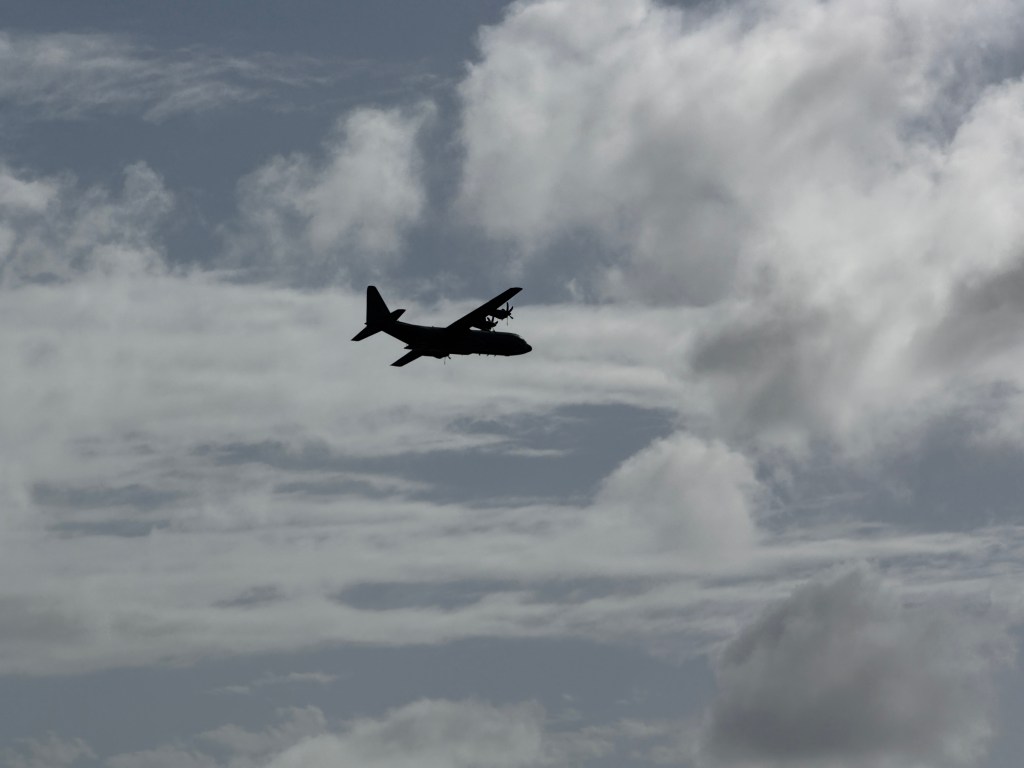
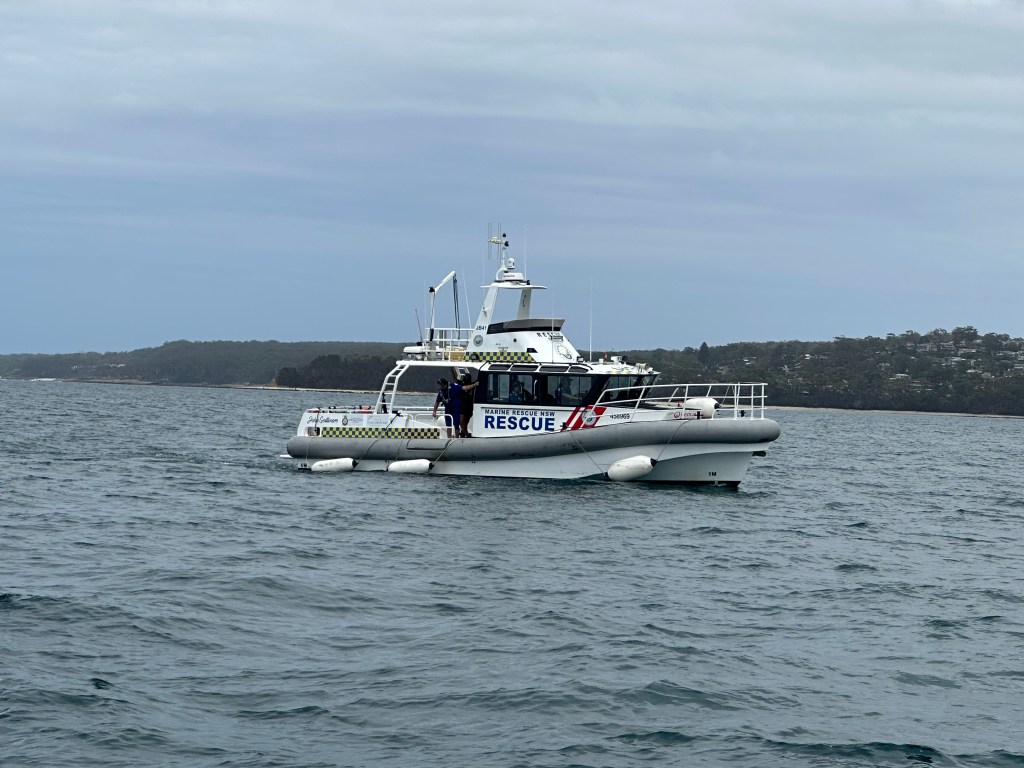
In the morning the weather looked kind for a southerly sail, so we packed up Taurus and preceded to head out of Jervis Bay. The wind was about 15 knots from the east sou’ east (changing to an easterly later) and we were happy to sail in the company of a tall ship leaving at the same time, no doubt also heading to Tasmania for the festival. As we left there was also a couple of naval vessels departing (the Royal Australian Naval College is based in Jervis Bay) and even a Hurricane C130 overhead. The radio chatter made it clear that that there was a big Search and Rescue training exercise taking place.
Tall ship heading south. Hercules overhead.
Trying to sail we headed off shore to get a better angle to head south. We then turned and had a fairly narrow angle of sail which we would have to carefully manage until we got past a nearby headland. As we approached the wind died and prudence dictated that we run the engine to keep a safe distance from the rocks whilst maintaining our heading.
With the engine running I thought I heard a ‘funny noise’ and whilst I was listening to see if I could identify the issue, Cara pointed out that though the engine was on and we were in gear, we weren’t actually going anywhere. With the headland looming we made the call to about turn and sail back into Jervis Bay with the aid of the easing wind. Once again, prudence reared her head and we decided to call up the NSW Marine Rescue chaps to let them know that we didn’t need assistance, but that the situation might change if the wind died completely. It is generally a good idea to open channels of communication early if situations start to head south, so that if they really go pear shaped response times can be much faster.
Before long we were back in sheltered water and making progress to an anchorage. Cara was ‘steering the cutter’ (well sloop) as I lay on the hot engine fiddling with the gear select lever to make sure that forward gear was actually being engaged. This was about all I could think of as an immediate action to try and remedy the problem, and it didn’t work. My next step was to phone a mechanic friend in New Zealand, and here I found one of the problems with activating the good services of Marine Rescue. Whilst I was talking to my friend they tried to call me so I declined the call. They then called back, and back, and back, and back until I had to end my call to my pal in New Zealand to tell them that we still didn’t require assistance and were still under sail. The nice man told us that a boat was coming to meet us anyway. A few minutes later a powerful launch with about six crew members arrived and took station off our port side. We continued to try and work out our issue, but our speed was painfully slow, and the resource that we felt we were tying up made what wasn’t a problem feel like a problem. We looked at the Marine Rescue staff and they looked at us as we ghosted along at a knot and a half. Ultimately, we kind of got peer pressured into asking if they wanted to give us a lift. To be fair, if the wind died completely before we got to the anchorage we would have needed a lift, but at this stage we were still moving.
Marine Rescue escort.
The first thing the Marine Rescue guys yelled back was ‘do you accept all liability,’ which seemed an odd thing to say at the time. ‘Sure’ we replied, not knowing what we were letting ourselves in for. Rather than tow us from in front, the launch came along side. We lay our fenders out and made bow and stern lines fast, at which point the launches skipper, possibly late for lunch, increased his speed and we took off. As the speed grew a bow wave was created which encouraged the boats to ‘work’ against each other, and caused the fenders to move and pop out from between the boats. This led to the rough rubber surface of the launches inflatable hull rubbing against our paint. We struggled to get the fenders back in place, realising too late why liability had been an issue. Still, as I said, we might well have needed this lift had the wind dropped further, and I wouldn’t look a gift horse in the mouth if it hadn’t been for what transpired later.
Marine Rescue deposited us on a public mooring off Huskisson, a touristy town named after William Huskisson (1770-1830) who was destined to be run over by The Rocket, thus becoming the first person to be killed by a train. The fortune of the town’s most famous son could perhaps have been taken as an omen.
The moorings at Huskisson are only protected from the south, and a long swell almost continually rolls in from the bay’s entrance to the east. The public mooring buoys are quite large, perhaps a meter in diameter and a metre deep (photo below). Normally with mooring buoys the thing to do is to pull them up nice and high so that they are under tension and can’t rub or bang against the hull. However, the depth of the buoys and size of the swell meant that even when hauled up as far as possible they were lifted by passing waves and then dropped back down with an almighty yank and a crash — over and over again. Having tried, and failed, to sleep through this constant jarring and noise the first night, we let some slack out the following day and were woken in the early hours by a different crash. As the swell subsided the buoy floated around Taurus’ hull and smacked against it. A boat’s hull acts a bit like a drum, so the noise created by a fairly mild knock can be pretty loud and alarming, and the force, if not gentle, can chip paint or even dent steel. This alternate pulling up and letting out of the mooring buoy to try and find a semblance of peace was one of the hallmarks of our stay at Huskisson, one of the most uncomfortable anchorages I have ever had the misfortune to visit, and this in pretty mild weather. Only one other boat stayed for a night whilst we were there, and they disappeared first thing the next day. Should I ever have to have to stay there again I think I might follow William Huskisson’s lead and throw myself in front of a train.
Mooring buoy at Huskisson at a time of relative peace. Note our anchor is turned upside down. This stops the mooring line chafing against it. The anchorage at Huskisson. You get an idea of the direction of the swell. All the boats in this picture were hobby horsing quite nicely even in these calm conditions.
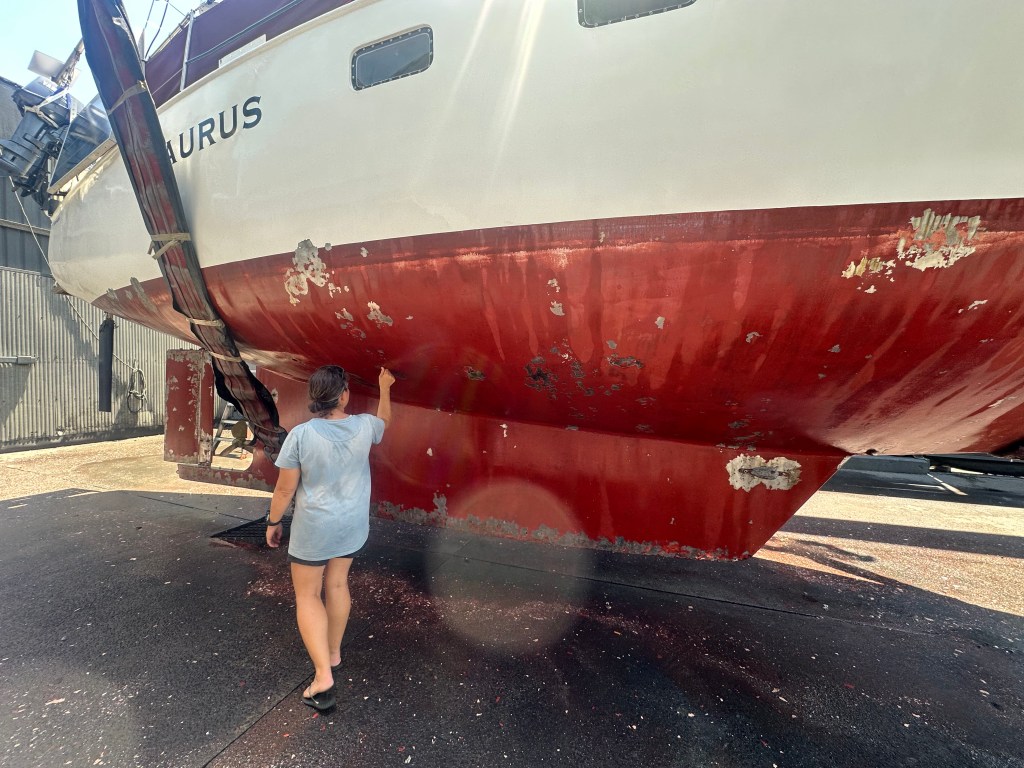
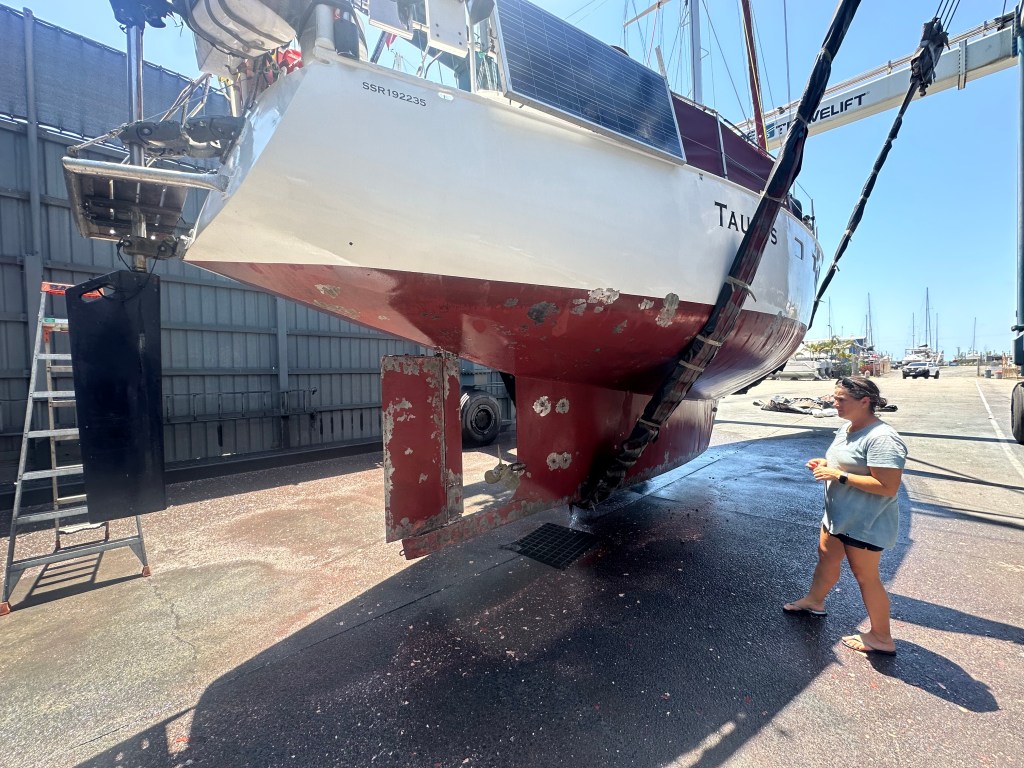
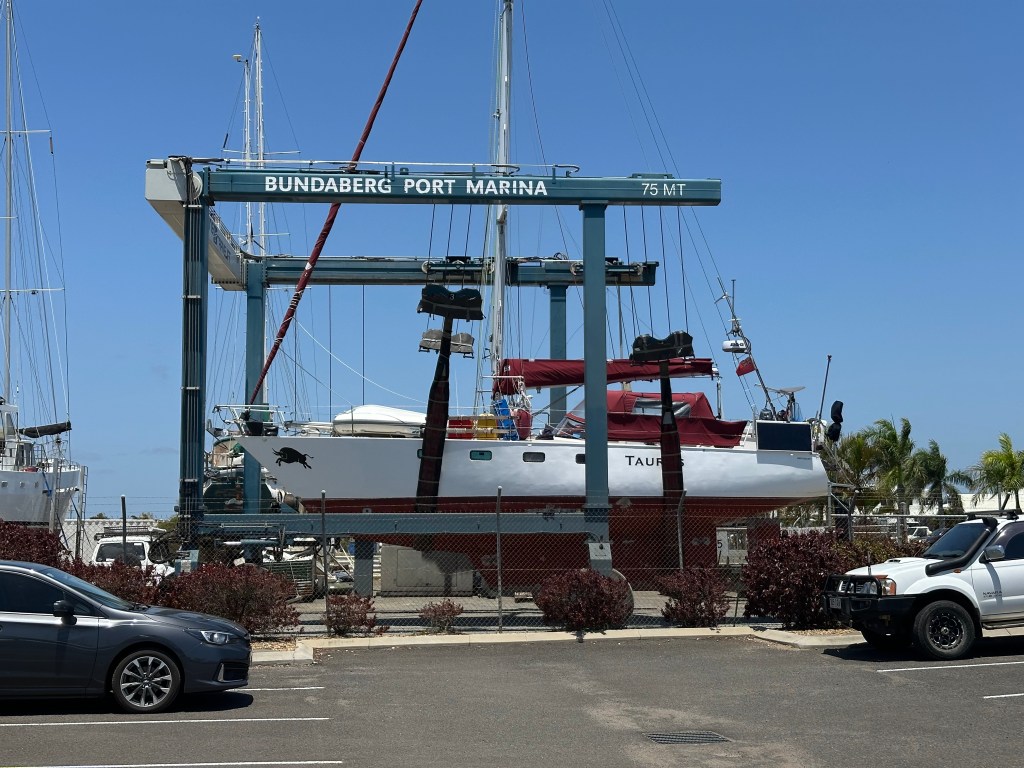
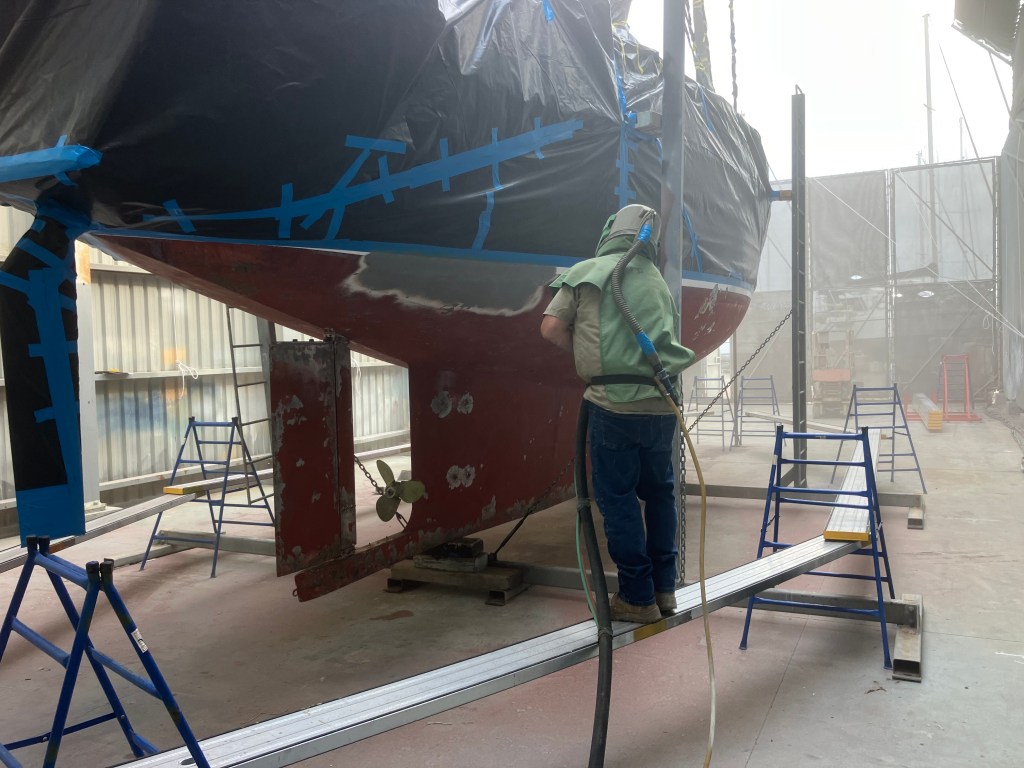
Of course, we weren’t at Huskisson for giggles, but rather to try and work out what was wrong with our drive, and if possible fix it. The problem was pretty clearly the gearbox, so we phoned up a few places and found that overhauling our existing unit would cost about $3,000. Another phone call to the manufacturers elicited the information that a new gear box would cost us $4,000 delivered. As the old gearbox probably dates to 1995, when the engine in Taurus was last replaced, the new option seemed the obvious way to go. Thankfully the manufacturers had a new gearbox on the shelf in Sydney, so we only had to work out where to have it sent. Fiddling with prop shafts in boats (the gearbox is attached to the prop shaft) whilst they are in the water can result in terrible things happening. In the worst case scenario the shaft can back out of the boat, letting in a deal of water and potentially sinking her if the hole can’t be blocked. Because of this (and other issues like stability, ease of access to hardware shops, and so on) most people would prefer to tackle this kind of job on the hard. However, putting a boat on the hard is not an easy proposition in rural Australia where small tinnies are the general rule, and if the facility exists using them comes with some pretty stiff financial costs. In the past we have been quoted $450 for the lift out, the same again for the lift back in, and up to $250 per day for a cradle.
In Jervis Bay, however, there were simply no facilities for us to access. It was not only impossible to get Taurus out of the water, but also to find a berth, or indeed anywhere with decent protection from more than one direction. As we discovered that we would have to lift the engine to remove the gearbox (the gear box is bolted on to the inside of the bell housing, which also features the rear engine mounts) there was no way in hell I was going to try and undertake the job on our super rolly mooring where just living was tough enough. After making more enquiries we found that Batemans Bay, about twelve hours to the south, had both a marina and a haul out yard.
We next had to wait for a weather window that would allow us to sail to Batemans Bay, and work out how best to get off the mooring. The latter was challenging because we would probably have to leave in a northerly, a wind that would create a lee shore behind us. Nearby to the west were shallows, a bar, and a reef; to the east lay space, providing we could get beyond the rocks that curved northwards from the end of the Huskisson beach. Adding to the complexity were moorings and the potential of boats being moored to either side of us when we wanted to go. Essentially, we had to be able to gain way immediately we left the mooring. Otherwise we would have to turn downwind to gain speed and steerage, almost certainly having to slip behind a fishing boat on a mooring to the east, a course that would take us perilously close to the beach and rocks and that would give us little in the way of a Plan B if things didn’t go well. Our confidence wasn’t boosted when we were told that the ground in the area was shale over rock, so that our anchor might not hold if we needed to deploy it.
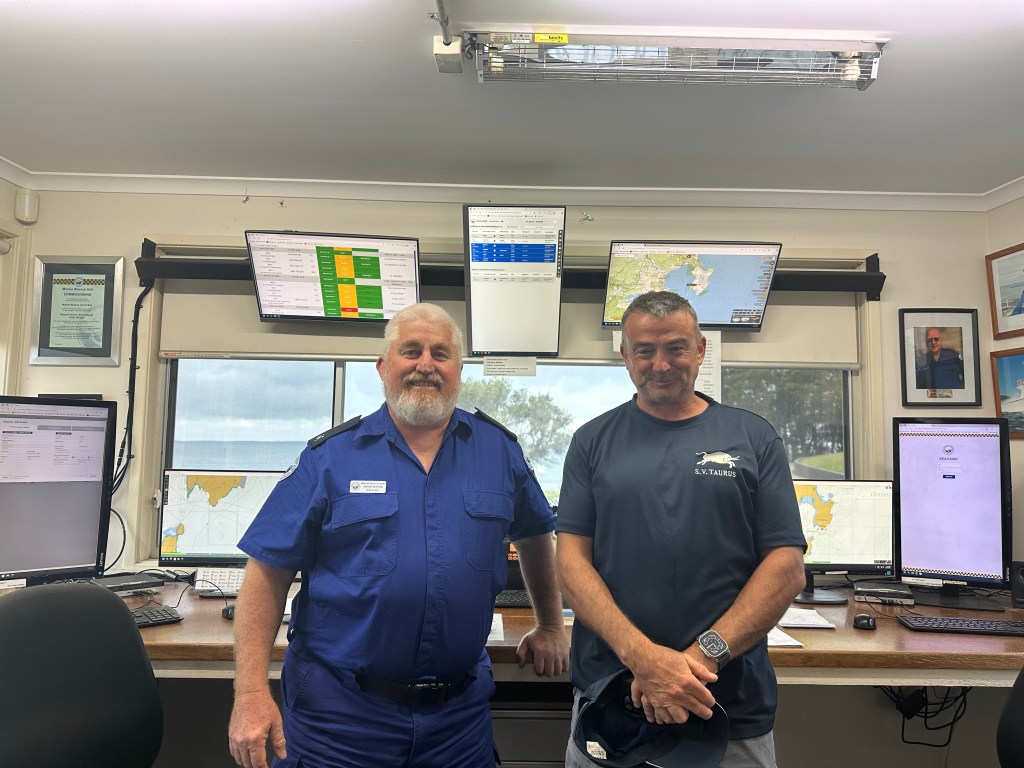
Ideally, we thought, we would get a tow for the few metres required to see us past the moored boats and the rocks to the east. A mere hundred metres or so. With this in mind we mentioned it to the chap at the Marine Rescue base when we popped in to thank them for their help. We also wanted to enquire about becoming members of the Marine Rescue service. We have been long term members of the NZ Coast Guard, which assures free assistance if needed, where as non-members are billed. Australia’s Marine Rescue is a different beast. Far from being a national service (as it is in NZ) Marine Rescue is state funded but functions via individual bases. This, we were told, means that if one base has an excess of volunteers they are not allowed to help out at another base that might have too few, or might have been hit by sickness. To those cruising the coast or country this approach might seem less than ideal, but as the service is state funded and free to the user it doesn’t really matter, apart from making membership a bit pointless. We have since been told that membership can confer a better quality of service, but this is far from guaranteed.
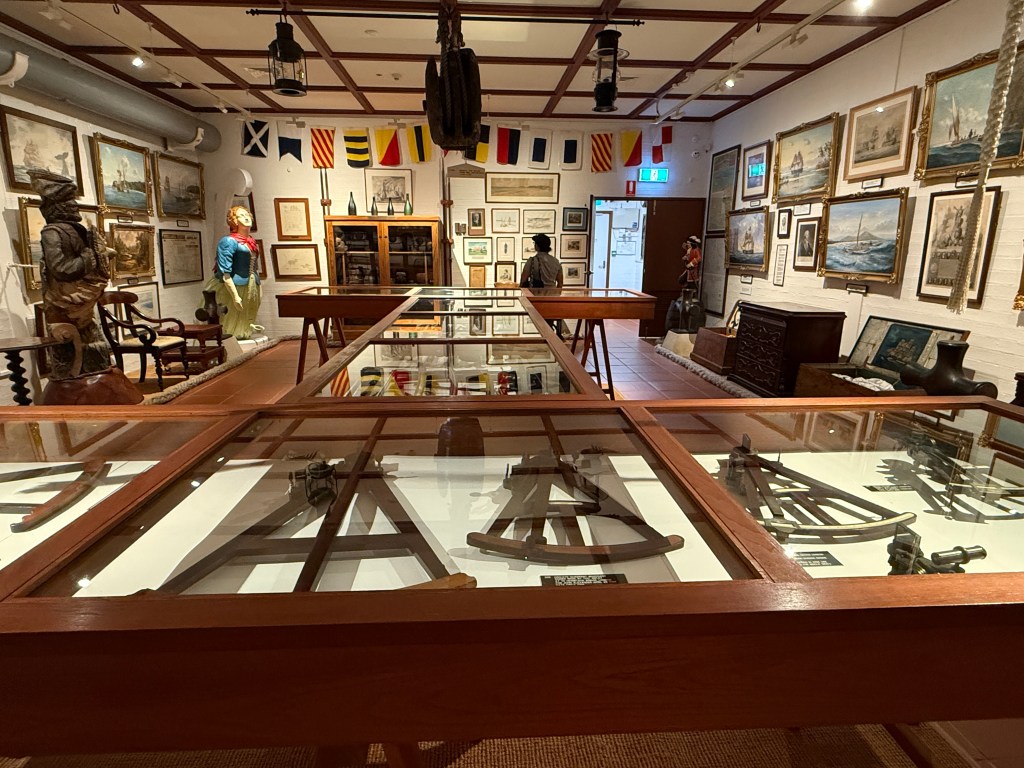
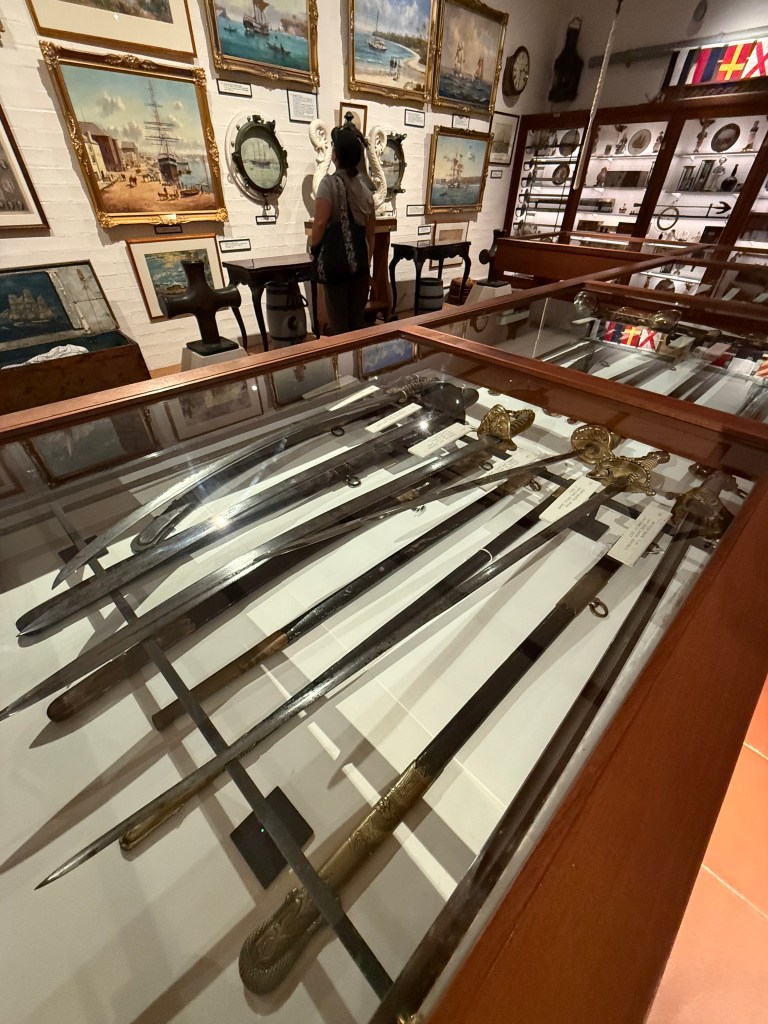
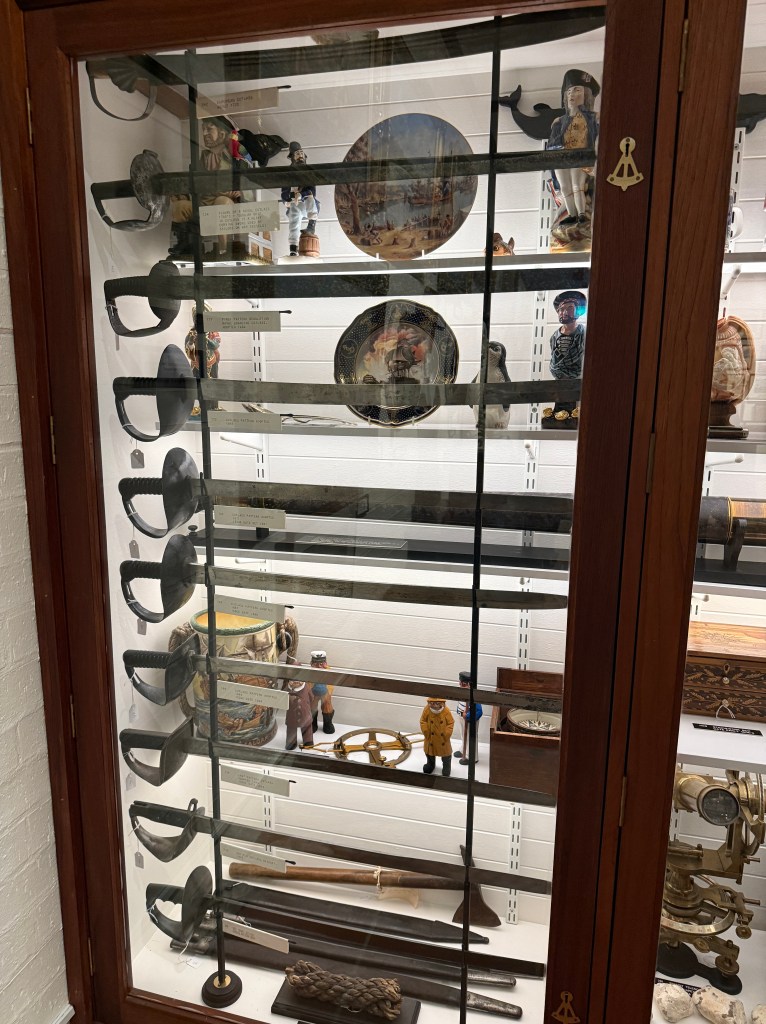
The Marine Rescue guy we spoke to was helpful and told us that we should be able to get a lift on either Saturday or Sunday as the patrol craft would be heading out anyway. Relieved, we did a few jobs, like fixing our 8hp outboard motor, and then a few touristy things, like visiting the Maritime Museum.
Dave of Marine Rescue Jervis Bay. Nice guy and keen to help. Getting some mechanical practice in before the ‘big job’.
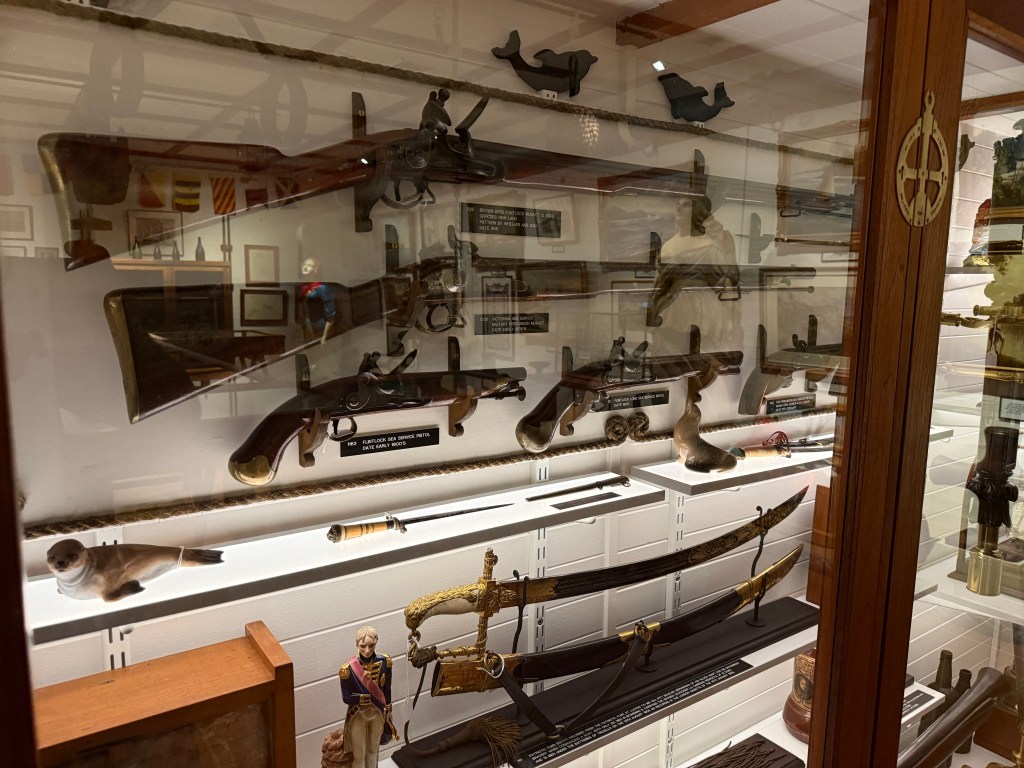
The maritime museum turned out to be excellent, especially the display of antique survey gear, sextants, and Napoleonic War weapons. For a fan of Patrick O’Brian, C. S. Forester, and Frederick Marryat, the latter was very interesting and right up my alley.
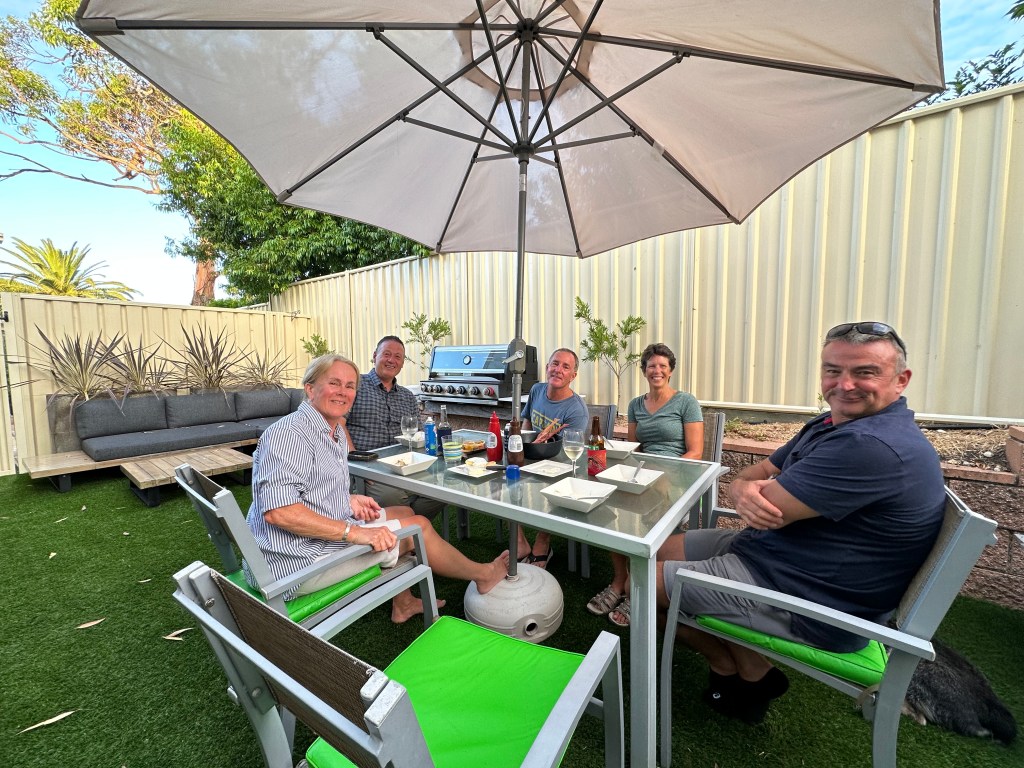
During our fact finding sessions regarding where to go, and how to fix our problem, Cara had made contact with local sailors who, after offering advice and assistance, kindly invited us to dinner. Dan and Liz, and Ross and Janet, have been building their own catamarans for several years, and whilst we won’t hold that against them, we hope that they see the light and get rid of an extraneous hull each. Five minutes with an angle grinder should do the job perfectly — two monohulls for the price of one cat, and an immediate boost in street cred and aesthetic appeal.
From left: Janet, Ross, Dan, Liz, and me. Cara taking the photograph.
But seriously, those interested in boat building, especially the process of building a cat, should check out Ross’ You Tube channel, ‘Life on The Hulls,’ for great tips and advice.
Having checked the weather we revisited the Marine Rescue centre to tell them that Sunday looked good for us to leave, and to ask what time might be convenient for them to help us. Our reception seemed much frostier this time around. We weren’t allowed in the building, and the person we spoke to on the phone said he would have to talk to his supervisor about our request. When we phoned back later we were told that they couldn’t assist us.
Next day dawned fine with a ten knot breeze from the north. We got ourselves ready to go, by which time the wind had increased to 15 knots. Working out our tactics it seemed a good idea to keep the Marine Rescue guys abreast of what we were doing. We spoke to a new person who encouraged us to wait so that he could talk to his supervisor to see if they could in fact help. We were reluctant to delay as the wind was increasing, which would help us gain way, but also increased the risk of being blown onto the lee shore. We were promised that he would have an answer within quarter of an hour. Fifteen minutes later we were told that the supervisor was on a boat coming out to see us.
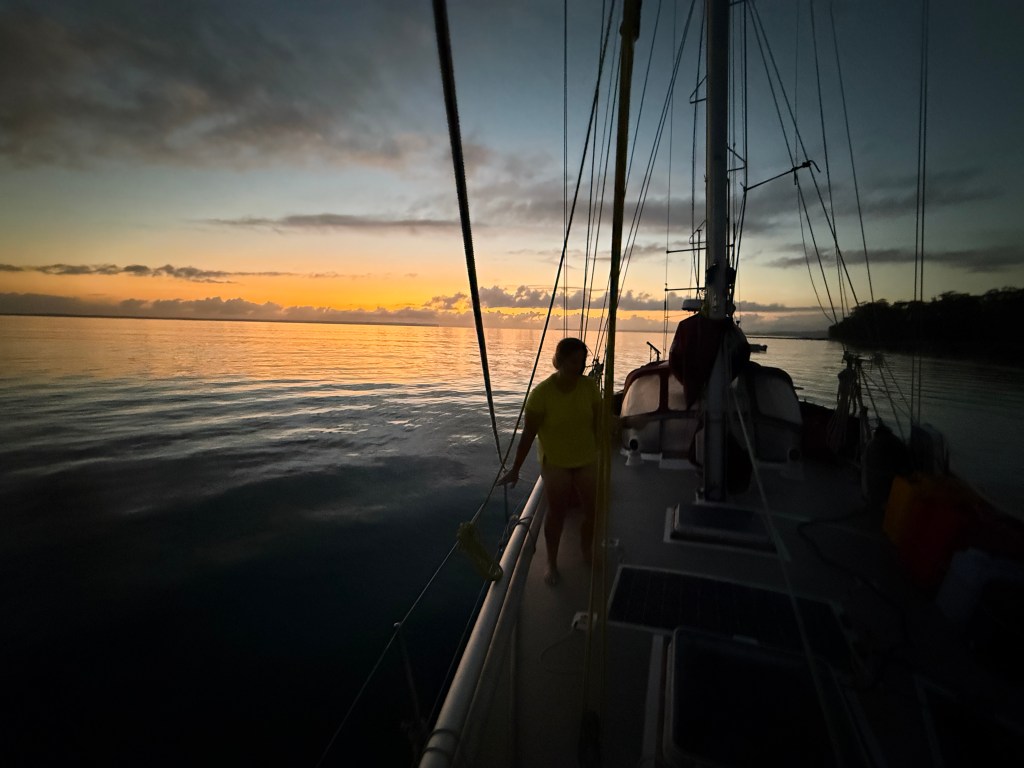
Early start on day of departure.
A short while later two Marine Rescue jet skis turned up. We had no idea what they wanted but they asked us the standard questions that Marine Rescue always ask, length, draught, and weight of vessel, number of persons on board, and so on. Having answered these questions a launch appeared with the supervisor, and we had to repeat the same information all over again. On hearing our weight, 10.5 tons, the supervisor said, ‘we can’t tow you, our maximum is 7.5 tons.’ As we had provided this information at least four times to local staff we weren’t too impressed by having been asked to wait for the supervisor to announce what was obviously a foregone conclusion. If the conversation had ended there we would have retained more respect for the guy’s judgement, but unfortunately he kept talking. He informed us that if they tried to tow us we would drag them onto the rocks. How this would happen is difficult to imagine, we only wanted an assisting tow to get going, and surely if the critical situation he described should arise they would be able to cut the tow line? The decision having been made it didn’t seem worth pointing this out. He then said that the jetskis could hold station with us, and if we were swept on to the beach we could jump into the sea and be rescued by them. I was so shocked by this vision that I think my jaw literally dropped open. Then, seeing our 8 hp outboard on the rail he asked why we didn’t attach it to the transom instead of asking for a tow. Trying to hog tie an outboard to a yacht’s transom is a good way to have a nasty accident, and almost certainly lose the motor in the process. The man suggesting this was the local Marine Rescue Operations Manager, standing on a launch with two massive outboards, providing, I would guess, something like two or three hundred hp. Somehow he had arrived at the conclusion that whilst his boat didn’t have the necessary power to help, our 8 hp motor could be jerry rigged to do the job. As if to prove that he knew absolutely nothing about yachts or sailing, the guy then asked why we didn’t wait for the wind to die — ‘because our engine doesn’t work’ we said in bemusement. More prosaically he then asked why we hadn’t booked a mechanic or a tow from a commercial operator. We replied that we had tried to speak to several mechanics, only one of whom had gotten back to us, to tell us he couldn’t look at our job for months. We added that we hadn’t investigated a commercial tow because we weren’t sure we needed one, and we had been told on Friday that Marine Rescue would be happy to help. The conversation clearly wasn’t going in a helpful direction. Having asked where we were heading the Ops Manager said something to the man at his helm and in a fit of what appeared a lot like pique he zoomed off, taking his jet skiers with him, and leaving us to face the peril of being ship wrecked alone.
Having messed around long enough we hoisted the main, pushed it around so that the boat was pointing in the right direction, let out the jib, and began to sail. Running forwards I released the mooring line and we were off and sailing. It was just as easy as it sounds. Though very slow to start with we were able to maintain our direction, and as our speed increased we knew that we were perfectly safe and really shouldn’t have bothered with all that Marine Rescue palaver.
We repeated our trip out through the heads, turned south and enjoyed another fast ride in the 15-20 knots and strong current, arriving at Batemans Bay at about 8:00 p.m. just as light was fading. Getting into the anchorage, behind a reef, was a bit of a game, involving some stressful tacks in light winds due to the shelter of the headland. Taurus needs some speed and momentum to tack (turn the bow across the wind), and if she doesn’t have it she’ll go so far and refuse to turn any further. The danger of this situation is that the boat can end up ‘in chains,’ that is head to wind and stalled without steerage. Once again, the need to practice anchoring and slow speed manouvering without a motor was brought home to us.
To anchor without an engine one simply has to reduce sail to slow down and then turn into the wind to effectively stop the boat. When the boat stops the anchor is released and the boat is blown back by the wind. More chain is released until the desired scope is out, we use 15 metres plus twice the depth of water, and then the chain is snubbed off. Job done.
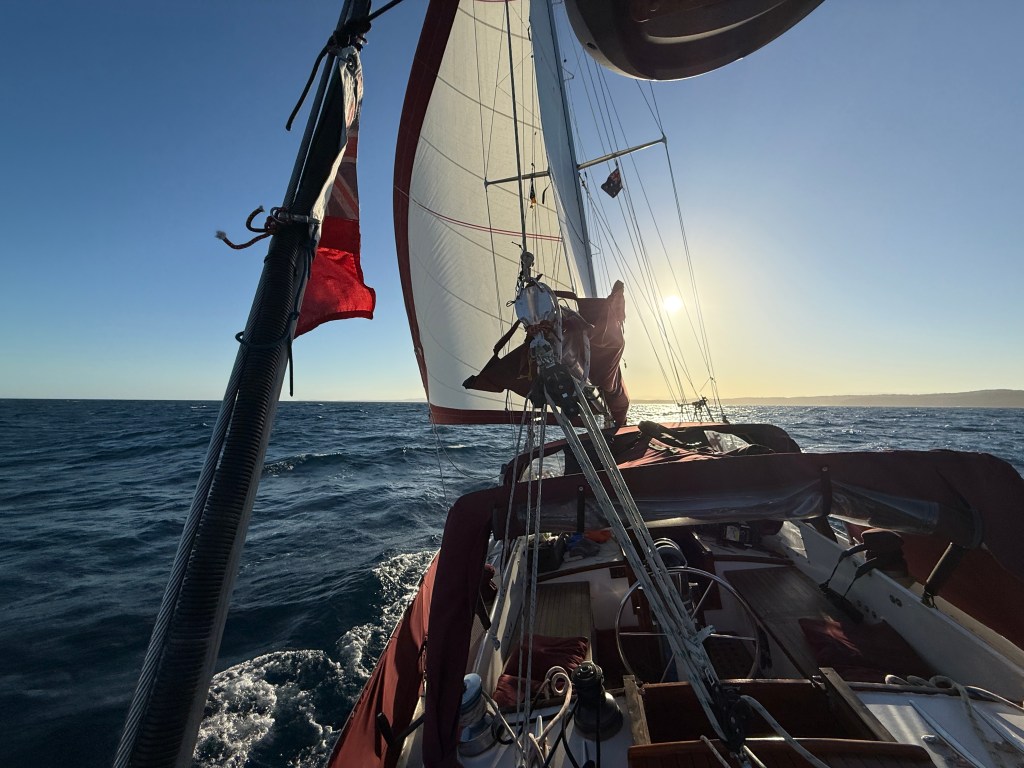
Another fast sail south. Arriving at Batemans Bay.
Anchoring without an engine isn’t then particularly hard, in good conditions with plenty of space, but being able to do it accurately takes practice, and I’m sure doing it in less than ideal conditions would be an entirely different kettle of fish.
Northerly winds had been forecast for the next day, but they failed to appear. The marina booking lady had told us that the marina staff would be able to assist us with a tow to get in, but after we spoke to them this proved not to be the case. We were a mere 2 NMs from the marina, but between us and it was yet another bar. The bar on the Clyde River is particularly shallow and we needed to cross it close on high tide, which was just after midday. Given the lack of any wind and the very calm sea state we decided to try and tow Taurus with our newly fixed 8hp outboard. Towing a boat of Taurus’ size isn’t inherently difficult. You aren’t after all trying to pull ten and a half tons, most of that weight being supported by the water, so in calm conditions it is pretty easy for an individual to pull Taurus around by brute force, say when moving her forward or backwards on a jetty. We have heard of boats being towed by someone swimming (that guy or gal must be a hell of a swimmer) or by a row boat. So, whilst we knew the practice wasn’t impossible, it was a technique that we had never had to learn. Essentially the outboard goes on the dinghy which is strapped to the beam (the side) of the boat. The engine provides power and is locked in a neutral helm position whilst the boat is steered from the main wheel. Like most things, practice makes perfect. Our first attempt saw Taurus swinging in circles that we were unable to control, possibly due to a current. We then tried towing in the normal car-like-fashion, but whilst we started in a straight line the boats kept diverging onto different paths that were difficult to realign. We then went back to having the dinghy tied to the beam in a slightly different configuration and found moderate success!
As time was critical, due to the tide, and it looked for a while like we would be unable to tow Taurus adequately, Cara called the Batemans Bay Marine Rescue to see if the staff there were of the helpful or unhelpful variety. As soon as she began to explain the situation the person on the end of the phone cut her off, telling her that there was a note on their desk from the Operations Manager at Jervis Bay stating that they were not to help us. It appears that the Manager in Jervis Bay had asked our destination not out of any concern for our wellbeing, but to forestall any request for assistance we might later make.
Having got Taurus moving we decided to keep going. The unknown bar was ahead of us and if there were any waves we would be completely stuck, so we found the number of a commercial tow operator and gave him a call. He reassured us by telling us the bar was like a millpond and suggested that we keep going if the boat was moving. He added that he could be with us in twenty minutes and that the fee would be $350.
Now, I understand that some people would say that we should just stump up for the services we need, but we, like many cruisers, do not have unlimited funds. If we had gone the way of commercial operators for every difficulty our latest escapade would have looked something like this: to get off the mooring in Jervis Bay – $350; to get into Batemans Bay Marina – $350; to go onto the hard for a few days – $2,000; for a mechanic to swop the gearboxes – $2,000–$2,500 (diesel mechanics charge around $100 per hour, the job took us three days). Time is a seperate factor, but also expensive. The wait for a mechanic is several months long at the moment (and many mechanics simply can’t or won’t work in the tiny space around Taurus’ engine), as such we would have had to stay in the marina at $107 per day for however long it took for them to do the job, say three months – $9,500. You get the idea. Paying someone to fix our problems has to be a last resort, and, to be frank, often the job you pay someone to do turns out to be poorly done.
We struggled on, and it was at this point that Guy from Ambrosia appeared in his dinghy with his 10 hp outboard to give us a hand. Tying this onto the opposite beam more than doubled our available power, and we shot ahead at around 3.5 knots. The bar was as described, very flat and shallow, but no great hindrance. Our next challenge was to turn ninety degrees into the marina, and then make a second ninety degree turn to access our berth, whilst more or less simultaneously getting Guy and dinghy out of the way before ‘landing.’
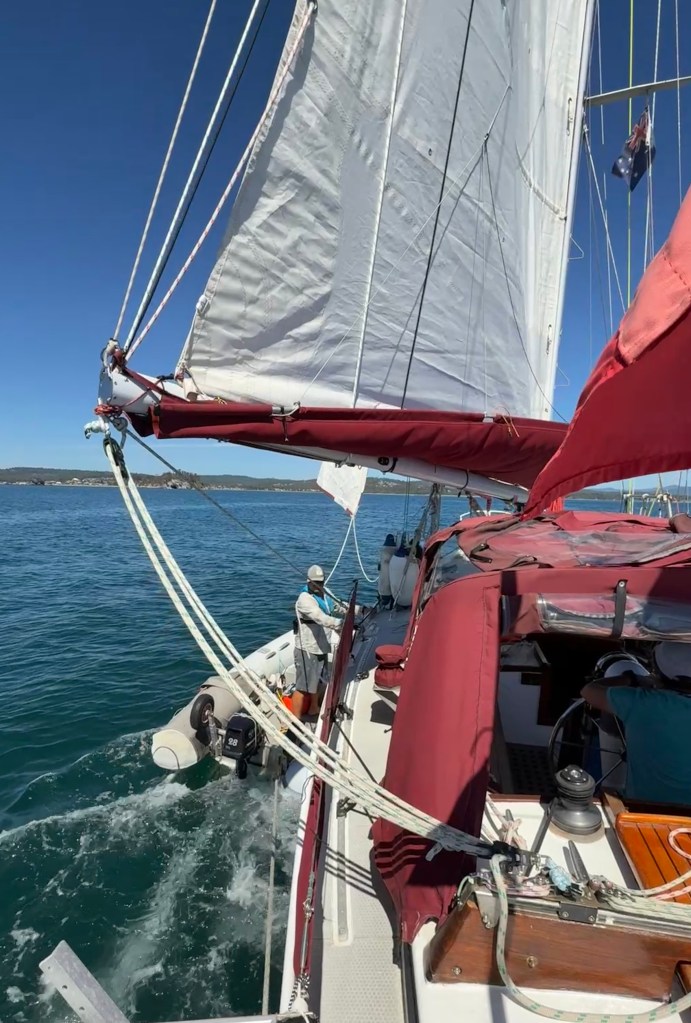
Guy from Ambrosia giving us a hand. We’d have been a bit buggered without him. Cheers Guy!In this photo you can see the challenge of getting into the marina. We had come from somewhere near the headland to the left. The bar is a narrow strip that follows the marina wall in centre. We had to follow the channel, turn sharply to port, and then sharply to starboard. Not easy with our reduced manoeuvrability.
Our first attempt to turn into the marina failed due to the strength of the current, but whilst I thought we would have to anchor and call the tow man, Cara simply swung us around 270 degrees, entered the marina and had us lined up with the jetty. Guy was rapidly released and just like that we were tied up and safe. Looking down the jetty we could see two Marine Rescue boats, once again with horse power to burn. We had towed ourselves with a total of 18 hp, so it was hard to credit that one of these boats with several hundred horse power couldn’t have helped us.
Now let me be clear. I can understand that the NSW Marine Rescue stance might be that they will only respond to situations in which lives are at risk, and that operations of a non-critical nature should be handed off to commercial operators due to cost, issues with manning, and so on. If that is the case the position is not advertised, and was never stated to us. In New Zealand if you need a tow then the Coast Guard will provide it, to ensure safety of crew and craft, avoid environmental issues, and so on. I presume it’s the same here. The reason we had been refused help in Jervis Bay was because we were ‘too heavy,’ not because our request fell outside the service’s remit. The reason why we were refused help in Batemans Bay is unclear and I have written to the service to clarify their position. It appears that our decision to keep the service informed of our intentions, as a responsible safety measure, served to preclude us from being able to access assistance because the Operations Manager in Jervis Bay took a dislike to us. If this is the case it’s hard to imagine a more irresponsible and unprofessional act. Intentionally excluding a disabled vessel from being able to access assistance, without knowledge of the circumstances in which aid has been requested, goes against every tenet of the sea, let alone the duty of a manager in ‘Marine Rescue.’ Hopefully we will be able to avoid any further need of Marine Rescue’s assistance, I would certainly be loathe to ask for it.
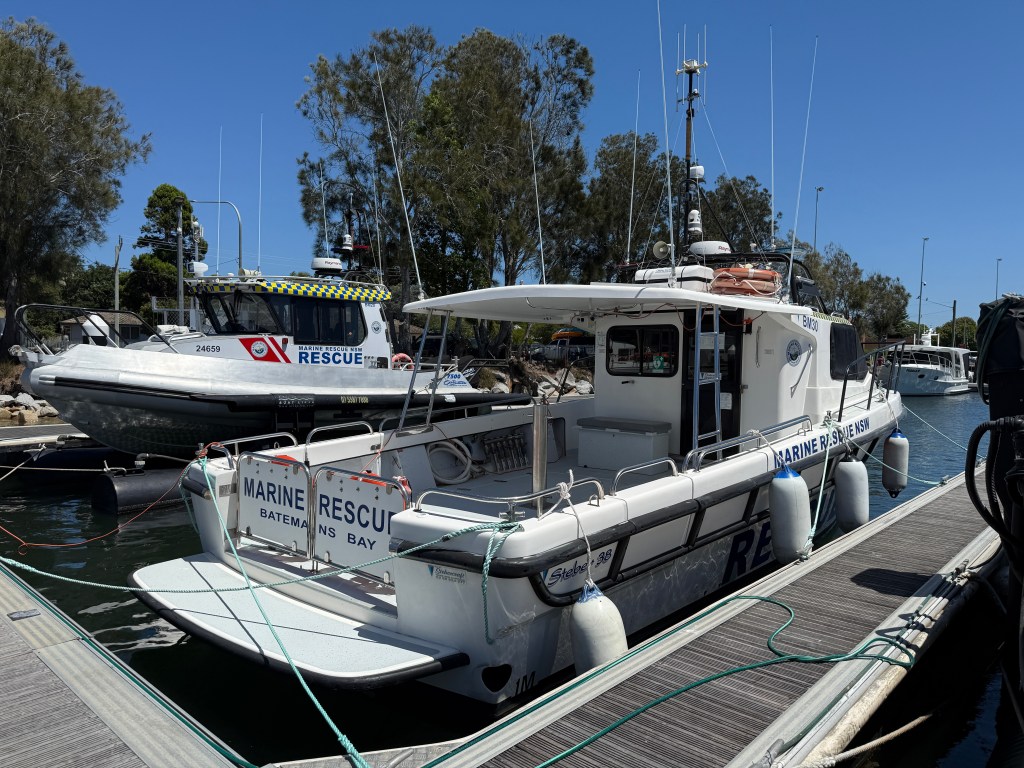
Marine Rescue vessels in Batemans Bay. Pretty, but not much use.
That afternoon we began stripping out our gearbox, but that tale will have to wait for next time!
Having to sail without an engine was an interesting, if stressful, experience, and certainly demands greater awareness and skill. I hope that when our engine is fixed we won’t forget the need to keep practicing the skills required when an engine is unavailable.
Voyage of the good ship Taurus: 29 January—2nd of February 2025.
We arrived in Sydney on Friday the 10th of January at about 10:00 am. Regular readers will know that we had been trying to arrive on this day or before because our good friend Eugene was visiting Sydney for a few days, giving us an opportunity to catch up with him.
Eugene is a solo-sailor from Bulgaria whom we met in Tonga, and ran into again in Fiji. He is one of those inspiring souls who would give you the shirt off his back, and spends his time sailing around the world, and learning languages. When not doing one of these things he inspires others to have a go at them.
We met Eugene at Rose Bay, fresh off the plane so to speak. After running him out to Taurus to deposit his luggage, we took the ferry to Circular Quay for an internet guided tour around The Rocks, the original site of the Sydney settlement.
Our first call was the Museum of Contemporary Art. I often find modern art a bit hit and miss. The recent sale of a banana taped to a wall for an astronomical $6 million highlighting, in my admittedly ignorant opinion, the absurd pretension of some so-called artists and their aficionados. It seemed telling that as we wandered the galleries we found that many people seemed to find whatever was happening outside of more interest than the art.
The above photograph is an ironic critique of modern art in a contemporary museum setting. Entitled ‘Modern Art is Shit; What’s Happening Outside’ it’s yours for a snip at $5,000,000.
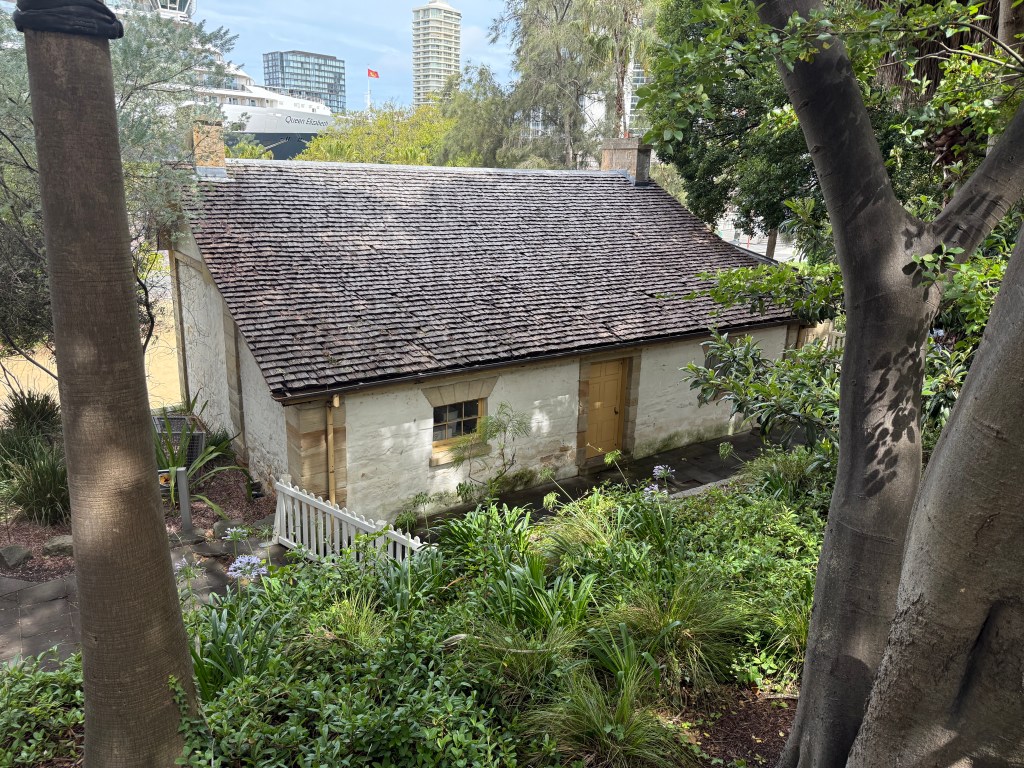
After coming to the unanimous decision that modern art is a bit rubbish, we wandered down to Cadmans Cottage which, built in 1816, is one of the few buildings left from Sydney’s early days.
Next on the tour was The Rocks Museum. This small building houses a host of interesting displays that informs the visitor about life in Sydney two hundred years ago.
Eugene and Cara.Inside the museum. Fire!
After the museum we headed towards the Sydney Harbour Bridge, making sure that we didn’t end up on the side reserved for cyclists. On my first trip to Sydney, almost thirty years ago, I made the cardinal mistake of walking on the cycling side and was given a real Aussie dressing down by some irate chap.
Heading up to the Sydney Harbour Bridge.Sydney Opera House from Sydney Harbour Bridge. Cara just needs a kangaroo, a boomerang, and Rolf Harris to be able to call Aussie Bingo!
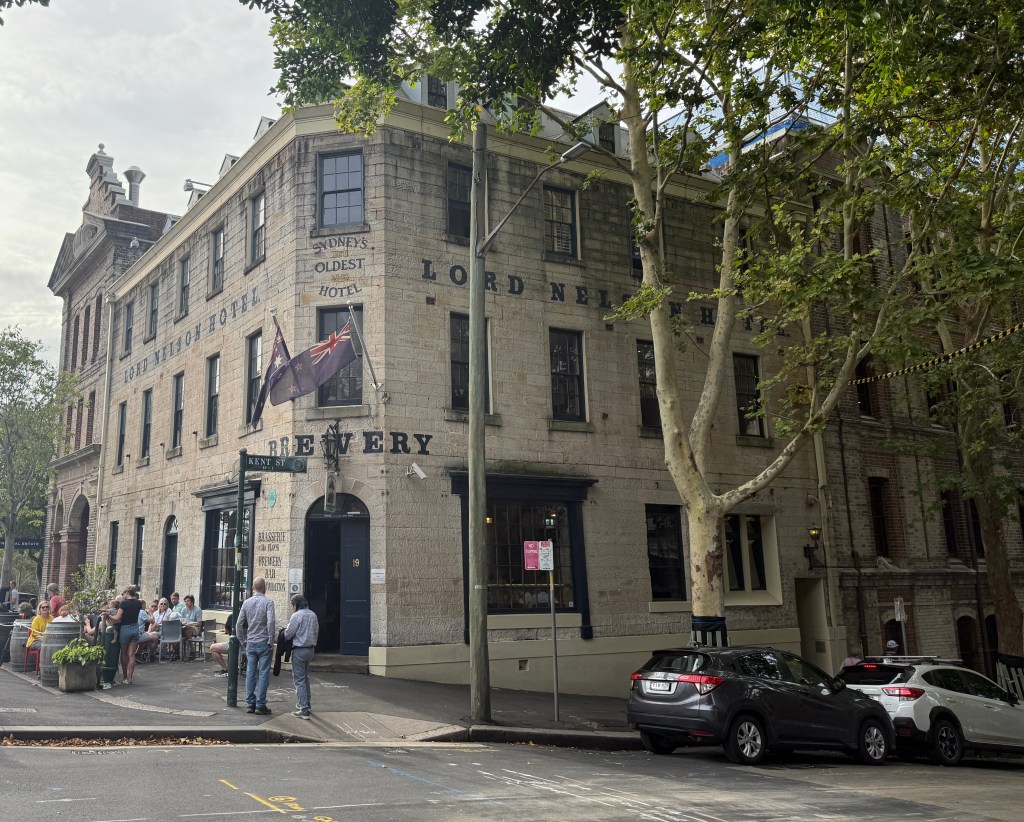
Having worked up a thirst we headed to Sydney’s oldest continually licensed pub, the Lord Nelson Hotel, which has a nice atmosphere and a great range of beers.
After so much excitement it was time to go home for a lie down and a wee nap.
On the ferry home.
Not having abandoned hope of the civilising influence of one of the world’s great cities, we headed to the Art Gallery of New South Wales to see what we could learn.
I have always admired the work of René Magritte (1898-1967), whose art blends skill, humour, and surrealism. So it was with great delight that we found that an exhibition of the great artist’s work was being held at the gallery when we visited. Less delightful was the A$35 dollar fee, but having screwed our wallets to the sticking place we sallied forth to pay. At the counter we met a young Maori-looking-girl who was taking money and collecting data. When she asked for a post code we replied that we were from New Zealand, to which she responded, “the best country in the world, you go in for free.” Who doesn’t love a free visit to a René Magritte exhibition?
Magritte is of course the artist who infamously painted a picture of a pipe and added the sentence beneath, “Ceci n’est pas une pipe,” or in English, “This is not a pipe.” I remember showing this picture to my kids when they were young and their subsequent confusion, but of course a picture of a pipe is not a pipe, it’s a picture. That famous image, The Treachery of Images, was, alas, not part of the exhibition, but a subsequent image, with the words, “This is still not a pipe” was present and correct.
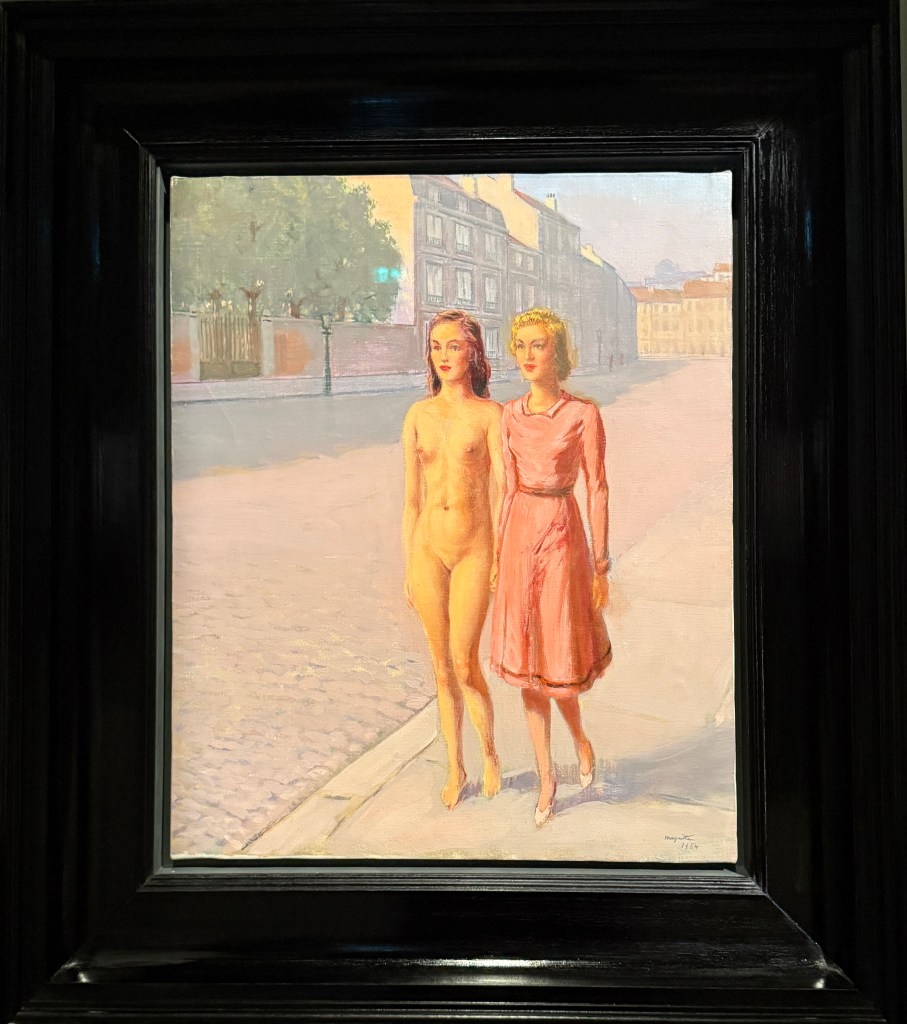
For Magritte fans, and who isn’t, here are a few more images from the exhibition:
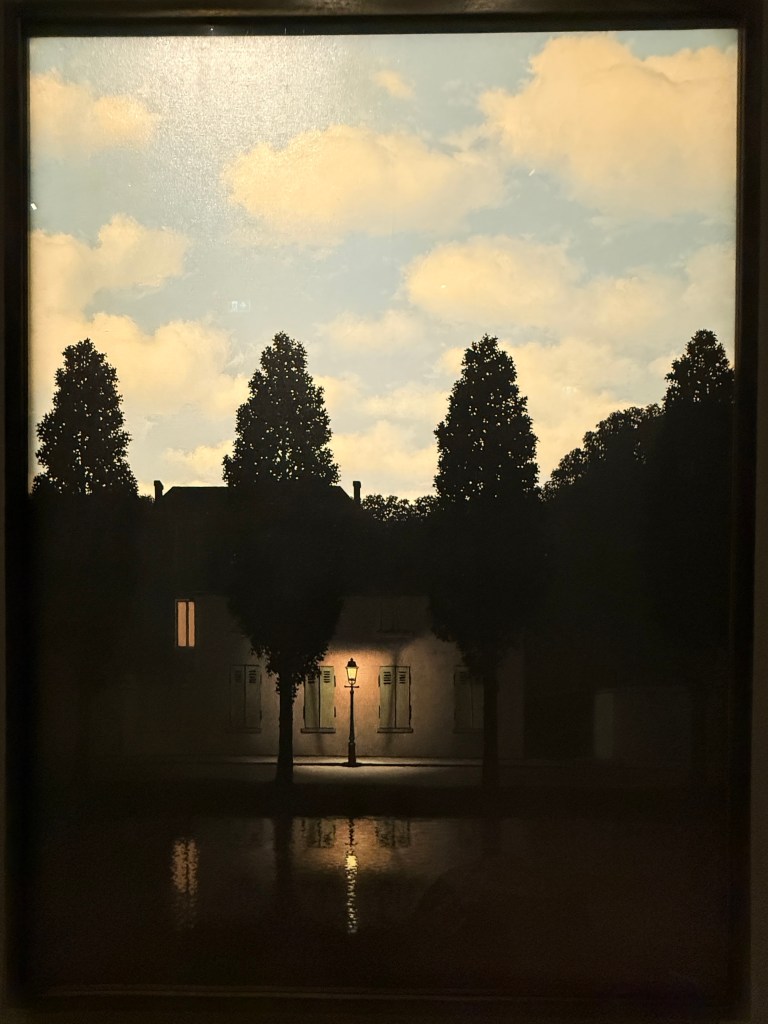
The Loversillustrated Youth. Ellipsis.Untitled.Golconda.L’empire des lumières. There are 27 versions of this painting. One of them recently sold for $121,000,000. You could buy twenty bananas for that!
After the gallery we headed back to Circular Quay and took the opportunity to have a look inside the Sydney Opera House. Here architecture, rather than art, is king.
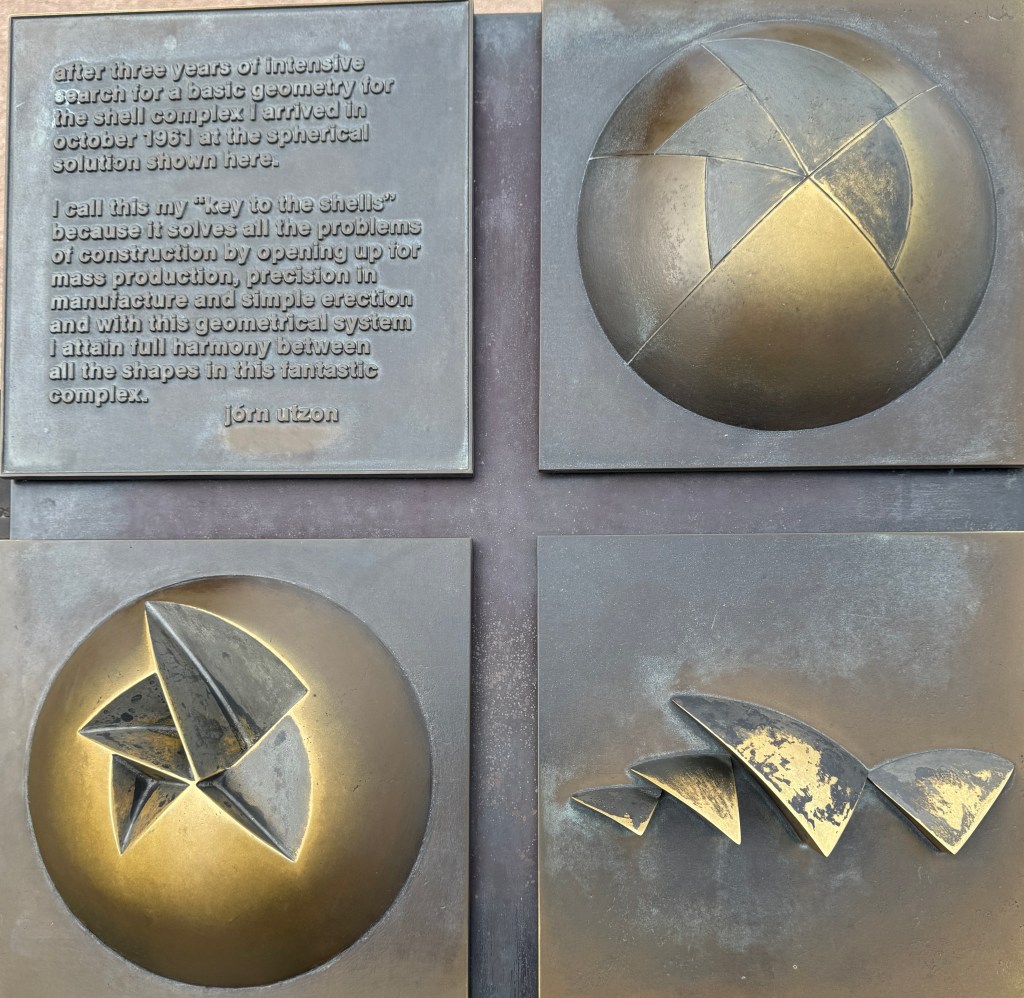
Widely regarded as one of the world’s most famous and distinctive buildings, the Sydney Opera House is a masterpiece of 20th-century architecture. Designed by Danish architect Jørn Utzon, the building was formally opened by Queen Elizabeth II on 20 October 1973, sixteen years after Utzon’s 1957 selection as winner of an international design competition. The government’s decision to build Utzon’s design is often overshadowed by the difficulties that followed; cost and scheduling overruns, and Utzon’s ultimate resignation from the project (Wikipedia).
Clever stuff…Eugene at Sydney Opera House.
Next day Eugene had to leave to fly back to New Zealand to where his boat is currently on a mooring. Hopefully, somewhere in the world, we will meet again. This typifies one of the best and worst aspects of the cruiser lifestyle, you constantly meet incredible people that become great friends, and then you say goodbye to them.
Sans Eugene we had to get back on with life and all its chores, big and little. Staying at Rose Bay we had quickly worked out that we could sneak into the local yacht club for showers (we had asked if we could make a donation for access but had been told it would be fine if we were discreet) but had yet to find a laundrette. The nearest self-service laundrette we were able to find, much cheaper than serviced types, was at Bondi Beach, fifteen minutes away on a local bus, so we dragged our laundry bag out and headed off to visit this Australian landmark.
Bondi Beach.
Like many tourist meccas, the beach was a bit sad and tawdry in ‘person,’ and not wanting to take our giant bag of newly washed laundry onto the sand we didn’t hang around.
The weather forecast boffins were warning of a storm from the north, followed by a storm from the south. We considered moving, as Rose Bay is a bit open to the north, but after a week or so on anchor we knew the anchor would be well bedded in, and we had plenty of room to swing, there not being many boats around us. With these factors in mind we decided to stay put, chucked the dinghy on deck, lashed everything well down, and let out extra chain until we were hanging off about 50 metres in about 5 metres of water. we also added a little extra length to our normal chain snubber, which bears some explanation.
A boat held in place by a chain in rough seas can experience strong jerking as waves act against her. These jerks, fairly continuous during bad weather, can exert massive forces that make life on-board unpleasant, can break equipment, and can encourage dragging by jerking the anchor out of the ground. One solution is to use a snubber: a bridle made of nylon line that is attached to the boat’s forward cleats on either side and extend forward where they are attached to the chain some distance from the boat (about 2-5 metres is our standard, 10 metres our maximum). The weight of the boat is then eased onto the snubber by letting out more chain, which slackens as the line takes the strain. Nylon is used because of its elastic properties which absorb the shock loads. The trick with a snubber is to use as thin a line as you think will hold the boat (with some longevity) and as long as is convenient — the longer and the thinner the more elasticity available, and thus the less shock loads the boat and anchor receive.
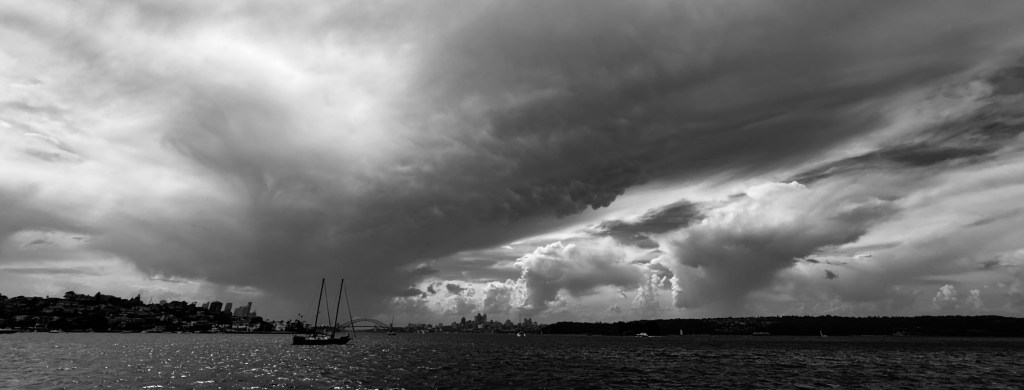
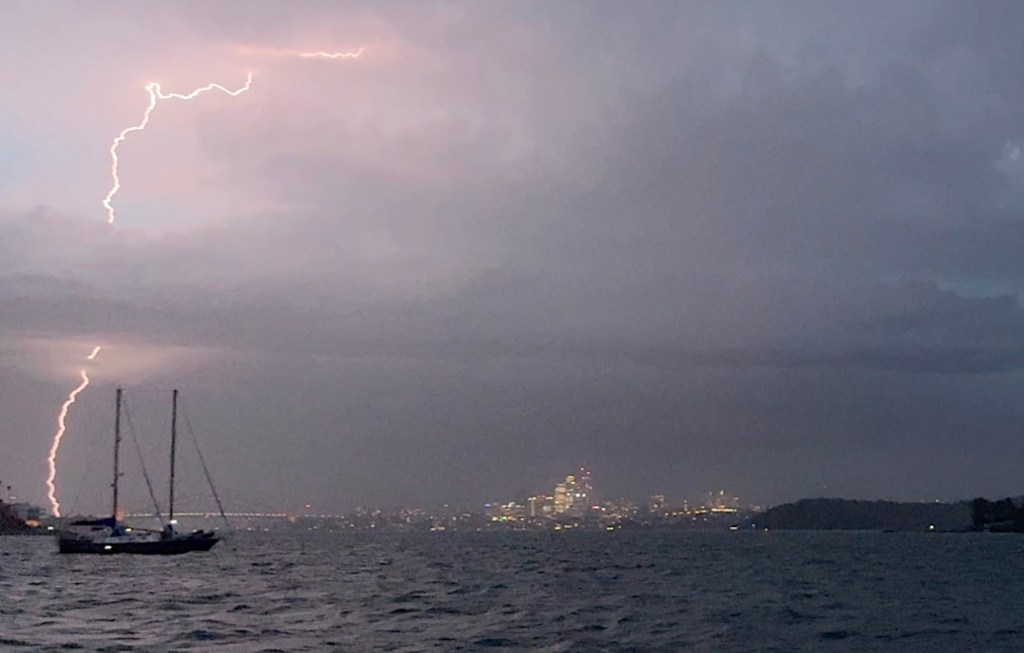
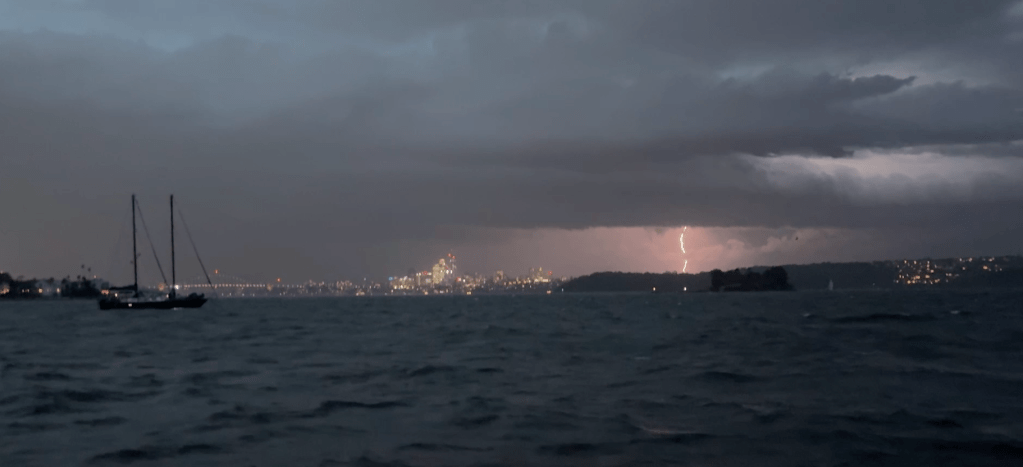
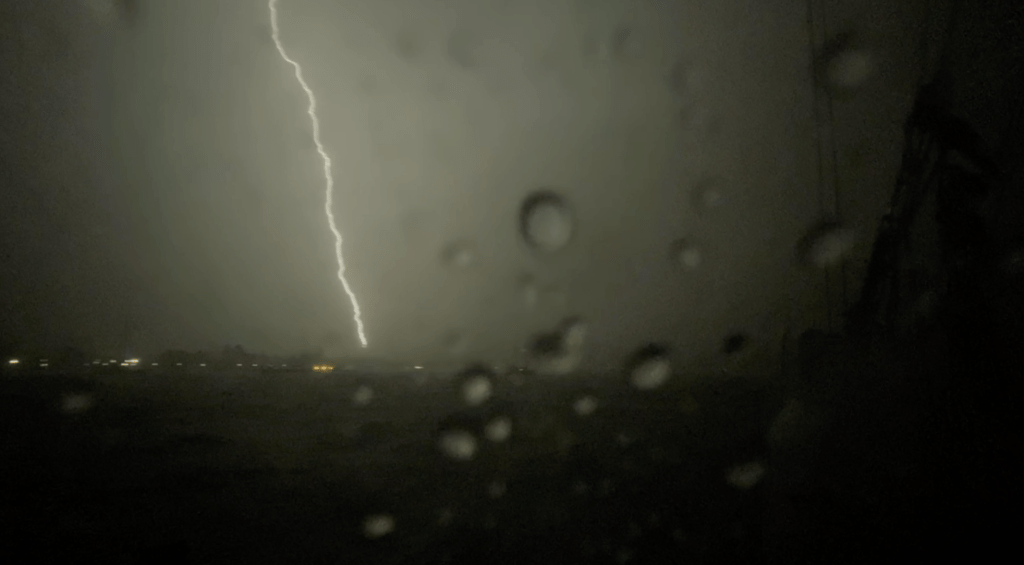
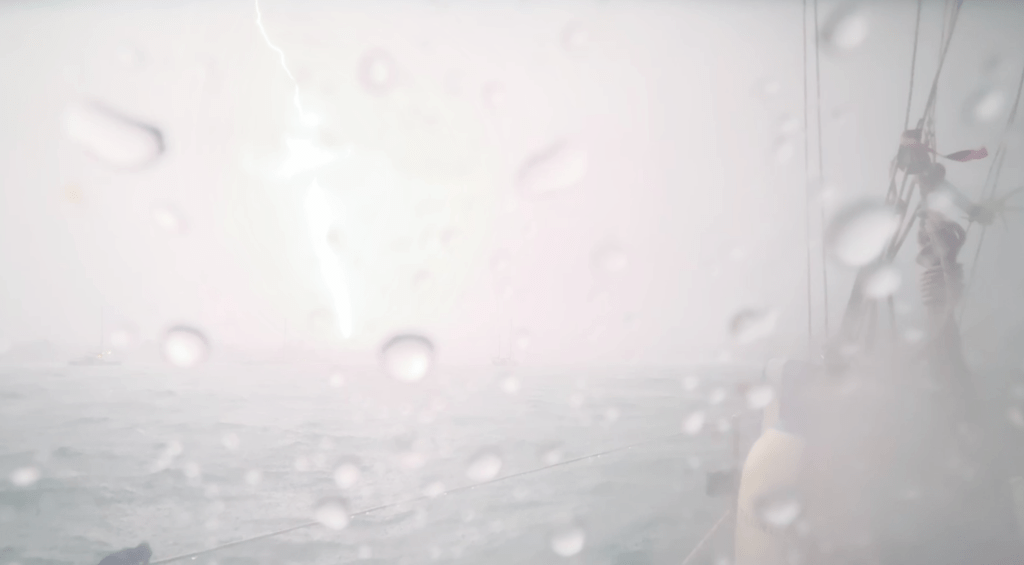
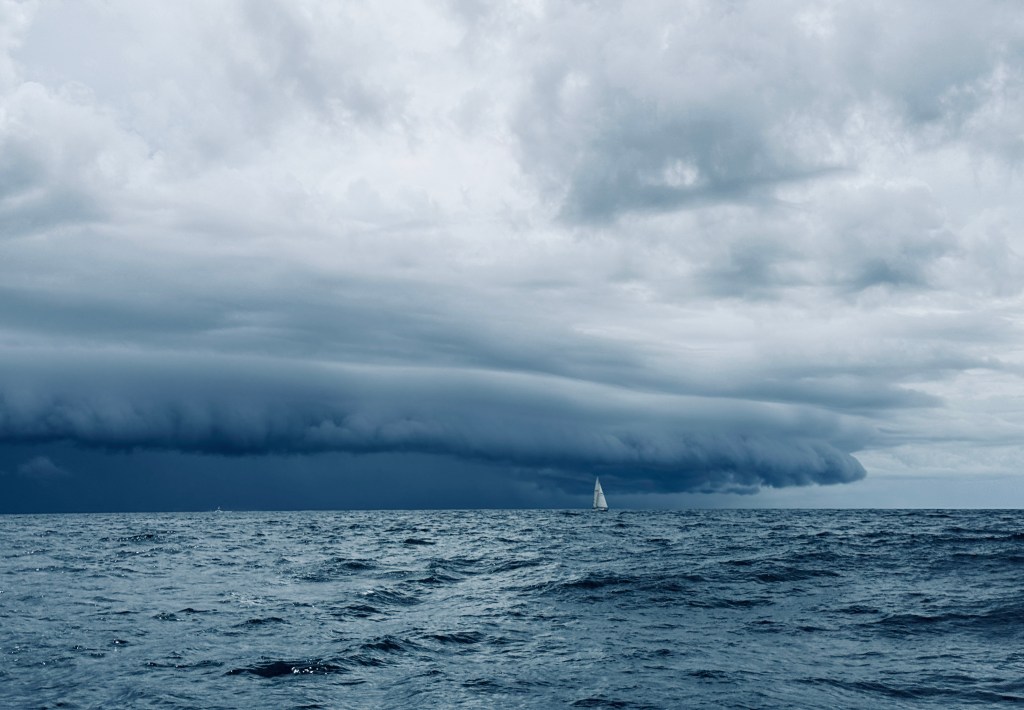
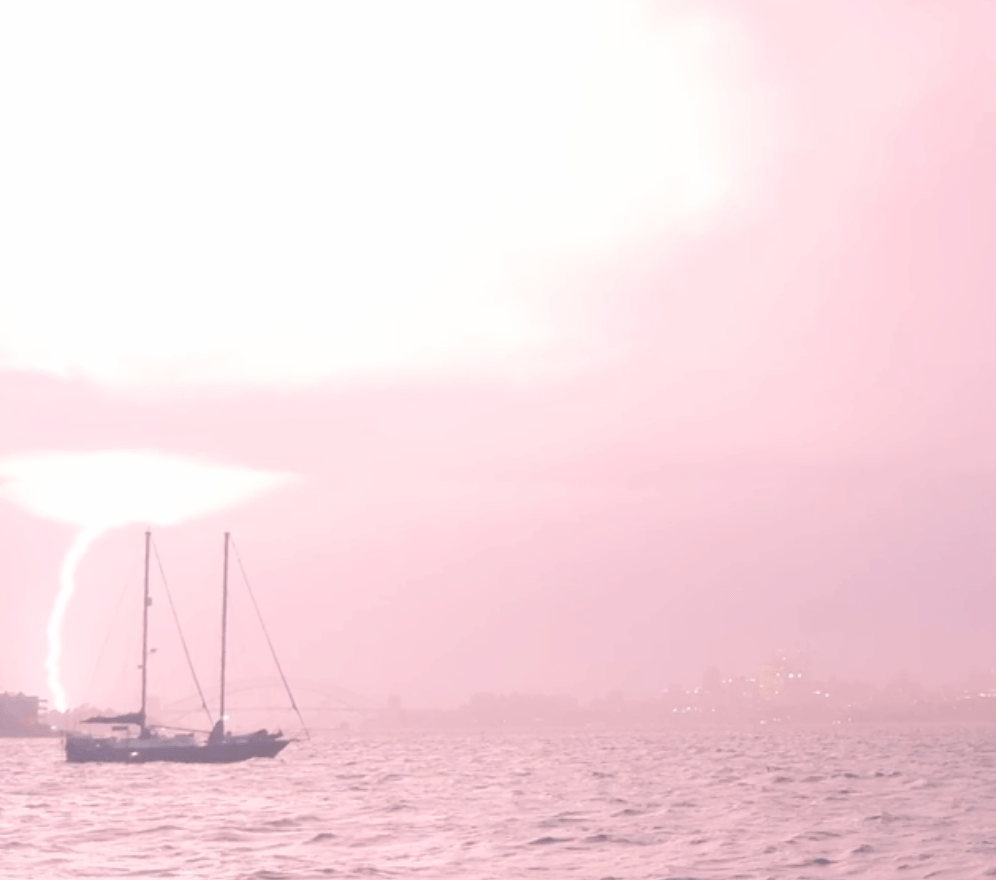
So, hunkered down we waited for the storm. We really had no idea how bad the storm would turn out to be, and were really more concerned with the southerlies to follow. As it turned out, the initial storm, which we watched slowly building on the horizon, was easily the most spectacular we have ever experienced. Headlines the following day reported 737,000 lightning strikes within 100 kms of the Sydney CBD, almost 9,000 of those struck the ground. One man was killed (when a tree fell on his car), 100 mm’s of rain fell, and 300,000 homes and properties were left without power.
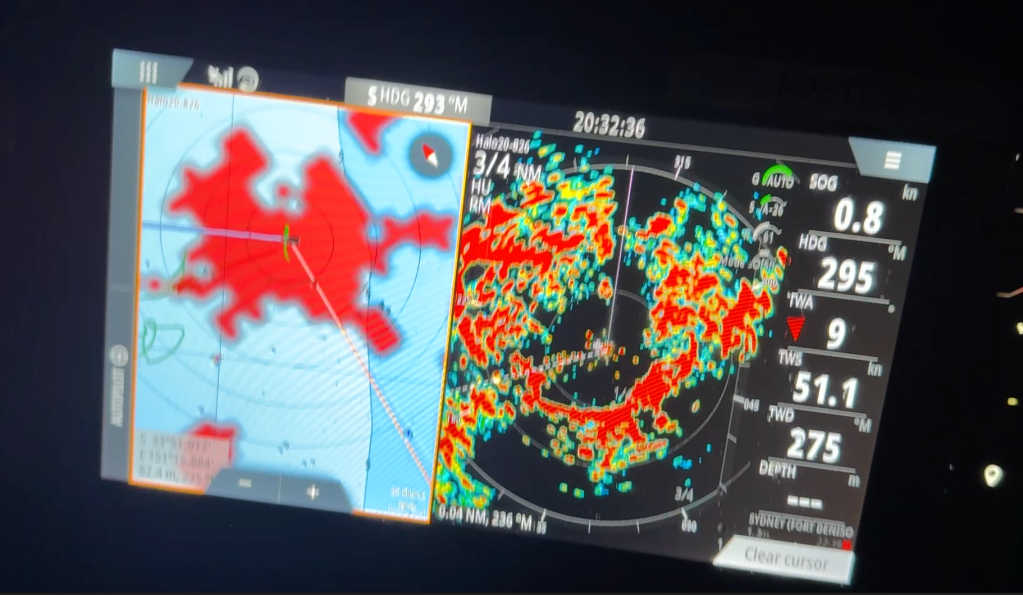
Storm approaching. Early lightning strike. Not long after this the sky was so dark that very little could be seen beyond flashes in the sky. The power unleashed during a strike. Still from video (Video 1). The wind came with a hiss and a roar. We saw a recorded windspeed of 54 knots, a nearby boat saw 63 knots. Decent sized waves for a protected anchorage. Charts and radar. Everything ready in case we drag (note windspeed of 51.1 knots)The following three images are a sequence taken of a single lightning strike. Ka-boom!
Below are three videos, uploaded to You Tube, which show the storm’s progression (clicking on the images below will allow them to play). They give a pretty good idea of what the experience was like. If you watch the second video you will hear an alarm at the end. This was our anchor alarm, which is intended to warn us when the boat moves a prescribed distance. Despite the scare it turned out that we weren’t dragging, merely swinging on the anchor a good way. Still, you can imagine why I stopped the video pretty hurriedly!
After an hour or so the worst of the storm had passed, though the lightning continued for some time afterwards. A little stunned and awed we went to bed, only to wake in a southerly gale. After the night before the 30 odd knot gusts of wind seemed pretty mundane, but they did prevent us from being able to leave the boat for the next three days. Incredibly, Taurus was held without any issue by our snubber, two 10mm lines of nylon (with 10mm chain as a back up of course) throughout. Modern rope is pretty amazing.
Once we could safely take the dinghy to the beach we decided a day out was in order, so we went to the zoo. Taronga Zoo sits on the harbour and enjoys spectacular views. The animals were pretty cool too.
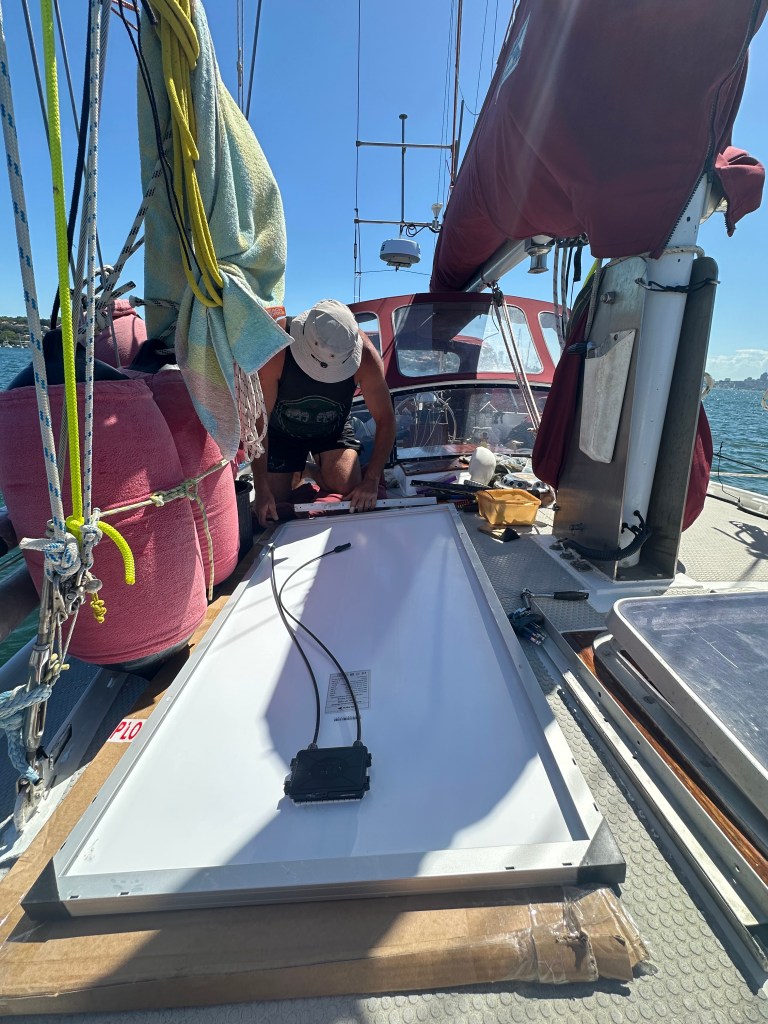
Of course, as ever, there were a few jobs to be done. We set to installing new solar panels and cleaning our blackwater pump —everyone’s favourite job.
In my naughty box. Playing with electricity.
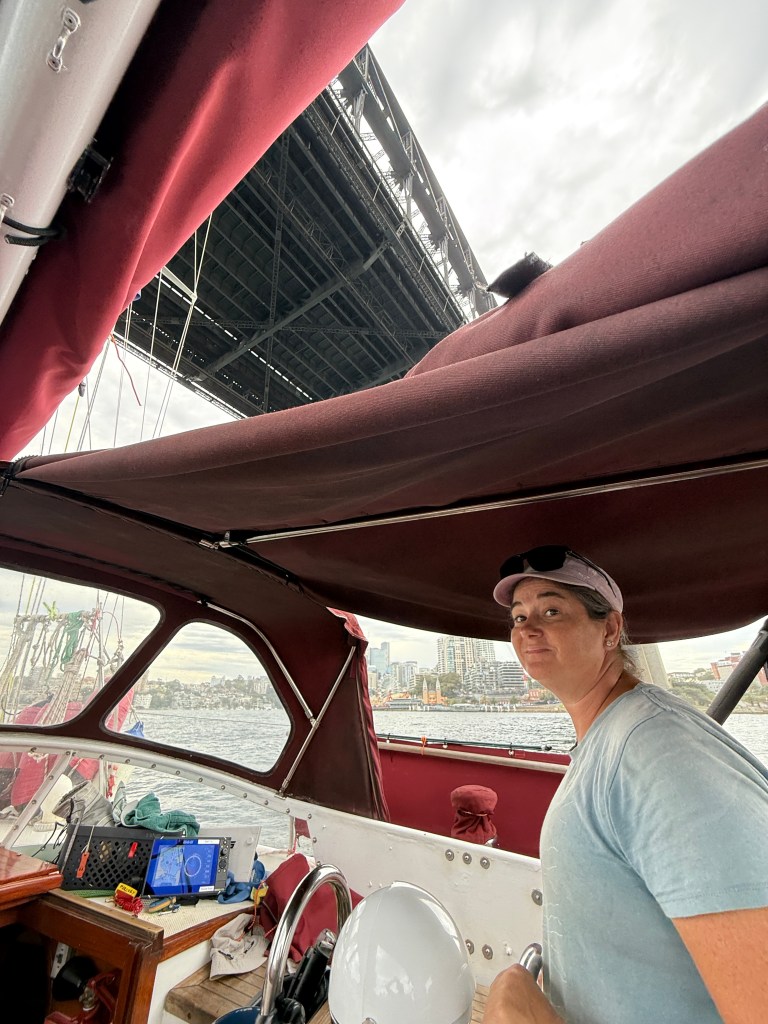
The next day we decided to shift to a new anchorage, and headed under the Sydney Harbour Bridge to Birkenhead, the site of a major discount store. At six the following morning we were rudely awakened by a crash and the sound of screaming. Thinking we might have dragged anchor into one of the super yachts in the marina opposite we jumped out of bed like a couple of released springs. We hadn’t dragged, rather a racing scull had powered right into Taurus’s bow, breaking one of their rowlocks and splitting the head of one of the female crew. Cara swung into action, and whilst I inspected Taurus she inspected the lady’s head. Then, the row boat being damaged and the injured party slightly hysterical, we took her in our dinghy back to the rowing club. Unfortunately our 8 horse power engine is currently on the blink so we had to take her some way with our small 3.3 hp run about. This has a small tank that ran out of petrol on the way home — luckily within rowing distance. All this before our morning coffee!
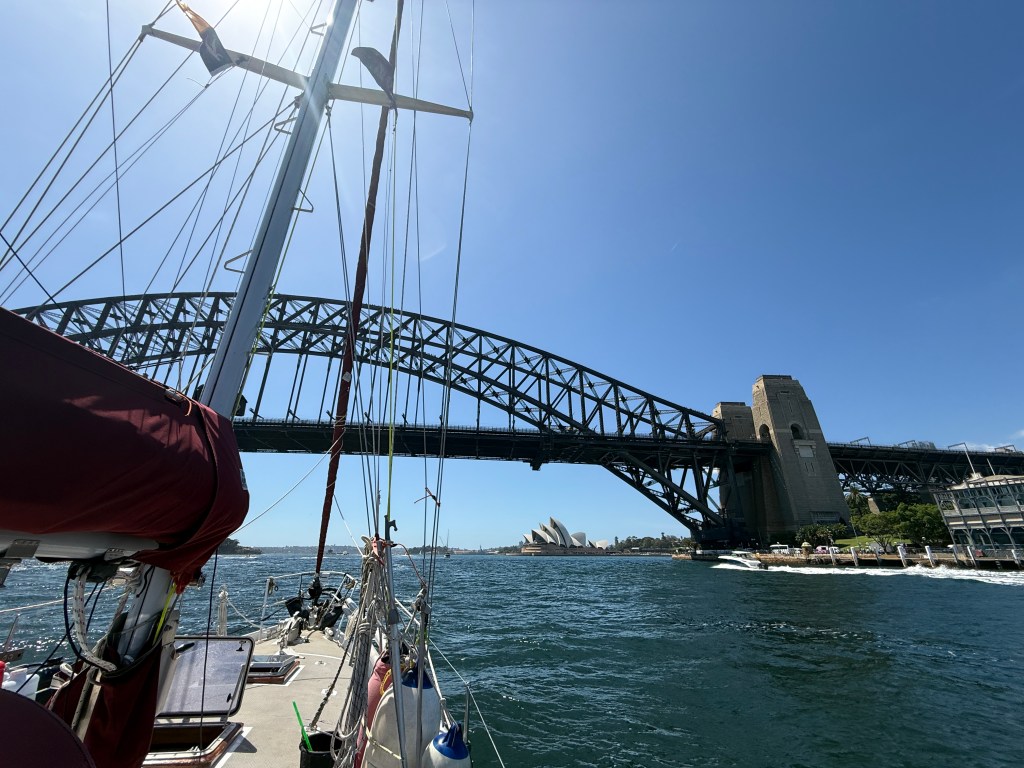
Going under Sydney Harbour Bridge. On anchor at Birkenhead. The rowers warned us that there would be more sculls out at the weekend, I managed to avoid suggesting they use mirrors.
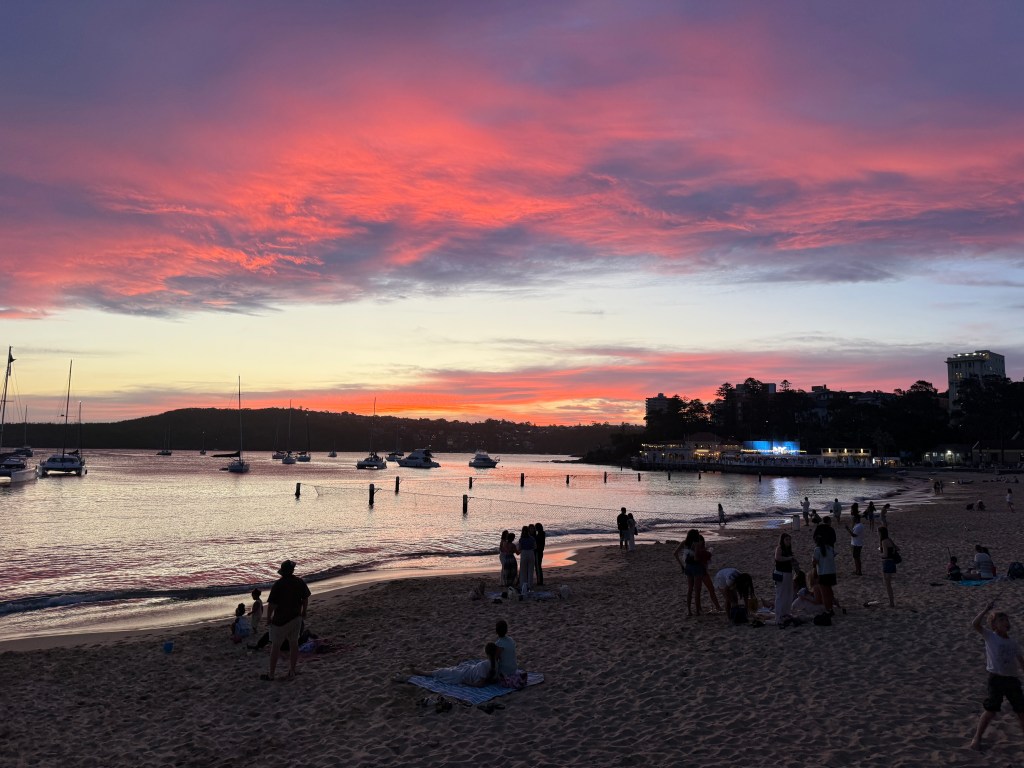
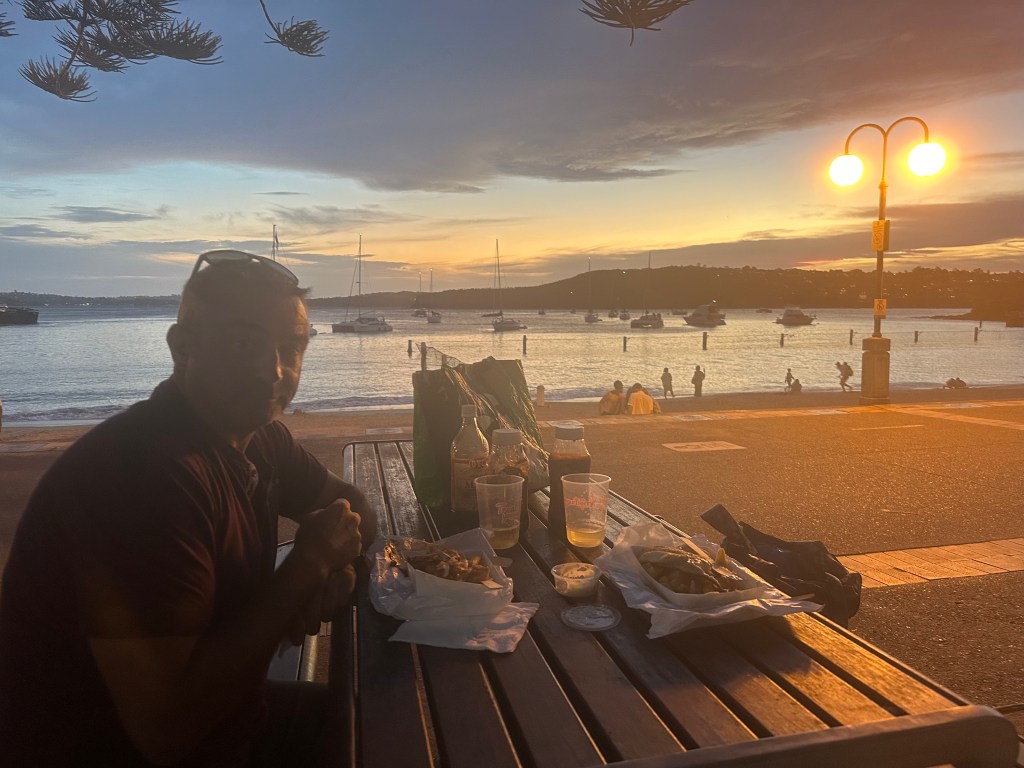
Our next destination was Manly, a popular beach area and playground for Sydney’s young, beautiful, and wealthy. I don’t fall into any of those categories, but Manly is a good jumping off point to leave Sydney. We snuck in, did some more clothes washing, and had fish and chips with wine out of plastic cups that we blagged from a yogurt store. How very sophisticated we are!
Back under the bridge. Head wind alas. Manly. Nice dinner out.
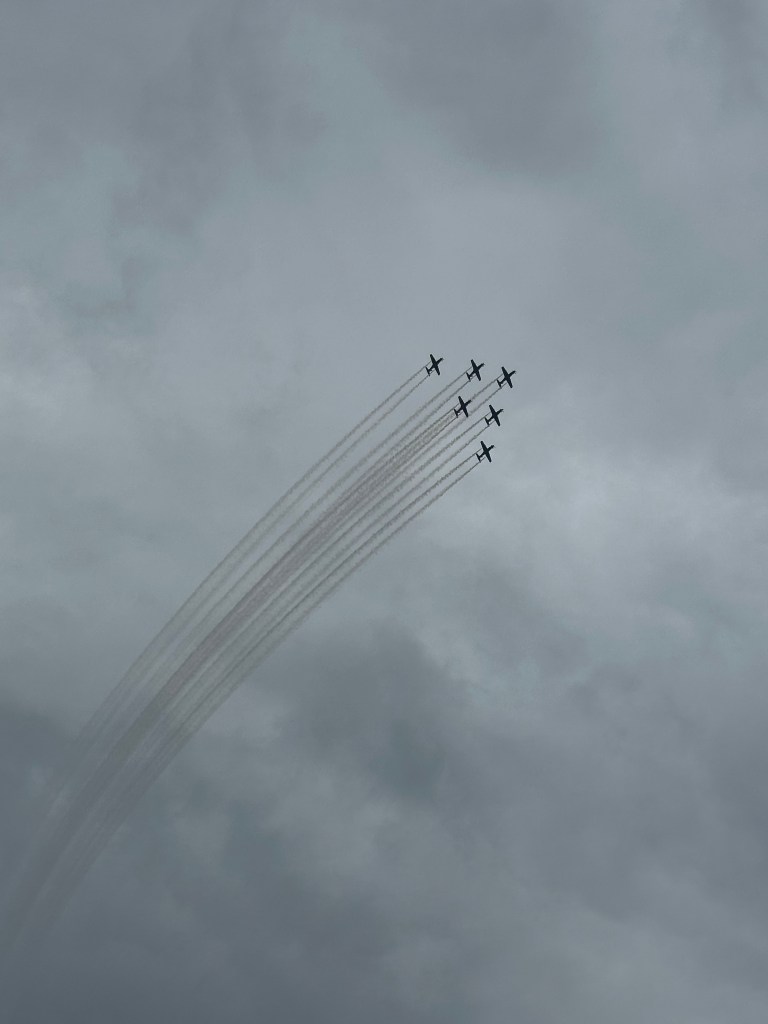
We had planned to leave at 5 am the next day to head to Jervis Bay about 12 hours away, but the wind remained absent until the early afternoon. This was fortunate in a way as we could watch some of the Australia Day celebrations, including a flypast and helicopter with a massive flag.
After lunch the wind finally appeared. We raised our sails and left Sydney, heading south for new horizons and new (gulp) adventures.
Next time: We sail to Jervis Bay, we break the boat, we get a tow from NSW Marine Rescue….
With a favourable easterly wind predicted we decided to leave Tweed Heads in the early afternoon of New Year’s Eve.
Before our departure we went over to the nearby beach and had a quick dip, staying in shallow water due to the threat of sharks. On our way back to the boat we stopped to talk to the owner of another yacht who was anchored just in front of us, and who, I feared, might be sitting above our anchor which would prevent us from raising it. I wanted to ask if he could drive forward to give us more room. The guy on-board apologised and told us he couldn’t move, explaining that he had no sails and that his gearbox had failed when trying to anchor the night before. He had basically anchored whilst being dragged sideways by the tide. We were lucky to have avoided a collision. Happily, a short while later the change of tide moved everyone around enough for us to lift the hook and we headed out of the river and across the bar.
The yacht in front is basically a house boat. Rising costs are forcing many people to move onto boats which can represent cheap accomodation. Unfortunately, many of these boats aren’t well maintained, or intended to ever move, and can become a bit of an issue for other boat users and local government.
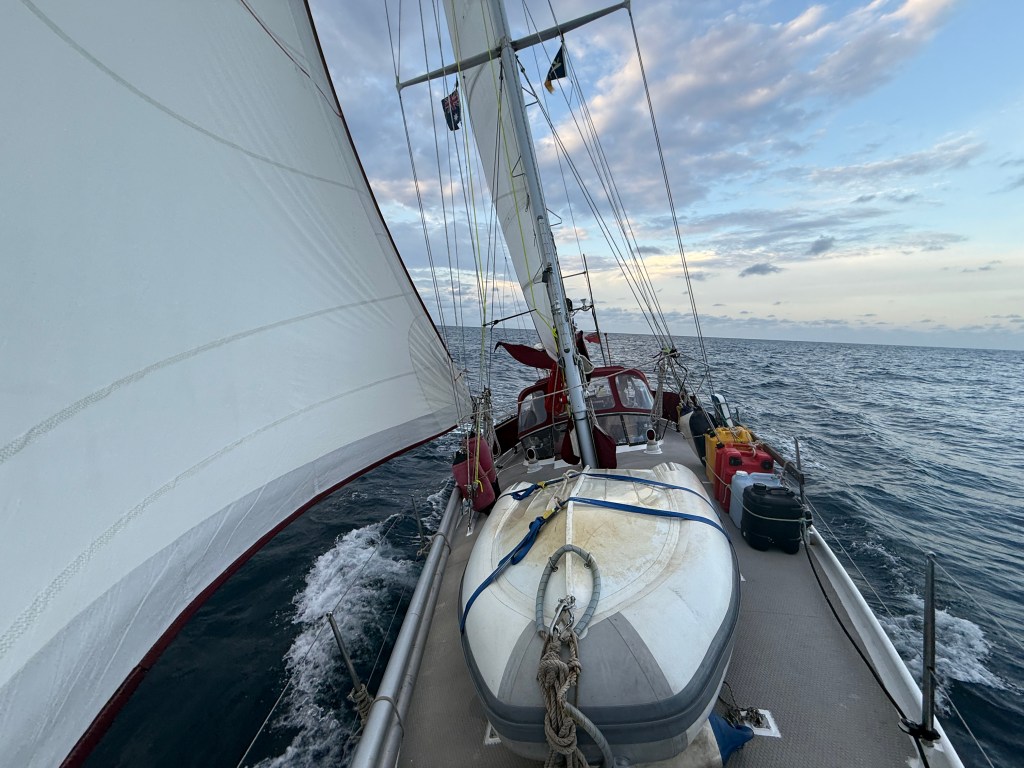
Our destination was Coffs Harbour, about 150 Nautical Miles away, some thirty hours of sailing at our average speed of 5 knots. Our sail was pretty relaxed and uneventful, and we spent New Years off Byron Bay, watching the fireworks in the distance.
Last sunset of 2024.
2025 started on a pleasant note with some unexpected positive feedback.. my thanks to the unknown cartographer, but surely the matter was never in any doubt!
Time passed slowly, as time does at sea when there’s nothing to do, and so we sat down to get on with a couple of projects. One of the things I had to do was add some material to our ‘red duster,’ the British civil ensign, which has been getting smaller and smaller as the end that flaps, frays and breaks down. We had bought some material in Tweed Heads and I thought the job had been quite successful until I later talked to a Canadian guy in a boat anchored next to us. He told me that he had been wondering what flag we were flying, being unsure as to the pink and red design…
Pink and red ensign.
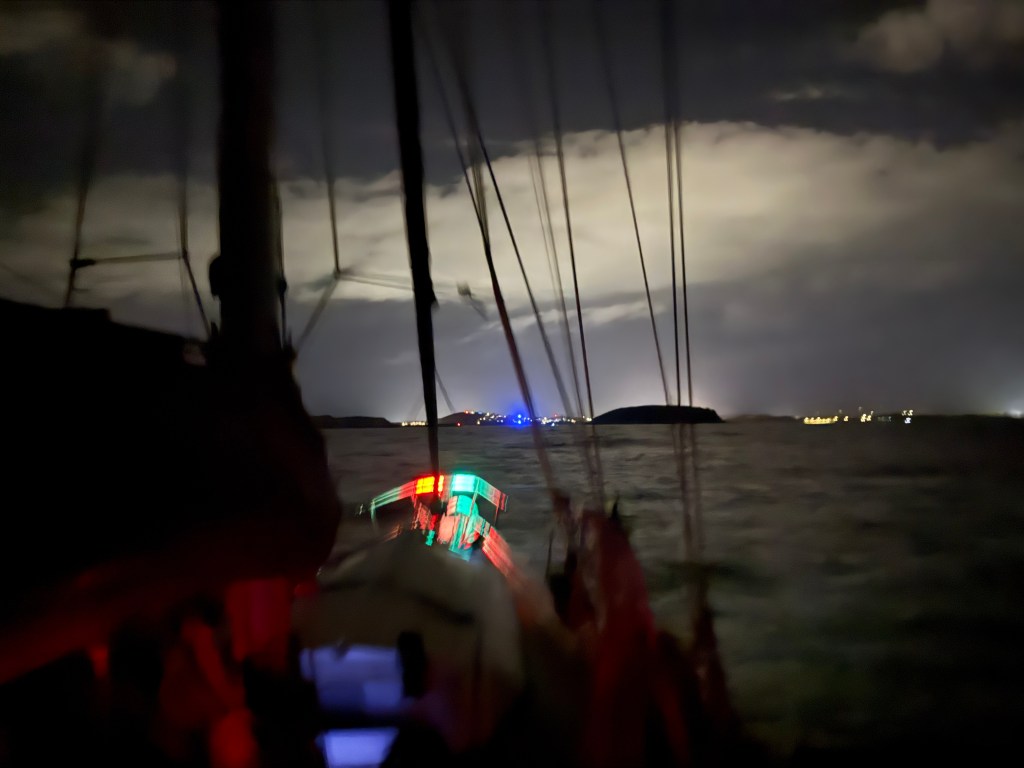
Day turned into evening again, and at about 11:00 pm we began our approach into Coffs Harbour. The harbour is chiefly a fishing port with a small marina but is well set up with a wide mouth, fantastic leading lights, and no bar. As such our entry, even in the dark, was nice and easy.
Entry to Coffs Harbour. The two blue lights on the horizon are leading lights. When aligned you’re on the right course.
We could see a few yachts in the wide bay ahead, so chose an empty spot and dropped the anchor.
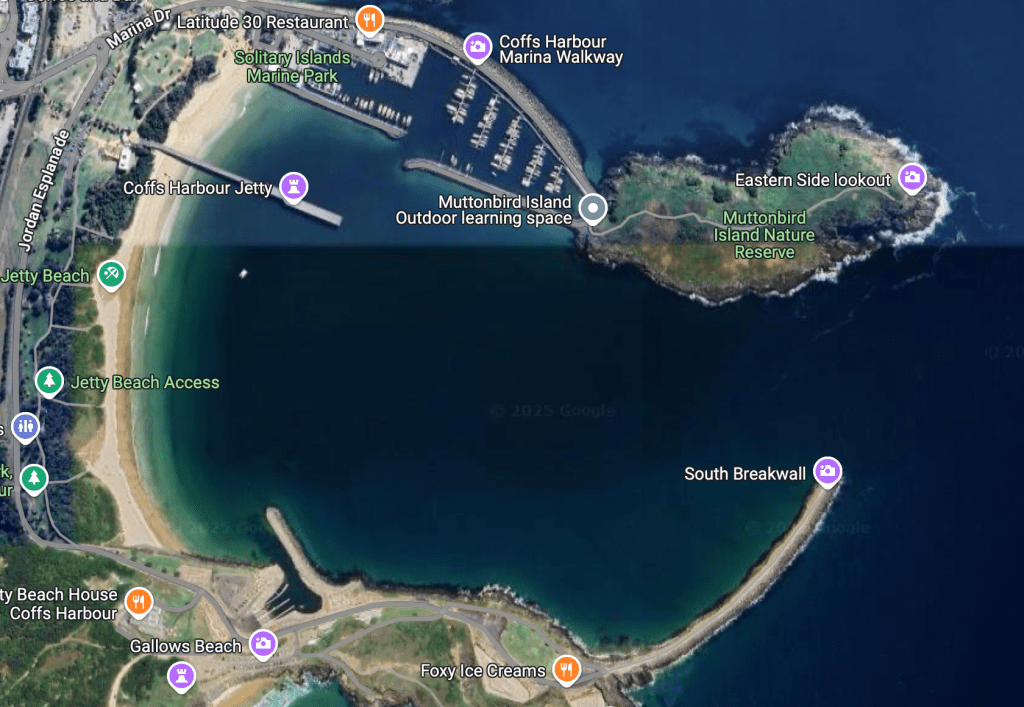
We slept well, but the bay was quite rolly due to the swell from the east. Roughly divided into two unequal parts by a long jetty, we had anchored in the larger southern part, but decided to move to the northern part, just past the jetty, where a couple of public moorings have been laid. To the north of this is a small protected area that houses the marina and fishing boats.
Coffs Harbour.
In our new spot the swell was much better and we resolved to save our money and not use the marina. As usual we had a few jobs to do. One of these was to clean the Hydrovane rudder which, not having been anti-fouled at the same time as the hull, was getting pretty encrusted with barnacles. We tried cleaning it in situ but ultimately chose to remove it to clean it on deck. Once clean, we hung it up and gave it a coat of etch primer and two of anti-foul. A nice quick and satisfying job.
Hydrovane rudder having a spruce up.
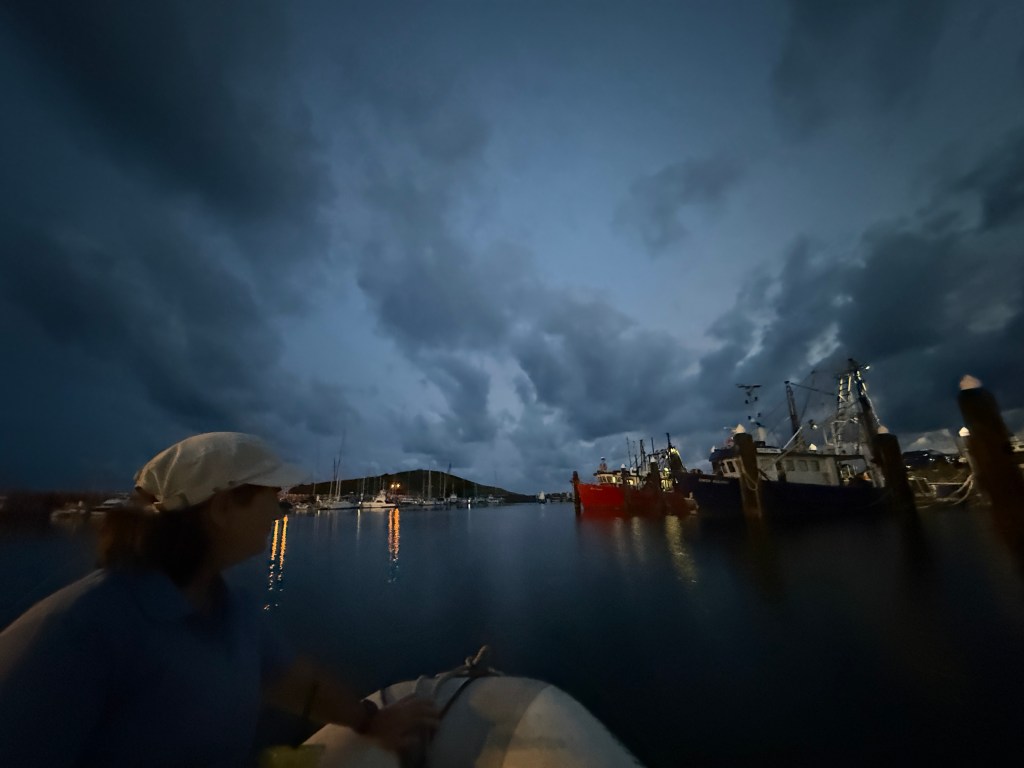
Feeling virtuous we headed into the protected harbour to visit the local chandler and town. Unfortunately many shops, including the chandler, were closed for the holidays, but it was nice to wander round. Coffs seemed like a nice place, much smaller and less consumer focussed than the touristy Gold Coast cities we had grown used to. Back on the boat we were entertained all day by children leaping from the jetty, upsetting the turtles and odd dolphin.
Fishing boats in Coffs Harbour. Tauurs in Coffs Harbour.
Next day we stretched our legs with a walk up to the Mutton Island reserve before feasting on fish and chips from the fisherman’s co-operative shop. Fish doesn’t get much fresher.
View from Mutton Island. Taurus on anchor near the jetty. Yum!
Unfortunately, there was little time to stop and relax. We were still trying to get to Sydney before the 10th of January to meet our friend Eugene. With the prevailing weather coming from the south we had to make the most of every opportunity to head that way.
Thus on the 4th of January we were off again. Our destination this time was a place called Pittwater, about 240 NMs distant.
As previously mentioned, Taurus’ average speed is about 5 knots. Less in light winds or lumpy sea states, more with a stronger breeze at the right angle of sail. On this sail, however, we were blown away to find ourselves consistently sailing at a speed far higher than we would expect in the light wind conditions. This it turned out was due to the East Australian Current, which was adding at least a couple of knots to our speed, enabling us to do 8 knots in less than 12 knots of wind. Fun!
The sailing was spectacular, but all too soon the wind shifted to a northerly and we were pointing straight downwind. We poled out the jib and continued to sail fast, but the rolling motion was pretty uncomfortable.
As if to distract us from the constant motion, a pod of dolphins arrived just before sunset and frolicked at the bow until dark.
Cara bothering dolphins.
The next day the wind continued to rise and we were soon surfing down some pretty big waves in 20 knots. As we got closer to Sydney the marine traffic increased considerably. With the jib still poled out we were starting to struggle with our heading angles, there being little lee way with this sail configuration. Just before dark we were contacted by a large container ship, 200m long, but still some seven NMs away. The voice on the radio asked us to pass starboard to starboard, that is right side of the ship to right side of ship. To do this would have required us to jibe sharply to port, something impossible with the jib poled out, and then to starboard. I answered that we were a sailing yacht and that the wind angle prevented us from taking the requested position. Much to my surprise the voice came back, saying “oh you sailing boat, we move for you.” Normally everyone gets out of the way of these behemoths, the mantra ‘might is right’ having some bearing, but more importantly the stopping distance and difficulty in manoeuvring these massive ships means everyone else shifts for them. However, on this occasion the container ship adjusted course by a few degrees and we sailed blithely on.
Wind picking up and waves building.
I confess that as it grew dark and the wind and waves continued to rise I began to grow worried about our decision to leave the jib poled out. We had reefed the jib considerably, but left the pole up because we were moving across the face of the wind a good deal as we surfed down the waves. Without the pole the jib would repeatedly collapse and snap back as the wind refilled it. The forces on gear as this happens over and over and over are considerable, as is the wearing effect on the crew. It was with some relief then that the wind dropped and we could put the sails to bed and motor the last 5NMs into Pittwater.
Pittwater is a drowned valley estuary boarded by national parks about 40 kilometres north of the Sydney CBD. Being so close it has become more or less a Sydney suburb, and the place where many Sydneyites choose to leave their boats. Happily, some of our friends from the Pacific were currently there, Ron and Sue from Eudora and Karl and Elaine from Salsa.
On arrival we had anchored in a safe but fairly exposed spot, not wishing to blunder around in the dark. So in the morning we sought advice and found a nice mooring, courtesy of the Royal Sydney Yacht Squadron, in Coasters Retreat, aka ‘The Basin.’ Pittwater would have been idyllic at one time, and it is still spectacular, but today, especially at this time of the year, it’s a bit hectic. From multi-million dollar super yachts to the humblest of tinnies, all can be found with their owners trying to enjoy time on the water.
Southern Cloud. We were informed that the owner had spent A$30 million getting her ready for a season in the Islands. They could have bought 300 Taurus’s instead…
One of the advantages of The Basin is that a campsite is located next to the mooring field. We soon found our way to shore to get rid of some rubbish and pay a A$1 for a hot shower.
Campground and ferry — The Basin.
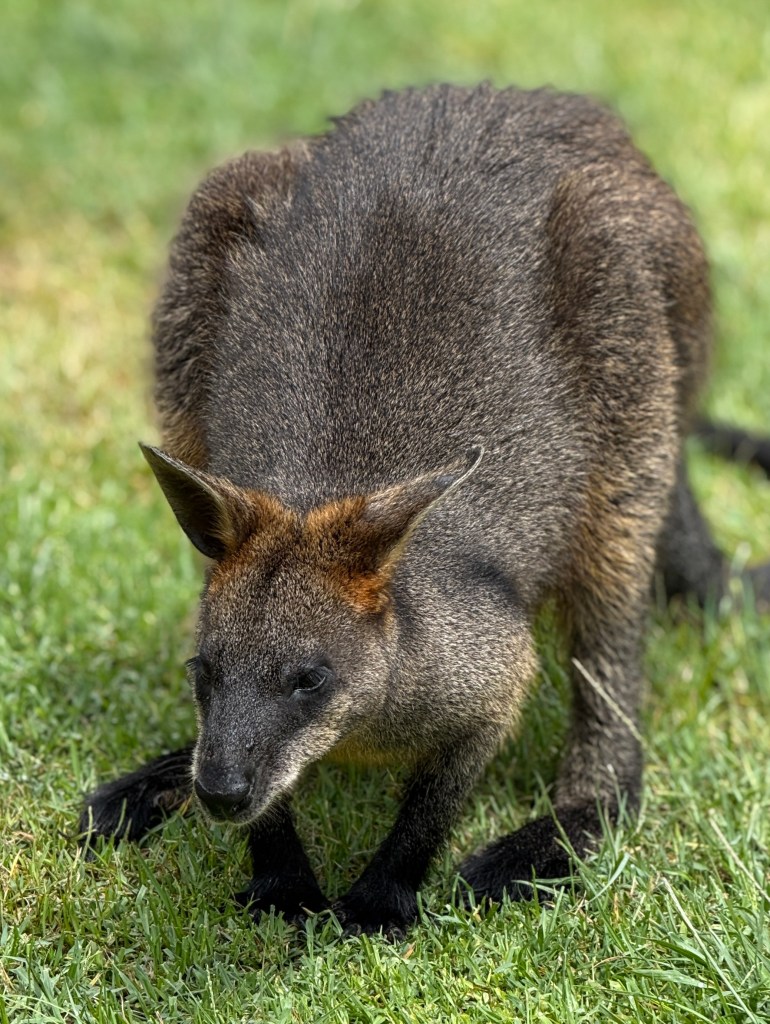
Semi-tame wallabies were an added attraction on land. These marsupials, an Australian icon, are a growing pest in New Zealand where they are shot with zeal in order, hopefully, to prevent them from becoming endemic. It is also held by some that too many Wallabies in New Zealand will drastically reduce the quality of the national sport, but of this I know nothing.
Wallaby — not very good at rugby.
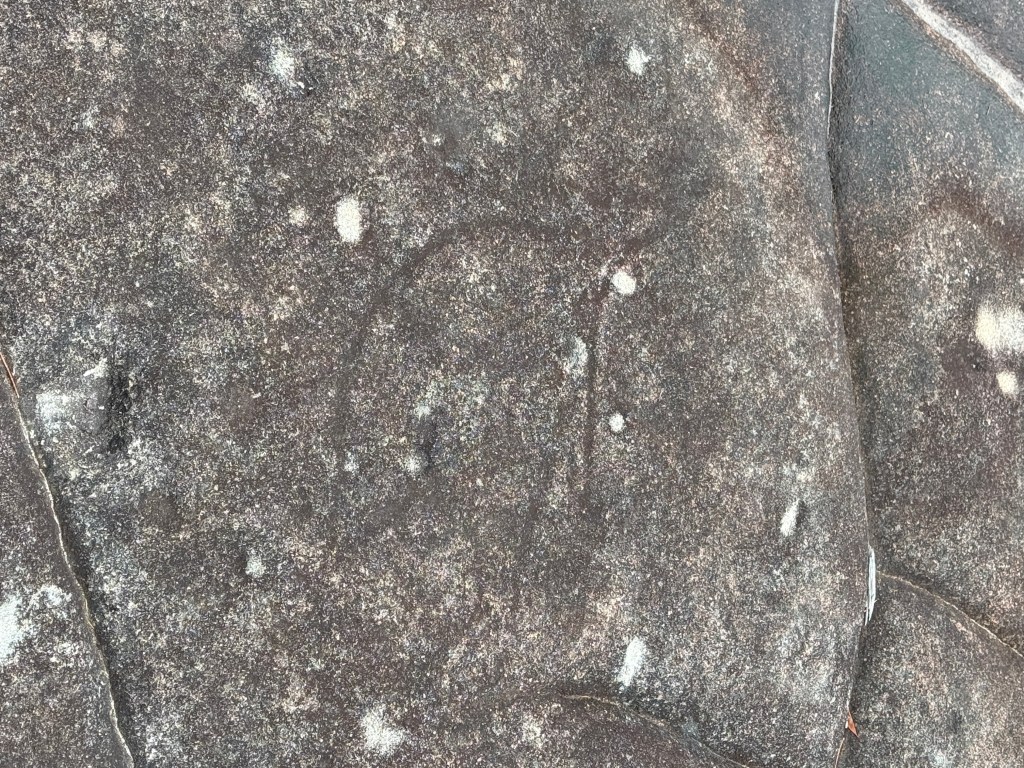
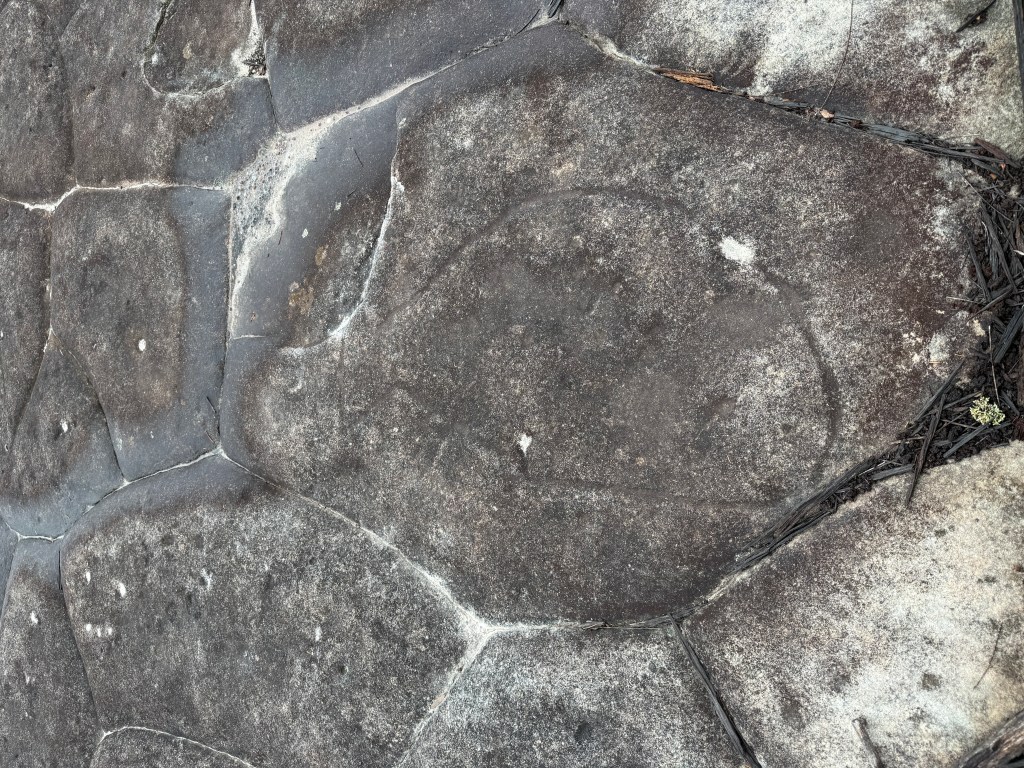
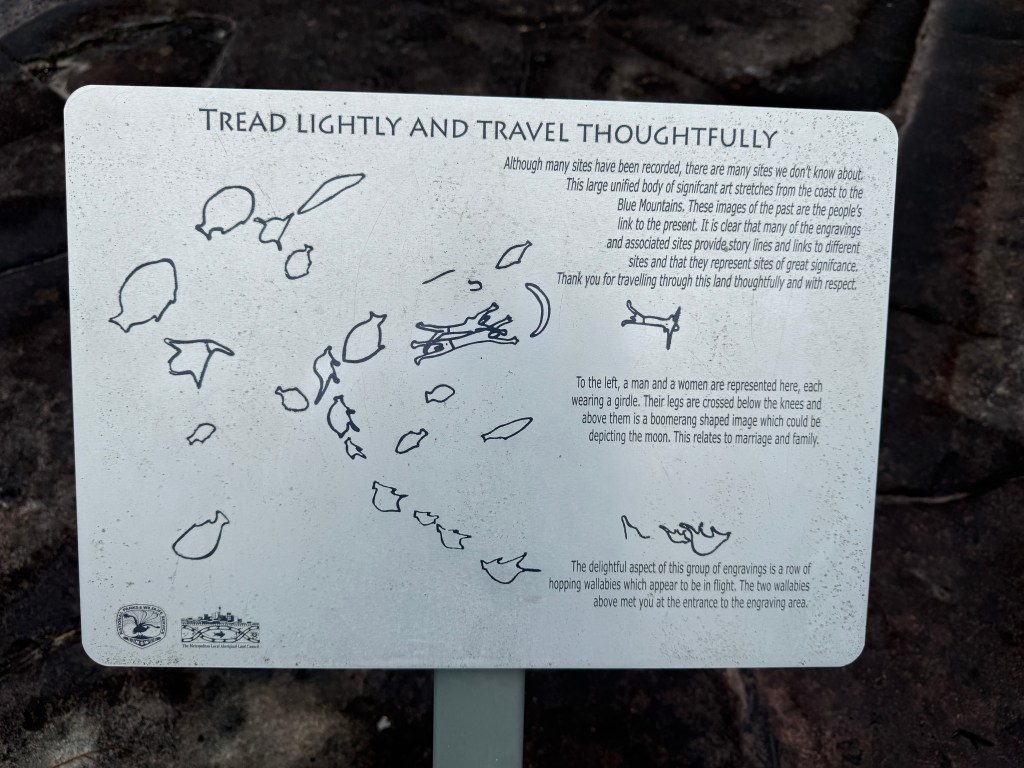
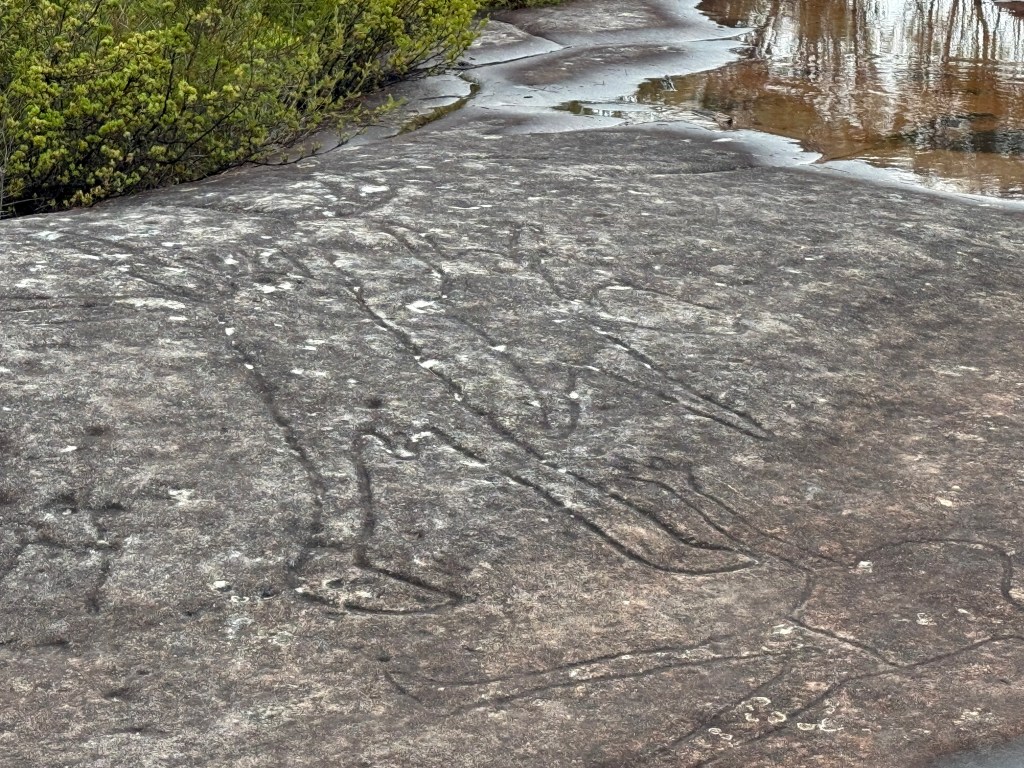
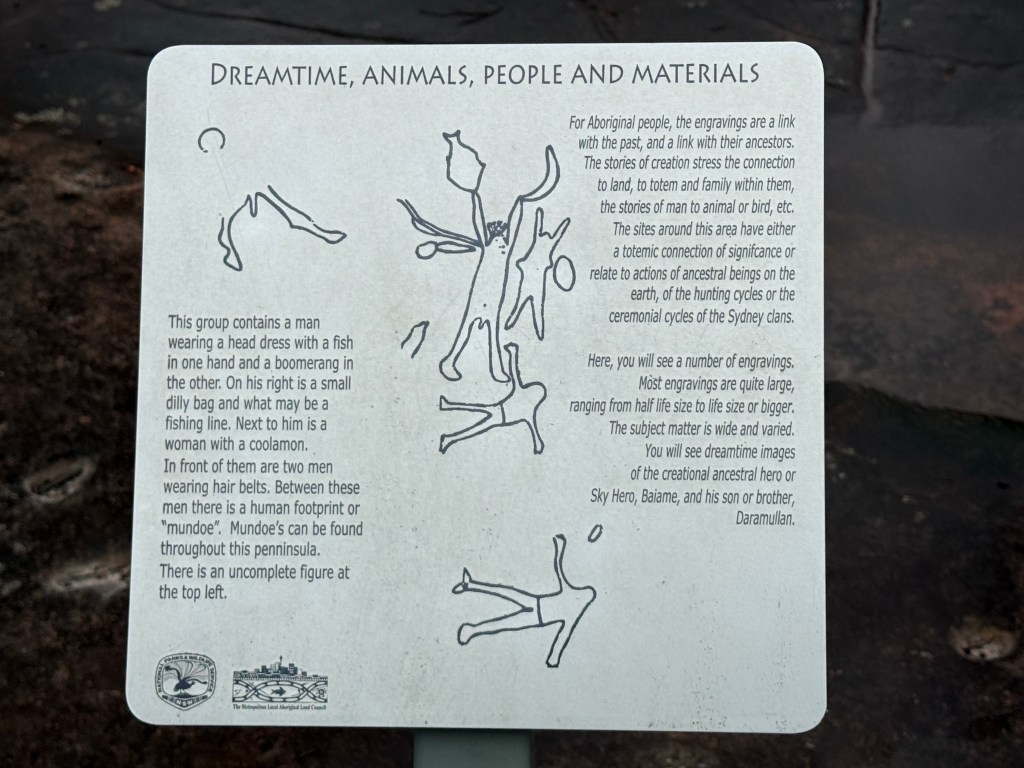
The campground also held a signpost pointing towards Aboriginal carvings. The walk followed a wide concrete road up a steep hill, but after so much time on the boat it was nice to move and work our bodies a bit. The carvings were pretty interesting and may be up to a thousand years old.
WallabyFish or whale?People.
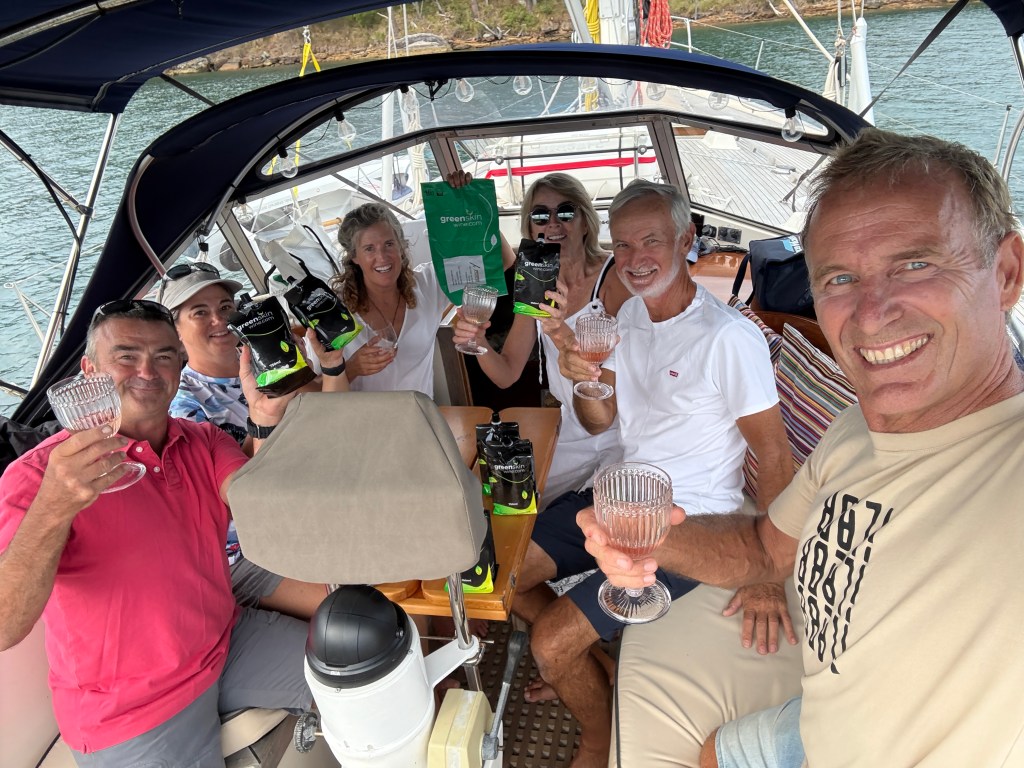
The highlight of our time in Pittwater was getting together with our friends for sundowners and a catch up. Karl kindly picked everyone up and took them back to his and Elaine’s yacht in Morning Bay. Cara and I took along the last of the Green Skin wine to share out amongst other members of the Pacific Rally as requested, and a good night was had by all.
Sun downers with friends: left to right: me, Cara, Sue, Elaine, Karl, and Ron.
Still needing to get to Sydney we left early the next morning. However, the forecast was entirely wrong and instead of a light to mid easterly we were met by 30 knots from the south and some hefty seas. We persevered for a little while but conditions weren’t improving and we were going to have to sail so far off shore to get south that it didn’t seem worth the effort and possible damage to gear. Taurus also wasn’t set up for heavy weather, the life lines, which you attach yourself to when on deck to prevent being swept overboard, for example having been stowed away to prevent UV damage. Discretion being the better part of valour, we tucked our tail between our legs and ran back into Pittwater.
Running back into Pittwater. In this picture we are back in sheltered water.
The next day we were up early and the weather was far more conducive to a southerly sail. There being three boats heading in the same direction the race was on, and though the other entries were light, and modern Taurus easily won first prize in her class (old, steel, and slow).
Sometimes its nice to be up early…
Only a few hours later we were sailing past Manly and then through the Sydney heads. Unfortunately the wind dropped as we made our approach so our dream of sailing into Sydney in full glory was nipped in the bud. Our disappointment was offset by the clouds growing behind us, indicating a front was on the way, so we were just glad to get in to shelter.
SydneyRunaway! (again…)
As the heavens opened we found our way to our chosen anchor site in Rose Bay. Our friend Eugene had arrived in Sydney at much the same time as us, so we unloaded the dinghy from the deck and ran ashore to pick him up. I hadn’t been sure that we were going to make it in time to see him, but as it turned out we made it with a few minutes to spare.
Voyage of the good ship Taurus: 31st of December 2024—10th of January 2025.
Next time: we explore Sydney with Eugene, we go to Bondi Beach to do our laundry, we experience an apocalyptic storm — and survive!
Lightning strike, Rose Bay. Sydney Harbour Bridge in background.
Before leaving Brisbane we had to catch up with our good friend, Julian. We had met Julian and his wife Tracey in Noumea, New Caledonia. They had sailed their yacht there before the troubles and ended up staying throughout and having an amazing time, making friends on both sides of the divide as they were apolitical and just about the only tourists in the country. They enjoyed New Caledonia so much that they decided to leave their yacht there and fly back to Australia, so that they could easily fly back again to resume cruising in the region. Unfortunately, Tracey was visiting family in Perth when we found ourselves in Brisbane, so we had to miss the pleasure of her company this time around.
I’ve often found that to get the best out of a new city you need to be shown around by someone who knows it. This certainly proved to be true in this case. Julian suggested we go for dinner at a place called ‘Eat Street,’ which we hadn’t heard of but which was a mere twenty minute walk from where we were anchored.
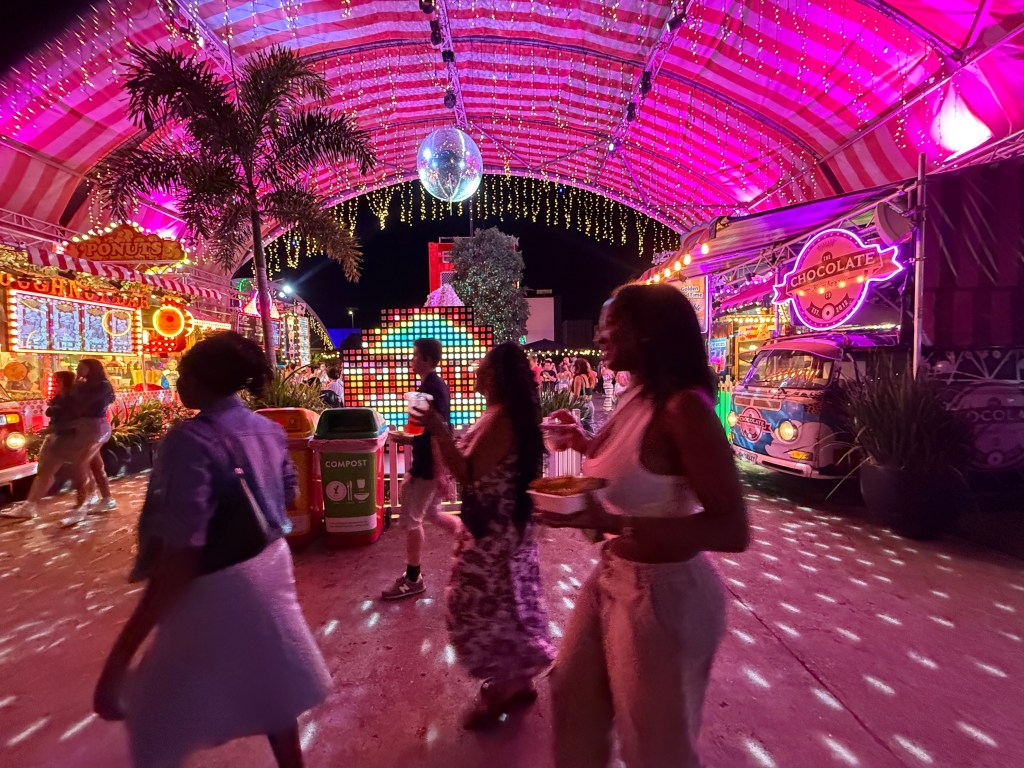
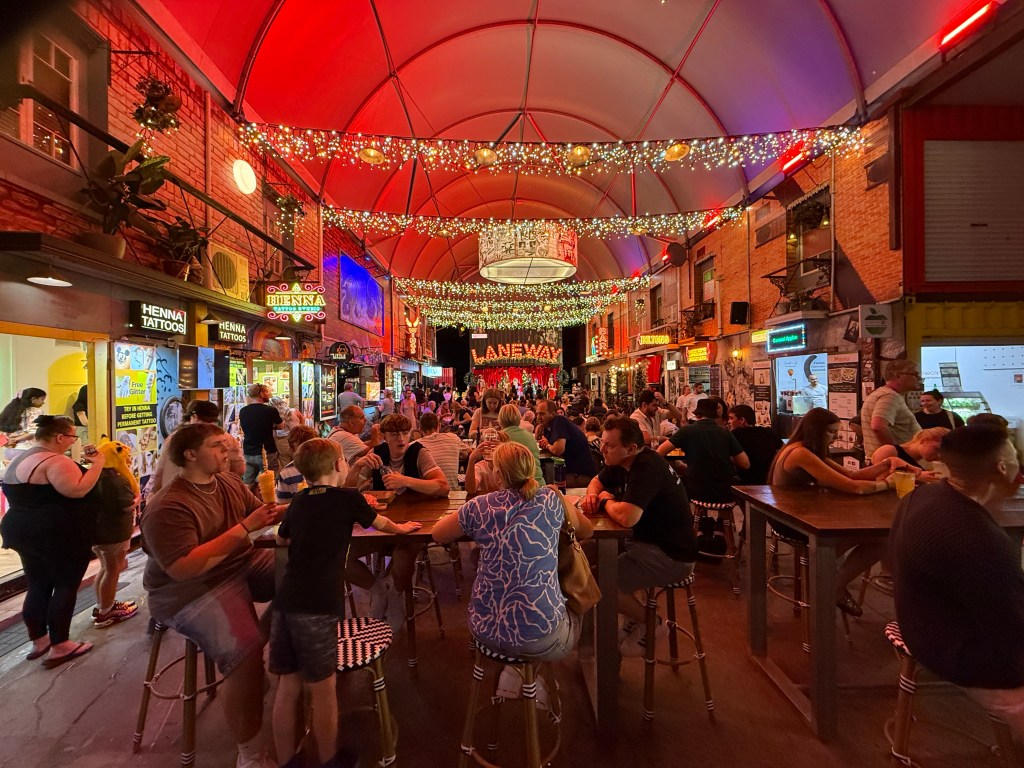
Eat Street is an incredible place that we highly recommend if you ever find yourself in Brisbane with an evening to fill. Part Moulin Rouge, part carnival, and all about satisfying carnal pleasures — of the eating and drinking variety. The ‘street’ is essentially a wide variety of quality street food outlets, bars, and live music stages thrown together in an eclectic fair-ground-type layout . We were there just before Christmas and the place was heaving, but the queues were short, the food was excellent, and there were tables enough to go around. The music, lights, crowd, and atmosphere created a kind of never never land for adults.
Julian and Cara… wait, what?Live music at Eat Street.
The evening was one of those in which you curse the fact that you only have one stomach to fill, and once full to the point of knowing that it would be a slow waddle home we had to call it a night.
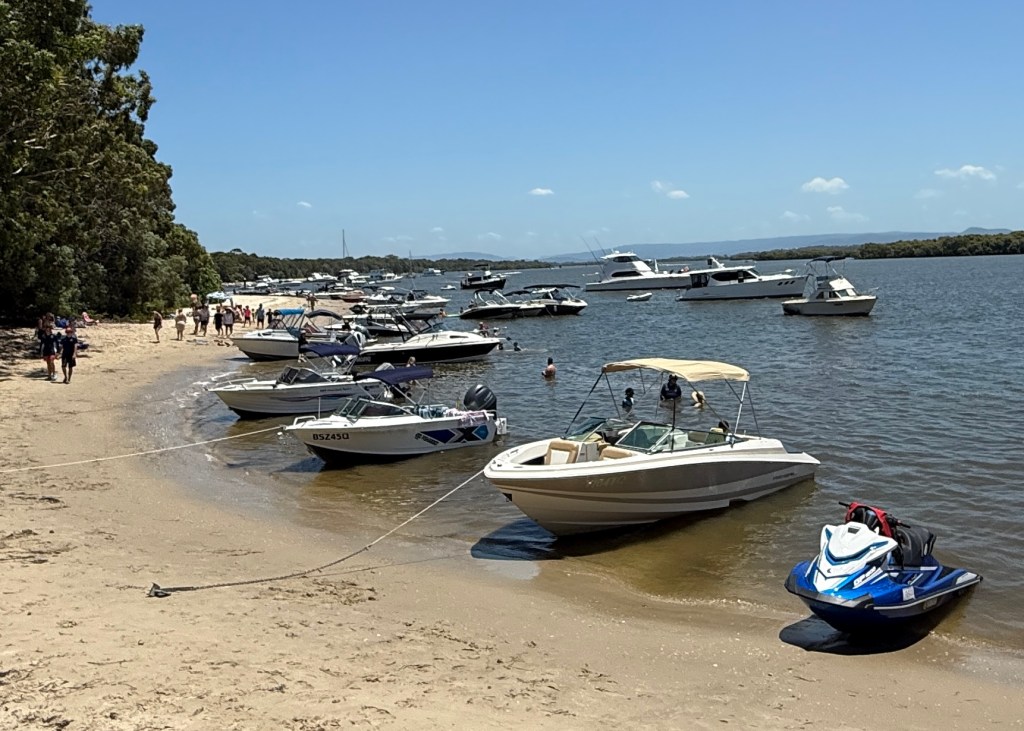
We had planned to head south after leaving Brisbane and find a place to anchor in South Port, the main marina and anchorage area serving the Gold Coast. However, Julian advised us that South Port and the area around it would be insanely busy. His work as a commercial skipper routinely takes him there, and he warned us that over the Christmas break it would be a mad house of launches, tinnies (small aluminium boats with outboard engines) and jetskis — all trying to get wherever they were going as fast as possible and without a clue about COLREGS (the International Regulations for Preventing Collisions at Sea), the rules of the road at sea.
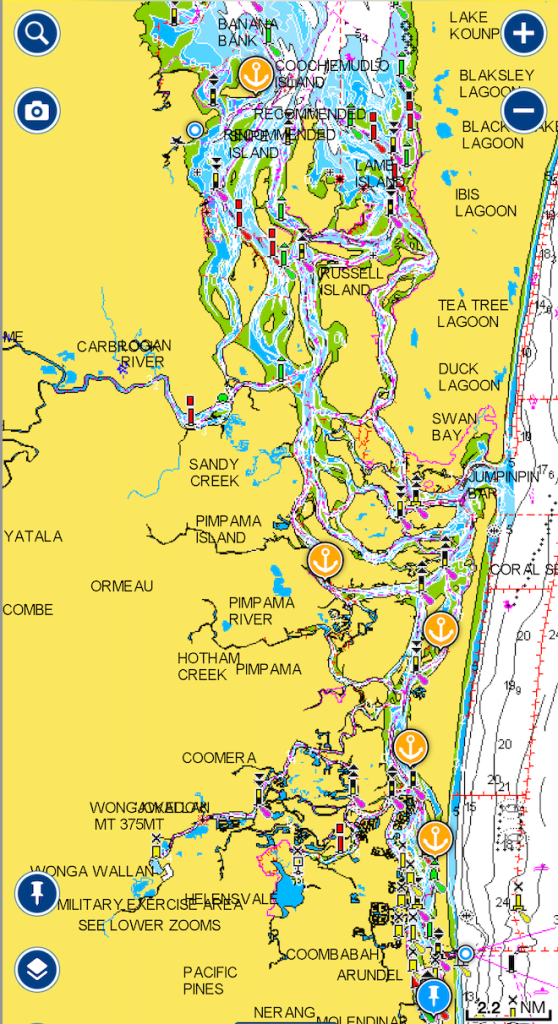
Not being a huge fan of too many people, and jetskis period, I was easily persuaded that we should instead anchor off the excellently named Coochiemudlo Island. Captain Matthew Flinders (16 March 1774 – 19 July 1814), Royal Navy officer, navigator, cartographer and leader of the first inshore circumnavigation of Australia, was the first European to land on Coochiemudlo in 1799. At that time he named the island ‘Sixth Island,’ which suggests he was sick of naming Australian features by the time he got there. Coochiemudlo is a bastardisation of the Aboriginal name “Kuychi Mudlo” meaning ‘place of red stone.’ For generations it was a source of ochre, which aboriginals used for body decoration.
As well as a sheltered anchorage, Coochiemudlo was a short ferry ride to the mainland, and a short walk from there to Julian and Tracey’s home. As if the idea of staying at Coochiemudlo needed any sweetening, Julian promised to cook us a roast dinner when we arrived, and generously offered us the use of his home and car when he headed away for a few days to catch up with Tracey and family. It’s been said many times before, but the best thing about travelling really is the people you meet along the way.
Heading back up the Brisbane River.
We headed down the Brisbane River early next morning to take advantage of the outgoing tide, and after some fun and games trying to fuel up at a jetty where the pump’s hose was too short to reach our fuel intake, we found ourselves back at sea.
Heading out of Brisbane. This nice chap gave us a friendly honk as we went past. We had called him up on VHF to check he was happy to pass port to port.
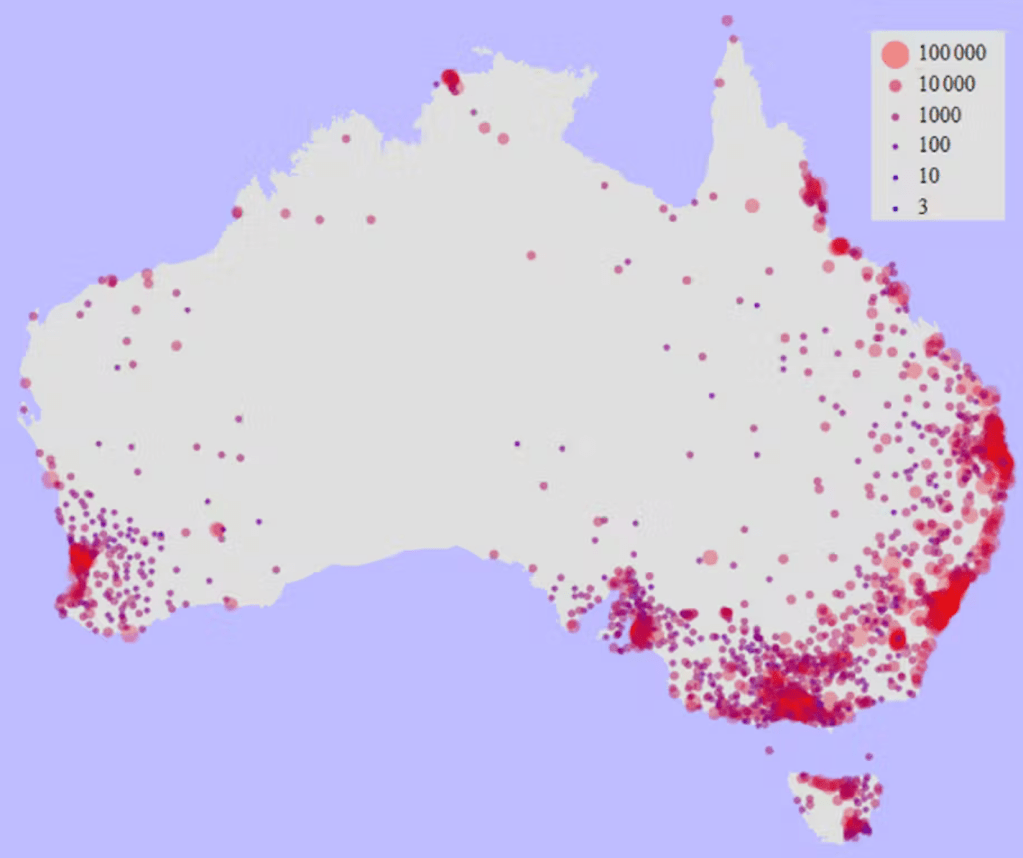
Visiting Brisbane had been fantastic, it’s one of the Australian cities we don’t know well but would like to know better. One of the things our stay highlighted was that despite being close neighbours, we Kiwis are often ignorant of the realities of Aussie life. I had remarked to Julian that it was a shame the river was in flood and too dirty and swollen to swim in. Slightly aghast, he said the river was always that dirty, it’s known as the ‘Brown Snake’ by locals, but, he added, no-one swims in it anyway because of the sharks. Not entirely sure if he was serious (who ever heard of sharks in rivers?) I later did a quick google and found that scientists believe that upto 3,000 bull sharks may be in the Brisbane River at any one time. Apparently bull sharks, one of the more aggressive and dangerous species of shark, have developed the ability to breathe in both salt and fresh water, and have learnt to go up the river to feed on livestock that fall into the water. The idea of thousands of sharks in that brown turgid mass was certainly enough to put me off the idea of a dip!
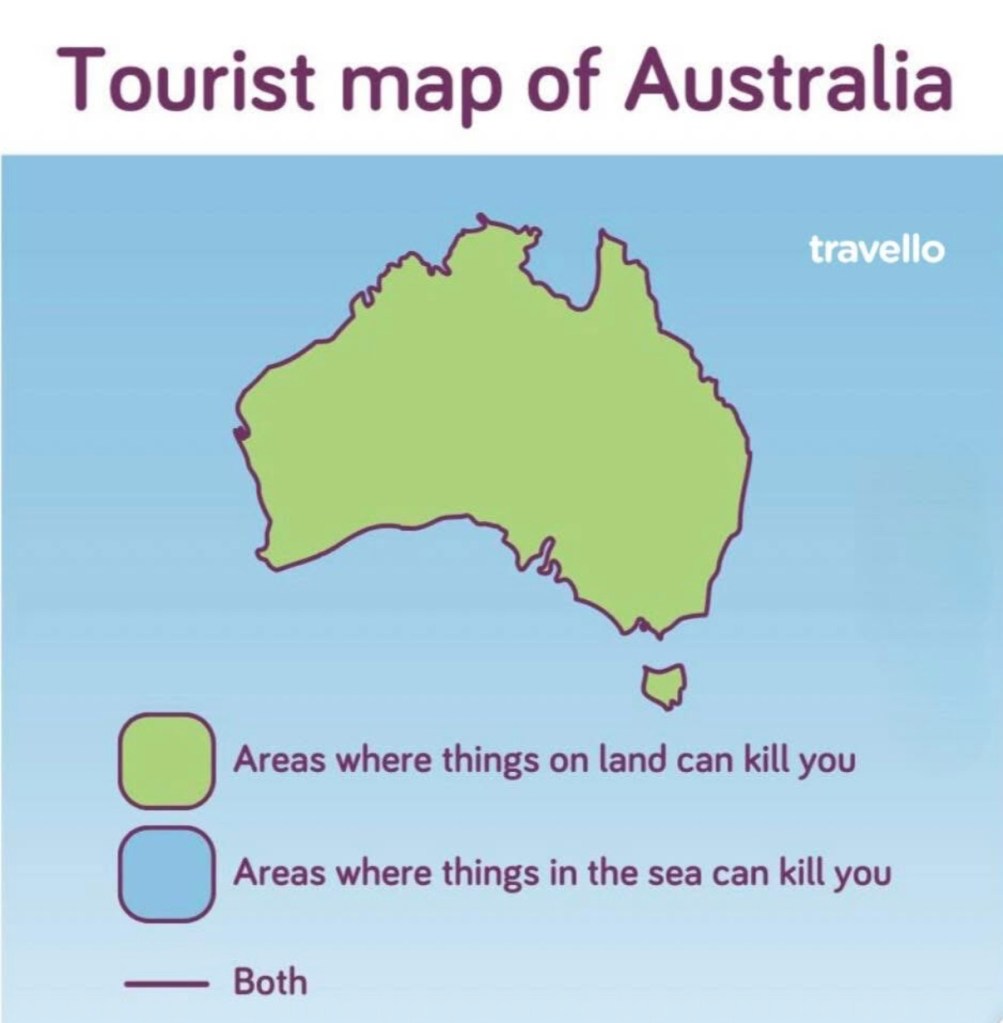
To remember the various hazards that Australia poses to the unwary we found a helpful map that reveals the areas of risk (below).
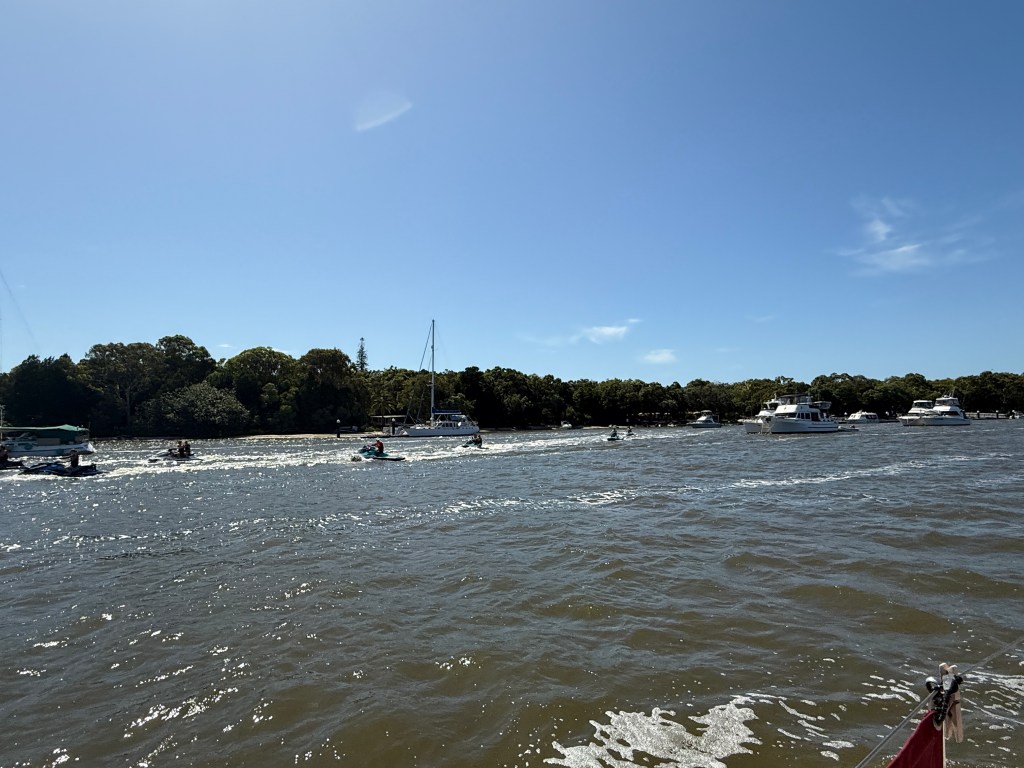
After a short sail of a few hours we reached Coochiemudlo, and dropped anchor a little way from the beach and moored boats. Steve and Karen who had been anchored in Moreton Bay sailed down to join us, and on hearing this Julian extended his dinner invitation to include them. We took our dinghies to the ferry terminal and headed to Victoria Point where Julian picked us up.
Anchored off Coochiemudlo. We lift the dinghy for two reasons: one, it helps keep it clean; two, it makes it harder to steal. Outboard engines are always in demand so it pays to keep a close eye on them.
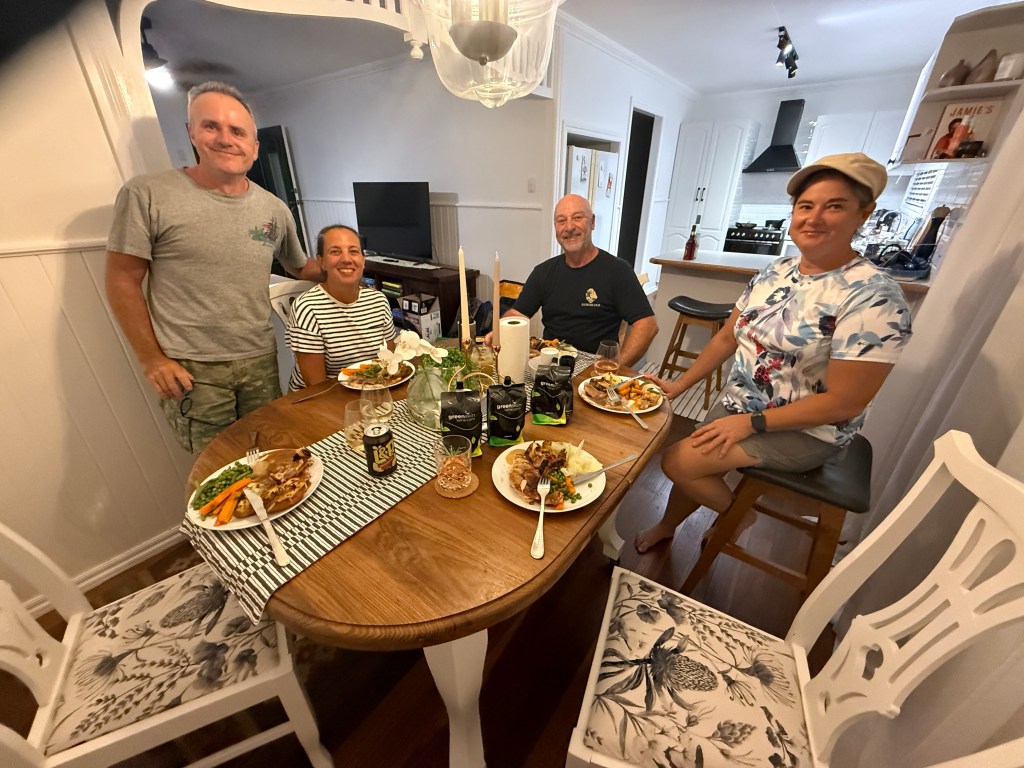
Dinner was roast pork with plenty of crackling, and by God it was good. The wine in the sachets on the table was gifted to us by Viki, the owner of the Pacific Island Rally. Greenskin, the wine company, had sent Viki some samples for cruisers to try. As well as being very palatable wine, the packets of 750ml each are much easier than bottles to store and can be returned to the company to be recycled once empty. So we now have white wine, red wine, and green wine! Thanks to Julian, Viki, and Greenskin, and can we make it a regular thing?
Dinner at Chez Julian’s. From left: Steve, Karen, Julian, and Cara.
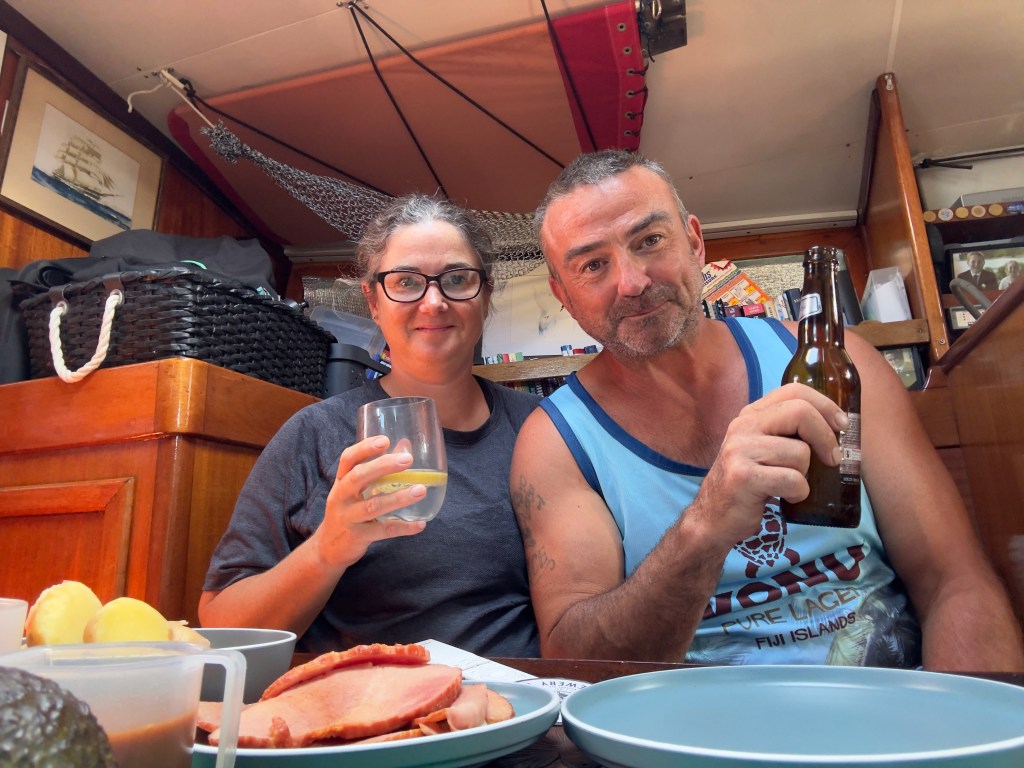
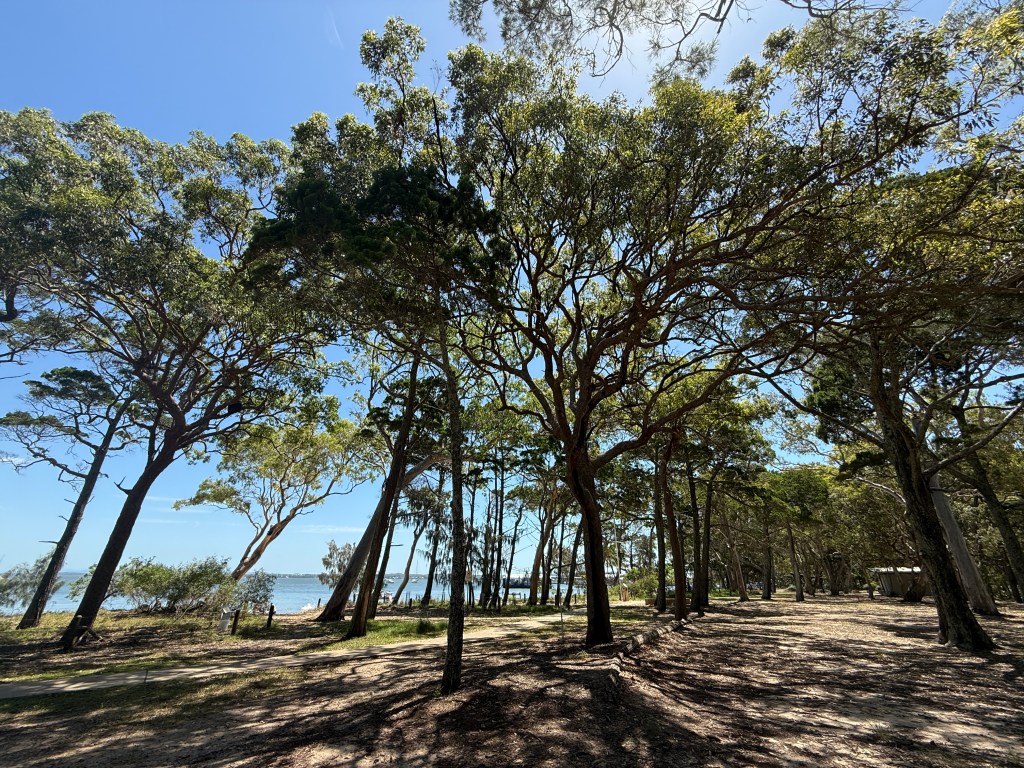
We stayed on Coochiemudlo for a few days, enjoying the island and making the most of access to a shower, washing machine, and car. Christmas Day was spent hanging out on Taurus eating too much (again), followed by a circumnavigation by foot of Coochiemudlo. On Boxing Day we drove down to the Gold Coast to catch up with my daughter, Abi, and her partner, Allan. It was an eyeopener to see how busy the four lane highways were and we ended up crawling along in a traffic jam for much of the way.
After picking Abi and Allan up we headed into town to try and find somewhere to get a meal and buy Abi a 21st birthday present. It being Boxing Day the city was insanely busy with shoppers looking for a bargain, and we maybe didn’t help ourselves by ending up at the Pacific Fair mall, the largest mall in Australasia apparently. The number of people was staggering, it seemed like half of Australia had decided to go shopping.
Christmas dinner on Taurus. Cheers!Beach at Coochiemudlo Island. Coochiemudlo Island. Aussie bar at Christmas. Coochiemudlo Island. Unimpressed local. Ferry terminal. Coochiemudlo ferry. Check out my new Crocs!Julian and Tracey’s. They gave us a set of keys and told us to make ourselves at home. Huge thanks, guys!Amazing the sense of liberation that a car provides. After having to rely on public transport or ‘shanks’ pony’ a car is a real luxury.Catching up with Abi and Allan.
After our trip into the big smoke, it was a relief to return to our little boat in our quiet little corner of paradise.
Sunset from Victoria Point ferry terminal.
Next morning we bid adieu to ‘Coochie,’ as the locals call it, and headed south towards South Port. The image below shows the inland waterways we followed. The anchor symbols show our route, where we stopped or considered stopping along the way. Normally, these channels are quiet and serene, but over the holiday period they were busy, and the closer we got to the Gold Coast, the busier they got.
chart of the region. This is an image of an iPhone app we use.
As we had been forewarned, the waterways were packed with boats and jetskis, all going as fast as they could, as loudly as they could. Often the people who had gone screaming past us turned around and came screaming back. I’m sure it would be great fun to ride a jetski for an hour or two, but the numbers involved and the apparent pointlessness of it all made it feel slightly perverse, the lack of attention to standard safety rules needlessly reckless. People flew past on either side, in either direction, often at the same time, cut across our bow, did little jinks to try and get each other wet, did circles around us, so that in the end we could only ignore them rather than try to maintain a safe distance. It was later reported that three people died in Queensland waters over the Christmas period. I’m amazed it was only three.
‘What ya rebelling against Johnny?’
We stopped for a short while at Tipplers Bay on South Stradbroke Island, and squeezed into the space between land and channel along with dozens of other craft of all shapes and sizes. A short walk across the island we came across the ocean and an enormous beach that was practically deserted in comparison to the resort side. With gratitude we enjoyed a semblance of peace, went for a swim, and then rejoined the throngs for a beer before clearing out.
South Stradbroke Island. Gold Coast in the distance.
Trying to get away from the crowds we anchored later than day in another bay closer to South Port but separated from the main channel by a sand bank. That night we were entertained by a thunder storm that reminded us that nature and beauty could still be found in that humanity over-loaded environment.
Lightning storm. On anchor near Southport.
Australia is a big country, the sixth largest in the world, but despite this its population is one of the most urbanised in the world. The Crocodile Dundee type image of Australia is largely a fallacy. The vast majority of its 27 million people are squeezed into a narrow corridor between ocean and inhospitable interior. A full 90% of Australians live within fifty kilometres of the coast (a mere 0.22% of the country’s land mass): 73% in major cities, 26% in inner and outer regional areas, and only 2% in remote or very remote areas. The resulting density of people can be a little overwhelming, and the boom in building over the past few decades has resulted in parts of Australia becoming a seemingly endless vista of beaches, high-rises, and malls.
Naturally, in this capitalist heaven some succeed and many fail. Great wealth and poverty rub shoulders on the street, if nowhere else. A common topic of discussion is the inaffordablity of housing. The average Australian house price in March of 2024 was A$959,000. When you think of the massive divergence in price between housing in the interior and exterior of the country it becomes readily apparent that most people, living where most Australians do, have no chance of owning a house. Many of the citizens of the ‘lucky country’ no longer seem to believe that luck is going to come their way. Cost of living, crime (especially youth knife crime), mental health issues, and drug addiction all seem out of control. We have been quite surprised by the number of people we have seen wandering the streets, mumbling to themselves or yelling at passers by. As if worried for their own safety the police here, armed with sidearms, tasers, pepper spray and wearing stab resistant vests, wander round in packs of three or more. Australia is obviously facing some serious social issues, but solutions seem to be in short supply.
Early next day the jetskis were back, and the weather offered a small window for us to clear out. With an opportunity to leave there was no question of staying, so we packed up and headed towards the South Port bar, our escape route to sea and sanity. Before attempting the bar we called the local Marine Rescue chaps and been given the all clear, checked the on-line cams, and made sure that all the conditions were favourable. Even though everything was in our favour the bar still provided a couple of waves of sufficient size to stop Taurus in her tracks. When doing our research we had found some images of a yacht that attempted the bar in 60 odd knots of wind, with predictable consequences. It was a good reminder that you just can’t be complaisant about bar crossings.
Once out at sea we had to tack through the reefs and shallows that sit outside the Gold Coast, before heading south towards our destination for the day — Tweed Heads.
The Gold Coast skyline never seemed to get further away.
Tweed Heads is only 15 nautical miles from the Gold Coast, some three hours sailing if the wind plays ball. In our case it took just over 7 hours as we tacked through a south easterly, zigzagging towards our destination because we couldn’t take the straight line into the wind. Still, it was nice to arrive and cross the bar during daylight, and even better to find the tempo of life turned down from the frantic pace of the Gold Coast.
Crossing Tweed Heads bar.
We motored a short way up the Tweed River before picking up one of the free public moorings provided by the New South Wales Government.
Tweed River. On anchor on the Tweed River
Tweed Heads and the merged town of Coolangatta lie across the border that divides Queensland from New South Wales. A 300 km fence once divided the states for ‘quarantine and customs purposes.’ The fence also held a darker purpose, making it harder for ‘black bird’ slaves, men taken from the Pacific Islands to work on the Queensland sugar plantations, to find freedom. New South Wales didn’t operate sugar plantations, and so the enslaved labourers were free men if they could find their way three miles or more over the border. If caught less than three miles from Queensland they were returned to their owners.
As mentioned in a previous post, Queensland, unlike the rest of Australia, decided against operating a daylight savings system, with the result that it lies an hour behind the rest of the country. In the photo below Cara’s right foot exists at 11:00 in the morning, whilst her left lies at 12:00 in the afternoon. I imagine living here would make my head ache.
We stayed in Tweed Heads for a couple of days, spending our time mooching around town and keeping a close eye on the weather. As soon as the opportunity arose we intended to head further south.
Voyage of the good ship Taurus — 21st of December to 31st of December 2024.
Next time: we celebrate New Years Eve at sea, do a couple of 48 hour passages, catch up with friends, and check out some Aboriginal rock carvings.
Cara keeps a sharp eye out for the markers that indicate the channel in the Great Sandy Strait
After saying our goodbyes to Martin and Trevor, we packed Taurus up and prepared to leave Bundaberg the following day. In order to make the most of the strong tidal flow we were up at 5am, and once past the channel entrance to the Burnett River we hoisted the sails and headed south.
Bundaberg sits on the west side of a bay that looks a little like a wine glass. We had entered the glass, from Noumea, from the east, stopped in Bundaberg on the west, and now needed to head south, into the centre of the glass and then down through the stem, if you will. In reality, the stem is a series of interlinking shoal channels. These channels wend their way through shifting banks of sand, some so shallow that they can only be passed by boats of Taurus’ size at high tide. Naturally, the weather needs to be right before entering these channels, you wouldn’t want to attempt them in strong winds for example, and you need to think carefully about your timing and where you want to be at high water.
From Noumea to Bundaberg to the Great Sandy Strait. Stars indicate Bundaberg and Bundaberg Marina.
The initial weather on departure was overcast, with 15 knots of breeze from the east. We enjoyed a nice fast sail on a beam reach (the wind ninety degrees to our direction of travel). However, as the day wore on the skies grew increasingly dark, and soon we were pounced upon by a series of squalls that brought torrential rain and thirty odd knots of wind from the south. The first squall to hit caught us by surprise, and being over-canvassed we let the boat round up slightly. Once it had passed we reduced sail and were better prepared for the next.
Nice sailing in overcast conditions…until a series of squalls came along to spoil the party.
The squally weather presaged a change in the wind, which swung around until it was blowing 15 to 20 knots on our nose. We were approaching the channels but approximately four hours away from where we had planned to anchor. In the circumstances we started to think about diverting to an alternative anchorage, one that was about an hour away to the west. We had a bit of time in which we could hedge our bets, heading in a south easterly direction that could either feed us into the channels or allow us to head to the secondary site. Happily, the wind died sufficiently for motoring to become a realistic option, so we rolled the dice and decided to give the channels a go. As it turned out, the first section that we were in was wide and deep, and within a few hours we were safely anchored in Kingfisher Bay on K’gari or Fraser Island.
The European name for the island, Fraser Island, is currently out of vogue, but it is worth remembering if for nothing other than the lurid tale that lies behind it:
Captain James Fraser and his wife, Eliza Fraser, of England, were shipwrecked on the island (Fraser Island) in 1836. Their ship, the brig Stirling Castle, set sail from Sydney to Singapore with 18 crew and passengers. The ship was holed on coral while travelling through the Great Barrier Reef north of the island. Transferring to two lifeboats, the crew set a course south, attempting to reach the settlement at Moreton Bay (now Brisbane). During this trip in the leaking lifeboats, Captain Fraser’s pregnant wife gave birth in water up to her waist; the infant drowned after birth. The Captain’s lifeboat began sinking and was soon left behind by the second one, which continued on. The wrecked boat and its crew was beached on what was then known as the Great Sandy Island (Fraser Island).
Captain Fraser died, leaving his wife Eliza and the second mate Mr Baxter living among the local peoples. Eliza and Baxter were found six weeks later by a convict, John Graham, who had lived in the bush as an escapee and who spoke the Aboriginal language. He was sent from the settlement at Moreton Bay by the authorities there who had heard about their plight, and negotiated their return.
Within six months, Eliza had married another sea captain. She returned to England and became a sideshow attraction in Hyde Park, telling increasingly wild tales about her experiences with the enslavement of the crew, cannibalism, torture, and murder. As she is known to have told several versions of the story, it is unknown which (if any) version was most accurate. She may, subsequently, have been killed in a carriage accident during a visit to Melbourne in 1858.
Fraser’s stories were disputed, by other survivors at the time and afterwards. On her return to England, Fraser appealed for money to the Lord Mayor of London, claiming to be a penniless widow in need, but the subsequent inquiry revealed that prior to leaving Sydney she had both remarried an English captain with whom she returned, and also there received a large sum of charitable funds in light of her ordeal.
Today, K’gari is a World Heritage-listed sand island, renown for its wild dingoes and its bird life. In the 2021 census, the island had a population of 152 people, but up to 500,000 people visit the island each year, many for four wheel drive excursions.
Kingfishers Bay is the site of a holiday resort which welcomes cruisers. After the inevitable boat jobs, which entailed getting so hot and sweaty that I was willing to risk the sharks and strong current for a cooling swim, we got on our glad rags and headed ashore. Parts of the resort were a bit run down, but the main centre has been rejuvenated and looks pretty flash. After a dip in the pool (no sharks or currents) we enjoyed a fancy meal for my birthday, which was the next day.
The following day we were up at 5:30 a.m. again. One outcome of the federal state system in Australia is that Queensland follows a different time schedule to the rest of the country, having opted out of daylight savings. This means that it’s an hour behind the rest of Australia. so whilst 5:30am might be 6:30am in real terms, it’s early enough in any state — especially a post big-night-out state.
We continued down the Great Sandy Strait, through river and past mangroves as if searching for our heart of darkness. The mainly windless day saw us weave our way between channel marking piles that stuck out of the glassy water like so many canapés randomly placed on a tray. Our early start ensured that we passed the shallowest areas at high tide, and so we snuck through without so much as grazing Taurus’ newly painted bottom.
Glassy water.Great Sandy Strait. Sometimes wide, sometimes narrow.
At one point during the day Cara disappeared and came back bearing a big birthday cake with an even bigger number iced on the front! It’s amazing what she can do in a boat galley!
Happy Birthday to me! Thanks Cara xx
Eventually we reached the anchorage at Pelican Bay where we intended to wait for the high tide needed to cross Wide Bay Bar and get back out to sea. Pelican Bay provided the promised pelicans, as well as a couple of crazy looking vessels that constantly ran backwards and forwards between mainland and K’gari beaches. These odd looking vessels were ferries, carrying a never ending stream of 4x4s across the estuary: the lucky folk heading for their holidays on K’gari, the not so lucky heading back to work on the mainland. The resources that Australia throws at satisfying its citizens every whim is a little surreal after time spent in the Pacific. Especially when one considers that these ferries may only cost the passengers a few cents or dollars. At the last election the Queensland State Government promised to make all public transport fares 50 cents per trip, which is terrific value for public transport users, but staggeringly expensive for the tax payers.
Ferries laid on for four wheel drive holiday makers.
Bars, areas of shallow water caused by sand deposits, that often lie between rivers and harbours and the sea are notoriously dangerous. As waves are forced upwards by the decreasing depth they peak, tumble, and collapse, and can easily swamp a small boat. Currents can also become much stronger as they are funnelled through bottle neck gaps, and an outgoing tide hitting incoming waves can ‘under cut’ them, making them peak even further. In Australia, boat owners are constantly advised against attempting bar crossings in any kind of adverse, or even non-mild weather — indeed, some bars are considered too dangerous to attempt at all. The channel across bars also changes frequently as the sand shifts. In the past, the channel at Wide Bay Bar was laid out via markers stuck into the sand, but this inaccurate and unwieldy system has been superseded by modern technology. Nowadays the would be bar crosser contacts Tincan Bay Marine Rescue and they reply with a list of co-ordinates. Once plotted into the boat’s chart plotter they provide an up to date course that makes use of the very latest data. Somehow these virtual waypoints also create AIS (Automatic Identification System) signals — signals that ‘ping’ on modern chart plotters as if they were approaching vessels. I can no more explain this wonder than I can the workings of television, or the telephone, or much of the modern world, but it works and that’s all I need to know.
Heading towards Wide Bay Bar.
For all of the above reasons, crossing a bar requires a bit of planning and is always a bit of an anxiety inducing business. But as so often in life the things you worry about in the early hours vanish in the light of the sun. So it was with our crossing. Apart from a brief spell of fog, in which a trawler came charging towards us from seawards, the crossing couldn’t have been more straightforward, and once clear we gratefully set sail and headed south. Ultimately, a rougher trip might have paid dividends, as we might have been less complaisant in regards to our next crossing.
Our destination for the following leg was Mooloolaba, a coastal town some sixty nautical miles south. Perhaps understandably, our focus for the past few days had been on tides and shallow spots, winds and currents. Now, back at sea, we found the wind angle right on the point between allowing us to sail and preventing us from sailing. For a few hours we sailed east to try and improve our overall angle to head south, but naturally the wind followed us around and we ended up in the same predicament, but further away from our destination. The next twelve hours could have been lifted from the pages of Greek myth. Like Tantalus, for whom water and food receded from reach every time he bent his head to eat or drink, every time we hoisted the sails the wind would shift a couple of degrees, just enough to prevent us sailing. Down would go the sails, on would go the engine, and the wind would shift back so that sailing might be just possible. Up would go the sails, off would go the engine, and we might sail for somewhere between ten minutes and three hours before the wind would shift again. Down go the sails, on goes the engine… you get the idea. Despite the frustrating conditions we slowly gained ground to the south, sometimes by wind, sometimes by diesel, but always at the cost of time.
Beautiful scenery on the way south.
There are few places to anchor between Broad Bay Bar and Mooloolaba, but none of then were recommended by people we knew who had actually used them. All are exposed to the east and/or south, bringing big swells and uncomfortable conditions to those who attempt to stay in them in Sou’ Easterly winds, like those we ‘enjoyed.’ After several early starts and long days we weren’t keen to have a night on anchor which would be at best uncomfortable, and at worst place us on a dangerous lee shore (a shore downwind, so that the boat would be blown upon it if engine or sails were insufficient to claw off). This lack of a safe anchorage led us to take the always nerve wracking option of entering a harbour at night.
In the past, we have entered various harbours and ports at night, and often afterwards wished we hadn’t. Any sailor approaching land is slightly nervous, because land and boats make for poor bed fellows. Whilst often the sea can be frightening, it is land that generally sinks boats. On the other hand, land, whilst worrisome for those with no wish to lose their homes and lives, also offers the bosom of all manner of comforts: a safe and comfortable night’s sleep, fish and chips, and beer, to name but three. The problem is how to navigate one’s way through the transition from sea to bosom without finding oneself on the rocks.
In this respect, large ships are fortunate as they are able to make use of pilots, experienced professional mariners who know their particular harbours like the back of their hands. Small boats rely on channel markers — piles with different coloured lights, red on the port side, green on the left (if returning from sea). At some point, some clever chap decided that each of these lights should have an individual sequence of flashes so that they can be identified and told apart from their compatriots. However, in my experience, no-one has the time to count the sequence of flashes and pauses and relate them to a pilot book, rather the dazed sailor approaching the rocky shore is faced by a dazzling confusion of lights that blink on and off, off and on, in a dazzling anarchic light show. The confusing result can be very hard to decipher, and the light closest to the boat is often missed as it winks off whilst its further siblings flash merrily away, and thus the channel markers can lie about where the channel lies.
So it was for our entry into Mooloolaba. Imagine an inky dark night in which you have red and green channel marker lights flashing at you in accordance to a tune that only they know. Now add the innumerable lights that modern society demands to maintain normal operations burning away in the background. These obliterate night vision, jealously hoarded at sea, and obscure the channel lights that show where the route to safe passage lies. Traffic lights, industrial lighting, domestic lights from the multi-storey homes that lie directly behind the channel into harbour, all serve to hinder the hapless sailor. Now, if you happen to try and enter said harbour during yuletide one has to add the flashing kaleidoscope of Christmas lights that every merry Christmastairan feels that she or he must decorate their flat, house, or boat with in order to enter the spirt of the season. On our entry we also had the added ‘help’ of some kind soul, or erstwhile ship wrecker, who chose to point a blindingly bright strobe at us from shore.
Entering Mooloolaba one also has to cope with a bar crossing, so that strong waves crossing the entry at right angles shove your boat around as you try to line up the various lights to make safe entry. In the past, when faced with conflicting information from passage marker lights, I have simply sat back and relied upon my instruments, following the chart plotter like a blind man clutches hold of his dog. However, when the boat is being thrown around by waves upon entry the instruments swing wildly, covering an arc of ninety degrees or more. In these disorientating conditions any attempt to correct tends to overcorrect.
So, here we found ourselves. Approaching unknown land, shallow seas to one side, a bar to the other, no real idea where the channel lay, and blinded by some dick head with a strobe light. For a minute or two I have to confess we were all over the shop, the impaired visibility in the cockpit made finding our course so much harder. But Cara ran up on deck and yelled directions, and as we steadied the ship a leading light became evident which we could follow between the rock walls that extended out like a mother’s welcoming arms. Once inside the channel, however, we found that we had leapt from the proverbial pan into the fire. The small channel, bound on either side by moorings, marinas, and ultra-expensive domiciles, provided a scene that lay somewhere between chaos and a descent into Dante’s Inferno. Every man and his dog with a boat had laden it with Christmas lights, laden him or herself with a dozen of Australia’s finest, and was busy chopping in and out of the channel whilst blasting their horns and yahooing like fifteen year olds allowed out on prom night. In a darkness splintered by a million LEDs we could make neither head nor tail of what the hell was going on. Our twelve metre boat with nav lights and steaming light showing fitted right in, and soon attracted a crowd of motor boats and jet skis that zoomed around us in joyous melee or dangerous idiocy, depending on your state of sobriety.
Approaching Mooloolaba.
As we tried to navigate through the mess Cara, still on deck, yelled at me to stop as we were heading for a buoy lit by a weak light that wasn’t on the chart. ‘Turn to starboard’ she said, ‘I can’t,’ I replied, ‘there are piles and boats there’, ‘well you jolly well should she said,’ ‘well, I jolly well can’t’ I replied, most civilly.
Fortunately, once inside the harbour the wind and current were such that we could cut power and remain stationary long enough to make out a gap between buoy, piles, and boats, and continue. The further we got inside the less insane the world appeared, and ultimately we found the berth that we had prearranged with Wharf Marina. They, very kindly, had offered us our first night’s stay free of charge, a consideration that had almost floored us after our experience at Bundaberg where any service came with a large invoice.
Somehow, given our jangling nerves, we managed to gently glide into our berth and pull to a stop at exactly the right moment for me to jump off and secure our mooring lines. We might have practiced the manoeuvre a thousand times. No doubt the inebriated souls ashore watching, celebrated our achievement with us, though I have a sneaking suspicion that they would rather have seen us, and filmed us, wiping out a dozen yachts for their amusement. Once tied down we did what any sensible soul would: we had a stiff drink and went to bed.
Taurus at Mooloolaba.
Next morning, after an energising breakfast of coffee and crepes, we wandered up to the channel entrance to try and debrief the previous nights events and see how we could have done better. In the cold light of day the entrance seemed fine, the bar was evident, but the better conditions and missing cacophony of lights made the whole thing look pretty tame. As we sat there we saw a motor launch come charging in, only cutting power once safely in the channel, which gave us some clue as to how those with experience tackle their entry. I remembered that I cut power as we swung towards the entrance, trying to gain time to see where we were going, but also giving the waves, which we couldn’t see, greater impetus to push us off course.
Entrance to Mooloolaba. The bar creates waves that run from centre to left (note wave crashing on right hand causeway). Easy peasy in daylight.
We later learnt that the Mooloolaba Christmas marine parade had been winding up just as we entered the harbour. The buoy we almost hit, which wasn’t on the chart, was gone the following day, so presumably it was just there just for the parade. We had been talking to the Mooloolaba Marine Rescue group in regards to the bar crossing, and, as their building overlooks the harbour, one might think they would mention the highjinks taking place. We had also asked about bar conditions, which is something boat owners are encouraged to do, but been told by a burly sounding Aussie voice, “I haven’t got a crystal ball mate.” Rightyo! The experience, like all ‘learning experiences’ was pretty stressful at the time. Entering unmarked Fijian reefs, storm force winds, and almost colliding with semi-sunken vessels pales in comparison to entering an Australian harbour at Christmas time. Like having a toe amputated, I don’t recommend it.
Our few days stay in Mooloolaba was greatly improved by friends of ours being in an adjacent marina. I first met Steve and Karen in Bundaberg, and being fellow Brits we quickly formed a bond that was cemented over a series of sun-downers. Steve and Karen own Naivasha, a stunning Halberg Rassy. Currently halfway round the world on their planned circumnavigation, they have amazing stories, and a generosity that most long range sailors seem to attain along the way (if they don’t already possess it) — along with salt encrusted skin and smelly waterproofs. It was great to be able to spend more time with these guys and try to absorb some of their sailing wisdom.
Steve and Karen. Cheers guys!
A couple of days later the winds at last appeared favourable for a sail to Moreton Bay, the large bay in which Brisbane sits. For once the wind gods smiled, and we were able to sail all the way in a blissful fifteen knots of warm and gentle breeze. The latter part of the trip was a bit more challenging as we negotiated the shoals, channels, and large ships plying their way into the bay, but nothing could spoil that idyllic day.
Nice sailing conditions. Cara, working hard.We moved over and slowed down to let the big boys through… (I’m not the big boy)Brisbane on the horizon.
We spent the night anchored off the charmingly entitled ‘Mud Island’, and next day headed up the Brisbane River.
Brisbane River channel. Port Brisbane.Fishing boats are followed by pelicans rather than gulls in Australia!Cruise liner was in.
As we headed up the river we received a phone call from Julian, a friend and fellow cruiser that we had met in Noumea. Julian is a commercial skipper based near Brisbane, and knowing that we were coming he called to tell us to be wary of going too far up the river. Whilst we knew that strong winds of up to forty knots were predicted for that evening and the following day, we were unaware that there had been record rainfalls inland, which meant that three of the dams up river were releasing water. Further rain was predicted that afternoon with the possibility of further easement and the potential for the Brisbane River to flood. This is not a particularly rare occurrence, with the river flooding in 1974, 2011, 2015, and 2022, but nor is it a small deal; the damage caused by the 2015 flood alone cost some A$2.4 billion to rectify. As Julian put it, “if the river floods it’s the last place on Earth you want to be.” As if on cue, dark clouds rolled in and the heavens opened.
Clouds.Rain.
In the circumstances we decided not to continue heading up river, and began looking for a likely spot to anchor. Somewhere where from which we could skiddadle out to sea quickly if needed, and somewhere protected from the strong southerlies that were due to arrive. In the end we found a perfect spot opposite Bretts Wharf jetty. We were protected from the south by multi-storey houses and could take the dinghy across the river to a public jetty. We could tie up the dinghy there and walk to Bretts Wharf where we could jump on one of the excellent public ferries that cost a mere fifty cents a trip. Compared to the issues we had faced getting off the boat in Bundaberg, Brisbane has its act together.
Anchor site in Brisbane River.Public jetty, Brisbane River. As explained, the river has stronger flow than usual.
After a bumpy night, weaving around in the mixture of forces created by the strong current and strong wind, we got the dinghy off and headed into the city to do the tourist scene.
Following the obligatory trip to the shops, we visited the Queensland Museum, the Maritime Museum, and the Art Gallery.
Aeroplane.Scary mural. WWI German tank. Small boat. Some crazy chap sailed from Canada to Australia in this…. no thank you!Jessica Watson’s Pink Lady. Shame to see such a lovely boat left to rot. HMAS Diamantina. Fire!Art. Painting of Brisbane in the 1850s. Amazing what people can do in two hundred years (apologies, failed to record artist).Brisbane today. Brisbane. Brisbane. Voyage of the good ship Taurus: 11th December to 21st December 2024.
Next time: We catch up with friends and family, we head down more shallow channels towards South Port, we catch a nasty bout of Aussieonhols and jetskitis, we flee back to sea.
Whilst cruising in the Pacific we had been growingly increasingly concerned about paint blisters on our hull below the waterline. When these blisters burst, bare steel could be seen underneath which then began to rust. Being perhaps too fastidious for my own good, the idea of my hull being exposed to salt water and slowly rusting away was a source of irritation and concern. Though I had been told by several steel boat owners that the likelihood of any real damage to the boat was exceedingly small, steel rusts very slowly when underwater due to lack of oxygen, it was not something I could forget or be sanguine about.
At some point the problem, and its founding cause, would have to be addressed and fixed. Unfortunately, the source of the problem was not entirely clear. Queries about paint blisters on hulls often feature in steel boat forums, but though the problem is common the cure can be elusive. The advice commonly meted out is that blisters can be caused by one, or a combination of, three things:
Poor paint application (paint applied on unclean steel, or when conditions were too hot or cold or humid).
Electrolysis (stray current from the boat’s electronic systems ‘leaking’ into the hull and creating a charge that lifts the paint).
Too many sacrificial anodes (zinc anodes, high on the galvanic scale, corrode before other metals such as bronze (which propellors are made of). The anodes are ‘eaten’ by the charge that inevitably occurs when dissimilar metals are placed in a solution (the sea in this case). Replaced annually, the sole purpose of anodes is to protect other more expensive items (like propellors) through their corroding away, but too many can apparently cause paint to blister).
As anyone familiar with sailors will be aware, we tend to hold strong opinions. We also like to be open minded, so tend not to limit ourselves to a single opinion. Ask three sailors a question and you are likely to get half a dozen differing opinions, all of which will be deeply held and strongly argued.
My own opinion on the cause of my hulls blisters was based on scientific fact and unassailable logic, of course. I reasoned that the paint application must have been fine as I did it myself only three or four years ago. Surely I could have done nothing wrong!
I could rule out electrolysis as Cara and I have spent a great deal of time and effort ensuring that every system on the boat is ‘above ground’ — i.e. not grounded to the hull.
Too many anodes seemed equally unlikely as we have only ever replaced the anodes that had always been on the boat, and even reduced the number of these, ‘just in case.’ So, we reasoned, the problem must be due to a vengeful God in an uncaring universe. C’est la vie!
But seriously, our purchase of an electrolysis monitor means that we can track any stray current and eliminate it. We have spent many, many hours on this endeavour, and I can therefore say with some certainty that Taurus has never been more electronically clean than she is today.
Too many anodes seemed equally unlikely. We have less anodes on her than she has had in the past, and our research suggests that we have slightly less than we should have (which is not a problem as long as we make sure the anodes don’t completely erode away before we change them).
So it seems maybe, just possibly, I didn’t do a great job when I painted her?
Naturally, we didn’t want to spend a vast amount of money getting the hull sandblasted, the best way to prepare steel for painting (and which I was all in favour of having spent a couple of weeks taking the paint off the hull with a sander last time, with the welcome help of my son, Daniel, it must be said — until he sanded the skin off his fingers) if the paint was only going to fall off again because the underlying cause hadn’t been rectified. On the other hand, the consequence of the problem had to be fixed regardless. Basically, we had to get the job done and hope the paint would stay on this time.
Sanding the hull. So much fun that I’m never, ever, going to do it again! Daniel, not yet sans fingerprints.
As to when and where to get the job done, the solution was oddly straight forward. A marine sandblasting and painting firm located in Bundaberg was able to do the job. Cara was keen to return to NZ to do some work that would help keep her anaesthetic registration current. A locum position for a month’s work came up, which meant that she could put in the necessary time and earn the money that would allow us to pay for the job, which I would ‘supervise’ whilst she was away. All the dots seemed to line up nicely.
A meme that could have been created just for Cara!
Taurus was hence lifted onto the hard, Cara prepared to fly back to NZ, and we moved into temporary accomodation at a nearby campsite as we couldn’t live on the boat whilst it was being sandblasted.
Up, up, and away!After being water blasted the extent of the problem became pretty evident..Nice shiny steel…Paint from the hull litters the ground… doh!From the marina to the yard.
The sandblasting progressed remarkably quickly. We came in to see how the work was going the morning after depositing Taurus in her shed, and found that she had already been blasted and had a coat of paint applied. Another was added the following day, on a Saturday, and two more the next day, on a Sunday! We could hardly believe it. The guys cracked on with the work, starting and finishing early before it got too hot, and then retreating to the local pub. Fair dinkum cobbers, as they don’t say in Australia!
Temporary accomodation. Tony, the foreman, sent us the following pictures, we were too late to see any bare steel.Bare bum… Primer applied.. Pretty in pink..
Happily, the sandblasters were very complimentary about the state of Taurus’ hull. Not only was there no damage, but they couldn’t believe that she was a 44 year old boat that had been round the world. The professional opinion was that the issue had indeed been one of paint application. So, hopefully, fingers crossed, the paint will stay on this time!
Undercoat..Antifoul applied and ready to go. The anchor isn’t there to hold her in place (ho ho), I took the opportunity to ‘end for end’ the chain, turning the chain around so that it wears evenly and hopefully lasts longer.
Cara had left by this time so I asked a friend to help me take the boat from the travel lift to an anchorage in the river. I couldn’t justify staying in the marina at $70 per day for a month, especially as you aren’t allowed to work on your boat in these places. I was glad I had help as when we were lowered into the water and went to reverse out of the travel lift the boat stalled. When I tried again it stalled again. I racked my brain for possible causes. The classic reason would be something caught around the propellor — but I had just been looking at the prop and it was free. The travel lift operators, for whom time is money, were asking if I wanted to be hauled out again and go on the hard to sort the issue out. I had limited time to solve the problem. Eventually, something freed up and we nervously headed out of the marina, praying the boat wouldn’t stall and leave us powerless to avoid crashing into someones expensive pride and joy. However, Taurus now seemed fine, and we anchored in a small bay beside the marina. In hindsight I can only think the problem was due to the prop shaft having been painted over at the the cutlass bearing (where the prop shaft enters the boat) which gummed it up enough to prevent the shaft from turning and hence stall the engine when it was put under power. Any other ideas?
Once on anchor I felt that Taurus was uncomfortably close to some boats in marina berths behind me. On the chart it appeared that I would have plenty of room but, as I eventually worked out, the marina had built another finger berth that wasn’t on the chart, thus reducing the room in the bay significantly. I wanted to anchor in that particular bay so that I could row ashore and be able to walk the couple of kilometres to the supermarket. I had been warned about thefts in the area so didn’t want to leave my dinghy with an outboard on the beach where there was nothing to lock it to. This meant being within rowing range. Ultimately, I didn’t feel that I could stay, so I picked up the hook and motored across the river to anchor opposite the marina. I spent a few days there but wasn’t happy about the dinghy/shore issue. I inquired at the marina if there was somewhere I could leave my dinghy and was told that yes, for A$30 a day they would let me use a dinghy dock. As I had just spent nearly A$3,000 with them I thought this was a bit on the nose, and thanked them kindly whilst cursing them deeply for their money grubbing ways. This attitude of extracting every possible cent seems to be standard at Bundaberg Marina. Friends of minepaid in advance to stay there whilst they waited for some engine work to be completed. When the job was finished early they wanted to leave, but the marina refused to refund any of their money. I suppose this might make good business sense, but it doesn’t encourage loyalty or positive recommendations.
Beacons on the Burnett River.
I returned to anchor in the bay, found that it hadn’t grown since my previous departure, felt that I was too close to the boats behind me, and left again after a quick trip to the supermarket.
The ‘too small’ bay. The bay is quite shallow in the centre and forward of my position so that you are forced to anchor in the spot shown. Whilst there was about thirty metres between me and the boats in the marina at this time, the distance was much reduced during strong winds. Had I dragged I would have had little time to react. I know other people might have been perfectly happy here, but I do like a bit more space.
It is possible, at high tide, to sail into Bundaberg itself and anchor there between moorings. However, the anchorage is supposedly full of debris from a marina that was destroyed in a flood some years ago, and there have been recent cases of dinghies being stolen and even stabbed for some reason — fun I guess? The idea of having to constantly worry about security, holding, and swinging room between moored boats didn’t appeal. I have to say that my reticence was partly due to Cara being away. When sailing short handed you get used to sailing with that other person, so that when they aren’t there everything seems that much harder. I didn’t fancy facing a very shallow river followed by trying to anchor solo in limited space; I simply didn’t feel confident to do it alone.
In some desperation I decided to head up river a ways to try another anchorage near Port Bundaberg. It might sound idyllic being on anchor on a yacht in Australia, but the reality can be pretty uncomfortable. Just about every day the temperature reached 30-35 degrees, at night it would drop to 25 or so. When it rains it pours, you have to shut the windows and the temperature, even outside, seems to leap up with the increased humidity. Sweat pours off you, especially if you are trying to do any work inside the boat. I ended up working naked much of the time because any clothing quickly became a sodden impediment. Washing frequently was a necessity, not just to avoid unpleasant body odour but to avoid sweat rashes. The river was too dirty to swim in, and there had been reports of crocodiles, so that was definitely out. Refrigeration on Taurus is very limited, so that fresh food only lasts a few days. I needed access to a washing machine, showers, and a supermarket. The anchorage off the port had plenty of room but the only landing site for a dinghy, a beach, was unusable except for two hours either side of high tide due to deep mangrove-like-mud. There was a navy cadet base with a jetty, but it was locked up like Fort Knox, due presumably to the crime issues. Trips to town to buy food, work supplies and so on, demanded access to shore and access to public transport, Bundaberg is about a forty minute bus ride from the port. Everything took a long time to organise, everything felt a bit more difficult than it needed to be, and everything was a bit of a PITA. On top of this, the isolation made the situation feel much worse. You don’t tend to meet people when on anchor, the people I had met previously had all left to head south, and you can quickly end up feeling like a stranger in a strange land. Working on the boat all day every day in these conditions, often finding new and bigger problems that had to be resolved, quickly became pretty miserable.
One bright spot, that helped massively in overcoming some of these issues, was meeting Trevor. Trevor was anchored on the boat next to me, so one day I took the dinghy over to ask him how he coped with life on anchor outside the port. He kindly put me in touch with a friend of his, Martin, who had a private jetty nearby. I spoke to Martin and he agreed to let me use his jetty, which was incredibly generous seeing as I had to walk through his garden to get from the jetty to the road. Trevor was also able to help me out with transporting some larger items that would have been difficult on the bus, and gave me a hand when I needed to move Taurus on to a berth. I dare say I could have coped without Trevor’s help, but it would have been bloody hard.
Anchorage at Port Bundaberg. Trevor, top bloke.
One of the jobs on my list was to clean up some surface rust in the bottom of the cockpit. Unfortunately, when I started cleaning the area up it soon became obvious that the rust was much worse than it appeared. As this area can catch waves it has to be waterproof, so the corrosion had to be repaired. The problem was how best to do it. The biggest difficulty was simply gaining access to the job. On the inside of the boat the corrosion was hidden behind wood panelling that had been epoxied in to place, the boat builders clearly hadn’t considered anyone ever having to take things apart.
Rust in the cockpit. The framework for the teak grill also had to be removed.On the inside… how to remove this?
I asked friends for advice, and one solution was to simply treat the rust with a chemical killer and use a marine adhesive and rivets to fix a sheet of steel over it. Hey presto, waterproof solution. As the area is non-structural this would be an acceptable fix. I knew, however, that a ‘band aid’ solution would bug the hell out of me, and if I was going to cut the rust out, which is what needed to be done, then I might as well have a new panel of steel welded in. I was warned that ‘hot work’ would create a hell of a mess, and it did, but ultimately I couldn’t stomach the idea of a ‘bodge’ job.
I spent a few days getting access to the area, using a skill saw to cut the panels rather than trying to remove the mahogany trim that was epoxied in to place and would inevitably splinter if attacked. Then I contacted some of the local welders to see if anyone could do the job before Christmas, which was beginning to loom large. After being told ‘no chance’ by a couple of firms, I was grateful to hear that Craig at ‘Oceanic Marine Services’ had had something fall through and could fit me in the next day. I then had to contact the marina to get a place on a working berth, with the fishing boats, and move Taurus with the kind aid of Trevor. The marina naturally charged me the standard rate for a berth, though there was no water and only one power outlet for all the boats to share. They also forgot to give me an access card so that I couldn’t get into the toilets and showers after hours… grrr.
On the working jetty. No idea why the lights there are red. Atmosphere probably.Rather than risk splintering the mahogany trim I used a multi tool to cut the panels. Hot work. Good as new. The beauty of steel boats is that welding can make them as strong as they ever were.
Working with the welder was an interesting experience. I was on ‘fire watch,’ making sure that the boat didn’t catch fire on the inside whilst he welded on the outside. Part of this role required me to hold a lump of steel, known as a ‘dolly,’ against the inside of the join being welded to reduce the number of sparks thrown through. I was running with sweat, but how the welder coped with his mask, hood, and heavy work gear is beyond me. I had thought of trying to do the job myself, but after seeing the experts struggle I was glad that I had had the sense to leave well enough alone.
With the welding finished, Trevor and I headed back to the anchorage so I could start the painting process — two coats of CRC rust killer, two coats of Altex 504 primer, two coats of Altex 634 undercoat, two coats of E-line 379 top coat, or more, as needed — but when stuff goes wrong it tends to want to keep going wrong. After motoring back to the anchorage I found water in the bilge. Bugger. After some investigation I discovered a hole in one of the 90 degree exhaust bends. Boats generally use sea water to cool their engines as the engines, on the inside, aren’t able to be air cooled, like most cars for example. A series of hoses and a pump sucks sea water in, sends it to a heat exchanger where the hot oil sits in close proximity to the water, which reduces its heat, and is then ejected overboard. Naturally this system is a little more complex in reality, due for one thing to the danger of sea water entering the engine from the hose used to eject the water when the engine isn’t running. To prevent this the exhaust hose is often run above sea level for a short distance. In Taurus this requires a ninety degree bend or two.
Remarkably, a replacement part was mine for $60, which is practically free for a boat part (the affordability was no doubt due to the fact that it’s actually a car part) but fitting this swine of a thing was a three hour test of strength, ingenuity, and endurance. How hard can it be to fit a tube into a pipe that it’s designed to fit inside? It can be very hard indeed. I changed the second bend, for safety’s sake, and it slotted in like the proverbial ferret up a drainpipe, but the other, identical, pig of a thing… my word. Grease, a heat gun, files, a grinder, hammers, all came to the fore with plenty of sweat, swearing, and not a little blood. Far from feeling triumphant once the job was done, I gazed at the mess and was reminded of Sir Arthur Wellesley’s famous quote as he surveyed the field of Waterloo, “Nothing except a battle lost can be half so melancholy as a battle won.” Quite so Sir, quite so.
Time for a new one. The tube is 304 stainless steel but it only lasts a few years in the potent mix of salt water and exhaust gases.
Putting the boat back together took a few days but it was all done before Cara got home. I have learnt that trying to live on a boat that resembles (or indeed is) a building site is less than ideal for marital relations, so it was a relief that it all came back together in the end. Then it was time for an outing and a well deserved drink, or two, possibly three…
Sadly the bottle is fake… Thank God for little girls (Cara) and alcohol!
Next time: we finally leave Bundaberg, we cross two sand bars in a day, we enter Mooloolaba Harbour at night and unintentionally join a Christmas parade, we enjoy other nautical frolics and mayhem…
Before leaving Amedee Island we had an opportunity to catch up with Rob and Kim from Sweet As, who we had last met at the Blue Lagoon Cave in the Ysawa islands in Fiji. Together with Karen and Dean from Run to Paradise, an Australian couple returning home after cruising in Japan and Alaska, we took our dinghies ashore and set up camp on the beach to enjoy the sunset and some cold drinks. We had been warned about the number of sea snakes that we might encounter on the island, but not having seen any we weren’t overly concerned.
However, the sea snakes obviously like sundowners too, and soon crashed the party. The snakes are actually kraits, which are ‘oviparous,’ meaning that they go to land to digest prey and lay eggs, as opposed to true sea snakes which are ‘ovoviviparous,’ or fully aquatic. Thankfully, the highly venomous kraits are docile and non-aggressive. As the sun prepared to set we were inundated with four or five slithering backwards and forwards, one even slithering over my foot. When someone says ‘don’t move!’ on a snake infested beach they certainly grab your attention!
Note the rudder-like tail. This physical feature differentiates kraits from sea snakes (as does being on land). Invasion of the kraits!‘Don’t move’ someone said….How many kraits can you see?
We didn’t linger once the sun had gone down and returned to our floating refuges. That night, however, the wind changed direction and picked up, and the boats without any shelter jerked hard on their moorings as they rose and fell with the waves. It was horribly noisy and uncomfortable, and Cara and I were up at first light to cast off the lines and head back to Noumea for some sleep. We had a great sail back in the fresh breeze. Although we had planned to anchor out we couldn’t find a free spot in the crowded mooring field / anchorage, so succumbed to the easy option and returned to the marina.
After a lazy day and a good sleep we headed into town to return a soda stream bottle that that turned out to have the wrong thread for our machine. The language barrier made things awkward until a young woman who spoke excellent English came to our rescue. Yolande had been taught English by an Australian manager at the mine where she worked, and was particularly proud of her ability to swear which she did like a true native Australian! Because the store would only refund money by transferring it into a bank account, Yolande offered to let us use her account and gave us cash from her pocket (she actually gave us too much and wouldn’t accept anything in return). This generous young lady then drove us across town so that we didn’t have to walk so far to visit the aquarium. During the drive I asked what she thought of the current troubles. She told us that she was very angry with the rioters, which had caused her to lose her job when the mine was closed. A Kanak, indigenous islander, she wanted to stay under French rule, though her mother, who was also with us, was a keen supporter of independence. Such is life in New Caledonia at the moment. Yolande’s ambition was to emigrate to Australia if she could get a working visa. New Caledonia seems fated to lose some of its best and brightest if the troubles can’t be resolved.
Yolande and her mum with Cara.
As we were too early for the aquarium, and it was very hot, we found a nice watering hole where we could hydrate, which is very important. On days like this we can hardly believe how lucky we are to be able to enjoy this lifestyle.
Hydrating…
The aquarium was well worth a visit. Many of the tanks had a kind of magnifying attribute built into them which created some interesting optical affects. The people were almost as much fun to watch as the fish.
Hello…. my name is Bruce!Fire fish. Wide screen fish tanks..Glowing things.
The trip to the aquarium was the last of the things we wanted to do before leaving Noumea, and with a weather window looking good in a couple of days we buckled down and did all we could to get the boat ready. This involved giving away food stuffs that Australian Customs would seize, checking the engine, stitching another patch on the jib where the material was getting thin, fuelling up the diesel tanks, and so on.
On the fuel jetty.
Saturday the 26th of October saw us doing the last bit of provisioning at the local market before saying a fond farewell to New Caledonia. We had thoroughly enjoyed our stay and hope to return some day.
The forecast was for several days of winds in the 10-15 knot range from the south east. Naturally, when we came to leave the wind was blowing from the west — the direction we we wanted to head in. Happily, we were able to divert to a sou’westerly passage in the reef, near Amedee, so we were able to sail. Once through the skirting reef we set the Hydrovane and settled down for the seven day passage. Apart from a day when we had no wind, the Hydrovane was to steer the boat near continuously for the next seven days. This simple piece of engineering uses no power, makes no noise, and yet keeps the boat reliably on course. We are still learning the intricacies of getting the best out of it, and it’s sometimes a PITA to set up, but I don’t think any cruising boat should be without some form of wind steering.
Later that evening we had to pass though a region marked as having a few FADs (Fish Aggregating Devices). We had never seen one of these, but had heard a few horror stories from other yachties who had collided with unlit FADs at night. I kept a lookout and was rewarded by finally seeing one of these floating hazards.
Can you see it? Look slightly left of centre near the horizon… You’d have no chance of seeing one of these at night…
The chart warned of several more FADs in the vicinity, and as our ability to see was reduced as we sailed into the setting sun, we took a cautious approach. Fortunately, no more FADs were spotted and the night remained calm and uneventful.
Keeping a sharp lookout. Sailing west.
The next few days gave us a variety of light wind sailing conditions. We tried umpteen sailing configurations with different sails up, down, half way up, halfway down, and everything in between. We poled out the jib, hoisted the spinnaker, and kept ourselves busy trying to keep the boat moving.
Cara!Still sailing west… Wing on wing..Spinnaker up… Spinnaker down…
The sailing was calm and undramatic, and life passed easily despite our being healed over a good deal of time with all the issues that entails. The only drama I recall is we had yet another headache with our spinnaker. On this occasion we tried to pull down the sock, a fabric tube that is pulled down over the sail to douse it, only to find that the sock wouldn’t budge. Somehow a line had wrapped around it and was cinching the sock tight as we tried to pull it down. Ultimately, we simply lowered the spinnaker by dropping the halyard, and though a small amount fell in the sea we simply tied it to the dinghy to dry. Though we need more practice, the asymmetrical spinnaker has been a great boon to the sail wardrobe, and gets less challenging (scary) as we gain experience with it.
In seven days we saw only one other vessel in the Coral Sea.
Later the wind built slightly and settled on 15 knots on the beam. The sea was remarkably calm and flat and Taurus sped along at 7-8 knots for hour after hour, day after day. We’ve never had sailing so fast and easy. Of course, it couldn’t last forever, and just when we started to talk about getting into Australia a day early the wind died away. The motor came on and we slowly chugged across a sea whose flatness would have done credit to any billiard table. The temperature remained around the 30 degree mark and the sea was such a beautiful azure that we were soon tempted to throw over a safety line and jump in.
Under engine, looking for wind. Going for a dip… Few hundred miles off shore, Cara cleans the hull…Taurus wallows in the slight swell. This is what you see if you look into the depths. At this point the sea is about 3 kms deep. The shimmering rays of light seem to come up from the deep towards you, though they must come from the sun above. It’s a beautiful sight.
After some 24 hours the wind started to pipe up again and we were soon able to turn the engine off and set the sails. That night when I was off watch, Cara came and woke me up and told me that there was a big storm approaching. She had been watching the squall on radar and changed course to try and avoid it, but it was too big and moving too quickly for us to get around.
Oh oh! The red and green splodge on the right is what a squall looks like on radar. The dotted line heading to the SW is our amended course, you can see on the chart (on left) that we were previously headed west (the horizontal red line is our plotted course to follow). The bar on the far right provides all sorts of useful information, much of which is absent because our plotter started to fail two days out from Noumea. It was only three years old and has since died. Naturally it had a two year warranty (thanks B&G).
We quickly lowered the sails as the wind can increase dramatically in squalls, and prepared the boat to the best of our ability — disconnecting all electrical appliances that we could disconnect, checking everything was tied down tight, girding our loins, and so on. As the storm got closer the lightning was almost constant, and the gap between the flash of lightning and the roar of the thunder became ominously short before non-existent. As we were unable to outrun the storm our best option seemed to be to turn around and aim for the thinnest part and try to break through in the shortest time possible. The following pictures give an idea of the visual experience:
Boom! This one seemed pretty close!
Pretty soon we were engulfed. The storm, as it appeared on radar, constantly changed in shape and intensity around us. Perhaps foolishly I tried to steer for the green areas and thinnest sections, though always with a NE heading in mind. In hindsight I would have been better off just steering in a straight line. Counter to our expectations, the wind died and instead the heavens opened and we were met by a monsoon-like downpour. Of course, the big worry in these situations is that the boat will be struck by lightning. I had actually been talking to someone in Noumea who had had this experience just before leaving; his rigging, sails, electronics, and anchor chain were all wrecked by the strike. Luckily, he was fully insured, but for us, having only third party insurance, such devastation would be… well devastating, or at least very expensive to put right, so we were on tenterhooks to get through to the other side as soon as possible. It took what seemed like a long time, I would have sworn the storm stopped on top of us, but within half an hour or 45 minutes we were through the other side and relishing the tranquil darkness of the skies ahead. How you can sail a steel boat with a 13.5m aluminium mast through an electrical storm of this magnitude and not be struck I don’t know. In the UK, cricket teams and such like are warned not to take shelter under lone trees if it starts to rain because several people have been killed when isolated trees have been hit by lightning. There can be no more isolated tall object than a yacht at sea, and there was no shortage of lightning, so we can only be grateful that we emerged unscathed.
After the excitement we settled down to sailing again. Our course hadn’t taken us far enough north so we couldn’t get around Breaksea Spit, a sandy bar that guards the approach to Bundaberg. We therefore had to tack and beat into a freshening wind for about four hours before we could tack back and begin the long, last haul to the west. Said quickly it would seem that this would take no time, but in fact it took another full day of sailing.
Crew was getting a bit slack…
As light fell the wind increased and we were soon hurtling along at 8 knots again, but this time the sea state provided a short, sharp chop that kept Taurus rolling from one side to the other. The uncomfortable sail only made us want to get into harbour as soon as possible, but as the anchorage for Customs lies up a river we felt it prudent to wait until daylight to make our entrance.
Once more we assumed our standard watch schedule: three hours on, three hours off. At about midnight I noticed a number of bright white lights ahead of us. According to AIS there were no boats or ships in front of us, the radar showed nothing, and the chart made no sense of what I was seeing. As we were speeding towards these strange objects, about a dozen of them spread across the horizon in front of of us, I woke Cara to see if younger eyes and keener intellect could make sense of the situation.
We were both non-plussed, but eventually it became clear that the lights were fishing boats. The brightness of the white lights totally obscured their nav lights, their AIS were all turned off (as is common for fishing boats for reasons of commercial competitiveness), but their failure to appear on radar remains a bit of a mystery — possibly a consequence of the chop and radar filter settings. Due to the brightness of the lights against a backdrop of pure darkness it was difficult to tell how far away the fishing boats were. We were still being steered by the Hydrovane, which in the wind and confused sea was tending to allow Taurus to wander a little. Despite our having settled on a course that would take us between two boats we still managed to point straight towards one of the fishing boats at one point, which then called us up on VHF to tell us that we should change course and that they were trawling at a couple of knots. Cara, tired and not impressed by the deliberate obscurity of these commercial vessels, suggested that the skipper put on his AIS so we could see where he was and where he was heading, but this good advice was studiously ignored. Still unsure as to how far away the fishing boats were and which direction they were heading in, we began hand steering and finally navigated this shifting hazard, though not before it seemed like another fishing boat wanted to play chicken with us, and steered straight towards us. No doubt these fishermen have their own imperatives, but after seven days at sea, sleeping a maximum of three hours at a time, being forced to face a confusing and unnecessarily hazardous situation because people have chosen to turn off their vessels safety devices was a bit frustrating.
After the fishing boats we were free to try and get some more sleep. Our planned arrival time, day break at 5:30 am, meant that we could aim for another hour and a half each. As the sun rose we headed up the channel towards the river entrance and enjoyed one last sunrise at sea.
The dreaded Australian Customs and Bio-Hazard people turned out to be helpful and friendly, though they still charged us A$550, and before we knew it we had been admitted into Australia. Somehow, unable to sleep despite being dog tired, we enjoyed a busy day, finding our way around the marina and socialising with friends old and new.
We sailed to Australia!
We had a lot to prepare for in the next week or so. Cara is returning to NZ to do some work, whilst I fix a few things on the boat. Hopefully everything goes smoothly…
Having no transport we converted Taurus into a car. Using the nav lights as indicators has caused some confusion… Voyage of the good yacht Taurus: 26th of October 2004 – 2nd November 2024.
New Caledonia has a land area of 18,575 km2 and a population of approximately 270,000. The indigenous ‘Kanak’ people make up about 41% of this total with the remainder made up of the Caldoche (Europeans born in New Caledonia), the Zoreille (those who have emigrated from metropolitan France), and non-Kanak Polynesians who make up about 10%. The Kanaks speak 28 different languages, which are unrelated and wholly incomprehensible to speakers of other local languages, so that French is the lingua franca.
James Cook was one of the first Europeans to sight New Caledonia, on 4 September 1774, during his second voyage. He named it “New Caledonia’ as the island reminded him of Scotland. The Comte de Laperouse followed Cook in 1788, and after him came various whalers and traders who continued the work of surveying and mapping the islands.
The value of sandal wood, found in New Caledonia, attracted ongoing European interest, after which the practice of ‘black birding,’ exploiting Melanesian and Pacific labour for use in the sugarcane plantations of Fiji and Australia, continued the one-sided relationship.
France took official possession of New Caledonia in 1853 and used the islands as a penal colony between 1864 and 1897, during which time some 20,000 French convicts arrived and were put to work mining nickel and copper. The Kanak people, treated like second class citizens and vulnerable to European diseases, revolted against colonial rule in 1878 which resulted in the death of 200 French men and 1,000 Kanaks. Eventually, the better armed French suppressed the revolt and beheaded the Kanak leader before exhibiting his head in the Museum of Natural History.
After WWII, the struggle for Kanak independence was given a boost when the UN placed New Caledonia on its ‘Decolonisation List of Non-Self Governing Territories.’ Adopting a more liberal strategy, the French gave Kanaks and French settlers the right to vote in 1951, and shortly after New Caledonia became an overseas territory of France — bestowing French citizenship on New Caledonian citizens. However, fresh rioting broke out in the 1980s which resulted in Kanak leaders and the French Government agreeing to a series of three referendums to decide the future of the country. The first two referendums resulted in a narrow win for those who want New Caledonia to stay under French rule. The third referendum was disrupted by Covid, and was boycotted by the Kanak people who wanted the French to postpone the vote. As such the result was a massive defeat for the independence party.
Fresh rioting broke out again in May 2024, with the loss of thirteen lives, 800 businesses, and over 10,000 jobs, amounting to some 30 percent of New Caledonia’s GDP (gross domestic product). The situation in New Caledonia remains slightly unstable and tense. For a short time, foreigners were asked not to visit, and several cruising yachts that were headed to New Caledonia chose to divert elsewhere. With all this in the air it was far from certain that we would be able to visit the country, though we were very keen to do so — not least because it breaks up the trip from Vanuatu to Australia.
The political tension in Noumea, the capital of New Caledonia, is palpable, but can’t entirely detract from the city which is easily the cleanliest, most modern, and most sophisticated we have visited in the Pacific Islands. The people have been universally helpful, but a clear divide separates the French from the Kanaks, the latter appearing much poorer, less well educated, and sometimes slightly unfriendly until they discover that we aren’t French. Despite large numbers of reinforcements having been brought in, the presence of the police and army seems, no doubt deliberately, understated.
Kanak dwelling.
There can be no doubt that a great many wrongs have been done to the Kanak people, but, as is always the way with these things, the situation is far from clear cut. Firstly, the majority of people allowed to vote want to remain French citizens (and voters had to have lived in New Caledonia for at least ten years, a move designed to make the vote more fair for Kanak people by removing the influence of recent French immigrants). It is also difficult for us not to remember speaking to David, a village elder in Vanuatu who wished independence had never been achieved there. David believed that Vanuatuan political freedom had led to a serious rise in illiteracy amongst the young (because education is no longer provided free of charge). He also expressed concern in regards to the growth of Chinese influence, and the degree of governmental corruption. Certainly, France continues to give vast amounts of money to New Caledonia, and one wonders what would happen if that easy money was suddenly cut off.
So, with the political situation in mind we began to explore the city. One of the first attractions we visited was the Maritime Museum, the walk there happening to take us past the local patisserie and supermarket. The museum was quite small but had some interesting exhibits. The Captain Cook area had a model of The Resolution and a reproduction of one of Cook’s charts which showed his journey through Vanuatu and New Caledonia. I hadn’t realised how closely our trips had aligned, we might have been following in his footsteps.
No dramas for salty sea dogs like us!Model of The ResolutionOur passages don’t exactly align, but it was interesting to see how many places Resolution and Taurus had both visited. Light house lens…
The next day we tried to find one of the local forts, but though we found a modern military base we couldn’t work out how to get to the headland without trespassing. The French take a dim view of such things so we found a bar instead and kept everyone happy.
French military base, note the cannon gate posts. If visiting New Caledonia I recommend you try Havannah Beer. Very good.
We left the marina the following day and headed out to Maa Bay, which someone had recommended to us. It was a fast sail in 25 knots and a pretty bumpy anchorage so we didn’t try to leave the boat till next morning. Then we jumped in the dinghy and tried to find a walk that led over a hill to the next bay. Unfortunately, after walking some way all we found was a private gated community. Being unable to find any other way we ignored the privee sign, but the gate and fence on the other side was pretty serious so we had to retrace our steps, all the way back to Taurus. Our attempt to cross the peninsula may have been unsuccessful but we had walked along way, and getting some exercise was the real goal.
Trying to find the track at Maa Bay. ..
From Maa Bay we sailed to Signal Island. The island is so called because a pillar was built on it in 1854, which, when aligned with a local hill, reveals where the channel through a nearby reef is. The island is now a nature sanctuary so that anchoring is not allowed and instead moorings are provided. After a walk around the island, and seeing lots of birds and some big spiders, we returned to Taurus and decided that now was a good time to clean the hull. Australian Customs can get very unhappy about boats turning up with a dirty bottom, so we risked the tiger and bull sharks and jumped in with scrubbing brushes. Hiding in the shade of the hull was a school of Bludger fish. If we hadn’t been in a reserve I would have been very tempted to grab the speargun, but they proved surprisingly good company, and it turns out they are often infected with ciguatera, a neuro-toxic disease, so best left alone.
Signal Island. Big spider. Signal Island’s signal. School of Bludger fish. These are often infected with ciguatera so not wise to eat. Swimming with the fishes..
Friends of ours were leaving Noumea to head to NZ the following day so we decided to head back into town. The sail was pretty gnarly with 25-30 knots of wind and a short, sharp chop that slammed into the bow, slowing us down and causing the bow to want to turn downwind. The conditions meant that we had to motor sail — sailing with the engine providing some additional thrust — so that we could make decent headway.
After seeing our friends off we decided to get the folding bikes out. These bulky items are often a subject of ‘should we get rid of them’ discussions, but though they don’t get used often, when they do get pulled out they can be indispensable and a lot of fun. Our goal for the day was firstly a big chandlery (boat stuff shop) that we had been told about, and secondly an old fort called Canons de Nouville. We managed to leave the shop empty handed and then tried to find our way to the fort. After many miles along dirt roads and tracks we finally reached the fort which was well worth the effort. The cannon are rifled breach loaders with a date of 1870 stamped into them, so roughly contemporaneous with the US Civil War. Who they were intended to defend Port Noumea from I have no idea. There was no information about them there, and even the staff at the local museum knew nothing about them. Presumably the threat was considered to be very real as they would have taken considerable effort to mount, and this is just one of several forts in the area.
Port Moselle, the marina that we stayed at is on the opposite shore. The fort boasted four cannon in amazing condition. The gunners would have aimed the cannon by pushing the lever and dragging the cannon around on its paved track. Explaining how cannon work to Cara — she was fascinated! Beautiful views, and great field of fire!There were several underground tunnels and chambers — presumably the magazine.
On the way home, to a pressing engagement at the local bar, Cara got a puncture. Naturally, it was this point that I realised that her wheels don’t have the common quick release system but instead require spanners to remove the wheel. We managed to remove the inner tube with the wheel in situ, but then the vulcanising rubber we had in our puncture repair kit refused to stick the patch on. In the end we had to resort to periodically pumping up her tyre and getting as far as we could before the tyre went flat again. Not exactly what you want after a long, hot day in the saddle, but at least we didn’t have to walk home, and the bar was still open and all our friends still there.
On our way home..Pacific Rally knees up.
After another couple of days seeing the sights in Noumea it felt like it was time to get out of the marina and save some money.
Noumea MuseumThese guys from a WWI diorama struck me as pretty cool. I guess the spike on their helmets makes them Germans….Food in Noumea has been amazing.
We had a fantastic sail to Amedee Lighthouse. The sun was shining, the breeze was just right, and though it wasn’t coming from quite the right direction we were happy to take our time and tack a few times to get there. The lighthouse is apparently one of the tallest and oldest in the Southern Hemisphere, it having been originally used in France and later dismantled and shipped to New Caledonia.
Crew enjoyed the trip. I finally managed to fix our old sextant, so trying now to learn some astro-navigation. Who needs GPS? (I do)Amedee Lighthouse, popular spot with the locals. Cara at sunset off Amedee.
As mentioned in a previous post, our intention was not to stay here long, but rather have a brief stop and continue on to Australia. However, the weather has been particularly unsettled with light winds in the Coral Sea that would require us to motor for 4-6 days of the 7 day trip. The weather looks like it may come right on Saturday, so we have a few more days to relax and enjoy Noumea before getting ourselves ready for our passage to Bundaberg.
Voyage of the good yacht Taurus: 8th of October-19th of October 2024.
Having sailed so far north to catch up with our friend Ralph on Jemellie, we needed to retrace our steps or face the difficult task of sailing due south to New Caledonia in an area of prevailing south easterly winds. Yachts of course can’t sail into the wind, or indeed roughly forty-five degrees either side of it. The name given to sailing at the closest angle to the wind is ‘beating.’ This is often a slow and uncomfortable angle of sail, involving the boat heeling to one side whilst rocking up and down fore and aft as she rides up and over the oncoming waves. Rather than beat south for a couple of days from Luganville we chose to try and ‘bounce’ back down the island chain in a series of day sails. The further south east down Vanuatu we travelled the easier our eventual angle of sail to New Caledonia would be.
This strategy unfortunately meant that sightseeing and tourism had to be put aside, and moving south made the priority. The cyclone season, starting at the end of October, is rapidly approaching and we have a long way to go. Fortunately, the often strong south easterlies were unusually weak, so we were able to motor into throw them, and we even had a day or two of light winds from a northerly direction that allowed us to sail.
Big distances and slow speed made for some long days. Best seat in the house. We are trying to use the orange storm jib as a cutter sail, increasing our sail area in the light winds. Often the wind would disappear, leaving the sails to flog and giving us no choice but to motor.
Despite staying at some beautiful anchorages we didn’t get off the boat until we reached the island of Efata again, the island on which Port Vila is based. Arriving at a village called Utanlangi after several days of hot travelling the urge to go for a swim couldn’t be ignored, and getting low on fresh vegetables we wanted to see if the village had any fresh produce for sale. As it turned out the snorkelling was spectacular and the village charming and well stocked with veg.
The coral had grown into a series of canyons that the sea life seemed to enjoy. We spotted Spotted Eagle Rays. Village kids playing in the sea…or playing football. Not a screen in sight and all having a ball. Sarah, who gave us a tour of the village and sold us some tomatoes, spring onions, and mangoes. Good taste in music too.
We left early the next day and decided to anchor about halfway to Port Vila for a quick swim and lunch. The quick stop ended up being slightly prolonged when the anchor got caught in what looked like an old boiler, the only debris on the seafloor as luck would have it. We tried the old trick of turning in a circle to see if the anchor would free itself, and thought about using the dinghy grapnel anchor to grab hold of the main anchor and pull it free, but after I went for a swim I could see that the anchor was so well wedged that the best option was to dive on it. The water was about ten metres deep and though I tried I couldn’t hold my breath long enough to dive down and free it, so we quickly got the scuba gear out. We actually bought and carry the diving gear for exactly this kind of situation, making sure that we always have at least one full tank, so it was good to use it for that purpose and know that the money and effort hasn’t been wasted.
Anchor well wedged. We find the easiest way to get the scuba BCD (vest) on is to have it lowered with the spinnaker halyard and put it on in the water.
Once free we set off again and had a fantastic sail to Port Vila in fifteen knots of wind. After all the motoring and light wind sailing we had been doing it was exhilarating to feel Taurus come alive again.
Arriving back in Port Vila that night we anchored in our old, familiar spot. We headed into town for dinner and to visit the supermarket, and later than night started looking for a weather window to get to New Caledonia. Kevin and Shawnea on Meraki II got in touch to arrange a meeting to discuss weather patterns at the local bar, which naturally ended up in a few beers and everyone going to a traditional fire show at a local resort. The show was pretty spectacular, though I’m not sure all the Western pop songs were traditional Vanuatuan, and Cara was poisoned by her (non)-gluten free pizza. As we were considering leaving in a day or two we were concerned that this ingestion might cause a repeat of the kind of illness I had suffered on the trip from Fiji to Vanuatu.
Fire show at Mele Beach.
It turned out that Saturday was a good day to go, so on Friday morning we headed to Customs to clear out. We were just in time as the offices closed shortly afterwards due to a public holiday that had only been announced a few days earlier. Friends on Norla who turned up just after us were turned away and had to go back the following morning.
Saturday morning saw us having a quick pack up and heading out of Port Vila by 9:30 am. The sail to Noumea started off with a bit of a choppy sea and 20 knots of wind on the beam, but as we left land behind the sea state calmed down and we enjoyed a peaceful, fairly fast, sail. The overall trip was nicely uneventful, the only excitement being when the wind swung to the SE and we struggled to get far enough south to follow our planned route through the Loyalty Islands. Pointing a little high slowed us down, but eventually the wind swung back to a more easterly direction and we could sail unhindered. The chart showed a series of FAGs between the islands (Fish Aggregating Devices), floating buoys that anchored in deep water can move upto one nautical mile. As we travelled through the area in the dark we kept a close look out, not knowing if they were lit or not, but we remain ignorant as we didn’t see or hit anything. All the following day we closed the distance to New Caledonia and were finally approaching the passage that takes one around the south of the island to Noumea, on the west, as darkness fell. At this point, after two and a half days, we were looking forward to our arrival. However, the speed of travelling by boat meant that we had another four hours to go, navigating through the channel markers in the pitch black and finally into the port of Noumea itself. Here we were forewarned to expect that we would have to anchor in a tight spot next to one of the mooring fields.
Approaching New Caledonia as the sunsets. Catching up on some sleep. The canvas sheet that stops you falling out of bed as the boat rolls is known as a lee cloth. I normally prefer to sleep on the floor between the table and other settee as there is nowhere you can go!Red light in the cockpit, to preserve night vision, as we follow the channel towards Noumea.
The Noumeans clearly enjoy their sailing as there are a number of marinas around the capital and well as large mooring fields, but it doesn’t leave visiting yachts arriving at 2 am much room to get the hook down. Thankfully, we were able to squeeze into a spot between a channel marker and another anchored boat. Due to lack of room we couldn’t use as much chain as we would normally like, but we were pretty confident that in the light air Taurus wouldn’t go walk about. It really pays to have confidence in your ground tackle in these kinds of situations, staying up for the rest of the night on anchor watch wasn’t an option!
Heading into Port Moselle Marina.
Next day we called up Port Moselle Marina and arranged a berth. This seemed the easiest option as we had to head into Noumea to go the Immigration Office, and we weren’t happy to leave Taurus by herself on anchor. The Marina staff were great, and it felt fantastic to experience French culture again, though my schoolboy French is getting hard to remember — and I never knew a lot to start with!
Our berth was G89, which gives you an idea of the size of the place.
We eventually found the Immigration Office (via a patisserie where we asked for directions so of course had to buy some pastries) and were glad not be asked for health insurance documents, which we were told we might need but don’t have. To cut a long story short, we had tried to get health insurance before leaving NZ, but despite explaining our plans to various companies and being sold different policies we kept finding that none of them covered us for sailing. Eventually we gave it up as a bad job and decided to take the risk, which has payed off so far (fingers crossed for the rest of the trip). The rest of the immigration process went without a hitch, with the bio-security folk coming to the boat and taking all of our fresh vegetables and fruit. We were just glad that we were able to keep the uber-expensive cheese we bought in Vanuatu, though the cheese available here is mouthwateringly good and much cheaper.
Since our arrival we’ve gorged ourselves on baguettes (still poison to Cara — poor her), ham, fresh tomatoes, soft cheese, and wine. The staff at the supermarket know us by sight, and we all have a good laugh trying to communicate. Food has been a bit hit and miss in the Pacific Islands, with the exception of the delicious and cheap food available in Fiji, so it’s hard to stop eating the food we have been craving for so long. Certainly we will be sorry to leave New Caledonia, despite the local unrest, of which I will say more next time.
Lordy! Heavenly delights!‘Q’ flag flying and waiting for bio-security to let us into the country. Voyage of the good yacht Taurus: 27th of September –8th of October 2024.