
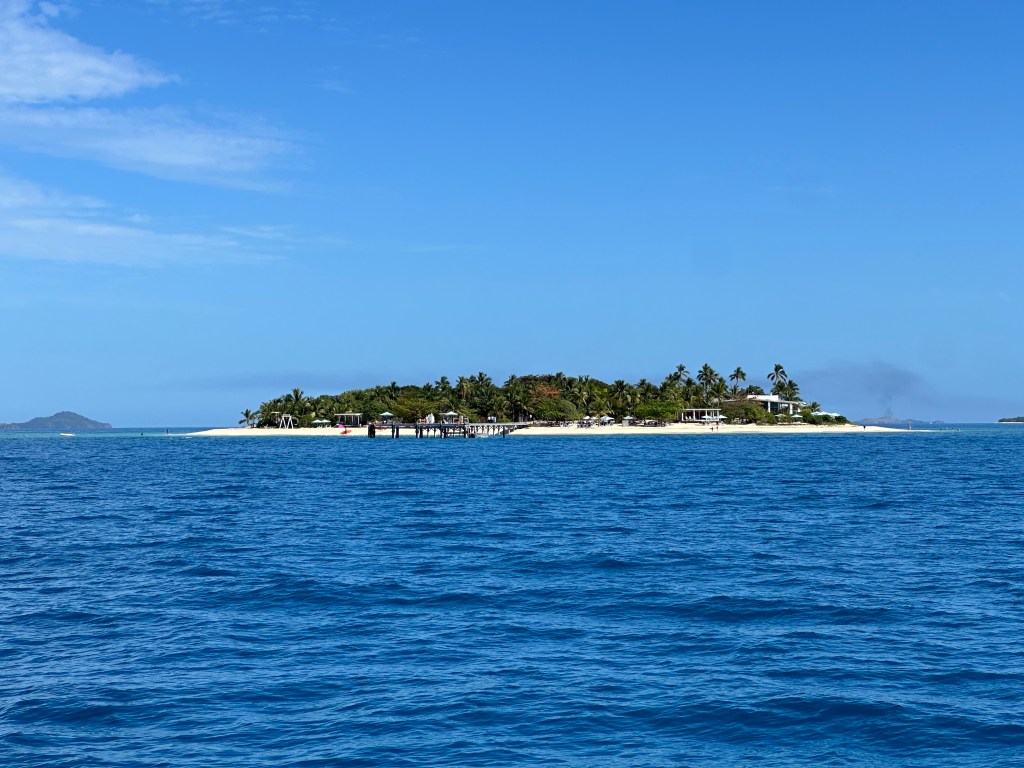
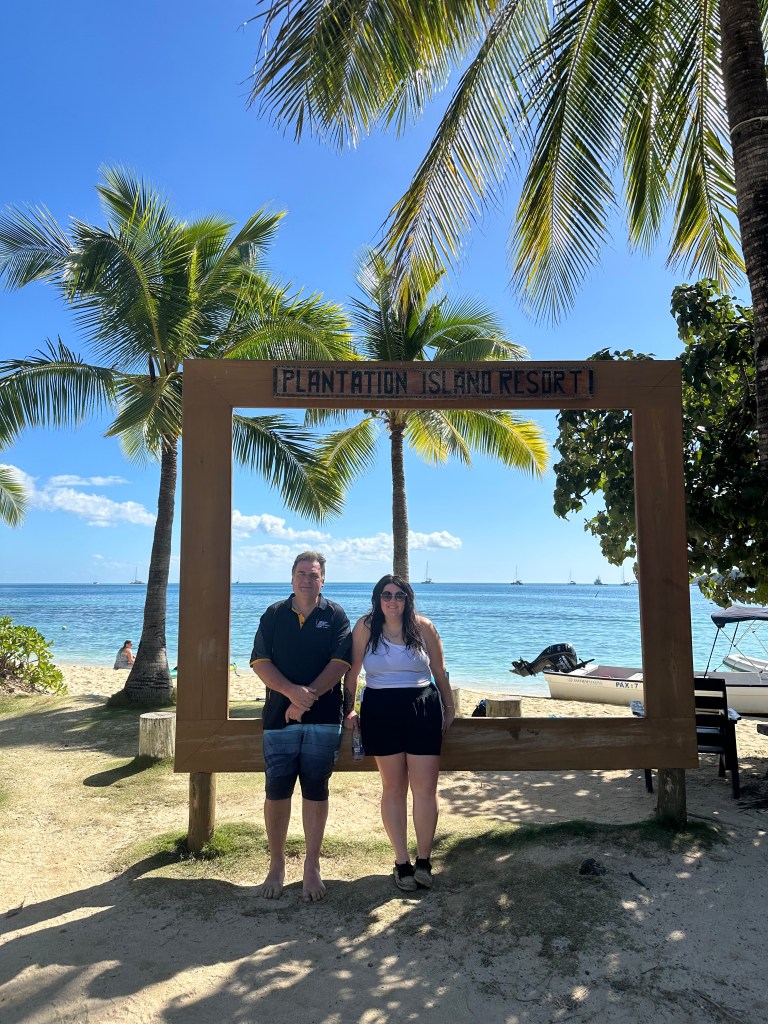
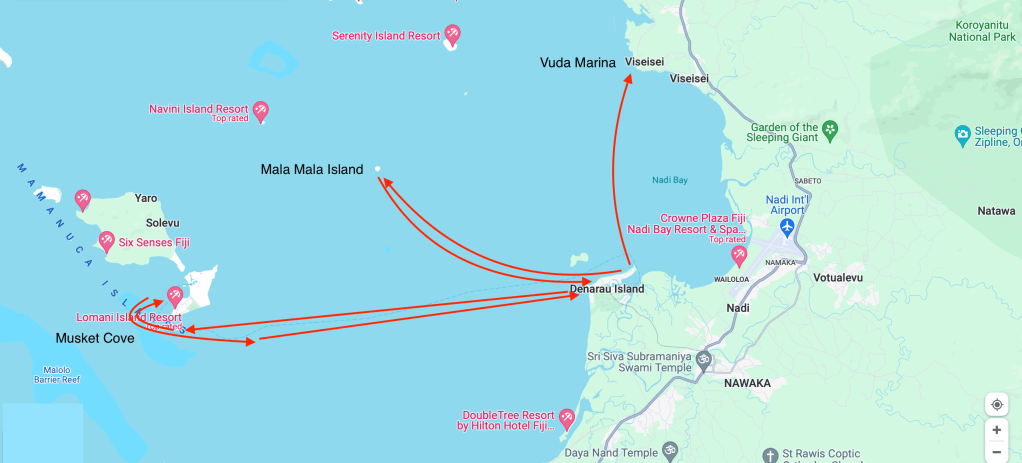
With Christine, Cara’s mum, visiting, our cruising experienced a change of tempo. Wanting to take Christine out on Taurus we sailed to Mala Mala Island, an island resort which we could visit for $30 a head. The price was pretty reasonable as it meant that we could use the resort’s facilities. The snorkelling around the island was surprisingly good and access to the reef was nice and easy. We settled down in the sun with a bottle of vodka that we had smuggled ashore and mixed with cold coke from the bar so we could get pleasantly inebriated without losing our shirts.
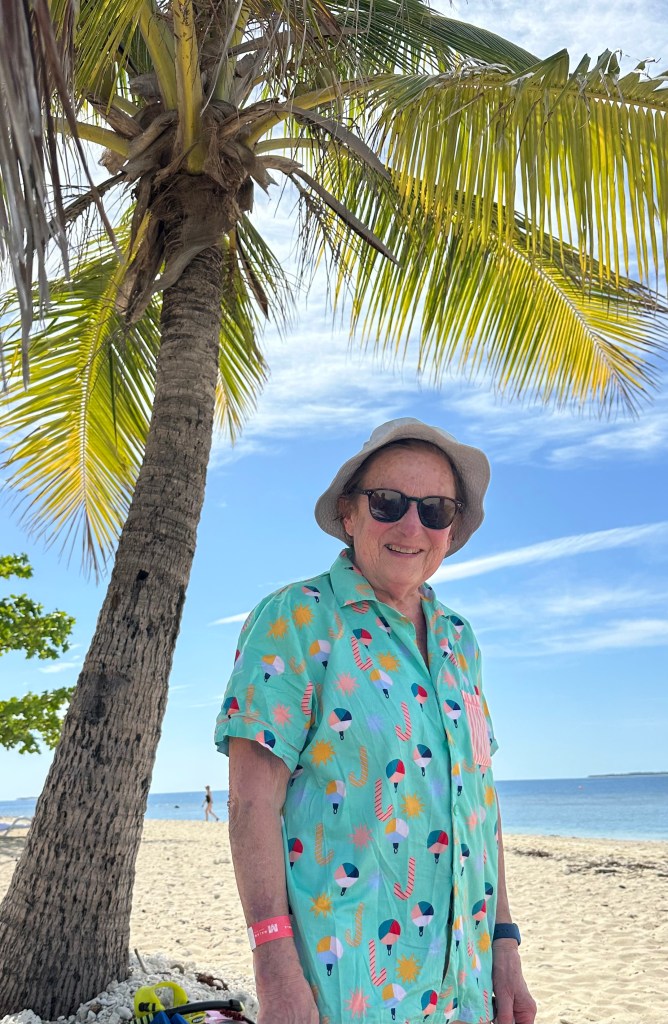
Getting onto Taurus from the dinghy is often challenging, in fact dinghies are generally acknowledged to be the most dangerous aspect of sailing, and it wasn’t made any easier on this particular day by a short chop and power boats racing past. Fijians are the loveliest of people, but the idea of slowing down when motoring through an anchorage hasn’t yet entered the cultural consciousness. Christine took the difficulties of transferring from a bouncing dinghy to a bouncing yacht in her stride, and we were very impressed by her derring do.
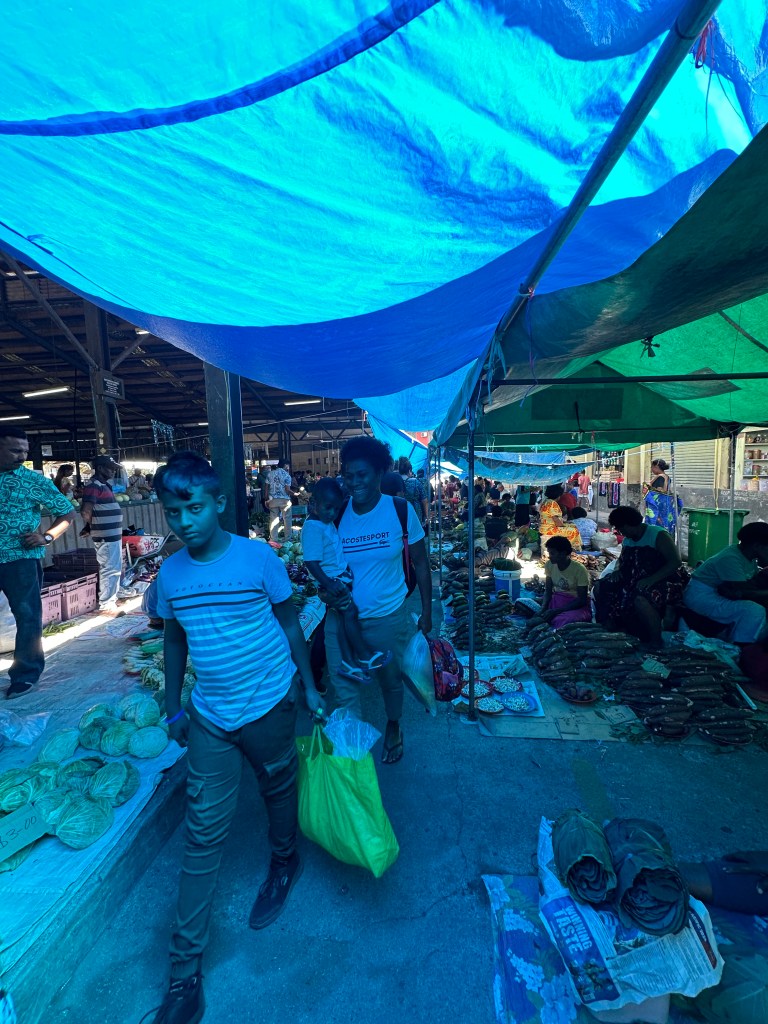
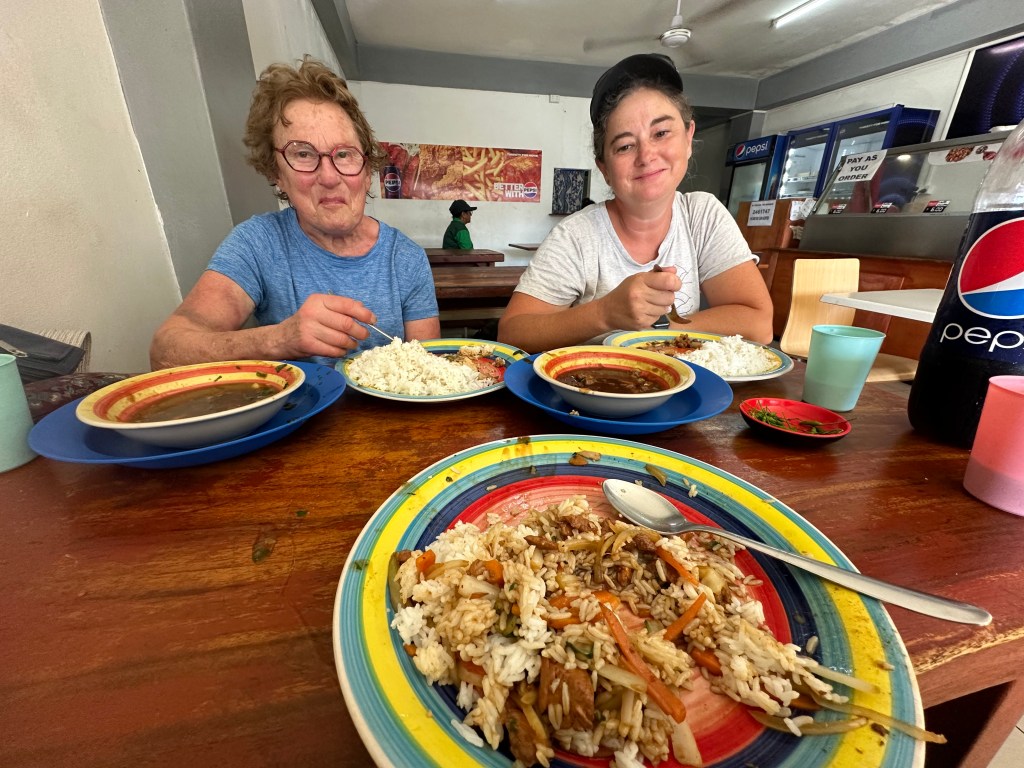
Another day we took a bus into Nadi to explore the market and have lunch.
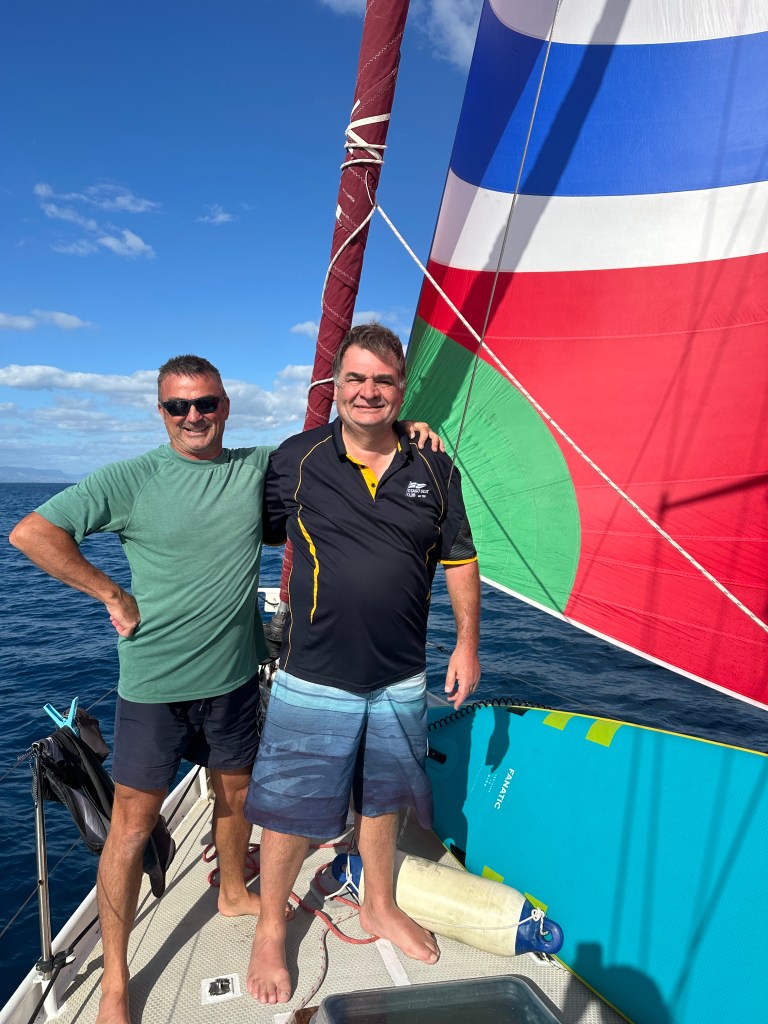
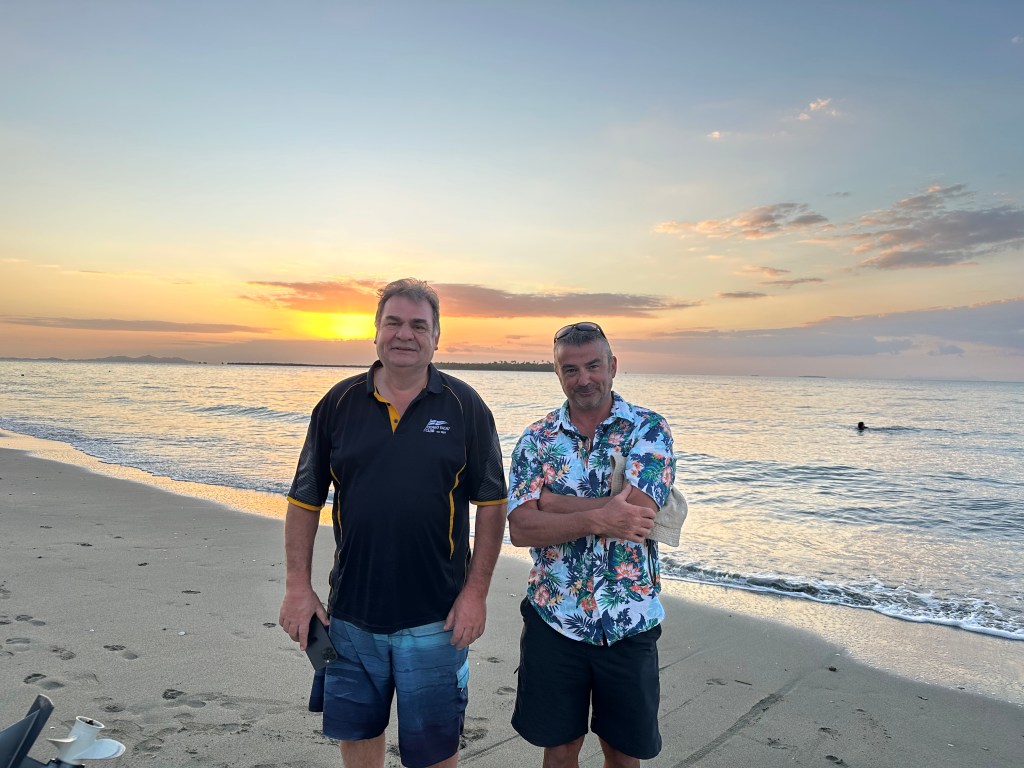
Pete, a good friend of ours from Dunedin, and his daughter, Emily, arrived a few days before Christine was due to depart. Pete, bless his heart, brought us a ‘new’ spinnaker, nuts and bolts, and numerous odds and ends that we hadn’t been able to find in the islands.

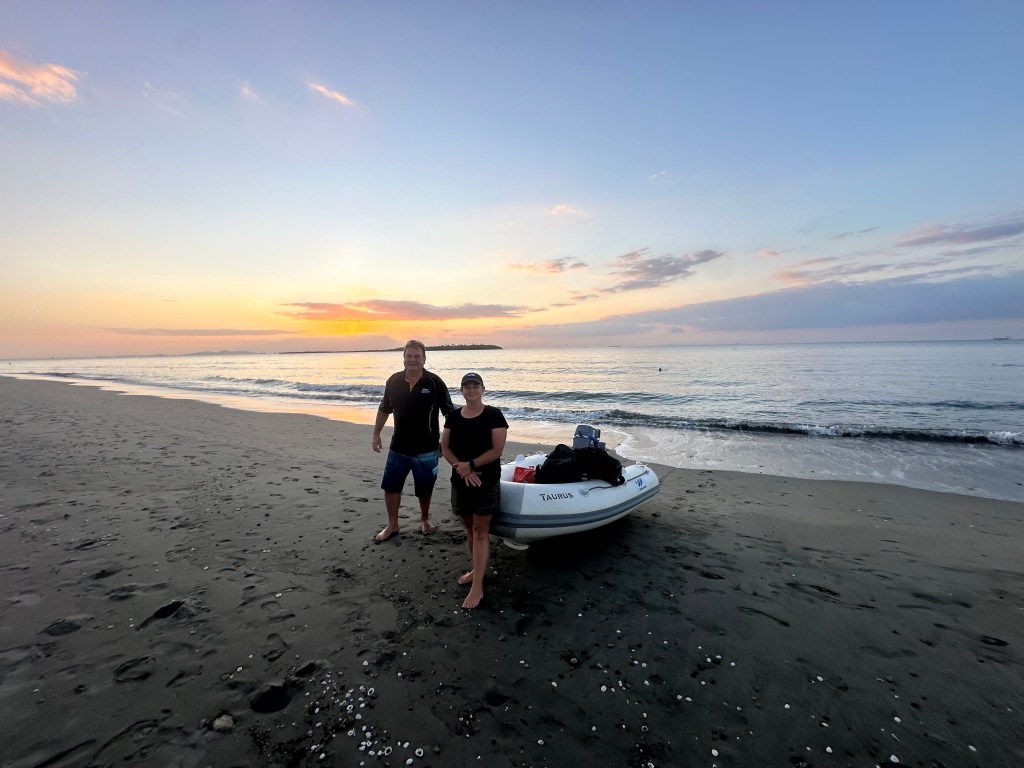
All too soon, Christine, Pete, and Emily were gone and we had to get on with the pressing need to get our mast fixed. Before that, however, we had the chance to meet Aaron Carotta, the chap whose ocean rowing boat we almost collided with in Tonga. The row boat eventually washed up in Fiji, and Aaron had come to collect and repair it. Despite being capsized by a freak wave and spending time in his life raft, Arron’s dream to circumnavigate the globe using human power only remains undiminished. He intends to set off again as soon as the boat is in a fit condition. Aaron is a really neat guy, very easy to chat to, and quite the inspiration. More about his adventures can be found here: http://www.adventureaaron.com.

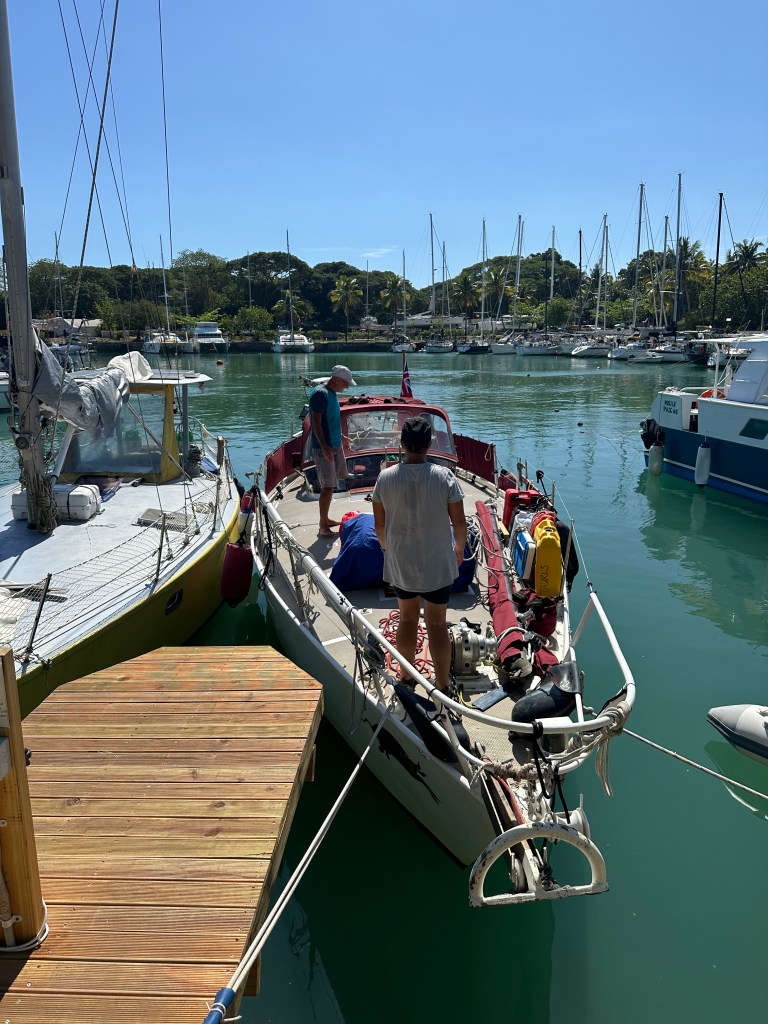
Next day we headed into Vuda Marina (pronounced Vunda) where we had arranged to meet the local rigger, Sam. Eugeni, the solo-sailor we had originally met in Tonga, was on a mooring in Denaru and offered to show us the way and give us a hand. The entrance to Vuda is both narrow and shallow, which equates to a nervous passage. Having someone on hand who knows where to go and how the marina ties its boats up is mighty reassuring and helpful in these situations.

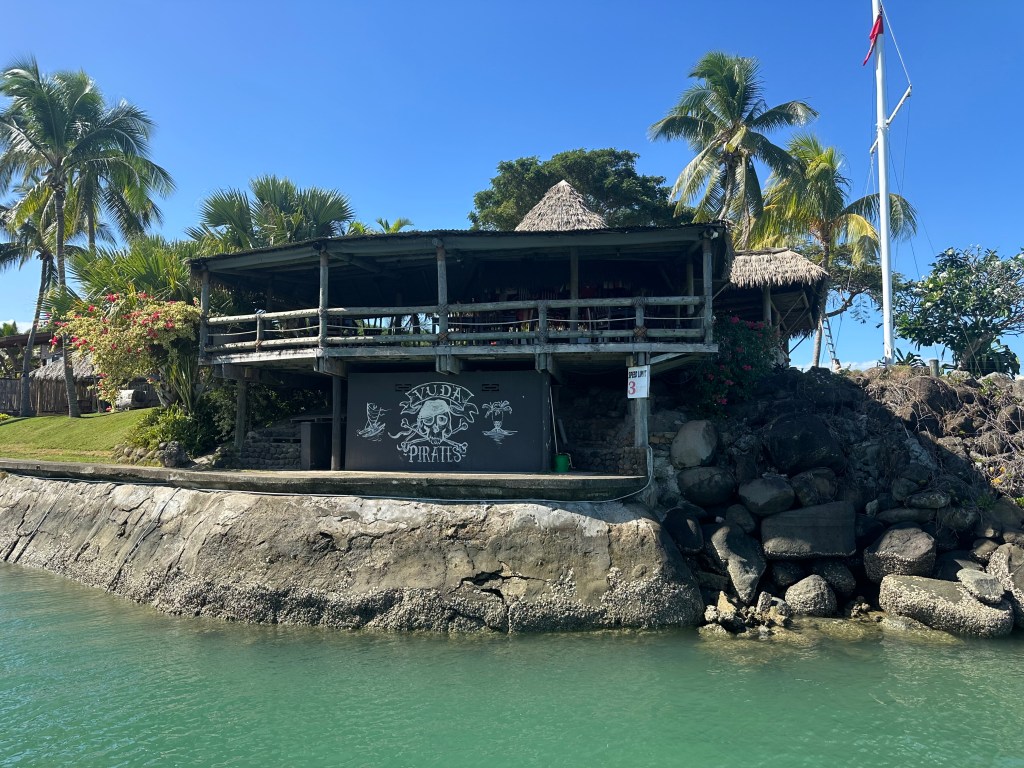

The marina has an odd setup that we haven’t experienced before due to the fact that it was originally a circular water storage facility. Visiting yachts are tied bow in with four lines holding the boat in position. In the middle of the circle is a large buoy which the boats tie up to during cyclones. I’m not sure how this exactly works, but the buoy is obviously the sailing equivalent of what is known in climbing circles as a BFR (a Big ‘Flaming’ Rock) — an anchor point so strong that it can’t fail. The berthing method made getting on and off the boat a bit of a game, and one boat that came alongside us decided it was too much trouble and left again within a half an hour.

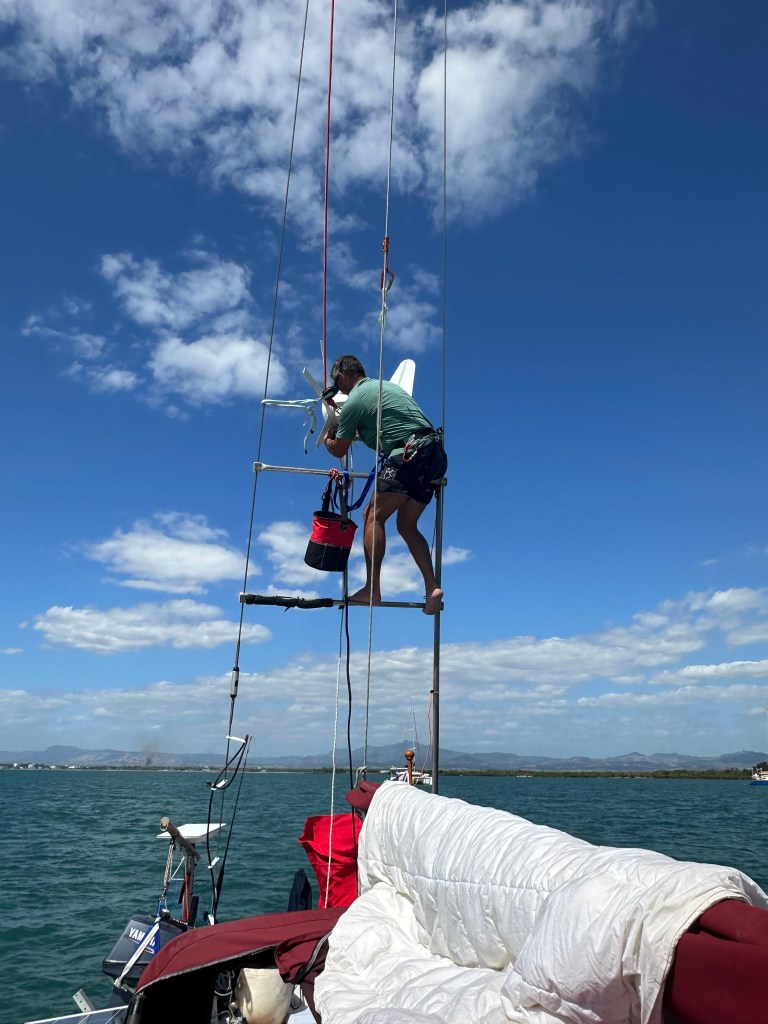
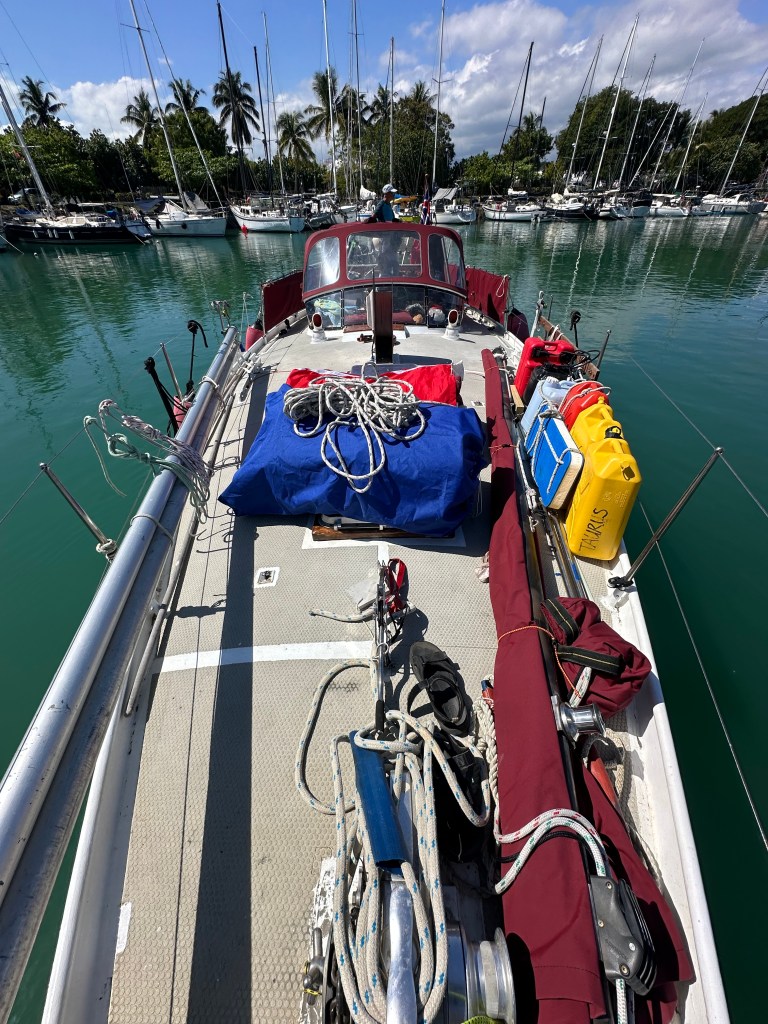
The marina staff weren’t very happy about our lack of detailed plans, but as Sam was in Australia competing in a sailing race, we hadn’t been able to discuss a timetable with him. As travel lift (a machine used to lift yachts onto the hard and which also has a crane that we intended to use to lift our mast off the boat whilst we stayed in the water) slots were filling up, Eugeni encouraged us to have a go at taking the mast down ourselves. We knew what needed to be done but lacked the confidence to try and do it ourselves. Eugeni’s experience provided the boost we needed, and thus armed we booked the travel lift and prepared the boat. This involved taking down all the stuff that attaches to the shrouds (wires that attach to the mast from port and starboard) and stays (wires that attach fore and aft), the sails, the furler, the radar and wind generator, the boom, and so on. If it sounds like a lot of work, it is, and the mid 30s temperature, day after day, made it sweaty hard work. On top of the heat, we had been warned that there were a lot of mosquitoes at Vuda, and they soon made an appearance. The mosquitoes at least give some whiney notice of their presence and impending bites, whilst the ‘no-see-ums’ have a magical ability to bite whilst remaining invisible. Insect repellent seems to attract these little monsters, so they, and their super itchy bites, have to be endured.
Having asked Sam to take the mast off the boat we thought we had better let him know what our plans were. Happily, it turned out that Sam had arrived back in Fiji the day before and was able to come and assist. Only having third party insurance focuses the mind on what can go wrong, so it was nice to have someone else, with their own insurance, turn up to take charge.
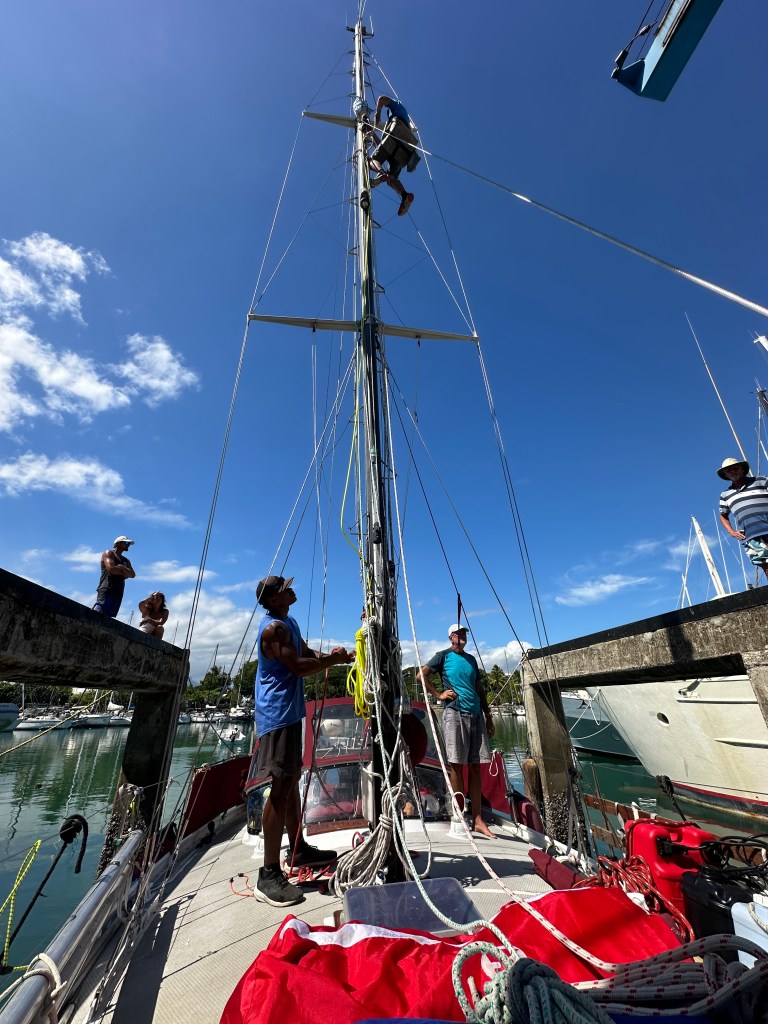
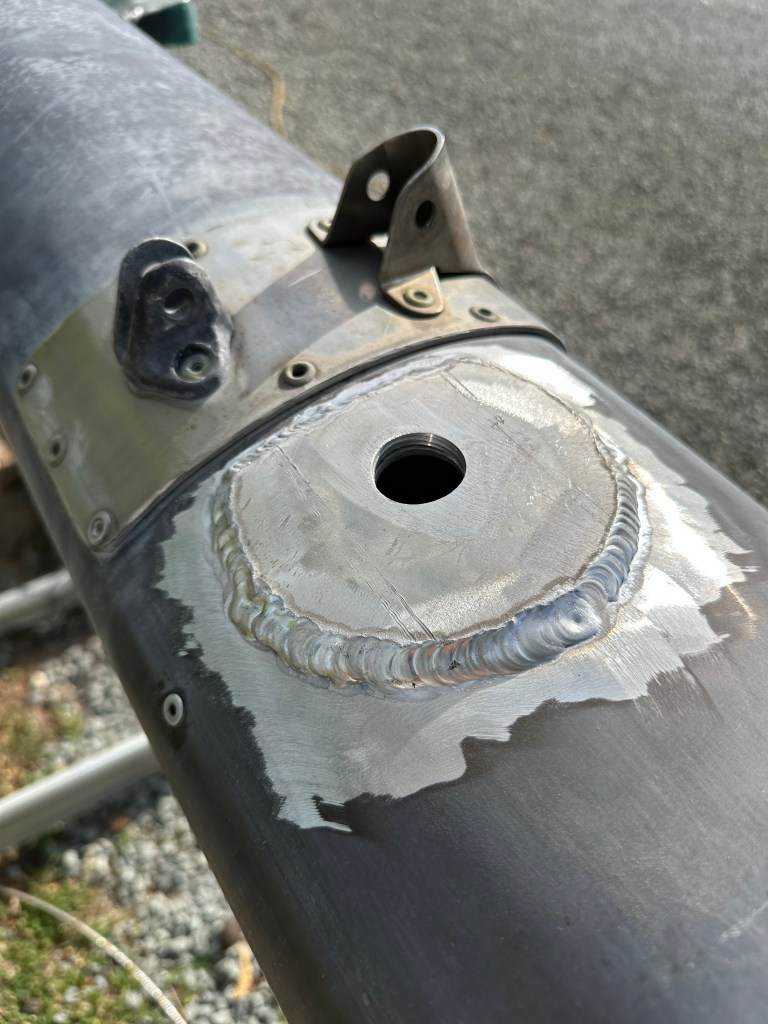
With the mast down we needed to remove all lines and wires to prevent them being melted during the welding process. We then detached the three points on the mast where the shrouds attach, a process that required us to make an improvised press before we could finally free them. Then we had to remove a number of cleats and the sheaves from the mast that the lines run through. By the time we were done the mast was almost a bare aluminium tube, 13.5 metres long. At this point Sam suggested that it might be a good idea to think about painting it. The bronze anodised finish was faded in places and there was no way that we would be able to find a paint to cover the reinforcing patches that would blend in, so painting didn’t seem a silly idea. Hopefully, we will never have the mast down again and painting it in situ, on the boat, would be nigh on impossible.

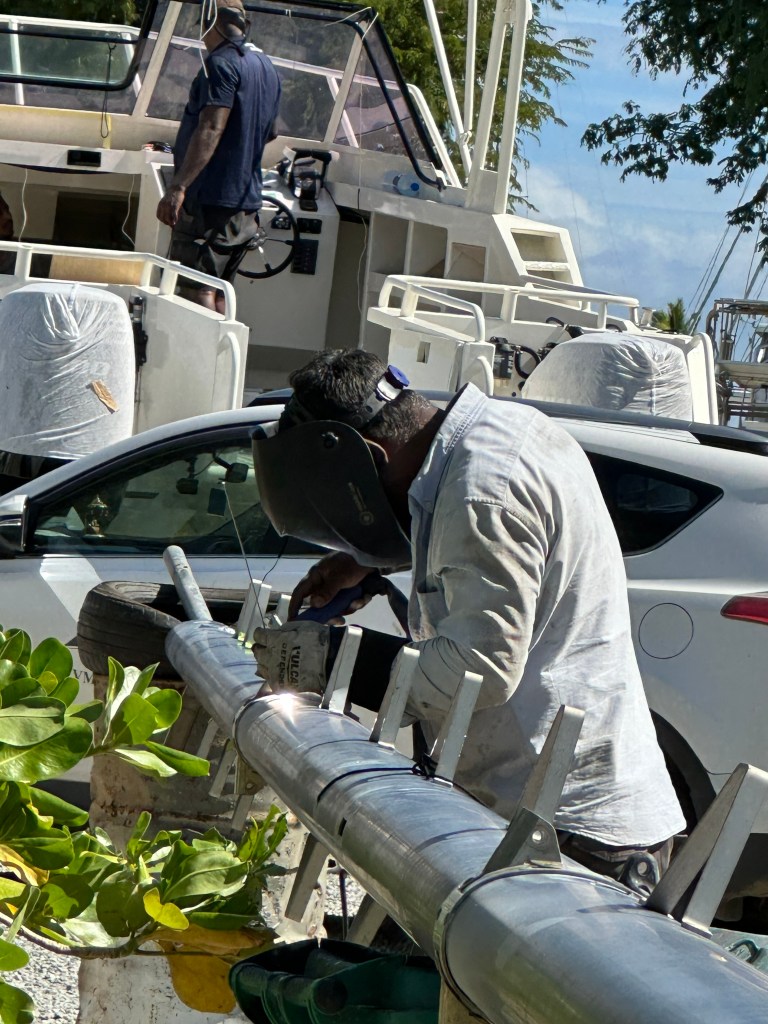
Before we could do anything we had to wait for Vakesh, a master welder, to weld three sets of reinforcing plates on the mast, making it much stronger than it was when new. After this we could sand the mast and boom, remove some more bits of hardware, fair any imperfections, apply an etch primer, and finally paint with two pot polyurethane paint. Because of the heat, humidity, and drying time we could only paint in the early morning. One day we came out to start work and found that someone had left a New Testament on the mast. Perhaps they thought we needed some spiritual support? We left the book there and when we returned it was gone — a miracle perhaps?

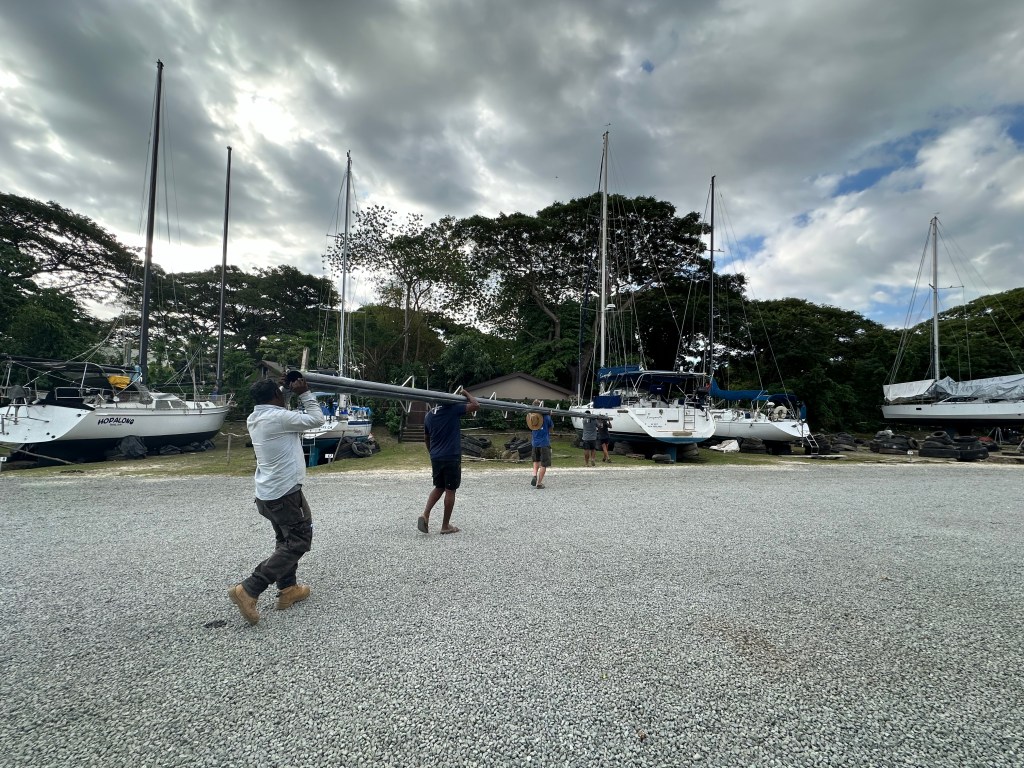
The marina has a policy that prevents spray painting unless a tent is erected that covers the work. A 14 metre tent was not something that we wanted to erect, so we decided instead to roll and tip. This involves rolling paint onto a surface with someone else lightly stroking a brush over the work to remove air bubbles and so on. Done well it can create a job very near the quality of a good spray job (this was the method we used to paint Taurus’ hull). However, a key factor when rolling and tipping is making sure the paint doesn’t dry too quickly as the brush will then ‘pull’ the paint making streaks. The first thing we needed to do was to move the mast into a more shaded spot where the paint wouldn’t immediately dry.
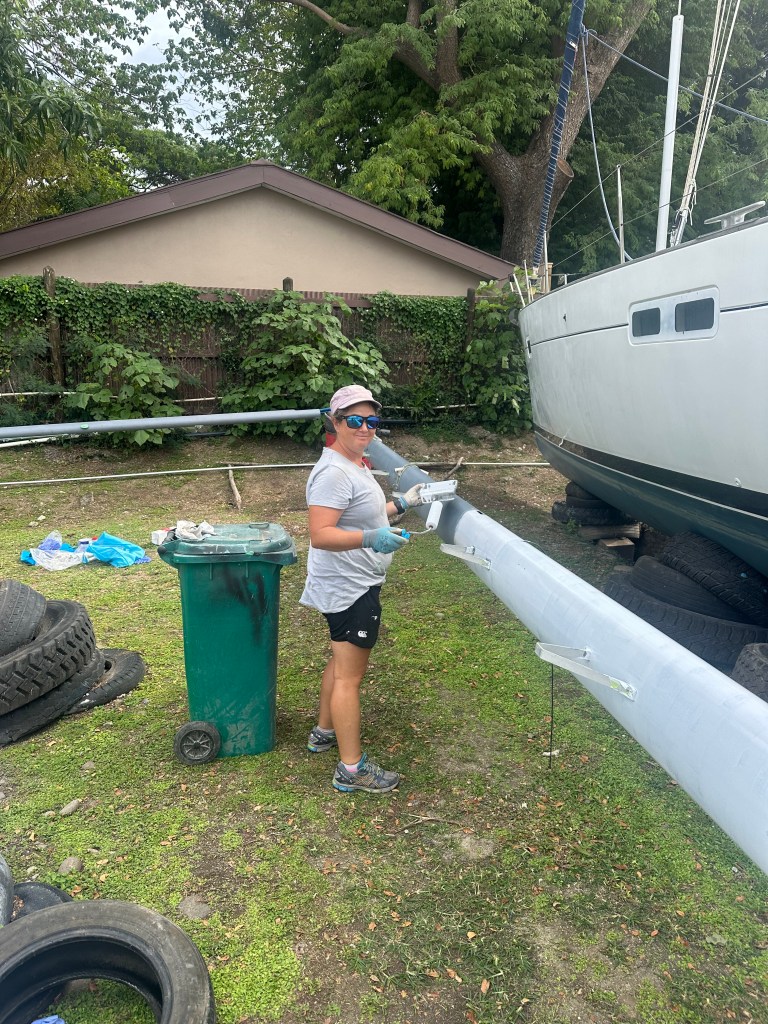
In the above picture Cara is laying the first coat of two-pot polyurethane, the dark grey coat she is painting over is etch primer. All up we gave the mast and boom three coats of the polyurethane light grey. The lines and wiring were then replaced with new, new lights, new VHF aerial, and all the jobs one does when the mast is down and access is available. Finding all the bits and pieces required was a mission, with things like coax cable (for the VHF radio) available, but the connectors that join the cable to the aerial at one end and the radio at the other couldn’t be found for love nor money. We had some spares, but only for the thick cable that wasn’t available in Fiji. Luckily we were able to beg, borrow, and buy the right size from other cruisers. Replacing the mast on the boat went without a hitch and by the end of day the riggers job was done. We had plenty more to do, replacing all the bits and pieces that we had previously taken off: boom, sails, radar mount, radar, and so on and so forth.
Of course, our stay at Vuda wasn’t all work, work, work. We found the time to catch up with friends, to visit the resort next door and spend a few hours by their pool, and to catch up with Eugeni in Denaru (and visit the chandlers there). Though the situation wasn’t ideal the setting was so beautiful that we still felt incredibly.

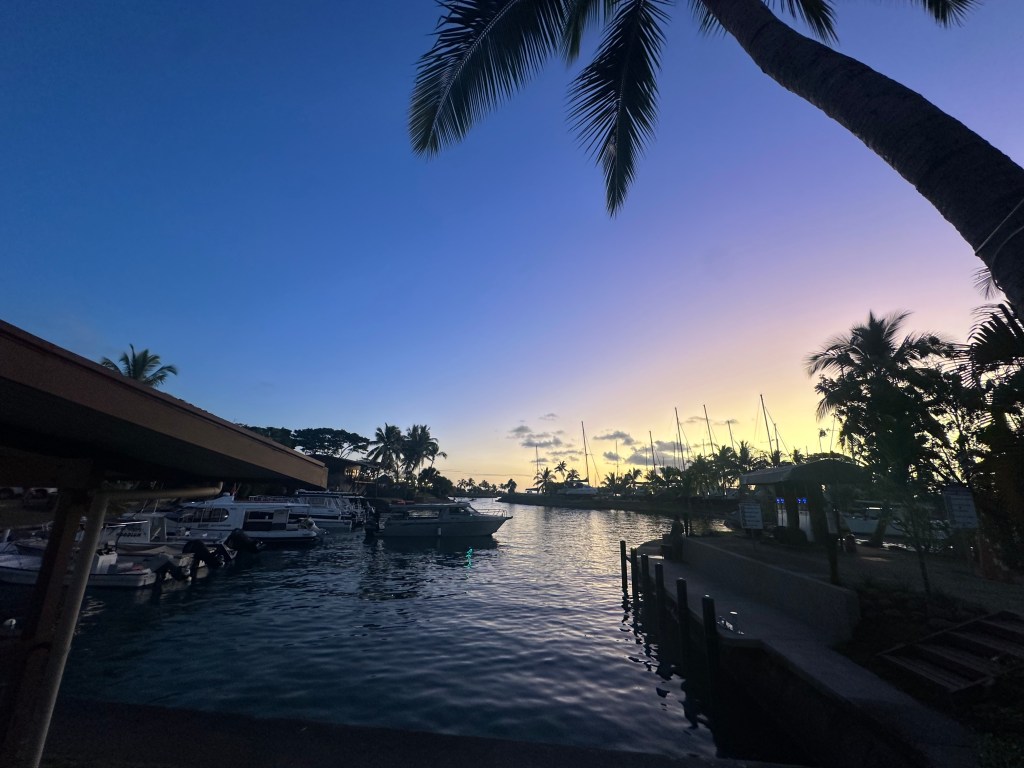

We eventually left Vunda sixteen days after our arrival. The rigger cost us F$2,600, the welder F$900, and the marina F$2,000 (F$300 for the crane each time, F$200 for storing the mast on the hard, and F$70 per day for the berth). The unexpected cost and lost time is a bit of a bummer, but it’s all part of the journey. It certainly makes us appreciate sailing again, with a ‘new’ mast and a tight rig, and we are now on our way to the Ysawa Island group that we hope to explore for a couple of weeks. Soon we will need to return to Denaru to check out of Fiji and then head towards our next destination, Vanuatu.



 Sailing Taurus NZ
Leave a comment