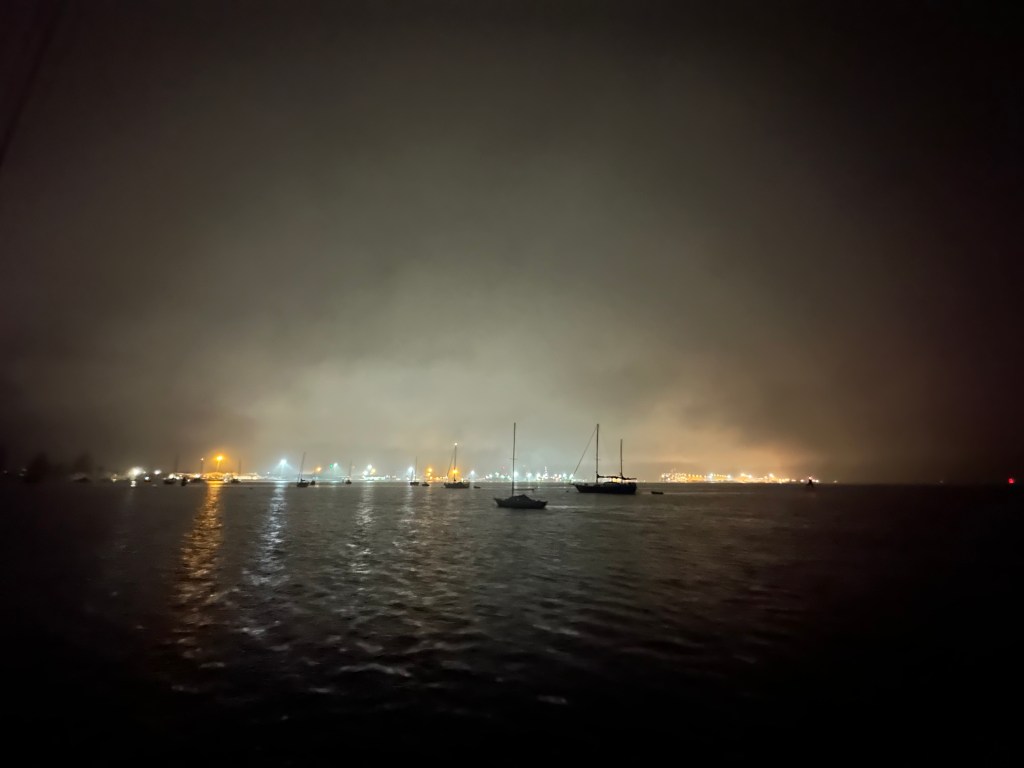
Our plan to leave Tauranga on Tuesday was foiled by strong nor-easterly winds that would have blown directly onto our nose. Rather than burn a lot of fuel and waste a lot of time we chose to delay our departure and make sure we were ready to go the following day. One of the items to take care of was a check of our engine’s oil level. Upon examination I was concerned to find that the oil level wasn’t showing on the dipstick. As we regularly check this it meant that we had used a considerable amount of oil since we last checked — about 40 hours of running time ago. The engine took about a litre to reach the right level, so we’d gone through a litre in 40 hours. No leaks could be found so it appeared the engine was burning oil, and indeed the transom (back of the boat) had a bit of an oily residue, which could only have come from the exhaust. A quick google of possible explanations suggested various dire issues, and a query on the Lister Petter Facebook group had a number of people suggest that the issue might be too much low speed running. This causes excess carbonisation that could possibly be reversed, to some extent, by running the engine hard.
As we wanted to go over to Tauranga Marina to top up our diesel and water tanks this short run seemed like a good opportunity to work the engine. We have some history with Tauranga Marina. When we were bringing Taurus south after buying her we arranged to stop there for a few days. At the time we had a lot less experience and entering the busy port was pretty stressful. It was a windy day and the marina had given us a berth number, something like K21. The ‘K’ signified the row, and ’21’ the berth in that row. We entered the marina through a narrow dog leg of built up blocks of stone. Once inside we found the row easily enough but none of the berths were numbered. At the end of the row was land so we were forced to try and reverse the boat whilst desperately looking for some idea of where to go. One of the great disadvantages of full keel boats is that they do not like to reverse, and rather than go where directed they prefer to go wherever they will. You can imagine our predicament. We were stuck in a narrow strip of water, other peoples’ expensive boats stacked either side, with a strong crosswind blowing, no idea of where we were supposed to go, and the only way out demanding we reverse through a narrow dog leg. Taurus refused to back up in anything like a straight line, and instead kept veering to port where we could see an empty berth. Rather than fight the will of the gods we decided that that was our spot and with barely any input from us Taurus parked herself beautifully. We were later very relieved to find that that berth was indeed K21, so we had no need to move. Sometimes it pays to bend like a reed in the face of the wind! On this new occasion, some years later, we were just approaching the dog leg with a strong wind blowing onto shore when the engine temperature alarm went off. Now, marine engines are cooled by raw water from the sea. Should something interrupt this flow then the engine will seize in short order — the pistons become friction welded into the cylinders and the engine is ruined. In our situation we were not able to turn off the engine as we were in a channel and had no room to try and turn to sail away, and any change in our drive was likely to see us blown onto the rocks. A quick run around the boat showed us that water was still being blown out the exhaust, so we knew that we had some cooling ability. In the circumstances we had little option but to slow the engine to help with the overheating and then ignore the alarm. Naturally, as we entered the marina we found a launch filling up and another waiting in the channel. Fortunately, an empty berth lay in front of us so we aimed for that, tied up, and turned the engine off asap.
After a cup of tea and another check of the engine compartment we restarted the engine. Thankfully, everything behaved, no alarms went off, and we were able to fuel up. Clearly the engine did not like being run as hard as we had tried to run her, and we did find a piece of rope wrapped round the prop a few days later which may have contributed to the problem. We are now trying to run the engine harder than we used to and keeping an eye on our oil consumption. Hopefully it drops because otherwise an engine overhaul lies in the not distant future.

That night we anchored near the marae on Rangiwaea Island ready to leave early the next day. Once again the strength of the currents in Tauranga took us by surprise and we found an incoming tide of 5 knots demanded that we had to work the engine hard to make headway. Happily, with a more judicious hand on the throttle and a close eye on the temperature gauge, we had no issues.

We were heading to an anchorage on Mayor Island called South East Bay — so named because it’s open to the south east. The wind proved light and fickle so we had to motor for several hours before the predicted winds arrived and we were able to sail past the container ships at anchor waiting their turn to enter Tauranga port.
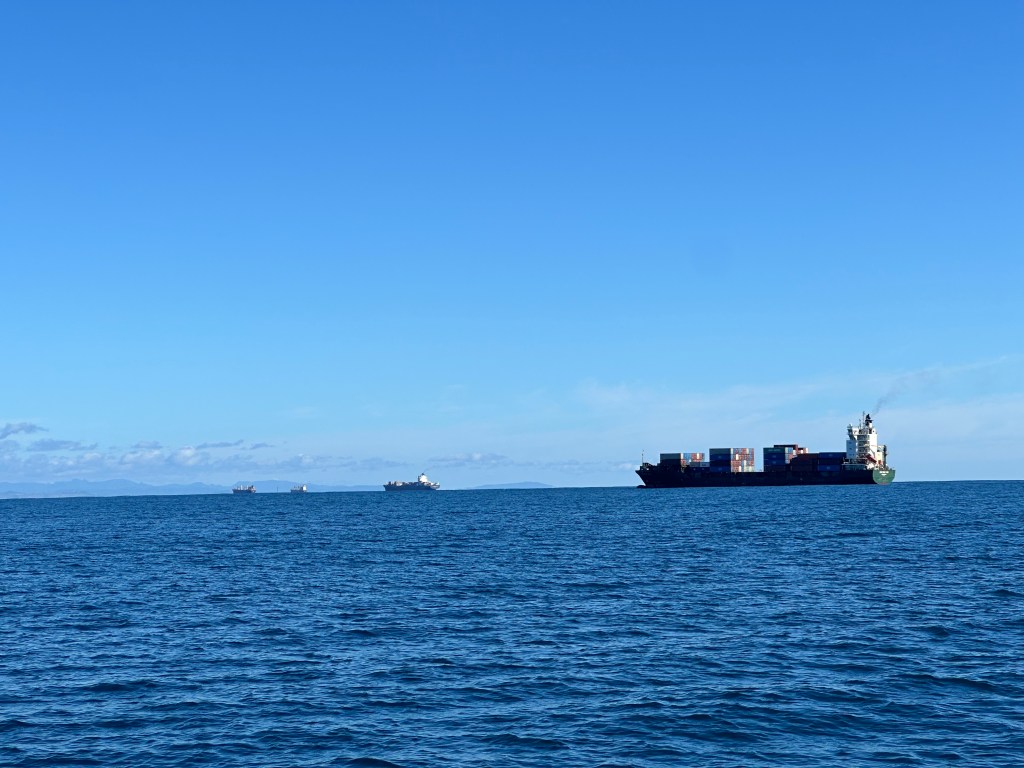
When the wind finally appeared the sail to Mayor Island was fantastic, and with the hydrovane steering us beautifully we were able to relax. I sat at the bow to enjoy the sun and views and had a long chat with my daughter, Abi, via Messenger. Abi has started nurse training in Australia and is somehow balancing two jobs whilst studying. The apple of my eye, I take my hat off to her.
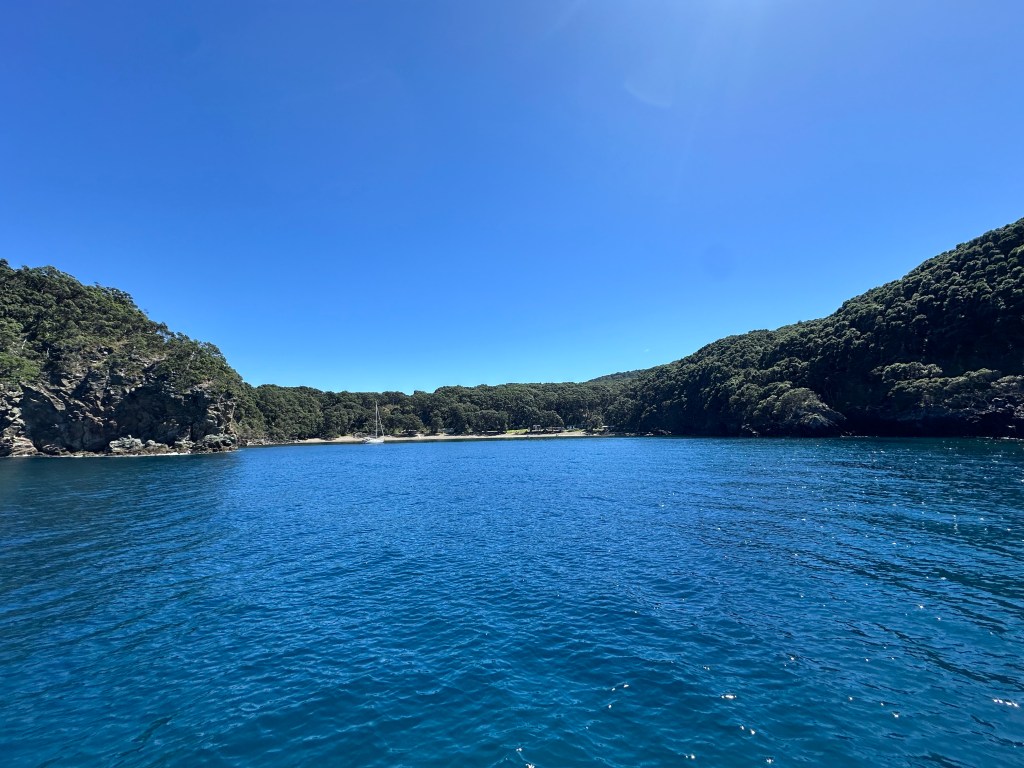
South East Bay turned out to be a lovely spot, and we soon found ourselves the only boat there. The island is privately owned and a small fee is charged to go ashore and walk around. As it was a bit late in the day, the water looked so inviting, and the dinghy was tied up on the deck we decided to go for a swim and think about going ashore later on. As happens, we had a nice swim and snorkel, then some snacks and wine, then it was time for a bit of a snooze.

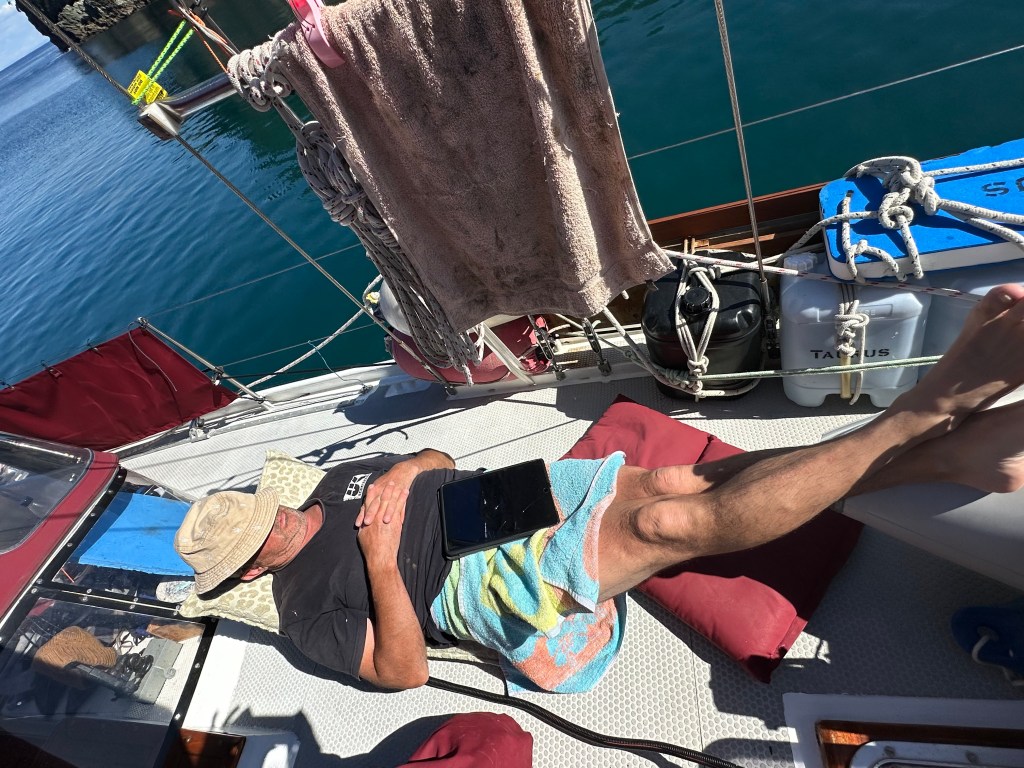
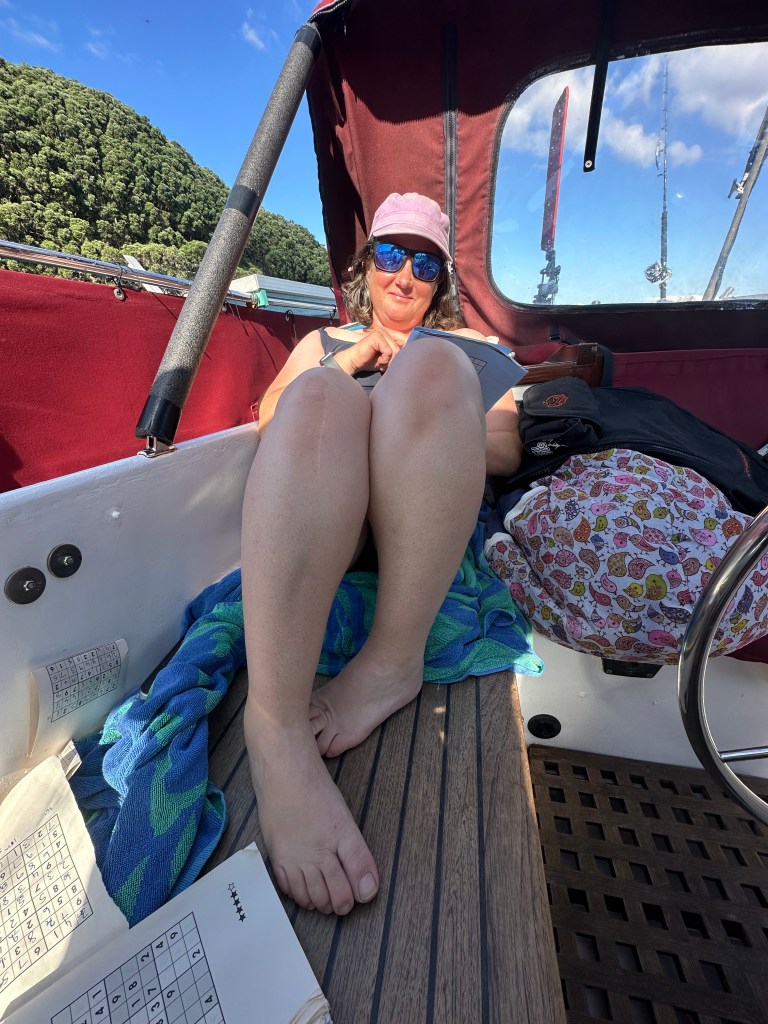
The forecast had predicted a 15 knot sou-easterly later in the day, which would of course blow straight into the bay. However, in our state of sleepy torpor 15 knots didn’t seem too big a deal, whereas hauling up the anchor, finding another bay, and re-anchoring did. If this sounds like a plot from Aesop’s Tales you might imagine, correctly, that the consequence of our foolishness would soon make itself apparent and teach us a sound moral lesson. The wind gradually built until it was blowing steadily in the low 20s and we were again bouncing around with a lee shore too close to comfort behind. After watching the chart plotter for a while to see how things were trending we decided to lift the hook at about midnight. We motored out and planned to hide in another bay around the corner. After a bit of a rough motor we found about a dozen fishing launches had beaten us to it. We had further issues trying to get our anchor to catch, whilst keeping our distance from the other boats and the shore. Finally, at about 3:00 am on our third or fourth attempt, we felt confident that we weren’t dragging and could turn in.
The next day, a bit worse for wear, we headed for Slipper Island. The conditions were grand and we enjoyed a cracking sail all the way, ultimately anchoring in Home Bay. The bay is home to a fancy holiday lodge, but at least you are allowed to walk along the beach, and I had another swim and snorkel, whilst Cara went paddle boarding. Getting closer to Auckland, the self-titled ‘City of Sails,’ we were finding a lot more ‘boaties’ about, and before dark four launches had joined us in the bay. The last tried to anchor practically on top of us, and whilst the inebriated crew were yelling across about their fishing, I was yelling back, ‘you’re too close!’ Thankfully the skipper realised that we would easily swing the short distance between us and moved further away. However, the proximity of all these boats, often on what seemed to be considerable shorter anchor rodes (the chain they swing on), meant another night with one eye and ear open.
In the morning we up-anchored and sailed towards our destination for the day: Great Mercury Island. Gail force nor-westerlies were predicted for that night so we were keen to find a well sheltered spot. A number of anchorages are no longer available on the east side of the island due to environmental concerns so we ended up on the west side. There the best option appeared to be Coralie Bay, though entering the bay is a bit nerve wracking. The cruising guide advises that you stick to the north shore to avoid rocks, and then move to the south side to avoid the reef that extends south west from the northern side. As we approached in some early strong gusts we were trying hard to identify the breaking waves that would give us a clue where these rocks and reefs lay. Ultimately, the entrance proved easier than we had feared, and once inside we found a nice spot to anchor. Another swim and snorkel and it was time for an early night.

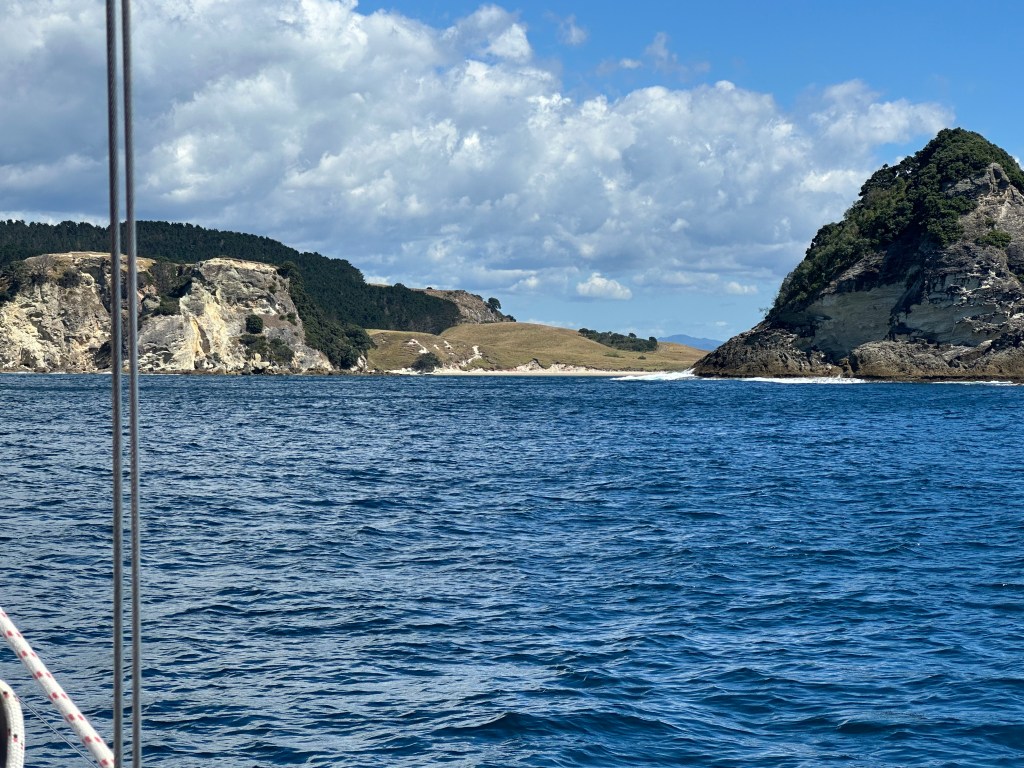
We had received some sad news on the way to Great Mercury. Rollo, one of Cara’s relatives, whom she had lived with whilst studying in Auckland, had fallen gravely ill. We were keen to get near to Auckland so that we could try to support Rollo and his family if at all possible. We made plans to try and get round Cape Colville and enter the Hauraki Gulf, gateway to Auckland. Unfortunately, the wind dictated that this was not going to be possible, and despite our best efforts we couldn’t sail west into the westerlies that blew up. Despite running the engine to try and reduce our leeway until we could tack and head south west we were inexorably pushed further and further to the north west.
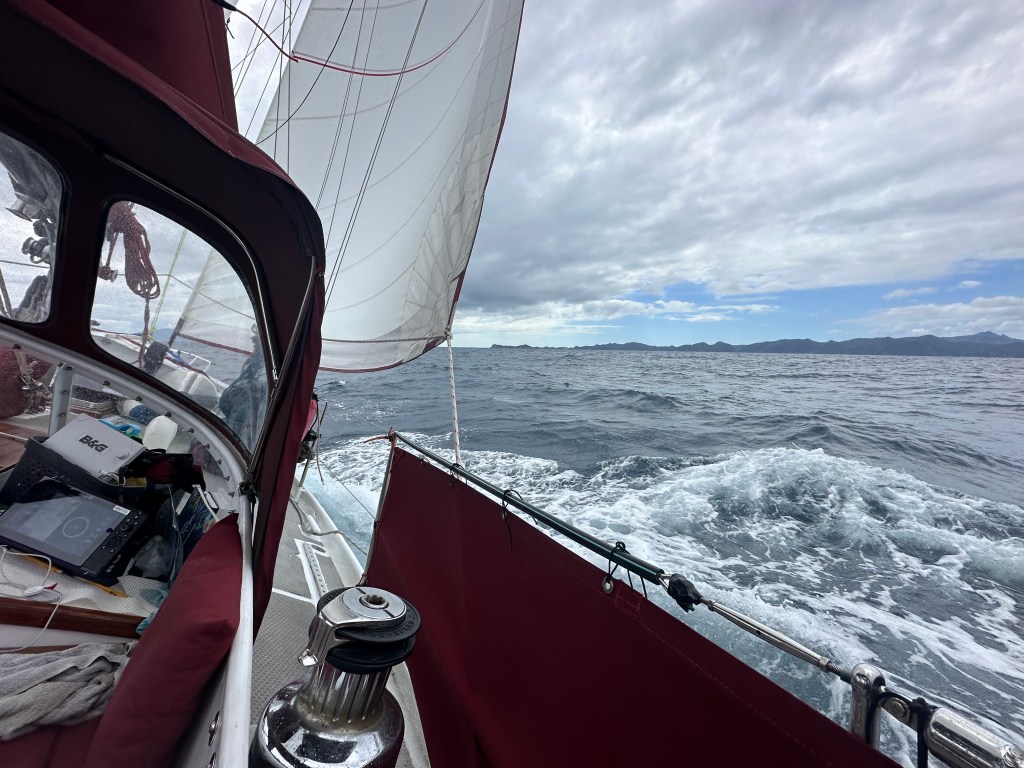
Ultimately, we had to accept that we couldn’t change the situation and ended up staying the night at Great Barrier Island. The decision to head south the following day wasn’t taken lightly as winds of up to 35 knots were predicted, but we had to weigh this against the fact that the winds expected for the rest of the week were all from the south and would leave us unable to reach Auckland.
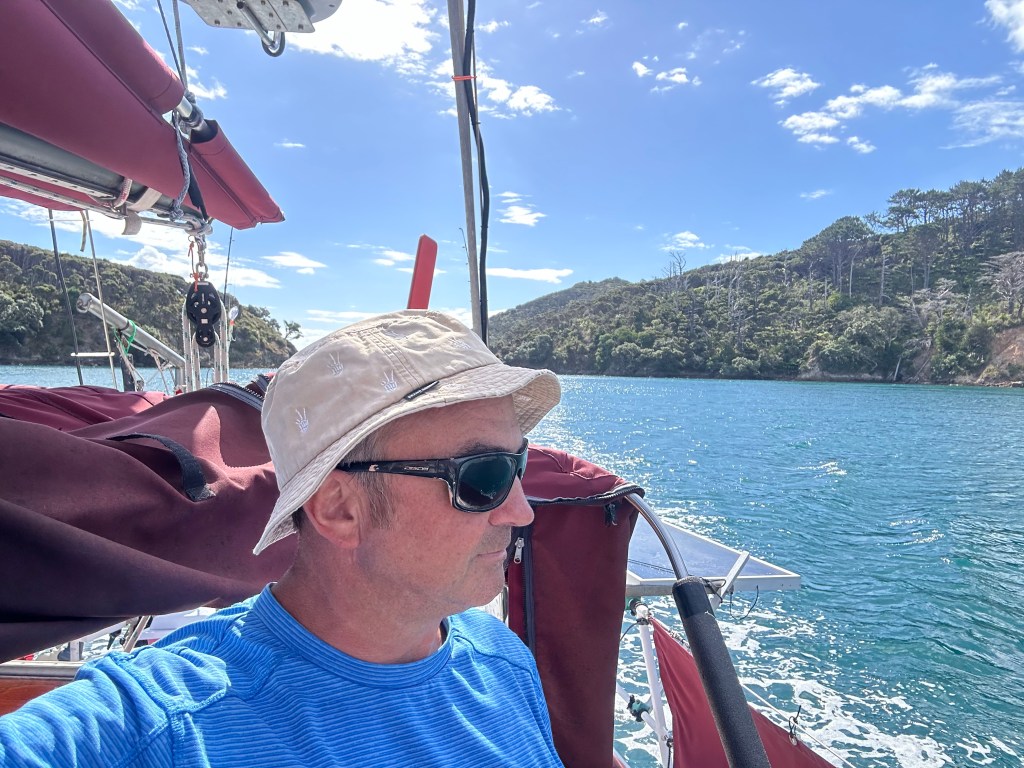
We headed out in a decent 15-20 knots and were a little relieved to see two other yachts heading in the same direction. Happily, The weather gods played nicely, and the rest of the day was more or less plain sailing with just one big squall an hour or so out from Waiheke.
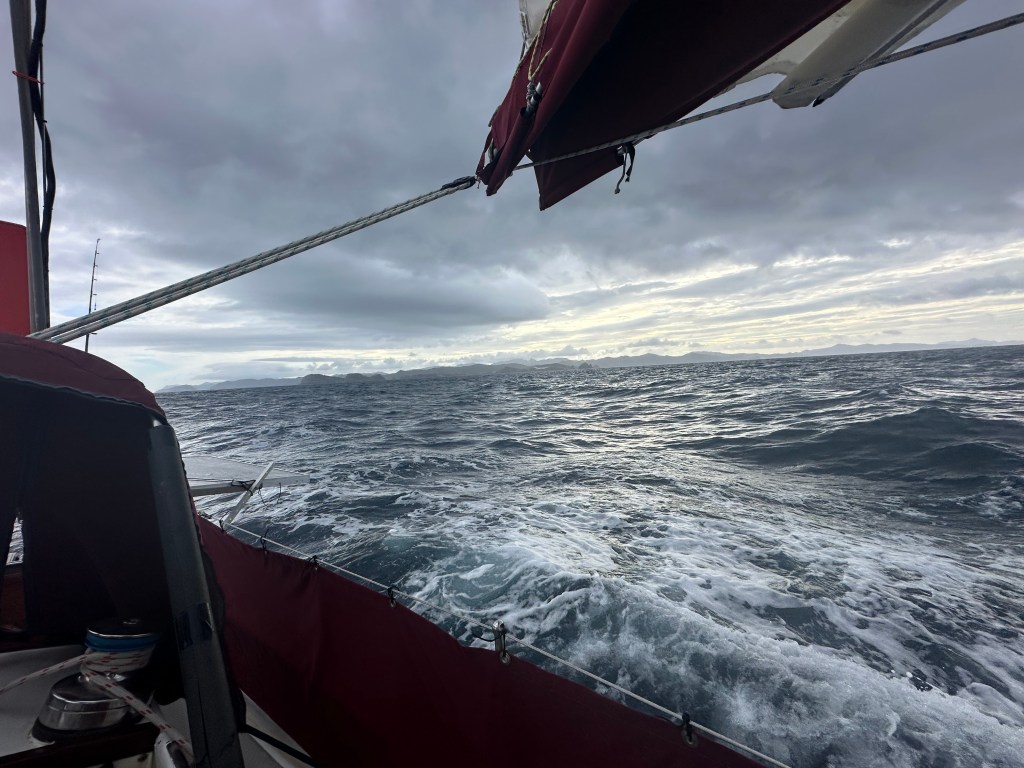

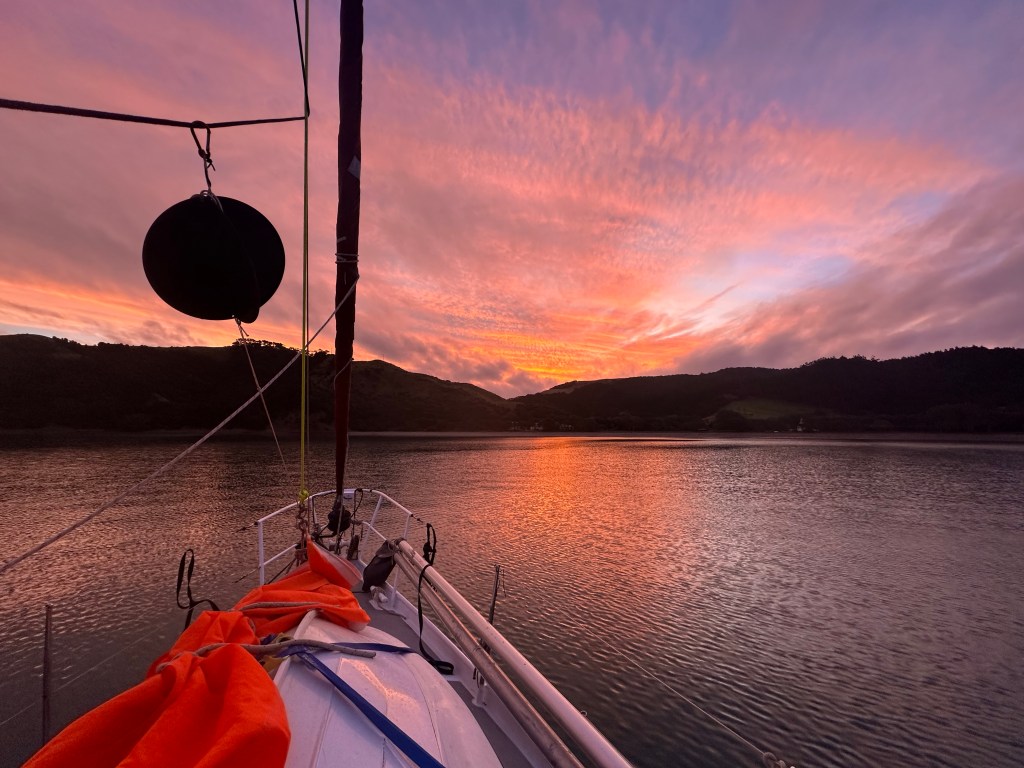
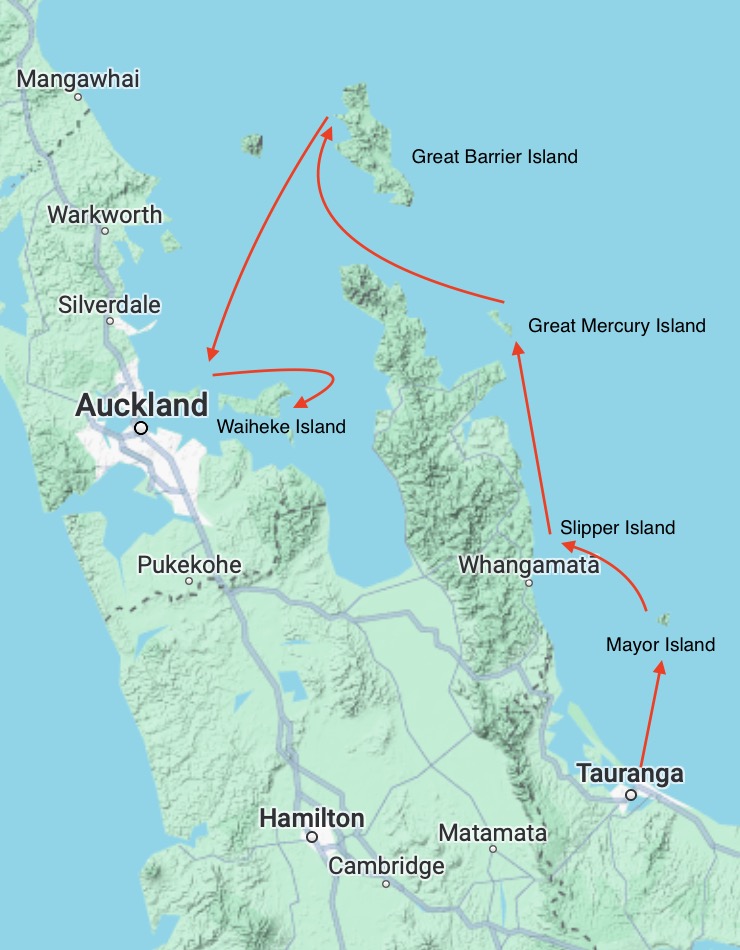
The squall came with driving rain and increased the wind from about 15 knots to 35 knots. Whilst we were busy sorting out our sails the hydrovane, which steers the boat to the wind rather than on any course, quietly changed our heading so that when we looked at the plotter again we found our course had changed by 90 degrees. The wind had unexpectedly shifted from the west to south just like that. There was no point trying to follow our previous southerly course, so we decided to head around the east side of Waiheke rather than the planned west side (see map at bottom). We anchored that night in Man of War Bay, a spot that Captain Cook visited in 1769, which was supposed to offer good shelter from strong nor-westerlies and that already contained a number of other yachts.
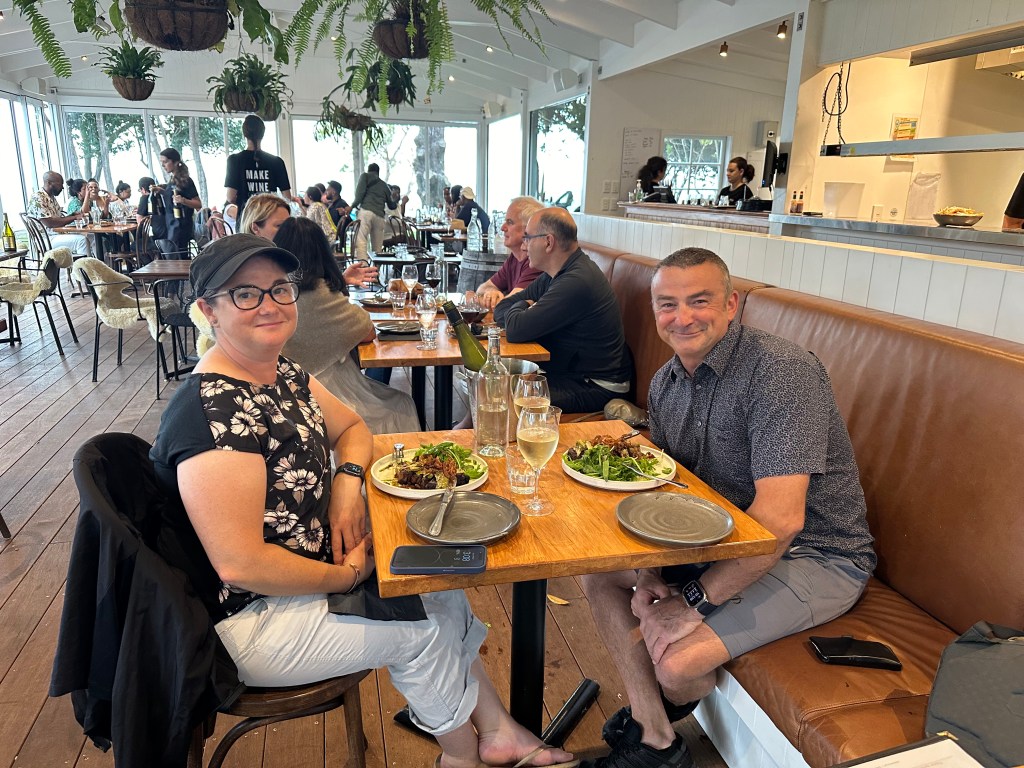
The next day we went ashore and found that the bay contained a vineyard and restaurant. Getting a bit sick of ship’s rations we reserved a table and enjoyed a fine meal, though a bit expensive — especially as we were charged for a third meal and haven’t been able to get a refund as yet. During the meal the heavens opened and a monsoon-like rain pelted down. During a lull we made a break for the dinghy and the short ride back to Taurus, getting thoroughly soaked, though the fresh water made a nice change.
I’m a bit paranoid about leaving the outboard on the dinghy as it can be a bit of a disaster if the dinghy gets blown over and ‘pickles’ the engine in sea water. As soon as the rain let up we got the engine off and were just about to settle down when things went haywire. We experienced about five minutes of exceedingly strong winds that heeled Taurus onto her side, ripped the canvas dodger off, threw the dinghy upside down, and turned the bay into a maelstrom. The yacht next to us instantly dragged its anchor and whilst we tried to hold onto our dodger and looked down into a sea whipped into a white frenzy with pelting rain and the wind roaring in our ears we watched them try to regain control. A local weather station reported a gust of 51 knots, but I wonder if there was a katabatic effect. This occurs when wind races down a hill or cliff, like the ones supposed to shelter us, and in doing so increases in strength. Certainly this wind was the strongest I have ever experienced, and made the roughly 70 knots we had near Lyttleton pale in comparison.
So we now plan to take a bit of a breather, restock, and head to Auckland in the next couple of days where we have a berth in a marina booked. Our thoughts remain with Rollo and his family at this tragic time.
 Sailing Taurus NZ
Leave a comment