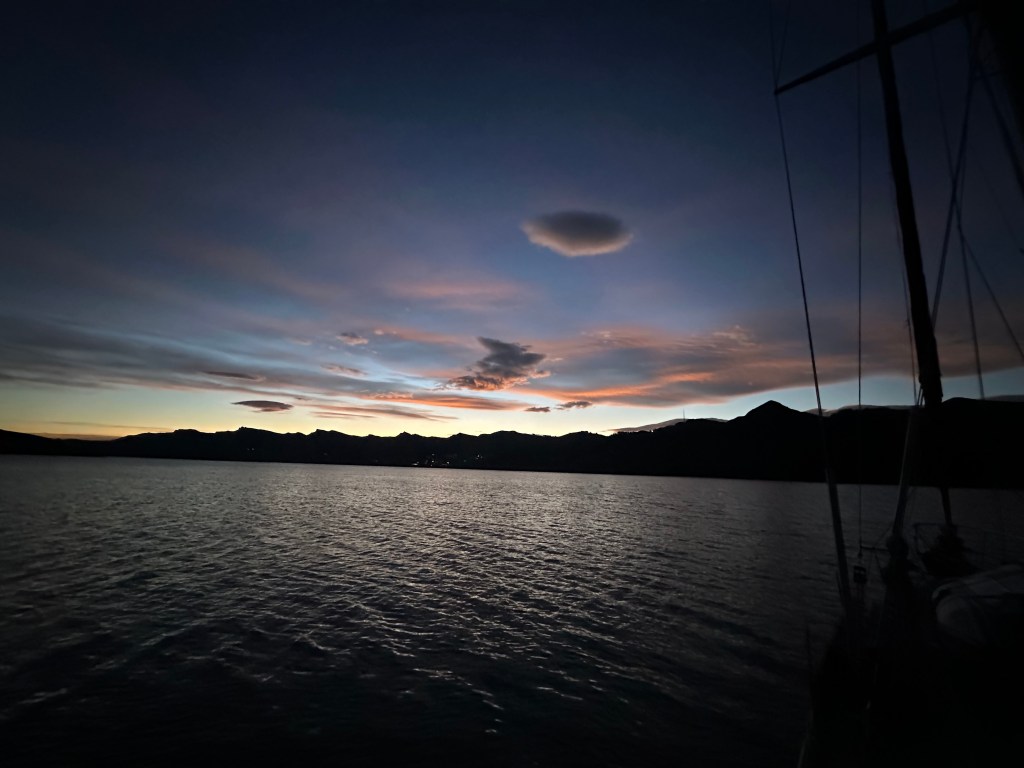
We left Lyttleton early on the 7th of October heading to Port Underwood, a sheltered area that would allow us to wait for suitable weather to get through the notorious Cook Strait and into the Marlborough Sounds.
The weather was flukey in the morning, with sails up, sails down, sails up, and eventually two reefs in the sails (reefs are a way of reducing sail canvas so that the boat doesn’t get overpowered in stronger winds). The route from Lyttleton to Port Underwood requires sailing up half of the east coast of the South Island, with nowhere really to stop along the way. Kaikoura is about halfway, but a recent earthquake lifted the seashore and made charts unreliable, and there had been many reports of trees and debris floating miles out to sea in the area after the various storms. We decided to stay well away and do the trip of about 160NM in one go, which would take us about 36 hours.
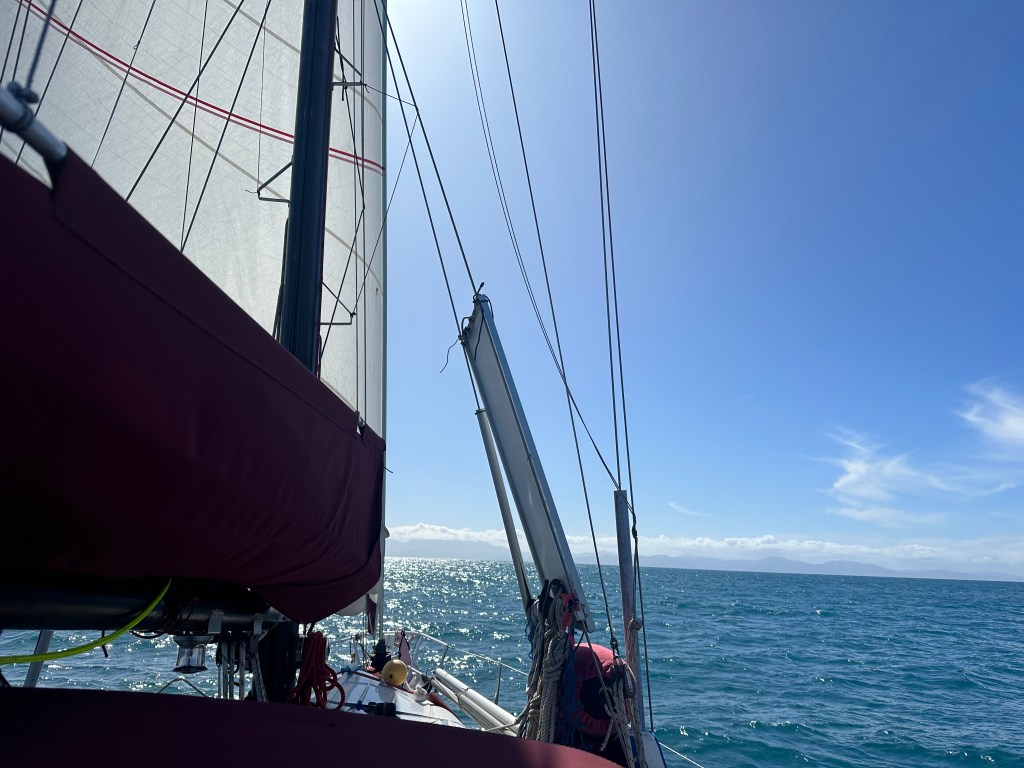
The day passed pleasantly with easy sailing, and the fair winds continued on into the night. One memorable incident occurred when a fishing boat, not on AIS but whose lights I had spotted, called us up on VHF. He warned us that we were approaching two fishing lines that he had set and rattled off four lat and long references to tell us where the lines were. This was a lot of information to take onboard at 3am, and not knowing how much time I had I woke Cara who was quickly able to plot the positions whilst I reduced sail to slow down. It turned out we had plenty of room and time, and were going to pass well to the west of the lines. Still, it was good practice to have to plot a lat and long co-ordinate on our electronic chart, something I was unsure of how to do.
The next day we calmly continued, streaming a couple of trolling lines behind the boat in hope of catching supper. Unfortunately, the only thing we caught was a petrel, who tried to seize the small fish shaped lure and ended up being seized itself. We brought the bird aboard, wrapped up in the line but without any hooks sticking in him. The petrel was not best pleased about being dragged through the water and I was glad I had asked Cara to bring some gloves as it attacked my fingers with vigour and had a surprisingly powerful bite for such a small thing. I was able to painfully wriggle my finger out of the glove, but the glove was stuck fast in the petrel’s maw. It was interesting to see that inside its beak there were rows of what appeared to be small teeth angled backwards, obviously to prevent fish, or gloves, from escaping. Eventually the bird was untangled and he reluctantly released my glove in return for freedom.
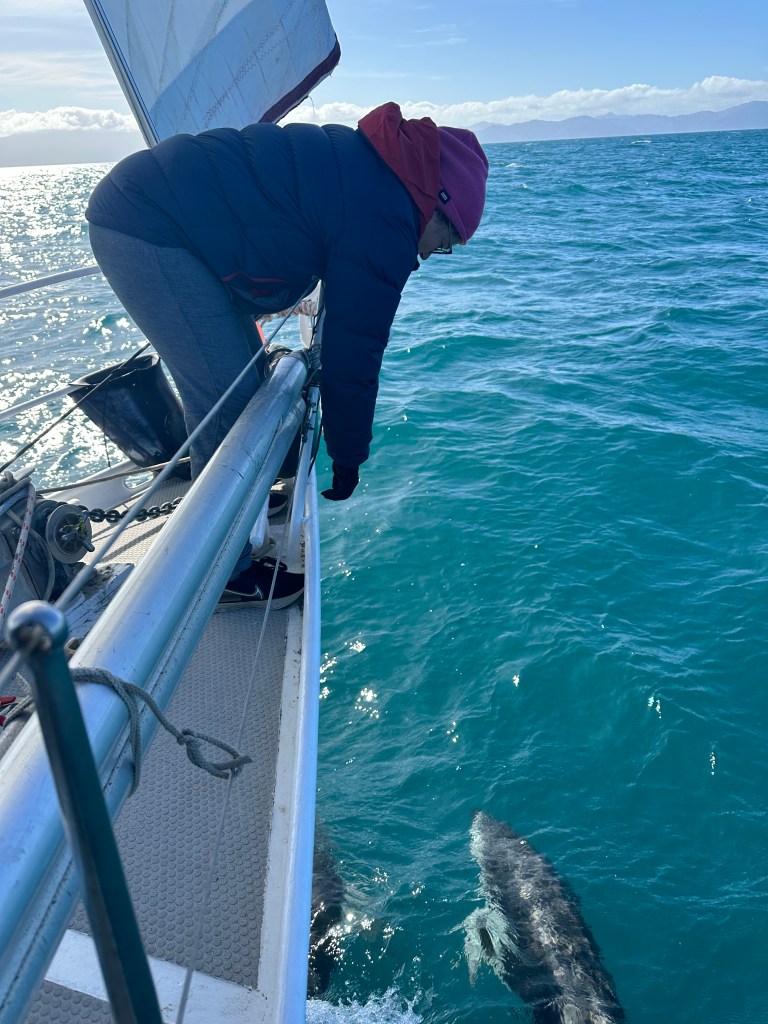
As we rounded Cape Campbell we began to see more sea-life, being joined by different species of dolphins (Hectors and Bottlenose) who rode along with us on our bow wave. Later we managed to catch a fish, a nice kahawai, which was to make a delicious supper.

I’ve read old accounts by early settlers, sealers, and whalers that tell of how easy it used to be to find fish and whales. Apparently in Dunedin in the nineteenth century a line with a few rusty nails was all it took to catch fish; one ship took 60,000 seal skins from Port Pegasus in Stewart Island; a whaling station in Pattersons Inlet, also Stewart Island, processed 90 blue whales in a season; and the people of Hobart used to boast that they could cross the river by jumping from whale to whale. Those days are sadly long gone. The paucity of fish nowadays is telling, with the capture of a decent fish cause for celebration. We might have to rethink the old saying about there being ‘plenty more fish in the sea,’ because maybe there isn’t. Even though we try to live a low impact, minimalist life aboard our boat, we are very much part of the problem, and to live is to consume and contribute to the world’s demise in one way or another. The apathy of our global leaders is depressing, and I can’t help but think that we might as well dance whilst the band can play. It’s the next generation that will carry the can, but they seem more intent on consuming than any generation that has gone before, so what can be done? I guess my answer was to ‘sail away.’
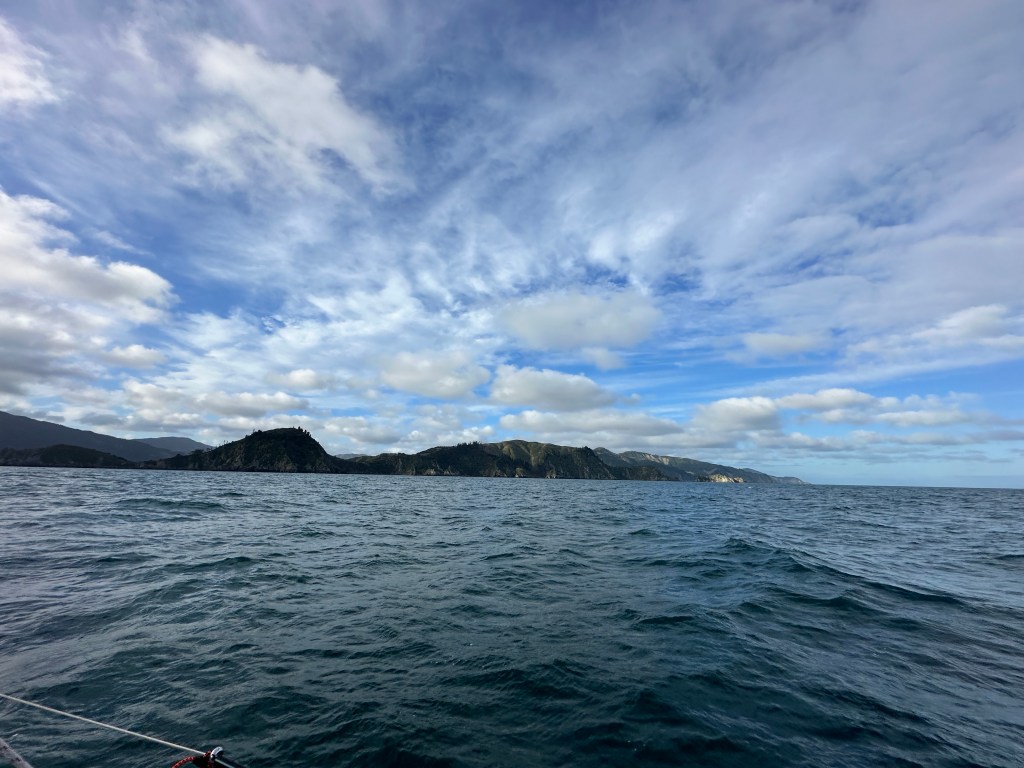
We reached Port Underwood at 6 pm, almost exactly 36 hours after leaving Lyttleton, and anchored in Pipi Bay, a sheltered spot not too far from the entrance so that we could get away early the next day. We had to try to time our arrival at the Tory Channel, entrance to the Marlborough Sounds, to take advantage of the ingoing tide which can reach speeds of up to 7 knots, more or less our maximum hull speed. With this in mind we were up at 6 am the following day and set sail once again.

The weather gods continued to be kind, and we were able to sail the 15 NM to the start of Tory Channel. Just as we approached we were called on the VHF by a ferry that had crossed the Cook Strait from Wellington. These ships are a vital lifeline between north and south islands and have right of way through the sounds. We had been watching the ferry approach and trying to time our entry either before or behind him, but the window was pretty narrow and so we offered to ‘heave to’ to ensure that he would have plenty of room.
Heaving to is a way of stopping a yacht in the water. The boat is tacked across the wind but the jib, the sail in front, is not pulled through so becomes ‘backed’ by the wind. The result is that the main sail and jib work against one another, and the boat gently bobs along. This worked well but increasing gusts of about 25 knots meant that we had to work to get underway again, Taurus refusing to tack back from a standstill. Soon we were approaching the channel once again and once committed realised that another ferry was heading out of the sounds. Luckily we had plenty of room and were able to watch the behemoth race past from the shelter of a bay at a speed some three times what we are capable of.
Sailing in the sounds was a new experience for us. The wind is unpredictable, with light winds typically followed by a series of strong gusts. The trick is to sail at a shallow angle and then head up during the gusts to try and make headway up the channel. In this environment sail management becomes problematic. You tend to be underpowered in the light air, and overpowered in the strong, and it’s still something that we are learning to deal with, especially, the way in which the winds change direction as you move along the channels.
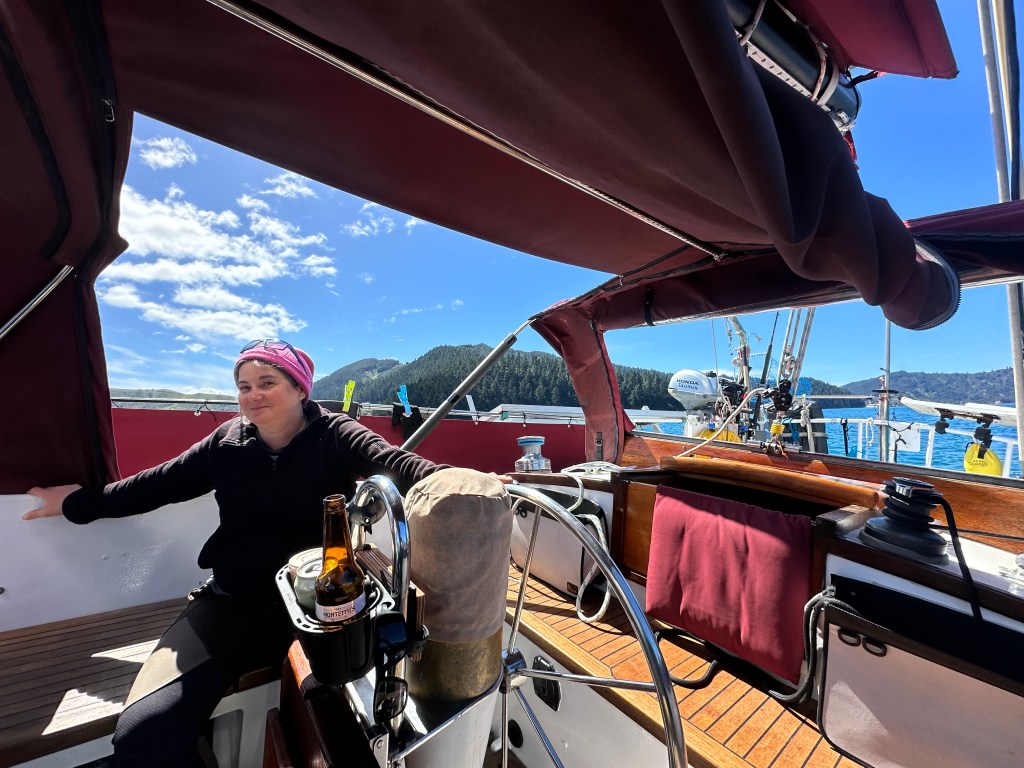
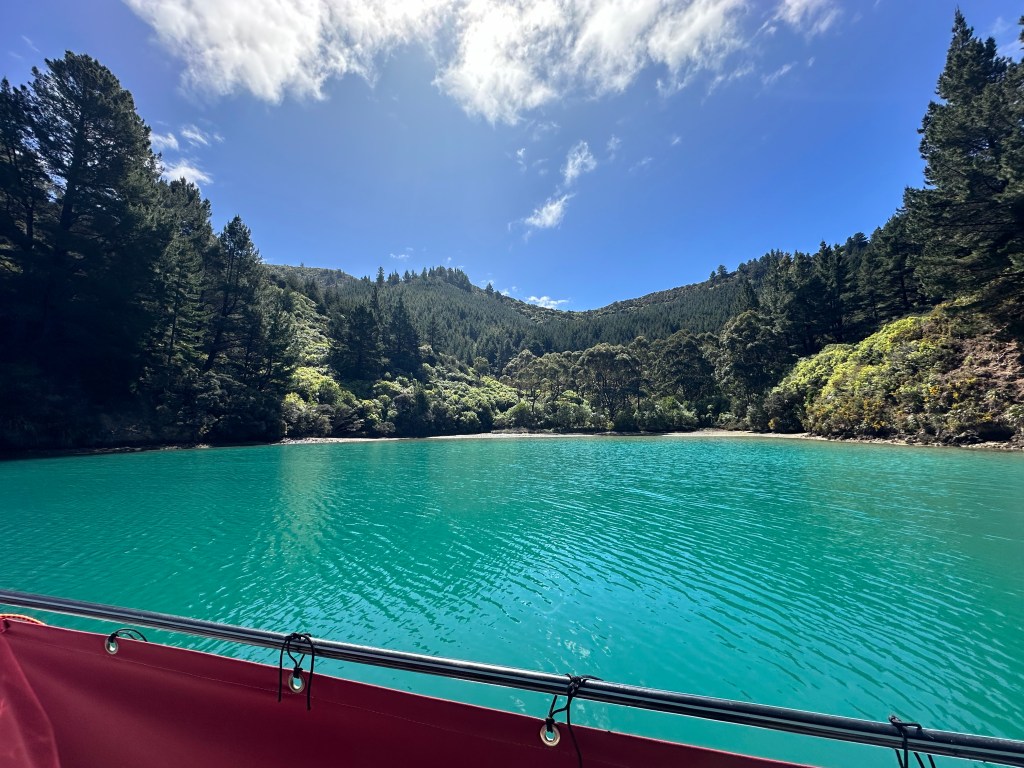
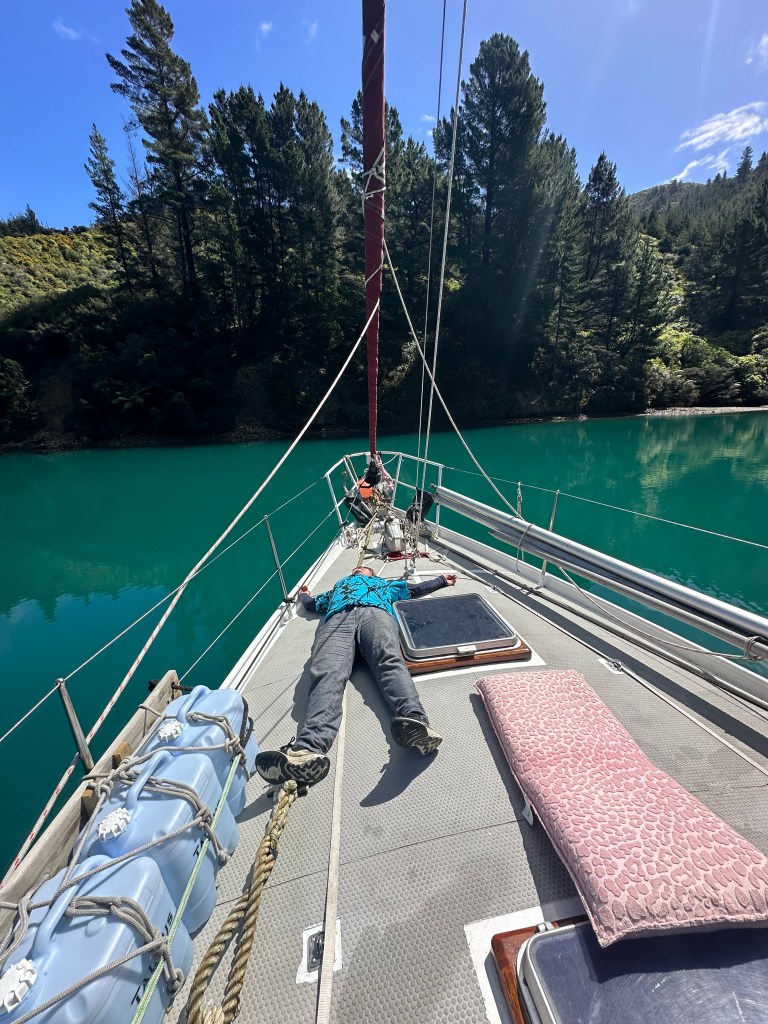
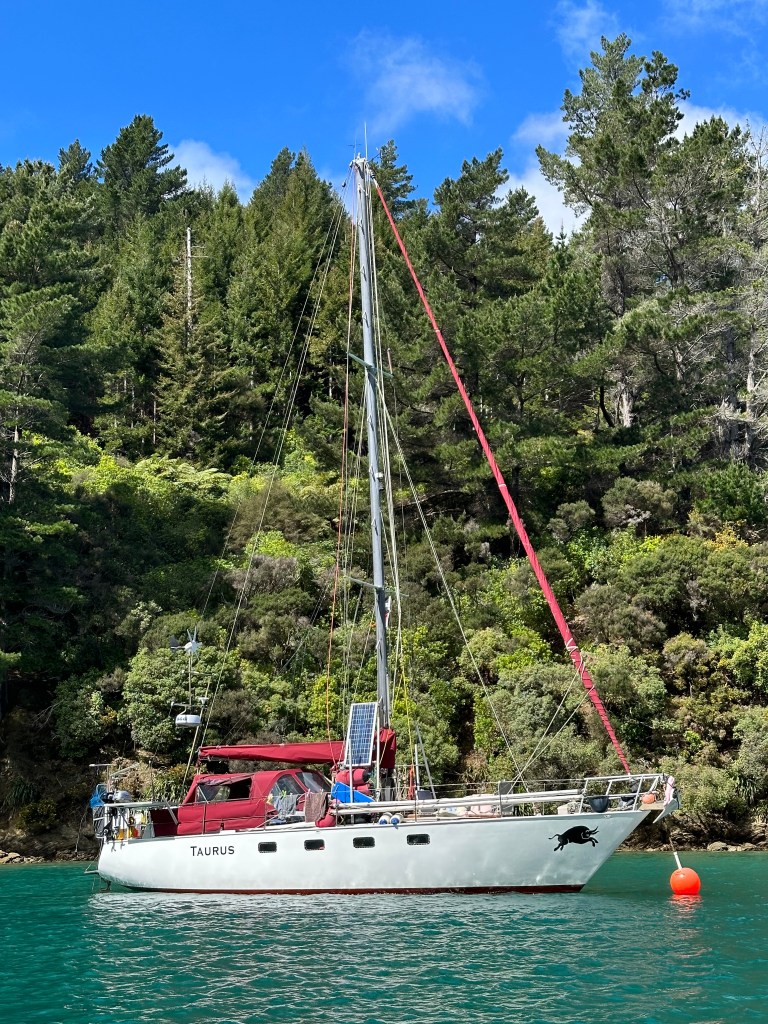
We decided to stop in Ngaruru Bay, where a local club that we had joined had a mooring. There are three clubs with a presence in the Marlborough Sounds who join together to offer their members a great number of moorings throughout the area. To show that the boat is a member of one of these clubs the crew is required to fly two small flags, known as burgees, one for the club, and one showing the year of membership. We had joined Pelorus, the cheapest, and so flew a flag showing a white dolphin on a black background. After a pretty long trip we were glad for the chance to stop and collect ourselves, and sit in the sun for a while.


 Sailing Taurus NZ
Leave a comment