We left Akaroa in weather that wasn’t ideal for our sailing plans, but was, once again, the best window available to us. As we left the protection of the harbour the wind settled into what often seems its favourite position, ‘on the nose.’ Wind from directly in front of the boat is disliked by all sailors as yachts can’t sail directly into a breeze, but rather need to sail at minimum of about 30 degrees to either side, depending on the design of boat. This is because sails act like aeroplane wings, they need a pressure differential on either side to create the ‘lift’ or pull that moves the boat forward. With even amounts of wind on either side the sail shakes like crazy, whipping its sheets around (the ropes that control the sail), and try to destroy themselves and anything in the near vicinity.
The weather was beautiful though, so we left the sails down and began motoring north, hoping the wind would swing and we could sail. Our destination for the night was Pigeon Bay, a protected mooring close to Lyttleton that we had been told about, and where we hoped we would find good shelter from the storm expected the following day.

As the day wore on the wind speed increased to 20 knots and above, so that we were making slow going under engine alone. We decided to abandon our course and sail out to sea, tacking as necessary (changing direction so that the wind fell onto different sides of the sails) so that we could turn the ‘iron donkey’ off.
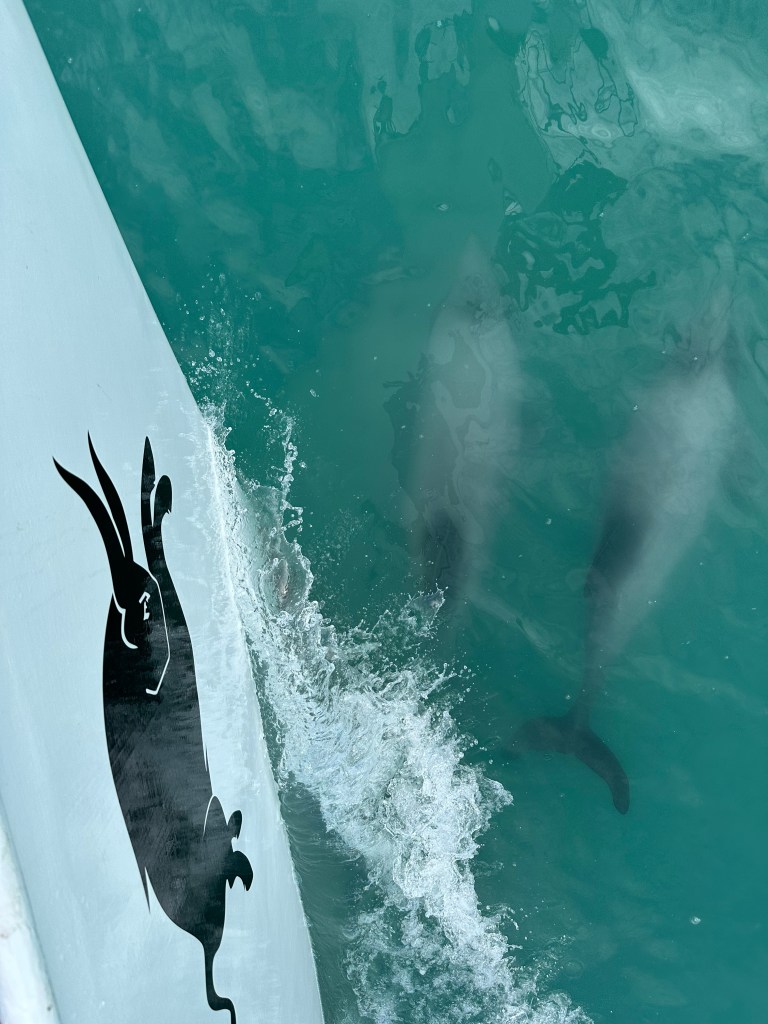
Akaroa is known for dolphin spotting, and it soon lived up to its reputation as we were joined by several pods of dolphins. A hull moving through water seems to have a magnetic appeal for dolphins, allowing them to surf and apparently play. It’s always a joy to watch them gliding along at the bow, and then speed ahead of the boat without any obvious effort or even motion. When dolphins appear everything else stops as Cara and I love to watch these labradors of the sea, whose mere presence always lifts our spirits.

At about 6pm we sailed into Pigeon Bay and picked up a mooring belonging to the Naval Point Yacht Club. We had been told we could use the mooring by a member and advised that Pigeon Bay was perhaps the most sheltered spot in Banks Peninsula. We needed an unusually sheltered place to stay as strong winds of up to 70 knots (approx 130kmh) were predicted from the NW, veering to SW as the day progressed.
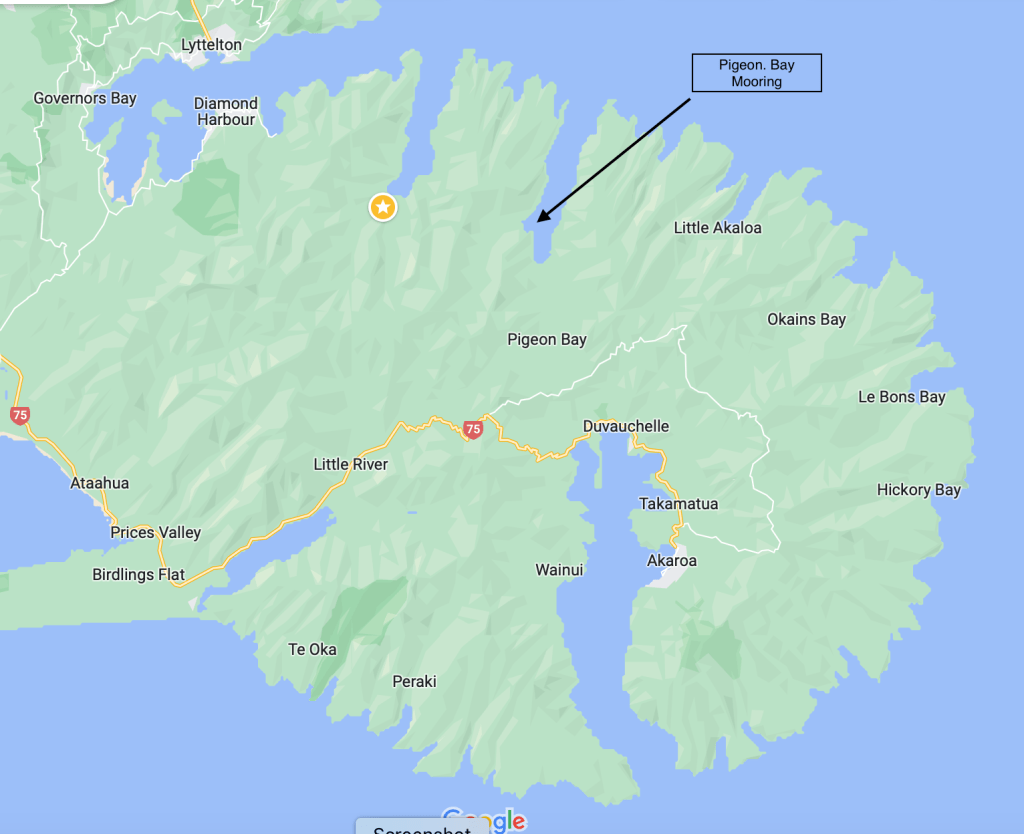
We secured everything on deck and settled down to see what would come. Next day the wind began building early until gusts of 30-40 knots were commonplace. Unfortunately, rather than coming from the NW the wind was channeling straight down the sunken valley from the N, or even NNE. This meant we were being blown directly onto a lee shore that was alarmingly close, perhaps 15 metres behind us. This meant that should the mooring fail Taurus would be on the rocks almost instantly. For some time we ran the engine, so it could be immediately put into gear to drive the boat away from land, but the slim time saving this provided seemed outweighed by the unneccesary wear to the engine. We had made our bed, and now we had to lie in it, hoping that the wind would shift as predicted so that the surrounding hills could protect us. The following day was pretty tense, but eventually in mid afternoon the wind slowly changed direction. However, our situation wasn’t greatly improved as it picked up strength as it moved. At one point I had gone forward to check the mooring line for chafe and a gust came through that heaved Taurus onto its side, so that I was standing on the side of the windlass with the boat almost 90 degrees over. The roar of the wind was deafening, and this with a cliff protecting us from the wind! As I quickly made my way back inside, I found Cara picking up pieces of broken crockery. She had chosen a bad time to start the washing up! We got ‘thrown onto our ear’ another 2 or 3 times during the evening and night, but by next morning the wind had died away.
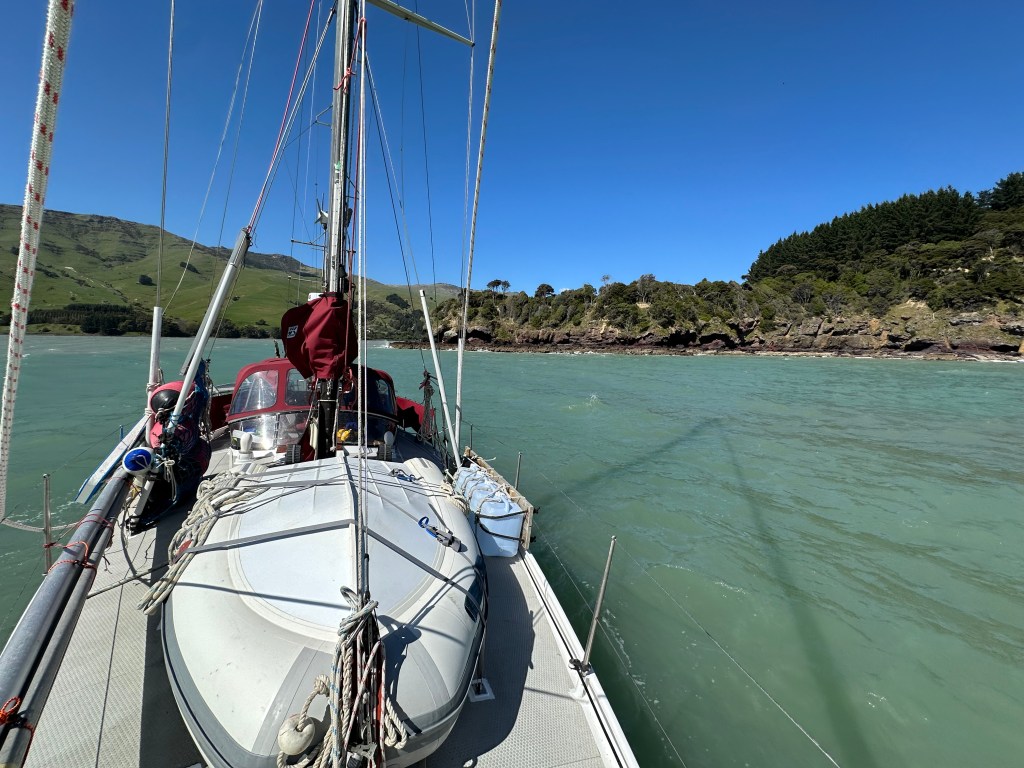
We left Pigeon Bay early the next day for the short sail round to Lyttleton with a welcome 15 knots all the way. In the harbour we saw a few spots that we thought might have been more sheltered, but it is not easy to know as the wind veers round depending on the local topography.

We anchored in Magazine Bay and met a friend for dinner and drinks in Lyttleton, a short walk from our anchorage. The township is quite alternative, with lots of organic food, micro breweries, and interesting characters.
The next day we picked up our life raft, which had been serviced in Invercargill, and stocked up on groceries. The Harbour Master came to see us on a flash looking jet ski, wanting to see who we were and what we were about. He told us that one boat had sunk and another broke its mooring during the bad weather.
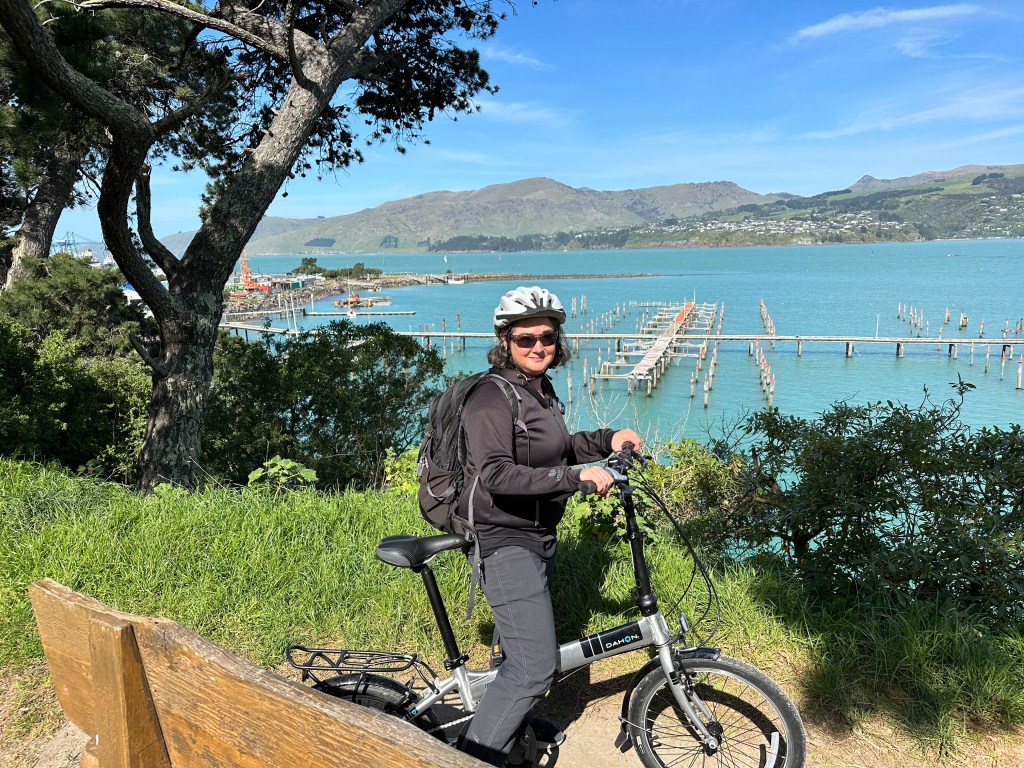
As was becoming standard, the storm was followed by warm sunny days, and we were able to take the folding bikes ashore and cycle along a track next to shore — until fallen trees blocked our path.

Later that day we took Taurus onto a council jetty and met Cara’s aunt and uncle for dinner at a local pub. It was great to see them, catch up, and show them round the boat.
The old marina next to the anchorage was wrecked in a storm about ten years ago, and was only now being demolished. Speaking to one of the contractors we found that he was responsible for the local club moorings. When he heard that we had stayed on the Pigeon Bay mooring he told us, ‘Better you than me, that mooring hasn’t been serviced in years.’ There is always a danger staying on moorings that you don’t know. The concrete block, earth screw, or what have you might be good, but shackles and ropes perish, and they can part with no warning when placed under strain. In hindsight we might have been better to anchor further into Pigeon Bay away from land, but we would have had less shelter and anchors can drag. In the winds we experienced it would have been difficult to reset. So often in sailing there is no black and white, but only shades of grey in which you make a decision, often ill-informed and based on ‘predictions,’ and then have to live with it come what may. I’m often a little shocked by comments on social media that criticise a sailor’s decisions after he or she had met some unfortunate outcome. Hindsight is always 20/20 as they say, and there but for the grace of God go I. One of the things I value most about sailing is the self sufficiency it demands; the need to make important decisions that routinely and directly impact upon our homes and personal welfare, decisions typically denied us by bureaucrats and nanny states that think they know best on land. In this world, at the mercy of the wind and sea, we engage in margins, hoping that the mistakes we make don’t become major, and instead allow us to accrue valuable experience so that we might do better next time. Of course, in an uncaring universe there isn’t always going to be a better choice. Sometimes it’s just a matter of luck. In any case, as Cara’s diary entry says for the storm at Pigeon Bay, we ‘survived the night.’
 Sailing Taurus NZ
Leave a comment